International relations scholarship has made great progress on the study of compliance with international agreements. While persuasive, most of this work has focused on states’ decisions, largely excluding the behavior of nonstate actors such as individuals, firms, or nongovernment organizations.Footnote 1 Most evidence centers on de jure implementation of formal rules with less attention paid to the de facto behavior of the signatories.Footnote 2 We address these important concerns by providing an empirical test of how a landmark international convention on bribery, the Organisation for Economic Cooperation and Development (OECD) Anti-Bribery Convention (OECD-ABC), affects the de facto compliance decisions of firms, an important group of nonstate actors, operating outside of their home states. We explore how such agreements use reputational concerns to raise the expected costs of malfeasance for firms operating abroad. Our analysis includes the use of an Unmatched Count Technique (UCT), or list experiment, to measure changes in illegal and socially undesirable behavior in conjunction with the OECD-ABC.
Designed to combat global corruption, the OECD-ABC has been lauded by legal experts for its influence on domestic anticorruption laws and enforcement patterns.Footnote 3 Despite the accolades, nearly two decades after the passage of the convention there is very little direct evidence to answer the important question of whether the OECD-ABC has fulfilled its objective of reducing the bribery of firms investing abroad. The goal of altering firm and individual behavior, enshrining the principle of extraterritoriality, and focusing on peer review as the main accountability mechanism, make the convention particular relevant for assessing international compliance.
The use of peer review as a mechanism in the OECD-ABC fits into broader discussion of “Global Performance Assessments.”Footnote 4 By generating new data that are public, “purposive” in an intent to affect change, and that have normative implications, the OECD-ABC can influence bribery through “naming and shaming” of countries into compliance with the international law. Greater enforcement at home in turn alters the cost-benefit calculations of their investors abroad, who must decide whether it is worth the risk to bribe local officials. Although our empirical analysis is limited to the OECD-ABC, our results contribute to the broader discussion of compliance with international agreements.
Evaluating the OECD-ABC's effectiveness is important on both academic and policy grounds, but is complicated by two well-documented research pitfalls. First, selection into the OECD-ABC was not random. The original signatories were a collection of the most democratic and wealthy countries in the world, comprising 63.9 percent of global exports and 85.1 percent of overseas direct investment.Footnote 5 Second, the standard measures of corruption in international surveys of investors are subject to both social desirability and nonresponse biases that are systematically associated with signing the OECD-ABC. Since signatories to the convention are, on average, at higher risk of prosecution for bribery in their home countries, the agreement not only reduces investors’ willingness to bribe but also their willingness to honestly answer survey questions regarding their engagement in the activity.Footnote 6
We set out to resolve these problems with a careful research design of a single host country—Vietnam—that is specifically devoted to testing whether the OECD-ABC reduced the instances of bribery payments by firms operating abroad. To address the first challenge, we use a differences-in-differences (diff-in-diff) estimator to analyze the change in graft activities between investors from signatories and nonsignatories of the convention. Key to our design is an analysis of bribery behavior after the 2010 introduction of Phase 3 of the OECD-ABC which, according to experts, marked an important shift toward greater compliance by forming working groups to perform onsite reviews of signatory countries and monitor their implementation of the convention.Footnote 7 By treating the Phase 3 onsite reviews as a critical turning point in the agreement's application to the behavior of firms, as well as the risk of enforcement and reputational costs, we can observe the difference in the behavior between firms from OECD countries that entered Vietnam prior to convention implementation and afterward. Since we focus on change in behavior (i.e., the reduction in the propensity to bribe), rather than the total level of corruption, we can separate the effect of the OECD-ABC from the time-invariant features of home countries’ attributes (i.e., culture, democracy, wealth) that are correlated with the likelihood of signing.
The diff-in-diff design, however, does not resolve the question of correlated measurement error. To address this problem, we take advantage of UCT or “list experiment” that was implemented every year between 2010 and 2016 in Vietnam's most well-known enterprise survey.Footnote 8 Using this approach, we can both directly measure corrupt behavior in a number of activities and simultaneously shield respondents from the dangers of admitting to illegal actions. We provide strong evidence that the level and growth of corruption is altered by the OECD-ABC. Crucially, firms from OECD countries (predominantly Japanese and South Korean firms) actually had a slightly higher propensity to bribe than nonsignatories (predominantly firms from Taiwan and Singapore) before the onset of Phase 3. Overall, around 25 percent of firms paid “informal fees” during registration and 19 percent paid kickbacks on government procurement contracts. After the onset of Phase 3 in 2010, when the risks of being caught bribing substantively increased, firms from countries party to the OECD-ABC significantly reduced bribery during registration relative to their nonsignatory peers. We also tested corruption in procurement, but cannot draw clear inferences from the analysis.
While we are primarily interested in de facto compliance by firms from signatory states, one unexpected but fascinating result is that we observe a significant increase in corruption after Phase 3 among firms from nonsignatories. In our diff-in-diff design, these firms are used to approximate the counterfactual and therefore the estimating assumption is that corruption would have also increased for firms from signatory countries as well in the absence of the OECD-ABC. Indeed, increasing corruption among foreign investors after Vietnam's 2007 entry into the WTO is the prevailing view among Vietnam watchers.Footnote 9
By sharp contrast to the trend among nonsignatories, after Phase 3, firms from OECD-ABC signatories saw their bribe propensity decline substantially for both payments made during entry (dropping by nearly twenty percentage points). Further analysis reveals that declines in corruption are driven by the small set of firms from actively enforcing countries who faced greater punishment. Our conjecture is that for firms from signatory states with weak enforcement records, reputational concerns constrain bribe behavior to pre-existing levels. Bribe propensity didn't increase, as it did with nonsignatories, but it didn't decrease either.
The Problem of Compliance in International Relations
Since the “Managerial School” first documented high levels of compliance with existing arrangements,Footnote 10 international relations scholarship has made great progress on the long-standing puzzle of why countries comply with international treaties and agreements.Footnote 11 Rationalist scholars have focused on self-enforcement by structuring institutions to reward reputationFootnote 12 and reciprocity,Footnote 13 demonstrating credible commitment through costly signaling,Footnote 14 building in ex post sanctioning costs through arbitration and dispute settlement,Footnote 15 and mobilizing domestic constituencies for compliance through transparency and monitoring.Footnote 16 Constructivist scholars, by contrast, have focused more on changing attitudes than constraining behavior, by highlighting the role of international agreements in altering societal norms through approbation, acculturation, persuasion, and recursive cycling between legal generation and norm making.Footnote 17 Critically for our work, both literatures point to the role of a state's reputation as a driver for compliance, although they disagree on whether the mechanism is greater opportunities for reciprocity or the broader goal of joining a community of like-minded states.
Despite great progress, two interrelated challenges haunt both literatures. First, most of the work focuses on states’ behavior, largely excluding the role of nonstate actors who are often the ultimate targets of the agreements. Their actions may take place outside of the borders of the signatory country,Footnote 18 leading some legal scholars and political scientists to question whether international law matters at all in situations where nonstate actors’ cooperation is necessary for reaching an agreement's goals.Footnote 19
Second, there is a critical difference between de jure and de facto compliance on the part of the group targeted by the agreement.Footnote 20 Nance and Cottrell highlight how states can exploit ambiguities in agreement language or the capacity of enforcers.Footnote 21 Baradaran and colleagues subdivide the concept of compliance into: (1) formal or de jure, which includes the laws passed, the resources expended on enforcing those laws, and how often the laws are enforced; and (2) informal or de facto, which studies whether the formal laws actually alter behavior among the target group.Footnote 22 It is possible for a state to do well on formal compliance but make little progress in inducing behavioral change.
Both of these problems are compounded when the nonstate actors who are the agreement's target are operating outside the jurisdiction of the state that signed the international convention. Shell companies, for instance, often operate in tax havens outside the reach of the states that joined the intergovernmental Financial Action Task Force on Money Laundering.Footnote 23 Labor rights violations by MNCs can occur in their production facilities in states with weak labor regulation, despite their home country affiliations.Footnote 24 The challenge of generating compliance seems quite daunting under these conditions. Responding to these difficulties, a new literature has begun to explore how to design international agreements that can effectively address the challenges of nonstate actors in de facto international compliance.Footnote 25 Two legal mechanisms commonly referenced in this literature played an important role in the design of the OECD-ABC—extraterritoriality and peer review.
The Role of Extraterritoriality in Influencing Compliance by Nonstate Actors
The problem of nonstate actors complying with international agreements is complicated by the fact that many of the violations—in our case, bribery by a country's multinational firms—occur outside of the country's borders. In these situations, the link between a state's commitments and the nonstate actor's behavior is the legal principle of extraterritoriality. This principle was first enshrined in 1945 as the “effects doctrine,” whereby countries can exercise jurisdiction over the behavior of corporations and citizens outside of their physical borders, applying domestic rules to the foreign conduct of those entities. Under extraterritoriality, nonstate actors, wherever they may be, are subject to the domestic laws of their home states. If a home state signed an international agreement that includes extraterritoriality, international commitments made by the home state likewise apply to the nonstate actor. The doctrine has now been applied to a wide spectrum of issues including terrorism, antitrust, criminal law, the environment, intellectual property, online markets, securities, and trade.Footnote 26
For our purposes, the 1977 US-Foreign Corrupt Practices Act (US-FCPA) was the first legislation to use the concept of extraterritoriality to criminalize public officials’ bribery by US citizens and companies, but other countries have since followed suit with their own national laws, and the OECD-ABC was ultimately an attempt to expedite that process. To be clear, the act of including extraterritoriality of bribery in domestic legislation is still only de jure compliance with the agreement OECD-ABC. De facto compliance requires the use of the doctrine to punish companies operating abroad for bribery of foreign officials, and the ultimate reduction in bribery by those companies.
Peer Review and De Facto Compliance
Its proponents consider peer review a mechanism for naming and shaming offending countries for not enforcing a convention.Footnote 27 It therefore raises the sovereignty costs of the agreement.Footnote 28 Peer review also facilitates transparency by allowing domestic actors, including citizens and businesses, to learn about how their country is performing and use this information in advocacy.Footnote 29
This use of peer review follows a similar logic to the concept of Global Performance Assessments (GPAs).Footnote 30 GPAs, such as Freedom House, Transparency International, or the World Bank's Doing Business rankings, provide a comparative yardstick to measure performance and influence actors’ behavior on a normatively important issue to the assessment creator. Like GPAs, peer review is a form of social pressure based on systematic monitoring and explicit comparisons.
The theoretical mechanism linking such assessments to improved behavior is the sociological concept of reactivity—the tendency to alter behavior in response to the act of evaluation.Footnote 31 Although the psychological basis for reactivity operates at the individual level, international relations scholars have argued that leaders of states face these same reputational pressures and therefore will alter policy in response to evaluation.Footnote 32 Kelley and Simmons find that, when generated by a respected organization and widely disseminated, performance evaluations can induce greater de jure compliance with international agreements.Footnote 33 States put on a “watch list” are more likely to criminalize human trafficking. Whether peer review or global performance assessments can actually reduce the amount of human trafficking (de facto compliance) remains an open question.Footnote 34
The literature on information transmission in international relations provides a mechanism for GPAs, suggesting that nonstate actors, such as private investorsFootnote 35 or domestic interest groups within the target state, can use the information generated by peer reports to assess future cooperation with the state or lobby for change.Footnote 36 Voters could use this new information to push their home state to change its behavior.Footnote 37 Chaudoin and Urpelainen show, through the case of trade arrangements, how the mechanism can also apply to monitoring other states’ behavior, as domestic constituencies use information from peer review to make sure other states live up to their side of the agreement.Footnote 38
This work has focused on nonstate actors as the actors carrying out reputational sanctioning. But nonstate actors can also be the target of such assessments, providing a critical link in altering their de facto behaviors. For example, an MNC cited in a peer review as a rule breaker in international environmental or financial transactions could face long-term financial consequences from the reputational consequences.Footnote 39 These reputational costs can manifest themselves in difficulties seeking approval for a new investment license or partnering with other firms, especially when trying to do business in other signatory states. This reputational impact of corruption, when coming from a credible source such as peer review, is especially difficult for the firm to repair or avoid.Footnote 40
Firms that merely share an MNC's home state may also have their reputations damaged by a compatriot rule breaker as a member of the same group,Footnote 41 and therefore would be more likely to take actions to limit their peers’ malfeasance. As this perception of business corruption increases, firms will disengage politically, investing less in cooperation between the firm and government.Footnote 42 This can be further exacerbated because information generated through peer review can trigger domestic constituencies’ mobilization in the host state for multinational investors, threatening the long-term performance of their projects. In our specific case of the OECD-ABC, enough activity by a host country might generate anticorruption investigations and proceedings in the home state. Importantly, the reputational effects of peer review for businesses may operate even if the home state of the firm shirks its own responsibilities to the agreement.
Background on the OECD Anti-Bribery Convention
The OECD-ABC is an excellent forum to study de facto compliance among nonstate actors with international agreements. Individual firms are incentivized to police one another's compliance with the agreement because a state unilaterally pursuing punishment would only disadvantage its own firms in global competition. Therefore, the peer review process provides a critical window to observe peers and mobilize constituencies to attack malfeasance.
The negotiations over the OECD-ABC were partially triggered by the United States’ amendment of the 1977 US Foreign Corrupt Practices Act (US-FCPA) in 1988, which required the president to begin negotiations with fellow OECD members on issues related to bribery.Footnote 43 This design issue is significant because pressure from the US facilitated a more expansive convention, beyond a “shallow” agreement with high levels of de jure compliance but limited influence on actual firm behavior.Footnote 44 The OECD-ABC began as an ad hoc working group in 1989, culminating in the passage of the convention in 1997 and officially coming into force in February 1999. Countries have joined and ratified the OECD-ABC at different dates, and new signatories (including Colombia in 2013) have continued to join since its inauguration.
Scholars have suggested two dominant motivations for the OECD. First, the convention expanded the jurisdiction of criminal activity beyond the host country for foreign investment because it was becoming clear that not all governments had the capacity, sophistication, or incentive to rid their investment environments of corruption.Footnote 45 Thus, extraterritoriality was essential in ensuring states had the capacity to shape firms’ compliance decisions.
Second, unilateral implementation by OECD members of such anticorruption legislation was insufficient because corruption posed a global collective action problem.Footnote 46 Although corruption had negative effects on the general investment environment, raising costs and increasing the uncertainty of doing business in some countries,Footnote 47 any one briber could benefit by winning lucrative procurement contracts, licenses, or land deals.Footnote 48 Thus, if a country unilaterally began to punish the activities of its investors abroad, as the United States did with the FCPA in 1977, it placed its investors at a disadvantage in competition with investors from other countries without similar restrictions.Footnote 49 As Sabel and Zeitlin put it, not agreeing to the OECD-ABC carried a severe “penalty default,” whereby noncooperation would be sanctioned by reverting to the original, less attractive regime—increasing costs of corruption for all businesses.Footnote 50
The OECD-ABC was a striking departure from how many OECD countries previously treated bribery abroad. Although all signatories had laws restricting domestic bribery in their own countries, the high-profile US-FCPA was one of the first acts that actually criminalized the corrupt behavior of home companies doing business abroad. Following in this vein, the OECD-ABC adopted an extraterritorial system requiring governments to pledge to criminalize bribery behavior outside of their home country. The bribery of an official abroad became a criminal act at home and individuals could be directly prosecuted in domestic courts for overseas bribery behavior.
The OECD-ABC includes a comprehensive peer-review process wherein each signatory must allow for a rigorous and intrusive dissection of its efforts by the OECD Working Group to comply with the convention.Footnote 51 Since all countries are subject to a three-stage review and lessons learned from previous stages are incorporated into two new reviews, the OECD-ABC provides a mechanism for evaluating the de facto compliance with the convention.
Although all peer-review reports maintain a diplomatic and formal tone, the legal language can certainly be strong and pointed. For example, evaluators savaged Australia in its Phase 3 report, complaining that the country “has only one case that has led to foreign bribery prosecutions, out of twenty-eight foreign bribery referrals received by the Australian Federal Police (AFP) … this is of serious concern.”Footnote 52 The report described the cases in extensive detail.
According to its authors, the OECD-ABC's main role is naming and shaming free riders since it does not have the power to directly enforce the convention. Drago Kos, the chair of the OECD Working Group on Bribery, said:
We must not forget that our members are still sovereign states, so we cannot literally force them to do anything. We have a procedure in place, which is mainly putting a lot of emphasis on the country's image in the international community, and if countries decide they're not much interested in their image, they may not decide to do much in this area.Footnote 53
The peer review process has proceeded in three phases, which countries have undergone at different times depending on their accession dates. Phase 1 (evaluation stage), which began in 1997 and was completed by 1999 for the original signatories, focused on whether legal documentation developed by the signatories met the standards set by the convention. Since monitoring concentrated on the wording of legal texts, Phase 1 posed very little threat to overseas multinational firms’ activities, and it is unlikely that we would observe significant changes in behavior after its onset.Footnote 54 The Phase 2 review (assessment stage), which began in 2002 with a follow-up evaluation in 2005 for the original signatories, studied whether the legal texts were being applied correctly and appropriately. It also broadened the range of covered activities to include noncriminal procedures, which were part of the original convention. Once again, these reports generally focused on de jure legal implementation and therefore were unlikely to influence overseas investors’ behavior.
Peer review did not cover the de facto behavior of firms from the member states until the onset of Phase 3, which sought to move beyond the textual legal analysis to focus specifically on whether signatory countries were living up to the spirit of the convention by punishing malfeasance by their citizens and businesses abroad. Even if the punishment probabilities were not high for some states, Phase 3 significantly raised the reputational costs for firms who might find their activities documented in painstaking detail in a report. Phase 3 also clarified the OECD's views about facilitation payments and recommended that signatories take steps to limit their usage.Footnote 55
The Phase 3 peer review was initiated in December 2009 with a full schedule for all signatories, running from June 2010 to June 2015.Footnote 56 Thus, even if a country was not scheduled to be reviewed until late in the evaluation period, it had full knowledge of when it would be scrutinized at the beginning of 2010. From a methodological perspective, countries and firms had the incentive to alter their behavior as soon as the new calendar was announced. Consequently, 2010 represents the critical shock to business behavior that we aim to evaluate in our data because it represents a sharp discontinuity in the probability and costs of punishment.
Prior to 2010, it was unclear what the convention's final phase would entail. Since then, the extent of monitoring has surpassed some of the most optimistic predictions. The Phase 3 peer reviews involve systematic on-site visits to both signatory countries and the overseas locations of investors, and a shorter, more focused assessment questionnaire was added to pinpoint violations. Working Group Reports now specifically focus on how particular cases of corruption by specific firms were dealt with and punished by signatory countries.Footnote 57 As Stevenson writes, “the reports are often quite harsh, even scathing, and the political embarrassment associated with a bad review can shame governments and mobilize public opinion.”Footnote 58 Despite the embarrassment, no single country can block a report because the working group has adopted a “consensus minus one” standard. The bite of the Phase 3 peer review has been further augmented by a companion document adopted by the signatories, called the “Recommendation of the Council for Further Combating Bribery of Foreign Public Officials in International Business Transactions,” which covers nineteen sections ranging from facilitation payments to procurement to internal taxation rules.Footnote 59
For countries party to the OECD-ABC, the more extensive peer reviews should alter the behavior of their firms operating abroad. Signatories to the OECD Convention are all compliant with it, having passed antibribery laws, but only after Phase 3 is there monitoring of country enforcement of these laws. It is this active enforcement of these laws that changes the incentive of the primary actors (firms) in their bribery decisions and thus de facto compliance with the convention. Therefore, we hypothesize that:
H1
After the onset of Phase 3 (2010) peer reviews, firms from countries that signed the OECD-ABC will reduce the frequency of their bribery compared to nonsignatories.
Even if H1 proves correct, it does not differentiate between two different mechanisms generating firm compliance. First, firms might change their behavior even if their home country's enforcement remains weak. The reputational effects of having a case show up in a peer review report can be extensive and damage an MNC's business prospects in other signatory countries, costing them opportunities for partnership, expansion, and sales, especially if they require special licenses or government procurement. Thus peer review in itself can shape firms’ compliance decisions.
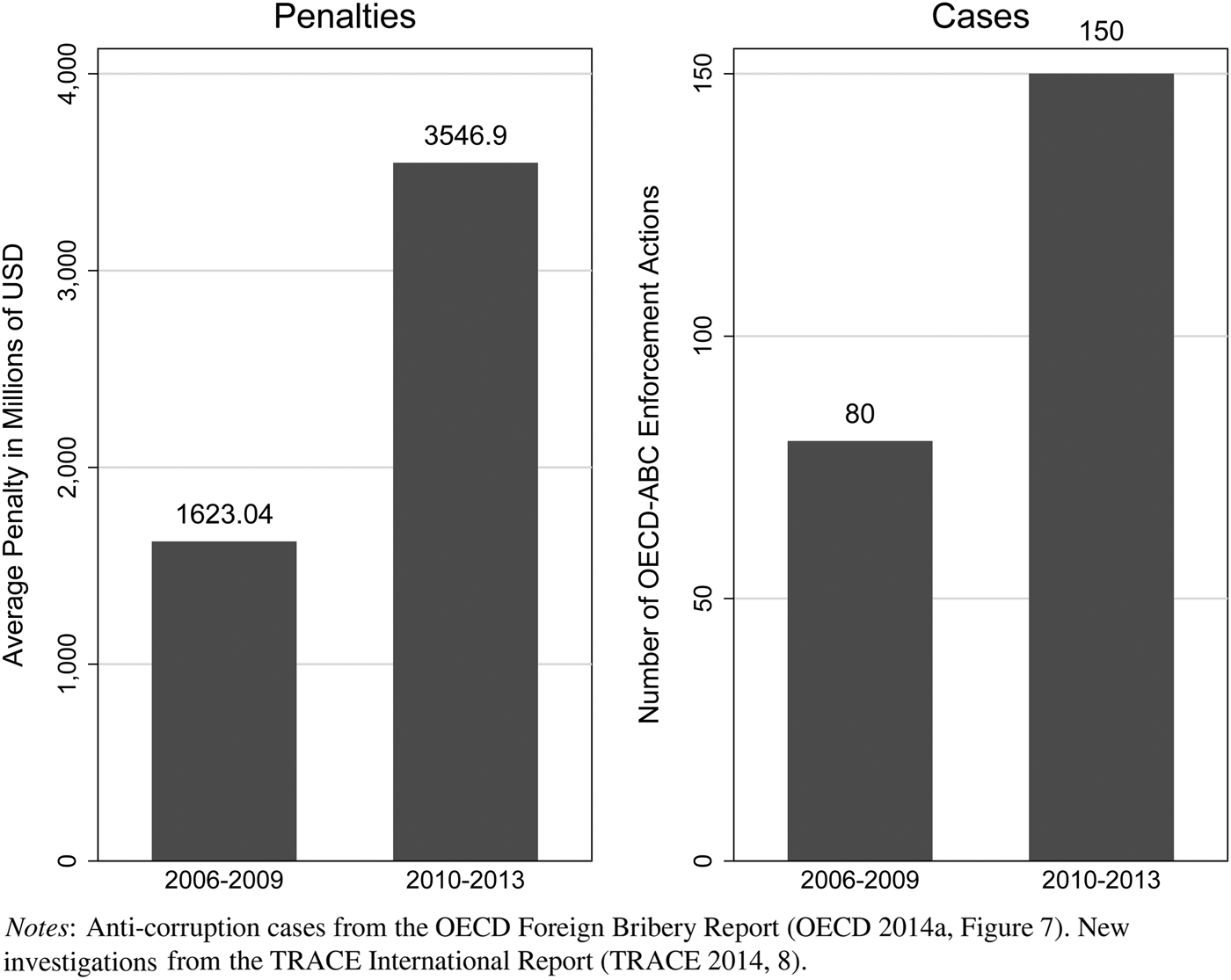
Second, the risk of increased enforcement as states are held accountable for implementation of domestic legal codes might also influence their firms abroad. Peer review can pressure governments to tighten their enforcement of antibribery laws and thus the convention's power is in pressuring domestic governments to act. Clearly, the OECD has mobilized domestic governments to enforce antibribery laws. Figure 1’s bar graphs show the change in the enforcement patterns before and after Phase 3.
Foreign bribery punishments and new investigations in signatory countries in four years before and after Phase 3

Measures of enforcement can fluctuate annually because they are contingent on the amount of cases, historical backlog, and time constraints of domestic prosecutors. Therefore, we smooth over the annual changes by averaging the amount of enforcement activity in the four years before and after the Phase 3 calendar was announced. In the first panel, we provide the average penalty allocated before and after Phase 3, showing that the costs of malfeasance for bribery abroad have more than doubled to USD 3.5 billion in total fines.Footnote 60 Similarly, the number of new investigations initiated by OECD member states nearly doubled, from eighty in the four years prior to Phase 3, to 150 cases in the four years afterward.Footnote 61 If the convention's proponents are correct, this greater extent of enforcement should result in a deterrent effect, leading MNCs to curtail their behavior abroad.
This change in enforcement could lead to difficulty in distinguishing which causal mechanism—shaming firms or pressuring governments to enforce laws—is affecting firms’ bribery decisions. Variance in home country enforcement gives us an important opportunity to sort out which mechanism is more operable. A closer look at data underlying Figure 1 reveals that most of the activity is driven by a handful of countries.Footnote 62 As the OECD Secretary-General soberly noted after touting early successes, “there has been little or no enforcement in over half of the Parties to the Convention.”Footnote 63 Heimann and colleagues note that few countries received the highest grade of Active Enforcement and the remaining signatories were spread over the three other categories of enforcement.Footnote 64 This wide variation in enforcement—though demoralizing for proponents—is interesting empirically. If the legal enforcement mechanisms or the reputation-induced enforcement mechanisms are operable, we would expect:
H2 (Enforcement)
After the onset of Phase 3 (2010), firms from countries that actively enforce the OECD-ABC will reduce the frequency of their bribery compared to non-active enforcers.
If only the reputational mechanism is operable, we would expect firms to reduce their bribe behavior in accordance with H1, but we should not see any relationship between state-level enforcement and changes in firm behavior. In other words, the reduction is entirely a firm-level reputational phenomenon.
Empirically Evaluating the OECD-ABC
The existing empirical evidence regarding the OECD-ABC's effectiveness at reducing bribery by firms is both limited and mixed. Some work has shown that the OECD-ABC leads foreign actors to curtail their behavior in suspect environments, including reducing foreign direct investmentFootnote 65 and exportsFootnote 66 into highly corrupt countries. Spencer and Gomez present mixed results that depend on where the survey was collected, finding evidence that the convention worked in Ghana but not in Eastern Europe.Footnote 67 They attribute this divergence to the fact that the survey in Eastern Europe was conducted during the OECD-ABC ratification process and therefore had no teeth.
There are important reasons for the mixed conclusions. Research on the OECD-ABC is hampered by two research dilemmas. First, selection into the OECD-ABC is not random. The original signatories were a collection of the most democratic and wealthy countries in the world. Firms from these wealthy countries were the most likely to be competing for opportunities abroad. However, because of the selection process, it is difficult to empirically separate the effects of signing the OECD-ABC on the corrupt behavior of signatories’ multinationals from other features of the signatory countries (e.g., wealth, democracy, lower home-country corruption, etc.) that might also reduce corruption.Footnote 68 All of these features are highly correlated, making it nearly impossible to pinpoint which of the home-country features is actually doing the work.Footnote 69
Second, the standard measures of corruption in international surveys of investors are subject to both social desirability bias and nonresponse bias. The strength of these biases is not random but instead strongly associated with signing the OECD-ABC. Since the OECD-ABC raises the risk of a signatory country prosecuting bribery by its investors abroad, it not only reduces the willingness to bribe but also reduces the willingness to provide honest answers in surveys regarding engagement in these activities, which presents an extreme example of social desirability bias.Footnote 70
Fearing home-country prosecution, firms from signatory countries are systematically less likely to report bribery and more likely to abstain from answering corruption questions. Although poor implementation in some countries indicates that the true probability of home-country prosecution is low, it is still higher than the zero probability faced by investors from nonsignatories. As a result, analysts cannot determine whether correlations between OECD-ABC membership and reduced bribery are the result of a real causal relationship or simply a correlation between signatory status and measurement error in the dependent variable.
Our Research Setting: Investment Liberalization and Bribery in Vietnam
To obtain more accurate measures of corruption and avoid noise caused by different levels of host country cooperation, we focus on a single FDI recipient. Vietnam has emerged as one of the most successful developing countries in attracting FDI across a number of sectors. Although liberalization in the 1980s and 1990s attracted large numbers of investors, Vietnam's entry into the World Trade Organization (WTO) in 2006 was the highpoint of attracting FDI. After entering the WTO, FDI inflows totaled a staggering 10 percent of GDP.Footnote 71 Many advanced industrialized countries have joined the convention, but the major investors in Vietnam consist of firms from both signatory and nonsignatory countries. Studying Vietnam allows us to examine investment in a developing country that includes a wide range of investors.
We draw on seven waves of the Vietnam Provincial Competitiveness Index (PCI) survey, conducted between 2009 and 2016.Footnote 72 The total number of respondents for all years is 10,064. Of these, 5,689 entered after 2005, the year we think it is reasonable to expect respondents to remember entry procedures without severe recall bias. This survey paints a relatively comprehensive picture of domestic and foreign firms in Vietnam's sixty-three provinces with high response rates of 30 percent for domestic firms and 25 percent for foreign firms. The PCI research team ensures that each year this survey is representative of the population of firms in Vietnam.Footnote 73 Of the 10,437 active foreign firms in Vietnam, 14 percent (1,385) are in the most recent 2016 PCI-FDI sample.
Foreign investment in Vietnam is dominated by firms from East Asia. The five largest investors, based on national data and the PCI sample, include: South Korea (22.24%), Japan (22.1%), Taiwan (20.67%), China (7.04%), and Singapore (4.88%). The 2010–2016 PCI sample also includes over 800 investors from the European Union (8.3%), 363 investors from the United States (3.65%), and 141 from Australia (1.42%). Although this concentration of investment from East Asia may seem like a liability for this study, two of the top five countries (Japan and South Korea) are both signatories of the OECD-ABC, though both are considered weak enforcers. The other top Asian investors are not signatories. Overall, 59 percent of foreign investors in Vietnam are subject to the OECD-ABC, providing comparison groups that are relatively equal in size. Thus, our study provides the added benefit of a large number of investors from the same region along with considerable variation in signatories to the OECD-ABC.
Despite Vietnam's success in attracting FDI and increasing liberalization over the past decade, Vietnam remains a difficult environment for foreign investors because of its complex FDI policies—currently ranking 116th out of 175 countries on TI's Corruption Perceptions Index.Footnote 74 Some analysts have even concluded that corruption in Vietnam has recently increased along with global integration and WTO entry in 2007.Footnote 75
A New Research Design for Evaluating OECD-ABC Effectiveness
There is a major inferential problem in assessing the effectiveness of the OECD-ABC using standard measures of bribery. If bribing firms were the most reluctant to answer a direct bribery question honestly because they were worried about criminal penalties, OECD-ABC respondents’ decision not to answer would lead to an apparently lower bribery share for that group. In other words, nonresponse and social desirability bias could be why OECD-ABC firms appear to have lower levels of bribery than their non-OECD-ABC competitors on standard questions. For this reason, the use of perceptions of corruption rather than actual incidence of corruption has been widely criticized.Footnote 76 There is evidence that firms are reluctant to share information on their direct payments to politicians for fear of legal or political reprisals.Footnote 77 To mitigate these concerns, scholars have been increasingly turning to alternative ways to measure corruption.
The List Approach to Corruption Analysis
Our approach directly asks respondents about their experience, while shielding them from incriminating themselves or being subject to reprisal, thereby reducing downward bias in corruption associated with the OECD-ABC. We designed the PCI survey to include a question that utilizes the Unmatched Count Technique (UCT), which is also known as a “list question.”Footnote 78 Evidence suggests that list questions are easy for respondents to understand and outperform other techniques in their ability to elicit sensitive answers from respondents.Footnote 79 In our context, a respondent can “admit” to bribery without fear that this information will be used against the manager or firm.
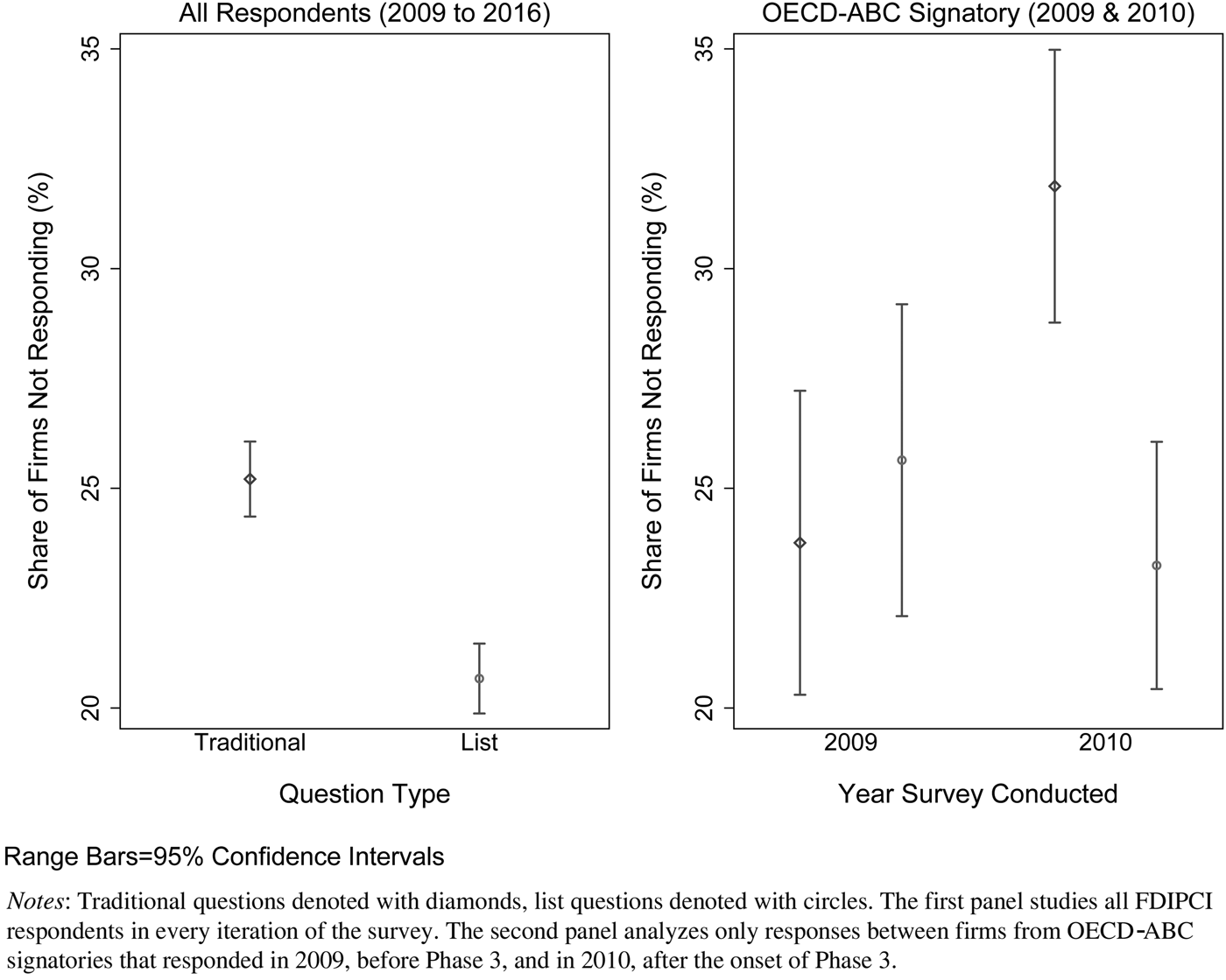
To get a sense of how well this is accomplished, Figure 2 shows the item nonresponse rate for standard corruption questions and UCT questions.Footnote 80 In the left panel, we show the share of firms that declined to answer the question throughout all years of the survey. On average, nonresponse for the traditional question (marked with a diamond) is 25.2 percent compared to 20.7 percent for the UCT (marked with circles). Because nonresponse is most likely among firms that actually paid bribes but refused to admit it, it is clear that traditional questions have greater measurement error than the UCT approach, which will lead to underreporting of bribery.
Item nonresponse rates in standard and list questions in PCI-FDI survey

More pernicious still, the measurement error in traditional questions is directly associated with the independent variable we want to analyze. We illustrate this point in the right panel by taking advantage of different iterations of the PCI-FDI survey. While the report bears the name of the year it was published, the survey was actually conducted in the prior calendar year. Thus, the data for the first report were collected in 2009, before Phase 3 went into effect, while the data for the 2011 report were collected in 2010, afterward. Both surveys were administered with the same random sampling strategy and thus the distribution of firms across years is balanced. Nevertheless, focusing on the firms from signatory countries, we see a disturbing pattern among traditional questions. Before Phase 3, nonresponse among signatory firms to traditional questions was about 26 percent, not significantly different from the national average throughout the survey. After Phase 3, however, nonresponse jumped seven percentage points to 33 percent. Consequently, using a traditional corruption question, we are likely to see lower reported corruption among signatory firms, but this reduction would be an artefact of measurement error—not an actual substantive decline.Footnote 81 By contrast, nonresponse from the UCT among signatory firms is not significantly different between periods, and is actually slightly lower after Phase 3.
Thus, the UCT question provides far more confidence to researchers that reductions in corruption are the result of true behavioral change over the period. The benefits of the UCT are achieved by separating respondents, in our case firms, into two groups that through randomization are equal in terms of all observable characteristics. One group that we call our “control group” receives a list of nonsensitive items and is asked to indicate how many of these items the respondent has engaged in. Respondents are instructed to indicate the total number of activities that they engaged in durng registration and procurement, but not to indicate their participation in any particular activity.
The other half of our sample, our “treatment group,” receives the same list, but with one additional sensitive activity. In our UCT question, the sensitive item is activity three. Respondents are given the same instructions: “Provide us a number, but do not indicate any of the individual activities that the firm or manager engaged in.”
Because the treatment group has one more item than the control group, if all of the respondents in the treatment group engaged in bribes, we would expect that the mean response of the treatment group would be one point higher than that of the control group. Conversely, if no firms paid bribes, the means for the control and treatment groups should be the same.
The second nonsensitive item was intentionally added because it is well documented that firms can avoid direct culpability for bribes by hiring an intermediary,Footnote 82 which may be a law or consulting firm, that takes care of all the business registration expenses and includes the potential bribe in only a non-itemized bill to the foreign investor. Although this type of indirect bribe payment contravenes Article 1 of the OECD-ABC, which specifically prohibits such indirect payments, the payer's goal is to achieve plausible deniability that they knew a payment was being made.Footnote 83 Since the respondent's firm has self-selected into ignorance, we cannot ask them about their bribery activity.
UCT Question 1: Please take a look at the following list of common activities that firms engage in to expedite the steps needed to receive their investment license/registration certificate. How many of the activities did you engage in when fulfilling any of the business registration activities listed previously?
-
1. Followed procedures for business license on website.
-
2. Hired a local consulting/law firm to obtain the license for your firm.
-
3. Paid informal charge to expedite procedures. (Only Available on Form B of the Survey; emphasis only added here)
-
4. Looked for a domestic partner who was already registered.
This design choice does not bias our estimates of direct bribery because our dependent variable is the difference between the control and treatment groups, not the absolute number of activities. Nevertheless, it does limit the scope of our conclusions. By adding intermediaries as a nonsensitive option (after all, it is not embarrassing to hire a law firm), we deliberately increase the absolute number of activities that will be selected in both the control and treatment group. In short, we sacrifice our ability to measure indirect bribe payments because both randomly selected groups have an equal propensity to use this approach. Even so, the treatment group still contains the sensitive item, which is direct experience with bribery. Consequently, by including the hiring of an intermediary as a nonsensitive item, we seek to capture only direct experience and thereby conservatively estimate a lower bound of bribe frequency.
Some readers may be concerned that registration bribes constitute a facilitation payment to obtain a necessary service, which is permitted by some countries’ domestic corruption laws. Indeed, the OECD has been vocal in recommending that signatories should make these illegal.Footnote 84 We are confident that informal charges constitute illegal bribes for two reasons. First, in many cases, they do constitute a firm gaining an “improper advantage,” the OECD's delineation for illegal bribery, because they can grant firms preferred access to valuable licenses in restricted industries.Footnote 85 Second, and even more fundamentally, Vietnam considers them illegal, which technically makes them illegal under the OECD-ACB framework.Footnote 86
To remove any potential ambiguity about facilitation payments, we also created a UCT for bribery during procurement contracts, which is clearly against the spirit of the OECD-ABC and has been the subject of numerous reports and initiatives.Footnote 87 In the agreement's official comments, the OECD clarified that bribery during procurement was outlawed, “whether or not the firm was the most qualified bidder.”Footnote 88 Unfortunately, this question asks about the respondent's experience with procurement corruption in the past year, rather than at the time of entry. As a result, we are not able to take advantage of corruption experiences before and after Phase 3, and must limit our analysis to differences in levels between signatories and nonsignatories.
UCT Question 2: If your firm competed for business with a government agency last year, please look at the following list of common activities firms engage in to make their goods or services more attractive to government clients. Please do not answer about any one of these activities specifically; we are only interested in the TOTAL NUMBER you may have utilized to win government business. How many of the below activities did you engage in when fulfilling business registration or licensing activities?
-
1. Dropped off pamphlets or fliers at government offices advertising your goods or services.
-
2. Opened your business or a branch of your business near government offices in order to be nearer to the decision-makers.
-
3. Paid a “commission” to a government official to ensure that your business won the contract, he would receive a small percentage. (Only on Form A; emphasis only added here)
-
4. Attended government functions or meetings in order to meet officials and make them aware of your goods or services
Both questions were included in all seven PCI-FDI surveys between 2010 and 2016 that were mailed out to firms in both English and Vietnamese.Footnote 89 There is excellent balance across the control and treatment groups, mitigating concerns that differences between the groups is attributable to differences in the subsamples.Footnote 90 Another concern is that if these activities are too frequent (i.e., everyone is answering at the maximum) or too rare (i.e., most responses are zero), respondent answers on the sensitive question are not effectively shielded. Luckily, our survey indicates that most firms answer one or two items, and few are near the floor or ceiling.Footnote 91
UCT Experimental Results
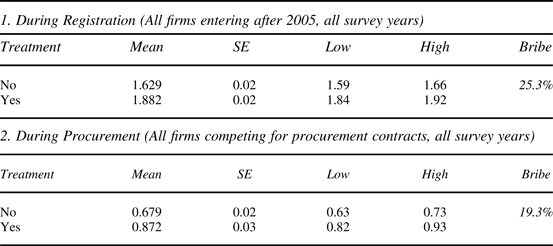
To first analyze the level of bribery during registration, we present a simple difference-in-means between the number of activities completed in the treatment and control groups in Table 1. As the table's first two rows show, treatment firms engaged in 1.882 activities during entry procedures, while the control firms engaged in 1.629 activities. These means are significantly different, indicating the success of the experiment. More specifically, subtracting the control from treatment averages, we find that on average, 25.3 percent of foreign firms engaged in bribery. Using the same approach, we calculate that 19.3 percent of all firms paid “commissions” or kickbacks when bidding for government procurement.
Calculation of firms paying bribes using the unmatched count technique

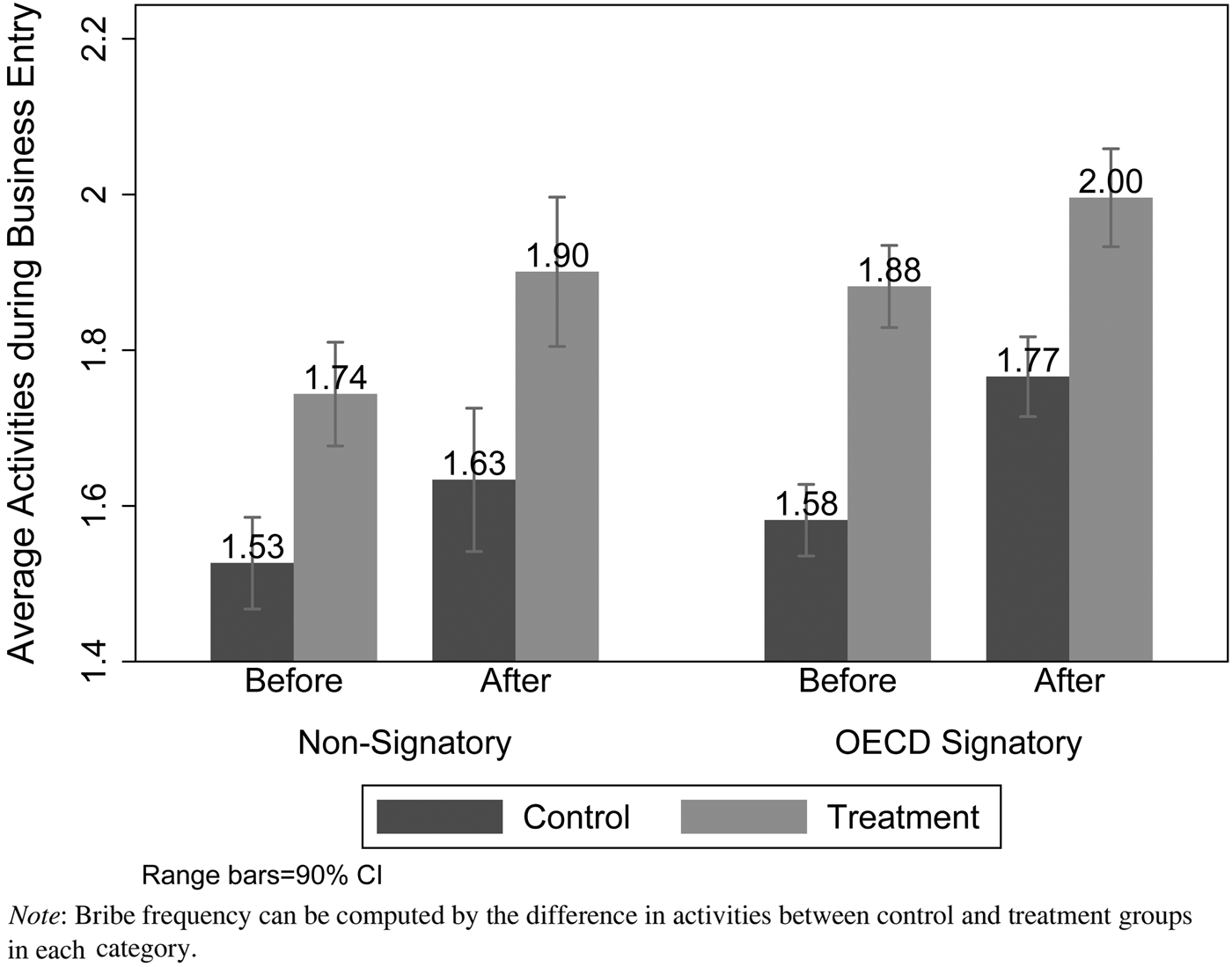
Although uncovering bribery by foreign firms is interesting, our key test is how OECD-ABC signatories fare relative to nonsignatories. In Figure 3, we disaggregate the analysis between OECD-ABC signatory and nonsignatory countries as well as whether the foreign business entered and registered its operations in Vietnam prior to the beginning of Phase 3 (January 2010), using question A1 on the PCI survey.Footnote 92 Firms that registered before Phase 3, regardless of the year they responded to the survey, are coded as 0, whereas firms that registered after Phase 3 are coded as 1. Focusing on Phase 3 has practical and empirical benefits. Practically, only 549 firms (229 from OECD-ABC signatories) were registered before 1997, limiting precision about the pre-OECD-ABC environment. Empirically, however, even if more firms entered before 1997, using it as the cut-off would still be risky because of recall and survival bias. Theoretically, the legal literature makes clear that Phase 3 posed a unique structural break in home-country implementation.
Average number of items completed during registration for OECD-ABC signatories and nonsignatories after Phase 3

Before Phase 3, firms from OECD-ABC firms were actually more likely to bribe then their nonsignatory peers (30 vs. 21%). However, after Phase 3, the trend completely reverses, which is in line with Hypothesis 2. Firms from OECD-ABC signatory countries reduced their bribery by eight percentage points, while firms from nonsignatories increased their corruption activity to nearly 27 percent of firms. While the reduction among OECD-ABC signatories is anticipated by our theory, which focused on the parties to an agreement, the increase among nonsignatories was not. A formal analysis of the increase is beyond the scope of this article, but we return to this surprising result in the conclusion.
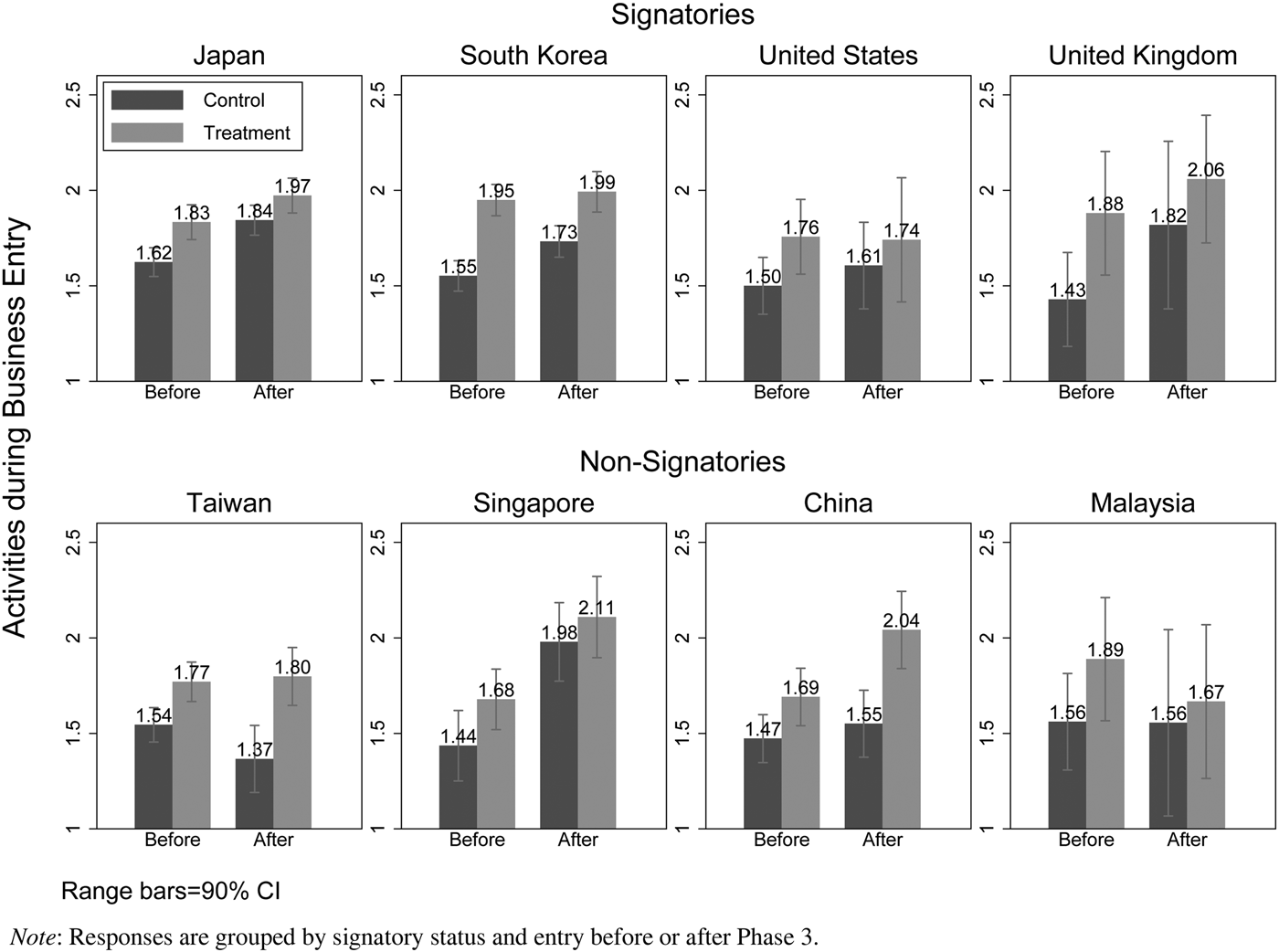
Figure 4 further explores the phenomenon by disaggregating the results to look at the changes within Vietnam's eight largest investor countries. The top panel shows the respondents from signatory countries, and the bottom panel depicts nonsignatories. Among all OECD-ABC countries, we observe declines after the onset of Phase 3. The United Kingdom is particularly enlightening. Prior to 2010, bribery was most severe in the UK (45%), but appears to have been reduced to 24 percent after the passage of the 2010 UK Bribery Act, which was strongly motivated by the UK's commitments under the OECD-ABC.Footnote 93 Among nonsignatories, we see that post-Phase 3 increases in bribery are primarily concentrated among Taiwanese and Chinese investors.
Average number of items completed during registration for firms from the eight largest foreign investors in Vietnam

These simple difference-in-means analyses are suggestive of our hypotheses but we are leaning heavily on the representativeness of the comparisons between the two groups. Are we sure that firms from nonsignatory countries are investing in the same sectors or types of operations? It is possible that these results suffer from omitted variable bias, which can be mitigated through multivariate regression. To control for potential confounders within the UCT framework, we utilize an adaptation of the two-stage estimation model developed by Blair and Imai called LIST.Footnote 94 This method uses a set of covariates to model nonsensitive responses in the control group and then uses this model to estimate responses for the treatment group.
Model Specification
In the first equation, we start with the control group that received only nonsensitive items, regressing the total number of activities (y
it
) completed by a firm on a set of covariates. In the simplest models, we use negative binomial regression because the dependent variable is measured as a count ranging from 0 to 3.Footnote
95
This allows us to calculate a predicted number of nonsensitive activities for each firm (i) at the time of entry (t), giving us (
 $\hat y_{it}$
), which we can apply to the treatment group. In the second stage, we calculate the surplus activities in the treatment group (
 ${\rm g}_{it} = (y_{it} - {\hat y_{it}})$
) and regress it on the same set of covariates but only for the treatment group. The coefficient in the second stage provides the marginal effect (δ) of the covariate on bribe propensity. Standard errors in the second stage are clustered by province, the primary sampling unit, and calculated using bootstrapping with 1,000 replications.
Using the UCT helps limit the dangers of nonresponse and social desirability biases. In addition to measurement error, however, a key issue in the naive analysis was the potential omitted variable bias that might be associated with OECD-ABC signatory status. Since so many factors correlate strongly with membership, causal inference is nearly impossible in a cross-sectional model. To address this, we employ a diff-in-diff estimator that assesses the change in the behavior of firms from OECD signatories before and after the onset of the Phase 3 implementation stage. Because registration occurs only once for most firms in our sample, we cannot assess firm-level panels and therefore employ the recommended diff-in-diff design for repeated cross-sections of respondents.Footnote 96
We expect that g, the predicted proportion of firms paying bribes, is determined by the following equation, where i is an index of firms and t indexes the year they entered Vietnam and engaged in registration activities. C is a matrix of time-variant firm and country controls. In the fully specified Model 6, we include a set of survey-year effects (λ) and two-digit sector fixed effects (α) to address the concern that there might be changes in industrial groupings associated with OECD-ABC membership.
-
1.
 $\eqalign{& y_{it} = \gamma _0 + \gamma _1OECD_{it} + \gamma _2Phase3_{it} + \gamma _3OECD*Phase3_{it} + C_{it} \cr & + \lambda + \alpha + e_{it} \,\hbox{if treatment = 0 (negative binomial regression)}}$
-
2.
$\eqalign{& {\rm g}_{it} = (y_{it} - {\hat y}_{it}) = \delta _0 + \delta _1OECD_{it} + \delta _2Phase3_{it} + \delta _3OECD_{it}*Phase3_{it} \cr & + C_{it} + \lambda + \alpha + e_{it} \,\hbox{if treatment = 1 (non-linear least squares)}}$


The diff-in-diff model's key feature is that we can separate the structural features of OECD signature status from the change caused by Phase 3, which takes the value of 1 if entry year is greater than 2009 and 0 if it is less than or equal to 2009 (Phase 3 = 1 if entry year > 2009; Phase 3 = 0 if entry year ≤ 2009). Thus, 2010 is the first year of Phase 3. This can be seen directly in the formula. The coefficient δ1 provides the effect of oecd-abc membership prior to the onset of Phase 3 at the beginning of 2010, and δ2 provides the change in corruption since 2010 in the nonsignatory group. The key parameter of interest, δ3, provides the additional effect of oecd-abc membership on bribery after Phase 3 came into force (the diff-in-diff).
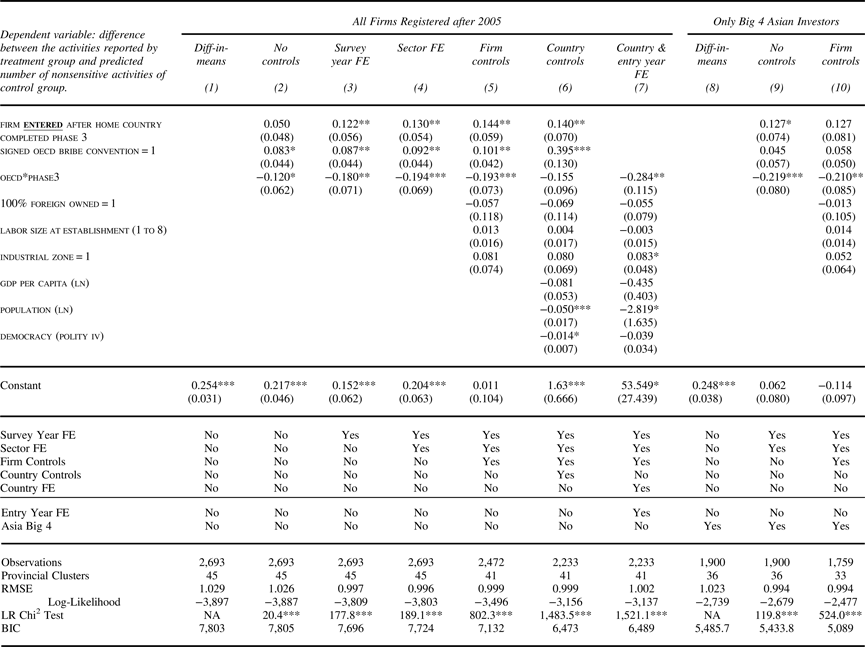
Since we are using a two-stage, nonlinear estimation strategy and our key causal variable is not exogenously assigned, it is crucial that we demonstrate that our results both hold in the most concise model and are robust to changes in specification. This is the strategy we adopt in Table 2 using the LIST methodology, where we present the simple relationship and then try our best to disprove it. Note that our sample size is halved because it is a two-stage model, where we first estimate the number of nonsensitive items in the control group, and then use those estimates to calculate bribery in the treatment group in the second stage. Thus, our n reflects the observations in the treatment group only.Footnote 97 In Model 1, we present a model with no controls, showing that our results correctly recover the difference-in-means estimate presented in Table 2. We find that 25.4 percent of firms pay bribes in our sample.
Correlates of corruption during business entry (LIST method)
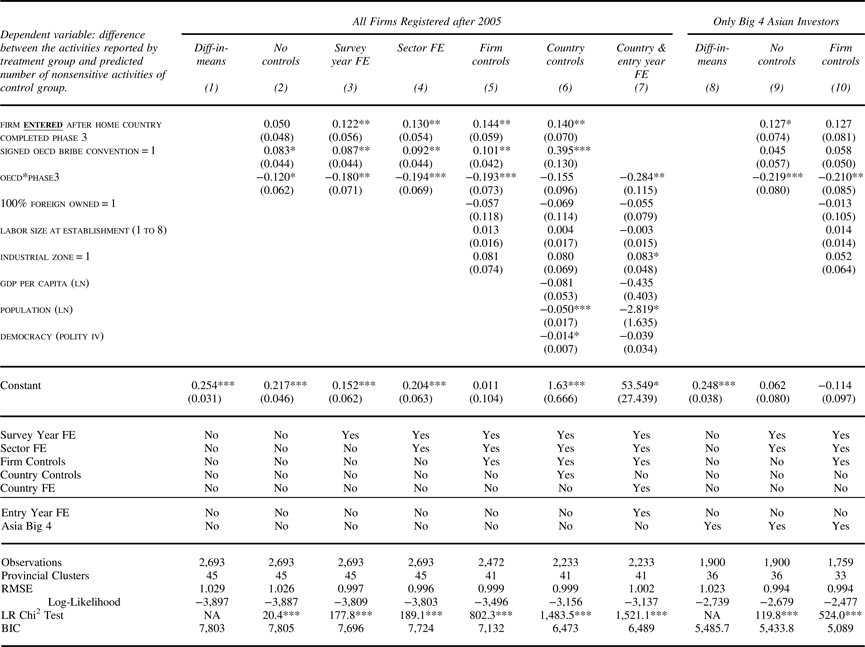
Notes: These results are derived from a two-stage model. In the first stage, the number of nonsensitive activities is regressed on the covariates for the control group using a negative binomial specification. The predicted number of nonsensitive activities is then subtracted from the total number of registration activities for the treatment group. The difference becomes the dependent variable in the second stage, which is analyzed using a Non-Linear Least Squares (NL) specification in models without fixed effects and OLS in models with fixed effects. Note that the number of observations (N) is the number of respondents in the treatment group. As Model 1 shows, the process correctly delivers the difference-in-means estimator for the whole sample, indicating that the two-stage procedure yields unbiased estimates. Panel 1 studies all respondents, Panel 2 studies only observations from Vietnam's four largest investors (Japan, South Korea, Taiwan, and Singapore). Because the dependent variable is an estimate, standard errors are calculated through bootstrapping procedure with 1,000 repetitions. Errors are clustered at the provincial sampling unit level in Panels 1 and 2. *p < .10; **p < .05; ***p < .01. (FE: Fixed Effects; LR Test: Likelihood Ratio Test; BIC: Bayesian Information Criterion). LR tests compare each new model to Model 1, where the null hypothesis is that the two models are not significantly different in the goodness of fit to the data.
We begin our analysis in Model 2 of Table 2 by assessing the interaction of oecd and phase 3. To make sure the annual events or particular features of the survey process are not biasing results, we introduce survey-year fixed effects in Model 3. Since bribe propensity can differ dramatically across sectors and because the change in the selection of firms into sectors may be associated with oecd-abc membership, we introduce two-digit International Standard Industrial Codes (ISIC) sector fixed effects in Model 4. Model 5 adds a battery of controls for potential firm-level confounders (e.g., 100% foreign owned versus joint ventures, labor size, and whether the firm is located in an industrial zone). One clear concern that remains thus far is whether country-level features are associated with both the selection into the OECD-ABC and levels of corruption. We address this unobserved heterogeneity at the country-level in three ways. First, Model 6 adds in commonly used country-level confounders from cross-national corruption literature (e.g., gdp per capita, home-country population size, and level of democracy from the Polity IV data set).Footnote 98 Second, Model 7 introduces two-way fixed effects: (1) entry-year dummies to address any systematic economic shocks in a particular year that might be biasing our results; (2) a full set of home-country dummies that capture all the variance associated with home-country status. This model essentially limits comparisons to foreign invested enterprises (FIEs) from the same country and sector that entered Vietnam before and after the Phase 3 onset. The Phase 3 and OECD component coefficients are perfectly correlated with country and entry year dummies and therefore must be dropped from the analysis.
Third, Models 8 to 10 rerun key specifications from Panel 1, but restrict analysis to four of Vietnam's five largest source countries for foreign investment. Fortunately for us, these four comprise a relatively matched sample of countries both inside (Japan and South Korea) and outside (Taiwan and Singapore) outside the OECD-ABC. All four of these countries have per capita GDP (in PPP) above $38,000, which ranks them in the top thirty in the world and among the top seven jurisdictions in Asia.Footnote 99 All are outward-oriented economies with extensive exports, overseas business relationships, and highly regarded MNCs. Furthermore, Taiwan's nonmembership is exogenously assigned. Because of its sovereignty dispute with China, it is extremely difficult for Taiwan to join international organizations.Footnote 100 This restrictive sample therefore helps address some of the threats from country-level confounders. Transparency International considers Japan and South Korea to be poor enforcers with almost zero investigations or sanctions of bribery by overseas investors in the Phase 3 period, so this test essentially isolates the reputational cost element of Phase 3. None of the four countries in the sample have active enforcement of the arrangement.
Results
Focusing on our preferred Model 5,Footnote 101 we find strong support for the notion that the Phase 3 implementation has important effects on reducing bribery in OECD-ABC signatories. Looking at the first coefficient in the table (δ2), we see that bribe frequency increased by 14.4 percentage points since 2010 among nonsignatories. In a potential outcomes framework, this figure represents the counterfactual—the expected corruption that would have occurred for signatories had Phase 3 never occurred. The second coefficient (δ1) shows that, after controlling for firm-level confounders, firms from OECD-ABC signatories were significantly more corrupt (by about ten percentage points) than nonsignatories prior to the onset of Phase 3. The coefficient on the interaction (δ3) is the critical parameter in our analysis, providing the diff-in-diff since 2010, and it shows a 19.3 percentage point reduction in the growth of bribery for OECD-ABC signatories relative to nonsignatories, leading to a marginal reduction overall in bribery by firms from signatories. Holding covariates constant at the mean, we find that expected bribe frequency after Phase 3 would be about 17.5 percent among nonsignatories and 11.6 percent among signatories.
After removing time-invariant cross-country confounders with the fixed effects in Model 7, we find that signatories experienced a 28.4 percentage point reduction in bribery after the onset of Phase 3. This result is upheld again in Model 9, where we limit analysis to only the four Asian sending countries. After adding firm-level controls, we find that Phase 3 was associated with a twenty-one-percentage-point reduction in bribery by Japanese and South Korean firms relative to their Taiwanese and Singaporean counterparts, despite the fact that neither country has shown an interest in actively enforcing the arrangement.
Thus, it is clear that H1 is upheld. During a period of high growth in the Vietnamese economy, along with lucrative opportunities for malfeasance, the implementation of Phase 3 appears to have significantly reduced the frequency of bribery by firms from countries party to the OECD-ABC during business registration.
Robustness Tests
At first blush, the findings appear compelling, but Phase 3's timing, the type of corruption measured, and the implementation of the PCI survey pose a number of threats to inference. In our online Appendix 7 we tackle these threats one by one: (1) the parallel trends assumption; (2) bandwidth size; and (3) allowing for initial entry years earlier than 2005. Our results remain robust to all of these tests.
Bribery During Procurement
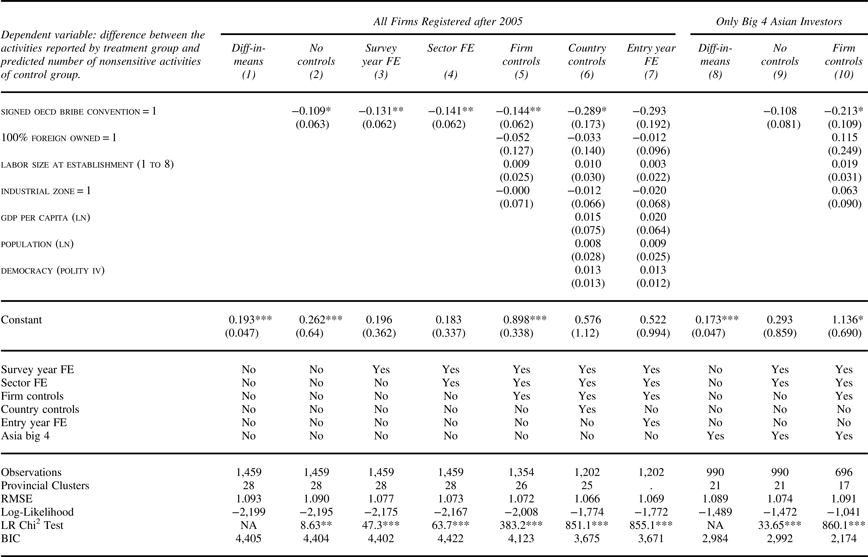
In Table 3, we examine bribery during procurement. Because the procurement question asks about bribes in the past year, we cannot date the specific timing of the bribe to the pre-Phase 3 era and so cannot use a diff-in-diff analysis. Nevertheless, our analysis uses the same two-stage estimation process as before, and we enter the confounders in a similar sequence to the earlier models. In our preferred Model 5 with firm-level controls, we find that firms from OECD-ABC countries are less likely to offer kickbacks during procurement than nonsignatory firms (a difference of about 14 percentage points). Limiting our analysis to the matched sample of Asian firms (Model 10), we find that OECD-ABC is associated with a reduction in corruption by 21.3 percentage points.
Correlates of corruption during procurement (LIST method)

Notes: These results are derived from a two-stage model described in Table 1. *p < .10; **p < .05; ***p < .01.
Although the results are not robustly significant according to standard p-value thresholds in Models 7 and 9, the direction of the coefficient remains similar through multiple specifications, including the introduction of survey-year and sector fixed effects as well as full sets of firm- and country-level controls. Bribery behavior can be driven by many factors, but our results are consistent when looking at the differences between OECD-ABC signatories and nonsignatories.
Testing Hypothesis 2: Enforcement
To assess whether these effects are driven by reputation, enforcement concerns, or a combination of the two, we code OECD-ABC firms by their level of enforcement that Heimann and colleagues deem to be active enforcers.Footnote 102 They use a four-point coding scheme though the assessment has changed methodologically over time. Initially, the assessment included only a two-point scale (active versus nonactive). It expanded to a three-point scale between 2008 and 2010, and currently is a four-point scale. The weighting system has also changed dramatically, leading to sharp shifts in countries’ assessments. South Korea and Japan, the two largest signatory investors in our sample, were coded as moderate enforcers in 2012 (3 on the TI scale), but were considered nonenforcers (0 on the TI scale) in 2013 and 2014. To simplify, we return to the original Transparency International metric and code countries as a “no enforcement” if they did not conduct an investigation or exact a punishment and “some enforcement” if any overseas bribers were investigated or punished in the previous year.
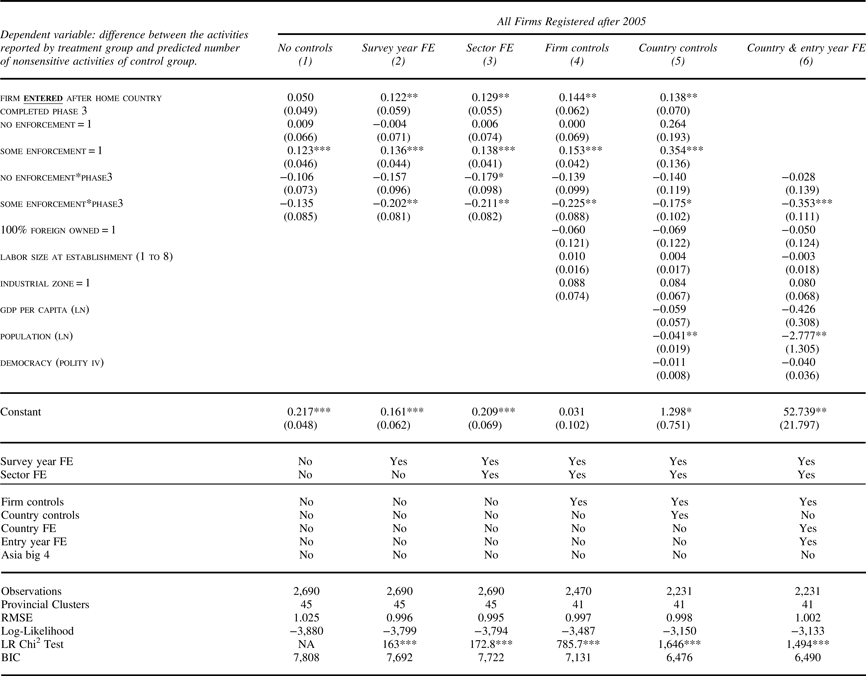
For bribery at entry, we return to the same diff-in-diff analysis, but this time interact Phase 3 with both categories of enforcement, thereby observing changes in three groups over time (nonsignatory, no enforcement, and some enforcement). For consistency, we follow the same sequence of Models as in Table 4.
Heterogeneous impact of home country enforcement on corruption during entry

Notes: These results are derived from a two-stage model described in Table 1. *p < .10; **p < .05; ***p < .01.
Focusing again on our preferred specification (Model 4), we observe a 14.4 percentage point increase in nonsignatories’ propensity to bribe. This result is strongly significant. The nonsignatories increased bribe behavior after Phase 3.
Turning to signatories who face low enforcement, we find zero effect of the convention. They appear to be constrained from increasing their corruption like their peers from nonsignatory countries, but are unlikely to actually reduce their behavior. The difference between the marginal effects for nonsignatories and nonenforcers is statistically significant. This result helps explain why the OECD-ABC appears effective when limiting the analysis to Asian investors with limited enforcement. The reputational benefits of the OECD-ABC are driven by limiting increased corruption among signatories as their peers in nonsignatory states (the most appropriate counterfactual) increase their bribery behavior. Because no enforcement takes place in this group, the constrained behavior can be attributed to only reputational concerns.
By sharp contrast, in countries with at least some reasonable enforcement, we observe reductions in propensity to bribe. The marginal effects are sizable (about a 22.5 percentage point reduction) and significantly different from zero. Thus, it appears that the OECD-ABC appears to be reducing bribery among the small set of firms that are actually experiencing increased risk of enforcement.Footnote 103
In sum, reputational and enforcement mechanisms apply to different types of states. In an environment of increased corruption in the counterfactual set of countries, the OECD-ABC constrains the bribery of firms during entry to pre-existing levels even when there is no threat of enforcement. This result constitutes the reputational mechanism. Only investigations and sanctions by home states, however, can actually cause firms subject to the OECD-ABC to reduce their propensity to bribe. Similarly, only the threat of sanctions appears to reduce corruption for procurement in the less well-identified model. This enforcement mechanism is sizable but limited to the small set of countries willing to take actions against their firms engaged in corrupt activities abroad.
Conclusion
Generally speaking, the OECD-ABC appears to be successful at limiting corruption during business entry. The growth in bribery during registration is significantly lower, and occasionally even negative, among firms from signatory nations. In our fully specified models, we observe a 19.3 percentage point reduction in bribe propensity during registration after Phase 3 of the convention instituted a peer-review process that could potentially implicate firms abroad. This success is achieved through two different mechanisms. When a home country signs onto the agreement but engages in no enforcement activities, such as investigating corruption cases or sanctioning convicted bribers, its firms abroad do not appear to change their bribery behavior. While the set of firms in the nonsignatory group (the counterfactual) increase their bribe propensity, firms from nonenforcers maintain the same level of bribery they had before Phase 3. When we limit our analysis to very similar Asian countries (signatories from Japan and Korea; nonsignatories from Taiwan and Singapore), we find a significant effect of the agreement. This constrained behavior can be attributed to only reputational effects because these firms fear retaliation by other signatory states and firms, even if they have no fear of punishment at home.
Only among countries that instituted serious monitoring and punishment, which raised the costs and risks of bribery after Phase 3 of the convention, do we see a reduction in bribery by signatories and nonsignatories. Firms from states that had even minimal enforcement of OECD-ABC saw 22.5 percentage point reductions in bribe propensity compared to the previous period. We do not find robust evidence of reductions in kickbacks during procurement.
Two problems affect our analysis, which we hope future work can rectify. First, question wording means we cannot pinpoint procurement kickbacks before Phase 3. Second, procurement remains a rare activity for foreign investors in Vietnam, which limits our statistical power and increases the inefficiency of our estimates.
An important puzzle remains from our empirical analysis. We hypothesized that the OECD-ABC would lower corruption among signatories, but we had no expectation that bribery would change among firms from nonsignatories, the counterfactual comparison group in our analysis. In fact, across different measures of corruption and model specifications, we consistently observe substantial increases in bribery among firms from nonsignatories. The diff-in-diff assumption is that corruption was increasing generally for MNCs in Vietnam after WTO entry as rents in the economy increased, and were it not for the OECD-ABC, signatory MNCs would have also engaged in increased bribery.
In our original research design, we did not anticipate the growth in bribery among nonsignatory firms and unfortunately did not put in place the requisite survey questions to test these three mechanisms. Therefore we can state with confidence only that Phase 3 has reduced the direct bribery behavior of firms subject to the OECD-ABC. In future work, we will be able to answer whether this activity accounts for a reduction in overall global corruption or whether, like a balloon being squeezed, the OECD-ABC has simply shifted corrupt activities to other areas.
Supplementary Material
Supplementary material for this article is available at <https://doi.org/10.1017/S0020818317000443>.