Introduction
Unethical behaviors, such as rule violations, lying, and stealing, are prevalent in the workplace (De Cremer & Moore, Reference De Cremer and Moore2020). While employees often engage in unethical behaviors to benefit themselves (Treviño, Den Nieuwenboer, & Kish-Gephart, Reference Treviño, Den Nieuwenboer and Kish-Gephart2014), they may also act unethically to benefit their work group (Thau, Derfler-Rozin, Pitesa, Mitchell, & Pillutla, Reference Thau, Derfler-Rozin, Pitesa, Mitchell and Pillutla2015; Umphress, Bingham, & Mitchell, Reference Umphress, Bingham and Mitchell2010). These behaviors, known as unethical pro-group behaviors (UPGB; Thau et al., Reference Thau, Derfler-Rozin, Pitesa, Mitchell and Pillutla2015), create a unique tension between ethical standards and group loyalty. A national survey of more than 14,500 employees in America revealed that 23% of them feel pressured to act unethically to make their work group look better (Ivcevic, Menges, & Miller, Reference Ivcevic, Menges and Miller2020). For instance, some employees may use unethical strategies to help their colleagues outperform other groups and secure federal funds (Balko, Reference Balko2011). What makes UPGB particularly concerning is that it often occurs under the guise of helping the group, making it harder to detect and prevent than clearly self-serving unethical behaviors (Umphress et al., Reference Umphress, Bingham and Mitchell2010). While these behaviors aim to benefit the work group, they violate social norms and harm other work groups, leading to intergroup conflict and damaged cooperation (Zhu, Lam, Li, & Shao, Reference Zhu, Lam, Li and Shao2024). Moreover, these behaviors can hurt the organization’s profits in the long run (Cialdini, Petrova, & Goldstein, Reference Cialdini, Petrova and Goldstein2004; Treviño et al., Reference Treviño, Den Nieuwenboer and Kish-Gephart2014). Therefore, understanding the drives behind employees’ UPGB and devising strategies to prevent them is of paramount importance.
To effectively prevent and reduce these unethical behaviors, it is essential to thoroughly understand the underlying mechanisms through which they can be impacted. Prior research has shown two streams of proximal antecedents for unethical pro-collective behaviors (e.g., UPGB and unethical pro-organization behaviors, or UPOB). The first stream focuses on moral-related factors, such as moral disengagement (Dennerlein & Kirkman, Reference Dennerlein and Kirkman2022) and moral justification (Chen & Chen, Reference Chen and Chen2023), which is a natural focus given the unethical nature of these behaviors. The second stream examines relational factors, such as organizational identification (Umphress et al., Reference Umphress, Bingham and Mitchell2010) and high-quality social exchange (Wang, Long, Zhang, & He, Reference Wang, Long, Zhang and He2019). Given that the pro-collective nature distinguishes UPGB or UPOB from the general pro-self unethical behaviors, research has predominantly focused on how relational factors contribute to UPGB and UPOB.
However, when we take a broader perspective from the ethics literature, we find that an individual’s choice of pro-self unethical behavior is also significantly influenced by ability-related factors. Existing research indicates that individuals often resort to unethical strategies when they perceive an inability to compete effectively with others (Kilduff, Galinsky, Gallo, & Reade, Reference Kilduff, Galinsky, Gallo and Reade2016; Piest & Schreck, Reference Piest and Schreck2021) or when they believe it is hard to reach the performance expectation. For example, coworkers may engage in undermining behavior when the focal employees have relatively higher performance (Sun, Li, Li, Liden, Li, & Zhang, Reference Sun, Li, Li, Liden, Li and Zhang2021), and employees may engage in cheating behaviors when they perceive competence threats and potential negative consequences of failing to achieve expectations (Mitchell, Baer, Ambrose, Folger, & Palmer, Reference Mitchell, Baer, Ambrose, Folger and Palmer2018). This pattern of findings suggests that individuals may engage in unethical behavior to compensate for perceived deficits in competence, aiming to achieve success. Conversely, when employees perceive themselves as having sufficient capabilities to succeed through legitimate means, they are less likely to resort to unethical behaviors. Therefore, enhancing employees’ perceived abilities and efficacy represents a critical pathway for reducing unethical behaviors in organizational settings. The theoretical foundation for this argument is grounded in social cognitive theory (Bandura, Reference Bandura1986), which suggests that individuals’ efficacy beliefs drive them to take action and maintain effort when facing obstacles.
Extending this logic to the group level, perceptions of their group’s general effectiveness, which is often conceptualized as group potency, can shape individuals’ (un)ethical choice (de Jong, de Ruyter, & Wetzels, Reference de Jong, de Ruyter and Wetzels2005; Hecht, Allen, Klammer, & Kelly, Reference Hecht, Allen, Klammer and Kelly2002). Perceived group potency reflects the extent to which an employee believes their work group is capable of achieving its objectives across tasks and contexts (Guzzo, Yost, Campbell, & Shea, Reference Guzzo, Yost, Campbell and Shea1993). This socially constructed belief about what the group can achieve enables individual employees to gauge the potential benefits and costs related to adopting (un)ethical strategies to help the group (Loi, Feng, Kuhn, & Tripp, Reference Loi, Feng, Kuhn and Tripp2022; Stenmark, Redfearn, & Kreitler, Reference Stenmark, Redfearn and Kreitler2021). When faced with perceived group inadequacy, members may view unethical behaviors as necessary means to preserve their group’s competitiveness. Therefore, to effectively reduce UPGB, it is critical to identify factors that can enhance employees’ perceived group potency.
According to social cognitive theory, perceived group potency emerges from a dynamic interplay of mastery experiences, vicarious learning, social persuasion, and psychological responses (Bandura, Reference Bandura1986). As key influencers within organizations, leaders are important sources of information for shaping employees’ efficacy beliefs (Hogan & Kaiser, Reference Hogan and Kaiser2005). We propose transformational leadership as an ideal antecedent to enhance employees’ perceived group potency because its core behaviors directly align with the mechanisms through which group potency develops. Specifically, transformational leaders provide mastery experiences through intellectual stimulation, offer vicarious learning through role modeling (idealized influence), deliver social persuasion through inspirational motivation, and foster positive psychological states through individualized consideration (Bass & Avolio, Reference Bass and Avolio1990; Kark, Shamir, & Chen, Reference Kark, Shamir and Chen2003; Schaubroeck, Lam, & Cha, Reference Schaubroeck, Lam and Cha2007). Beyond its comprehensive influence on efficacy perceptions through these four development mechanisms, transformational leadership also carries significant ethical dimensions that make it particularly relevant for addressing UPGB. Effelsberg and Solga (Reference Effelsberg and Solga2015: 581) pointed out that ‘investigating the ethical dimension of transformational leadership (TFL) has evolved as a distinct line of research within the broader field of TFL studies’. Given this theoretical foundation, examining transformational leadership’s role in UPGB presents a compelling yet unexplored research direction. Therefore, building on social cognitive theory and transformational leadership research, we propose that transformative leadership contributes to individual employee’s perceived group potency, which in turn mitigates UPGB.
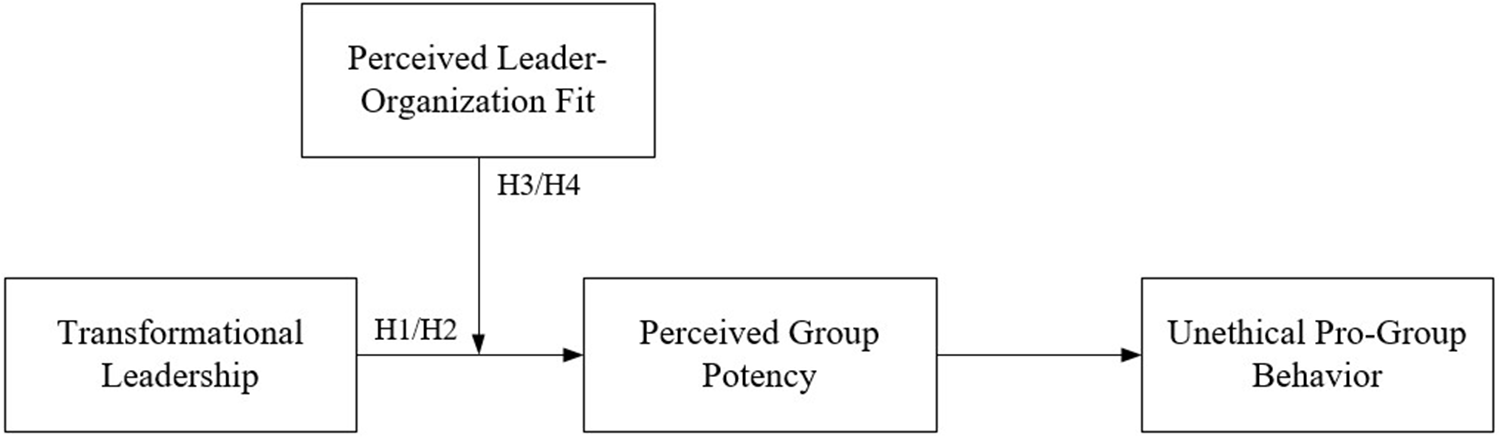
Social cognitive theory further suggests that individuals are more receptive to feedback from sources that they deem credible and authoritative (Bandura, Reference Bandura1977). This receptivity influences the formation and adjustment of their efficacy beliefs. In light of this, we posit that leader–organization fit plays a moderating role in this dynamic as it captures the leaders’ embedded credibility and authority within the organizational context. Leader–organization fit, which refers to the alignment between a leader’s characteristics and values and those of the organization (Cable & Judge, Reference Cable and Judge1997), is particularly relevant in our theoretical framework for two reasons. First, transformational leadership operates primarily through vision transmission, role modeling, collective inspiration, and individual consideration rather than merely through task-related capabilities (Bass & Avolio, Reference Bass and Avolio1994). When leaders demonstrate strong alignment with organizational values (high leader–organization fit), they display consistency and harmony with organizations (Hogg, Reference Hogg2001; Kouzes & Posner, Reference Kouzes and Posner2011). Under this condition, leaders’ transmission of organizational values and visions is more likely to be taken as an authentic interpretation, and their inspirational influence and social persuasion are more compelling, thus enhancing their transformational influence. Furthermore, when leaders are aligned with the organization’s characteristics and values, they are easily perceived as the representatives of the organization, which reinforces the authority and influence of leader behaviors (Anderson, Spataro, & Flynn, Reference Anderson, Spataro and Flynn2008; Eisenberger et al. Reference Eisenberger, Karagonlar, Stinglhamber, Neves, Becker, Gonzalez-Morales and Steiger-Mueller2010). Under this condition, leaders’ transformational behaviors are more likely to be accepted and recognized by employees, thus amplifying their influence. Therefore, we propose that employees’ perceived leader–organization fit moderates the relationship between transformational leadership and perceived group potency and the indirect effect on UPGB. Figure 1 depicts our theoretical model.
Conceptual model

Our research makes several theoretical contributions. First, we contribute to the theoretical understanding of UPGB by exploring the impact of an ability-related factor on such behavior. Most existing research has focused on explaining why employees want to help their group through unethical means—typically through relational mechanisms (e.g., strong bonds with groups make employees want to benefit their group, Thau, Derfler-Rozin, Pitesa, Mitchell, & Pillutla, Reference Thau, Derfler-Rozin, Pitesa, Mitchell and Pillutla2015). In contrast, our ability-based perspective reveals why employees feel they need to help through unethical means—when they perceive their team’s abilities as inadequate, they may feel compelled to engage in UPGB as a compensatory response. This shifts the theoretical focus from voluntary choice based on attachment (‘I want to help because I care’) to perceived necessity based on capability evaluation (‘I need to help because we can’t succeed otherwise’). This want-versus-need distinction is crucial because it suggests that UPGB might occur not only in groups with strong relationships but also in groups with perceived capability deficits. By revealing this novel compensatory mechanism, our research provides a more comprehensive understanding of why employees choose unethical means to help their group. In doing so, we also broaden the application of group potency into the ethical realm. Perceived group potency has been recognized as a significant cognitive element affecting group members’ motivation, effort, persistence, and performance outcomes (e.g., Lester, Meglino, & Korsgaard, Reference Lester, Meglino and Korsgaard2002 ; O’Neill, McLarnon, Xiu, & Law, Reference O’Neill, McLarnon, Xiu and Law2016; Stajkovic, Lee, & Nyberg, Reference Stajkovic, Lee and Nyberg2009). Yet, the exploration of its effects on group members’ unethical behaviors remains limited.
Second, our research broadens the understanding of the impact of transformational leadership on employees’ unethical behaviors. Prior investigations have primarily highlighted the positive effects of transformational leadership on employee performance (e.g., Bass, Avolio, Jung, & Berson, Reference Bass, Avolio, Jung and Berson2003; Hoffman, Bynum, Piccolo, & Sutton, Reference Hoffman, Bynum, Piccolo and Sutton2011). However, its influence on ethical decision-making remains underexplored. While some scholars have examined the impact of transformational leadership on unethical pro-organizational behavior (Effelsberg, Solga, & Gurt, Reference Effelsberg, Solga and Gurt2014), we extend this line of research by revealing its impact on UPGB.
Third, by exploring the moderating effect of employees’ perceptions of leader–organization fit, our study enriches current insights into the boundary conditions of transformational leadership. While existing research has primarily examined general contextual characteristics, such as group power distance and collectivism, as significant contingent boundaries (Schaubroeck et al., Reference Schaubroeck, Lam and Cha2007), it has overlooked how the interplay between leaders and organizations may shape the influence of transformational behaviors. This oversight is particularly salient in the dynamics between employees and leaders, where the leader serves as a pivotal conduit between employees and the organization. By examining the moderating role of employees’ perceived leader–organization fit, our research also contributes to the literature on person–organization fit, which has traditionally focused on individuals’ perceptions of their own fit with the organization (Kristof, Reference Kristof1996; Van Vianen, Reference Van Vianen2018).
Theoretical Background and Hypotheses Development
Transformational Leadership and Employees’ Perceived Group Potency
Social cognitive theory, as proposed by Bandura (Reference Bandura1977, Reference Bandura1986), posits that individuals’ self-efficacy beliefs—confidence in their capacity to execute tasks and achieve goals—constitute the cornerstone of human agency. These beliefs foster the motivation to take action and persist in the face of challenges (Bandura, Reference Bandura1989, Reference Bandura2006). The formation of efficacy beliefs is a dynamic interplay among four principal sources: mastery experiences, vicarious learning, social persuasion, and physiological and emotional states (Bandura, Reference Bandura1977). Mastery experiences stem from personal accomplishments and direct success. Vicarious learning arises from observing the performance and outcomes of others. Social persuasion involves the impact of verbal encouragement from others on one’s belief in own abilities. Physiological and emotional states refer to the bodily and emotional reactions experienced during task execution.
Individuals form efficacy beliefs that extend beyond personal abilities to encompass collective units (Bandura, Reference Bandura1977; Dotan-Eliaz, Sommer, & Rubin, Reference Dotan-Eliaz, Sommer and Rubin2009; Neubert, Taggar, & Cady, Reference Neubert, Taggar and Cady2006). Compared with related constructs such as group efficacy (focusing on task-specific collective beliefs, Gully, Incalcaterra, Joshi, & Beaubien, Reference Gully, Incalcaterra, Joshi and Beaubien2002) and group competence (emphasizing actual ability levels, Kauffeld, Reference Kauffeld2006), perceived group potency reflects an employee’s belief in their group’s collective ability to excel across various tasks and situations (Guzzo et al., Reference Guzzo, Yost, Campbell and Shea1993). We believe that this broad conceptualization is particularly relevant for studying UPGB, as such behaviors can emerge across diverse contexts and challenges, not just in specific task situations. Analogous to self-efficacy, perceived group potency is informed by the same sources, including mastery experiences, vicarious learning, social persuasion, and physiological and emotional arousal states (Bandura, Reference Bandura1977). Crucially, it is important to recognize that within a single group, individual members may develop markedly different perceptions of the group’s potency. This divergence can be attributed to a multitude of factors, including but not limited to: diverse personal experiences within and outside the group, distinct roles and responsibilities within the group structure, and varied interpretations of shared information and group outcomes. These factors can lead to significant disparities in how group members assess their collective capabilities, even when they are part of the same group and exposed to similar group dynamics (Klein, Conn, Smith, & Sorra, Reference Klein, Conn, Smith and Sorra2001; Loignon, Woehr, Loughry, & Ohland, Reference Loignon, Woehr, Loughry and Ohland2019). This heterogeneity in perceived group potency highlights the need to consider individual-level variations when examining group-level constructs.
In this research, we focus on the role of transformational leadership in shaping employees’ individual perceptions of group potency. Transformational leadership refers to leadership behaviors intended to inspire employees to move beyond their individual goals and self-interests and internalize the collective goals and visions (Bass, Reference Bass1990; Burns, Reference Burns1978). Typical transformational leadership behaviors are composed of four dimensions: intellectual stimulation, charisma or idealized influence, inspirational motivation, and individualized consideration (Bass, Reference Bass1990; Jung & Avolio, Reference Jung and Avolio1999). Intellectual stimulation involves challenging employees to think creatively, critically, and innovatively, and encouraging them to question assumptions and experiment with new ideas. Charisma or idealized influence involves acting as a role model for employees, displaying confidence and conviction, and earning their respect and trust. Inspirational motivation involves articulating a compelling vision of the future, setting high expectations and standards, and expressing optimism and enthusiasm. Individualized consideration involves paying attention to the needs, interests, and abilities of each employee, providing coaching and mentoring, and creating opportunities for growth and development. Transformational leadership behaviors play a crucial role in shaping employees’ perception of their group’s potency through multiple mechanisms aligned with the sources of efficacy beliefs.
Through intellectual stimulation, transformational leaders enhance employees’ perception of group potency primarily via mastery experiences. By challenging employees to think creatively and critically, these leaders create opportunities for individuals to participate in solving complex problems collectively (Bass et al., Reference Bass, Avolio, Jung and Berson2003). When employees experience their group successfully navigating challenges through innovative thinking, they develop firsthand evidence of the collective capabilities. This dimension encourages experimentation with new approaches, allowing individual members to witness successful performance outcomes that serve as concrete proof of their group’s abilities, thereby strengthening members’ belief in the group’s potency.
Charisma or idealized influence contributes to employees’ perception of group potency through vicarious learning and modeling (Bass et al., Reference Bass, Avolio, Jung and Berson2003; Hoffman et al., Reference Hoffman, Bynum, Piccolo and Sutton2011). Transformational leaders exemplify what effective group performance looks like through their own behaviors and actions. When these leaders display confidence while working with the group, they create observable demonstrations of effective action that group members can learn from and emulate. By showcasing stories of other successful groups’ problem-solving approaches and highlighting specific group members’ accomplishments, transformational leaders provide concrete models that illustrate the path to group success. This modeling process allows employees to acquire new knowledge and skills vicariously without having to experience every situation firsthand. As group members watch their leader navigate challenges confidently alongside the group, they mentally rehearse these successful approaches and incorporate them into their own behavioral repertoire, strengthening their perception of the group’s capabilities (Bass & Avolio, Reference Bass and Avolio1994; Hannah, Schaubroeck, & Peng, Reference Hannah, Schaubroeck and Peng2016).
Inspirational motivation improves employees’ group potency perceptions through verbal persuasion. When transformational leaders articulate a compelling vision, set high expectations, and express optimism, they actively convince group members of their collective potential (Bass, Reference Bass1990). This dimension involves leaders directly communicating confidence in the group’s abilities to overcome challenges and achieve exceptional results. These persuasive messages, especially when delivered with authentic enthusiasm by transformational leaders, influence how employees evaluate their group’s capabilities. Regular expressions of confidence in the group’s collective strength reinforce and elevate employees’ perceptions of group potency (Dvir, Eden, Avolio, & Shamir, Reference Dvir, Eden, Avolio and Shamir2002; Kark, Shamir, & Chen, Reference Kark, Shamir and Chen2003).
Individualized consideration increases employees’ perception of group potency by enhancing positive physiological and emotional states within the group context. By attending to individual member’s unique needs and providing personalized development opportunities, transformational leaders create emotional safety in the group context. When leaders demonstrate that they value each contribution to the group’s efforts, employees experience positive emotions about their membership in the group. This dimension helps employees regulate negative emotions like anxiety that might otherwise diminish their confidence in the group (Arnold, Reference Arnold2017; Ashkanasy & Tse, Reference Ashkanasy, Tse, Ashkanasy, Härtel and Zerbe2000). Accordingly, they become more receptive to positive beliefs about their group’s capabilities, strengthening their perceptions of the group’s potency.
Hypothesis 1 (H1): Transformational leadership is positively related to employees’ perceived group potency.
Mediating Role of Perceived Group Potency
Groups often need to compete for scarce resources in the organization (Kistruck, Lount, Smith, Bergman, & Moss, Reference Kistruck, Lount, Smith, Bergman and Moss2016; Nalbantian & Schotter, Reference Nalbantian and Schotter1997). They may compete using ethical or unethical strategies. Ethical competition strategies are those that conform to moral norms of competition, such as working hard and learning from others, whereas unethical competition strategies are those that violate moral norms of competition (Treviño, Weaver, & Reynolds, Reference Treviño, Weaver and Reynolds2006; Yip, Schweitzer, & Nurmohamed, Reference Yip, Schweitzer and Nurmohamed2018). UPGB are actions that benefit one’s own group at the expense of other groups, violating moral norms of competition (Thau et al., Reference Thau, Derfler-Rozin, Pitesa, Mitchell and Pillutla2015). Examples of such behaviors include withholding key information from other groups, bad-mouthing other groups, hoarding resources that should be available to all groups, and deliberate omission of corrective feedback to other groups, thereby ensuring a comparative advantage for one’s own group (Treviño et al., Reference Treviño, Weaver and Reynolds2006).
Social cognitive theory suggests that efficacy beliefs play a key role in influencing the activities, strategies, and environments that people choose to get into (Bandura, Reference Bandura1986). Research related to self-efficacy shows that people with high self-efficacy believe they have the capacity to get desired results in ethical ways (Elias, Reference Elias2009; Loi et al., Reference Loi, Feng, Kuhn and Tripp2022; Stenmark, Redfearn, & Kreitler, Reference Stenmark, Redfearn and Kreitler2021). They tend to persevere even in the face of difficulties and resort to ethical strategies (e.g., learning and working hard) rather than unethical strategies (e.g., cheating) to achieve goals (Loi et al., Reference Loi, Feng, Kuhn and Tripp2022; Putarek & Pavlin-Bernardić, Reference Putarek and Pavlin-Bernardić2020). It is reasonable to expect that the same logic applies to the relationship between perceived group potency and employees’ UPGB.
When employees possess a strong perception of group potency, they are more inclined to believe that their group can earn the competition with other groups through ethical approaches. For instance, when employees are assured that their group can increase its performance by exerting efforts and acquiring new competencies, they are less likely to resort to unethical competition tactics, such as disparaging other groups. Under this condition, the additional benefit derived from such malevolent strategies (i.e., UPGB) is negligible, while the potential cost induced by such behaviors is great and unworthy (Brass, Butterfield, & Skaggs, Reference Brass, Butterfield and Skaggs1998; Welsh, Baer, Kim, Thiel, & Smith, Reference Welsh, Baer, Kim, Thiel and Smith2022). For example, in such a scenario, if their unethical actions were discovered, their previous achievements may be subject to scrutiny, leading to doubts about their group’s abilities and reputation (Newman & Cain, Reference Newman and Cain2014; Stellar & Willer, Reference Stellar and Willer2018). Conversely, when employees doubt their group’s ability to succeed, they may fear the prospect of their group failing in competing for limited resources. Under this condition, engaging in UPGB, such as slandering a rival work group or concealing crucial information, may appear as a viable option to enhance group performance beyond ethical means (Thau et al., Reference Thau, Derfler-Rozin, Pitesa, Mitchell and Pillutla2015). The perceived benefits of such unethical behaviors outweigh the potential drawbacks, prompting employees to adopt unethical competitive strategies to bolster their group’s chances of success. Consequently, we expect an inverse relationship between employees’ perceived group potency and their UPGB.
As postulated in H1, transformational leadership has the potential to increase employees’ perceived group potency by disseminating diverse sources of information that reinforces their confidence in their group’s capabilities. Integrating these arguments, we posit that transformational leadership behaviors are likely to diminish UPGB by bolstering employees’ perceived group potency.
Hypothesis 2 (H2): Perceived group potency mediates the negative relationship between transformational leadership and employees’ UPGB.
Moderating Role of Perceived Leader–Organization Fit
Social cognitive theory further suggests that individuals are more receptive to feedback from sources that they deem credible and authoritative (Bandura, Reference Bandura1977), and a model’s credibility and authority are enhanced when the model demonstrates alignment with the broader social context in which learning occurs. Transformational leadership theory complements this perspective by emphasizing the importance of leader legitimacy in the organizational context. When transformational leaders are perceived as authentically representing organizational values and embodying their mission, their symbolic influence is amplified (Bass & Steidlmeier, Reference Bass and Steidlmeier1999). Therefore, we propose that leader–organization fit may serve as a moderator impacting how transformational leadership influences the formation and adjustment of employees’ efficacy beliefs. Higher leader–organization fit reflects the alignment between a leader’s characteristics and values and those of the organization, signifying leaders’ embedded credibility and authority within the organizational context and thereby amplifying their transformational influence.
Particularly, high leader–organization fit enhances the leader’s credibility by demonstrating their consistency and harmony with the organization (Hogg, Reference Hogg2001; Kouzes & Posner, Reference Kouzes and Posner2011). Transformational leadership inherently involves articulating organizational vision and values to inspire group performance (Bass, Reference Bass1990). When leaders are perceived as strong leader–organization fit, they are easily taken as legitimate interpreters of organizational values and capabilities, which increases the credibility of the leader’s persuasion about group potential. Under this condition, employees are more likely to believe and internalize the transformational leader’s positive expectations and beliefs about the group’s capabilities. When employees view the leader as a strong advocate for the organization’s values, they are more likely to believe in the transformational leader’s ability to bring about positive change. This heightened belief amplifies their mastery experience, motivating followers to have confidence in the group’s potential to achieve success (Walumbwa, Avolio, & Zhu, Reference Walumbwa, Avolio and Zhu2008). Second, when leaders are aligned with the organization, they are easily taken as representatives of the organization, which reinforces their authority and amplifies their influence on others (Anderson et al., Reference Anderson, Spataro and Flynn2008; DesJardins, Srivastava, Küfner, & Back, Reference DesJardins, Srivastava, Küfner and Back2015). Under this condition, employees are more willing to follow the guidance of transformational leaders (Bandura, Reference Bandura1986; Uhl-Bien, Riggio, Lowe, & Carsten, Reference Uhl-Bien, Riggio, Lowe and Carsten2014). They are more motivated to engage in observational learning from exemplars and accept leaders’ individualized consideration and support, thus generating more positive emotional experiences. All of these contribute to their increased belief in group potency.
Conversely, when employees discern a misalignment between their leader and the organization, such perception easily evokes a sense of discord and inconsistency, which may attenuate the extent to which transformational leadership can enhance employees’ perception of group potency. Particularly, such misalignment undermines the leader’s credibility as it indicates conflicts between leaders and organizations, leading to a decrease in employees’ belief in the leader’s vision and social persuasion. As a result, the effectiveness of transformational leadership in boosting employees’ confidence in their group’s success is compromised. Additionally, a perceived lack of congruence diminishes the leader’s authority and influence within the organization (Anderson et al., Reference Anderson, Spataro and Flynn2008), thereby lessening the inspirational impact of the leader’s role modeling and weakening employees’ followership towards the transformational leaders. In summary, we propose that perceived leader–organization fit amplifies the impact of transformational leadership on employees’ perceived group potency.
Hypothesis 3 (H3): Perceived leader–organization fit moderates the relationship between transformational leadership and employees’ perceived group potency, such that the relationship is stronger when perceived leader–organization fit is higher than lower.
Integrating our first three hypotheses, we propose a first-stage moderated mediation model. The basic premise of this model is that transformational leadership plays a crucial role in reducing employees’ UPGB. This is achieved by enhancing their perceived group potency. Furthermore, we propose that this indirect effect is moderated by perceived leader–organization fit. Specifically, when employees perceive a high level of leader–organization fit, transformational leadership has a stronger positive effect on perceived group potency, which in turn reduces UPGB.
Hypothesis 4 (H4): Perceived leader–organization fit moderates the indirect relationship between transformational leadership and employees’ UPGB via perceived group potency, such that the indirect effect is stronger when perceived leader–organization fit is higher than lower.
Research Overview
To empirically test the proposed hypotheses, we executed two distinct studies. Study 1 employed an experimental design aimed at establishing causal inferences and exploring the relationships among transformational leadership, perceived group potency, and unethical pro-group intention. Study 2, a multi-source, three-wave field study, was conducted to validate the findings of Study 1 and to further explore the moderating effect of perceived leader–organization fit. This second study extended beyond measuring intentions to capture actual UPGB as reported by supervisors, providing a more rigorous test of our hypotheses by addressing potential concerns about common method bias and self-reported behavioral intentions. The use of behavioral measures strengthens our conclusions by demonstrating that the effects extend beyond mere intentions to manifest in observable workplace actions that benefit the group through questionable means. Collectively, both studies provide robust empirical backing for our theoretical model and reinforce the internal and external validity of our findings.
Study 1 Methods
Participants and Procedures
We recruited a sample of 100 US employees, all native English speakers, via CloudResearch (Litman, Robinson, & Abberbock, Reference Litman, Robinson and Abberbock2017), to participate in our experiment in exchange for a payment of $1.50. Eligibility criteria required participants to be a minimum of 18 years of age and employed full-time. Due to one participant’s failure to submit the required completion code for payment, we inadvertently over-recruited, resulting in a final sample size of 101 participants. Among the 101 participants, 47.5% are female, 76.2% are in the age range from 18 to 45 years old, and 69.3% have at least a Bachelor’s degree.
Participants were randomly assigned to one of two experimental conditions: high (n = 53) or low (n = 48) transformational leadership. Upon enrollment, they were prompted to envision themselves as employees at ByteStorm Games, an online gaming company, where they had been part of a project group for four years under the leadership of a manager named Tom. Participants were then exposed to a vignette illustrating Tom’s leadership behavior, categorized as either high or low in transformational behaviors. Following the vignette, participants evaluated Tom’s leadership and their perception of the group led by Tom. Subsequently, participants learned that ByteStorm Games had introduced a collegial ranking system earlier in the year to navigate the competitive gaming industry and optimize resource allocation. This system aimed to recognize and reward the top-performing groups with increased budgets and organizational support. The benefits for the leading group were underscored during a recent quarterly review ceremony. Finally, participants were asked to express their willingness to engage in UPGB to secure the top rank for their team by year-end.
Transformational Leadership Manipulation
In alignment with established experimental research on transformational leadership (e.g., Bono & Judge, Reference Bono and Judge2003; Kovjanic, Schuh, & Jonas, Reference Kovjanic, Schuh and Jonas2013), we crafted scenarios that delineate high versus low transformational leadership behaviors. The high transformational leadership scenario was crafted to be motivational, encapsulating fundamental aspects of transformational leadership such as articulating a clear vision, setting elevated expectations, exuding confidence, and providing mentorship (Bass & Avolio, Reference Bass and Avolio1990). In contrast, the low transformational leadership scenario was devoid of these key elements. To ensure the internal validity of our experimental design, we carefully crafted the scenarios for the high and low transformational leadership conditions to be as congruent as possible in terms of tone and length. The only variations between the scenarios were those necessary to differentiate the levels of transformational leadership depicted. This approach helped minimize the potential for confounding factors to influence participants’ responses, allowing us to more confidently attribute any observed differences to the manipulated levels of transformational leadership.
Measures
Perceived group potency
We employed a six-item scale from Guzzo et al. (Reference Guzzo, Yost, Campbell and Shea1993) to measure participants’ perceptions of group potency. This instrument has been utilized in prior research to assess individuals’ convictions about their group’s effectiveness (e.g., Dotan-Eliaz et al., Reference Dotan-Eliaz, Sommer and Rubin2009; Neubert et al., Reference Neubert, Taggar and Cady2006). Participants rated their agreement with various statements concerning their group under Tom’s leadership (1 = strongly disagree, 7 = strongly agree). A sample item is ‘I am pretty sure that our group led by Tom is a high-performing group’. The reliability was 0.91.
Unethical pro-group behavioral intention
We used a five-item scale from Thau et al. (Reference Thau, Derfler-Rozin, Pitesa, Mitchell and Pillutla2015) to measure participants’ unethical pro-group behavioral intention. Participants were asked to assess the likelihood of engaging in each behavior (1 = extremely unlikely, 7 = extremely likely). A sample item is ‘Failed to tell someone not in your workgroup that something they did was wrong, so they do not perform as well as your workgroup’. The reliability was 0.92.
Study 1 Results
Manipulation Check
To validate our manipulation, we utilized a condensed five-item version of the Transformational Leadership Scale, as outlined by Detert and Burris (Reference Detert and Burris2007). This abbreviated scale has been found to possess comparable reliability to the original comprehensive version (Koh, Lee, & Joshi, Reference Koh, Lee and Joshi2019). An example item is: ‘Gives me specific feedback when I do something well’. The scale demonstrated high reliability, with a Cronbach’s alpha of 0.98. An independent-sample t-test showed that participants assigned to the high transformational leadership condition reported significantly higher transformational leadership evaluation (M = 6.10, SD = 0.71) than participants assigned to the low transformational leadership condition (M = 2.41, SD = 1.63; t (99) = 14.98, p < 0.01), thus confirming the effectiveness of our manipulation.
Descriptive Statistics
Table 1 presents the means, standard deviations, correlations, and internal reliabilities of the variables.
Means, standard deviations, correlations, and reliabilities of all variables (Study 1)

**,* Notes: N= 101. p < 0.01, p < 0.05, two tailed.
Hypotheses Testing
The results of an independent sample t-test showed that the mean of participants’ perceived group potency in the high transformational leadership condition was significantly higher (M = 5.61, SD = 1.26) than the mean in the low condition (M = 2.97, SD = 1.13; t (99) = 11.06, p < 0.01). Therefore, H1 was supported. We tested the indirect effect of transformational leadership on unethical pro-group behavioral intention via perceived group potency using the PROCESS SPSS macro (Hayes, Reference Hayes2012). Results showed that transformational leadership was positively related to perceived group potency (B = 2.64, SE = 0.24, p < 0.01), and perceived group potency was negatively related to unethical pro-group behavioral intention (B = −0.48, SE = 0.11, p < 0.01). Furthermore, the indirect relationship between transformational leadership and unethical pro-group behavioral intention via perceived group potency was −1.27 with a 95% confidence interval (CI) of [−1.92, −0.65], excluding zero.Footnote 1 Therefore, H2 was supported.
Study 1 Discussion
In this experimental study, we found that transformational leadership is negatively associated with employees’ unethical pro-group behavioral intention, mediated by perceived group potency. However, a key limitation of Study 1 is that we measured UPGB intentions rather than actual behaviors. Additionally, the reliance on self-reported measures introduces concerns about common method bias. Moreover, Study 1’s vignette methodology imposes limitations on the external validity of the results. To address these limitations and enhance the generalizability of our results, we conducted Study 2, a field study with a multisource, time-lagged design. This new study aimed to (1) corroborate our findings in authentic organizational settings, thereby strengthening external validity; (2) investigate the hypothesized moderating influence of perceived leader–organization fit on the relationship between transformational leadership and perceived group potency; and (3) empirically test our full moderated mediation model using behavioral measures of UPGB reported by supervisors rather than self-reported intentions.
Study 2 Methods
Sample and Data Collection
We collected data from six firms in the service industry, including consulting, food services, medical logistics and technology, and real estate in China. The service industry often adopts competitive strategies to motivate groups and employees to vie for opportunities within the company (Brown, Cron, & Slocum, Reference Brown, Cron and Slocum1998; Chen, Zhu, & Zhou, Reference Chen, Zhu and Zhou2015). This makes UPGB, such as withholding information to gain a competitive edge for one’s work group, or intentionally excluding a member from another work group to enhance the perceived value of one’s own work group, particularly prevalent in this context (Goette, Huffman, Meier, & Sutter, Reference Goette, Huffman, Meier and Sutter2012; Kilduff et al., Reference Kilduff, Galinsky, Gallo and Reade2016). Our data collection was conducted in three waves, each separated by a two-week interval. Temporally segregating variables is recognized for its efficacy in reducing common method bias, recommended by Podsakoff, MacKenzie, Lee, and Podsakoff (Reference Podsakoff, MacKenzie, Lee and Podsakoff2003) and employed in research examining unethical behaviors (e.g., Cheng, Zhu, & Lin, Reference Cheng, Zhu and Lin2022; Lee, Schwarz, Newman, & Legood, Reference Lee, Schwarz, Newman and Legood2019; Wang, Xiao, & Ren, Reference Wang, Xiao and Ren2022).
We invited 356 employees, along with their 70 leaders, to engage in our study. At Time 1,344 employees (97% response rate) reported their leaders’ transformational leadership behaviors, their own perceptions of leader–organization fit, and demographic information. At Time 2, the same cohort of employees reported their perceived group potency and perceived group identification. At Time 3, 69 leaders assessed employees’ UPGB. Employees were compensated with 14 US dollars, while their leaders were given 21 US dollars. The consent form for our survey underscored the voluntary nature of participation and the commitment to confidentiality and exclusive use of the data for scholarly research.
Participants were assigned a unique code, which they were required to enter into the survey to facilitate the matching of data across multiple time points. The final matched data comprised responses from 327 employees and 69 leaders. Among the 327 employees, 60.2% were females, and 54.7% had an educational level of junior college or above. Their average age was 29.2 years (SD = 6.81). Their average tenure working with their current leader was 3.02 years (SD = 3.49), and the average tenure in the group was 3.07 years (SD = 3.58).
Measures
All measures used in this study were originally in English. We translated them into Chinese following the translation and back-translation procedure (Brislin, Reference Brislin, Triandis and Berry1980).
Transformational leadership
In this study, we employed the same five-item scale from Detert and Burris (Reference Detert and Burris2007) that was utilized in Study 1 to assess transformational leadership. Group members evaluated their direct supervisor’s transformational leadership behaviors (1 = never, 5 = always). The reliability score of this scale was 0.96.
Perceived group potency
We employed the same six-item scale from Guzzo et al. (Reference Guzzo, Yost, Campbell and Shea1993) that was used in Study 1 to assess employees’ perceived group potency. The group members expressed their level of agreement with the statements about their group’s capabilities (1 = strongly disagree, 5 = strongly agree). The reliability score of this scale was 0.83.
Perceived leader–organization fit
We used a three-item scale from Cable and Judge (Reference Cable and Judge1997) to measure perceived leader–organization fit. This measure was widely used in existing literature (e.g., Carless, Reference Carless2005; Kristof‐Brown, Reference Kristof‐Brown2000). Group members rated the alignment between their leader and the organization (1 = not at all, 5 = completely). An example item is ‘To what degree do your supervisor’s values, goals, and personality match or fit this organization’? The reliability score of this scale was 0.89.
UPGB
We used the same five-item scale from Thau et al.(Reference Thau, Derfler-Rozin, Pitesa, Mitchell and Pillutla2015) as in Study 1 to assess the frequency with which employees acted unethically for the benefit of their work group. Group leaders evaluated the frequency of each member’s UPGB (1 = never, 5 = very often). The reliability score of this scale was 0.86.
Control variables
We controlled for employees’ age (in years) and gender (male = 1, female = 0) because prior research has suggested that these demographics may shape employees’ unethical behaviors (Kish-Gephart, Harrison, & Treviño, Reference Kish-Gephart, Harrison and Treviño2010). In addition, we also controlled for employees’ tenure working with the leader (in years) and tenure in the group (in years) because a longer tenure with the leader or group may increase employees’ intention to engage in unethical behaviors for the group (Mesdaghinia, Rawat, & Nadavulakere, Reference Mesdaghinia, Rawat and Nadavulakere2019). Furthermore, we controlled for group identification as an alternative mechanism in our analyses for two important theoretical reasons. First, relational mechanisms (e.g., identification with the unit) constitute the core explanatory mechanism for the relationship between transformational leadership and unethical pro-collective behavioral dynamics (Effelsberg et al., Reference Effelsberg, Solga and Gurt2014). Second, prior studies have found that transformational leadership can significantly influence members’ identification with their group (Horstmeier, Boer, Homan, & Voelpel, Reference Horstmeier, Boer, Homan and Voelpel2017). By controlling for group identification, we aimed to examine whether our proposed ability-based mechanism exists above and beyond the traditional relational pathway. Employees rated their group identification with an eight-item scale from Johnson, Morgeson, and Hekman (Reference Johnson, Morgeson and Hekman2012) at Time 2 (1 = strongly disagree, 5 = strongly agree). One sample item is ‘I feel happy to be an employee in the group’. The reliability score of this scale was 0.93.Footnote 2
Analytical Strategy
Although we measured all the variables at the individual level, the individuals were nested in groups. Accordingly, we tested our model by using path analysis with the sandwich estimator (Type = Complex) in Mplus 8 (Muthén & Muthén, Reference Muthén and Muthén2017), which provides unbiased and robust estimates of standard errors for nested data (Rogers, Reference Rogers1993).Footnote 3 When examining the moderating effect of perceived leader–organization fit, we grand-mean–centered transformational leadership and perceived leader–organization fit prior to creating their interaction. We plotted the interaction based on the steps proposed by Aiken and West (Reference Aiken and West1991). We computed the 95% CI for the indirect effect as well as the conditional indirect effects by using the Monte Carlo simulations with 20,000 replications (Preacher, Rucker, & Hayes, Reference Preacher, Rucker and Hayes2007; Selig & Preacher, Reference Selig and Preacher2008).
Study 2 Results
Confirmatory Factor Analyses
We conducted a series of confirmatory factor analyses (CFAs) to examine the discriminant validity of the studied variables, including transformational leadership, leader–organization fit, perceived group potency, and UPGB. To maintain a reasonable sample size-to-parameter ratio and provide more accurate estimates of these parameters, we formed parcels for perceived group potency by randomly assigning two items to each parcel (Little, Cunningham, Shahar, & Widaman, Reference Little, Cunningham, Shahar and Widaman2002), reducing the six original items to three parcels. The CFA results showed that the hypothesized four-factor model fitted the data well [χ2 (98) = 321.04, p < 0.001, root mean square error of approximation (RMSEA) = 0.08, comparative fit index (CFI) = 0.95, standardized root mean square residual (SRMR) = 0.07] and better than a three-factor model combining transformational leadership and perceived group potency [χ2 (101) = 640.20, RMSEA = 0.13, CFI = 0.87, SRMR = 0.09; Δχ2 = 319.16, Δdf = 3, p < 0.001], a three-factor model combining transformational leadership and leader–organization fit [χ2 (101) = 558.35, RMSEA = 0.12, CFI = 0.89, SRMR = 0.08; Δχ2 = 237.31, Δdf = 3, p < 0.001], a three-factor model combining perceived group potency and leader–organization fit [χ2 (101) = 630.72, RMSEA = 0.13, CFI = 0.87, SRMR = 0.09; Δχ2 = 309.68, Δdf = 3, p < 0.001], and a two-factor model combining transformational leadership, leader–organization fit and perceived group potency [χ2 (103) = 867.69, RMSEA = 0.15, CFI = 0.82, SRMR = 0.09; Δχ2 = 546.65, Δdf = 5, p < 0.001]. Therefore, our measures had strong discriminant validity.
Descriptive Statistics
The means, standard deviations, correlations, and reliabilities are presented in Table 2. As expected, the correlation between transformational leadership and perceived group potency was significantly positive (r = 0.40, p < 0.01). The correlation between perceived group potency and members’ UPGB was significantly negative (r = −0.21, p < 0.01), providing preliminary support for our hypotheses.
Means, standard deviations, and correlations of all variables (Study 2)

*,** Notes: N = 327; data in parentheses on the diagonal represent coefficient alphas estimates of reliability; gender: male = 1, female = 0. p < 0.05, p < 0.01, two tailed.
Hypotheses Testing
Table 3 presents the results of the path analysis. The relationship between transformational leadership and perceived group potency was significantly positive (B = 0.33, p < 0.001, Model 1), supporting H1. The relationship between perceived group potency and UPGB was significantly negative (B = −0.27, p < 0.05, Model 3). The Monte Carlo analysis further showed that the indirect effect of transformational leadership on employees’ UPGB via perceived group potency was −0.09 with a 95% CI of [−0.19, −0.0034], excluding zero. Therefore, H2 was supported.
Results of hypotheses testing (Study 2)

*,**,*** Notes: N = 327. p < 0.05, p < 0.01, p < 0.01, two tailed.
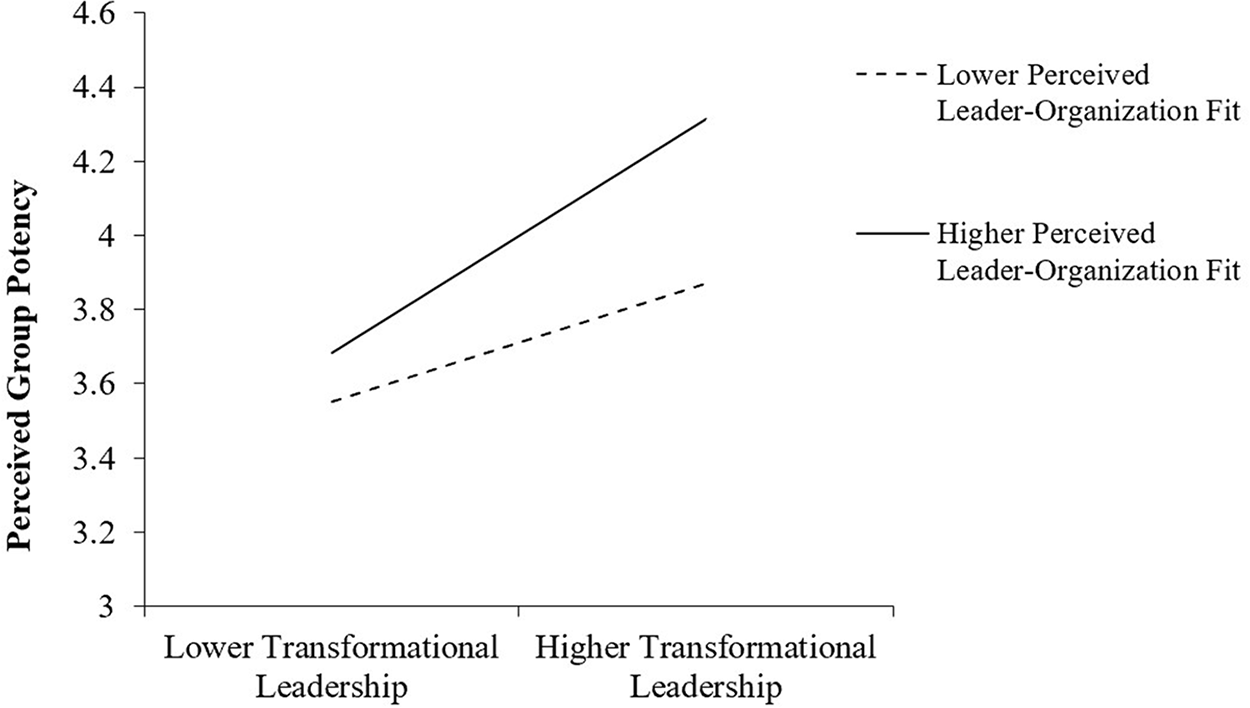
As Table 3 shows, the interaction between transformational leadership and leader–organization fit on employees’ perceived group potency was significant (B = 0.12, p < 0.01, Model 2), supporting H3. To better present this moderating effect, we plotted the interaction effect at conditional values of leader–organization fit (1 SD above and below the mean). The results showed that the positive relationship between transformational leadership and perceived group potency was stronger when leader–organization fit was higher (simple slope = 0.37, p < 0.001) than when it was lower (simple slope = 0.19, p < 0.01). The difference between those two slopes was also significant (difference = 0.18, p < 0.01). Figure 2 shows the interaction pattern.
The moderating effect of perceived leader–organization fit on the relationship between transformational leadership and perceived group potency

We further tested the moderated mediation effect by using the Monte Carlo simulation. Results showed that the indirect effect of transformational leadership on employees’ UPGB via perceived group potency was significant at both the higher level of leader–organization fit (indirect effect = −0.10, 95% CI [−0.22, −0.0042]) and the lower level of leader–organization fit (indirect effect = −0.05, 95% CI [−0.12, −0.0009]). The comparison between the two indirect effects revealed a significant difference, as evidenced by a 95% CI of [−0.12, −0.0007], which does not include zero. This indicates that the indirect effect is more pronounced when the leader–organization fit is higher rather than lower, thus supporting H4.
Study 2 Discussion
In Study 2, we implemented a multi-wave, multi-source field design to test our comprehensive theoretical framework. The findings corroborated Study 1’s results, demonstrating that transformational leadership diminished the tendency of employees to engage in UPGB by bolstering their sense of group potency. Furthermore, we discovered that the perceived leader–organization fit served as a first-stage moderating factor. This fit enhanced the positive effects of transformational leadership on perceived group potency, which, in turn, reduced its indirect negative impact on UPGB.
General Discussion
Considering the detrimental effects of employees’ UPGB on intergroup collaboration and organizational functioning, recent scholars have begun to explore the underlying catalysts of such behavior. However, existing research has primarily focused on relational motivations, largely neglecting ability-related drivers. Grounded in social cognitive theory, we probe the role of employees’ perceptions of low group potency in eliciting UPGB. Moreover, we investigate the role of transformational leadership to mitigate such unethical behaviors by enhancing employees’ perceptions of group potency and the role of perceived leader–organization fit as a first-stage moderator that strengthens the influence of transformational leadership.
Theoretical Implications
Our research extends existing literature in several ways. First, our research significantly enriches the body of knowledge on UPGB by introducing perceived group potency as a mitigating factor. Unlike prior studies that have primarily focused on relational determinants such as group identification and social inclusion (e.g., Thau et al., Reference Thau, Derfler-Rozin, Pitesa, Mitchell and Pillutla2015; Umphress et al., Reference Umphress, Bingham and Mitchell2010), our research sheds light on the often-neglected ability-related factors – specifically, employees’ efficacy beliefs about their group. Such beliefs are crucial as they shape employees’ sense of agency and the strategies they employ in pursuit of good performance (Bandura, Reference Bandura1977, Reference Bandura1989, Reference Bandura2006). Grounded in social cognitive theory, we discovered that employees are less inclined to resort to unethical behavior for their group’s benefit when they perceive their group as capable. This finding is particularly noteworthy as it holds even after accounting for the relational dynamics of group identification, underscoring the unique influence of perceived group potency. Furthermore, our investigation extends the application of group potency to the ethical domain – a relatively underexplored area. Although prior studies have established the impact of group potency on motivation, effort, and performance (e.g., Lester, Meglino, & Korsgaard, Reference Lester, Meglino and Korsgaard2002; O’Neill et al., Reference O’Neill, McLarnon, Xiu and Law2016; Stajkovic et al., Reference Stajkovic, Lee and Nyberg2009), its role in shaping ethical conduct among group members represents a novel and valuable extension of this construct.
Second, our research contributes a novel perspective to the transformational leadership literature by highlighting its differential effects on unethical behaviors within organizations. Existing literature recognizes transformational leadership’s beneficial effects on employee performance and group effectiveness (e.g., Dvir, Eden, Avolio, & Shamir, Reference Dvir, Eden, Avolio and Shamir2002; Koh et al., Reference Koh, Lee and Joshi2019). The dynamic relationship between transformational leadership and unethical behaviors remains a promising area for further investigation. Effelsberg et al. (Reference Effelsberg, Solga and Gurt2014) laid the groundwork for this discussion by suggesting that transformational leadership could unintentionally amplify employees’ unethical pro-organizational behaviors through heightened organizational identification. Building upon this research trajectory, our study indicates that transformational leadership diminishes UPGB by enhancing employees’ perception of group potency. This underscores the importance of discerning the diverse mechanisms that underlie various forms of employees’ unethical behaviors when assessing the ethical implications associated with transformational leadership.
Third, by highlighting the moderating role of leader–organization fit, our research makes a theoretical contribution to the understanding of boundary conditions for the effects of transformational leadership. While previous research has focused on pure contextual factors as significant boundary conditions (e.g., Schaubroeck et al., Reference Schaubroeck, Lam and Cha2007), our examination of the alignment between leaders and the organization offers a novel perspective. Leaders serve as a pivotal conduit, connecting the workforce to the organization. By exploring employees’ perceptions of the alignment between their leaders and the organization, our research sheds valuable light on the interplay between leader–organization fit and employee behaviors. Moreover, our findings extend the person–organization fit literature, which has traditionally focused on individuals’ perceptions of their own congruence with the organization and how this alignment impacts their attitudes and behaviors (Kristof, Reference Kristof1996; Van Vianen, Reference Van Vianen2018). By broadening the scope to include employees’ assessment of their leaders’ fit with the organization, we contribute to a more comprehensive understanding of the complex dynamics between individuals, leaders, and the organizational environment.
Practical Implications
Our findings offer actionable strategies for mitigating UPGB in the workplace. To begin, it is crucial for organizations and managers to assess whether employees view their groups as capable of engaging in fair competition with other groups. A perception of group incapacity may predispose employees to adopt unethical strategies. To counter this, organizations and managers can take actions that bolster employees’ perceived group potency. For instance, providing training focused on group coordination can enhance the likelihood of successful group work (Mathieu, Maynard, Rapp, & Gilson, Reference Mathieu, Maynard, Rapp and Gilson2008), instilling a belief in the group’s ability to surmount challenges through collaboration, rather than unethical tactics. Additionally, offering timely commendations and positive feedback on group achievements can fortify employees’ confidence in their group’s capabilities (Gully et al., Reference Gully, Incalcaterra, Joshi and Beaubien2002).
Given that transformational leadership is effective in curbing employees’ UPGB, organizations could select and train leaders who can demonstrate transformational leadership behaviors. For instance, organizations can use assessment centers to identify potential leaders who have the skills and attributes of transformational leadership. Organizations can also provide training programs or mentoring opportunities to help existing leaders develop and enhance their transformational leadership behaviors. To increase the effectiveness of leaders’ transformational leadership behaviors in curbing employees’ UPGB, organizations could also foster a culture of value congruence between leaders and the organization, such as by communicating the organizational mission and goals, rewarding leaders who align their actions with the organizational values, and providing feedback and coaching to leaders who deviate from the organizational values.
It is essential to acknowledge the potential unintended consequences of transformational leadership. While such leadership is generally associated with positive outcomes, there is evidence suggesting that it may also inadvertently foster unethical pro-organizational behaviors by making employees identify with the organization (Effelsberg et al., Reference Effelsberg, Solga and Gurt2014). Leaders should be cognizant of this paradox and actively seek to mitigate these risks by fostering an organizational culture that emphasizes ethical practices. By doing so, leaders can ensure that their transformational behaviors uphold the ethical standards of the organization.
Limitations and Future Research Directions
Our research has several strengths. We conducted two studies with different designs, measuring key variables at different times, and controlling for organizational identification as an alternative relation-related mechanism. Despite these strengths, our research is not without limitations that pave the way for future research avenues. A notable limitation of our experimental Study 1 lies in its reliance on measuring participants’ intentions to engage in UPGB, rather than capturing the actual behaviors themselves. Intentions, while indicative of potential actions, do not always correspond directly to behavior due to various external and internal factors. Future research could employ more immersive and controlled experimental settings to observe actual UPGB in experiments. Incorporating experimental manipulations of transformational leadership variables and measuring their direct effects on unethical behavior can provide more conclusive evidence of causality.
A primary limitation in Study 2 stems from our reliance on employees’ ratings to measure transformational leadership, perceived group potency, and leader–organization fit, which may elicit concerns regarding common method bias (Podsakoff et al., Reference Podsakoff, MacKenzie, Lee and Podsakoff2003). However, this type of data is considered valid and appropriate for capturing employees’ perceptions of these constructs (Chan, Reference Chan, Lance and Vandenberg2009). Additionally, the staggered measurement of transformational leadership and perceived group potency serves to alleviate common method bias concerns (Podsakoff et al., Reference Podsakoff, MacKenzie, Lee and Podsakoff2003). Furthermore, the significant interaction we observed between transformational leadership and perceived leader–organization fit in relation to perceived group potency lends further confidence to our findings, diminishing the impact of common method bias (Evans, Reference Evans1985).
In addition, Study 2 employed the concept of employees’ perception of leader–organization fit as a moderator in the relationship between transformational leadership and perceived group potency, without directly measuring the underlying mechanisms that drive this effect. Future studies could investigate the specific processes through which employees’ assessments of leader–organization fit affect the link between transformational leadership and group potency. Moreover, the effectiveness of leader–organization fit as a moderator may itself be contingent on employees’ organizational identification. Future research can explore this moderated moderation model, examining how employees’ organizational identification might strengthen or weaken the moderating effect of leader–organization fit on the relationship between transformational leadership and perceived group potency.
Interestingly, our analyses revealed that neither the main effect of group identification nor its interaction with group potency was significant, while the effect of perceived group potency remained robust.Footnote 4 These findings suggest that in certain organizational contexts, particularly those with strong performance expectations and competitive pressures, ability-related concerns might become more salient than relational factors in driving UPGB. The non-significant effect of group identification in our study does not necessarily contradict previous findings about the importance of relational mechanisms but rather indicates that the relative importance of different mechanisms may vary across contexts. In our research context, employees’ cognitive assessment of their group’s capabilities appeared to play a more prominent role in their decision to engage in UPGB than their emotional bonds with the group. This finding aligns with social cognitive theory’s emphasis on human agency and cognitive evaluation in behavioral choices (Bandura, Reference Bandura2006). The absence of an interaction effect between group identification and group potency suggests that these mechanisms might operate independently rather than synergistically in our research context. This independence of mechanisms enriches our theoretical understanding by suggesting that UPGB may stem from multiple pathways – one based on ability-related concerns and another on relational factors – with their relative influence potentially varying depending on situational factors such as performance pressure, organizational culture, or task characteristics. For instance, in contexts where performance outcomes are highly visible and consequential, ability-related concerns might become particularly salient. These findings open new theoretical directions for future research to explore the conditions under which different mechanisms might become more or less influential in driving UPGB, and how various contextual factors might shape the relative importance of ability-related versus relational mechanisms.
Conclusion
While employees may engage in UPGB with the intention of benefiting their group, these actions can undermine intergroup collaboration and the organization’s overall effectiveness. Identifying mechanisms to curtail such behaviors is thus crucial. Our findings indicate that transformational leadership diminishes employees’ UPGB by bolstering their perception of group potency, particularly when there is a strong perception of leader–organization fit. Our research contributes to a deeper theoretical understanding of the dynamics driving UPGB and provides valuable insights for organizations seeking strategies to mitigate these actions.
Data availability statement
The data, analysis codes and output, experiment manipulations, measurements, and supplemental results are provided in the online supplemental materials in the OSF (https://osf.io/z3d9a/?view_only=d9386dd524744bc58eaf8563acf21b0b).
Mingyun Huai (miahuai@hit.edu.cn) is a research professor at Harbin Institute of Technology. Her primary research interests include leadership, unethical behavior, justice, and proactive behavior. Her work has been published in the Journal of Applied Psychology, Journal of Management, The Leadership Quarterly, Tourism Management, and Journal of Business Research, among other outlets. She holds a PhD in management from the Hong Kong University of Science and Technology.
Xingyu Pang (pxy631@tongji.edu.cn) is an assistant professor of management at the East China University of Science and Technology. Her research interests include newcomer socialization, proactive behavior, and gender diversity. Her research has been published in the Journal of Occupational and Organizational Psychology. She holds a PhD in management from Tongji University.
Lida L. Zhang (lidazhang@um.edu.mo) is an associate professor of management at the University of Macau. Her research interests include relational demography and diversity, social identity, and employee proactivity. Her research has been published in journals such as the Academy of Management Journal, Organization Science, Management and Organization Review, and Asia Pacific Journal of Management.
Jiping Li (j.li@fs.de) is an assistant professor of organizational behavior at the Frankfurt School of Finance & Management. She received her PhD in management from the Hong Kong University of Science and Technology. Her research interests include diversity and inclusion, team dynamics, and workplace proactivity. Her work has been published in the Academy of Management Journal, Management and Organization Review, Journal of Applied Social Psychology, and Group Dynamics.
Long W. ‘Rico’ Lam (ricolam@um.edu.mo) is university registrar and professor of management at the University of Macau. His primary research areas are trust, dirty work, and workplace mistreatment. His research has appeared or been accepted for publication in the Journal of Applied Psychology, Journal of Management, Human Relations, Human Resource Management, Journal of Occupational and Organizational Psychology, among other outlets. He holds a PhD in management from the University of Oregon.