Introduction
Impulsive behavior is an important feature of a number of serious mental illnesses (SMI), including schizophrenia, bipolar disorder, substance abuse, and borderline personality disorder. In many cases, impulsive behavior can lead to other problematic behaviors, including violence or self-harm. Such violence is a highly significant public health issue because often it is a proximate cause of hospitalization and leads to increased healthcare costs,Reference McEvoy 1 particularly because persistently aggressive patients can be difficult to discharge. Moreover, the media often sensationalizes violent acts associated with mental illness, which contributes to stigma.Reference Torrey 2 It is becoming increasingly clear that increased violence risk is not fully explained by symptoms characteristic of SMI. Although aggression in SMI is heterogeneous,Reference Volavka and Citrome 3 impulsivity has been posited to play an important role. This article examines the neural circuitry of impulsivity and aggression in schizophrenia, a disorder characterized by positive symptoms (e.g., hallucinations, delusions), negative symptoms (e.g., social withdrawal, blunted affect), and a wide range of cognitive deficits. Because the review focuses specifically on impulsivity and aggression, important work on psychotic and psychopathic bases of aggression is not included herein, largely due to space limitations. To set the context, I first briefly discuss the heterogeneity of violence in schizophrenia and issues related to its measurement.
Body of Review
Etiology
First and foremost, aggression in schizophrenia is multidetermined.Reference Volavka and Citrome 3 Therefore, attempts to treat aggression in schizophrenia that use a one-size-fits-all approach are doomed to fail. The literature suggests that in schizophrenia, the 3 primary causes of aggression in schizophrenia are psychotic symptoms, psychopathy, and impulsivity.Reference Stahl 4 Other factors are also important, including neurological abnormalities, substance use, and poor medication adherence,Reference Witt, van Dorn and Fazel 5 although these may exert their influence on aggression via the primary causes named above. Thus, in an important study, Nolan et al Reference Nolan, Czobor and Roy 6 interviewed inpatients with schizophrenia whose violent acts were recorded on videotape. About 20% of assaults were attributed directly to positive symptoms. A factor analysis revealed 2 psychosis-related factors: one related to positive symptoms, and the other related to disorganization/confusion. A third factor differentiated impulsive from psychopathically based assaults. Impulsive versus psychopathically based aggression is often mapped onto a distinction between reactive and instrumental/proactive aggressionReference Dodge, Lochman, Harnish, Bates and Pettit 7 or impulsive versus predatory aggression.Reference Stahl 4 An important conclusion from that study is that patients could not be characterized by the type of violence they tended to commit, and that within an incident, multiple factors are likely to play a role.
The literature consistently shows that at least a plurality of inpatient aggression has an impulsive basis,Reference McDermott and Holoyda 8 although it is notable that the comorbidity of psychopathy and schizophrenia is higher in violent than nonviolent patients.Reference Nolan, Volavka, Mohr and Czobor 9 However, the most common measures of impulsivity, such as the Barratt Impulsiveness Scale (BIS),Reference Patton, Stanford and Barratt 10 have not always shown particularly strong correlations with aggression.Reference Nolan, D’Angelo and Hoptman 11 This could be, in part, because the theory behind the BIS explicitly separates impulsivity and emotion.Reference Barratt 12
It has long been understood that impulsivity is a multifaceted construct. An important distinction in this regard is between behavioral and trait measures of impulsivity. Regarding the former, a number of studies have examined response inhibition, measured using the go/no-go and stop signal tasks, as a key aspect of impulsivity. Indeed, patients with schizophrenia show significant deficits in the ability to inhibit prepotent responses.Reference Nolan, D’Angelo and Hoptman 11 , Reference Lipszyc and Schachar 13 The circuitry for response inhibition is fairly well understood, and includes the right inferior frontal gyrus, the supplementary motor area, the globus pallidus, the striatum, the thalamus, and the subthalamic nucleus.Reference Chambers, Garavan and Bellgrove 14 However, response inhibition is only weakly correlated with aggression,Reference Nolan, D’Angelo and Hoptman 11 , Reference Enticott, Ogloff, Bradshaw and Daffern 15 suggesting that other aspects of impulsivity may be more relevant to these behaviors in schizophrenia.
A major advance with regard to understanding trait impulsivity regarding aggression was achieved by Whiteside and Lynam.Reference Whiteside and Lynam 16 They compared many different measures of impulsivity, and their factor analysis yielded 5 constructs: Urgency, (lack of) Premeditation, (lack of) Perseverance, and Sensation seeking (UPPS). Urgency is defined as impulsive behavior in the context of strong negative emotion. A newer subscale adds the construct of positive urgency, which is defined as impulsivity in the context of strong positive emotion, yielding the UPPS-P.Reference Cyders and Smith 17 Urgency is elevated in a number of psychiatric populations that have affective dysregulation, including in schizophrenia.Reference Hoptman, Antonius, Mauro, Parker and Javitt 18
The neural correlates of urgency are thought to include aberrant patterns of activity in the orbitofrontal and ventromedial prefrontal cortex, as well as in the amygdala.Reference Cyders and Smith 19 Indeed, in a study of social drinkers, Cyders et al Reference Cyders, Dzemidzic, Eiler, Coskunpinar, Karyadi and Kareken 20 found that orbitofrontal cortex (OFC) and amygdala activation in response to negative emotional pictures correlated with negative urgency. Further, negative urgency mediated between general risk-taking and both amygdala and OFC activation to negative emotional pictures.
Behavioral and trait impulsivity measures are not strongly related in schizophrenia.Reference Enticott, Ogloff and Bradshaw 21 These measures are somewhat better correlated in healthy individuals.Reference Enticott, Ogloff and Bradshaw 22 The lack of correlation in schizophrenia may reflect other factors, including heterogeneity of symptoms or different subtypes. In healthy individuals, variable results may reflect the difference between trait and state aspects of impulsivity. More generally, trait measures (such as urgency) and the most commonly used behavioral measures (stop and go/no-go paradigms) appear to involve somewhat different neural circuitry. Relatively new behavioral tasks that include emotional conditionsReference Pawliczek, Derntl, Kellermann, Kohn, Gur and Habel 23 appear to activate, among other regions, areas thought to be relevant to urgency-based circuitry. However, whether performance on these tasks correlates with trait measures of impulsivity is not yet known.
Individuals with schizophrenia appear to experience emotions at the same level as healthy individuals, albeit with reduced outward expression.Reference Green and Lee 24 Patients with schizophrenia have problems in both emotional control and impulsivity—domains that are highly relevant to urgency. Moreover, urgency appears to have face validity as a correlate of aggression, and as will be discussed below, recent work suggests that it is the specific aspect of impulsivity most clearly linked to aggression in schizophrenia.
Measurement of aggression
The NIMH Research Domain Criteria (RDoC) initiativeReference Insel, Cuthbert and Garvey 25 points to the importance of examining different units of analysis within a domain. However, the assessment of aggression in schizophrenia so far has focused on only 1 or occasionally 2 levels of measurement. For measurement of aggressive behavior, the most relevant units would include behavior, self-reports, and paradigms. Many studies of violence in schizophrenia use direct observation of behavior.Reference Yudofsky, Silver, Jackson, Endicott and Williams 26 Self-report measures also have been used extensively.Reference Buss and Perry 27 Paradigms such as the Taylor Aggression Paradigm (TAP)Reference Taylor 28 and the Point Subtraction Aggression Paradigm (PSAP)Reference Cherek, Moeller, Dougherty and Rhoades 29 allow for fine-grained analyses of aggressive phenomena, but these have not been widely applied in schizophrenia. It is thus promising that the PSAP has been included in the RDoC matrix (http://www.nimh.nih.gov/research-priorities/rdoc/nimh-research-domain-criteria-rdoc.shtml), which may lead to a broader adoption of this online measure of aggression (classified under Frustrative Nonreward construct within the Negative Valence Systems domain).
Neural correlates of aggression in schizophrenia
Magnetic resonance imaging (MRI) studies of aggression specifically in schizophrenia have been relatively limited.Reference Soyka 30 – Reference Weiss 32 Most studies of the neurobiology of aggression have been based on findings from studies examining mixed diagnostic populations, as well as animal studies that concluded that aggression is associated with dysfunctions in ventral prefrontal and temporolimbic regions, as well as the interaction of these regions.Reference Volavka 33
Structural MRI
Structural MRI studies have primarily focused on cortical volumetrics. Some of these studies have found that larger caudate,Reference Hoptman, Volavka and Czobor 34 left orbitofrontal volume, and right orbitofrontal white matter volumeReference Hoptman, Volavka and Weiss 35 correlated with aggression in treatment-resistant patients with schizophrenia. These findings may reflect enlargement in cortical volumes due to the iatrogenic effects of long-term treatment with first-generation neuroleptics, given that these agents can increase basal ganglia volumes.Reference Chakos, Lieberman and Bilder 36 Similar findings with regard to orbitofrontal white matter volume were found in patients with schizophrenia who had prior suicide attempts.Reference Rüsch, Spoletini and Wilke 37 Narayan et al Reference Narayan, Narr and Kumari 38 found reduced cortical thickness in the ventromedial PFC (vmPFC) and lateral sensorimotor areas in violent compared to nonviolent patients. Of the violent patients, only those with antisocial personality disorder (and not schizophrenia) showed a reduction in thickness of the vmPFC. In a diffusion tensor imaging study, Hoptman et al Reference Hoptman, Volavka, Johnson, Weiss, Bilder and Lim 39 found that increased diffusivity, which may be reflective of atrophy, was correlated with higher levels of aggressive attitudes in men with persistent, long-term forms of schizophrenia. These studies are broadly consistent with the idea that structural abnormalities in ventral prefrontal and some subcortical regions are associated with aggression in schizophrenia.
Functional studies
There are quite a few functional studies of violence in patients with SMI, although these studies have not necessarily been limited to patients with schizophrenia, and most of them have used radiological methods. For instance, Raine et al Reference Raine, Buchsbaum, Stanley, Lottenberg, Abel and Stoddard 40 conducted an important series of studies using positron emission tomography to examine murderers judged not guilty by reason of insanity who were performing a continuous performance task. These studies found reduced glucose metabolism in prefrontal brain regions. Similarly, Volkow et al Reference Volkow, Tancredi and Grant 41 found reduced resting regional cerebral metabolism in prefrontal and medial temporal regions in a small sample of psychiatric patients with repetitive violence. Other radiological studies have found generally similar results.Reference Wong, Fenwick and Lumsden 42
Task-based functional MRI (fMRI) studies of violence in schizophrenia are relatively uncommon and point to the importance of comorbid diagnoses. Joyal et al Reference Joyal, Putkonen and Mancini-Marie 43 examined blood oxygen level–dependent (BOLD) responses during a go/no-go task. Patients with comorbid antisocial personality and substance use showed increased activation in motor, premotor, and anterior cingulate cortex, as well as reduced ventral prefrontal activation compared to controls and to violent patients with schizophrenia. Kumari et al Reference Kumari, Das and Taylor 44 used an anticipatory fear task, and found that individuals with schizophrenia and violent history showed hyperactivity in thalamostriatal regions, whereas antisocial patients showed hypoactivity in the same regions. Finally, in a small study of men with schizophrenia, Dolan and FullamReference Dolan and Fullam 45 found that patients with schizophrenia and high psychopathy had reduced amygdala activation to fearful faces compared to individuals with schizophrenia with low comorbid psychopathy.
A promising area of study is resting state fMRI. A major advantage of this method is that it avoids performance confounds and can thus be used in most study populations. A key measure using this approach is functional connectivity, which describes the temporal correlation of activation in different brain regions. In an initial study, Hoptman et al Reference Hoptman, D’Angelo and Catalano 46 examined functional connectivity of the amygdala in patients with persistent forms of schizophrenia. Compared to healthy controls, individuals with schizophrenia showed reduced functional connectivity between the amygdala and ventral prefrontal regions. This reduction correlated with higher levels of aggression in the patients as measured using arrest histories and self-report measures.
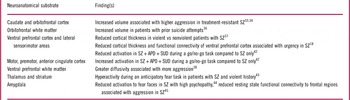
In a more recent study, Hoptman et al Reference Hoptman, Antonius, Mauro, Parker and Javitt 18 examined impulsivity and aggression in patients with schizophrenia compared to healthy controls using the UPPS-P, as well as several aggression questionnaires. They found that on the UPPS-P, patients had a selective increase in urgency, and that this increase explained significant variance in the also-observed increase in aggressive attitudes. Moreover, the investigators found that impulsive, but not premeditated, aggression was elevated in patients. Higher levels of urgency predicted reduced cortical thickness in ventral prefrontal regions, as well as reduced functional connectivity between ventral prefrontal and both limbic (e.g., rostral anterior cingulate) and executive brain regions. It is clear that a number of frontolimbic and subcortical regions are involved in impulsivity and aggression in schizophrenia. These are shown in Table 1.
Potential neuroanatomical substrates and causes of aggression in schizophrenia

Note. SZ = schizophrenia, APD = antisocial personality disorder, SUD = substance use disorder.
Implications
These findings may have important implications for the theoretical and clinical understanding of aggression in schizophrenia.Reference Hoptman, Antonius, Mauro, Parker and Javitt 18 , Reference Szeszko 47 From a theoretical perspective, the findings refine our understanding of the role of impulsivity in aggression. Thus, not all impulsivity is the same, and many aspects of impulsivity are not elevated in chronic schizophrenia. On the basis of self-report measures, only the emotional components (i.e., urgency) of the construct were elevated. Moreover, the neural circuitry related to urgency involves the structural integrity of ventral prefrontal regions and their functional connections to limbic and executive regions. Dysfunction of these circuits, which are implicated in emotional regulation, may predispose an individual toward aggression.Reference Davidson, Putnam and Larson 48 The extant literature suggests the importance of emotional dysregulation deficits in schizophrenia.Reference Kring and Werner 49
From a clinical perspective, the results suggest implications for treatment. Targets may include cognitive interventions to enhance regulation of impulsivity and aggression. These could include techniques such as reappraisal of negative emotional experiences, or suppression of negative affect.Reference Gross and Jazaieri 50 It is not yet known if these interventions can be used to effectively reduce aggression in patients with schizophrenia. However, their use, including techniques related to acceptance of emotional experiences,Reference Perry, Henry, Nangle and Grisham 51 might lessen the impact of distress associated with strong emotional states, and thereby prevent urgency-related aggression.
The literature also points to neural targets. Some antipsychotic medications appear to have specific antiaggressive effects, particularly clozapine.Reference Krakowski, Czobor, Citrome, Bark and Cooper 52 , Reference Volavka, Czobor and Nolan 53 Although second-generation antipsychotic agents have mixed effects on neurotransmitters, they do affect serotonin systems. Abnormalities in these systems have been associated with violent behavior in a number of populations. Of relevance to aggressive behavior, serotonin transporter sites are selectively reduced in ventral prefrontal regions in suicide victims compared to those with depression only.Reference Arango, Underwood and Mann 54 It would be important to examine serotonin transporter distribution patterns in violent patients with schizophrenia. Moreover, it would be interesting to examine the effects of clozapine on urgency in patients with schizophrenia. In the study by Hoptman et al,Reference Hoptman, Antonius, Mauro, Parker and Javitt 18 patients taking clozapine had lower urgency ratings on the UPPS-P than patients taking other medications. Clearly, a better definition of the multidimensional construct of aggression may lead to better treatment decisions and outcomes.Reference Citrome and Volavka 55
Other treatment approaches also may be useful to reduce impulsivity-based aggression. Transcranial magnetic stimulation (TMS) has traditionally been unable to reach cortical depths of greater than 2 cm, thereby rendering it unable to stimulate ventral prefrontal regions. However, we can apply our knowledge from big data approaches such as the Functional Connectomes ProjectReference Biswal, Mennes and Zuo 56 to identify circuits that are functionally connected to ventral prefrontal regions. Thus, it may be efficacious to stimulate regions such as the dorsolateral prefrontal cortex or precuneus in order to modulate activation in ventral prefrontal regions. Alternatively, deep TMS has the potential to reach depths of up to 6 cm from the cortical surface. This technique has shown treatment utility in a number of disorders involving emotional dysregulation, including major depression, hallucinations and delusions in schizophrenia, bipolar depression, and Asperger’s syndrome.Reference Bersani, Minichino and Enticott 57 Neither of these TMS approaches has been specifically applied to impulsive aggression in schizophrenia, but such methods may prove useful from both mechanistic and treatment perspectives.
Another potentially interesting approach is the use of real-time fMRI neurofeedbackReference LaConte, Peltier and Hu 58 to modulate the neural circuitry related to impulsivity and aggression. Real-time fMRI has been applied to the “default mode network” (DMNReference Raichle, MacLeod, Snyder, Powers, Gusnard and Shulman 59 )—a set of brain regions, including medial prefrontal cortex, posterior cingulate, and lateral parietal regions, that typically shows increased activity during rest, compared to task, conditions. Studies on DMN suggest its involvement in self-directed cognition.Reference Gusnard, Akbudak, Shulman and Raichle 60 Real-time fMRI has had limited application in schizophrenia so far.Reference Ruiz, Lee and Soekadar 61 In principle, one could identify critical circuitry for urgency and train patients to modulate their own circuitry. Recent studies show that orbitofrontal circuitry can be manipulated in this manner in healthy subjects with contamination anxiety,Reference Hampson, Stoica and Saksa 62 and that anterior insula circuitry can be modulated in criminal psychopaths,Reference Sitaram, Caria, Veit, Gaber, Ruiz and Birbaumer 63 which suggests that this approach might be applicable in other populations with abnormalities in such circuitry.
As has been stressed in this article, aggression has multiple causes, and a complete understanding of aggression in schizophrenia will extend the knowledge of impulsive, psychotic, and psychopathically based aggression, as well as interactions among these 3 types of aggression. For example, an important literature is emerging on the role of persecutory delusions in aggression in schizophrenia.Reference Keers, Ullrich, DeStavola and Coid 64 Significantly, it appears that delusions that engender anger are those that are most likely to lead to aggression,Reference Coid, Ullrich and Kallis 65 suggesting a mechanism whereby urgency could interact with psychotic symptoms to yield violent behavior. Finally, the circuitry underlying psychotic, impulsive, and predatory violence likely differs, and an understanding of these distinct circuits and their interactions will inform our ability to understand the genesis of aggression in schizophrenia.Reference Stahl 4
It should be noted that I am not arguing that all aspects of aggression in schizophrenia are determined by urgency. However, given the role that urgency may well play in aggression in schizophrenia, as well as the fact that at least a plurality of inpatient aggression is impulsive in nature, it may be that an assessment of urgency would be useful prior to intervention. Moreover, as noted above, it could be that other causal factors might interact with urgency so that changes in urgency might have as-yet-unknown effects on those factors. It would thus be important to know to what extent treatments typically used to address impulsively based aggression work through the construct of urgency and/or via related circuitry.
More generally, the literature on impulsivity and violence in schizophrenia points to the need for a better understanding of the regulation of emotionally based impulsivity and aggression in this disorder, as well as the need to better understand the regulation of other problematic behaviors associated with emotionally based impulsivity. This conceptualization places the problem in the context of a phenomenon that we know to be an issue transdiagnostically,Reference Johnson, Carver and Joormann 66 in keeping with the NIMH’s RDoC mission. It will be important to use information on regulation of impulsivity and aggression more broadly to help understand how it plays out in schizophrenia and other disorders.
Challenges
There are several important challenges in this line of work. First, there is no known paradigm that ideally probes urgency, which makes it difficult to objectively evaluate this construct in imaging studies. It may be that urgency has such strong trait properties that it cannot be easily modified. Alternatively, behavioral tasks that are typically used to measure impulsivity may have to be adapted to include a strong emotional component in order to better investigate this construct. Even if urgency cannot be easily manipulated, initial approaches might include (a) finding tasks that are closely related to urgency that can be modulated and/or (b) modulating urgency-related circuitry with the goal of examining its downstream effects on impulsively based aggression,
Paradigms such as the TAP or PSAP might be promising. Although the PSAP is part of the RDoC matrix, the task requires substantial motor activity and thus might be difficult to implement in fMRI studies. The TAP has been used in some fMRI studies. In particular, Dambacher et al Reference Dambacher, Sack, Lobbestael, Arntz, Brugman and Schuhmann 67 used the go/no-go task to measure response inhibition and the TAP to measure reactive aggression in healthy men. They found that both failed response inhibition (compared to go trials) and reactive aggression were associated with activation of the anterior insula, suggesting a role for that region in self-control. This same group showed that theta burst TMS in the right anterior insula and superior frontal cortex leads to impairments in both action restraint (go/no-go task) and action cancellation (stop task) in the former, and in action restraint in the latter compared to sham stimulation.Reference Dambacher, Sack, Lobbestael, Arntz, Brugmann and Schuhmann 68 By identifying regions indirectly stimulated by TMS in these studies, a better understanding of the circuitry associated with reactive aggression, action restraint, and action cancellation could be derived.
Conclusion
This article focuses on impulsive aggression. In general, imaging studies point to the role of abnormalities in circuitry involving ventral prefrontal, medial temporal, and subcortical regions as playing a key role in these behaviors. The recent finding that urgency plays a special role in aggression in schizophrenia suggests several novel approaches to better understand and treat these dysfunctional behaviors, and these approaches may have utility for other problematic behaviors associated with urgency, as well. Nonetheless, aggression in schizophrenia is not homogeneous across individuals, and a complete understanding of these behaviors will consider this heterogeneity. Newer assessments and guidelines for inpatient aggression are explicitly doing just that.Reference Warburton 69 , Reference Stahl, Morrissette and Cummings 70 By improving this understanding, we will be better equipped to manage aggressive behavior in schizophrenia, leading to reductions in harm, trauma, healthcare costs, and stigma.
Disclosures
Matthew Hoptman has the following disclosures: NIMH, researcher, research support (grants); Kessler Foundation, consultant, consulting fees.