Introduction
Phytotelmata, bodies of water impounded by plants, harbour a wide range of organisms, including insects, mites, entomostracods, micro-organisms, annelids, crabs and anurans (Varga, Reference Varga1928; Kitching, Reference Kitching1971; Fish, Reference Fish, Frank and Lounibos1983).
Kitching (Reference Kitching1971) categorized phytotelmata habitats into tree holes, leaf axils, flowers, modified leaves, fallen vegetative parts such as leaves or bracts and fallen fruit husks. Greeney (Reference Greeney2001) revised the composition of insects found in plant-held water, and reassessed and amplified Kitching's (Reference Lane1971) classification of phytotelmata habitats. Particularly, the tree-hole category was extended to include the internodal pools that form in many species of bamboo (Gramineae) when shoots break or sustain insect-feeding damage that allows water to enter (Lounibos et al., Reference Lounibos, Frank, Machado-Allison, Ocanto and Navarro1987).
These bamboo habitats have structural and macroinvertebrate compositions similar to that of tree holes (Kitching, Reference Kitching1971; Greeney, Reference Greeney2001). When a bamboo shoot is broken, split or perforated, decomposition of the inner walls occurs, supplying organic matter for several months. Complete transverse rupture allows the entry of fallen leaves and other detritus. Pre-adult Diptera dominate these habitats, which exhibit high persistence, intermediate structural complexity and nutrient concentration (Machado-Allison et al., Reference Machado-Allison, Barrera, Frank, Delgado, Gomez-Cova, Lounibos, Rey and Frank1985).
Tree holes and other phytotelmata are the principal larval microhabitats for many mosquito species (Fish, Reference Fish, Frank and Lounibos1983; Yanoviak, Reference Yanoviak2001; Yanoviak et al., Reference Yanoviak, Lounibos and Weaver2006), including several pathogen vectors. For example, tree hole- and bamboo-inhabiting Haemagogus spp. and Sabethes spp. are the most common enzootic vectors of the yellow fever virus in the Americas (Galindo et al., Reference Galindo, Carpenter and Trapido1955; Arnell, Reference Arnell1973; Navarro, Reference Navarro1998).
Almost any container filled with rainwater and a small amount of leaf litter will function as an artificial tree hole for short-term microcosm experiments (Yanoviak, Reference Yanoviak1999a,Reference Yanoviakb, Reference Yanoviak2001). Tree-hole analogues can be constructed from bamboo sections, automobile tyres, stone vases or plastic pots (Yanoviak and Fincke, Reference Yanoviak, Fincke and Leather2005). Galindo et al. (Reference Galindo, Carpenter and Trapido1955), studying yellow fever vector ecology in Panama, described two bamboo trap designs (closed-top and open-top), and the differences in mosquito species composition between the two. Closed-top traps with small lateral openings mimic a specific tree-hole morphology that is difficult to sample, and thus provide a useful tool for tree-hole experiments or vector control surveys.
Navarro and Machado-Allison (Reference Navarro and Machado-Allison1995) used closed-top bamboo traps for spatial and temporal mosquito sampling in a tropical humid forest mixed with cocoa plantation. They found Sabethes chloropterus (Humboldt), a sylvatic yellow fever vector, most abundant at 10 m above the ground, and in higher precipitation months. Vertical distribution was influenced more by microclimatic variations within the breeding sites than by adult mosquitoes' flying ability or the availability of food (blood) sources.
Louton et al. (Reference Louton, Gelhaus and Bouchard1996) explored patterns of community structure in bamboo internodes with lateral openings. They found 29 species dominated by insects, primarily Culicidae and a species of Zygoptera. The succession in this community was influenced by the size of the lateral openings; the average number of species, individuals and their percentage out of the total fauna increased as the size of the opening was increased.
More recently, Yanoviak et al. (Reference Yanoviak, Lounibos and Weaver2006) have compared species richness and composition of macroinvertebrate communities in natural tree holes and water-filled open-top bamboo traps in three habitats: patches of forest in the western Amazon converted to small-scale subsistence plantations, early successional forest and an adjacent primary forest. They showed that the composition of macroinvertebrate communities in phytotelmata differed between forested and deforested habitats, with effects apparent among both potential disease vectors and their major predators.
The principal goal of our study was to determine, using bamboo trap sampling, the temporal variation of macroinvertebrate communities in a habitat located in Henri Pittier National Park, a cloud forest in north-central Venezuela.
Materials and methods
Study area
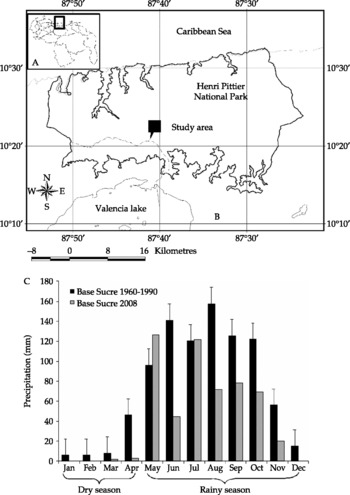
The fieldwork for this study was conducted in north-central Venezuela (Fig. 1A), in the forest near Dr Alberto Fernández Yépez Biological Station in Rancho Grande (10° 21′ N, 67° 41′ E, and 1100 masl) (Fig. 1B). The biological station is located within Parque Nacional Henri Pittier, a subtropical cloud forest with evergreen vegetation composed of arborescent ferns, mosses, epiphytes, Heliconia, aroids, palms (Bactris, Euterpe and Geonoma spp.) and Gyranthera caribensis Pittier (Huber, Reference Huber and Huber1986; Fernández-Badillo, Reference Fernández-Badillo2000).
Study area in north-central Venezuela (A) in the Henri Pittier National Park (B), and rainfall data for 1960–1990 and 2008 (C)
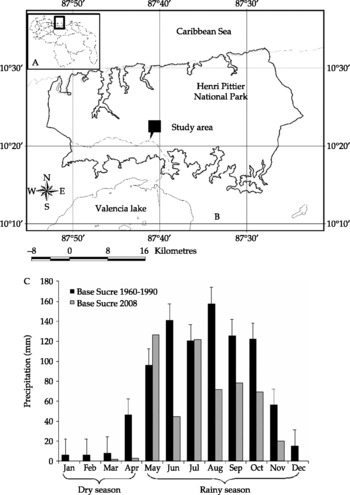
The cloud forest of the Henri Pittier National Park is one of the best known in South America. It is internationally famous for its high biodiversity, and its avifauna is of particular importance; about 43% of Venezuela's bird species, including six globally threatened species, are found there (ParksWatch, 2006). The forest presents a climatic pattern from humid to superhumid, having a fundamental composition in its orographic fog, with a very short dry season from January to April, and high precipitation from June to November. September is the wettest month. The annual temperature is almost constant (20–22 °C), and high relative humidity occurs almost year-round (Beebe and Crane, Reference Beebe and Crane1947; Seres and Ramirez, Reference Seres and Ramirez1990; Fernández-Badillo, Reference Fernández-Badillo2000).
In this study, we used precipitation records for 1960–1990 and 2008 (Fig. 1C) obtained from the meteorological station located at the Base Sucre military air base in Maracay-Aragua State (10° 25′ N, 67° 65′ E and 437 masl).
Macroinvertebrate sampling
The study started in January 2008, with the selection of 12 trees in which were placed 24 bamboo traps at 1.5 m above the ground. In total, we investigated 168 bamboo trap contents (24 traps × 7 months) from February to August 2008. The bamboo traps were made from a closed-top (removable) internode with a lateral orifice (2 cm diameter). Each trap contained a glass jar filled with rainwater, a partially submerged piece of tree bark (to serve as a perch for ovipositing insects), and leaf litter from the forest floor (as a nutrient base for the aquatic communities). As proposed by Yanoviak and Fincke (Reference Yanoviak, Fincke and Leather2005), the initial volume of uncompressed litter was 25–50% of the total artificial hole volume.
The trap contents were emptied monthly into labelled plastic bags and transported to the field laboratory at the biological station. Each trap was then refilled with rainwater and leaf litter, and the same tree bark was placed back (to retain any eggs attached). Dissolved oxygen (DO; Oakton dissolved oxygen probe), acidity (Oakton pH probe) and conductivity (TDSTestr conductivity meter) were recorded at that time. All measurements took place in the morning, between 09.00 and 11.00 h. In the laboratory, each sample was emptied into a white pan and the mosquito larvae and pupae present were removed for rearing and identification. The remaining contents were sifted with an 80 mesh/cm2 sieve, preserved with 80% ethanol and emptied into a labelled plastic jar.
All invertebrate taxa were sorted into recognizable taxonomic units or morphospecies (Armbruster et al., Reference Armbruster, Hutchinson and Cotgreave2002; Burdett and Watts, Reference Burdett and Watts2009) and identified to the lowest practical level with general (Bouchard, Reference Bouchard2004) and specialized references (Epler, Reference Epler1996; González and Darsie, Reference González and Darsie1996; Fernández and Domínguez, Reference Fernández and Domínguez2001). Mosquito species were identified using the keys of Lane (Reference Lane1953) and Berlin and Belkin (Reference Berlin and Belkin1980). The feeding guilds or functional roles of the taxa were determined from the literature (Machado-Allison et al., Reference Machado-Allison, Barrera, Frank, Delgado, Gomez-Cova, Lounibos, Rey and Frank1985, Reference Machado-Allison, Barrera, Delgado, Gómez-Cova and Navarro1986; Lounibos et al., Reference Lounibos, Frank, Machado-Allison, Ocanto and Navarro1987; Louton et al., Reference Louton, Gelhaus and Bouchard1996; Yanoviak, Reference Yanoviak2001) and from observations of feeding behaviour at the field station laboratory.
Statistical analyses
Results are presented as means and standard errors. For all statistical tests, normality was determined using Kolmogorov–Smirnov tests and by examination of normal probability plots. Average macroinvertebrate abundance was compared between months using one-way analysis of variance. When significantly different, means were compared using Ryan–Einot–Gabriel–Welsch multiple range tests (REGW-r) with the SPSS statistical software (SPSS Inc., 2004). Abundance data were log (x+1)-transformed prior to analysis to correct variance from heterogeneity (Sokal and Rohlf, Reference Sokal and Rohlf1981). However, all the means presented in the Results section were calculated from untransformed data. Phycochemical water properties were compared between months using the Kruskal–Wallis test (P < 0.05) with Mann–Whitney pairwise comparisons, applying P-value Bonferroni correction. Differences of significance between monthly macroinvertebrate taxa were tested by analysis of similarities (ANOSIM; Bray–Curtis distance; 10,000 permutations) with monthly pairwise comparisons using the Bonferroni correction. ANOSIM compares the ranks of distances between groups with ranks of distances within groups. The means of those two types of ranks are compared, and the resulting R-test statistic measures whether separation of community structure is present (Clarke, Reference Clarke1993; Ramett, Reference Ramett2007).
Invertebrate taxa responsible for similarities or differences between months were investigated using similarity percentages (SIMPER; Clarke, Reference Clarke1993) with Bray–Curtis distance. A cluster analysis was performed to classify monthly abundance using the Bray–Curtis distance between mean macroinvertebrate taxa abundances. Cluster analysis was carried out using the unweighted pair-group average method. Non-parametric tests (including ANOSIM), SIMPER and cluster analysis were carried out using PAST software (Hammer and Harper, Reference Hammer and Harper2008).
Results
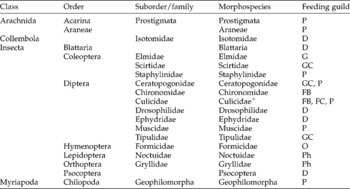
We collected a total of 1024 invertebrates belonging to the classes Arachnida, Collembola, Insecta and Myriapoda. The most diverse class was Insecta, with the order Diptera having six families (Ephydridae, Culicidae, Ceratopogonidae, Chironomidae, Drosophilidae and Tipulidae) and Coleoptera with three families (Scirtidae, Elmidae and Staphylinidae). The Culicidae species Culex (Anoedioporpa) conservator Dyar & Knab, Culex (Culex) mollis (Dyar & Knab), Wyeomyia (Wyeomyia) arthrostigma (Lutz) and Toxorhynchites (Lynchiella) theobaldi (Dyar & Knab) were identified. The macroinvertebrates included members of eight feeding guilds, with predators, detritivores and collectors (filtering and gathering), being the most abundant (Table 1).
Taxonomic classification and feeding guilds of fauna collected in bamboo traps in Henri Pittier National Park, Venezuela
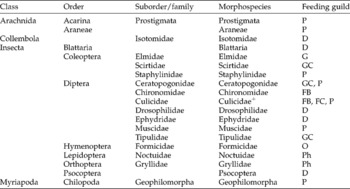
P, predator; D, detritivore; G, grazer; GC, gathering collector; FC, filter collector; FB, filter browser; O, omnivore; Ph, phytophagous.
+ Culicidae includes Culex (Anoedioporpa) conservator, Culex (Culex) mollis, Wyeomyia (Wyeomyia) arthrostigma and Toxorhynchites (Lynchiella) theobaldi.
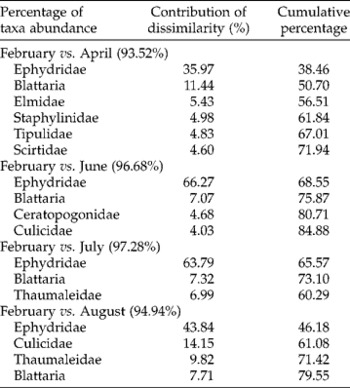
Mean invertebrate abundance differed significantly between months (Table 2). Post hoc univariate tests showed a significant difference (REGW-r, P < 0.05) between February and June, July and August. ANOSIM indicated significant differences between monthly taxa compositions (R = 0.144, P < 0.001), with pairwise comparisons showing differences between February and April (R = 0.224, P < 0.05), May (R = 0.195, P < 0.05), June (R = 0.511, P < 0.05), July (R = 0.645, P < 0.05) and August (R = 0.309, P < 0.05). In addition, SIMPER analyses (Table 3) indicated that these differences were attributable to the greater abundance of Ephydridae, Blattaria and Culicidae in June, July and August.
Mean and standard error of macroinvertebrate abundance in bamboo traps

Sample sizes are in parentheses. ANOVA F 6,105 = 5.36, P < 0.001. Different letters indicate statistically significant differences.
The contribution of taxa abundance to observed month differences determined by SIMPER analyses
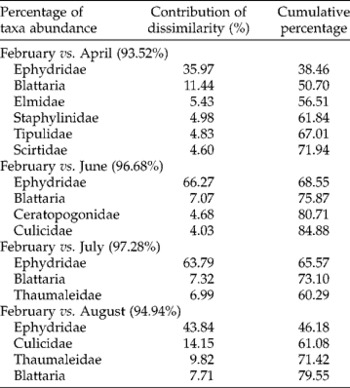
Abundances are listed in descending order of percentage contribution and only taxa contributing >4% to the observed differences are shown.
The pH and DO of water in the traps differed between months (Table 4), with June and July being significantly different from the other months (Mann–Whitney test, P < 0.001). Conductivity was not significantly different for the duration of the study.
Mean and standard error of phycochemical properties of water in bamboo traps

Sample sizes are in parentheses. *Kruskal–Wallis test, χ2 = 18.20, df = 6, P < 0.01; **χ2 = 2457, df = 6, P < 0.001.
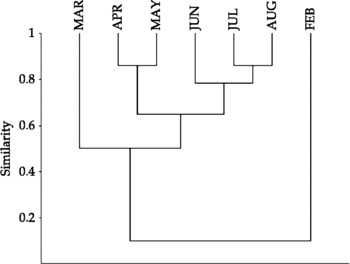
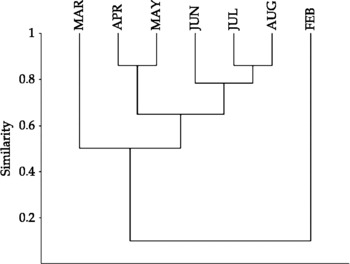
Cluster analysis showed five main groups of months (Fig. 2), with one group representing all months except February (50% of macroinvertebrates taxa similarity), and a second group within March (50%) separated from the rest. A third group comprised April and May (>80%), a fourth group June, July and August (80%), and a fifth July and August (>80%).
Cluster analysis showing grouping by months, based on the similarity of the mean macroinvertebrate taxa abundance.
Discussion
The macroinvertebrate communities found in bamboo traps were similar to those reported in other Neotropical studies in natural internodes (Lounibos et al., Reference Lounibos, Frank, Machado-Allison, Ocanto and Navarro1987; Louton et al., Reference Louton, Gelhaus and Bouchard1996; Yanoviak et al., Reference Yanoviak, Lounibos and Weaver2006). Immatures of the Culicidae species C. conservator, W. arthrostigma and T. theobaldi are specific to bamboo internodes or tree holes (Berlin and Belkin, Reference Berlin and Belkin1980; Machado-Allison et al., Reference Machado-Allison, Barrera, Delgado, Gómez-Cova and Navarro1986; Navarro et al., Reference Navarro, Liria, Piñango and Barrera2007). These species have been previously reported in Venezuelan phytotelmata studies, occurring in association with Aedes spp., Haemagogus spp. and Sabethes spp. (Heinemann and Belkin, Reference Heinemann and Belkin1978; Machado-Allison, et al., Reference Machado-Allison, Barrera, Frank, Delgado, Gomez-Cova, Lounibos, Rey and Frank1985, Reference Machado-Allison, Barrera, Delgado, Gómez-Cova and Navarro1986; Navarro and Machado-Allison, Reference Navarro and Machado-Allison1995; Navarro, Reference Navarro1998).
The temporal variations of macroinvertebrate abundance, and particularly the increased abundance of insects during the high-precipitation months (June–August), could be a function of the increased number of potential breeding sites (natural tree holes), which results in increased adult eclosion and consequently oviposition in the bamboo traps (Navarro and Machado-Allison, Reference Navarro and Machado-Allison1995).
The differences observed in tree-hole community structure between February and the other months are probably related to two factors. Firstly, low precipitation during this month may have resulted in the drying out of the habitat and death of many aquatic organisms (although some tree-hole invertebrates can survive periodic dehydration) (Yanoviak, Reference Yanoviak1999a,Reference Yanoviakb). Secondly, bamboo internode maturation involves physical and chemical changes in internal and external walls during the first few months (January–February), permitting a favourable microcosm for adult oviposition and subsequently immature development (Louton et al., Reference Louton, Gelhaus and Bouchard1996).
As in natural tree holes, the bamboo trap invertebrate communities are detritus-based systems, with a few species feeding directly on decaying leaves or woody material. Aquatic and terrestrial predators feed mainly on filter feeders, collectors and detritivores. However, some predators also scavenge on dead or dying insects trapped in the surface film (Barrera, Reference Barrera1996; Louton et al., Reference Louton, Gelhaus and Bouchard1996; Yanoviak, Reference Yanoviak2001).
A small amount of dissolved organic matter initially leaches from the leaf litter, tree bark and stem wall of the bamboo trap. The decomposition of coarse material produces particles that deposit at the bottom of the trap or diffuse into the standing water. This organic material is colonized by micro-organisms, and used as food and a substrate for aquatic insects. The guild of grazers and gathering collectors, represented by Elmidae and Scirtidae, respectively, feed on vegetative surfaces, mainly the decomposing leaf litter. The scirtids are leaf shredders, skeletonizing leaf litter. A portion of what they shred is unconsumed, and consequently becomes available to Ephydridae and microbes feeding on detritus. Filterers and/or browsers, such as W. arthrostigma, C. conservator, C. mollis and Chironomidae feed on suspended particles and microbes. Ceratopogonidae not only feed on fine particulate organic matter, but also sweep and gather particles deposited on submerged surfaces (Barrera, Reference Barrera1996; Louton et al., Reference Louton, Gelhaus and Bouchard1996; Paradise and Dunson, Reference Paradise and Dunson1997). Among the aquatic predaceous insects, T. theobaldi, Muscidae and Tipulidae capture prey of Ephydridae, Culicidae and Ceratopogonidae (Lounibos et al., Reference Lounibos, Frank, Machado-Allison, Ocanto and Navarro1987; Barrera, Reference Barrera1996).
The temporal differences observed in DO and pH were consistent with the results of previous tree-hole and bamboo internode studies (Paradise and Dunson, Reference Paradise and Dunson1997; Yanoviak, Reference Yanoviak1999a; Yanoviak et al., Reference Yanoviak, Lounibos and Weaver2006). It is notable that most tree-hole inhabiting macroinvertebrates respire at the air/water interface, suggesting that DO content is not limiting to their distributions (Yanoviak et al., Reference Yanoviak, Lounibos and Weaver2006). However, we attribute the observed monthly differences in DO and pH to leaching and conditioning of the leaf litter and bamboo material, although the resident fauna may also have influenced these parameters (Paradise and Dunson, Reference Paradise and Dunson1997; Paradise, Reference Paradise1998, Reference Paradise2000; Yanoviak et al., Reference Yanoviak, Lounibos and Weaver2006).
Artificial containers offer several advantages over natural tree holes for observational or manipulative experiments: they are portable, replicable and have standardized ecological histories (Yanoviak and Fincke, Reference Yanoviak, Fincke and Leather2005). However, Yanoviak et al. (Reference Yanoviak, Lounibos and Weaver2006) noted that non-living bamboo sections used for long-term studies of phytotelm communities in the tropics tend to degrade after 3–4 months' exposure. In our study, we used the same 24 bamboo traps over 7 months without severe damage occurring. However, more testing is needed to determine the attractiveness of these modified internodes to phytotelm colonizers, and also to compare the properties of water in natural internodes and bamboo traps.
Acknowledgements
We thank Ing. A. Maggiorani, Ing. G. Jimenez and Ing. R. Gruber of InParques, Ministerio del Ambiente, for granting us access permission to the Henri Pittier National Park; Ing. C. A. Hernández and Lic. V. Mondazzi of Oficina Administrativa de Permisiones, Ministerio del Ambiente, for granting us invertebrate sampling permission for scientific purposes; Lic. W. Pozsgay, Lic. M. Nuñez and C. Parra for field and laboratory assistance; Dr J. Lattke, Ing. D. Grance, Sr J. García and Sr C. Laucho, Universidad Central de Venezuela, for allowing us to conduct research at Dr Alberto Fernández Yépez Biological Station, availing lodging and the use of the facilities at the field station's laboratory; and MSc. A. Soto, Centro de Estudios en Enfermedades Endémicas y Salud Ambiental, for assistance with laboratory work. This research was supported in part by Departamento de Biología, Universidad de Carabobo, Venezuela.