Introduction
The Carabidae are a highly diverse family of Coleoptera, represented by about 40 000 species worldwide (Lövei and Sunderland Reference Lövei and Sunderland1996; Lorenz Reference Lorenz2005). Due in large part to the work of Lindroth (Reference Lindroth1961–1969), Bousquet (Reference Bousquet1991, Reference Bousquet2010), Bousquet and Larochelle (Reference Bousquet and Larochelle1993), and Goulet and Bousquet (Reference Goulet and Bousquet2004), the biogeography of Canadian carabid fauna is fairly well understood. In Nova Scotia, there are over 290 species of Carabidae, representing over 82% of the carabid fauna in the Maritime Provinces (Majka et al. Reference Majka, Bousquet and Westby2007; Majka and Bousquet Reference Majka and Bousquet2008; Neil and Majka Reference Neil and Majka2008). Although their general ecology and distribution throughout the region is largely understood, we lack significant knowledge on the distribution and abundance of many Carabidae in agricultural habitats.
Understanding the spatial and temporal dynamics of carabid beetles is valuable since there is interest in exploiting them for biological control in agroecosystems. For example, the abundance of carabids in agricultural fields has been positively correlated with prey removal rates (Menalled et al. Reference Menalled, Lee and Landis1999) and with a reduction of crop damage by various pests (Wright et al. Reference Wright, Hughes and Worrall1960; Lövei and Sunderland Reference Lövei and Sunderland1996). Most carabids are polyphagous and are known to feed on a wide variety of arthropod pests, weed seeds, and/or slugs (Lund and Turpin Reference Lund and Turpin1977; Asteraki Reference Asteraki1993; Lövei and Sunderland Reference Lövei and Sunderland1996; Kromp Reference Kromp1999). Eggs, larvae, and pupae of a large number of Diptera and Lepidoptera agricultural pests may be readily eaten by carabids (Symondson Reference Symondson2002). Herbivorous or omnivorous Carabidae may provide control of weeds (Kromp Reference Kromp1999; Honek et al. Reference Honek, Martinkova and Jarosik2003; Lundgren Reference Lundgren2005).
Wild blueberry (Vaccinium angustifolium Aiton; Ericaceae; also known as lowbush blueberry) is an indigenous plant of eastern Canada that has become an important global horticultural commodity (Robichaud Reference Robichaud2006). Although commercially managed, fields originate when competing vegetation is removed from native plant stands. Fields are typically managed on a 2-year cycle with a “sprout” year of vegetative plant growth, followed by a “crop” year during which fruit are harvested. Crop fields are usually mowed or burned after harvest, and thereby re-enter the sprout phase of production. Management of insect pests in wild blueberry currently relies heavily on chemical insecticides, but this falls short of grower and consumer goals of integrated pest management (Ramanaidu et al. Reference Ramanaidu, Hardman, Percival and Cutler2011). Thus, there is interest in improving opportunities for biological control in wild blueberry production.
Carabidae have been studied in highbush blueberry and have demonstrated potential for biological control. Harpalus affinis (Schrank) and Pterostichus Bonelli spp. readily consumed winter moth pupae in the laboratory and predation by generalist invertebrates was an important mortality factor for this pest in the field (Horgan and Myers Reference Horgan and Myers2004). O'Neal et al. (Reference O'Neal, Mason and Isaacs2005a, Reference O'Neal, Zontek, Szendrei, Landis and Isaacs2005b) showed that it was possible to manipulate blueberry habitats to increase predation rates, and ground covers or management regimes may influence predatory carabid beetle communities. Similarly, Renkema et al. (Reference Renkema, Lynch, Cutler, MacKenzie and Walde2011) found that, in the absence of alternative prey, Pterostichus melanarius (Illiger), significantly reduced numbers of blueberry maggot. However, Carabidae have been little studied in wild blueberry agroecosystems.
Here we provide results from a 2-year study examining spatial and temporal distributions of Carabidae in wild blueberry fields in Nova Scotia. We hypothesised that more beetles would be collected near the forest edge than further into fields. Although pest insects (potential prey) are usually found in both crop and sprout fields, we suspected that greater vegetation cover in crop fields would be more favourable to most carabid species. We also hypothesised that the abundance of different carabid predators would vary over the collection period, highlighting specific species that could be targeted as biological controls for insect pests that peak at different times during summer.
Materials and methods
Blueberry fields
The study was done during May–August of 2008 and 2009 on four wild blueberry farms in Nova Scotia, Canada. These were located near Mount Thom, Pictou Co. (45°29′22′′N; 62°59′34′′W); Kemptown, Colchester Co. (45°30′01′′N; 63°06′23′′W); Glenholme, Colchester Co. (45°25′06′′N; 63°30′38′′W); and Great Village, Colchester Co. (45°24′24′′N; 63°40′17′′W). At each farm, beetles were collected in two fields on the same farm. Each field was 10–15 ha and trapping lines for beetles were several hundred metres apart. One field was in the crop phase of production, and the other was in the sprout phase of production. In the 2nd year of the study, the production phase in each field was alternated as per the usual biennial management regime of the farmer. All fields were in rural, sparsely populated areas, cleared from mixed forests of hardwood and softwood species.
Beetle collections
Beetles were collected with pitfall traps. A single trap consisted of two pairs of 473 mL plastic cups (9 cm diameter) placed in the ground and separated by a distance of 100 cm. Each pair was double cupped so that the outer cup remained in the ground, while the inner cup could be easily removed for extraction of specimens. Cup rims were flush with the soil surface. We placed a 100 × 15 cm high sheet of 24-gauge aluminium between each pair of cups to serve as a wall to guide beetles into the trap. Approximately 50 mL of a brine solution was added to cups to kill and provide short-term preservation of captured specimens. A 100 × 100 × 5 mm thick piece of plywood supported on nails was placed over each pair of cups and served as a rain cover.
Traps were placed at a range of distance treatments close to and far from the forest edge. In 2008, we placed pitfall traps at 1, 5, and 25 m from a forest edge of each field. In 2009, we placed traps at 1, 5, 25, and 55 m from the same forest edges. Samples were collected once per month from May to August (except May 2008 when two collections were done) and each collection event was for ∼1 week. Between collections, cups were covered with aluminium foil or tight-fitting lids, and clean brine was added to cups at the beginning of each collection event. Specimens were temporarily preserved in 70% ethanol before being pinned and identified. All specimens are held in the A.D. Pickett Entomology Museum at the Agricultural Campus of Dalhousie University in Truro, Nova Scotia, Canada.
Data analysis
Carabids were designated as being either predominantly predatory (carnivorous) or phytophagous (granivorous) using descriptions in Larochelle and Larivière (Reference Larochelle and Larivière2003) and Lundgren (Reference Lundgren2009). Separate mixed model analysis of variance (ANOVA) were used to test fixed effects of field type (crop or sprout) and distance of pitfall traps (1, 5, 25, and 55 m) from the forest edge on the number of predatory and phytophagous beetles captured each year. The four farms were entered as random, blocking effects. Analyses were done using PROC MIXED in SAS (SAS 2008) at α = 0.05.
Species diversity was compared among field types and distances from field edges using rarefaction and Simpson's indices. Data were pooled between farms and trapping periods (n = 20 for 2008; n = 16 for 2009, except n = 12 for 55 m distance in crop fields as some data were missing). The Coleman approximation for rarefaction estimates of species richness was used with the sample-based method and then rescaled to estimates of number of individual beetles collected per sample. Rarefaction estimates of richness were compared between field types and distances at a specific sampling effort each year. Variances (±1 SD) for indices were estimated by recalculating each estimate 50 times based on randomly selected subsets of samples without replacement. Diversity indices and rarefaction curves were obtained from EstimateS 8.2.0 (Colwell Reference Colwell2006).
Six abundant carabid species were examined in more detail. Three species were analysed during 20–26 May 2008 and 2009, and three other abundant species were analysed for 8–18 August 2008 and 18–25 August 2009. These periods were chosen because they coincide with the phenology of important insect pests: for example, blueberry spanworm (Itame argillacearia Packard) (Lepidoptera: Geometridae) and blueberry flea beetle (Altica sylvia Malloch) (Coleoptera: Chrysomelidae) in late May, and blueberry fruit fly (Rhagoletis mendax Curran) (Diptera: Tephritidae) maggots and pupae in August. We first did separate linear regressions each year using PROC GLM (SAS 2008), where Y was the log(x + 1) transformed number of beetles at each farm at each collection date (field type or trap distance not used as factors), and X was the collection date (continuous variable). Beetle data were log(x + 1) transformed to normalise residuals. Significance of slopes (deviation from zero) and coefficients of determination (R 2) are reported.
Mixed model ANOVA was used to examine responses of the same six carabid species to field type and trapping distance from the forest edge. Because there was some variability in the duration of trap activation throughout the summer, beetle captures were expressed as number per trap per day. Data from the 55-m pitfall trap distance in 2009 were not used in analyses with these specific species as samples at this distance were only recorded in the 2nd year (2009). The fixed effects were year, field type, and distance from the forest edge with the four farm locations entered as random, blocking effects. Nonnormal data were log(x + 1) transformed to satisfy ANOVA assumptions, and back-transformed means and 95% confidence intervals (CI) are reported as required. Analyses were done using PROC MIXED in SAS (SAS 2008) at α = 0.05.
Results
General observations
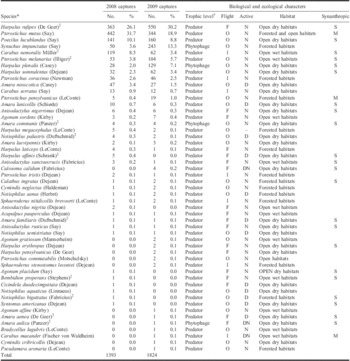
We captured 1393 and 1824 carabid beetles in 2008 and 2009, respectively. Fifty-one species were collected in total. The six most frequently captured species comprised 83.5% of all captures in 2008 and these same species were 80.2% of all captures in 2009 (Table 1). Over half of all species we collected were relatively rare, with five or fewer total specimens collected over 2 years. Thirteen species were represented by collection of only a single specimen (Table 1). Most species collected are also nocturnal predators that fly only occasionally. Eleven of the 51 species (21.6%) found in the study were nonnative Palaearctic species. In 2008 and 2009, respectively, 551 (39.6%) and 725 (39.7%) individual specimens belonged to nonnative species, a significant fraction of the total carabid fauna found in the fields (Table 1).
Bionomics of Carabidae captured in pitfall traps placed in wild blueberry field at four locations in central Nova Scotia, May–August.

*Species arranged in order of abundance.
Bionomic information compiled from Larochelle and Larivière (Reference Larochelle and Larivière2003).
†Not always strict designations as some are omnivores. Main trophic level occupied is indicated.
‡Nonnative species.
Flight: F, frequent; I, incapable of flight; O, occasional flier. Diel Activity: D, diurnal; DN, diurnal and nocturnal; N, nocturnal. Synanthropic: M, moderately synanthropic; S, strongly synanthropic.
Effects on feeding guilds and community diversity
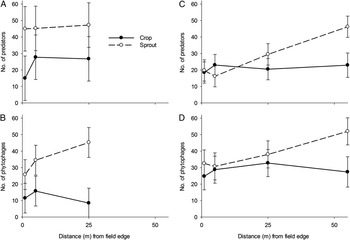
In 2008, captures of predatory carabids were greater in sprout than crop fields (F 1,15 = 4.80, P = 0.045) (Fig. 1), but there was no significant effect of pitfall trap location (F 2,15 = 0.19, P = 0.83) or the interaction of field type and trap location (F 2,15 = 0.13, P = 0.88). In 2009, there was a marginal effect of distance from the forest edge on captures of predatory carabids (F 3,20 = 2.67, P = 0.076), but there was no significant effect of field type (F 1,20 = 2.48, P = 0.13), or the interaction of these factors (F 3,20 = 2.16, P = 0.13).
Mean (± SEM) number of predatory and phytophagous Carabidae captured in 2008 (A, B) and 2009 (C, D) in Nova Scotia wild blueberry sprout and crop fields, using pitfall traps placed different distances from a forest edge.

In both years, captures of phytophagous carabids were significantly greater in sprout fields than crop fields (2008: F 1,15 = 16.35, P = 0.0011; 2009: F 1,20 = 4.05, P = 0.058) (Fig. 1), but there was no effect of trap location (2008: F 2,15 = 0.76, P = 0.48; 2009: F 3,20 = 1.05, P = 0.39), or the interaction of trap location and field type (2008: F 2,15 = 1.43, P = 0.27; 2009: F 3,20 = 0.97, P = 0.42).
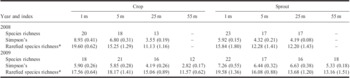
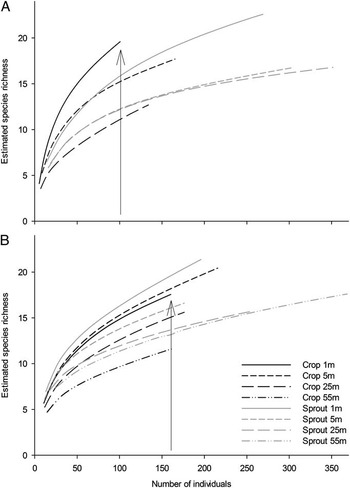
Despite usually capturing fewer individuals near forest edges than further into fields, rarefaction analysis and Simpson's diversity index suggested that species richness was greatest near forest edges (1 and/or 5 m) and decreased as distance from the edge increased (Table 2, Fig. 2). Rarefied species richness estimates and Simpson's diversity index were greater in crop fields at 1 and 5 m from the forest edge than in sprout fields in 2008, but there were no obvious differences between field types in 2009 (Table 2).
Species richness and Simpson's diversity index (±1 SD) for Carabidae trapped at increasing distances from forest edges in crop or sprout lowbush blueberry fields during 2008 and 2009.

*Rarefied species richness obtained from rescaling sample-based rarefaction estimates to richness per 101 and 160 individuals in 2008 and 2009, respectively.
Rarefied estimates of Carabidae species richness in Nova Scotia wild blueberry fields, 2008 and 2009. Pitfall traps were placed different distances from a forest edge in nearby crop and sprout fields. Data were rescaled to the number of individuals captured. Error bars (±1 SD) have been removed for visual clarity. Arrows represent subsample sizes used each year to compare diversity standardised by sampling effort.

Effects on individual species
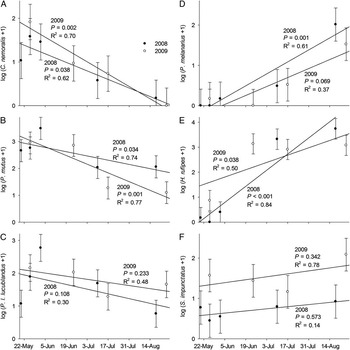
Captures of Carabus nemoralis (Müller) (predator of slugs, earthworms, Lepidoptera larvae; Larochelle and Larivière Reference Larochelle and Larivière2003) and Pterostichus mutus (Say) (predator of Lepidoptera larvae, diplopods; Larochelle and Larivière Reference Larochelle and Larivière2003) were greatest in late spring, and then declined over the summer (Fig. 3). Captures of Poecilus lucublandus (Say) (predator of Lepidoptera, Coleoptera, Diptera, and Hymenoptera larvae, other insects, fungi, plant material; Larochelle and Larivière Reference Larochelle and Larivière2003) also tended to be highest in late May and early June, but our regression analyses detected no significant changes in capture rates for this species over the summer (Fig. 3). Conversely, captures of P. melanarius (Illiger) (predator of Lepidoptera and Diptera larvae, earwigs, aphids, gryllids, Chrysomelidae eggs; Larochelle and Larivière Reference Larochelle and Larivière2003) and Harpalus rufipes (strawberries, plant seeds, Lepidoptera larvae predator; Larochelle and Larivière Reference Larochelle and Larivière2003) were initially low but increased significantly over the summer (Fig. 3). We detected no seasonal changes in captures of Synuchus impunctatus (Say) (Lepidoptera larvae, plant seeds; Larochelle and Larivière Reference Larochelle and Larivière2003) in either year of our study. In some cases, R 2 values were low (e.g., P. lucublandus in 2008, S. impunctatus in 2008), suggesting that in such cases a fair amount of variation in beetle captures was not explained by the linear model.
Linear regressions illustrating changes in seasonal captures of Carabus nemoralis (A), Pterostichus mutus (B), Poecilus lucublandus (C), Pterostichus melanarius (D), Harpalus rufipes (E), and Synuchus impunctatus (F) in pitfall traps (pooled samples) placed in wild blueberry fields (n = 4) in Nova Scotia, 2008 and 2009.

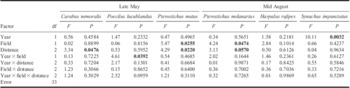
When activity–density of these species was analysed during their respective peak periods, only captures of S. impunctatus differed significantly between years (Table 3), with more than a threefold increase in captures from 2008 to 2009 (1.02 versus 3.12 ± 1.07 95% CI). Field type significantly affected P. mutus and P. melanarius and had some effect on H. rufipes (Table 3). There were approximately twice as many P. mutus captured per day in crop than in sprout fields (3.06 versus 1.68 ± 0.81 95% CI), whereas H. rufipes and P. melanarius were more frequently captured in sprout than in crop fields (4.78 versus 2.56 ± 1.36 95% CI and 1.25 versus 0.55 ± 1.15 95% CI, respectively). Distance from the field edge (1, 5, 25 m) significantly affected C. nemoralis, P. mutus, and P. melanarius (Table 3). Captures of C. nemoralis declined as the distance from the field edge increased (1.53, 0.82, 0.36 ± 1.14 95% CI), whereas activity–density of P. mutus and P. melanarius increased with increased distance from the field edge (1.46, 2.17, 3.62 ± 0.86 95% CI and 0.36, 1.07, 1.30 ± 1.20 95% CI, respectively). Captures of H. rufipes, S. impunctatus, and P. lucublandus were not influenced by distance from the forest edge. Poecilus lucublandus response to field type differed significantly by year (Table 3), with 2008–2009 daily captures decreasing in sprout fields but increasing in crop fields.
Analysis of variance results for the effects of year (2008, 2009), field (crop, sprout), and pitfall trap distance from the forest edge (1, 5, 25 m) on captures of six major Carabidae species in wild blueberries at four locations in Nova Scotia.

Bold values indicate a statistically significant effect, P < 0.05.
Discussion
Conservation biological control is a pest management strategy that aims to enhance natural enemy efficacy through modification of environment or existing pesticide practices (Eilenberg et al. Reference Eilenberg, Hajek and Lomer2001). Interest in the field has grown considerably in the past decade (Landis et al. Reference Landis, Wratten and Gurr2000; Pimentel Reference Pimentel2008), not only because of its potential to provide effective pest management, but because the goals of conservation biological control are well aligned with those of ecological conservation and agricultural sustainability (Letourneau Reference Letourneau1998; Straub et al. Reference Straub, Finke and Snyder2008). Early stage efforts towards conservation biological control are well served by baseline investigations that attempt to understand the biodiversity of groups of interest, while identifying promising natural enemies of key pests in the agricultural system.
We discovered that wild blueberry fields in Nova Scotia harbour a rich Carabidae community. Our relatively moderate sampling efforts recovered 51 species from four sites, representative of over 17.5% of the provincial carabid fauna (Majka et al. Reference Majka, Bousquet and Westby2007; Majka and Bousquet Reference Majka and Bousquet2008). The 10 most captured species represented ∼95% of the total 2-year collection, and most of these species are synanthropic. Overall, 49% of the species found in the study are synanthropic. Similarly, Drummond et al. (Reference Drummond, Collins, Choate, Woodman, Jennings, Forsythe and Cokendolpher2010) found that the harvestman (Opiliones) community in Maine wild blueberry fields was generally dominated by two introduced, synanthropic species. However, only three of the top 10 species we collected, H. rufipes, C. nemoralis, and P. melanarius are nonnative. Nonnative species often favour and numerically dominate human-made environments, such as agricultural land. For example, Spence and Spence (Reference Spence and Spence1988) collecting in synanthropic habitats in British Columbia, Canada, found that 53% of the individual carabids collected in their study were species of European origin. In contrast, in a study of Carabidae in undisturbed forest habitats in Kejimkujik National Park, Nova Scotia in 2004–2005, only 3 of 26 species (11.5%) and 5 of 3043 specimens (0.2%) represented nonnative species (based on data collected by C.G.M.). Wild blueberry fields are anthropogenically disturbed habitats, but in comparison to other cropping systems receive fewer disturbances (e.g., blueberry fields are not tilled like fields for most annual crops). Fields are derived from native stands of naturally occurring blueberries, and relative to other agroecosystems retain a high degree of ecological similarity with the surrounding habitat. Therefore, blueberry fields may be attractive to many synanthropic and some nonnative species, but also seem to offer conditions suitable for native species to thrive at relatively high numbers.
In both years of our study, there were overall more carnivorous and phytophagous beetles captured in sprout fields than crop fields. Drummond et al. (Reference Drummond, Collins, Choate, Woodman, Jennings, Forsythe and Cokendolpher2010) found that Opiliones also tended to be more abundant in pruned (sprout) than fruit-bearing (crop) wild blueberry fields, speculating this may be due to reduced insecticide use in the pruned phase of crop production. Differences in pesticide application may partially explain our higher rates of carabid captures in sprout fields, although growers do apply insecticides to sprout fields if required. In highbush blueberry fields, carabids were more abundant in plots covered with clover or rye grass compared with bare control plots (O'Neal et al. Reference O'Neal, Zontek, Szendrei, Landis and Isaacs2005b), but pesticide applications did not seem to influence diversity and abundance of most species (O'Neal et al. Reference O'Neal, Zontek, Szendrei, Landis and Isaacs2005b).
Our results showed a strong tendency towards greater beetle diversity near forest edges, despite the abundance of carnivorous and phytophagous carabids not usually being influenced by trap placement. Karem et al. (Reference Karem, Woods, Drummond and Stubbs2006) found that forest edge habitats were also important refugia for parasitic wasp populations in wild blueberry fields, although assemblages of some species were equally or more abundant in the centre of fields. Rarefaction curves indicate that our species diversity estimates near forest edges may increase with further sampling, whereas further from edges some curves approached asymptotes, suggesting maximum species richness had been determined. Therefore, differences in species richness close to and far from forest edges may be greater than what we have recorded. High carabid diversity near forests or in heterogeneous landscapes (Dietkötter et al. Reference Dietkötter, Wasmer, Wolters and Birkhofer2010; Woodcock et al. Reference Woodcock, Redhead, Vanbergen, Hulmes, Hulmes and Peyton2010; Roume et al. Reference Roume, Ouin, Raison and Deconchat2011) is likely due to the presence of both forest and open habitat carabid species and suitability of these edge habitats for overwintering (Sotherton Reference Sotherton1984). Restoration of semi-natural habitats in and around fields may benefit carabid beetles (MacLeod et al. Reference MacLeod, Wratten, Sotherton and Thomas2004; Cole et al. Reference Cole, Morton, Harrison, McCracken and Robertson2008). Higher abundance of predatory carabid beetles should reduce effects of crop pests, and techniques for increasing abundance in blueberries should be explored.
Most of the dominant species we collected are carnivores or omnivores (Larochelle and Larivière Reference Larochelle and Larivière2003). It seems reasonable to assume that some of these are preying upon insect pests of wild blueberries, but this needs to be tested. Follow-up studies for biocontrol should focus on predacious species that were highly abundant, with temporal and spatial occurrences tightly coupled with that of particular pest targets. Carabus nemoralis, P. mutus, and P. lucublandus were frequently captured, mostly in late May to early June, declining later in summer. These species might be good candidates for future biocontrol work against larval stages of blueberry spanworm or blueberry flea beetle, both of which also tend to arrive in blueberry fields in May/June. In addition, these pests are problematic for growers in both crop and sprout fields, and we found all three beetle species in both field types. Poecilus lucublandus was found equally at all trap placements, suggesting it would be as likely to prey on insect pests in field interiors as field edges. On the other hand, C. nemoralis favoured forest edges, whereas P. mutus occurred more in the interior portions of fields. Habitat management experiments might be useful to determine ways of homogenising distributions of these two species in wild blueberry fields.
Harpalus rufipes and P. melanarius captures were highest in mid-August when blueberry maggots begin dropping from fruit to pupate in the ground, but were collected twice as much in sprout (nonfruit-bearing) as crop fields. Since fruit flies often emerge from sprout fields that were harvested the previous year and then fly to crop fields to oviposit in fruit (Gaul et al. Reference Gaul, McRae and Eastbrooks2002), predatory beetles that consumed pupae in sprout fields before emergence could be very beneficial. Pterostichus melanarius will prey upon blueberry maggot pupae (Renkema et al. Reference Renkema, Lynch, Cutler, MacKenzie and Walde2011) and its preference to reside along forest edges may not be limiting for pest management since blueberry maggot infestations are often most severe around field edges (Collins and Drummond Reference Collins and Drummond2004). Harpalus rufipes and P. melanarius were also found in crop fields and probably consume some maggots and pupae after maggots drop from fruit.
In conclusion, diverse carabid communities were found in Nova Scotia blueberry fields, but synanthropic species that favour open habitats strongly dominated the habitat. Some of these species are predacious, abundant, and have population peaks that tend to match well spatially and temporally with important blueberry insect pests. To be most effective in biocontrol, a candidate species should have a specialist feeding habit. Most carabids are highly polyphagous and in general do not seem effective at suppressing pest outbreaks, but even these taxa can prove effective at reducing the incidence of pest outbreaks (Larochelle and Larivière Reference Larochelle and Larivière2003). Future investigations should hone in on abundant predatory species identified here that coincide with key blueberry pests. This work should quantify predation efficiency in the laboratory and field, and test the effectiveness of different habitat management tactics to promote populations of beneficial carabids for improved biological control.
Acknowledgements
Financial support for this research was through a Nova Scotia Department of Agriculture Technology Development 2000 grant in partnership with the Wild Blueberry Producers Association of Nova Scotia and the Prince Edward Island Wild Blueberry Growers’ Association, and through the Advancing Canadian Agriculture and Agri-Food program (Agriculture and Agri-Food Canada) in partnership with Agri-Futures Nova Scotia, Conseil pour le développement de l'agriculture du Québec, the New Brunswick Agricultural Council, the Prince Edward Island Adapt Council, and Newfoundland Agri-Adapt Council Inc. We thank Bragg Lumber Co. for access to blueberry fields, and numerous summer research interns that assisted in collecting and processing beetles. We are grateful for comments and suggestions from two anonymous reviewers on an earlier version of this paper.