The phonological system is heavily relied upon for oral communication (German & Newman, Reference German and Newman2007; Newman & Ratner, Reference Newman and Ratner2007) and written communication (Elbro, Borstrom, & Petersen, Reference Elbro, Borstrom and Petersen1998; Fowler & Swainson, Reference Fowler and Swainson2004). Abilities such as articulation, speech perception, phonological awareness, and phonological memory involve accessing the phonological representations of words. Because the study of representation-related phonological processing abilities is a relatively new area of investigation that crosses disciplines, there are a number of conceptual and methodological variations that make synthesizing the literature quite challenging. First, although the term phonological representation is used precisely by some researchers, it is used more generally by others to globally refer to a number of potentially different representation-related phonological processing abilities. Second, a large variety of tasks have been used to purportedly measure “phonological representation,” when phonological representation ability is conceptualized more globally as any phonological process involving phonological representations. Third, the study of phonological representation has been limited to individuals from only a few linguistic backgrounds. Moreover, there is little comparability of methods and measures across studies that examine samples from different linguistic backgrounds. Consequently, the field is in need of cross-linguistic research aimed at examining the convergent and discriminant validity of the various representation-related phonological processing abilities, and the field is in need of research aimed at identifying which tasks best reflect the underlying phonological abilities of interest in a given language.
The processes by which words are phonologically stored and organized change with maturation. When children first begin to acquire spoken language, their phonological representations of words are holistic. That is, they are based on large portions of the speech signal that correspond to physical, acoustic markers of changes in the complex waveform, like changes in amplitude that can demarcate words and syllables (Barton, Reference Barton, Yeni-Komshian, Kavanaugh and Ferguson1980; Vihman & Croft, Reference Vihman and Croft2007). According to the “segmentation” (Fowler, Reference Fowler, Bradey and Shankweiler1991) and “lexical restructuring” (Metsala & Walley, Reference Metsala, Walley, Metsala and Ehri1998) hypotheses, with rapid vocabulary growth during the first years of acquiring oral language, the phonological system becomes increasingly sensitive to the phonemic differences among words, and phonological representations become increasingly more refined, composed of smaller and smaller sound-based and/or speech-based segments. Individuals eventually develop high-quality phonological representations that reflect the precise specifications of the phonemic structure of words.
We believe that at least three types of representation-related phonological processing abilities have been studied in the research that has addressed the processing of phonological representations through development: (a) ease of forming new phonological representations, (b) accessibility of extant phonological representations, and (c) precision or distinctness of extant phonological representations. It is quite possible, and likely, that these three representation-related phonological processing skills play unique roles in the development of oral and written language.
The different representation-related phonological processing skills call for different assessment methods. For example, individual differences in how readily individuals form new phonological representations have been assessed using a variety of word learning paradigms (Carroll & Snowling, Reference Carroll and Snowling2004; Davis, Reference Davis2008; Hogan, Reference Hogan2006). Much research has investigated how individuals form new phonological representations and what conditions support word learning. However, few studies have examined the extent to which one's ability to form new phonological representations is associated with one's ability to efficiently access existing phonological representations or with the precision of one's existing phonological representations. Perhaps this is because word-learning scores do not always demonstrate good discriminant validity, as word-learning scores sometimes relate more closely to vocabulary size than they do with other types of phonological processing (Davis, Reference Davis2008).
Individual differences in accessibility of extant phonological representations have generally been assessed with naming tasks. Naming tasks require participants to name pictures of objects, letters, colors, and so forth. It is critically important for naming tasks that the stimuli illustrate words in participants’ receptive vocabularies. This assures that what is being measured is accessibility of extant phonological representations rather than whether a participant has phonological representations for the target words, which is also known as vocabulary size. Scoring of rapid naming tasks has traditionally been of three varieties. Some researchers have tallied percent of target words correctly produced (e.g., Swan & Goswami, Reference Swan and Goswami1997). Others have tallied number of words produced within a criterion time limit of less than 5 s per picture, for example (Fowler & Swainson, Reference Fowler and Swainson2004). Another frequent scoring method is to document the total amount of time required to name all of the illustrated target words (Anthony et al., Reference Anthony, Williams, McDonald, Corbitt-Shindler, Carlson and Francis2006; Anthony, Williams, McDonald, & Francis, Reference Anthony, Williams, McDonald and Francis2007; Elbro, Reference Elbro1990; Elbro & Petersen, Reference Elbro and Petersen2004).
Another method used to assess accessibility of phonological representations is the gating procedure. The gating procedure involves presenting increasingly longer segments of a spoken word to participants, and participants are instructed to say the word as soon as they recognize it. This method has been used with mixed success (Metsala, Reference Metsala1997; Wesseling & Reitsma, Reference Wesseling and Reitsma2001), which has lead some researchers to conclude the gating procedure may be a poor measure of access to phonological representations (Wesseling & Reitsma, Reference Wesseling and Reitsma2001).
Precision of phonological representations has been assessed using both expressive and receptive tasks. Because phonological representations carry information about the phonemic segments of words and/or the articulatory gestures used to produce those segments (Liberman, Reference Liberman1999), one of the most common methods of assessing precision of phonological representations is to evaluate articulation accuracy. Tasks employed to elicit verbal productions have ranged from picture naming (Fowler & Swainson Reference Fowler and Swainson2004; Foy & Mann, Reference Foy and Mann2001; Roberts, Reference Roberts2005), to imitation of real words and nonwords (Fowler & Swainson, Reference Fowler and Swainson2004), to having participants correct other's mispronunciations (Elbro & Petersen, Reference Elbro and Petersen2004; Elbro et al., Reference Elbro, Borstrom and Petersen1998; Fowler & Swainson, Reference Fowler and Swainson2004; Foy & Mann, Reference Foy and Mann2001). Particular item characteristics and test characteristics have been shown to influence how well expressive test items reflect precision of phonological representations. For example, research suggests that articulation accuracy for long, phonologically complex, and less familiar words better index individual differences in phonological representation than does articulation accuracy for short, phonologically simple, and familiar words (Fowler & Swainson, Reference Fowler and Swainson2004; Swan & Goswami, Reference Swan and Goswami1997). Similarly, research suggests that assessment of articulation accuracy in the context of connected speech may provide a deeper assessment of speech production abilities than assessment of articulation accuracy for single words (Andrews & Fey, Reference Andrews and Fey1986; Morrison & Shriberg, Reference Morrison and Shriberg1992). Finally, because individuals are more prone to make articulation errors or deletions in unstressed syllables (Blasdell & Jensen, Reference Blasdell and Jensen1970) and complex consonant clusters (Vihman, Reference Vihman, Traugott, Labrum and Shepherd1980), these item characteristics should be particularly sensitive to individual differences in precision of phonological representations.
Receptive tasks designed to measure precision of phonological representations have been developed out of a need to assess phonological representations of children with speech sound disorders (Carroll & Snowling, Reference Carroll and Snowling2004; Rvachew, Ohberg, Grawburg, & Heyding, Reference Rvachew, Ohberg, Grawburg and Heyding2003), for whom expressive measures may be confounded by the effects of speech motor issues and oral mechanism differences. The simplest receptive task used to measure precision of phonological representation requires participants to indicate whether a word spoken by an examiner or puppet was pronounced correctly (Carroll & Snowling, Reference Carroll and Snowling2004; Rvachew et al., Reference Rvachew, Ohberg, Grawburg and Heyding2003). Another receptive measure of precision of phonological representations requires participants to choose which of a number of pronunciations spoken by an examiner or puppet was pronounced most accurately (Fowler & Swainson, Reference Fowler and Swainson2004). Finally, speech discrimination tasks (e.g., Elbro & Petersen, Reference Elbro and Petersen2004; Foy & Mann, Reference Foy and Mann2001) require participants to point to the one picture from among a number of pictures that corresponds to a word spoken by an examiner. Foils illustrate words that differ by a sound segment, usually a single phoneme (e.g., lake, rake, wake).
As the roles of representation-related phonological processing in oral and written language acquisition is a relatively new area of study, there are many gaps in the literature that need filling before one can confidently assert any means by which the various phonological processing abilities may influence language and literacy development. One such gap concerns how to assess individual differences in phonological representation. As reviewed above, a variety of tasks and behavioral markers have been employed. Because most studies that purport to assess phonological representation have only included one or two such measures, there is little evidence relevant to comparing how well the various measures actually reflect the construct of interest, and there certainly is no consensus on what types of measures best reflect quality of the phonological representation.
Another significant gap in the literature concerns the convergent and discriminant validity of representation-related phonological processing abilities. Only two studies have examined this question to our knowledge. First, in a study of 40 English-speaking children, Foy and Mann (Reference Foy and Mann2001) used exploratory factor analysis (EFA) to examine relations among 12 variables, including variables reflecting word reading, letter knowledge, chronological age, vocabulary, and a variety of speech and phonological processing abilities. The exploratory analysis revealed three factors that seemed to reflect literacy, speech production, and speech perception. Of most relevance to the topic at hand, there was some degree of evidence supporting the convergent validity of representation-related phonological processing skills, but limited evidence for their discriminant validity. Specifically, variables reflecting precision of phonological representations, phonological awareness, phonological memory, and phonological access often loaded on the same factor. Second, in a study of 175 English-speaking children, Anthony, Williams, Aghara, Dunkelberger, and Novak (Reference Anthony, Williams, Aghara, Dunkelberger and Novak2010) used confirmatory factor analysis to test the dimensionality of representation-related phonological processing. With many more tests of phonological processing, a larger sample, and statistical comparisons of fits from alternative models, this second study more persuasively demonstrated three separate but moderately intercorrelated phonological abilities. Specifically, children's performances on the representation-related phonological tests were well explained by (a) efficiency of phonological access, (b) precision of phonological representations as reflected in articulation accuracy, and (c) precision of phonological representations as reflected in speech perception.
Although the studies by Foy and Mann (Reference Foy and Mann2001) and Anthony et al. (Reference Anthony, Williams, Aghara, Dunkelberger and Novak2010) were certainly important as the first comprehensive examinations of the dimensionality of representation-related phonological abilities, these studies were limited in that both investigated the phonological abilities of English speakers. It is certainly plausible that features of one's oral language affect the organization of one's phonological system, just as features of one's oral language influence how quickly one acquires different levels of phonological awareness (Anthony & Francis, Reference Anthony and Francis2005; Caravolas & Bruck, Reference Caravolas and Bruck1993; Cossu, Shankweiler, Liberman, Katz, & Tola, Reference Cossu, Shankweiler, Liberman, Katz and Tola1988; Demont & Gombert, Reference Demont and Gombert1996; Durgunoglu & Oney, Reference Durgunoglu and Oney1999). As such, the third purpose of the present study was to extend recent investigations of the dimensionality of representation-related phonological processing abilities to speakers of Spanish. This population was of interest because Spanish is the second most spoken language in the world, behind only Mandarin (Lewis, Reference Lewis2009). In addition, speakers of Spanish are the largest and fastest growing language minority in the United States. The study focused on preschool-age children because it is during the late preschool and early elementary school years when processing of phonological representations is hypothesized to play a role in the development of phonological awareness and literacy (Elbro et al., Reference Elbro, Borstrom and Petersen1998; McCardle, Scarborough, & Catts, Reference McCardle, Scarborough and Catts2001; Vihman & Croft, Reference Vihman and Croft2007), which we intend to investigate with follow-up assessments of the present sample. During this age, however, many young Spanish speakers in the United States are experiencing increasing opportunity and necessity to communicate in English as well. Thus, this study reports on Spanish-language representation-related phonological abilities of children who are speaking Spanish, but who are also experiencing increasing English communication opportunities. We call these children incipient Spanish–English bilinguals.
To consider how typical tasks might index representation-related phonological abilities in Spanish it is necessary to review some important differences in the phonological systems of Spanish and English. There are many differences between languages such as word length, syllable shape, consonant cluster production, and word neighborhood effects. Words tend to be longer in Spanish than in English, and speakers of Spanish need to be able to produce longer sequences of sounds for communication. For example, Vihman (Reference Vihman, Traugott, Labrum and Shepherd1980) observed how 11 toddlers attempted long words (three syllables or greater) in five different languages. She found that Spanish-speaking children attempted the highest percentage of long words (25%), and English-speaking children attempted the lowest percentage (3%). Another difference is that in Spanish only five consonants (d, n, s, r, and l) appear in syllable final position, whereas words in English contain many final consonants. Thus, many words in Spanish contain consonant–vowel (CV) syllables, whereas English words are more likely to contain CVC syllables. The words cat and gato illustrate these word length and syllable shape differences. In English, cat (CVC) is a single syllable word with a final consonant; the Spanish translation, gato (CVCV), is a two-syllable word with no syllable final consonants. In addition, word initial clusters contain only two phonemes in Spanish, for example, blusa (blouse), whereas word initial clusters can contain two or three phonemes in English, for example, blouse and stripe. These differences demonstrate the importance of examining phonological representation across languages to understand both the language specific and the universal factors that contribute to phonological representation skills.
The incipient bilingual status of the children in this study also warrants further discussion because bilingual and monolingual language development are different. Although development in a specific language may follow a “generally” predictable path in both monolinguals and bilinguals (e.g., Genesee, Paradis, & Crago, Reference Genesee, Paradis and Crago2004), a conceptualization of a bilingual speaker as simply two monolinguals in one provides an incomplete picture of how bilingual communicators develop, store, and use their two languages (Grosjean, Reference Grosjean1982; Valdes & Figueroa, 1984). In addition, factors such as crosslinguistic effects and the age of acquisition of the two languages will influence the development of skills in each language. One aspect of bilingual language development that is relevant to the present study is transfer or crosslinguistic effects. As children develop and use two languages they may use features from one language in the other language. For example, Goldstein and Iglesias (Reference Goldstein and Iglesias1999) observed that in the Spanish of some Spanish–English bilingual 4- to 6-year-old children, the flap r, as in the word flor (flower), was replaced by the English unstressed, postvocalic r. Moreover, in order to communicate in two languages bilinguals must deal with processes such as comparing sounds across languages and inhibiting transfer of lexical or phonological features when pragmatics dictate a monolingual communication context (Grosjean, Reference Grosjean1982). Goldstein and Washington (Reference Goldstein and Washington2001) observed relatively similar performance in the two productive phonologies of typically developing 4-year-old simultaneous Spanish–English bilingual children compared to monolingual children. However, an interesting difference in error patterns was noted for the Spanish flap r, for example, cara (face), and trill r, for example, perro (dog). Compared to monolingual Spanish-speaking children, bilingual children demonstrated a high number of deletions or [l] substitutions for the flap r and a larger variety of substitutions for the trill r.
Another aspect of bilingual development that is relevant to the present study is the age at which children learn each of their two languages. The bilingual children participating in this study have primarily been exposed to Spanish first in their homes, and then they learned English later in their schools. This profile of learning, often referred to as sequential bilingualism, may contribute to slightly different language skills compared to monolingual children as well as bilingual children who learn two languages simultaneously. Gildersleeve-Neumann, Peña, Davis, and Kester (Reference Gildersleeve-Neumann, Pena, Davis and Kester2009) found evidence of crosslinguistic effects in sequential bilinguals by observing the changes in the Spanish speech sounds produced by Spanish-speaking preschoolers who were just beginning to learn English. With increasing exposure to English, the Spanish-speaking preschoolers demonstrated an increase in Spanish vowel errors and a decrease in Spanish cluster reduction errors. The authors propose that at the time of the study the preschoolers had already developed a relatively complete representation of the 5-vowel Spanish system, and the introduction of an 11-vowel English system necessitated a reorganization of the first vowel system to accommodate the distinctions necessary for the new vowel sounds. In contrast, as cluster production is mastered relatively later than vowels and the contrasts between Spanish and English clusters are less ambiguous, the children demonstrated an increasing ability to produce Spanish clusters even with exposure to English.
Although a general pattern of similarity between overall language growth in both monolinguals and bilinguals has been observed (Genesee et al., Reference Genesee, Paradis and Crago2004), these studies by Goldstein and colleagues (Goldstein & Iglesias, Reference Goldstein and Iglesias1999; Goldstein & Washington, Reference Goldstein and Washington2001) and Gildersleeve-Neumann et al. (Reference Gildersleeve-Neumann, Pena, Davis and Kester2009) reveal specific evidence to indicate that Spanish–English preschoolers demonstrate differences from monolingual children in their production of Spanish sounds. In addition, as Spanish–English bilingual children demonstrate differences in their sound production when compared to monolingual speakers of each language, they may also be developing differences in their phonological representations. Through both speech production and receptive speech perception tasks, the current study represents an attempt to explore the phonological representations of incipient bilingual preschoolers learning Spanish and then English.
To analyze the Spanish phonological representation skills of incipient bilingual children we used three strategies. First, we performed descriptive, correlational, and exploratory factor analyses to examine the factorability of the phonological processing data and flag any measures that failed to reflect latent phonological processing abilities. Second, we used confirmatory factor analysis to compare the utility of three a priori models and one a posteriori model that specified the dimensionality of representation-related phonological processing according to the research described above. Third, we compared how well prototypic measures actually indexed latent phonological processing abilities.
The first a priori model we tested was a one-factor model that reflected common practice among researchers in that it specified that all prototypic measures reflect the same latent ability, presumably phonological representation. The second a priori model tested a two-factor model. The two-factor model specified separate, but correlated, factors that reflect accessibility of phonological representations and precision of phonological representations. The third a priori model tested a three-factor model. This model specified separate, but correlated, factors that reflect accessibility of phonological representations, precision of phonological representations as indexed by expressive tasks, and precision of phonological representations as indexed by receptive tasks. This later model has its theoretical underpinnings in notions of input phonology and output phonology (e.g., Carroll & Snowing, Reference Carroll and Snowling2004; Martin & Saffran, Reference Martin and Saffran2002) and is consistent with the findings of Foy and Mann (Reference Foy and Mann2001) and Anthony et al. (Reference Anthony, Williams, Aghara, Dunkelberger and Novak2010).
METHOD
Participants
Participants were Spanish-speaking preschool-age children who attended center-based preschool programs in Houston, Texas. These preschool programs primarily served children from low-income backgrounds. Teachers from all 24 participating classrooms were enrolled in the Texas Early Education Model (Landry, Swank, Anthony, & Assel, in press). This empirically validated model emphasizes frequent, intensive, and ongoing professional development for early childhood educators, onsite mentoring, regular monitoring of children's academic progress, and research-based curricula (Landry, Anthony, Swank, & Monsegue-Bailey, Reference Landry, Anthony, Swank and Monsegue-Bailey2009). The Texas Early Education Model also requires integration among early childhood education service delivery systems (e.g., subsidized child care, Head Start, public school prekindergarten) to reduce systemic inefficiencies, preserve the current childcare workforce, and expand access to high quality early childhood education.
Classroom-level inclusion criteria were (a) full-day preschool programming, (b) at least some children in the classroom spoke Spanish in their homes, and (c) most children in the classroom were 4 years of age. Class sizes were moderate or large, for example, 68% included 16–20 children and 27% included 21–25 children. Most classrooms had two or three teaching staff, including aids, present in the classroom at any given time of day (55% and 27%, respectively). Although 45% of participating teachers reported that the primary goal of their instruction was to promote English language and literacy, 23% of teachers reported their instruction was aimed mostly at promoting English language and literacy but also at maintaining children's Spanish language and literacy. In contrast, 27% of teachers reported trying to equally foster both English and Spanish language and literacy. Finally, 5% of participating teachers reported that the primary goals of their instruction were to promote Spanish language and literacy. Consistent with the wide range of teachers’ instructional goals, language of instruction also varied tremendously. On average, 70% of instruction was provided in English (SD = 34%), and 30% of instruction was provided in Spanish (SD = 34%).
Child-level inclusion criterion were (a) Spanish spoken in the home according to parental report, (b) parental consent, (c) child assent, and (d) the child obtained a raw score of 10 or more on a Spanish-only administration of the Expressive One-Word Picture Vocabulary Test: Spanish Bilingual Edition (Brownell, Reference Brownell2001), which roughly corresponds to an age equivalent of 2 years, 0 months. Children with known or obvious sensory, physical, or cognitive impairments, with abnormal oral mechanisms, or with gross craniofacial asymmetries were excluded. Children with speech problems or language delays were not excluded because the methods we employed are applied most appropriately to heterogeneous samples.
Most of the 129 participating children were 4 years of age (mean = 4 years, 7 months; SD = 5 months) when tested. Sixty-five children were female; 64 were male. The sample was 100% Hispanic/Latino. Parents of 87% of participants reported speaking only Spanish in their homes, and parents of 13% of participants reported speaking both Spanish and English in their homes. Children's raw scores on the Spanish-only administration and the English-only administration of the Expressive One-Word Picture Vocabulary Test: Spanish Bilingual Edition were compared to provide a clearer picture of participants’ Spanish and English competencies. Eighty-one percent of children scored higher on the Spanish administration, and the group average for Spanish vocabulary (raw score mean = 26.5) was greater than that for English vocabulary (raw score mean = 16.1; t = 6.11, p < .0001). The sample's better Spanish skills was likely because of their home language environment, as most parents reported only speaking Spanish in their homes. However, because these children were being exposed to English in their preschool classrooms and to some extent in their communities, they should be considered incipient Spanish–English bilinguals who were Spanish language dominant.
Procedures
Children were tested individually at their preschools in locations that school administrators designated for testing. All testing was conducted in Spanish. The assessment team was composed of three bilingual undergraduate speech–language pathology students and one bilingual postdoctoral speech–language pathologist. Examiners attended a 2-day training workshop led by the first and second authors. Following training and ample practice, examiners were required to demonstrate competence on all tests during test-out sessions prior to working with children. Testing was conducted in 20- to 60-min sessions depending on a given child's attention span and desire to continue. Testing of the entire sample took place over a 6-week period in late fall. Children were given verbal praise, physical praise (e.g., high fives), and tangible reinforcements (e.g., stickers) for participating.
Measures
Bilingual English Spanish Assessment (BESA). The Spanish phonology subtest of the BESA (Peña, Gutierrez-Clellen, Iglesias, Goldstein, & Bedore, Reference Peña, Gutierrez-Clellen, Iglesias, Goldstein and Bedore2010) was administered as a test of Spanish articulation accuracy. The BESA employs a picture-naming task to elicit single word utterances. Three levels of prompting are available for each item. First, a child is provided with a generic prompt, “¿Qué es esto?” (What is this?). Second, if the child does not provide the target word following the generic prompt, then the examiner provides some contextual cues as part of a cloze procedure and the child provides one word to complete the sentence. Third, if the child does not provide the target word as part of the cloze procedure, then the examiner models the target word and asks the child to repeat it. Modeling was required for 35% of trials.
Target words in the Spanish phonology subtest of the BESA are age appropriate, high-frequency words. The 28 target words were on average 2.3 syllables and 5.0 phonemes in length. These stimuli elicited 139 consonants, vowels, and consonant clusters. All items were administered to all children. Although mostly developed and accompanied by an impressive quantity of standardization data, the BESA was administered in the current study using some modified procedures. For example, although standard scoring procedures, which are aimed at diagnosis and treatment planning, dictate that dialectal differences should be scored as correct, the scoring system used in the present study, which was aimed at quantifying individual differences for research purposes, dictated that dialectal differences were generally scored as incorrect. There were two exceptions to this general scoring principle. First, /v/, /b/, and /β/ were all accepted in the word clavo, and, second, /x/ and /h/ were both accepted in the word bruja. These exceptions were made to improve reliability of scoring, as our examiners struggled to perceive these subtle phonetic differences. In addition, the original photographs that served as visual stimuli were replaced with colored line drawings that more clearly illustrated the target words. The modified BESA demonstrated good internal consistency (Cronbach α = 0.93).
Articulation correction. Because the Spanish phonology subtest of the BESA employs a citation method with stimuli that are short, high-frequency words, it may only provide a shallow assessment of expressive phonology. We consequently developed two additional expressive measures of precision of phonological representation. The Articulation Correction Test was specifically designed to assess the phonological accuracy of children's productions of longer, less frequent, and more phonologically complex words than those presented in the BESA. Theoretically, this expressive measure was expected to provide deeper examination of precision of phonological representations, given that children are able to accurately produce a given consonant phoneme in the context of a short single word utterance before they can in long, phonologically complex words (Fowler & Swainson, Reference Fowler and Swainson2004; Swan & Goswami, Reference Swan and Goswami1997).
The Articulation Correction Test was patterned after similar tests used by Elbro and colleagues (Elbro, Reference Elbro1990; Elbro et al., Reference Elbro, Borstrom and Petersen1998; Elbro & Peterson, Reference Elbro and Petersen2004), Fowler and Swainson (Reference Fowler and Swainson2004), Foy and Mann (Reference Foy and Mann2001), and Anthony et al. (Reference Anthony, Williams, Aghara, Dunkelberger and Novak2010). A child was first introduced to a hand-held puppet. The examiner explained that the puppet does not talk very well, and that the child and examiner are going to help the puppet talk. The examiner then displayed a picture in view of both the puppet and child. The puppet looked down at the picture, looked up at the child, and then named the picture in a much reduced form. Stimuli were therefore Spanish nonwords, unrecognizable in the absence of contextual cues. The puppet's mouth was opened once for each syllable of the nonword spoken by the puppet. The examiner then instructed the child to tell the puppet how to say this picture, and the examiner pointed to the picture.
In an effort to maximize the sensitivity of the articulation correction measure to individual differences in precision of phonological representations, we scored children's responses as the total number of consonant phonemes that were articulated accurately. Dialectal differences were generally scored as errors, with the only exceptions paralleling those used to score the BESA. This scoring procedure differed from that used by Elbro and colleagues and Foy and Mann (Reference Foy and Mann2001), who scored children's productions as either all right or all wrong. The benefit of our scoring routine was that it provided a means to quantify and distinguish among all different degrees of phonological imprecision. However, this scoring routine posed a challenge for how to score children's responses that differed from the target words. On average, 24% of children's initial responses were words that differed from the target word. In such situations, the examiner asked the child for another word, and if the child responded with the target word then it was scored for number of consonants correctly articulated. If this general prompt still did not yield the target word, then the examiner modeled the complete target word and asked the child to repeat it. Examiner modeling of target words occurred in approximately 10% to 20% of trials. Occasionally, some children blurted out the correct target word as soon as the picture was displayed. In such situations, children's spontaneous production of the target word was scored. If a child prematurely blurted out a word other than the target word, then the examiner told the child to wait for the puppet and then the task proceeded as usual.
All 22 target words were three syllables in length and had primary stress on the penultimate syllable, which is the most common syllable stress pattern in Spanish. Although three syllable words are very common in Spanish, these stimuli were longer than those used in the Spanish phonology subtest of the BESA. Specifically, not only were stimuli for articulation correction on average 0.7 syllables longer than stimuli on the BESA, but they were also on average 1.3 phonemes longer than stimuli on the BESA. No target words on articulation correction were English cognates (see Appendix A). The target words contained 36.1% early-developing consonants, 27.8% middle-developing consonants, and 36.1% late-developing consonants, using Spanish criteria established by Goldstein, Fabiano, and Washingon (Reference Goldstein, Fabiano and Washington2005). Broad sampling of phonemes was intended to maximize the measure's sensitivity. Auditory stimuli included 45.5% of target words with alterations only in unstressed syllables (e.g., /omi/ for comida), 13.6% of target words with alterations only in stressed syllables (e.g., /kopio/ for columpio), and 40.9% of target words with alterations of both stressed and unstressed syllables (e.g., /kana/ for campana). In words where whole syllables were deleted, the spoken stress pattern for the resulting nonwords followed a penultimate stress pattern; therefore, the stressed syllable might have been the same as the target word (e.g., /ado/ for pescado) or different from that of the original target word (e.g., /abe/ for cabeza). The 22 test items yielded a maximum score of 86 consonant errors. The Articulation Correction Test had high internal consistency (Cronbach α = 0.90).
Spontaneous productions. A second score was generated from the Articulation Correction Test to index how readily children arrived at the target words. That is, examiners noted for each item whether or not a child produced the target word after he or she was presented with an illustration of the target word and had heard the puppet say the target word in reduced form. More specifically, if a child produced the target word either as soon as he or she saw the illustration or immediately following the stimulus nonword, then the item was scored as a spontaneous production. However, if a child required either the prompt “Tell me another word” or modeling of the complete target word by the examiner, then the item was scored as not being a spontaneous production. Responses were scored as spontaneous or not spontaneous, independently of how accurately a child articulated the target words. This 22-item Spontaneous Production Test yielded high internal consistency (Cronbach α = 0.98).
Houston Sentence Imitation Test of Articulation—Spanish Edition (HSITA-S). The HSITA-S (Aghara, Anthony, & Dunkelberger, Reference Aghara, Anthony and Dunkelberger2008) was designed to assess the phonological accuracy of children's continuous speech. This measure was expected to provide a deeper examination of precision of phonological representations than the Spanish phonology subtest of the BESA, given that children are able to accurately produce a given consonant phoneme in the context of a short, single-word utterance before they can in continuous speech (Andrews & Fey, Reference Andrews and Fey1986; Morrison & Shriberg, Reference Morrison and Shriberg1992).
The HSITA-S required children to repeat sentences spoken by an examiner. Consonant omissions, consonant substitutions, and dialectal differences involving consonants were scored as errors. Stimuli included 15 sentences that contained a total of 79 consonant phonemes. Consonant phonemes included 29 early consonants, 23 middle consonants, and 27 late consonants. A number of steps were taken when creating the sentences to minimize demands on language and memory. For example, sentences were kept short, containing two to five words, with a mean length of utterance in words of 3.067 and a mean length of utterance in morphemes of 4.4. The sentences also contained primarily early developing linguistic elements. For example, a majority of the verbs were general all purpose verbs that are used most often by preschool-age children and may provide a more familiar and facilitative context for the accurate production of verbal inflections (Kester, Bedore & Peña, Reference Kester, Bedore and Peña2001). Unstressed morphemes of short duration that are often more difficult for children to produce only appeared in their most frequent and earliest developing forms, such as singular masculine articles, for example, un (a) and el (the; Bedore & Leonard, Reference Bedore and Leonard2001; Bosch & Serra, Reference Bosch, Serra, Baker, Beers, Bol, de Jong and Leemans1997; Jacobson & Schwartz, Reference Jacobson and Schwartz2002; Restrepo & Gutierrez-Clellen, Reference Restrepo and Gutierrez-Clellen2001). Finally, all verbs were inflected in the present tense, and all but two verbs were inflected with singular forms, as some past tense and plural forms are more difficult for children to produce (Bedore & Leonard, Reference Bedore and Leonard2001; Bosch & Serra, Reference Bosch, Serra, Baker, Beers, Bol, de Jong and Leemans1997). The HSITA-S has been shown to have high internal consistency (Cronbach α = 0.90 for 15 sentences), to measure a single latent ability, to demonstrate convergent validity with other articulation measures, and to demonstrate discriminant validity relative to measures of language and phonological memory (Aghara et al., Reference Aghara, Anthony and Dunkelberger2008).
Articulation judgment. The Articulation Judgment Test was developed for the current study because no extant measures were appropriate for our sample, given our sample's age range and linguistic background. The Articulation Judgment Test was loosely patterned after those used by Sutherland and Gillon (Reference Sutherland and Gillon2005), Fowler and Swainson (Reference Fowler and Swainson2004), Bird and Bishop (Reference Bird and Bishop1992), and Rvachew et al. (Reference Rvachew, Ohberg, Grawburg and Heyding2003). Specifically, a given child was introduced to a puppet. The examiner explained that the puppet had a hard time saying words and that he did not talk very well. The examiner further explained that the puppet would look at some pictures and tell us what they were. After each production by the puppet, children were asked if the puppet said the word right. Practice items and test items started with the examiner asking the puppet, “¿Qué es esto?” (“What is this?”). The puppet responded in a high-pitched voice with either the correctly pronounced name of the picture or with an incorrect approximation of the name of the picture. The child was then asked by the examiner, “¿Lo dijo bien?” (“Did he say it right?”). Both verbal and nonverbal responses were accepted from participants.
Children were exposed to each picture one or two times, depending on whether a given picture was used to assess precision of phonological representation for vowels, precision of phonological representation for consonants, or if the word was also produced accurately. Twelve words were used to assess phonological representation for vowels. A single vowel was changed in 3 words (e.g., /oɾoha/ for oreja), and 2 or 3 vowels were changed in 10 words (e.g., /kel ompio/ for columpio). Of the 25 vowel manipulations, 12 appeared in stressed syllables and 13 appeared in unstressed syllables. Seventeen words were used to assess phonological representation for consonants. A single consonant was changed in 8 words (e.g., /baluɾa/ for basura), and two or three consonants were changed in 9 words (e.g., /fan sa pon/ for pantalon). Individual consonant substitutions ranged from a subtle difference in place, manner, or voicing to more obvious differences in multiple distinctive features. All manipulations to both vowels and consonants were substitutions. Deletions were avoided in order to maintain the syllable shapes and stress patterns of the original words. None of the target words were English cognates.
Item analyses revealed a number of important findings that informed how the Articulation Judgment Test was ultimately scored. Most noteworthy was a lack of variance in children's responses to items that were pronounced accurately by the puppet. That is, essentially all children correctly indicated when the puppet said the target word correctly. Because of the lack of variance of such items, they had low item to total score correlations. Therefore, scores for articulation judgment for vowels and articulation judgment for consonants were based only on children's responses to items that would have been correctly answered with a “No” response. Even though only about one-quarter of the items could correctly be answered with a “Yes” response, it is interesting that the children nonetheless demonstrated a response bias toward indicating that the puppet accurately pronounced the target words. Practically, our preschool-age children were less sensitive to the puppet's misarticulations then we originally expected. Therefore, some “No” items that involved only minor changes to one vowel or one consonant behaved psychometrically like items that were correctly answered “Yes.” Nonetheless, even with the positive response bias on “No” items, the 12-item Articulation Judgment for Vowels Test (see Appendix B) and the 17-item Articulation Judgment for Consonants Test (see Appendix C) still demonstrated impressive internal consistencies (Cronbach αs = 0.93 and 0.94, respectively).
Rapid object naming—A (RON-A). The RON-A (Lonigan et al., Reference Lonigan, Farver, Eppe, Wagner, Torgesen and Rashotte2002) subtest from the Spanish Preschool Comprehensive Test of Phonological and Print Processing (Lonigan et al., Reference Lonigan, Farver, Eppe, Wagner, Torgesen and Rashotte2002) was administered to presumably measure accessibility to phonological representations. The RON-A subtest consists of an 8.5×17 in. stimulus card with seven rows of 4 illustrations. The illustrations depict objects whose names are single-syllable words common in young children's vocabularies, that is, flor (flower), tren (train), sol (sun), rey (king). Each row presents the same four illustrations in random order, and the first row serves as practice for the remainder of the task. During practice, the examiner points to each object and names it until the child can correctly identify all four illustrations without assistance. Once this is accomplished, the child is told that he or she should say the names of each picture on the page as fast as possible without making a mistake or skipping any pictures. During the test, correct identification of each illustration is required before continuing to the next illustration. In the case of an incorrect identification, the examiner first requests another attempt by pointing to or tapping the misidentified picture. If a second incorrect response is given, then the examiner prompts the child with “Esto es ____. Di ____. Sigue.” (“This is ____. Say ____. Keep going.”) The number of seconds required for the child to name all 28 illustrations is recorded. RON-A has good reliability, with internal consistency values and immediate test–retest values ranging from 0.80 to 0.89 (Anthony et al., Reference Anthony, Williams, McDonald, Corbitt-Shindler, Carlson and Francis2006).
Rapid object naming—B (RON-B). RON-B (Anthony et al., Reference Anthony, Williams, McDonald, Corbitt-Shindler, Carlson and Francis2006) was parallel in structure and had the same administration procedures as RON-A. The illustrations in RON-B depicted objects whose names were single-syllable words common in young children's vocabularies. The difference between RON-A and RON-B was that the stimulus cards depicted different objects. Specifically, the RON-B test included illustrations of luz (light), pan (bread), pie (foot), and pez (fish). RON-B has good reliability, with internal consistency values and immediate test–retest values that range from 0.79 to 0.90 (Anthony et al., Reference Anthony, Williams, McDonald, Corbitt-Shindler, Carlson and Francis2006).
Rapid size naming. Rapid size naming (Lonigan et al., Reference Lonigan, Farver, Eppe, Wagner, Torgesen and Rashotte2002) was parallel in structure and had the same administration procedures as the two rapid object-naming tests. The stimulus card included illustrations of a big circle, little circle, big square, and little square. Children were required to say the words “grande” (big) or “chiquito” (little) to describe each shape. Two trials were administered, and the average time required to complete both trials was recorded as the score on the test. Rapid size naming has good reliability, with internal consistency and test–retest values between 0.83 and 0.91 (Anthony et al., Reference Anthony, Williams, McDonald, Corbitt-Shindler, Carlson and Francis2006).
Receptive picture vocabulary (control task). To verify that children were familiar with the words that served as stimuli in the Articulation Judgment, articulation correction, and three rapid-naming measures, we constructed a measure of receptive picture vocabulary. This 46-item test required participants to point to one of three pictures that illustrated a word spoken by the examiner. Position of correct pictures on the page was counterbalanced across items. Order of test items was determined randomly, but was the same for all children. Foils were from the same semantic field or categorical level (e.g., spoon, knife, fork; swing, slide, teeter totter; horn, bell, drum). All items were administered to all children. This control test was administered 1 to 2 weeks before the rest of the phonological processing measures.
RESULTS
Preanalysis data inspection
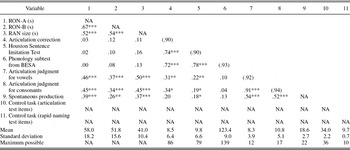
Descriptive statistics and correlations among observed scores are reported in Table 1. Note the apparent ceiling effects obtained with the receptive picture vocabulary test. Illustrations from the articulation correction and articulation judgment tests were correctly recognized during the receptive vocabulary test by 79% to 100% of children (M = 94%, SD = 6%), which for all items was significantly above the chance level of 33% (zs = 10.80–16.73, ps < .001). Similarly, illustrations from the rapid naming tests were correctly recognized during the control test by 80% to 99% of children (M = 94%, SD = 6%), which for all items was significantly above the chance level of 33% (zs = 11.34–15.87, ps < .001). These results indicate that the words used as stimuli in the articulation correction, articulation judgment, and rapid naming tests were within participants’ receptive vocabularies.
Correlations, descriptive statistics, and reliabilities (diagonal) for observed variables

Note: RON-A and -B, rapid object naming—A and B; NA, not available; RAN size, rapid size naming; BESA, Bilingual English Spanish Assessment, Spanish phonology subtest.
*p < .05. **p < .01. ***p < .001.
Most phonological processing tests did not evidence floor or ceiling problems. However, the spontaneous production score was skewed (M = 18.6, SD = 2.7, maximum possible = 22). These results indicate that most children verbalized the correct names for most of the picture stimuli used in the Articulation Correction Test without being prompted by the examiner for a second response. Correlation analyses found that despite some skewness spontaneous production was still reliably associated with other phonological processing tests. Therefore, the spontaneous production variable was retained for subsequent analyses.
Preanalysis data inspection included examination of patterns of missing data, potential outliers, and departures from normality. Investigation of missing data found coverage among pairs of variables ranged from 97% to 100%. Because these data appeared to be missing at random, full information maximum likelihood estimation was employed using data from all cases. Some moderate outliers were detected, but examination of raw data provided no justification for eliminating these observations. In addition, mild departures from normality were found for several variables. Consequently, latent variable analyses were conducted using the robust maximum likelihood estimation method, the Satorra–Bentler scaled chi square, and adjustments to the standard errors to the extent of the nonnormality in the raw data. Confirmatory factor analyses were conducted using Mplus version 5.
Specification of phonological processing variables as uniquely indexing particular factors in the a priori models was reasonable for all but one phonological processing variable. Specifically, task analysis of spontaneous production suggested that this task involved a number of cognitive and phonological processes. For example, children had to perceive an auditory stimulus, which was a nonword created from deletion of some phonemes from a real word. Children had to then compare this incomplete word to real words in their lexicon. Once a phonological match was obtained, children had to say the real word. Visual recognition processes were, of course, also involved given that an illustration of the real, complete word was presented along with the incomplete auditory stimulus. Given the multifaceted nature of this task, EFA was used to examine with which other phonological processing measures this task tended to cluster.
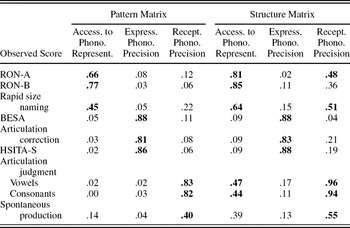
EFA of the nine representation-related phonological processing scores yielded three factors with eigenvalues greater than 1.0. The three factors collectively explained 78% of the covariance in children's scores. Similarly, the scree plot was consistent with a three-factor model, with eigenvalues of 3.63, 2.33, 1.07, 0.61, 0.50, 0.30, 0.24, 0.21, and 0.09. However, the three-factor model and the two-factor model were both readily interpretable. The obliquely rotated three-factor model closely resembled our a priori three-factor model (see Table 2). Specifically, it included an Expressive Phonological Precision factor indexed by the BESA, HSITA-S, and articulation correction; a Receptive Phonological Precision factor indexed by articulation judgment for vowels, articulation judgment for consonants, and spontaneous production; and an Accessibility of Phonological Representation factor indexed by RON A, RON B, and rapid automized naming (RAN) size. Most noteworthy was that spontaneous production uniquely contributed to only the receptive phonological precision factor. Apparently, children's performance on this auditory cloze task was influenced more by children's speech perception abilities than by how readily children could access phonological representations of known words. The obliquely rotated two-factor solution did not resemble any of our a priori models. Instead, it included the same expressive phonological precision factor found in the three-factor model along with a second factor that was indexed by all remaining variables.
Results obtained from exploratory factor analysis of phonological processing measures

Note: n = 129. RON-A and -B, rapid object naming—A and B; BESA, Bilingual English Spanish Assessment, Spanish phonology subtest; HSITA-S, Houston Sentence Imitation Test of Articulation—Spanish Edition. Loadings of .40 and above are in bold type. The pattern matrix reflects the partial correlations of observed variables with factors after controlling for shared variance among the factors. The structure matrix reflects the zero-order correlations of observed variables with factors. The three factors were significantly intercorrelated after oblique rotation (rs = .10–.47).
Data analysis plan
The first stage of our plan to examine the dimensionality of preschool children's representation-related phonological processing abilities involved using confirmatory factor analysis to compare three a priori measurement models and the two-factor, a posterior measurement model indicated by the EFA. A priori models included (a) a model with one first-order factor that presumably reflected general phonological representation ability (Model 1); (b) a model with two intercorrelated first-order factors that presumably reflected accessibility to phonological representations and precision of phonological representations (Model 2); and (c) a model with three intercorrelated first-order factors that presumably reflected phonological accessibility, expressive phonological precision, and receptive phonological precision (Model 3). The a posteriori model included two intercorrelated first-order factors that presumably reflected expressive phonological precision and accessibility of phonological representations (Model 4). The second stage of analyses compared how well each of the observed scores indexed their respective latent phonological processing ability.
Stage 1: Convergent and discriminant validity of representation-related phonological processing abilities
The models that we examined lie on a continuum of conceptual and empirical parsimony. On one end of the continuum is the least parsimonious base model that consisted of three freely intercorrelated factors (Model 3) and on the other end is the most parsimonious one factor model (Model 1). The models are nested in that they can be derived by imposing constraints on other models. For example, constraining the correlations between the expressive phonological representation factor and receptive phonological representation factor of the three-factor base model (i.e., Model 3) to 1.0 yields the a priori two-factor model (Model 2). This relation between different models is important because the utility of one model to explain covariances among observed variables can be statistically compared to the utility of another model in which it is nested by using χ2 difference tests or Satorra–Bentler scale χ2 difference tests when robust maximum likelihood estimation is employed. The base model always yields the best fit because it includes the most estimated parameters and is therefore the least restrictive model. However, the most restrictive nested model that fails to yield a significantly worse fit is accepted as superior in the interest of parsimony.
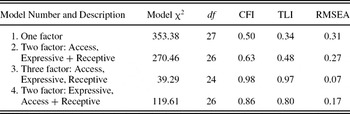
To evaluate the viability of a broad conceptualization of phonological representation as directly indexed by all tasks that involve accessing phonological representations, we tested an a priori model that included only a single latent ability (Model 1). Model fits were assessed with three indices: comparative fit index (CFI), Tucker–Lewis index (TLI), and the root mean square error of approximation (RMSEA). Given that CFIs greater than 0.95, TLIs greater than 0.95, and RMSEAs less than 0.05 are generally considered indicative of excellent fitting models (Hu & Bentler, Reference Hu and Bentler1999), one can see from Table 3 that Model 1 explained the data very poorly. Model 2 tested a further specified conceptualization of representation-related phonological abilities as two intercorrelated factors. One factor presumably reflected the processes involved in accessing phonological representations, and it was indexed by the RON-A, RON-B, and RAN size variables. The second factor presumably reflected precision of extant phonological representations, and it was indexed by all remaining variables. This a priori two-factor model explained children's performances significantly better than the one-factor model: χ2 difference (1, N = 129) = 125.63, p < .0001. However, the two-factor model still characterized the data quite poorly (see Model 2 in Table 3). The final a priori model tested a conceptualization of representation-related phonological processing abilities as composed of three distinguishable yet intercorrelated phonological abilities. Specifically, this model specified separate abilities for accessibility of phonological representations, expressive phonological precision, and receptive phonological precision. Accessibility of phonological representations was again indexed by all three rapid-naming variables. Expressive phonological precision was indexed by scores obtained on the BESA, HSITA-S, and articulation correction. Receptive phonological precision was indexed by scores obtained on articulation judgment for vowels, articulation judgment for consonants, and spontaneous production. Model 3 explained children's performances significantly better than the a priori one- and two-factor models: χ2 difference (3, N = 129) = 350.71, p < .001; χ2 difference (2, N = 129) = 228.46, p < .001; respectively. Moreover, this three-factor model characterized the data extremely well (see Model 3 in Table 3). A two-factor posteriori model was also evaluated (see Model 4 in Table 3). Based on our EFA, this model included one factor indexed by the BESA, HSITA-S, and articulation correction and a second factor indexed by all remaining variables. Although this model characterized the data significantly better than the one-factor model, χ2 difference (1, N = 129) = 193.71, p < .001, it still fit quite poorly (see Model 4 in Table 3). Model 4 also fit the data significantly worse than the three-factor model: χ2 difference (2, N = 129) = 107.21, p < .001.
Fit indices for models of the structure of representation-related phonological processing

Note: n = 129. CFI, comparative fit index; TLI, Tucker–Lewis index; RMSEA, root mean square error of approximation; Access, Access factor indexed by rapid size naming, rapid object naming A, and rapid object naming B; Expressive, Expressive Phonological Representation factor indexed by articulation correction, Houston Sentence Imitation Test of Articulation—Spanish Edition, and phonology subtest of the Bilingual English Spanish Assessment; Receptive, Receptive Phonological Representation factor indexed by articulation judgment for vowels, articulation judgment for consonants, and spontaneous production.
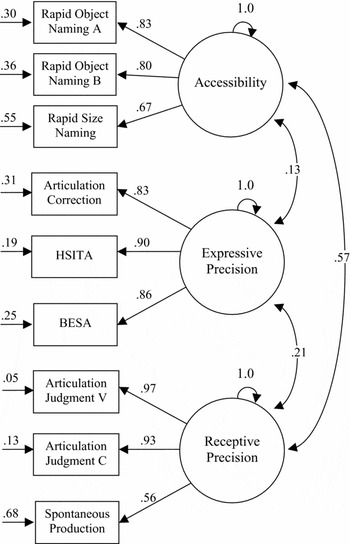
In summary, the three-factor a priori model (i.e., Model 3) was the only model that adequately explained children's performances on the phonological processing measures. As reported in Figure 1, most observed variables loaded substantially and reliably onto their respective factors (λs = 0.83 to 0.97, ps < .001). However, the spontaneous production and RAN size variables had only moderate size loadings (λs = 0.56 and 0.67, ps < .001). As for notable factor intercorrelations, Receptive Phonological Precision and Accessibility of Phonological Representations were moderately correlated (r = .57, p < .001), Receptive Phonological Precision and Expressive Phonological Precision were lowly correlated (r = .21, p = .04), and Accessibility of Phonological Representations and Expressive Phonological Precision were not reliably correlated (r = .13, p > .15).
The three factor model of representation-related phonological abilities. HSITA, Houston Sentence Imitation Test of Articulation—Spanish Edition; BESA, Bilingual English Spanish Assessment.

Stage 2: Comparative utility of measures to index representation-related phonological processing abilities
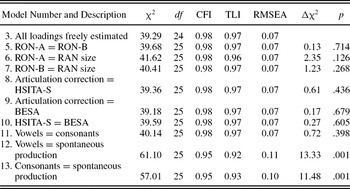
In order to compare how well our behavioral measures indexed the three latent phonological abilities, we evaluated a series of models that imposed equality constraints on pairs of factor loadings. The fit of each model that imposed an equality constraint was compared to the fit of Model 3, in which the two-factor loadings were freely estimated. Equality constraints were only imposed on pairs of variables that indexed the same factor.
Accessibility of Phonological Representations was equally well measured by all three of its indicators: χ2 differences (1, N = 129) = 0.13 to 2.35, ps > .10; see Models 5, 6, and 7 in Table 4). Expressive Phonological Precision was also equally well measured by all three of its indicators: χ2 differences (1, N = 129) = 0.17 to 0.61, ps > .40; see Models 8, 9, and 10 in Table 4). Receptive Phonological Precision was equally well measured by articulation judgment for vowels and articulation judgment for consonants: χ2 difference (1, N = 129) = 0.72, p = .40; see Model 11 in Table 4). However, Receptive Phonological Precision was more poorly indexed by spontaneous production than it was by either articulation judgment for vowels and articulation judgment for consonants, χ2 differences (1, N = 129) = 13.33 and 11.48, ps < .001; see Models 12 and 13 in Table 4).
Model fit indices and chi-square difference tests of the equivalence of factor loadings

Note: n = 129. CFI, comparative fit index; TLI, Tucker–Lewis index; RMSEA, root mean square error of approximation; RON-A and -B, rapid object naming—A and B; RAN size, rapid size naming; HSITA-S, Houston Sentence Imitation Test of Articulation—Spanish Edition; BESA, Bilingual English Spanish Assessment, Spanish phonology subtest; Vowels, articulation judgment for vowels; Consonants, articulation judgment for consonants.
DISCUSSION
This study was undertaken with the hope of advancing a multidisciplinary field that asserts that representation-related phonological processing plays a number of roles in the development of oral and written language. Specifically, the study aimed to expand the field's understanding of representation-related phonological processing abilities and their measurement. Because the methods used in the current study paralleled those of Anthony et al. (Reference Anthony, Williams, Aghara, Dunkelberger and Novak2010), comparisons can be made about how similarly the phonological systems are organized between Spanish- and English-speaking children.
First, this study demonstrated that it was inadequate to vaguely conceptualize phonological representation as a global ability that solely drives Spanish-speaking children's performances on all tasks involving phonological representations. Instead, there appear to be at least three representation-related phonological processing abilities: accessibility of phonological representations, precision of phonological representations evidenced via articulation accuracy, and precision of phonological representations evidenced via speech perception. These findings are remarkably similar to those found with English speakers. For example, Foy and Mann (Reference Foy and Mann2001) found evidence for a latent speech production ability and a latent speech perception ability. That Foy and Mann did not find evidence of a separate ability reflecting accessibility to phonological representations was probably because they only included one measure of rapid naming. The present study's findings also parallel those of Anthony et al. (Reference Anthony, Williams, Aghara, Dunkelberger and Novak2010), who found evidence for the same three representation-related phonological processing abilities in 175 monolingual English-speaking preschool children. Thus, it appears that phonological representation abilities are similarly organized in monolingual English-speaking preschoolers and incipient bilingual preschoolers who are Spanish dominant.
Although the three studies that have examined the dimensionality of representation-related phonological abilities produced quite similar results, they did yield some subtle differences. Specifically, the study by Anthony and colleagues (Reference Anthony, Williams, Aghara, Dunkelberger and Novak2010) with monolingual English-speaking preschoolers found that the three representation-related phonological abilities were significantly intercorrelated, and that their covariance could be explained by a second-order Phonological Representation factor. In contrast, the present study with Spanish–English bilingual preschoolers found that representation-related phonological abilities were not intercorrelated enough to warrant exploration of higher order factor structure. Although at first glance these findings appear in disagreement, a careful look shows that the three representation-related phonological abilities in the Anthony et al. study (Reference Anthony, Williams, Aghara, Dunkelberger and Novak2010) were no more highly correlated on average (average factor intercorrelation = .32) than in the present study (average factor intercorrelation = .36). Unfortunately, the study by Foy and Mann (Reference Foy and Mann2001) cannot speak to the topic because an orthogonal rotation was imposed. In summary, data from the present study along with Anthony et al. (Reference Anthony, Williams, Aghara, Dunkelberger and Novak2010) provide cross-linguistic evidence that representation-related phonological processing abilities are only slightly to moderately intercorrelated, and as such, notions of a second-order Phonological Representation factor must be considered tentative, as cautioned by Anthony et al. (Reference Anthony, Williams, Aghara, Dunkelberger and Novak2010). Future research that includes larger sample sizes, additional phonological constructs, and nonphonological general abilities is needed to thoroughly examine whether or not a latent phonological representation ability explains relations among the three representation-related phonological abilities identified in the present study, Anthony et al. (Reference Anthony, Williams, Aghara, Dunkelberger and Novak2010), and Foy and Mann (Reference Foy and Mann2001).
The convergence of evidence from independent studies in multiple languages indicates that there are clearly distinguishable representation-related processing abilities rather than a single, global phonological representation ability. This is relevant to theories of language and literacy development and to the conduct of associated research. Although individuals’ performances on tasks presumed to measure global phonological representation may be somewhat influenced by a second-order phonological representation ability (Anthony et al., Reference Anthony, Williams, Aghara, Dunkelberger and Novak2010), performances are much more heavily influenced by different first-order representation-related phonological abilities. Such findings call for researchers to be more cautious than common practice when interpreting results they obtain with any one or two tasks they presume to measure global phonological representation. Similarly, the multidimensional nature of phonological representation abilities calls for not only cautious interpretation of prior research findings but, perhaps more importantly, it also indicates that sophisticated research methods should be used in studies that aim to identify the roles of phonological representation abilities in the development of oral and written language. Specifically, multiple measures of each representation-related phonological ability should be administered so that latent variable modeling approaches can be used to disentangle the role of phonological representation from those of more transparent representation-related phonological abilities, like articulation, speech perception, phonological access, phonological memory, and phonological awareness.
Second, this study demonstrated that not all tasks are equally good measures of representation-related phonological processing abilities. For example, whether or not children spontaneously generated the correct label for a picture that was accompanied by a partial auditory stimulus turned out to be a relatively poor measure in the present study. A parallel English test also turned out to be a poor measure in the Anthony et al. (Reference Anthony, Williams, Aghara, Dunkelberger and Novak2010) study. It is interesting though that the Spanish version of the spontaneous recognition task better indexed representation-related phonological processing than the English version of the task. An explanation for this difference could be that although essentially all children receptively knew all the words in both versions fewer incipient bilingual Spanish-speaking children knew the words expressively in the Spanish version (average percent correct in Spanish and English versions = 54% and 76%, respectively). Although this difference in preschoolers’ expressive vocabulary could simply be an artifact of the two versions being of different difficulty, this difference has been noted in past research and attributed to possible cultural differences in child socialization patterns (Peña & Quin, Reference Peña and Quinn1997). For example, whereas middle class English-speaking children are often exposed to and encouraged to produce object names (Goldfield, Reference Goldfield2000), children from non-English speaking or low socioeconomic status families may be encouraged to develop and demonstrate language skills related to social routines (Eisenberg, Reference Eisenberg, Schiefflin and Ochs1986; Slobin, Reference Slobin1983) or object functions (Peña & Quin, Reference Peña and Quinn1997) rather than object names. Thus, although the English version of the test evidenced ceiling effects and was essentially uncorrelated with other measures of phonological processing, the Spanish version evidenced enough reliable variance that was, albeit to a small extent, related to individual differences on other measures of phonological processing. It is important to note, however, that even though the Spanish version of the test evidenced variance related to individual differences, and the English version did not, both versions of the test proved to be significantly worse indicators of representation-related phonological processing than other prototypic measures.
With the sole exception of the spontaneous recognition task, all of the prototypic measures proved to be excellent measures of representation-related phonological abilities. That is, the rapid-naming tasks were highly reliable indicators of efficient access to phonological storage, the articulation judgment tasks were highly reliable indicators of speech perception, and the articulation accuracy tasks were highly reliable indicators of speech production. It is also important that the tasks within any representation-related phonological ability were essentially exchangeable. For example, the three articulation tests did an equally good job discriminating individual differences in accuracy of speech production. Likewise, the two articulation judgment tasks were equally good indicators of speech perception, and the three rapid-naming tasks were essentially equally good indicators of access to phonological storage, although rapid size naming might be a slightly less reliable indicator than rapid object naming. These later differences were not statistically significant in the present study, but they were in a slightly larger study of English speaking preschool children (Anthony et al., Reference Anthony, Williams, Aghara, Dunkelberger and Novak2010).
Some important limitations to the present study should be noted. First, the present study did not include measures that may have potentially revealed a fourth representation-related phonological processing ability. Tests that assess how readily children form new phonological representations were not administered. Our interest was instead in phonological processing of extant representations for known words. Moreover, some recent psychometric research suggests that performances on word-learning tasks may reflect breadth of extant vocabulary as much as phonological processing (Davis, Reference Davis2008; Hogan, Reference Hogan2006), but these findings are mixed. Expansion of the current research methods through addition of word-learning tasks will be important for future research, as additional research is needed to understand what types of phonological processing are involved in word learning.
Second, another limitation of the present study is that it was narrowly focused on tasks that prior researchers have used to operationalize phonological representation abilities. Although this was an appropriate scope for our aim of comparing the utility of prototypic measures, we critically view this scope as insufficient for verifying how to best operationalize latent phonological processing abilities. To confidently arrive at a precise model of latent phonological processing abilities, we believe it will be necessary to examine how different specifications of latent phonological representation relate to all other relevant phonological processing abilities (e.g., phonological memory, phonological awareness, articulation, speech perception, RAN) and particularly important nonphonological, cognitive abilities (e.g., general intelligence and vocabulary). Thoughtful modeling of the relations among phonological processing abilities will permit exciting investigation of the roles of phonological processing in the development of oral and written language.
Issues that deal with the Spanish and English status of the children in the study need to be addressed in future studies. First, although the current study examined children's Spanish language use, their dialect status was not specifically addressed. Spanish dialects often used in the United States have been described as two types; General Spanish/Mexican Spanish and Caribbean Spanish as spoken in Cuban or Puerto Rico (Iglesias & Anderson, Reference Iglesias, Anderson, Bernthal and Bankson1993). Although these dialects are mutually intelligible, they differ from each other in some important phonological features. For example, in General Spanish plural words are articulated with a final /s/; however, in Caribbean dialects the final /s/ is often deleted, although the preceding phoneme might be slightly longer in duration to indicate plurality. Although dialect use was not systematically surveyed for each participant in the current study, the Spanish-language examiners in this study reported that most children spoke General Spanish or Mexican Spanish. We believe that there were relatively few children in the current study that used a Caribbean Spanish dialect. However, our scoring procedures, which used General Spanish as the standard for accuracy, could have inadvertently indicated individual differences in children who were actually developing appropriate phonological representations for their communication environments (Goldstein & Iglesias, Reference Goldstein and Iglesias2001). This issue can be eliminated in future studies with a careful survey of the dialect status of each child and individualized scoring procedures for each dialect.
Second, another issue related to language status that needs to be addressed in future studies is children's bilingual status. The current study provides information about the Spanish-language representation abilities of incipient bilingual children. Information from both languages of bilingual speakers will need to be studied extensively to reveal the full organization of bilinguals’ phonological systems. For example, additional research is needed to determine if incipient bilingual speakers employ a single unitary system to organize all the sounds of both languages (Volterra & Taeschner, Reference Volterra and Taschner1978), or if alternatively, bilinguals develop dual systems for sound representation (i.e., one in each language; Genesee, Reference Genesee1989; Paradis, Reference Paradis2001). Bilingual evaluations of phonological representation will help uncover any language specific influences on how sounds are learned, organized, and retrieved for communication. A bilingual analysis of children's phonological skills should help to reveal any representation related abilities that develop uniquely in the sound systems of bilingual children.
Third, although this study focused primarily on the relationship of oral language skills and phonological representation, future research that focuses on the relationship of reading skills and phonological representation should address the differences in orthography of the two languages. Specifically, the shallow orthography of Spanish, when compared to English, may heighten literate children's ability to process phonological information. For example, in Spanish the word casa (house) is written with four graphemes that represent four phonemes. However, in English the word house is written with five graphemes that represent three phonemes. It is reasonable to assume that these differences in orthography can manifest themselves as differences in the phonological representation skills of literate children who are learning each language.
Fourth, generalizations from the current study must be limited to children who have experienced mostly monolingual exposure to Spanish during infancy and toddlerhood and who are becoming bilingual in Spanish and English during early childhood. Research indicates that children who are exposed to two languages are both similar to and different from monolingual children in their perception of phonemes for each language (Bosch & Sebastián-Gallés, Reference Bosch and Sebastián-Gallés2003; Sundara, Polk, & Molnar, Reference Sundara, Polka and Molnar2008). Cross-linguistic effects on the output phonology of bilingual children's two languages are also well documented (Gildersleeve-Neumann et al., Reference Gildersleeve-Neumann, Pena, Davis and Kester2009; Goldstein & Washington, Reference Goldstein and Washington2001; Keshavarz & Ingram, Reference Keshavarz and Ingram2002). Likewise, studies with adults indicate an influence of first-language phoneme categories on second-language phoneme categories (Best, Reference Best and Strange1995; Flege, Reference Flege and Strange1995). However, these specific cross-linguistic influences have been noted along with patterns of general similarities in speech production abilities even with varying levels of language exposure across the monolingual–bilingual continuum (Goldstein et al., Reference Goldstein, Fabiano and Washington2005). A synthesis of prior research with the present findings also suggests that, although there are cross-linguistic influences on preciseness of phonological representation skills, the overall organization among Spanish phonological abilities of incipient bilingual children is similar to the overall organization among English phonological abilities in monolingual English children. Future research is needed to compare the organization of phonological abilities of bilingual children in both of their languages to determine if there are separate speech perception, speech production, and phonological access abilities for each language or if there are single latent abilities for each phonological process, which serve both languages. It will also be important to compare such findings with those obtained from monolingual Spanish samples and monolingual English samples. Such comparisons will allow inferences about the influences of bilingualism on the organization of children's various phonological abilities and could have implications for the assessment and intervention of phonological skills of bilingual children.
APPENDIX A
Word list for Articulation Correction Test

APPENDIX B
Word list for articulation judgment for vowels

APPENDIX C
Word list for articulation judgment for consonants