In all languages, the realization of a given sound may vary both within and across prosodic positions, including those defined by the word and syllable. For example, French 〈r〉 is typically described as the voiced dorsal fricative

. However, alongside this most common realization, variants that differ in both voicing and manner are widely attested. As concerns voicing, 〈r〉 is devoiced following a voiceless obstruent and, in many cases, syllable-finally. Manner varies, with typical fricative realizations existing alongside trills, approximants, and, in codas, vocalized variants. Nativelike acquisition of the French rhotic thus requires that learners come to master not only the articulation of a voiced dorsal fricative but also the patterns of variation present in the target language.
Research on the acquisition of new second language (L2) sounds has frequently demonstrated that L2 learners also show variation in realization related to position. This variability, however, is frequently not of the type present in the input. For example, studies have regularly shown that learners whose first language (L1) does not permit voiced stops often master voicing in onsets first; target-language voiced codas may be realized as voiceless by the same learners. To date, such asymmetries have been demonstrated primarily for stop voicing, particularly with learners of English (Cebrian, 2000; MacKay, Flege, Piske, & Schirru, 2001; Nathan, 1987; Port & Mitlet, 1983; Riney & Takagi, 1999). To account for such variation, many previous analyses have invoked crosslinguistic typology. Under the assumption that SLA is constrained by implicational markedness, with marked structures acquired with relatively more difficulty (e.g., Carlisle, 1997; Eckman, 1977; Major & Faudree, 1996), the L2 voicing asymmetry that favors the mastery of stop voicing in onsets falls out naturally. Crosslinguistically, voiced stops are considered marked because their presence in a language implies that of their voiceless counterparts. This general tendency is further constrained by position. As is the case with other parameters, including manner, languages may restrict the voiceless-voiced contrast to onset position, with syllable-final voiced stops being devoiced (e.g., German). Thus, voicing is relatively more marked in codas.
Accounts of voicing asymmetries based on implicational markedness provide important insights into potential constraints on the SLA of new segments (see Eckman, in press, for an overview). However, they leave a number of issues unanswered. First, most previous accounts do not address the degree of variability in the input attested both between and within prosodic positions. As such, the challenges that L2 learners face in the acquisition of new segmental contrasts are underestimated. Second, concerning differences between positions, the use of the broad labels onset and coda in discussing positionally conditioned variation potentially obscures other position-related asymmetries. For example, whereas voicing is favored in onsets, not all onsets are created equal. Indeed, voicing is relatively easier in intervocalic stops than in stops that occur word- or utterance-initially (e.g., Kohler, 1984; Ohala & Kawasaki, 1984). However, most L2 studies to date—particularly those using experimentally elicited speech—have tended to investigate word-initial or word-final stops mainly in monosyllables. Consequently, it is not possible to examine potential differences related to position in the syllable versus the word. Third, as mentioned, research has tended to focus on stop voicing. In contrast, little is known of the acquisition of new segments that involve differences in manner as well as the interaction of manner with voicing.1
Some work has touched on the SLA of fricatives when looking at the acquisition of obstruents or consonants more generally (e.g., Boix & Olive, 1987; Díaz-Campos, 2004; Flege, Munro, & MacKay, 1995; Pilus, 2002).
Seeking to answer such questions, in this article we will investigate the acquisition of French 〈r〉. Although much work has been done on the SLA of rhotics, the focus most often has been on learners' mastery of the phonological contrast between the English approximant

and its lateral counterpart /l/ (e.g., Aoyama, Flege, Guion, Akahane-Yamada, & Yamada, 2004; Brown, 1998). In research on Romance languages, the Spanish tap and trill have received the most attention (Colantoni & Steele, 2006a; Face, 2006; Major, 1986; Waltmunson, 2005). With the exception of Colantoni and Steele, these studies either relied on auditory transcriptions (Face; Major) or used global measurements rather than focusing on the acquisition of individual phonetic parameters (Waltmunson). There are very few studies on the SLA of French

. Berri (1998), who focused on Portuguese-speaking learners' acquisition of rhotic voicing and demonstrated that learners fail to master this phonetic parameter even in intervocalic position, is of particular relevance to the research undertaken here.
The current study will focus not only on voicing but also on manner, including the interaction of both phonetic parameters across prosodic positions. The data come from an experimental study that tested intermediate and advanced English-speaking learners' production of French

occurring initially and finally both in the syllable and word. As with previous studies, we will highlight position-sensitive asymmetries in the learner data, including those between onsets and codas. However, in contrast to most previous research, we will not argue that implicational markedness is at the source. Rather, we will explain the asymmetries that are normally attributed to typological markedness as the consequence of basic phonetic principles, such as aerodynamic constraints on the production of voicing in fricatives (e.g., Ohala, 1993a, 1997). Indeed, we will argue that, in the absence of transfer, these principles will govern the acquisition of new segments. Specifically, we will test the hypothesis that target language segments are acquired more readily in positions that favor the phonetic parameters necessary for their realization. For example, voiced fricatives should be acquired first in intervocalic position, followed by word-initial position, and finally coda position, either word-medially or word-finally (see Ohala & Kawasaki, 1984). Indeed, we will suggest that the phonetic principles that underlie these developmental patterns are the same ones that govern sound change. Under the assumption that diachronic change also involves the acquisition of new segments, particularly by younger speakers, interesting parallels exist in the asymmetry between maintenance of contrasts in onsets versus lenition in codas. Finally, we will demonstrate that acquiring new segments might involve not only mastering differences related to position (e.g., voicing in onsets vs. codas) but also learning to realize the different variants attested in a given position. Moreover, learners might seek to be more accurate on one of the multiple parameters being acquired; this might manifest itself in context-specific trade-offs. This position-internal variation can be explained with reference to hypoarticulation versus hyperarticulation (Lindblom, 1989) and constraints on production that allow for featural change in perceptually less distinct positions, including codas (Steriade, 1999, and references therein).
To address the issues of L2 learners' acquisition of French

, we will first present a comparison of the phonetic realization of English and French 〈r〉 as well as a discussion of the relative articulatory difficulty of realizing both manner and voicing in voiced dorsal fricatives, necessary for target

. On the basis of interlanguage differences and the articulatory difficulty of realizing a voiced dorsal fricative, we will present three hypotheses about the relative ease of acquiring the French rhotic in terms of (a) manner versus voicing, (b) initial versus final position in the syllable and word, and (c) segmental environment, namely postvocalic versus postconsonantal. The experiment from which the data relevant to the testing of these hypotheses are taken will then be presented, followed by the results and hypotheses evaluation and our conclusions.
ENGLISH AND FRENCH 〈r〉: PHONETIC REALIZATION AND ARTICULATORY-BASED PREDICTIONS FOR DEVELOPMENT
Comparing English and French 〈r〉
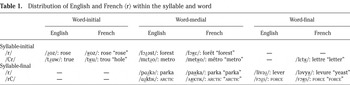
As shown in Table 1, English and French 〈r〉 occur in the same positions in the syllable and the word,
2The English coda 〈r〉 is present in the North American varieties of English that are the L1s of the learners tested in this study.

“thunder,” couvre

“cover-3rd person sing.”).
Distribution of English and French 〈r〉 within the syllable and word

Whereas the distribution of the English and French rhotics is similar, their phonetic realization differs greatly. In most varieties of French, 〈r〉 is realized as the voiced uvular fricative

(e.g., Léon, 1992).
3In certain parts of Quebec, including Montreal, the rhotic is sometimes realized as the apical trill [r]. However, studies from the 1970s to the present (e.g., Clermont & Cedergren, 1978; Sankoff & Blondeau, in press; Santerre, 1978) have shown a consistent increase in the percentage of dorsal variants. Indeed, among younger speakers, the use of

is almost categorical (see Sankoff & Blondeau). Given that virtually no apical realizations were attested in the interlanguage data investigated here (see Tables 3 and 4), we will assume that the English-speaking learners' targets were primarily the dorsal variants.

or

“train”). The French rhotic may also be devoiced syllable-finally (see Table 3). Second, manner varies with trilled realizations attested alongside approximant (e.g., Colantoni & Steele, 2006b; O'Shaughnessy, 1982) and vocalized variants (e.g., Ostiguy & Sarrasin, 1985; Straka, 1979); the latter are restricted to codas, particularly in word-final position.
4There is also variation in place of articulation. Some descriptions characterize /r/ as velar (e.g., O'Shaughnessy, 1982; Tousignant, 1987). Because we focus on voicing and manner, the exact place of articulation is not relevant to testing the present hypotheses.

. As in French, English 〈r〉 is devoiced following a voiceless obstruent.
5In coronal clusters, English

may be fricativized, with the cluster realized as an affricate (e.g., Muhr, 1980).
Acquiring French 

The voiced uvular fricative

is rare in the world's languages (Maddieson, 1984). Although the English consonantal inventory includes both labial and coronal fricatives

and voiced velar stops

, dorsal fricatives—voiceless or voiced—are absent. Moreover, as is the case crosslinguistically, English voiced fricatives are often (partially) devoiced in codas, particularly word-finally (e.g., Ladefoged, 1993), utterance-finally, and before voiceless obstruents (Smith, 1997). In order to acquire target

, English-speaking learners must simultaneously master voicing and manner. Both parameters, however, do not co-occur in all contexts. With respect to voicing, as French 〈r〉 is partially or fully devoiced following voiceless obstruents, learners need to master voicing only in singletons and voiced clusters. Consequently, we will focus on these contexts in the present work. Within singletons, learners might realize a lesser rate of voicing in codas and still be faithful to the target, given the partial devoicing present in native French. Manner is also more variable in codas. Given the existence of approximant and vocalized variants in the input, learners need to master frication to a greater extent in onsets.
Articulatory accuracy in the realization of

might prove difficult in two respects related to voicing. First, in the interaction of voicing and manner, aerodynamic constraints account for the crosslinguistic disfavoring of voiced fricatives (Maddieson, 1984; Ohala, 1993a, 1997; Pickett, 1999): Optimal fricatives require sufficient airflow for frication to occur, whereas increased airflow triggers vocal fold abduction, thus inhibiting voicing. Second, with respect to the interaction of voicing with place, voicing is generally dispreferred in dorsals vis-à-vis labials and coronals (e.g., Ohala, 1993a, 1993b, 1997).
In summary, in singletons and voiced clusters, the acquisition of French

requires simultaneous mastery of frication and voicing in the segment (i.e., the voiced dorsal fricative, for which these properties are marked). Given the challenge that this represents, it is possible that learners might master one parameter before the other. Moreover, there might be trade-offs, where accuracy with one aspect of the realization of 〈r〉 results in the nontargetlike realization of the other. With this in mind, we will present a series of hypotheses about the relative order of acquisition of manner and voicing, including the role of position and phonetic environment.
PHONETICALLY BASED HYPOTHESES FOR DEVELOPMENTAL SEQUENCES
Our approach follows from previous research that has proposed that relatively more complex new target language sounds will be acquired with greater difficulty. However, we diverge from many previous studies that have assumed that complexity is measured in terms of markedness as determined by implicational universals (e.g., Carlisle, 1997; Eckman, 1977; Major & Faudree, 1996). Whereas we do not wish to deny the usefulness of crosslinguistic typology in the formulation of predictions, we argue that spelling out markedness using phonetic and, most likely, cognitive principles allows for a more explanatory account of the difficulties learners face.
6We will focus here on phonetic principles. However, we acknowledge that other factors such as the maintenance of contrast or processing need to be taken into account as well.

in terms of the relative difficulty of mastering (a) the parameters of manner and voicing, (b) voicing by position (initial vs. final in the syllable and word), and (c) phonetic environment (singletons/postvocalic vs. clusters/postconsonantal).
Hypothesis 1: Simultaneous Acquisition of Voicing and Manner
As mentioned earlier, English does not have a voiced dorsal fricative. Following Flege's (e.g., 1987, 1995) speech learning model, we thus predict that English-speaking learners will be able to accurately perceive and eventually produce French

because it is a new segment. Given the lack of transfer, we propose that general phonetic principles will govern its acquisition. The articulatory constraints against voiced dorsal fricatives preclude immediate acquisition. Rather, there are two likely developmental paths: (a) Learners might attempt to master both properties simultaneously with the possible consequence that neither parameter might be highly targetlike, at least at earlier stages of acquisition; (b) learners might focus on one of the two parameters and seek to be as accurate as possible, which might lead to lower rates of accuracy with the other parameter. We propose that native speakers (NSs) of English will follow the latter path and will be more successful with manner than voicing of

for several reasons. First, following our general hypothesis, dorsal fricatives are new segments for these speakers and, as such, there is no possibility for equivalence classification. Given the high saliency
7We adopt Ohala and Kawasaki's (1984) definition of saliency here, namely “a scalar property that determines a given event's detectability—that is, both the probability that it will be detected in the stream of speech (as opposed to being missed) and that its identity (the way in which it differs from other speech events) will also be perceived” (p. 116).

, on the assumption that L2 learners seek to be perceptually faithful to the perceived target, learners should seek to realize this frication. Whereas failing to produce voicing still results in a segment relatively similar to the target, failure to produce a fricative does not: The voiced velar or uvular stops

or [G] do not resemble

perceptually.
8See Steriade (1999) for a review and discussion of research supporting the claim that stricture (i.e., manner) differences are the most important in creating perceived segmental dissimilarity in listeners.

(Colantoni & Steele, 2006a). In summary, learners' realization of manner should match that of NS controls more closely than their voicing of the rhotic; this will be particularly evident with those at an intermediate level of proficiency. Furthermore, the acquisition of both parameters might be conditioned by position.
Hypothesis 2: Voicing by Position
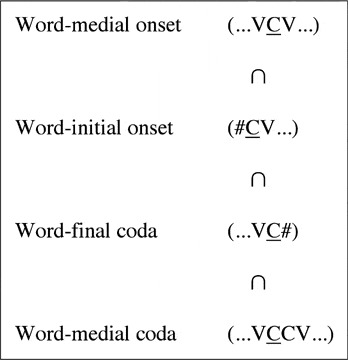
Voicing is generally disfavored in obstruents, especially in fricatives (e.g., Hoole, 1999; Ohala, 1993a, 1997). However, it is phonetically favored prevocalically, particularly intervocalically. Combining these two tendencies, it is possible to formulate an acquisition hierarchy. Within singletons, given the favoring of voicing intervocalically, voicing should be acquired in syllable-initial word-medial position (V.CV) first; prevocalic syllable and word-initial

(#CV) will be mastered next. Coda position (VC.CV, VC#) should prove most difficult for several reasons. First, there is no following vowel to create the facilitating context for voicing, and a following obstruent (word-medially) or pause (word-finally) might impede voicing (Blevins, 2004; Smith, 1997). Second, cues are weaker in codas, which allows for less articulatory precision (Ohala & Kawasaki, 1984). Third, coda consonants tend to be longer, and longer obstruents are more likely to be devoiced, especially word- and utterance-finally (Blevins, 2004; Smith, 1997). Indeed, voicing is disfavored in this context crosslinguistically. As concerns the relative ease of acquisition within codas, we hypothesize that word-final codas might prove slightly easier, given that devoicing occurs in this particular syllable-final context more frequently across languages. Furthermore, obstruents are variably devoiced in exactly this position in the learners' L1.
9In word-medial codas, the presence of a following voiceless obstruent will create a further impediment to voicing; voicing should be relatively easier when followed by a sonorant (e.g., Blevins, 2004; Smith, 1997). Although this is an empirically testable hypothesis, the data here are taken from a study that was designed particularly to test learners' realizations of liquids in onsets. As such, there are insufficient coda stimuli both in terms of number and voiceless-voiced balance to explore this further.

Acquisition hierarchy: Voicing by position.
Hypothesis 3: Voicing in Singletons versus Voiced Clusters
For onsets, a further level of complexity might exist, namely clusters in which the rhotic occurs as the second member. Voicing should not be equally easy in this context (Hoole, 1999). Indeed, given the even greater difficulty of maintaining voicing in an obstruent + obstruent sequence, we predict that voicing should be acquired in singleton onsets first. However, French voiced stop + rhotic clusters present an interesting situation, as they are not phonetically realized as clusters in the target. Indeed, Colantoni and Steele (2005a, 2006b) demonstrated that, in both Quebecois and European French, voiced stop +

clusters are broken up by a cluster-medial vowel both word-initially and word-medially (e.g., bras

“arm,” dégrader

“to debase”). In both varieties, epenthesis is virtually categorical in such clusters (Quebec: 90%; France: 97%).
10In voiceless clusters, in contrast, essentially no epenthesis is attested.
EXPERIMENT
Participant Groups
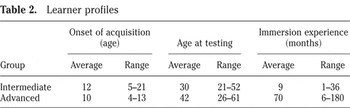
Along with 10 NS controls—5 each from Quebec and France—20 French learners (10 intermediate, 10 advanced), all NSs of North American English, participated in the experiment.
To ensure that the learners had all been sufficiently exposed to the target structure, one requirement for participation was having spent time in a French-speaking milieu. For the intermediate learners, 3 months of immersion experience was required, and for advanced learners, 6 months was required.11
As shown by the range in Table 2, one intermediate learner only had 1 month of French milieu immersion. However, this participant had taken 10 years of French immersion schooling in Canada and, consequently, most probably did not lack sufficient input.
The five NSs were all given ratings of 5, with the exception of one speaker to whom one judge assigned a score of 4.5.
Learner profiles

Tasks
The learners and controls performed three tasks: (a) a French word-reading task, (b) a mirror English task, and (c) the French reading passage task. The English task was included to test another set of hypotheses related to cluster-medial epenthesis; because it is not relevant to the hypotheses under investigation here, it will be discussed no further. The French word-reading task involved 24 stimuli containing stop + rhotic clusters controlled for voicing and position in the word (initial vs. medial) and 14 tokens containing a singleton 〈r〉 (see Appendix C) as well as 37 other words without rhotics. All words were embedded in a carrier sentence (“Je dis [TARGET] encore une fois” “I say [TARGET] again”) presented in written form to the subjects on note cards. The reading passage included 21 singleton rhotics.
Methodology
Subjects were tested individually in a quiet room. The French stimuli were read during three rounds, each time in random order. Between each round, the subjects were given an approximately 5-min break. During the first break, subjects completed a background questionnaire. Following the three rounds, the participants read the text “La bise et le soleil.” Finally, the English stimuli were read once. This generated 72 French stop + rhotic clusters (3 × 24 from the word reading) and 63 singleton rhotics (3 × 14 = 42 from the word reading + 21 from the passage) per participant. All four rounds were recorded (44100 Hz; 32-bit; stereo) using a Marantz CDR300 CD recorder and unidirectional AudioTechnica AT803B lavaliere microphone.
Data Preparation and Analysis
Sound files were downsampled (22050 Hz; 16-bit; mono) and tokens with rhotics were extracted and labeled. For all such tokens, the rhotic's length (ms), voicing, and manner were determined using Praat 4.0.41 software. Voicing was measured in terms of the percentage of the rhotic's articulation that included the presence of F0 on the spectrogram. Manner—either fricative, trill, tap, approximant, vocalization, or realizations of mixed manner (e.g., initial approximantization followed by frication or vice versa)—was evaluated based on an examination of periodicity and noisiness in the waveform and spectrogram. Results were exported to a spreadsheet and statistics were calculated with SAS 8.12.
RESULTS AND HYPOTHESES EVALUATION
Hypothesis 1: Relative Difficulty of Rhotic Voicing versus Manner
As stated earlier, English-speaking L2 learners face the problem of acquiring voicing and manner in target

. Given that it is unlikely that both can be mastered simultaneously, we predicted that learners would seek to be more accurate with one of the two parameters. Specifically, learners should acquire manner (i.e., frication) before mastering voicing, given the aerodynamic constraints against voicing—particularly in dorsals and fricatives—and the perceptual salience of manner.
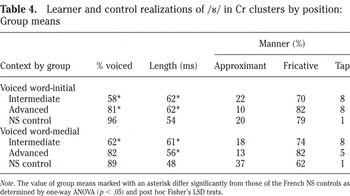
A comparison of the learners' mastery of these two phonetic parameters in singleton rhotics and voiced stop + rhotic clusters is given in Tables 3 and 4, respectively. For manner, the approximant and fricative labels represent dorsal realizations; virtually no Englishlike coronal approximants were attested in the data, even with the intermediate learners. This contrasts with the data from English-speaking learners of Spanish reported in Colantoni and Steele (2006a) and Face (2006). In both of these studies, the researchers found that a frequent realization of the Spanish rhotic

by the intermediate learners was the L1-transferred coronal approximant

. As such, the difference in performance between English-speaking intermediate learners of Spanish and French—L1 transfer in the case of Spanish

but not in the case of French

—supports our proposal that the phonetic characteristics of French

are highly salient and that L2 learners seek to be faithful to manner.
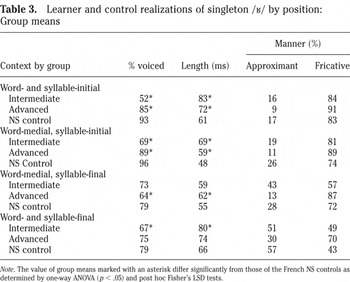
We begin by examining the learners' realization of singleton rhotics as given in Table 3. In terms of voicing, there is a general trend across positions for the percentage of the rhotic's articulation that is voiced to increase with proficiency: With the exception of word-medial, syllable-final 〈r〉 (e.g., marcher

“to walk,” fermer

“to close”), the advanced learners produced a higher rate of voicing vis-à-vis their intermediate counterparts across positions.
Learner and control realizations of singleton by position: Group means

The increase in percentage of voicing is accompanied by a general shortening of the rhotic. Whereas both groups of learners' realizations were generally longer than those of the French controls, the advanced group nonetheless produced shorter 〈r〉s on average, with the exception of the word-medial, syllable-final context.13
The difference in length between the learner groups is statistically significant in onsets alone.
Realization of manner was more accurate on the whole. Table 3 gives the proportions of fricatives and approximants, the overwhelmingly most common realizations. Other manners, including taps and mixed realizations (frication followed by approximantization or vice versa) as well as vocalization in codas, were also observed. However, given their low frequency and in order to facilitate comparison between the learners and the NS controls, who produced relatively few of these latter variants, only proportions of approximant and fricatives are given here.
14See Appendix D for the values for all manners observed. Note that all statistics involving manner, with the exception of the chi-square for word-initial syllable-initial, were run on the complete dataset, which included all manners.

“to do”) that a greater proportion of approximant realizations was produced (57% vs. 43%). The learners' realization of manner mirrors the variation witnessed in the NS data. Indeed, the intermediates matched the controls for this parameter much more closely than they did for voicing, particularly for all proportions in word-initial onsets, χ2(1, 1143) = .01, p = .09, and the proportion of fricatives in word-final codas (49% vs. 43%). Their particular accuracy in onsets occurred in exactly the context in which voicing proved most problematic. In codas, intermediate learners' production reveals a trade-off between manner and voicing not only consistent with the prediction that both parameters would be acquired simultaneously but also consistent with the patterns observed in the NSs' production. For the advanced learners, a higher rate of approximants, which favor voicing, was also observed but to a much lesser extent. In general, in word-initial and word-medial onsets, both groups of learners targeted a fricative realization significantly longer than the one produced by the NS controls and, consequently, devoiced to a greater degree.
In word-medial codas, the intermediate learners produced a less constricted articulation that resulted in a higher proportion of approximants. We propose that this was the consequence of a lack of motor control as opposed to an attempt to be faithful to the manner in the input. In this same position, the advanced learners targeted fricatives (87%). As stated earlier, it was in this context that the advanced learners produced a lower rate of voicing than their intermediate counterparts. Once again, it would appear that it in order to master manner, voicing is sacrificed. In word-final positions, the intermediate learners had an equal proportion of approximant and fricative realizations but a high proportion (15%) of other realizations (see Appendix D).
In summary, it could be argued that the learners were more faithful to manner in the context in which perceptual saliency is greatest for their hearers (i.e., CV; see Ohala & Kawasaki, 1984). Conversely, they were less faithful to manner where it is less salient (i.e., VC). This asymmetry mirrored the trend observed in the controls, on the one hand; on the other hand, it increased the onset-coda asymmetry by increasing the difference in the manner dimension. The patterns observed, particularly in the trade-offs between voicing and manner, are consistent with two proposals. First, in terms of production, the learners seemed to oscillate between hyperarticulation and hypoarticulation based on position (Lindblom, 1989). Learners, particularly the intermediate speakers, hyperarticulated in salient positions (CV) and hypoarticulated in less salient ones (VC). Second, the patterns in the learner data are consistent with Steriade (1999), who proposed that speakers will resolve marked structures—here, obstruent coda voicing—in certain positions via means that are perceptually less distinct. As we will suggest in our discussion, this pattern mirrors asymmetries observed in sound change. What is arguably most striking for manner realizations is the extent to which even the intermediate learners' production resembled that of the controls.
In our analysis of stop + rhotic clusters, we will focus only on voiced clusters, as the rhotic of a voiceless cluster is mainly devoiced by NSs of the target language (85% in word-initial and 78% in word-medial contexts in our data) and, thus, learners do not need to master voicing here.
15In voiceless clusters, the learner values differed significantly for voicing vis-à-vis the French NS controls (word-initial: intermediate: 23%, advanced: 7%, control: 15%; word-medial: intermediate: 30%, advanced: 13%, control: 22%). Learners' realization of manner in these clusters was highly accurate: The advanced group produced only fricative variants, mirroring the NSs. The intermediate learners produced a small number of approximant variants (12% in word-initial and 14% in word-medial contexts).

“to debase,” poudrer

“to powder”), there was no significant difference between the advanced learners and the NS controls. The intermediate learners, in contrast, failed to voice

sufficiently in both word-initial (58%) and word-medial (62%) contexts. The differences observed for the intermediate learners can be attributed to the lack of mastery of cluster-medial vowel epenthesis. Colantoni and Steele (2005b) showed that intermediate speakers epenthesized in only 55% of target cases, differing from advanced speakers, whose rate of epenthesis was 84% and approached that of the NS controls (90%). The lack of mastery of epenthesis combined with the production of longer fricatives accounts for the higher rate of devoicing in intermediate speakers' rhotics.
Learner and control realizations of in Cr clusters by position: Group means

Manner, in contrast, was very accurate. In word-initial clusters, the advanced learners matched the target values for the proportion of fricatives (82% vs. 79%), χ2(1, 340) = 6.2, p = .01.16
However, unlike the NSs, there are a certain percentage (8%) of taps. Note that, for both learner groups, these taps were produced almost exclusively by a single speaker.
In summary, whereas not even the advanced English-speaking learners matched the French NS controls for rhotic manner in all positions, there were a considerably larger number of targetlike realizations with this phonetic parameter than with voicing. Moreover, the less proficient intermediate learners already showed high percentages of fricative realizations. Voicing, in contrast, was generally insufficient with both groups of learners. Although they matched the targets in singleton codas on two occasions, it was due to the possibility of partial devoicing in the target in this environment. In contexts in which the rhotic was virtually fully voiced by the French NSs, only the advanced learners matched the controls and only in one context—namely word-medial voiced clusters. This could be attributed to their nativelike mastery of cluster-medial vowel epenthesis.
Hypothesis 2: Voicing by Position
Based on the greater ease with which obstruent voicing was produced in intervocalic and syllable-initial position, a voicing acquisition hierarchy was predicted in which voicing should be acquired first in intervocalic position

, followed by word-initial prevocalic position

, then word-final position

, and finally word-medial preconsonantal position

.
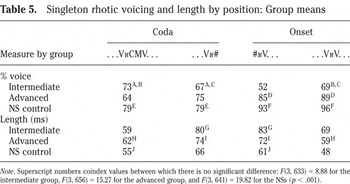
Table 5 gives the values both for the percentage voiced and the length (ms) of the rhotics elicited in the two reading tasks. We begin by noting that the four-way split predicted based on relative articulatory difficulty was not attested in the NS controls. The results for voicing present a clear asymmetry between syllable-initial (word-initial: 93%; word-medial: 96%) and syllable-final 〈r〉 (word-medial: 79%; word-final: 79%).
Singleton rhotic voicing and length by position: Group means

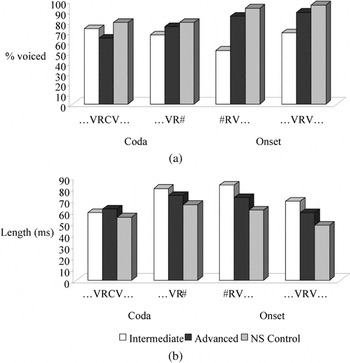
This asymmetry was also observed in the advanced learner data, with significantly greater voicing in onsets (word-initial: 85%; word-medial: 89%) than in codas (word-medial: 64%; word-final: 75%). Consistent with our predictions, there was a statistically significant lower rate of voicing in word-medial versus word-final codas, F(3, 656) = 15.27, p < .0001. Given the number of variables in question in Table 5, we reproduce the data as Figure 2a and 2b for ease of comprehension.

Singleton rhotic voicing (a) and length by position (b): Group means.
Whereas the advanced learners' performance was consistent with the predicted hierarchy of difficulty in mastering voicing, here as before, one should not consider voicing in isolation. Rather, it is necessary to examine its interaction with manner. As shown in Table 3, the word-final context was one in which the advanced learners produced a greater number of approximant realizations (word-medial: 13%; word-final: 30%). As predicted, when it was not possible to realize both parameters accurately, learners focused on one at the expense of the other: Approximantization in word-final codas allowed learners to be faithful to voicing. Interestingly, this alternation in manner was also observed for NSs, albeit at a lower rate. Thus, manner was manipulated where it is less salient. Moreover, this change in manner involved only a slight difference in the degree of constriction. This slight articulatory difference might result in perceptual similarity, which would again increase in codas. Dorsal rhotics can be considered wall fricatives: They are characterized by a distributed source of noise that results from the airstream moving parallel to the point of frication and might be perceptually more similar to approximants (Shadle, 1999). This similarity is supported by the existing alternation between dorsal approximants and fricatives in French (O'Shaughnessy, 1982) and the fricative-approximant-tap alternation in codas in Spanish (e.g., Blecua, 2001). Crucially, if there were a perceptual difference between rhotic approximants and fricatives, this difference would be obscured in codas, where the two segments would be even more similar (Ohala & Kawasaki, 1984). As such, this manipulation of the degree of constriction by learners, independently of its degree of perceptibility, indicated the mechanisms by which learners start to approach a targetlike pronunciation.
The intermediate-learner data was marked by a two-way split of another type. The learners realized the lowest rate of voicing (52%) in word-initial onsets. There was no statistically significant difference in the other three contexts (word-final: 67%; word-medial coda: 73%; word-medial onset: 69%). However, if we compare these results with those reported in Table 3, we see that it was indeed in onsets in general where intermediate speakers devoiced the most; in codas they approached the NSs' values more closely. Once again, the low rate of voicing here is related to manner. Indeed, it was in word-initial position that these learners produced the highest percentage of fricatives (

: 79%;

: 41%;

: 51%;

: 66%) as well as the longest segments.
To summarize, our second hypothesis is supported to the extent that the learners' production reflected the two-way split observed in the NS data. Although the intermediate learners achieved similar rates of voicing across positions, when the results presented in Table 3 and Table 5 are compared we can see that the acquisition of voicing was delayed the most in onsets. This was the consequence of the learners targeting manner over voicing, which provides evidence for the fact that they target the most salient property of the rhotic in the most salient position (CV). This targeting of manner triggered devoicing, especially when combined with the production of overly long fricatives. In codas, learners were less faithful to manner. This is coupled with a language-specific tendency present in the control group and a crosslinguistic tendency both to devoice and to reduce articulatory precision in codas (e.g., Ohala & Kawasaki, 1984). The advanced learners, in contrast, showed a higher rate of voicing in onsets. However, there was no difference between word-initial and word-medial contexts.
Hypothesis 3: Voicing in Singletons Versus Voiced Clusters
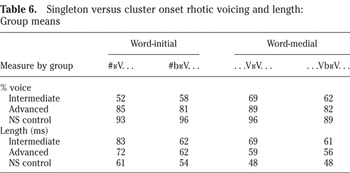
The final prediction made was that voicing should be mastered more readily in singleton onsets than in clusters. As shown in Table 6, this hypothesis was not supported by the intermediate speakers' data.
Singleton versus cluster onset rhotic voicing and length: Group means

For both word-initial and word-medial contexts, there was no significant difference between

and

sequences, with the exception of the NSs' realizations in medial position, F(1, 328) = 7.62, p = .006. Moreover, the sole advanced learner-NS control pairing occurred word-medially in clusters (advanced: 82%; NS: 89%). Once again, it is necessary to consider the phonetic context. As mentioned previously, sequences composed of a voiced stop + rhotic are realized with a cluster-medial epenthetic vowel, and intermediate speakers have not yet mastered cluster-medial epenthesis.
DISCUSSION AND CONCLUSION
The analysis of the experimental data has confirmed previously reported onset-coda asymmetries in the acquisition of a new segmental contrast while providing a number of important new insights into the ways in which L2 learners acquire target language segments, including those that require simultaneous mastery of multiple phonetic parameters. Comparison of the intermediate- and advanced-learner data with data from NS controls reveals that learners master manner before voicing and that this occurs in salient positions (CV) before less salient ones (VC). This conclusion is supported by the higher rate of fricative realizations in onsets, in particular by intermediate speakers. By targeting manner, intermediate speakers hyperarticulate, producing an overly long rhotic that results in devoicing. This strategy allows the L2 learners to produce a greater percentage of targetlike rhotics because their production may involve some devoicing and still be faithful to the target. Codas are also less salient, and learners, especially intermediate ones, have some degree of freedom in the extent to which it is possible to be less faithful to manner and nonetheless produce what is perceived as a targetlike segment. In coda position, greater variation in manner is permitted in the target. The L2 learners benefit from the variation and achieve similar rates of voicing by manipulating this parameter. Finally, no effect was found when comparing singleton rhotics versus those syllabified as the second member of an onset cluster. We have argued that this lack of asymmetry is directly related to the presence of an epenthetic vowel in voiced French stop + rhotic clusters. Learners who master epenthesis create a voicing environment that facilitates nativelike realization of 〈r〉.
The findings of this study make a contribution to existing models of L2 phonetics. First, although not all of the parameters were mastered natively in all contexts, the lack of Englishlike 〈r〉 realizations and the performance of the advanced speakers, in particular, support the speech learning model (Flege, 1987, 1995). Indeed, the L2 learners in question were able to acquire a new segment that lacks a L1 equivalent. Second, it is clear that phonetic theory has important contributions to make to L2 theories of the acquisition of segmental contrasts. L2 learners' production attests to the contrasting forces of hyperarticulation and hypoarticulation; the former, which occurs in prominent (e.g., word-initial) positions, leads to the emphasizing of some parameters while reducing learners' accuracy with others. This was witnessed in the intermediate learners' trade-off between targetlike manner versus sufficient voicing in singleton onsets. In nonprominent positions, including word-final position, hypoarticulation is likely to occur. This might manifest itself as weakening—vocalization, in the present study—or, at an extreme, deletion. In summary, lacking sufficient articulatory control to realize all parameters in all positions, L2 learners will move between hyperarticulation and hypoarticulation until sufficient control has been gained for consistently targetlike realizations.
This onset-coda asymmetry resembles the one observed in NS performance. Moreover, there are interesting ties between the variation patterns attested in L2 phonological acquisition and sound change, where variation is also often attributed to constraints on articulation and perception. First, the onset-coda asymmetry is well documented in sound change, especially for weakening processes (see Ohala & Kawasaki, 1984, for an overview). In cases of weakening (e.g., nasal deletion in French or /s/ aspiration in Spanish), codas are targeted first. Indeed, Diehl and Lindblom (2000) and Lindblom (1996) pointed out that weakening processes, being context-sensitive, can be interpreted as a case of hypoarticulation. Second, this alternation of fricatives and approximants is also observed in changes that affect rhotics in other Romance varieties. For example, it has been shown that an ongoing change from a fricative rhotic to a trill in Spanish is going through an intermediate stage in which approximants are targeted (Colantoni, 2006). As such, the change proceeds by manipulating manner to achieve voicing. In summary, a parallel between SLA and sound change suggests that the positions targeted first in weakening processes are the last ones to be acquired by L2 learners. Regarding the acquisition of rhotics, in particular, L2 learners proceed by small manipulations of the degree of constriction in the same way NSs do when facing variation. The L2 learners' variation vis-à-vis the target is consistent with Steriade's (1999) proposal for sound change that “speakers are actively concerned with avoiding perceptible deviations from established lexical norms, but they are otherwise not averse to linguistic innovation, insofar as it remains covert” (p. 13).
In future research, there are a number of issues that need to be investigated. First, there is a clear need to refine the proposals made here, including the role of position and the interaction of phonetic parameters such as voicing and manner. It will be important to reexamine the categorical nature of these phonetic parameters. For example, manner as discussed here was typically a discrete variable of fricatives versus approximants. Yet we observed the presence of intermediate or mixed realizations in learners' productions. It should also be of interest to expand the empirical basis for comparison. Including beginner learners might allow for the discovery of further asymmetries, as these learners' lack of articulatory control is even greater. Moreover, as we have demonstrated, comparisons between SLA and sound change might offer important insights into the ways in which sound systems, including those of interlanguages, are shaped by the competition between maintenance of contrast and articulatory ease. Further research could be designed to investigate the acquisition of other segmental contrasts that have been known to change and to see whether patterns of variation found in learners' production correlate with diachronic evolution. Finally, production studies should arguably be undertaken with parallel studies on perception. For example, whereas learners might demonstrate a trade-off between different parameters, the question remains as to the extent to which learners' perceptual awareness might constrain such trade-offs. Proposals such as Steriade's (1999) p-map, which argues that constraints on faithfulness between speakers' inputs and outputs are shaped by the degree of perceived confusability, offer interesting frameworks for subsequent research. In the case of rhotic voicing, it is plausible that learners might fail to realize their lack of sufficient voicing, given the absence of phonemic contrasts between a voiced and voiceless dorsal fricative. It might be that, were learners perceptually aware of the difference, faithfulness to the target might have precluded the trade-offs witnessed; perceptual awareness will need to be evaluated.
APPENDIX A
TEXT: LA BISE ET LE SOLEIL
La bise et le soleil se disputaient, chacun assurant qu'il était le plus fort. Quand ils ont vu un voyageur qui s'avançait, enveloppé dans son manteau, ils sont tombés d'accord que celui qui arriverait le premier à le lui faire ôter serait reconnu comme le plus fort. Alors, la bise s'est mise à souffler de toutes ses forces mais plus elle soufflait, plus le voyageur serrait son manteau autour de lui. Finalement, elle renonça à le lui faire ôter. Alors, le soleil commença à briller et au bout d'un moment le voyageur, réchauffé, ôta son manteau. Ainsi, la bise dut reconnaître que le soleil était le plus fort
APPENDIX B
JUDGES' EVALUATION OF SUBJECT PROFICIENCY LEVEL BASED ON READING PASSAGE

APPENDIX C
WORD-READING TASKS STIMULI

APPENDIX D
LEARNERS' REALIZATION OF RHOTIC MANNER: SINGLETONS