Introduction
Specification of germ cell lineage, including haploid gametes and their diploid progenitor population called primordial germ cells (PGCs), is fundamentally important for sexual reproduction. Preformation and epigenesis are two independent modes in the process of PGC specification (Extavour and Akam, Reference Extavour and Akam2003). In the preformation mode, maternally inherited germ plasm components play a determinant role. Asymmetrical cell division ensures that cells containing germ plasm develop into PGCs, which migrate towards and invade gonads. In contrast, the epigenesis mode relies on signals outside the future PGCs for specification (Swiers et al., Reference Swiers, Chen, Johnson and Loose2010). Both modes have been found for PGC specification in amphibians. The preformation mode is found in frogs, while the epigenesis mode is found in newts (Smith, Reference Smith1966; Johnson et al., Reference Johnson, Bachvarova, Drum and Masi2001). Why amphibians have evolved two different specification modes is unknown. The detailed mechanisms of PGC specification in amphibians remains to be fully elucidated. For example, how are the conserved germ cell specification components organized? What are the biochemical functions of the key components, such as Dazl?
Germ cell specification is tightly regulated by a variety of factors conserved in many organisms (Lehmann and Ephrussi, Reference Lehmann and Ephrussi1994; Extavour and Akam, Reference Extavour and Akam2003). Of particular importance is the RNA-binding protein Dazl, which is a member of the DAZ (Deleted in Azoospermia) family. The DAZ family contains three members: Daz, Dazl and Boule. Boule is widely present in invertebrates and vertebrates. Daz is currently found only in primates. Dazl is expressed in all vertebrates studied including humans, chickens, mice, Xenopus, zebrafish (Yen et al., Reference Yen, Chai and Salido1996; McNeilly et al., Reference McNeilly, Saunders, Taggart, Cranfield, Cooke and McNeilly2000; Sekizaki et al., Reference Sekizaki, Takahashi, Tanegashima, Onuma, Haramoto and Asashima2004; Elis et al., Reference Elis, Batellier, Couty, Balzergue, Martin-Magniette, Monget, Blesbois and Govoroun2008; Takeda et al., Reference Takeda, Mishima, Fujiwara, Sakamoto and Inoue2009). The RNA recognition motif (RRM) and at least one DAZ domain are evolutionarily conserved in the DAZ family (Cooke et al., Reference Cooke, Lee, Kerr and Ruggiu1996; Reijo et al., Reference Reijo, Seligman, Dinulos, Jaffe, Brown, Disteche and Page1996). Dazl homologues are specifically expressed in male and female germ cells. It has been proposed that Dazl regulates its target genes by a post-transcriptional mechanism (Reynolds et al., Reference Reynolds, Collier, Maratou, Bingham, Speed, Taggart, Semple, Gray and Cooke2005, Reference Reynolds, Collier, Bingham, Gray and Cooke2007; Shah et al., Reference Shah, Vangompel, Naeem, Chen, Lee, Angeloni, Wang and Xu2010). Dazl RNA accumulates in the vegetal cortex of oocytes and the cleavage furrow of embryos in Xenopus and zebrafish (Houston et al., Reference Houston, Zhang, Maines, Wasserman and King1998; Hashimoto et al., Reference Hashimoto, Maegawa, Nagai, Yamaha, Suzuki, Yasuda and Inoue2004). Dazl homologues of Ambystoma mexicanum and Cynops pyrrhogaster have been identified and characterized (Johnson et al., Reference Johnson, Bachvarova, Drum and Masi2001; Tamori et al., Reference Tamori, Iwai, Mita and Wakahara2004). Dazl has a key role in spermatogonia differentiation and meiosis (Schrans-Stassen et al., Reference Schrans-Stassen, Saunders, Cooke and de Rooij2001). Dazl is also required for pluripotency maintenance of embryonic stem cells (ESC) and germ cell differentiation of ESCs in vitro (Yu et al., Reference Yu, Ji, Cao, Zhu, Li, Zheng, Chen and Feng2009). Loss of Dazl functions causes infertility in fish, frogs, mice and humans (Houston and King, Reference Houston and King2000; Hashimoto et al., Reference Hashimoto, Maegawa, Nagai, Yamaha, Suzuki, Yasuda and Inoue2004; Lin and Page, Reference Lin and Page2005; Kee et al., Reference Kee, Angeles, Flores, Nguyen and Reijo Pera2009).
To assist the further study of germ cell development in amphibians, we cloned Ccdazl cDNA from Cynops cyanurus. Phylogenetic tree analysis indicated that the predicted Ccdazl protein clusters closely with its homologues from other species. Expression analysis of Ccdazl in oogenesis and gonads suggested that Ccdazl plays a role in gametogenesis. These results will facilitate germ cell specification studies in this newt species and in amphibians in general.
Materials and methods
Animal and embryo collection
Adult males and females of Cynops cyanurus were sampled from Chuxiong, Yunnan, China. The embryos in different stages were collected according to previous studies (Wang et al., Reference Wang, Fei and Ye1984). All animal experiments in this study were performed under the animal welfare guidelines and were approved by the Institutional Experimental Animal Review Board, Yunnan University.
RNA extraction
Adult tissues of Cynops cyanurus (ovary, testis, brain, fat, heart, liver, lung, muscle, skin and spleen) were collected from adult Cynops cyanurus. Oocytes from four different stages were collected based on their size and morphology. Total RNA from tissues, oocytes and embryos were extracted using the Animal Total RNA Isolation kit (Foregene, China).
Ccdazl cDNA cloning
Here, 1 μg total RNA from ovary was reverse transcribed to generate the Ccdazl cDNA using the TransScript Two-step RT-PCR Supermix (TransGen Biotech, China). Primers were designed according to the Cydazl homologue sequence (Accession number: AB164065.1; Cynops-Dazl-F1/Cynops-Dazl -R1; Table 1). A single-band PCR product that met the expected size (1000 bp) was obtained. Then the 5′/3′ rapid amplification of cDNA ends (RACE) primers were designed according to the 1000-bp product. The segments at both ends were obtained using the SMARTer RACE 5′/3′ Kit (TaKaRa Bio Inc., USA; Dazl-RACE-3′F1/RACE-UPM, RACE-UPM/Dazl-RACE-5′R1; Table 1). Full-length Ccdazl cDNA was amplified by primers located at the 5′ and 3′ ends (Ccdazl Fx1-FL/Ccdazl Rx1-FL, Ccdazl Fx2-FL/Ccdazl Rx2-FL; Table 1).
Primers used in this study

Quantitative RT-PCR analysis
The first-strand cDNA was generated from the total RNA of adult tissues and oocytes using the TransScript Two-step RT-PCR Supermix (TransGen Biotech, China). Quantitative PCR (qPCR) was performed using the SsoFast EvaGreen Supermix (Bio-Rad Laboratories Inc., USA). The specific qPCR primers for Ccdazl were designed according to full-length cDNA sequence (Ccdazl-qPCR-F/Ccdazl-qPCR-R; Table 1). The internal reference Gapdh was designed based on the Cynops pyrrhogaster Gapdh sequence (Accession number: AB643658.1; Gapdh-qPCR-F/Gapdh-qPCR-R; Table 1).
Amplification of embryo cDNA and qPCR
Full-length cDNA from embryos at different stages were amplified and generated following a protocol for Smart-seq2 (Picelli et al., Reference Picelli, Faridani, Björklund, Winberg, Sagasser and Sandberg2014). qPCR was conducted, as mentioned above (Ccdazl-qPCR-F/Ccdazl-qPCR-R; Table 1).
Sequence assembly and data analysis
Sequences of PCR segments were assembled using Vector NTI software (ThermoFisher). The similarity analysis for the Dazl sequence referred to previous studies (Stothard, Reference Stothard2000). The multiple amino acid sequence alignments were made using DNAMAN software (LynnonBiosoft). The phylogenetic tree was based on the neighbour-joining (NJ) method and was constructed using MEGA4 software (Saitou and Nei, Reference Saitou and Nei1987).
Results
Cloning of Ccdazl cDNA from Cynops cyanurus
To obtain the full-length Cynops cyanurus dazl (Ccdazl) sequence, we extracted RNA from adult ovary of Cynops cyanurus followed by RT-PCR and RACE procedures. Three different Ccdazl cDNAs were identified, namely Ccdazl-I, Ccdazl-II and Ccdazl-III. Ccdazl-I was 1540 bp in length, including 32 bp of the 5′ untranslated region (5′UTR), 599 bp of the 3′UTR, and 909 bp of the open reading frame (ORF), which was predicted to encode a protein with 302 amino acid residues. Ccdazl-I is identical to a predicted protein (Cydazl) from Cynops pyrrhogaster (Tamori et al., Reference Tamori, Iwai, Mita and Wakahara2004), suggesting that the proteins are high conserved in newt species. Separately, the Ccdazl-II (1569 bp) was predicted to encodes a protein with 291 amino acid residues. Lastly, Ccdazl-III (1466 bp) encoded a protein with 176 amino acid residues. Whether the three Dazl isoforms have different functions remains to be investigated (Fig. 1). Note: Nucleotide sequence data reported are available from the GenBank databases under accession numbers MW803135, MW803136 and MW803137.
Schematic diagram of Ccdazl mRNAs. The open reading frames of three Ccdazl mRNAs are indicated by light grey boxes. The black boxes and the darker grey boxes represent the RRM motif and the DAZ repeat, respectively. The arrows indicate the position of the RT-PCR primers.

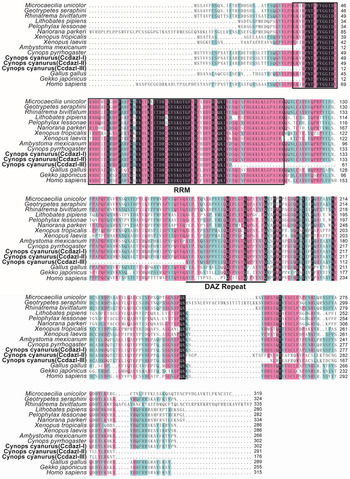
Sequence alignment of amino acid sequences of Dazl homologues is shown in Fig. 2. Each isoform of Ccdazls contained one RRM domain and one DAZ motif, suggesting that they all bound to RNA and regulated RNA functions such as translation.
Multiple sequence alignment of Dazl proteins. The alignment was performed using the Dazl sequences from Cynops cyanurus, amphibians (Microcaecilia unicolor, XP_030058470.1, Geotrypetes seraphini, XP_033786595.1, Rhinatrema bivittatum, XP_029432885.1, Lithobates pipiens, AAV30542.1, Pelophylax lessonae, CAM32330.2, Nanorana parkeri, XP_018428601.1, Xenopus tropicalis, NM_001016823.3, Xenopus laevis, NM_001088259.1, Ambystoma mexicanum, AY542375.1, Cynops pyrrhogaster, AB085215.1), bird (Gallus gallus, NP_990039.2), reptile (Gekko japonicus, XP_015278700.1), and mammal (Homo sapiens, NP_077726.1). The dark blue highlighted sequences indicate that the similarity between homologues is 100%. The purple and light blue highlights represent the similarities of 75–99% and 75–99%, respectively. The RRM motif is shown as black boxes. The DAZ repeat is underlined.

Phylogenetic analysis of Dazl proteins
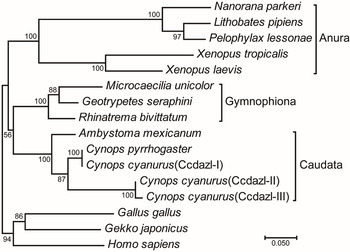
Pairwise sequence analysis of DAZL protein sequences of different species showed that Ccdazl-I, Ccdazl-II and Ccdazl-III were mostly similar to the sequence from Cynops pyrrhogaster, similarity was 100%, 85.0%, and 51.0%, respectively. Identity of Ccdazl-I, Ccdazl-II and Ccdazl-III to the homologues protein of other representative species is shown as follows: Ambystoma mexicanum (82.8%, 68.8, 54.1%), Pelophylax lessonae (63.7%, 53.6%, 39.0%), Xenopus laevis (69.2%, 59.9%, 40.3%), Microcaecilia unicolor (78.0%, 67.9%, 42.6%), Homo sapiens (70.4, 59.6%, 36.1%), Gallus gallus (77.2%,65.3%,40.7%) and Gekko japonicus (68.9%, 57.7%, 46.0%) (Fig. 2). The phylogenetic reconstruction results showed that major clades conformed to three taxa of amphibians, including Gymnophiona, Caudata and Anura. Cynops cyanurus is clustered with Cynops pyrrhogaster (Fig. 3).
Phylogenetic tree analysis of Dazl proteins. The phylogenetic tree was constructed using the neighbour-joining method. Numbers indicate bootstrap values.

Expression pattern of Ccdazl
First, we used quantitative RT-PCR (qRT-PCR) to examine Ccdazl RNA expression. Ccdazl specific primers were designed according to the consensus sequence of Ccdazl-I and Ccdazl-II. The qRT-PCR result confirmed that Ccdazl mRNA is highly expressed in gonads with little expression in somatic tissues. We noticed that the expression level in the ovary was higher than that in testis (Fig. 4). Next, we measured Ccdazl expression from stage I to stage IV oocytes. Ccdazl mRNA expression levels decreased gradually during oogenesis (Fig. 5). During embryogenesis, we also observed that expression levels at early stages (stages 6 and 7) were higher than that at later stages (stages 13, 14, and 20) (Fig. 6). In summary, Ccdazl is mainly expressed in germlines, suggesting that it functions in germ cell formation and maintenance.
Expression of Ccdazl mRNA in adult tissues. Ccdazl mRNA expression in adult tissues was detected by quantitative RT-PCR. Ccdazl mRNA is abundant in ovary and testis. Gapdh was used as the internal reference.

Expression of Ccdazl mRNA during oogenesis. Ccdazl mRNA is highly expressed in the early stages of oogenesis. Then, the expression level gradually decreased. Gapdh was used as the internal reference.

Expression of Ccdazl mRNA during embryogenesis. Embryonic expression of Ccdazl mRNA during stage 6 is higher than during stage 7, and disappears in the later stage. Gapdh was used as the internal reference.

Discussion
The DAZ family proteins have been found in species including C. elegans, Drosophila, zebrafish, Xenopus, mouse, and humans (Eberhart et al., Reference Eberhart, Maines and Wasserman1996; Maegawa et al., Reference Maegawa, Yasuda and Inoue1999; Karashima et al., Reference Karashima, Sugimoto and Yamamoto2000). DAZ family proteins play vital roles in meiosis and gametogenesis based on loss of function studies (Eberhart et al., Reference Eberhart, Maines and Wasserman1996; Ruggiu et al., Reference Ruggiu, Speed, Taggart, McKay, Kilanowski, Saunders, Dorin and Cooke1997; Karashima et al., Reference Karashima, Sugimoto and Yamamoto2000). The RRM domains in DAZ, BOULE, and DAZL are critical for their physiological functions, such as fertility, indicating that the RRM domain is essential for biochemical activities of DAZ proteins (Reijo et al., Reference Reijo, Lee, Salo, Alagappan, Brown, Rosenberg, Rozen, Jaffe, Straus, Hovatta, de la Chapelle, Silber and Page1995). However, biochemical functions of DAZ repeats are unknown (Teng et al., Reference Teng, Lin, Lin, Tsao, Hsu, Lin, Tsai and Kuo2002).
In this study, we cloned three isoforms of Ccdazl cDNAs of Cynops cyanurus and examined their expression patterns in adult tissues and early development. As expected, Ccdazls belong to DAZL members but not to BOULE or DAZ. The RRM domain showed marked homology in all DAZL proteins. The sequence of Ccdazl-I was identical to that of Cydazl, and shares an 82.8% identity with the homologue protein of Ambystoma mexicanum (Axdazl). Interestingly, the identity of Ccdazl-I to mammals is higher than to frogs. These results are in agreement with the previous studies in newt (Johnson et al., Reference Johnson, Bachvarova, Drum and Masi2001; Tamori et al., Reference Tamori, Iwai, Mita and Wakahara2004). as mammals and frogs follow the different germ cells specification modes, it is reasonable to speculate that Cynops cyanurus uses the epigenesis mode. Ccdazl mRNA is abundant in ovary and testis but low or negative in somatic tissues. Ccdazl mRNA was highly expressed in ovary with decreasing expression, suggesting that it may play a role during oogenesis. In addition, the disappearance of Ccdazl mRNA in late-stage embryos suggested that maternal Ccdazl is degraded without zygotic Ccdazl transcripts. Cloning of the three isoforms of Ccdazl cDNAs will pave the way to study their functions in germ cell formation in this newt species and help comparative studies of germ cell specification in amphibians.
Author contributions
Shu Wei and Fang Yan conceived and designed the study. Yinjiao Zhao performed the experiments. Ya Du and Qinglan Ge analyzed the data. Shu Wei wrote the paper. All authors read and approved the manuscript.
Financial support
This work was supported by the National Key Research and Development Program of China (2017YFA0504304), the National Key Research and Development Program of China (2018YFC1003304), the National Natural Science Foundation of China (32060828), the Basic Research Program of Yunnan Province (202001BB050010).
Competing interests
The authors have declared that they have no competing financial interests.
Ethical approval
All animal experiments in this study were performed under the animal welfare guidelines and were approved by the Institutional Experimental Animal Review Board, Yunnan University.