Introduction
Following total laryngectomy, the purported advantages of early oral feeding are increased patient comfort and confidence, reduced length of hospital stay and reduced financial cost. The safety of early oral feeding has been previously investigated.Reference Kishore, Suja, Naveen, Sampath and Satish1–Reference Boyce and Meyers3 More than 50 per cent of the world's people live in developing countries. Unlike developed nations such as the USA, developing countries in Africa and elsewhere have a high prevalence of human immunodeficiency virus infection, tuberculosis, malnutrition and extreme poverty, and a shortage of healthcare staff. All these factors place an additional strain on available health resources and necessitate cost-saving measures. Although there has been a shift toward treating advanced laryngeal cancer with chemoradiation and reserving surgery for salvage in developed countries, primary laryngectomy remains the mainstay of treatment in developing nations due to limited resources.Reference Genden, Ferlito, Rinaldo, Silver, Fagan and Suárez4
Groote Schuur Hospital is situated in Cape Town, South Africa, and serves a low socioeconomic group of patients. Until the commencement of this study, post-operative laryngectomy patients at this hospital were tube-fed for a week via a tracheoesophageal fistula, before oral feeding was commenced. It was considered that early oral feeding following total laryngectomy could have benefits in this hospital, and within underfinanced and understaffed health systems in general.
Materials and method
The aims of this study were: to compare early feeding with conventional, delayed feeding of laryngectomees; to compare complication rates of early feeding in our clinical setting with those reported elsewhere; to identify factors associated with higher rates of early feeding complications; to determine the cost–benefit ratio of early feeding, within a developing country setting; and to determine whether early oral feeding, as reported in centres in developed countries, is appropriate in a developing world context.
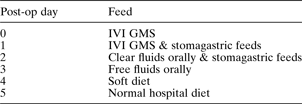
A prospective study was performed of early oral feeding in laryngectomy patients at Groote Schuur Hospital, Cape Town, South Africa. The study was submitted to and approved by the University of Cape Town ethics committee. We excluded from the study patients who required myocutaneous flaps to augment pharyngeal repair; those who had tumour extension to the tongue base, and one patient in whom the cricopharyngeal myotomy inadvertently breached the mucosa. Table I outlines the early feeding protocol used. Data sheets were completed for each patient regarding age, sex, tumour stage, surgery, reported risk factors for pharyngocutaneous fistula formation, and the development of pharyngocutaneous fistulae.
Early feeding protocol

Post-op = post-operative; IVI = intravenous infusion; GMS = general maintenance solution
The outcomes for this early feeding group were compared with those for a (conventionally treated) delayed feeding group. Data for the latter group were collected by retrospective chart review of patients previously treated in the same surgical unit.
Surgery was standardised for both the early and the delayed feeding groups, including pharyngeal closure technique. A Gluck–Sorenson apron flap was used for access. Neck dissection was performed in patients with advanced tumours or with clinical evidence of cervical metastasis. A cricopharyngeal myotomy was routinely performed. A primary tracheoesophageal fistula was created and a Foley catheter inserted through the fistula to act both as a stent and a conduit for stomagastric feeding. A T-shaped or horizontal pharyngeal closure was performed in two continuous layers with vicryl 3/0 thread (Connell suture), depending on whether horizontal repair could be achieved without undue suture-line tension. Methods to test the closure of the pharynx after suturing and before closure, such as the ‘Ambu bag water-leaking test’, were not employed. The platysma muscle was approximated with vicryl, and staples were used to close the skin. A 6 mm closed suction drain was left in situ until the drain fluid was ≤50 mls/24 hours. Antibiotics (ampicillin 1 g 6-hourly and metronidazole 500 g 8-hourly, or augmentin 1.2 g) were administered for 24 hours.
Results
Between November 2002 and December 2006, 56 patients underwent total laryngectomy with or without partial pharyngectomy for advanced cancer of the larynx and hypopharynx. Forty of these fulfilled the criteria for inclusion in the study. Of these 40 patients, 82.5 per cent (n = 33) were male and 17.5 per cent (n = 7) were female. Patients' ages ranged from 36 to 77 years (mean, 60.5 years).
All patients had advanced (tumour (T) grading T3 or T4) squamous cell carcinoma of the larynx with or without hypopharyngeal involvement. Thirteen (32.5 per cent) patients had stage III disease and 27 (67.5 per cent) were stage IV. Partial pharyngectomy for hypopharyngeal tumour extension was required in five patients (12.5 per cent). Twenty-six patients (65 per cent) underwent modified neck dissection, 12 (30 per cent) of which were unilateral and 14 (35 per cent) bilateral.
Pharyngocutaneous fistulae developed in eight (20 per cent) of the 40 patients, being diagnosed on post-operative days three, 10, 10, 11, 11, 12, 12 and 19. These patients were managed by converting oral feeding to stomagastric feeding, using antibiotics where appropriate.
Additional complications observed were haematomas (n = 3) and skin flap necrosis (n = 1). The haematomas were detected on the day of surgery and drained immediately. None of these patients developed pharyngocutaneous fistulae. One patient who underwent salvage laryngectomy and bilateral modified neck dissection, for recurrent carcinoma of the larynx following CO2 laser resection and radiation therapy, developed necrosis of the apron skin flap without developing a pharyngocutaneous fistula. This patient had additional co-morbid factors (hypertension, non-insulin dependent diabetes and a pre-operative haemoglobin level of 9.5 g/dl).
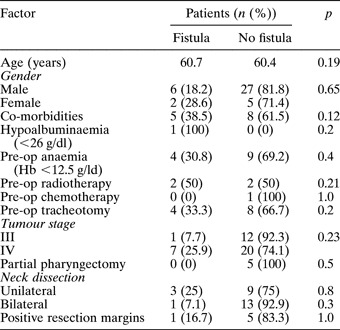
We recorded the following potential risk factors for pharyngocutaneous fistulae development: patient age, gender, other co-morbid factors, tumour stage, hypoalbuminaemia (i.e. serum albumin concentration <26 g/dl), anaemia (i.e. haemoglobin level <12.5 g/dl), prior radiotherapy, chemotherapy, tracheotomy, extent of surgery, and tumour margins. Table II lists possible risk factors for fistula formation. There were no statistically significant relationships between any of these factors and fistula formation.
Possible risk factors for pharyngocutaneous fistula development

Pre-op = pre-operative; Hb = haemoglobin
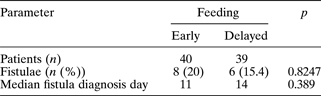
Table III summarises a comparison between the early feeding group and the 39 similar, control patients who had previously undergone laryngectomy with or without partial pharyngectomy, in the same surgical unit, and who had received a delayed oral feeding regime. There was no significant difference in fistula rates between the two groups (p = 0.825), and there was no significant difference in the median post-operative day of fistula diagnosis (p = 0.389).
Pharyngocutaneous fistula development in early vs delayed oral feeding groups

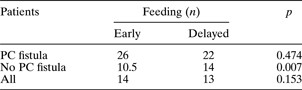
Comparison of the median durations of hospital stay for the early and delayed feeding groups is shown in Table IV. The length of hospital stay was calculated from the day of surgery to the day of hospital discharge. The duration of hospital stay ranged from seven to 37 days for the patients receiving delayed oral feeding and from six to 63 days for those receiving early oral feeding; medians were 14 and 13 days, respectively (p = 0.153). Hospitalisation was less than or equal to 36 days, except for one 66-year-old man with stage III cancer of the larynx, who was hospitalised for 63 days. This patient had chronic obstructive airways disease and a low pre-operative haemoglobin level. He developed wound sepsis post-operatively and, on the 11th post-operative day, wound dehiscence. His pharyngocutaneous fistula was diagnosed on the 19th post-operative day, hence the extended hospital stay. Statistically, there was no difference in overall lengths of hospitalisation between the two groups. However, if patients who developed pharyngocutaneous fistulae are excluded from analysis, the median duration of hospital stay was shorter for those receiving early oral feeding (p = 0.007).
Patients' median length of hospital stay

PC = pharyngocutaneous
Discussion
The principal objectives of early feeding of laryngectomees are: to reduce financial costs; to expedite the patient's psychological rehabilitation; to increase patient comfort; to reduce nursing requirements; and to reduce length of hospitalisation.
Traditionally, oral feeding has been delayed for at least seven days after laryngectomy.Reference Kishore, Suja, Naveen, Sampath and Satish1–Reference Boyce and Meyers3 This has been based on a misunderstanding of the healing process of the pharynx, according to which oral feeding was delayed to allow for healing of the pharyngeal suture line.Reference Applebaum and Levine5, Reference Cantrell6 It is now known that the skin incision heals in a watertight fashion within 24 to 48 hours. It is reasonable to assume that the pharyngeal mucosa could also do so within the same period of time.Reference Kishore, Suja, Naveen, Sampath and Satish1
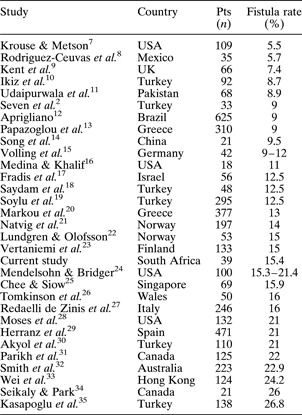
Reported pharyngocutaneous fistula rates in conventional, delayed feeding groups of laryngectomy patients vary from 5.5 to 26.8 per cent (Table V). Our historical delayed feeding control group had a fistula rate of 15.4 per cent.
Reported pharyngocutaneous fistula rates for delayed postlaryngectomy oral feeding

Pts = patients
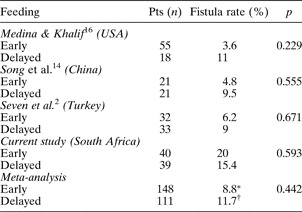
Table VI presents the results of three previous reports that compared early and delayed postlaryngectomy feeding, plus those of the present study.Reference Seven, Asli and Suat2, Reference Song, Jing and Shi14, Reference Medina and Khalif16 Meta-analysis of all these results reveals no significant difference in fistula rates between early and delayed feeding groups (p = 0.442). In the study by Medina and Khalif, lower fistula rates could be attributed in part to exclusion of patients with abnormal haemoglobin, albumin and total protein levels, as well as of those who had undergone partial pharyngectomy or had been previously irradiated. These authors also ensured intra-operatively that there was no leakage through the pharyngeal repair, by injecting water into the pharynx.Reference Medina and Khalif16 Seven and colleagues' inclusion criteria were similar to our own.Reference Seven, Asli and Suat2 Whereas our pharyngeal closure was T-shaped or horizontal, Medina and Khalif's was T-shaped and Seven and colleagues' was T-shaped or straight. In the latter two studies, peri-operative antibiotics were administered until the drains were removed, while we gave antibiotics for 24 hours only.
Studies of early vs delayed postlaryngectomy feeding, and meta-analysis

* 13/148 patients; †13/111 patients. Pts = patients
No factors predisposing to fistula formation emerged from our analysis of our patients receiving early oral feeding. Similarly, Seven et al. Reference Seven, Asli and Suat2 did not find any statistically significant predisposing factors, although they observed a trend suggesting that advanced T stage increased the risk of pharyngocutaneous fistula development. Parikh et al. Reference Parikh, Irish, Curran, Gullane, Brown and Rotstein31 found no association between pharyngocutaneous fistula development and age, gender, patient morbidity factors, tumour–node–metastasis stage, choice of ablation, choice of reconstruction, modality of post-operative feeding or primary tracheoesophageal puncture. Morton et al. Reference Morton, Mehanna, Hall and McIvor36 reported that extended laryngectomy and increased amylase in the neck drains were the only significant predictors of fistula formation; previous radiotherapy, neck dissection, pre- and post-operative haemoglobin and albumin levels, and post-operative transfusion were not significant predictors. Pre- and post-operative haemoglobin levels of <12.5 g/dl have been associated with pharyngocutaneous fistulae in some studies.Reference Radaelli de Zinis, Ferrari, Tomenzoli, Premoli, Parrinello and Nicolai27, Reference Lavelle and Maw37, Reference Horgan and Dedo38 This was not evident in our series. Similarly, Seikaly and ParkReference Seikaly and Park34 did not find pre-operative haemoglobin level to be a significant risk factor. Hypoalbuminaemia has been shown to delay the rate and quality of wound healing.Reference Gray and Cooper39 However, as only one patient in our study had a low serum albumin level (25 g/dl), it is not possible to draw any conclusions as regards hypoalbuminaemia and pharyngocutaneous fistula formation. There are conflicting reports about the association between pre-operative radiotherapy and pharyngocutaneous fistulae.Reference Kent, Liu and Das Gupta9, Reference Aprigliano12, Reference Fradis, Podoshin and David17, Reference Natvig, Boysen and Tausj21, Reference Mendelsohn and Bridger24, Reference Radaelli de Zinis, Ferrari, Tomenzoli, Premoli, Parrinello and Nicolai27, Reference Seikaly and Park34, Reference Weigrad and Spiro40–Reference Sarkar, Mehta, Tiwari, Mehta and Mehta44 Four patients in the present study had received pre-operative radiotherapy, half of whom later developed fistulae. Advanced tumour stage is associated with more frequent pre-operative tracheostomy, wider surgical resection and a higher likelihood of neck dissection. These factors have been reported in some studies to predispose to pharyngocutaneous fistulae,Reference Boyce and Meyers3, Reference Wei, Lam, Wong and Ong33, Reference Horgan and Dedo38, Reference Davidson, Briant, Gullane, Keane and Rawlinson45 while others have found no such association.Reference Kishore, Suja, Naveen, Sampath and Satish1, Reference Lavelle and Maw37, Reference Heir, Black and Lafond41, Reference Cavalot, Gervasio, Nazionale, Albera, Bussi and Staffieri46 No such association was found in our study. Cavalot et al. Reference Cavalot, Gervasio, Nazionale, Albera, Bussi and Staffieri46 reported lower rates of pharyngocutaneous fistulae in patients who had undergone accompanying neck dissection. Markou et al. Reference Markou, Vlachtsis, Nikolaou, Petridis, Kouloulas and Dahiilidis20 found a statistically significant correlation between positive surgical margins and pharyngocutaneous fistula development; however, Qureshi et al. Reference Qureshi, Chaturvedi, Pai, Chaukar, Deshpande and Pathak47 did not find any such association.
• Most centres still delay oral feeding following total laryngectomy
• Three previous studies have demonstrated the benefits and safety of early feeding
• This prospective study compared patients receiving early oral feeding with retrospective, historical controls receiving delayed feeding
• There was no significant difference in pharyngocutaneous fistula rates
• In patients who did not develop fistulae, hospitalisation was shorter in the early oral feeding group
• Early oral feeding is recommended
The median length of hospital stay for the early feeding study group did not significantly differ from that of the (historical) delayed feeding group. Statistically, there was no significant difference in overall lengths of hospitalisation between the two groups. However, when one excludes patients who developed pharyngocutaneous fistulae, the median duration of hospital stay was shorter for patients receiving early oral feeding. These findings are however not necessarily an accurate reflection of the minimum duration of hospitalisation that can be achieved under more optimal socioeconomic conditions, as hospital discharge of poor patients or those living far from the hospital is often delayed by waiting for speech prosthesis fitting or for public transport. Kishore et al. Reference Kishore, Suja, Naveen, Sampath and Satish1 reported a shorter duration of hospital stay among patients receiving early oral feeding compared with controls. Seven et al. Reference Seven, Asli and Suat2 found no significant difference in the length of hospital stay between the study and control groups with or without pharyngocutaneous fistulae.
Although we did not measure the psychological benefit of early feeding, Kishore et al. Reference Kishore, Suja, Naveen, Sampath and Satish1 reported that all the patients in their control group (i.e. delayed oral feeds) stated their desire for removal of the feeding tube and initiation of oral feeding. Soylu et al. Reference Soylu, Kiroglu, Aydogan, Cetik, Kiroglu and Akçali19 reported that patients felt more comfortable and confident without a feeding tube.
Conclusions
For lower socioeconomic group patients within developing nation health systems, early commencement of postlaryngectomy oral feeding may not reduce the overall length of hospitalisation, but it has advantages in terms of psychological benefit to the patient, reduced need for specialised nursing care and reduced financial cost (by avoiding special enteral tube feeds). The results of the present study concur with those of previous reports, i.e. that early oral feeding is safe in patients who have undergoing laryngectomy, both with and without neck dissection, and that it can be recommended in both developing and developed world settings.