Introduction
‘Low birth weight’ (LBW) is an important determinant of neonatal and post-neonatal mortality and morbidity, linked to ill health in childhood and later life (Kramer, Reference Kramer1987, Reference Kramer1990). Numerous epidemiological studies have demonstrated severe negative effects, including delays in childhood development, early onset of diabetes and various adulthood chronic diseases, mainly of the circulatory system (Barker, Reference Barker1994, Reference Barker1998; Huxley et al., Reference Huxley, Shiell and Law2000; Strauss, Reference Strauss2000). According to the World Health Organization, infants weighing less than 2500 g at birth are classified as LBW, while those weighing below 1500 g are classified as ‘very low birth weight’ (VLBW) (WHO, 2004).
The effects of ‘heavy birth weight’ (HBW), on the other hand, have been explored systematically only recently. In the short-term, there are greater risks of delivery complications and, for birth weights above 5000 g, a higher risk of neonatal and infant mortality (Boulet et al., Reference Boulet, Alexander, Salihu and Pass2003). In the long-term there is a greater likelihood of developing type 1 diabetes in childhood and rheumatoid arthritis later on (Mandl et al., Reference Mandll, Costenbader, Simard and Karlson2009; Cardwell et al., Reference Cardwell, Stene, Joner, Davis, Cinek and Rosenbauer2010). Additionally, HBW females exhibit higher chances of becoming obese adolescents and developing type 2 diabetes, thus facing increased risks of cardiovascular disease (Wang et al., Reference Wang, Gao, Wu, Zhou, Yang and Walker2009; Huang et al., Reference Huang, Mori, Burrows, Ha, Oddy and Herbison2012). While there is no standard definition of HBW, the most frequent cut-off points are 4000 or 4500 g (Boulet et al., Reference Boulet, Alexander, Salihu and Pass2003; Donma, Reference Donma2011).
Over the past 20 years the reduction of the incidence of LBW has become an important policy issue since it would amount to a decrease in infant mortality both in developed and developing countries. Such a decline was outlined as a major goal in A World Fit for Children, the Declaration and Plan of Action adopted by the United Nations General Assembly Special Session on Children in 2002 (WHO, 2004). Moreover, keeping LBW babies alive and, in particular, VLBW babies, is extremely costly, while their poor health status later on entails additional medical expenses (Frisbie et al., Reference Frisbie, Forbes and Pullum1996; Reime et al., Reference Reime, Ratner, Tomaselli-Reime, Kelly, Schuecking and Wenzlaff2006; Russel et al., Reference Russell, Green, Steiner, Meikle, Howse and Poschman2007). Recent research suggests that HBW babies may also induce extra costs to health care systems through higher rates of Caesarean section deliveries, obstetric/perinatal complications and later life morbidity (Rouse et al., Reference Rouse, Owen, Goldenberg and Cliver1996; Jolly et al., Reference Jolly, Sebire, Harris, Regan and Robinson2003). Hence, identification of modifiable determinants and of possible mediators is crucial for the control of health expenditure and achieving further reductions in infant mortality.
Most research in the past has focused on factors related to LBW. There are certain non-modifiable demographic factors affecting birth weight in general, such as sex of the baby, parity and multiplicity of birth; females are lighter than males and the same holds for first and multiple births (Astolfi & Zonta, Reference Astolfi and Zonta1999; Mohsin et al., Reference Mohsin, Wong, Bauman and Bai2003; Meggiolaro, Reference Meggiolaro2009). Mothers over age 35, as well as teenage mothers, tend to have lighter babies (Machado, Reference Machado2006). A woman's body mass index before the pregnancy, her nutritional intake and weight gain, as well as infections and medical conditions occurring during pregnancy and certain genetic factors, also seem to play a part (Kramer et al., Reference Kramer, Séguin, Lydon and Goulet2000; Kramer, Reference Kramer2003). Modifiable factors include, among others, risky health behaviours such as smoking, excessive alcohol consumption and use of narcotic substances, which may have a detrimental effect on birth weight (Rodriguez et al., Reference Rodriguez, Regidor and Gutierrez-Fisac1995; Kesmodel et al., Reference Kesmodel, Wisborg, Olsen, Henriksen and Secher2002). Many of the aforementioned adverse biological and behavioural risk factors are more prevalent among persons of low socioeconomic status; it has been found that indicators such as low educational attainment, material deprivation, unemployment, psychosocial stress and single motherhood are strongly associated with LBW (Rodriguez et al., Reference Rodriguez, Regidor and Gutierrez-Fisac1995; Cheung & Yip, Reference Cheung and Yip2001; Mulder et al., Reference Mulder, Robles de Medina, Huizink, Van de Bergh, Buitelaar and Visser2002; Reime et al., Reference Reime, Ratner, Tomaselli-Reime, Kelly, Schuecking and Wenzlaff2006; Meggiolaro, Reference Meggiolaro2009). Regarding factors related to HBW, there is some evidence that maternal obesity and gestational diabetes mellitus have a strong effect; advanced age of the mother has also been linked to a higher incidence of HBW (Boulet et al., Reference Boulet, Alexander, Salihu and Pass2003; Jolly et al., Reference Jolly, Sebire, Harris, Regan and Robinson2003; Donma, Reference Donma2011). Possible associations with socioeconomic status, however, have not been explored in depth yet.
Race and immigrant status have diverse associations with birth weight (Urquia et al., Reference Urquia, Glazier, Blondel, Zeitlin, Gissler and Macfarlane2010). Genetic characteristics such as maternal stature, weight and height play a part; Caucasian babies, for instance, tend to be heavier than Asian infants (Wen et al., Reference Wen, Kramer and Usher1995). Another layer of complexity is introduced by selectivity among immigrants. According to the healthy migrant theory, immigrants tend to be healthier than their counterparts in the country of origin while they also maintain a healthier life style in the country of destination, thus having better birth outcomes compared with the indigenous population or second-generation immigrants (Kramer et al., Reference Kramer, Séguin, Lydon and Goulet2000; Wingate & Alexander, Reference Wingate and Alexander2006). Foreign-born women in the USA and European countries, for example, have better birth outcomes than native women (Acevedo-Garcia et al., Reference Acevedo-Garcia, Soobader and Berkman2007; Gagnon et al., Reference Gagnon, Zimbeck and Zeitlin2009; Verropoulou & Tsimbos, Reference Verropoulou and Tsimbos2012).
The present analysis uses individual-level vital registration data on the live births of singletons occurring in Hong Kong in the period 1995–2009 to explore the associations of socio-demographic factors with adverse pregnancy outcomes, putting emphasis on the immigrant status of the parents. This later aspect is very important since, in the more recent period, a very high proportion of the births occurring in Hong Kong are to Mainland Chinese parents. Use of such a large dataset has a significant advantage; whereas most similar analyses consider all LBW births as a homogeneous group, in this instance the sample size allows separate consideration of VLBW babies. Additionally, it allows examination of risk factors related to HBW infants, which have been identified as a high-risk group only recently. The present study, hence, employs multinomial logistic regression techniques and aims at: (1) identifying and distinguishing between factors linked to VLBW, LBW and HBW births; (2) ascertaining the importance of socioeconomic risk factors in each of these instances; and (3) detecting differentials in adverse pregnancy outcomes between immigrant groups.
Methods
Data
The data come from the vital registration system of Hong Kong and include all live births recorded in the period 1995–2009. The available information includes sex of the baby, birth order, birth weight (in grams), multiple deliveries, age of parents, their educational attainment and occupation, their usual place of residence, whether born in Hong Kong, previous place of residence if not born in Hong Kong, length of stay in Hong Kong, marital status of the mother and housing of the mother. It should be noted that birth registration forms do not include any information on gestational age. Information on weight at birth is provided to the relevant authorities (including the Immigration Department) by the hospital via a form called ‘Birth Return’.
In the period under investigation there were 897,180 live births recorded, 19,278 or 2.15% of which were multiple; these were discarded as they are usually low birth weight (Joseph et al., Reference Joseph, Kramer, Marcoux, Ohlsson, Wen, Allen and Platt1998; Mohsin et al., Reference Mohsin, Wong, Bauman and Bai2003). Of the remaining 877,902 births, another 48,927 were dropped due to incomplete data in the variables of interest; hence, the analysis is based on 828,975 births of singletons.
Measures
The dependent variable includes four categories, comparing adverse pregnancy outcomes with births of normal weight. More specifically, VLBW births (<1500 g), LBW births (≥1500 g and <2500 g) and HBW births (≥4500 g) are all compared with normal weight births (≥2500 g and <4500 g), which represent the most numerous group. This categorization allows adverse outcomes to be compared strictly with normal weight births.
Concerning the characteristics of the baby there are two explanatory variables included in the models: a binary indicator comparing male (=1) with female births (=0), with a second comparing first births with births of second or higher order. Year of birth is also introduced in the models as a control. All other regressors reflect paternal and maternal characteristics. Maternal age is represented by a three-category variable: teenagers and women aged 35 or higher are compared with women aged 20–34 (reference category). Married mothers (=1) are compared with single mothers (=0); women whose marital status is unknown form a third group so as to be included in the analysis.
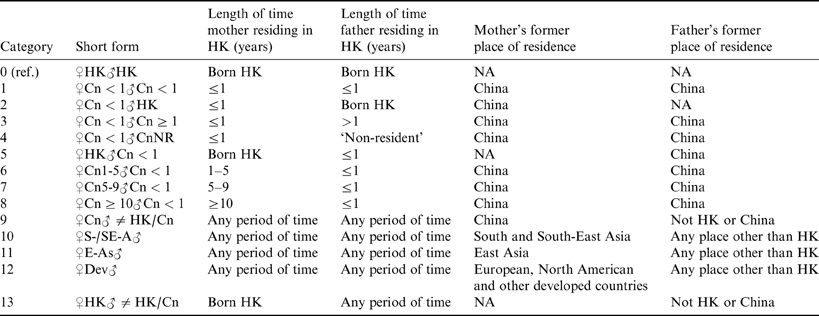
Socioeconomic status (SES) is represented by paternal educational attainment and occupation. Maternal socioeconomic characteristics were dropped from the models following exploratory analysis as these became non-significant when paternal SES was introduced. Educational qualifications of the father constitute a three-category variable comparing men who have completed some years in secondary (6–12 years) and in tertiary education (at least 13 years) with those who have no qualifications or have completed at the most primary education (0–6 years) (reference category). The variable on occupation distinguishes managers, professionals and associate professionals (=0) from clerks and service workers (=1), semi-skilled and unskilled occupations (=2) (i.e. craft workers, plant and machine operators, etc.) and economically inactive/unemployed persons (=3). As another proxy of SES a variable on the mother's housing is used as that has been found to be significant in the past (Cheung & Yip, Reference Cheung and Yip2001). This variable compares women living in public housing (i.e. affordable housing provided by the Government of Hong Kong, usually subsidised) and those who live in temporary housing (non-permanent structures) with those who can afford private housing (reference category). Finally, a detailed variable representing immigrant status of the parents is included, comprising fourteen migrant groups, differentiated by period of time spent in Hong Kong and place of former residence (if any) of both father and mother. The reference category includes newborns whose father and mother were born in Hong Kong (see Table 1); the remaining categories represent combinations of Mainland Chinese and Hong Kong Chinese as well as other Asian or European groups.
Immigrant categories in analysis, Hong Kong (HK) SAR, 1995–2009

Analysis
The effects of demographic and socioeconomic factors on adverse pregnancy outcomes are assessed using multinomial logistic regression models since the response variable is nominal and includes four categories (Agresti, Reference Agresti2002). The technique provides estimates of Relative Risk Ratios (RRR) or, in effect, three sets of odds ratios, each comparing an adverse pregnancy outcome with having a normal birth. Hence, in this case the multinomial model is equivalent to the estimation of a set of three multiple logistic regressions. The overall goodness-of-fit of the models is evaluated on the basis of the Likelihood Ratio chi-squared test. The statistical analysis was carried out using STATA 10.1.
Results
Descriptive statistics
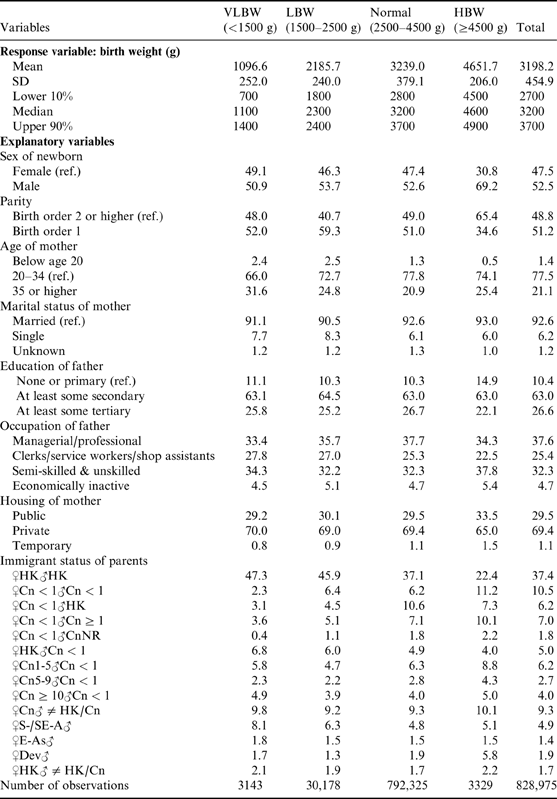
Descriptive statistics (means and standard deviations, percentiles and medians) for the response variable, as well as the percentage distribution of the explanatory variables by birth weight category and for the whole sample, are shown in Table 2. Though the total number of observations in the study is very substantial (828,975 births), only a tiny proportion is recorded in the extreme categories; VLBW births constitute only 0.4% of the sample, LBW represent 3.6% and HBW another 0.4%. This further justifies taking into account births over a long period of time so as to obtain more accurate estimates. The overall incidence of low birth weight (<2500 g) based on the sample is about 4% among singleton births, or would have been 5% if multiple births had been taken into account. The latter figure is fairly low compared with the rest of Asia according to the WHO figures for 2000, but identical to the one published for Hong Kong and very similar to the 6% reported for China (WHO, 2004).
Relative distribution of explanatory variables and descriptive statistics for dependent variable (N=828,975), Hong Kong SAR, 1995–2009
There is a slight excess of male newborns for most birth weight groups but excess for HBW is marked (69% of males against 31% of females). First births constitute slightly more than half of the sample; among LBW births, however, they represent 60% while among HBW only they represent 35%. About 78% of the mothers in Hong Kong are aged 20–34 while 21% are aged 35 or higher. The proportion of older mothers, however, is higher among compromised birth outcome categories, reaching 32% for VLBW babies. The proportion of single mothers is somewhat higher among babies weighing below 2500 g. Regarding paternal educational qualifications, the proportion of fathers with at least some tertiary education is similar across birth weight categories, the only exception being HBW, where that percentage is lower. As far as paternal occupation is concerned, fathers of normal weight babies have better occupations, followed by fathers of LBW, VLBW and HBW newborns. Regarding maternal housing, the only category that presents a slightly different profile to the norm is mothers of HBW babies, who seem worse off. Finally, the proportion of couples where at least one of the partners was born in Hong Kong is highest among VLBW and LBW births and lowest among HBW babies. In contrast, relatively high proportions of HBW babies can be observed among groups of Mainland Chinese parents and mothers from developed countries.
Multinomial logistic regression models
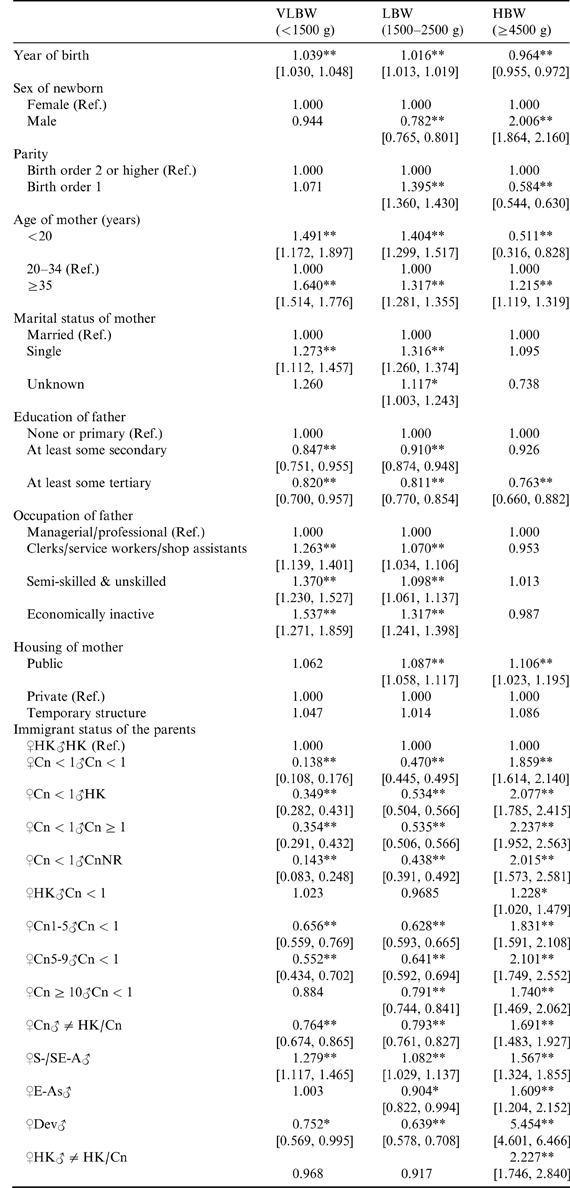
Table 3 shows relative risk ratios and 95% confidence intervals based on multinomial logistic regression for the births occurring between 1995 and 2009 in Hong Kong. All models control for year of birth of the baby. Regarding VLBW births, sex and primiparity are not significant in this instance. Teenage mothers face 49% higher chances of such an outcome, while the odds for women aged 35 or more are greater by 64% compared with mothers aged 20–34. Single motherhood is strongly related to higher chances of a VLBW birth. By contrast, higher educational attainment of the father and higher occupational class have a significant and independent protective effect; clerks/service workers, men in semi-skilled/unskilled occupations and economically inactive/unemployed men have progressively increasing chances compared with managerial/professional occupations, of having a VLBW infant. With respect to immigrant status of the parents, being a Chinese transient mother, or a Chinese mother resident in Hong Kong for less than 10 years, significantly reduces the chances of a VLBW birth; this also holds for mothers born in developed countries (e.g. the USA, Western Europe). In contrast, women born in South-East Asia have higher chances of an adverse outcome. Other groups where the mother only was born in Hong Kong do not differentiate compared with the reference category.
Relative risk ratios [95% CIs] based on multinomial logistic regression for all births, Hong Kong SAR, 1995–2009 (N=828,975)
Ref., reference category: normal weight full-term births.
Log Likelihood=–168489.17; χ2 (df 81)=6421.12 ; sig.=0.000.
**Significant at the 1% level; *significant at the 5% level.
The chances of a LBW birth increase by about 2% per year while the odds are significantly lower among males, but higher by about 40% among first births. Teenage mothers and women aged 35 or higher face about 40% and 32% higher chances, respectively, of such a birth compared with the reference category. Single mothers are also at a disadvantage compared with married mothers. Higher educational attainment of the father is linked to lower chances of a LBW birth. Higher occupational class also has a significant protective effect, though not as pronounced as for VLBW births; babies of economically inactive/unemployed fathers seem again to be the worst off. Finally, mothers living in public housing have a 9% higher chance of an adverse outcome compared with mothers living in privately rented or owned housing. Regarding mother's and father's immigrant status, women born in Mainland China or in developed countries have significantly lower chances of a compromised outcome, by about 40–60%, compared with parents born in Hong Kong. In contrast, women born in South and South-East Asia experience slightly higher odds of a LBW birth.
Regarding the last category of adverse birth outcomes, HBW births, the chances of such an outcome significantly decrease over time. Sex and birth order are important factors; male sex doubles the chances while primiparity nearly halves the odds of such a birth. Being a teenage mother in this instance has a strong protective effect while being over age 35 substantially increases the chances of a HBW birth by 20%. Marital status of the mother has no association. Having tertiary educational qualifications has a significant protective effect, though occupation of the father seems of no importance. Mothers living in public housing have significantly higher odds of an adverse outcome. Finally, regarding citizenship, parents born in Hong Kong seem to have the best outcome in this case; mothers from Mainland China have about double the chance of a HBW birth, women from East Asia, South and South-East Asia have about 50–60% higher odds, while women from developed countries have a staggering 545% higher chance of such a birth.
Discussion
The present paper employs a large dataset of 828,975 births that occurred in Hong Kong in the period 1995–2009 to explore the effects of socio-demographic factors and immigrant status of the parents on compromised pregnancy outcomes. Use of such a large dataset enables investigation of associations, not only for LBW but also VLBW and HBW births; the latter pregnancy outcome has only recently been recognized as adverse. The analysis was performed using multinomial logistic regression models, controlling for year of birth.
The incidence of births below 2500 g in Hong Kong is fairly low in the overall period according to both the present data and WHO (2004); in fact, it is one of the lowest in Asia and comparable to the respective figures for Europe (6%). The findings of the research indicate that sex and birth order have the expected significant association with birth weight, albeit only for births above 1500 g. Female and first-born babies tend to weigh less and, hence, they are more likely to be LBW but less likely to be HBW. Most other studies have reported similar findings (Astolfi & Zonta, Reference Astolfi and Zonta1999; Boulet et al., Reference Boulet, Alexander, Salihu and Pass2003; Mohsin et al., Reference Mohsin, Wong, Bauman and Bai2003; Meggiolaro, Reference Meggiolaro2009). These two factors do not seem significant regarding VLBW births. This latter category includes mostly preterm deliveries and represents the most compromised pregnancy outcome. Such births are strongly related to infections occurring during pregnancy (e.g. bacterial vaginosis), conditions such as pregnancy-induced hypertension (Wessel et al., Reference Wessel, Cnattingius, Bergstrom, Dupret and Reitmaier1996; Chaim et al., Reference Chaim, Mazor and Lieberman1997; Kramer, Reference Kramer2003) and past history of preterm births (Adams et al., Reference Adams, Elam-Evans, Wilson and Gilbertz2000; Kramer, Reference Kramer2003).
Teenage mothers, and especially mothers over age 35, face higher risks of an adverse pregnancy outcome, particularly VLBW and LBW births, a fact that has been reconfirmed in past studies (Astolfi & Zonta, Reference Astolfi and Zonta1999; Machado, Reference Machado2006). Regarding HBW births, the adverse effects of the advanced age of the mother have been noted before (Boulet et al., Reference Boulet, Alexander, Salihu and Pass2003; Donma, Reference Donma2011). On the other hand, teenage motherhood has a strong protective effect in the present study.
Socioeconomic characteristics of the father and of the mother are very important factors related to birth weight. Lower occupational class and, in particular, economic inactivity/unemployment of the father are significant predictors of LBW, while the effect is more pronounced among VLBW births. No association was found with HBW. Paternal educational attainment also has an independent protective effect against VLBW and LBW; having some tertiary education additionally protects strongly against having a HBW birth. A pronounced socioeconomic gradient in LBW has been found in past research, mainly with respect to maternal education or occupation, but also paternal characteristics or more complex indices based on both parents (Golding & Shenton, Reference Golding and Shenton1990; Bener et al., Reference Bener, Abdulrazzaq and Dawodu1996; Letamo & Majelantle Reference Letamo and Majelantle2001; Torres-Arreola et al., Reference Torres-Arreola, Constantino-Casas, Flores-Hernández, Villa-Barragán and Rendón-Macías2005). In Hong Kong, higher maternal educational qualifications had the effect of increasing birth weight among births occurring between 1984 and 1997 (Cheung & Yip, Reference Cheung and Yip2001). In that instance, however, paternal qualifications and occupation had not been taken into account. In contrast, in the present study maternal occupation and education were found to be non-significant once the respective paternal characteristics were included in the models.
Material deprivation, as implied by single motherhood and public housing, are also significant predictors. Public housing has been found, in past studies of birth weight in Hong Kong, to be an important factor reducing birth weight in OLS models (Cheung & Yip, Reference Cheung and Yip2001). In the present analysis it was found to be significant in predicting both LBW and HBW. Single motherhood, which in this instance includes both unpartnered and partnered unmarried mothers, captures another dimension of socioeconomic disadvantage since it reflects hardship as well as psychosocial stress, particularly in a country where such behaviour still represents a deviation from established norms (Rodriguez et al., Reference Rodriguez, Regidor and Gutierrez-Fisac1995; Pattenden et al., Reference Pattenden, Dolk and Vrijheid1999). The results of the present study reconfirm a significantly greater propensity among unmarried women to have a VLBW or LBW birth (Mohsin et al., Reference Mohsin, Wong, Bauman and Bai2003; Reime et al., Reference Reime, Ratner, Tomaselli-Reime, Kelly, Schuecking and Wenzlaff2006; Chiavarini et al., Reference Chiavarini, Bartolucci, Gili, Pieroni and Minelli2011; Tsimbos & Verropoulou, Reference Tsimbos and Verropoulou2011). Overall, a strong socioeconomic gradient in adverse birth weight outcomes has been demonstrated that is more pronounced among births below 2500 g.
Immigrant status seems to be important in defining risks of adverse pregnancy outcomes. Parents from Mainland China, independent of whether they are transient immigrants or Hong Kong residents, have significantly lower odds of a VLBW and a LBW delivery compared with parents born in Hong Kong, followed by couples where the mother was born in developed countries. Couples where the mother originates in South and South-East Asia, on the other hand, have a higher risk. Regarding HBW births, all foreign-born mothers run a higher risk of such a birth compared with parents born in Hong Kong; the odds are especially high for babies of women born in developed countries.
Past studies have found genuine differences in fetal growth between racial/ethnic groups that are, at least partly, attributable to maternal weight and height (Wen et al., Reference Wen, Kramer and Usher1995; Drooger et al., Reference Drooger, Troe, Borsboom, Hofman, Mackenbach and Moll2005). This is supported by the results of the present study since mothers originating in developed countries such as the USA and Western European countries having a higher BMI compared with Asian women, seem more likely to have heavier offspring. A greater propensity for LBW births among Asian women in the USA, the UK and other developed countries has been noted before (Parker et al., Reference Parker, Schoendorf and Kiely1994; Acevedo-Garcia et al., Reference Acevedo-Garcia, Soobader and Berkman2005; Gagnon et al., Reference Gagnon, Zimbeck and Zeitlin2009; Urquia et al., Reference Urquia, Glazier, Blondel, Zeitlin, Gissler and Macfarlane2010). The better outcome of Mainland Chinese mothers compared with those born in Hong Kong, regarding LBW and VLBW outcomes, may be related to these women representing a selected group of immigrants who come specifically to give birth in the territories, and who arrive fairly late in their pregnancy, near term. It also conforms to the healthy migrant theory, which suggests better health for recent immigrants and better outcomes among foreign-born women of the same ethnicity (Wingate & Alexander, Reference Wingate and Alexander2006; Acevedo-Garcia et al., Reference Acevedo-Garcia, Soobader and Berkman2007). The greater tendency of women from South and South-East Asia to have LBW and HBW births may be partly related to genetic factors and a physiological tendency for down-regulation of fetal growth (Leon & Moser, Reference Leon and Moser2012); in fact, the WHO estimate of low birth weight incidence in South-East Asia in 2000 (WHO, 2004) is 11.6%, about double the respective figures for China (6%) and Hong Kong (5%).
Contrasting risk factors increasing the chances of LBW and HBW births – female sex and primiparity – have opposing effects, increasing the odds in the first case but decreasing them in the second. Age of mother also has a differential impact; whereas women over age 35 have a higher chance of an adverse outcome in both instances, though more pronounced for VLBW, teenage motherhood has a protective effect regarding HBW births. Finally, the impact of lower socioeconomic profile is a severe disadvantage regarding LBW but seems less important with respect to HBW; in the latter case only tertiary paternal educational qualifications and maternal housing were found to be significant.
Limitations of the study
A few limitations of the study should be mentioned. The most important is the lack of any information on the gestational age of the baby. This is very unfortunate since the substantial number of cases would have allowed separate analysis and observation of very small and particular groups, such as ‘LBW and preterm’ against ‘LBW and term’ births. On the other hand, it is very likely that VLBW births are mostly preterm and hence they may correspond roughly to the ‘LBW and preterm’ birth category.
Another limitation is the recording of birth weight to the nearest 100 g, which may reduce accuracy as, for instance, a baby born weighing 2450 g may have been reported as 2500 g and fall wrongly in the normal weight category. However, as the dependent variable is categorical, miss-recording at the fringes is not likely to introduce any severe bias in the analysis if it is non-systematic.
Finally, the lack of any information in vital registration data on the medical history of the mother, her BMI before and weight gain during pregnancy, prenatal care, risky health behaviours (smoking habits, alcohol consumption, drug abuse etc.) and other possible confounders poses a constraint on the analysis.
Nevertheless, an advantage of the vital registration data is that the records include information on the socioeconomic characteristics of the parents as well as their marital and immigrant status. Moreover, the dataset used in the present study includes a substantial number of cases thus allowing distinction between VLBW and LBW births as well as the exploration of risk factors for HBW deliveries, which have been only recently identified as an adverse pregnancy outcome.
Conclusion
Birth weight below 2500 g and, in particular, very low birth weight (below 1500 g) has severe negative implications for the chances of survival of an infant and of leading a healthy life. Heavy birth weight is also linked to perinatal complications, higher chances of maternal and infant morbidity as well as adverse health outcomes in later life. The medical expenses required to support such infants and individuals during childhood and adulthood pose a burden on health care systems in developed and developing countries. Thus, identification of modifiable factors and mediators associated with the incidence of low and heavy birth weight births is crucial for improving health of the general population and reducing health expenditure.
Overall, the present research indicates a strong SES gradient among compromised birth outcomes, more marked among births below 2500 g. Moreover, couples born in Hong Kong tend to have significantly lighter babies compared with Mainland Chinese giving birth in Hong Kong and to most other immigrant groups, with the exception of South-East Asian mothers.
The study has identified specific groups of women who are in need of intervention. High-risk groups, such as teenage and older mothers, parents of lower socioeconomic profile and unmarried pregnant women, should be offered good quality prenatal care, be monitored in frequent prenatal visits and be informed about risky health behaviours, appropriate diet and other factors that may present a hazard. Special policies should be formulated to support these vulnerable segments of the population. This is especially crucial as single mothers represent a fast growing group worldwide. Immigrants from South and South-East Asia also seem to be an especially susceptible group, while women born in developed countries should be monitored for HBW births.