Introduction
The “Barker’s hypothesis” or “fetal origins of adult disease” hypothesis states that adverse events found during intrauterine life (e.g. inadequate diet and dyslipidemia, smoking)Reference Barker, Winter, Osmond, Margetts and Simmonds1–Reference Yuan, Yang and Liang3 can lead to metabolic alterations in the infant, which may result in increased risk of chronic diseases throughout the life span.Reference Balte, Karmaus, Roberts, Kurukulaaratchy, Mitchell and Arshad4 In fact, the impact of birth weight, a proxy of the fetal conditions in the uterus,Reference Tam, Wang and Luan5 on health outcomes during childhood and adolescence has been widely investigated.
For example, scientific literature has pointed out that extremes of birth weight (low and high [macrosomia]) lead to higher adiposity during childhood and adolescence,Reference Yuan, Yang and Liang3, Reference Tam, Wang and Luan5, Reference Kuh, Hardy, Chaturvedi and Wadsworth6, Reference Malina, Katzmarzyk and Beunen7 while it is believed that its impact on adiposity and low-grade inflammation attributed to adiposity might be relevant mediators in the harmful impact of extremes of birth weight on cardiovascular and metabolic outcomes.Reference Velazquez-Bautista, López-Sandoval, González-Hita, Vázquez-Valls, Cabrera-Valencia and Torres-Mendoza8–Reference Sass, Gravena, Pelloso and Marcon11 In terms of cardiovascular aspects, intima–media thickness is a relevant measure of atherogenesis and its relationship with birth weight seems to be affected by macrosomia. In infant at 6 weeks of age, higher birth weight and adiposity at birth seem related to aortic intima–media thickness,Reference McCloskey, Burgner and Carlin12 while macrosomia is positively related to carotid intima–media thickness (CIMT) in 11-year-old adolescents.Reference Dratva, Breton and Hodis13 On the other hand, the impact of low birth weight on the vasculature of adolescents seems unclear.
Although hormonal aspects coordinate gains of adiposity mainly during adolescence, the magnitude of how adiposity tissue develops during childhood and adolescence is a phenomenon strongly affected by behavioural variables, such as diet, skipping meals, sleep quality, and physical activity.Reference Cayres, Urban and Fernandes14, Reference Duncan, Duncan and Fernandes15 In terms of physical activity, sports participation is the main manifestation of physical exercise during adolescence and its regular engagement is beneficial not just to control adiposity, but also to improve metabolic and cardiovascular aspects.Reference Cayres, Urban and Fernandes14, Reference Werneck, da Silva, Fernandes, Ronque, Coelho-E-Silva and Cyrino16, Reference Cayres, de Lira, Kemper, Codogno, Barbosa and Fernandes17
In this complex scenario investigating the impact of birth weight on vascular outcomes, it is still necessary to consider the potential impact of birth weight in physical activity level during adolescence, which is unclear so far. Among adolescents, birth weight does not predict the physical activity level,Reference Hallal, Dumith and Ekelund18 but it is a correlate of sedentary behaviour in a relationship partially mediated by central adiposity.Reference Hildebrand, Kolle and Hansen19
The absence of clear data about the relationship between birth weight, adiposity, and physical activity constitutes a gap in the literature, limiting a clear understanding of how the birth weight would influence harmfully vascular parameters in adolescence. In one hand, it is possible that birth weight does directly affect these vascular outcomes, but in the other hand, it is necessary to consider that this harmful impact might be partially or even entirely attributed to the fact that adolescents with extremes of birth weight would have lower physical activity and higher adiposity. With this in mind, we have hypothesised that birth weight may negatively influence CIMT and femoral intima–media thickness (FIMT), while adiposity and sports participation partially would mediate this relationship.
Thus, the objective of the study was to analyse the relationship of birth weight with inflammation and intima–media thickness among adolescents, as well as to identify if sports participation and adiposity are able to mediate this impact of birth weight on inflammation and vascular outcomes.
Methods
Sampling
This cross-sectional research is part of the baseline measurements of an ongoing longitudinal study entitled “Analysis of Behaviours of Children During Growth” (ABCD Growth Study), which has been carried out in the city of Presidente Prudente (≈200,000 inhabitants, State of São Paulo State, Brazil) since 2017. Data collection and analyses were performed by researchers of the Laboratory of Investigation in Exercise (LIVE) (from November 2016 to June 2017), which is part of the Department of Physical Education of the São Paulo State University (UNESP). The ABCD Growth Study has been approved by the Ethics Committee of the São Paulo State University (UNESP [process: 1.677.938]) from Presidente Prudente, Brazil.
In terms of sampling, researchers have contacted adolescents aged 11–18 years old at schools (public and private) and sports clubs of the metropolitan region of the city, after previous authorisation of principals and coaches, respectively. Researchers have contacted adolescents in order to explain all the objectives and inclusion criteria of the study, as well as to deliver ethical forms in order to get parents/guardians authorisation. Inclusion criteria adopted were 11–18-year-old adolescents; written consent form signed by parents/guardians; non-regular use of any medicine; and for adolescents contacted at sports clubs, at least one year of engagement in the current sport and for adolescents contacted at schools, at least one year without regular engagement in any sport. Adolescents who accepted to participate and brought back the ethical forms properly signed were included in the baseline measurements of the ABCD Growth Study.
All data collection has been carried out in the facilities of the LIVE. Adolescents were contacted by phone in order to schedule a visit to the LIVE, and during the scheduled visit, researchers took the face-to-face interview, anthropometric measures, body composition assessment, and ultrasound measures. Blood samples were collected at LIVE as well (by nurses), but all analyses were performed in a private laboratory of clinical analysis, which meets all the certifications required by the Brazilian Ministry of Health. After data collection, 285 adolescents registered in 11 schools/sports clubs were involved in the baseline measurements of ABCD Growth Study. However, 20 adolescents did not have birth weight reported by their parents/legal guardians and were excluded from the study, leading to a final sample size of 265 adolescents of both sexes.
Birth weight
Adolescent’s birth weight was self-reported by their parents or legal guardians. Adolescents with birth weight ranging from 2501 to 4449 g were treated as “normal birth weight” (n = 230),Reference Askari, Heidari-Beni, Mansourian, Esmaeil-Motlagh and Kelishadi20 while adolescents with self-reported birth weight ≤2500 gReference Simiyu, Mchaile, Katsongeri, Philemon and Msuya21 or birth weight ≥4500 gReference Tikanmäki, Tammlin and Vääräsmaki9 were treated as “altered birth weight” (n = 35; n = 26 low birth weight and n = 9 macrosomia). Parents also reported the length of pregnancy (in weeks), mother’s age when she got pregnant (in years), and the time of breastfeeding in months (both time of exclusive breastfeeding [no other liquid or solid foods] and time of breastfeeding combined with other liquids and solid food).
Sports participation
Adolescents who were engagement in sports (baseball, basketball, judo, karate, kung-fu, gymnastics, swimming, tennis, and track and field) reported the previous time of engagement in the sport (in months). Moreover, adolescents also reported the number of days per week dedicated to sports and the time per day training. The amount of time per week engaged in sports (in minutes per week) was calculated as follows: number of day × time per day.
Arterial thickness
The intima–media thickness is the distance between two echogenic lines that show the lumen/intima interface and media/adventitia of the arterial wall,Reference Jourdan, Wühl and Litwin22 and it was assessed in the carotid and femoral artery on frozen pictures on the R wave that were recorded from the far wall of the arteries in end diastole. CIMT and FIMT were assessed by a trained researcher using an ultrasound device (Figlabs, model FP 102, Brazil) equipped with a high-resolution, multi-frequency linear transducer, set to 12 MHz. All measurements followed the guidelines.Reference Jourdan, Wühl and Litwin22 When testing the common carotid artery, the neck was slightly hyperextended and inclined at an angle of 45°. The femoral artery was also assessed in the same day, and for the measure, the adolescent’s leg was stretched out on the bed and the measurement was carried out near the inguinal line.Reference Stein, Korcarz and Hurst23
Inflammation
Blood samples were collected in the morning, after 12 hours of overnight fasting, by a nurse in a private laboratory. C-reactive protein (expressed as mg/L) level was determined by the immunoassay method using a specific kit (brand Ortho-Clinical Diagnostics) and processed in a biochemical Autohumalyser (brand Vitros, model 250), obtained from the Ortho Clinical Diagnostics company, Rochester, New York, USA.
Adiposity
Body fatness was assessed using a dual-energy X-ray absorptiometry scanner (Lunar DPX-NT; General Electric Healthcare, Little Chalfont, Buckinghamshire, United Kingdom) with GE Medical System Lunar software, version 4.7. The scanner quality was tested by a trained researcher before each measurement, in accordance with the manufacturer’s recommendations. Following this stage, an examination of the whole body was performed. Throughout the test, the patients wore light clothing, no shoes, and remained in the supine position on the machine.
Sex, age, and anthropometry
Sex and chronological age were established with a face-to-face interview. In addition, body weight was measured using an electronic scale (Filizzola PL 150, model Filizzola Ltda, Brazil), and height using a wall-mounted stadiometer (Sanny, model American Medical of the Brazil Ltda, Brazil). All anthropometric measurements were performed according to standardised techniques.Reference Gordon, Chumlea, Roche, Lohman, Roche and Martorell24
Statistical analyses
The descriptive statistic was composed of mean values, standard deviation, and 95% confidence interval (95% CI). Student t-test for independent samples was used to compare the outcomes according to birth weight status “altered birth weight” and “normal birth weight”. Linear regression has been used to analyse the relationship between birth weight and dependent variables (CIMT, FIMT, and C-reactive protein), adjusted for the comparisons by sex, somatic maturation, body fatness, breastfeeding, previous time of engagement in sports, and amount of time per week training. Partial correlation was adopted as a measure of effect size.Reference Antunes, Rossi, Inoue, Rosa Neto and Lira25 Structural equation modelling has been used in order to identify the potential role of body fatness and sports participation on the relationship between birth weight and FIMT. Statistical significance was set at p value lower than 0.05 and all analyses were performed using the software BioEstat (version 5.0).
Results
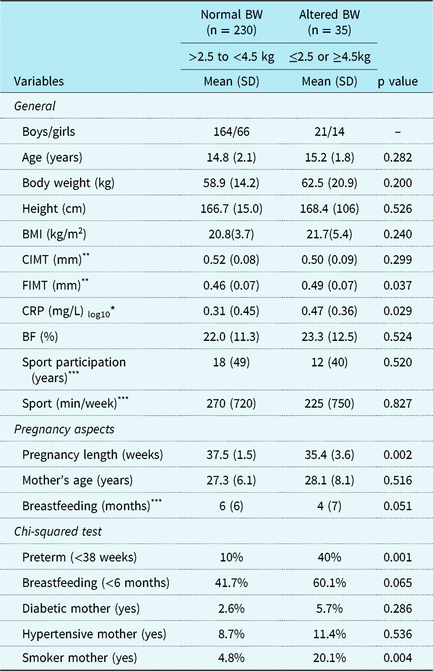
In our study, 35 adolescents were classified as altered birth weight (13.2% [95% CI: 9.1–17.2%]). Adolescents with normal and altered birth weight were similar in chronological age, anthropometry, adiposity, and metabolic aspects, except FIMT (p value = 0.037). C-reactive protein values were higher in adolescents with altered birth weight when compared to those with normal birth weight (p value = 0.029). Occurrence of altered birth weight was not associated with sex (boys: 11.4% versus girls: 17.5%; p value = 0.246), while the percentage of both smoking (p value = 0.004) and preterm delivery (p value = 0.001) were higher among adolescents with altered birth weight than those ones with normal birth weight (Table 1). There was no association between gestational diabetes and macrosomia (diabetic mothers: 12.5% versus non-diabetic mothers: 3.1%; p value = 0.244).
General characteristics of the adolescents stratified by normal and altered birth weight (Brazil, n = 265).

CIMT, carotid intima–media thickness; FIMT, femoral intima–media thickness; HOMA IR, homoeostasis model assessment of insulin resistance; BF, body fatness; BMI, body mass index; CRP, C-reactive protein; BW, birth weight; SD, standard deviation.
* N = 212.
** N = 261.
*** Variable expressed as median and interquartile range due to non-parametric distribution; p value = statistical significance.
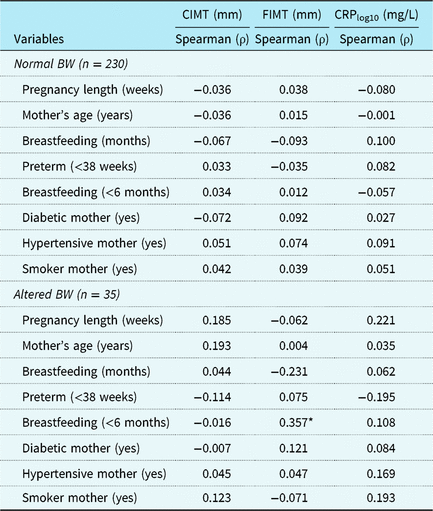
Aspects of pregnancy were related to the metabolic and cardiovascular outcomes stratified according to normal and altered birth weight (Table 2). Only in adolescents with altered birth weight, FIMT has been positively related to breastfeeding lasting less than 6 months (ρ = 0.357; p value = 0.045). Therefore, the linear regression model involving FIMT as the dependent variable was adjusted by all covariates plus breastfeeding lasting less than 6 months.
Univariate relationship between aspects of pregnancy and metabolic and cardiovascular outcomes among adolescents (Brazil, n = 265).

BW, birth weight; CIMT, carotid intima–media thickness; FIMT, femoral intima–media thickness; CRP, C-reactive protein.
* p value <0.05.
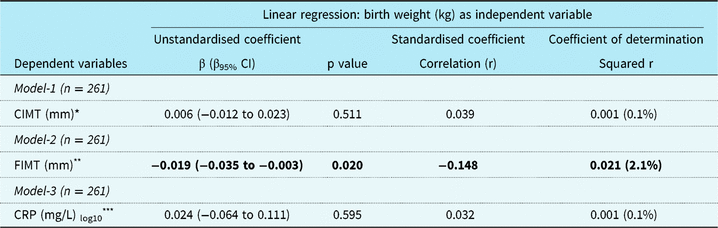
Birth weight and FIMT were inversely related to each other, in which birth weight explained 2.1% of all variance observed in FIMT (Table 3). CIMT and birth weight were not related to each other. Similarly, birth weight and C-reactive protein were not related each other, but in this model sex (r = 0.221; p value = 0.001), body fatness (r = 0.201; p value = 0.003), and previous time of engagement in sports (r = −0.258; p value = 0.001) affected C-reactive protein significantly and independently of birth weight (Table 3).
Linear regression between birth weight, intima–media thickness, and inflammation in adolescents (Brazil, n = 265).

95% CI: 95% confidence interval; CIMT: carotid intima–media thickness; FIMT: femoral intima–media thickness; CRP: C-reactive protein. BW: birth weight.
* Model adjusted by sex, somatic maturation, body fatness, previous sport participation and weekly engagement in sports.
** Model adjusted by sex, somatic maturation, body fatness, previous sport participation, weekly engagement in sports and breast feeding <6 months.
*** Model adjusted by sex, somatic maturation, body fatness, previous sport participation and weekly engagement in sports.
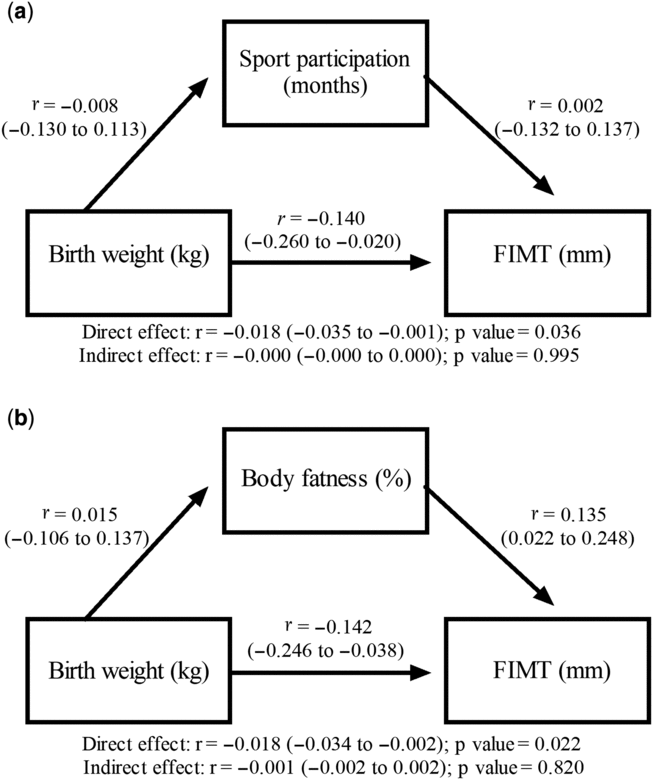
Structural equation modelling was created to assess the mediation role of sports participation (Fig 1a) and body fatness (Fig 1b) on the significant relationship between birth weight and FIMT. In both models, birth weight was still significantly affecting FIMT, while the mediation effect of sports participation was not statistically significant with approximately 0.015% of the total effect (of birth weight on FIMT) being mediated. The mediation effect of body fatness was statistically significant with approximately 1.48% of the total effect (of birth weight on FIMT) being mediated.
Mediation analysis of sport participation between the relationship of birth weight and FIMT (Panel A). Total, direct and indirect effect are presented in values of b (95%CI) and statistical significance (p<0.05). Mediation analysis of body fatness between the relationship of birth weight and FIMT (Panel B). Total, direct and indirect effect are presented in values of b (95%CI).

Discussion
Our main findings show that adolescents who experienced lower birth weight had higher intima–media thickness in the femoral artery, and this relationship not mediated by sports participation and slightly by adiposity.
In the discussion of our findings, two limiting aspects should be highlighted in order to give a better sight of this issue to the readers. First, the relationship between birth weight and intima–media thickness is of small magnitude, which is similar to the magnitude observed in the scientific literature,Reference Dowd, Zajacova and Aiello26, Reference Labayen, Ortega, Sjöström and Ruiz27 denoting the role of other variables not accounted in this study but relevant in this phenomenon, such as maturation and some hormones. Second, similar to other studies,Reference Dowd, Zajacova and Aiello26 C-reactive protein was not significantly related to birth weight, while birth weight seems able to affect other inflammatory markers,Reference Labayen, Ortega, Sjöström and Ruiz27 raising the relevance of future studies to include other potential relevant inflammatory markers, such as interleukine-6 and tumour necrosis factor alpha.
Obesity is a health outcome usually related to extremes of birth weight and, initially, it was hypothesised that body fatness would be the link between birth weight and the vascular outcomes, mediating this relationship. In fact, adiposity seems to be a pathogenic denominator of many chronic diseases, such as atherosclerosis,Reference Antunes, Rossi, Inoue, Rosa Neto and Lira25, Reference Kaijser, Bonamy and Akre28–Reference Li, Atochin and Satoshi Kashiwagi30 and birth weight has been frequently related to obesity during adolescence.Reference Yuan, Yang and Liang3, Reference Velazquez-Bautista, López-Sandoval, González-Hita, Vázquez-Valls, Cabrera-Valencia and Torres-Mendoza8, Reference Raaijmakers, Jacobs and Rayyan31 However, the relationship between birth weight and FIMT was just 1.4% mediated by adiposity, denoting the existence of a non-adiposity-dependent pathway linking birth weight to FIMT.
One candidate of non-adiposity-dependent pathway linking birth weight and FIMT would be the impact of birth weight on inflammationReference Labayen, Ortega, Sjöström and Ruiz27 because vascular damage has been attributed to higher inflammation among adults,Reference Würtz, Wand and Niiromen32 and higher C-reactive protein values have been linked to arterial thickening among adolescents.Reference Cayres, Kemper and Vanderlei33 Moreover, although data about this issue are scarce, there is evidence suggesting that neonates who were small for gestational age have higher C-reactive protein concentrations in umbilical cord than neonates who did not,Reference Trevisanuto, Doglioni, Altinier, Zaninotto, Plebani and Zanardo34 suggesting that fetal adaptive responses may permanently alter the fetal metabolism after birth even without the presence of obesity. However, as said before, C-reactive protein was not related to birth weight in this study, leading us to believe that other inflammatory markers should be explored, but also it is necessary to consider that C-reactive protein is an acute-phase protein, which is a component of the non-specific response of the innate immune system to infection and injury, not just obesity and atherosclerotic process.
It is noteworthy that previous time of engagement in sports (and not its weekly amount) was inversely related to C-reactive protein, denoting an anti-inflammatory role attributed to the regular engagement in sports among adolescentsReference Sass, Gravena, Pelloso and Marcon11 happening independently of birth weight status. In fact, regular engagement in sports seems beneficial to adiposity, metabolic, and cardiovascular aspects,Reference Cayres, Urban and Fernandes14, Reference Werneck, da Silva, Fernandes, Ronque, Coelho-E-Silva and Cyrino16, Reference Cayres, de Lira, Kemper, Codogno, Barbosa and Fernandes17 being a perfect candidate to mediate the relationship between birth weight and vascular aspects, but sports participation did not mediate the impact of birth weight on FIMT. The cross-sectional design might one of the reasons behind the absence of significant mediation attributed to the sport. In a Brazilian cohort study assessing the impact of sports participation on intima–media thickness of adolescents, sports participation and intima–media thickness was not related with each other at baseline,Reference Cayres, de Lira, Machado-Rodrigues, Freitas Júnior, Barbosa and Fernandes35 but after 12 months follow-up, adolescents who remained engaged in sports presented reduction in FIMT.Reference Ferreira, Jardim and Póvoa36 Therefore, longitudinal studies assessing how sports participation can mediate the harmful impacts of birth weight on vascular aspects are necessary.
In terms of why there were no significant results for CIMT, this finding is different from those one observed in adults, in which birth weight is related to increased CIMT.Reference Trevisanuto, Doglioni, Altinier, Zaninotto, Plebani and Zanardo34, Reference Harville, Jounala, Viikari, Kähönen and Raitakari37 The significant result observed only for femoral artery might be attributed to the fact that this artery has increased oscillation in wall shear rates than other arteries, which increases the propensity to atherosclerotic events in this artery bed.Reference Rothwell38, Reference Wu, Ringgaard, Oyre, Hansen, Rasmus and Pedersen39
Another limitation of the study should be recognised. First, the cross-sectional design is a limitation because it does not allow to establish causality statements. Second, the self-report of birth weight should also be considered as a potential source of bias and thus a limitation of this study, because the data reported by parents were not checked in hospitals’ official reports. Third, the small number of adolescents classified as altered birth weight (35 cases) is a limitation because adolescents with low birth weight (26 cases) and macrosomia (9 cases) were gathered into the same group. In order to avoid bias related to the imbalance on the groups’ sample size (n = 230 versus n = 35), homogeneity of variances was tested and adjustments were made when necessary. Fourth, in this study, the definition of macrosomia was birth weight ≥4500 g, but it is necessary to recognise that other cut points are used to diagnose macrosomia (≥4000 g) as well. Our choice was based on the fact that, in our sample, birth weight ≥4500 g represented better two standard-deviation score than birth weight ≥4000 g. Fifth, the sports participation does not reflect parameters of intensity. Sixth, in this study, it was made a single measurement of CIMT and FIMT, while a 24-hour evaluation of these parameters seems better than a single measurement.Reference Bassareo, Marras, Pasqualucci and Mercuro40
In conclusion, our study has pointed out that vascular structure seems to be affected by birth weight in adolescents, while this phenomenon seems not to be mediated by sports participation and adiposity.
Acknowledgments
We would like to thank the participants of our study and the members of the Scientific Research Group Related to Physical Activity (GICRAF) who helped during data collection.
Financial support
We acknowledge the Coordenação de Aperfeiçoamento de Pessoal de Nível Superior, Brasil (CAPES), Finance Code 001.
Conflict of interest
Nothing to declare.
Ethical standards
The ABCD Growth Study has been approved by the Ethics Committee of the São Paulo State University (UNESP process: 1.677.938]) from Presidente Prudente, Brazil.