Introduction
During the period 2012–16, breast cancer was the most commonly occurring cancer in women in Northern Ireland. 1 On average, 1,367 female patients were diagnosed with breast cancer each year with the lifetime risk of women developing breast cancer predicted as 1 in every 10. 2 The figures demonstrate that from 2007 to 2016, the number of women diagnosed with breast cancer increased from 1,159 to 1,437 equating to an aging population adjusted average of +1·3% per year. 2 Although the incidence of breast cancer increased during that decade, statistics also show that mortality rates decreased, and survival rates improved. Five-year survival increased to 81·7% in 2006–10 from 75·9% in 1993–2000 2 and this can be attributed to advances in early detection and the effective management and treatment for breast cancer.
Treatment options currently offered for breast cancer in the National Health Service include surgery, chemotherapy, radiotherapy, hormone therapy and biological therapies. 3 The various treatment modalities can be offered alone or in conjunction with other treatments. There are many factors to be considered when selecting the most appropriate course of treatment for each individual patient. The advantages, disadvantages and any potential acute or chronic side effects are discussed with the patient so that they can make an informed decision when consenting for treatment.
The majority of patients who undergo radiotherapy treatment to the breast develop a radiation-induced skin reaction. Occasionally, the skin toxicity can be so severe it can result in an interruption in treatment delivery which can have a negative impact on the treatment outcome of radiotherapy. A skin reaction develops during radiotherapy due to increased cell cycle arrest and reduced mitosis leading to the loss of epidermal cells. Reference Haydaroglu and Ozyigit4 The severity of the skin reaction is a reflection on the number of epidermal cells lost. As treatment progresses, the production of new cells is reduced and can sometimes completely stop leaving the basal layer and dermis entirely exposed. 5 This can result in swelling, redness, pigmentation, fibrosis, ulceration, pain, warmth, burning and itching of the skin. Reference Chan, Webster, Chung, Marquart, Ahmed and Garantziotis6 Radiation-induced skin reactions can arise 2–3 weeks after treatment commences and can persist up to 4 weeks after the treatment ends. Reference Naylor and Mallett7
Radiotherapy is delivered by therapeutic radiographers who administer ionising radiation according to a planned prescription designed for individual patients by clinical oncologists. It is the duty of the therapeutic radiographer to ensure treatment is delivered safely and accurately and the radiation-induced skin reactions are monitored daily and managed effectively.
More recently, the therapeutic radiographers’ role has extended with appropriately qualified and experienced radiographers undertaking breast cancer patient, radiographer-led, on-treatment review clinics. Patients are routinely reviewed in a separate clinical room away from the treatment unit allowing more time and privacy for the patient to be clinically assessed. One of the key responsibilities for the review radiographer is the effective clinical assessment and management of skin reactions, in close liaison with the clinical oncologist, clinical specialists and treatment radiographers.
The main effort of this evaluation focuses on radiotherapy treatment, particularly discussing and exploring radiation-induced skin reactions and the guidelines and protocols that are currently being adopted. The work is undertaken in part fulfilment of professional practice development as an on-treatment review radiographer and aims to evaluate the skincare management of patients receiving radiotherapy for breast cancer in order to help inform best practice.
Methods
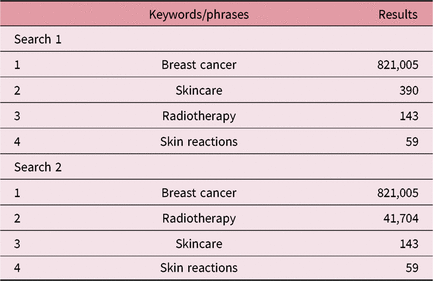
The evaluation was based on literature and on experiential learning and practice gained undertaking the on-treatment review of patients receiving radiotherapy for breast cancer. The literature search used Ulster University’s USearch. USearch offers a Google-like search across many databases with links to thousands of e-journals. A single results list of journal articles, conference papers, reports and more can be refined easily using intuitive controls shown alongside the results. Databases include: CINAHL plus; ScienceDirect; Directory of Open Access Journals; Scopus®; MEDLINE PubMed and the Science Citation Index. An example of the search strategy is shown in Table 1. The marked narrowing of the results clearly demonstrates the relatively limited number of published works in the specific field of ‘skincare’ for breast cancer patients experiencing radiation-induced skin reactions. Abstracts were reviewed and full-text articles assessed where applicable. Articles which highlighted national guidelines, scoring guidelines, radiation skin dermatitis and reactions were considered.
Summary of the search results using USearch

Keywords used in searches:
-
Breast cancer
-
Radiotherapy
-
Skincare
-
Skin reactions
Results were further refined using the following criteria:
-
Peer-reviewed publications
-
English language
-
Year 2000–19
Additional relevant material was identified using HONNI (Health on the Net Northern Ireland), the healthcare library of Northern Ireland which was established to provide health and social care professionals with library and information services to support patient care, evidence-based practice and Continuing Professional Development.
A comprehensive portfolio of evidence was accrued while undertaking a period of supervised and later, unsupervised on-treatment radiographer reviews of patients undergoing external beam radiotherapy for breast cancer. The development of a portfolio of evidence of reflection is an effective method for recording and providing evidence of skills and achievement of clinical experiences. The creation of the portfolio helped to develop critical thinking and competency in practice knowledge and was assessed by clinical and academic supervisors. The professional practice knowledge demonstrated through the portfolio informed the evaluation.
Discussion
Interventions for radiation-induced skin toxicities can include preventative strategies and management strategies. Reference Bolderston8 Preventative strategies comprise of approaches that reduce irritants to the skin such as preventing friction, either between two skin surfaces or between the skin surface and a foreign material such as clothing. Altering the frequency of washing and restricting the use of certain creams, soaps and deodorants are all routinely used as preventative measures. Reference Wells, Macmillan and Raab9 Management strategies when a skin reaction is established include strategies to limit pain and discomfort such as the use of topical creams, ointments and dressings depending on the severity of the skin reaction. Management strategies are aimed at alleviating symptoms and providing comfort.
Several studies have been undertaken to establish best practice for preventing and managing radiation-induced skin reactions. However, there is a wide variation in the skincare advice given to patients. In 2015, the Society and College of Radiographers (SCoR) published updated guidelines advising best practice in the management of skincare for patients undergoing radiotherapy treatment. Research carried out by SCoR over the past few years has uncovered that many departments across the UK are not following updated evidence and guidelines regarding skincare advice and washing instructions. Reference Harris, Beardmore and Bolderston10 Guidelines advise that on the first day of radiotherapy treatment it is important to undertake and record an assessment of the patient’s current skin condition in order to accurately assess the development of a skin reaction as a result of radiotherapy treatment. This should include what current skincare products the patient is currently using. According to surveys carried out by SCoR in 2014, the recording of the baseline skin condition of patients was not recorded by 52% of departments and 42% of departments did not record the skincare products being used by patients during treatment or how often they were being applied. The recording and documentation failure make it extremely difficult for future studies, aiming to evaluate skincare regimes, to be effectively compared. Furthermore, there are vast variations in the washing instructions and advice regarding deodorants given to patients who do not follow the guidelines. Historically patients were advised to wash with water only in the treatment area or even in some cases not to wash at all; however, updated evidence proves there should be no restriction to the using of a specified soap. Reference Butcher and Williamson11 Despite the evidence, 74% of departments still advised washing restrictions according to 2014 SCoR data. Reference Harris, Beardmore and Bolderston10
Therapeutic radiographers have regular and first-hand clinical experience of the negative impact that the development of skin reactions can have on patients, not only physically but also mentally. Self-esteem visibly plummets and this can have a knock-on effect on the social wellbeing of the patient. Ill-informed restrictions on washing and the prohibition of using deodorant can result in patients being self-conscious about body odour and hygiene and, although this is no longer recommended or practised in many departments, it is evident that some draconian practices continue. This needs to be addressed to ensure the holistic wellbeing and care of the patient.
Consideration needs to be given to various other factors that influence how people react to radiotherapy when advising patients on skincare. These are known as intrinsic and extrinsic factors and they can influence the development or severity of skin reaction. Intrinsic factors include general skin condition, age, previous comorbidities, ethnicity, hormonal status and genetic factors. Reference Chan, Webster, Chung, Marquart, Ahmed and Garantziotis6 Smoking and obesity have also been implicated. Extrinsic factors include the total prescription dose, number of fractions delivered, volume of tissue being irradiated, concurrent chemotherapy, radio-sensitisers and the site of treatment. Reference Chan, Webster, Chung, Marquart, Ahmed and Garantziotis6
Extrinsic factors can be dependent on each other such as total dose and fractionation. There is an increase in tolerance of the skin when treatments are fractionated compared to high doses of radiation being delivered in single doses. This enables dose escalation with increased fractionation as the skin tolerates smaller doses of radiation over a longer period. Reference Bray, Simmons, Wolfson and Nouri12 The introduction of the UK Standardisation of Breast Radiotherapy (START) trial, to reduce the number of fractions per treatment, can benefit the patient and department in terms of fewer visits for treatment delivery, although it can have a detrimental impact on skin toxicity. The START trial reduced radiotherapy fractionation from 25 to 15 and the higher dose of radiation per fraction has increased the number of patients returning for skincare management post-treatment. The shortened overall treatment delivery time provides a false sense of skin tolerance with the radiation induced reactions simply not manifesting until post treatment (Anecdotal evidence). Moist skin folds in the body are most susceptible to a skin reaction due to increased radiation absorbed dose anomalies at the skin fold interface. This is particularly apparent in the fold of skin under the breast where radiation-induced skin breakage often occurs. Intensity-modulated radiotherapy and advances in technology and immobilisation techniques have made a contribution in reducing radiation-induced skin reactions by sparing normal tissue while continuing to establish a homogenous dose distribution throughout the target volume. Reference Bray, Simmons, Wolfson and Nouri12 However, often used in conjunction with tangential glancing photon fields, the inclusion of adjuvant electron beam boosts can raise skin dose. The surface dose increase, further raised by the common use of bolus material, escalates the absorbed dose to the skin and can lead to acute skin reactions.
In terms of intrinsic factors, some genetic conditions, such as Fanconi’s anaemia and bloom syndrome, effect the body’s ability to repair DNA thus influencing the development of acute reactions from radiation. Reference Bray, Simmons, Wolfson and Nouri12 In these cases, it would be worth considering prescribing a lower dose of radiation to reduce the risk of serious skin complications. Patients should be discouraged from smoking and to maintain a healthy and active lifestyle to reduce the risk and severity of a skin reaction.
Several grading scales exist to aid in categorising skin reactions. The most common scale used is the Radiation Therapy Oncology Group/European Organization for Research and Treatment of Cancer (RTOG/EORTC) toxicity criteria. Reference Cox, Stetz and Pajak13 Grading scales are recommended to promote consistency and continuation of appropriate management and interventions until the skin reaction has settled. Reference Harris, Beardmore and Bolderston10 Although the RTOG grading system is a useful tool in assessing skin toxicity, it has limitations as it does not take into account aspects of skin damage such as pain and discomfort. It is therefore important to question patients on how their skin is feeling in order to ensure complete clinical assessment of the patient. A physical examination without feedback from the patient is inadequate when assessing a skin reaction.
Common practice for breast cancer patients receiving radiotherapy is for an emollient, moisturising and protective cream (e.g., Diprobase® cream) to be provided on the first day of treatment and advice given to start using the cream on the treatment area once or twice per day initially. This should be increased to three or four times per day as treatment progresses. Patients are advised not to use any other form of cream in the treatment area. Although it was previously recommended not to use deodorant under the arm on the side being treated, advice has now been updated in line with SCoR guidelines allowing patients to continue using deodorant unless the skin becomes irritated or broken. Washing advice includes gently washing the skin with soap and warm water; however, if skin becomes red or broken, it is not advised to use shower gels, bubble baths or perfumed soaps. Before the guidelines were updated, patients struggled greatly with the advice regarding washing and deodorant instructions as it affected their self-esteem. Patients were worried about hygiene issues and the smell of body odour especially as a lot of the patients were experiencing hot flushes. It was very evident when treating patients how much this was affecting their mental health and wellbeing. Patients were highly embarrassed and apologised profusely when asked to raise their arms into the appropriate immobilisation position for treatment. The advice given to patients regarding skincare is emphasised by providing an information leaflet when they attend their initial planning appointment. This is considered helpful as patients are bombarded with a lot of new information and experiences at this time and it is difficult to retain all the important information.
Although it should be policy to record the baseline skin conditions of patients before they begin radiotherapy treatment, this is not always practiced within radiotherapy departments and supports the findings of the SCoR as previously discussed. This makes it difficult for both treatment and review radiographers to critically assess radiation-induced skin toxicities as the treatment progresses as there is no initial baseline reference point. Also, where a department uses the RTOG grading system to assess skin toxicity, the establishment of a baseline skin appearance is essential. The baseline recording is fundamental when ruling out signs of infection in the breast. Patients who present with reddening of the skin and what seems to be a skin reaction in the first few days of treatment should medically be assessed to rule out infection as a radiotherapy skin reaction rarely develops in the first few days of treatment. A baseline skin recording on the first day of treatment would be invaluable in this situation as it could help determine if the skin appearance has changed since commencing radiotherapy or if an infection had been developing before the onset of radiotherapy.
Managing skin toxicities is an important priority when treating patients with breast cancer so it is imperative to know when the expertise of other medical professionals and nursing staff is required. Daily assessment of patients’ skin toxicity is relied upon to ensure patients are referred to the radiotherapy nursing department in a timely manner to provide the best possible care to the patient and minimise discomfort. When the skin breaks, the emollient cream is no longer recommended and patients are referred for specialist skincare assessment. This may involve a change from the cream to an emollient, moisturising and protective ointment and possibly the application of a dressing. It is the duty of the treatment radiographer or review radiographer to ensure the referral is made when required. Therapeutic radiographers need to be fully conversant with skincare management protocols.
During radiographer-led on-treatment reviews, it is vital that a skincare assessment is undertaken. As the review is carried out in a private clinical room away from the time-limited pressures of a treatment unit, a more comprehensive conversation can take place regarding skincare to ensure patient compliance and to provide further advice. Patient reassurance is also a key factor to consider when reviewing patient skin toxicity as the patient may be distressed or worried that their skin reaction is not typical. By assessing and managing the skin reactions with the patient, it promotes patient comfort and compliance which in turn improves quality of life. 14 Effective communication is essential when assessing patients in terms of patient individual needs and offering support and reassurance Reference Martin and Hodgson15 especially if the patient is struggling to come to terms with the side effects from radiotherapy. A brisk skin reaction could be affecting their social life or preventing them from carrying out activities of daily living which could be impacting greatly on their emotional wellbeing. Building an element of trust and open communication encourages patients to divulge information and ask questions, increasing compliance and enhancing overall wellbeing.
Although skincare management is important during radiotherapy, it is just as important after the completion of radiotherapy. Skin reactions may become more severe 7–10 days after the completion of radiotherapy as it can take this amount of time for cells affected by radiotherapy to reach the outer epidermis. It is at this time skin reactions can be at their worst. After this time, the skin gradually starts to repair. 16 Skin should be healing well, and in some cases healed completely, 4–6 weeks after completion of radiotherapy as it takes this time for the basal layer cells to start to recover and for new cells to grow and heal. Patients should be made aware of the process on the last day of treatment to emphasise how important it is to continue managing their skin with appropriate skincare. The aims of care for skin reactions following radiotherapy remain the same as during radiotherapy: maintaining integrity and hydration of skin, encouraging comfort and compliance, reducing trauma and protection from infection. 16 Appropriate advice and contact details should also be given so patients can contact the department if they have any concerns regarding an on-going skin reaction. If required, patients should be referred to district or community nursing care teams to ensure continuity of skincare.
Conclusion
With the incidence of breast cancer increasing, more and more patients are being treated with radiotherapy. Many of the patients develop a radiation-induced skin reaction during radiotherapy treatment and therefore skincare management is an essential consideration.
Studies show that the skincare management of patients receiving radiotherapy for breast cancer varies widely even though national guidelines exist. There are variations in terms of the types of creams prescribed, washing and hygiene advice and the use of deodorants. Preventative and management strategies are used as interventions to reduce the onset and severity of skin reactions. Even though there have been a number of randomised studies carried out investigating the management of skincare for breast cancer patients, the evidence-base appears to have had a limited definitive impact on changing clinical practice and updating the advice given to patients. Reference Kole, Kole and Moran17 This is in most part due to the lack of accurate recording and documentation of the skincare management of patients in departments and the lack of consensus of the optimum standard of care.
Preventative and management strategies are used as interventions to reduce the onset and severity of skin reactions. Other factors that need taken into consideration when evaluating skincare management are the intrinsic and extrinsic factors which in some cases cannot be avoided or altered in order to give the patient the best possible treatment experience. An expected increase in clinical trials to investigate hyper-fractionated treatments will inevitably have an impact on the timing and severity of radiation-induced skin reactions as witnessed in the START trial.
It is clear that robust, evidence-based studies and trials should be undertaken to investigate best practice when it comes to the management and perhaps even prevention of radiation-induced skin reactions. This would be more achievable with the standardisation of care and advice given to patients across all radiotherapy departments along with accurate and detailed documentation regarding patient compliance.
Future research conducted to investigate preventative measures could possibly include the prophylactic use of an approved skin moisturiser 3–4 weeks prior to starting radiotherapy treatment to clarify if this skin preparation truly can reduce the severity of radiation-induced skin reactions. It is important to remember that a breakthrough in the management of skincare in patients with breast cancer could also relate to other treatment sites such as head and neck cancers where skin reactions can be equally problematic. If skin reactions could be reduced, it would greatly reduce the skincare management burden within radiotherapy departments but more importantly, it would benefit our patients.
Acknowledgements
The authors thank the staff of the Northern Ireland Cancer Centre, Belfast Health and Social Care Trust for their support.
Financial Support
This study received no specific grant from any funding agency, commercial or not-for-profit sectors.
Conflicts of Interest
None.