Introduction
Interpersonal cooperation is a major feature of human social life, promoting survival fitness both at individual and group levels. Prosocial/moral sentiments (e.g. guilt, shame, etc.) are important in terms of forming a motivational basis of altruistic behaviours (Zahn et al. Reference Zahn, de Oliveira-Souza, Moll, Armory and Vuilleumier2012). Experimental elevation of guilt and shame increases altruistic acts in decision-making situations (Ketelaar & Au, Reference Ketelaar and Au2003; De Hooge et al. Reference De Hooge, Zeelenberg and Breugelmans2007; Jacquet et al. Reference Jacquet, Hauert, Traulsen and Milinski2011), although there is controversy regarding the positive influence of shame (de Hooge et al. Reference de Hooge, Breugelmans and Zeelenberg2008; Jacquet et al. Reference Jacquet, Hauert, Traulsen and Milinski2011), with some authors suggesting that shame influences social decisions in opposition to altruistic tendencies by increasing social distance (Tangney et al. Reference Tangney, Stuewig and Mashek2007).
Major depressive disorder (MDD) is associated with elevated self-blaming moral emotions (see reviews by Kim et al. Reference Kim, Thibodeau and Jorgensen2011; Pulcu et al. Reference Pulcu, Zahn and Elliott2013b ) as well as abnormalities in social decision-making (Harle et al. Reference Harle, Allen and Sanfey2010; Destoop et al. Reference Destoop, Schrijvers, De Grave, Sabbe and De Bruijn2012). Abnormalities associated with moral emotions may be responsible for real-life social decision-making impairments, which contribute to social and economic costs of psychiatric disorders (Beddington et al. Reference Beddington, Cooper, Field, Goswami, Huppert, Jenkins, Jones, Kirkwood, Sahakian and Thomas2008). Independent clinical studies show increased experience of both guilt and shame in MDD (O'Connor et al. Reference O'Connor, Berry, Weiss, Schweitzer and Sevier2000, Reference O'Connor, Berry, Lewis, Mulherin, Crisostomo, Farrow and Woodruff2007, Reference O'Connor, Berry, Lewis and Stiver2012), but evidence as to how this affects interpersonal/social decisions is lacking.
Survivor guilt, defined as feeling guilty for being better off than other individuals; and omnipotent responsibility guilt, defined as blaming oneself for the consequences of events which take place beyond one's control, are particularly elevated in MDD (O'Connor et al. Reference O'Connor, Berry, Weiss, Schweitzer and Sevier2000, Reference O'Connor, Berry, Lewis, Mulherin, Crisostomo, Farrow and Woodruff2007). These forms of guilt have also been shown to differentiate patients with fully remitted symptoms from healthy subjects (Green et al. Reference Green, Ralph, Moll, Deakin and Zahn2012, Reference Green, Moll, Deakin, Hulleman and Zahn2013), suggesting a role in depression vulnerability. O'Connor and colleagues have proposed a ‘pathological hyper-altruism hypothesis’ based on elevated levels of altruistic forms of guilt in current MDD patients relative to healthy subjects and predicting that patients will make altruistic decisions more frequently (O'Connor et al. Reference O'Connor, Berry, Weiss, Schweitzer and Sevier2000, Reference O'Connor, Berry, Lewis, Mulherin, Crisostomo, Farrow and Woodruff2007, Reference O'Connor, Berry, Lewis and Stiver2012). A somewhat conflicting hypothesis posits that shame may increase interpersonal/social distance in MDD, and consequently predicts that patients may be less likely to make altruistic decisions (Tangney et al. Reference Tangney, Stuewig and Mashek2007).
Direct evidence to measure the influence of guilt and shame-proneness on different aspects of altruistic behaviour in depression is lacking, and therefore it is unclear whether either of these conflicting hypotheses is supported. A recent epidemiological study has shown that depression vulnerability may indeed be associated with elevated levels of altruism (Fujiwara, Reference Fujiwara2009), although this study did not relate altruism to guilt or shame. Furthermore, neither O'Connor nor Tangney distinguished between different types of altruistic behaviours. Recent research suggests that the notion of ‘altruistic behaviour’ can be stratified into different components with different interpersonal/social functions (Boyd et al. Reference Boyd, Gintis, Bowles and Richerson2003); such as cooperation, altruistic punishment or making donations. Therefore, in order to evaluate hypotheses of altruism in MDD, it is important to consider dissociable forms of altruistic behaviour.
In this study, we used behavioural-economical paradigms modelling real-life decision-making mechanisms using various tangible resources such as money or time within interpersonal decision problems. We used four different paradigms probing different forms of altruistic behaviour: charitable donation, interpersonal cooperation, fairness/generosity and altruistic punishment. The hyper-altruism hypothesis predicts higher donations, elevated cooperation and generosity and more altruistic punishment in current MDD (cMDD). By recruiting remitted MDD (rMDD) patients we also tested whether any abnormalities associated with cMDD are present in remission, which would be consistent with hyper-altruism representing a trait factor.
Method
Participants
The study received ethical approval from the North West/Manchester South NHS Research Ethics Committee. Participants were recruited using online and print advertisements. Initial suitability was assessed with a phone screening interview based on participants’ responses to an online survey. Written informed consent was obtained from all participants.
Inclusion/exclusion of participants
Patients with cMDD fulfilled criteria for a current major depressive episode according to Diagnostic and Statistical Manual IV-TR (APA, 2000). We excluded people with psychotic disorders, clinically significant levels of suicide risk [>5 on Montgomery–Asberg Depression Rating Scale item-10 (MADRS; Montgomery & Asberg, Reference Montgomery and Asberg1979)], bipolar depression, and patients with a diagnosis of anxiety disorders preceding the diagnosis of MDD. Participants in the rMDD group fulfilled criteria for a past major depressive episode according to DSM-IV criteria. Exclusion criteria for the remitted depression group were similar but we also excluded current major depression or psychotropic medication. The control group had no current or past Axis-I or Axis-II disorders. No participant had a history of neurological disorder or substance abuse.
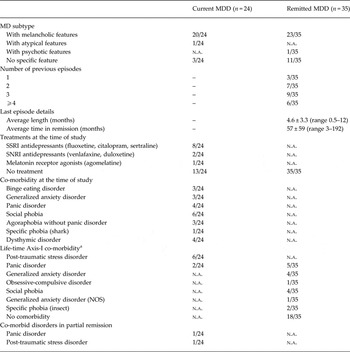
In total, 33 healthy control participants, 35 individuals with rMDD and 24 patients with cMDD (see Table 1) were included.
Clinical characteristics of MDD groups

MDD, Major depressive disorder; n.a., not applicable information; SSRI, selective serotonin reuptake inhibitor; SNRI, serotonin norepinephrine reuptake inhibitor; NOS, not otherwise stated.
a All co-morbid disorders were fully remitted at time of study, unless otherwise specified. None of the co-morbid disorders was a likely primary cause of the depressive episodes.
MDD subtype classification was based on adapting the SCID-I for DSMIV-TR to allow lifetime assessment of the subtypes. All medication-free participants had stopped medication well before the required washout phase. Co-morbid disorders in partial remission indicate presence of subclinical threshold symptoms.
Clinical interview procedure
Participants were invited for a clinical interview in which trained researchers (E.P., E.J.T. and P.D.T.) conducted the MINI screening (Sheehan et al. Reference Sheehan, Lecrubier, Sheehan, Amorim, Janavs, Weiller, Hergueta, Baker and Dunbar1998) and the psychotic screening of the Structured Clinical Interview for DSM-IV-TR (SCID-I ; First et al. Reference First, Spitzer, Miriam and Williams2002). Relevant SCID-I modules were then used in order to make a full assessment. The Global Assessment of Functioning (GAF) scale (Axis V, DSM-IV) was employed to provide measures of functional impairment. All participants also completed a battery of affective measures, including the Positive and Negative Affect Scale (PANAS; Tellegen et al. Reference Tellegen, Watson and Clark1988), Test of Self-Conscious Affect (TOSCA measuring characterological forms of guilt and shame based on their behavioural manifestations; Tangney, Reference Tangney1990) and Interpersonal Guilt Questionnaire (IPGQ-67 measuring characterological forms of guilt including survivor and omnipotent responsibility; O'Connor et al. Reference O'Connor, Berry, Weiss, Bush and Sampson1997).
Materials and procedures
All testing was conducted in a quiet room designated for testing purposes. For each task, the participants read relevant instructions on paper and were allowed time to ask any questions. All tasks contained practice rounds to make sure that all participants understood them fully. All outcomes were fully predictable so there was no risk-taking element to the tasks. All tasks were run on a laptop computer using E-Prime v. 2.10 (Psychology Software Tools Inc., USA).
Prisoner's Dilemma (PD) task
The PD probes interpersonal cooperation (Rapoport, Reference Rapoport1965). Participants engaged in a 31-round iterated PD task based on a hypothetical water shortage scenario, adapted from Mokros et al. (Reference Mokros, Menner, Eisenbarth, Alpers, Lange and Osterheider2008). Overall, the computer strategy was set to tit-for-two-tats (Farrell & Ware, Reference Farrell and Ware1989). This strategy defects (i.e. chooses option B on the PD matrix; see online Supplementary material and Appendix I) only when participants defect twice in a row and keeps on defecting until the participant cooperates and then restores back to cooperation. It is regarded as a forgiving/compassionate strategy and we selected this strategy as the most suitable model for real-world social interactions with friends/family. No deception was used in this paradigm (i.e. participants knew that they were interacting with a computer partner in an imagined water shortage scenario) and participants did not receive any real financial rewards based on their task performance. On each trial, the participants were presented with the PD matrix (shown in the online Supplementary material) on a white background. No pictures of human faces or computers were used to indicate any features of the computerized partner. The task was self-paced, where participants freely chose their responses by pressing the buttons A or B.
The PD task was taken from Mokros et al. (Reference Mokros, Menner, Eisenbarth, Alpers, Lange and Osterheider2008) who investigated interpersonal cooperation in a population of people with psychopathy. Interestingly, MDD and psychopathy are clinically considered to occupy two extremes of the guilt spectrum: patients with MDD exhibit elevated levels of guilt, while psychopathic individuals exhibit callousness and lack of guilt (Blair, Reference Blair1995). Direct comparison between these clinical populations may therefore be interesting.
Dictator game (DG)
The DG probes fairness and interpersonal fund allocation (Camerer, Reference Camerer2003). Before the Ultimatum Game (UG; see below), participants were asked to make three Dictator offers by choosing from a list of offers to split £10 between themselves and other players (see below for details). The offers varied between £9 v. £1 (most unfair) and £5 v. £5 (fair). The offers were based on hypothetical money and participants did not receive the amount they decided to keep for themselves (also for the UG).
UG
The UG probes perception of fairness and altruistic punishment for violation of this norm (Sanfey et al. Reference Sanfey, Rilling, Aronson, Nystrom and Cohen2003; de Quervain et al. Reference de Quervain, Fischbacher, Treyer, Schellhammer, Schnyder, Buck and Fehr2004; Crockett et al. Reference Crockett, Clark, Tabibnia, Lieberman and Robbins2008). In the iterated UG, both the proposer and the responder earn nothing when a proposal is rejected. Therefore, rejecting unfair offers in the UG would mean sacrificing possible monetary earnings in order to punish an unfair proposer, and is considered as an act of altruistic punishment. Furthermore, in order to address whether there is abnormal affective response following unfair interpersonal financial bargaining, we conducted a stimulus rating task.
Participants were told that they would be interacting anonymously with other players sitting in computer laboratories in two other locations within the University of Manchester or seeing financial offers recorded previously from other participants. This measure was taken in order to ensure that participants felt they were interacting with individuals rather than a random computer strategy. In fact, all participants were engaged in a UG experiment with predetermined offers. All participants completed a 30-round UG task using designated ‘Accept’ and ‘Reject’ buttons to make decisions. The positioning of these labels on the computer screen was counterbalanced across participants (also in the donations task, below). As in the DG paradigm, the offers varied between £9 v. £1 (most unfair) and £5 v. £5 (fair). There were 11 fair offers (equal split of £5 v. £5), 16 unfair offers (below 30% of the stake; any split below £7 v. £3) and three offers falling between these extremes (splits of £6 v. £4 and £6.50 v. £3.50). The offers were presented in text for 4 s and did not contain any human pictures (e.g. ‘The proposer gets £6, You get £4’). The participants had 10 s to respond to the offers. The offers were presented in a random order and full debriefing was provided at the end of the testing session.
UG emotion ratings
In order to investigate whether receiving unfair offers in the UG probes self-blaming feelings, we asked participants to rate how they felt upon receiving financial offers from anonymous partners. A representative sample of UG offers were re-presented in random order and following each offer the participants were asked to choose a single emotion from a list comprising guilt, shame, pride, gratitude and indignation, as well as an ‘other/none’ option. Then the participants were asked to make a rating for the pleasantness/unpleasantness of the offers that they received on a 1–7 Likert scale on which 1 corresponded to ‘very unpleasant’ and 7 corresponded to ‘very pleasant’. Trials on this task did not have any time restrictions. We also investigated the relationship between the number of guilt or indignation ratings, mean unpleasantness ratings for unfair offers and the average acceptance rate.
Charitable donations task
In a charitable donations paradigm, we investigated costly and non-costly forms of donation, with real financial implications. We predicted that hyper-altruism would be particularly pronounced in the charitable donations task with costly donation, as this task has the highest ecological validity to detect real-life decision-making abnormalities (Rilling & Sanfey, Reference Rilling and Sanfey2011).
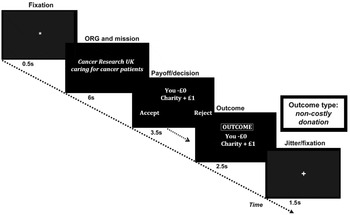
The charitable donations task was adapted from Moll et al. (Reference Moll, Krueger, Zahn, Pardini, de Oliveira-Souzat and Grafman2006) and the choice of charities was based on the findings of a pilot study, which investigated people's perceptions and preferences about charitable organizations in England and Wales. The pilot study contained 95 charitable organizations, from which we selected the most positively rated 36 charitable organizations. Their mission statements were obtained from The Charity Commission for England and Wales (http://www.charity-commission.gov.uk/). Before the experiment, participants were given a document containing the full name and the mission statement of these charities and the payoff conditions were explained to them. The charitable donations task lasted for 72 rounds containing costly and non-costly donation options and participants started with £20 of funds corresponding to real currency. In each round, charity information was presented to the participants, comprising the name of the charity and a shortened version of its mission statement (for 6 s). On the next screen, participants saw the payoff conditions (for 3.5 s). £1 of donation in the costly donation condition cost participants 30p, whereas non-costly donations did not have any financial cost to the participants. Participants responded by using ‘Accept’ and ‘Reject’ buttons to make decisions. A 20p penalty was enforced when participants failed to respond within 3.5 s. On the final screen, participants were presented with the outcome of their decisions and the amount of remaining funds (see Fig. 1 for the sequence of screens). At the end of the game, the remaining funds were rounded to the nearest pound and given to participants; they knew at the outset that they would receive this money. They were also told that there would be a real donation to the charity receiving the highest total support at the end of the experiment.
Experimental timeline of the charitable donations task showing the non-costly donation proposal. Adapted from Moll et al. (Reference Moll, Krueger, Zahn, Pardini, de Oliveira-Souzat and Grafman2006).

Data analysis
Test of general hyper-altruism hypothesis
Analyses were conducted using SPSS v. 20 (SPSS Inc., USA). We used appropriate χ2 tests for comparing group demographics in order to establish whether there were group differences on these measures. Non-parametric tests were used to compare group scores on psychological scales consisting of ordinal categorical variables, as these scales are nonlinear with no zero-point.
For our central analysis, we used a single overarching general linear model (a multivariate analysis of variance; MANOVA) to investigate the effect of clinical grouping on different types of altruistic decisions. This approach controls the Type I error rate better than using five separate ANOVAs, one for each task. The five dependent variables (DVs) in the MANOVA were the main outcome measures for each task; frequency of cooperation in the PD, average offers in the DG, average acceptance rates in the UG, and frequency of costly and non-costly donations in the charitable donations task. In order to avoid any confounding effects of scaling on these DVs, we applied z-transformations and used the z-transformed variables in the model. Therefore, we fitted a 5 × 3 model (a MANOVA with the five different altruistic outcome measures by three clinical groups). We computed the model for participants who completed all of the tasks.
Post-hoc analysis to explore significant main effects and interactions in the MANOVA was done by using appropriate one-way analysis of variance (ANOVA) tests with post-hoc pairwise comparisons (using Fisher's LSD where group sizes were comparable and the Tukey–Kramer procedure where group sizes were imbalanced; Hayter, Reference Hayter1984).
Correlations between altruistic guilt, shame-proneness and altruistic decisions
In order to test the prediction that altruistic forms of guilt (survivor and omnipotent responsibility) promote altruistic behaviour, whereas shame-proneness (TOSCA Shame subscale) works counter to altruistic tendencies, we conducted Pearson's correlational analyses. We restricted the correlational analyses to costly donations, so that our results have the highest ecological validity for real-life financial consequences. We investigated the relationship between affective measures and the number of costly donations, separately for each group in order to avoid the possible confounding impact of clinical status on these correlations. Fisher's z test was used in order to detect whether correlation coefficients were significantly different between our groups. All correlational analyses were conducted on the 76 participants who completed all tasks.
Results
Participants
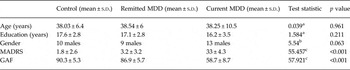
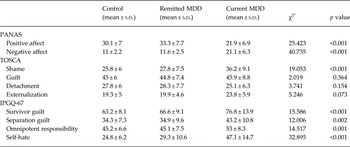
The groups did not differ significantly for age, gender or years of education (see Table 2). Healthy subjects and people with rMDD had MADRS scores that were well below the cut-off for full remission from depression (<10) (Hawley et al. Reference Hawley, Gale and Sivakumaran2002). Both of these groups had GAF scores indicating minimal or absent functional impairment (>80). Patients with cMDD had significantly higher MADRS and lower GAF scores (see Table 2). Patients with cMDD had significantly lower scores on the positive affect subscale of PANAS and self-esteem, whereas they had significantly elevated scores on TOSCA Shame as well as all the subscales of the IPGQ-67 compared to healthy subjects and remitted patients (see Table 3).
Group comparison on demographic and basic clinical variables

MADRS, Montgomery–Asberg Depression Rating Scale; GAF, Global Assessment of Functioning Scale.
a One-way ANOVA (df = 2,89).
b Pearson's χ2 (df = 2).
c χ2 value in Kruskal–Wallis test (df = 2, showing asymptomatic significance).
Control: N = 33; Remitted MDD: N = 35; MDD: N = 24. Pairwise comparisons revealed that patients with remitted major depressive disorder had MADRS scores lower than healthy subjects approaching significance level (p = 0.066), whereas GAF scores were significantly lower in the remitted patient group (p = 0.012).
Summaries of affective measures

MDD, Major depressive disorder; PANAS, Positive and Negative Affect Scale; TOSCA, Test of Self-Conscious Affect; IPGQ-67, Interpersonal Guilt Questionnaire.
Summaries of between-group differences on affective measures, differences are significant at p < 0.01, two-sided (control group: N = 33; rMDD group: N = 35; MDD group: N = 24).
Pairwise comparisons revealed that patients with remitted MDD had higher self-hate scores compared to healthy subjects approaching significance (U = 423.5, p = 0.058).
a Kruskal–Wallis test.
Impact of clinical diagnosis on social-economical decision making
Sixteen individuals randomly chosen from the control and the remitted groups participated in a functional neuroimaging version of the charitable donations experiment and therefore did not complete this behavioural version to avoid repetition effects. We therefore performed the MANOVA on the 76 individuals who completed all tests (Controls 29, cMDD 23, rMDD 24). The MANOVA showed a significant main effect of clinical group (F 2,73 = 3.277, p = 0.04) with a significant clinical group × type of altruistic outcome interaction (F 8,292 = 2.242, p = 0.025). In order to understand the interaction term, we explored task-specific results as described below.
Tasks with hypothetical rewards: PD, DG and UG
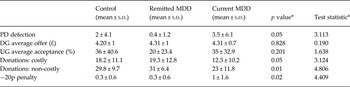
Patients with cMDD defected significantly more in the PD (F 2,73 = 3.113, p = 0.05) than the other groups. There were no significant differences between groups for average DG offers (F 2,73 = 0.190, p = 0.828) or the acceptance rates of unfair offers (F 2,73 = 1.638, p = 0.201; see Table 4, online Supplementary Fig. S1].
Summaries of altruistic outcome measures

MDD, Major depressive disorder; PD, Prisoner's Dilemma; DG, Dictator Game; UG, Ultimatum Game.
Summaries of between-group differences on altruistic outcome measures at p < 0.05, two-sided.
* One-way ANOVA.
Tasks with real currency: charitable donations task
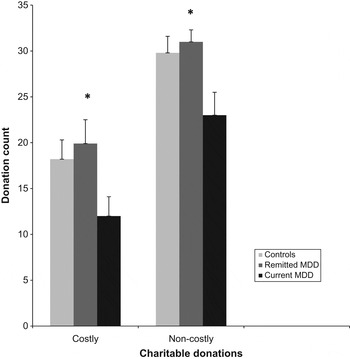
Overall, patients with cMDD made significantly fewer costly (F 2,73 = 3.124, p = 0.05) and non-costly (F 2,73 = 4.806, p = 0.01; see Table 3 and Fig. 2) donations. Post-hoc pairwise comparisons using Fisher's LSD suggested that patients with cMDD made significantly fewer costly donations relative to rMDD patients, and fewer costly donations at threshold level relative to healthy subjects (p = 0.02 and 0.056, respectively). Patients with cMDD made significantly fewer non-costly donations relative to the other groups (all p values: 0.005 < p < 0.01). Remitted patients and healthy subjects did not differ in frequency of costly or non-costly donations (all p > 0.588). Medicated and unmedicated patients within the cMDD group did not differ for either the number of costly or non-costly donations (all p > 0.580). There were no significant differences between the groups for the response times of acceptance or rejection under any of the donation conditions (see online Supplementary material and Table S3).
Patients with current major depressive disorder (MDD) made significantly smaller costly and non-costly donations relative to healthy subjects and remitted patients (*p < 0.05). Error bars represent ± 1 s.e..

Exploratory analysis of affective responses
Self- v. other-blame patterns in the UG
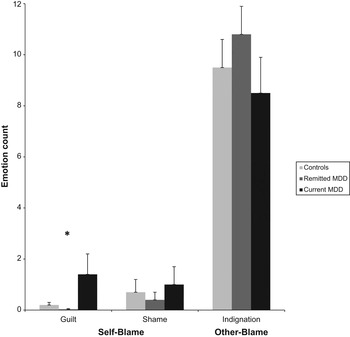
This analysis was performed in the full cohort of 92 who performed this task. None of the participants reported self-blame for receiving fair offers. Patients with cMDD experienced significantly more guilt compared to both control and rMDD groups when they received unfair offers (F 2,89 = 3.582, p = 0.032; see Fig. 3). Post-hoc pairwise comparisons using the Tukey–Kramer procedure and studentized critical range values (at q < 0.05 for df2,89 = 3.37; absolute difference > critical range value) suggested that the cMDD group was significantly different from the rMDD group (1.35 > 1.27), but only marginally different from the healthy subjects (1.20 < 1.29; t test equivalent p = 0.088). Within the cMDD group, guilt ratings were not significantly different between medicated and unmedicated patients (t = − 1.225, df = 22, p < 0.235). There were no significant differences for guilt ratings between the rMDD and the healthy subjects (0.15 < 1.16). The groups did not differ on the frequency of shame or indignation responses upon receiving unfair offers (F 2,89 = 0.421 and 1.012, respectively, p > 0.367), the pleasantness ratings of fair offers or the unpleasantness of unfair offers (see online Supplementary material and Table S2).
Post-Ultimatum Game (UG) emotion ratings. Patients with current major depressive disorder (MDD) experienced a significantly higher amount of guilt upon receiving unfair offers in the UG, relative to healthy subjects and remitted patients (*p < 0.05). Error bars represent ± 1 s.e.

Controlling for depression severity (i.e. MADRS scores), we observed a significant relationship between indignation (r = − 0.438, p < 0.001), and unpleasantness ratings (r = 0.425, p < 0.001) with acceptance rates, but not with frequency of guilt and this measure (r = − 0.106, p = 0.316).
Correlations between altruistic guilt, shame-proneness and altruistic decisions
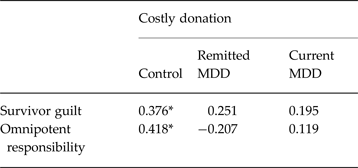
Shame and survivor guilt scores correlated significantly in all groups (most strongly in the cMDD group: r = 0.848, p < 0.001). Correlations between number of costly donations and altruistic guilt scores are summarized separately for each group in Table 5. Altruistic guilt scores correlated significantly with costly altruistic decisions only in healthy subjects (p < 0.05), but not in either of the depression groups (Table 5 and legend). Shame scores did not correlate with number of costly donations within each group or across all participants (−0.1 < r < 0.1, all p > 0.303).
Correlations between the number of costly donations and altruistic guilt scores

MDD, Major depressive disorder.
The control and the remitted groups were significantly different for the comparisons of the correlation coefficients between costly donations and omnipotent responsibility guilt scores using Fisher's z test (z values > z threshold = 2.17 > 1.96, p < 0.03).
* p < 0.05, two-tailed.
Discussion
Rather than supporting a general hyper-altruism hypothesis, our results suggest more specific interactions between clinical status and different kinds of altruistic decisions. For the DG and UG, probing fairness and altruistic punishment behaviour, performance of cMDD and rMDD patients did not differ from controls. However in the PD, probing interpersonal cooperation in a hypothetical scenario; and the donations task, probing decisions to help distant beneficiaries, we observed a significantly lower frequency of altruistic responding in cMDD compared to rMDD or healthy controls. Interestingly this difference in charitable donation was observed even when altruistic decisions were associated with no personal cost (i.e. non-costly donations). Recent independent reviews suggested that charitable donation paradigms have the highest ecological validity in terms of studying human altruistic behaviours (Rilling & Sanfey, Reference Rilling and Sanfey2011). Our results, showing a lower frequency of altruism in current depression in the culturally and ecologically valid context of charitable giving, therefore challenges the hyper-altruism hypothesis.
Charitable donation behaviour is a unique form of altruism where people behave altruistically towards distant beneficiaries who are not genetically related (Hamilton, Reference Hamilton1963). Compared to our other tasks, charitable donation paradigms may more closely reflect real-life decision-making mechanisms, or at least represent a context that participants are familiar with. Patients with cMDD show less altruistic behaviour in the form of charitable donation, irrespective of personal costs associated with these decisions. In a similar cohort of participants, we recently demonstrated that patients have comparable reward value perception over time for financial rewards of the magnitude used here (Pulcu et al. Reference Pulcu, Trotter, Thomas, McFarquhar, Juhasz, Sahakian, Deakin, Zahn, Anderson and Elliott2013a ), and therefore it is unlikely that the lower level of charitable donation reflects a difference in simple reward processing. Indeed the lower level of donation was observed most significantly in the non-costly condition where there was no cost (or benefit) to participants. Patients with cMDD also received a significantly higher number of penalties due to failing to respond to donation proposals within 3.5 s. Although this could reflect a general deficit in processing speed or executive functioning, cMDD participants were no slower than controls on trials where they accepted or rejected proposals. The lack of significant between-group differences on the UG or DG task argues against a generalized executive impairment.
Consistent with previous studies from our research group (Green et al. Reference Green, Ralph, Moll, Deakin and Zahn2012, Reference Green, Moll, Deakin, Hulleman and Zahn2013), we showed that the self-hate subscale of IPGQ-67 distinguished both patient groups from healthy subjects.
This could be important in terms of identifying the role of this domain of self-blame in depression vulnerability. Affiliative prosocial sentiments such as survivor guilt, compassion and empathy/empathic concern are proposed to influence decisions about making donations (Zahn et al. Reference Zahn, de Oliveira-Souza, Moll, Armory and Vuilleumier2012). In line with this hypothesis, we showed a significant relationship between donation behavior and prosocial sentiments in healthy subjects. However, there was no relationship in either of the depression groups. Altruistic guilt scores in the remitted group were comparable with healthy subjects, but these emotions did not influence altruistic decisions in the remitted group (see Table 5); somewhat counter to the guilt-driven hyper-altruism hypothesis (O'Connor et al. Reference O'Connor, Berry, Lewis and Stiver2012) which might predict increased guilt driving increased altruism in those vulnerable to depression. Therefore, it is plausible to propose that previous episodes of major depression could be disrupting the healthy functioning of these prosocial emotions.
It is possible that abnormal charitable donation behaviour may have neurobiological origins in MDD.
Neuroimaging studies using a similar paradigm have shown that charitable decisions probe subgenual cingulate and striatal regions in the brain (Moll et al. Reference Moll, Krueger, Zahn, Pardini, de Oliveira-Souzat and Grafman2006). A valid established clinical literature suggests that MDD is associated with functional impairments in these regions (Drevets et al. Reference Drevets, Price, Simpson, Todd, Reich, Vannier and Raichle1997; Eshel & Roiser, Reference Eshel and Roiser2010) and we have recently demonstrated that patients during stable remission display abnormal neural responses in these regions while making charitable donations (Pulcu et al. Reference Pulcu, Zahn, Moll, Trotter, Thomas, Juhasz, Deakin, Anderson, Sahakian and Elliott2014). Taken together with the present results, these findings suggest difference at the neuronal level in the absence of a significant difference in behavioural choices (the rMDD participants in the present study also did not differ from healthy controls in costly or non-costly donation frequency). It is therefore possible that the neuronal differences reflect the different emotional drivers of donation behaviour rather than differences in the behaviour itself. The absence of a relationship between altruistic guilt and donation observed in healthy subjects in this cohort may be one such difference.
The other significant difference we observed was in the PD game, with cMDD patients defected significantly more in a hypothetical survival situation while interacting with forgiving partners. Previous studies have shown that people reporting depressive symptoms but not meeting criteria for MDD defected at a significantly higher level in the PD when their partners were experimentally made vulnerable to defection (Hokanson et al. Reference Hokanson, Sacco, Blumberg and Landrum1980), but more likely to behave aggressively when their playing partner defected (Haley & Strickland, Reference Haley and Strickland1986). To the best of our knowledge, there are no previous studies investigating interpersonal cooperation with a PD paradigm in cMDD. As with the charitable donations results, higher PD defection rates in cMDD are a challenge to a general hyper-altruism hypothesis, which would predict more cooperative responding rather than higher defection. However, the PD results should be interpreted in the light of the design specifications, which was based on using a hypothetical setting with hypothetical partners, therefore, may have its limitations to explain interpersonal cooperation in patients with MDD, in real life. Using this specific design allowed us to compare patients with MDD and people with psychopathic traits who were previously studied using the same paradigm (Mokros et al. Reference Mokros, Menner, Eisenbarth, Alpers, Lange and Osterheider2008). Interestingly, both of these patient groups defect at a similar level, despite clinically distinct profiles of guilt pathology.
Neither the rMDD or cMDD groups differed from controls on DG offers nor acceptance of UG offers. Two previous studies of the UG suggested that acute incidental sadness and clinical depression have opposing effects on altruistic punishment, whereby individuals reject unfair offers in order to punish proposers who make them (Harlé & Sanfey, Reference Harlé and Sanfey2010; Harle et al. Reference Harle, Allen and Sanfey2010). They showed that patients with cMDD accepted, whereas individuals with acute sadness induction rejected, unfair offers at significantly higher rates than healthy subjects. Conversely two recent studies showed elevated rejection behaviour in patients with MDD (Radke et al. Reference Radke, Schäfer, Müller and de Bruijn2013; Scheele et al. Reference Scheele, Mihov, Schwederski, Maier and Hurlemann2013). Another study which manipulated serotonin levels by an acute tryptophan depletion procedure showed that the tryptophan-depleted group (often seen as a model for depressed mood) rejected unfair offers at a significantly higher rate than the placebo group (Crockett et al. Reference Crockett, Clark, Tabibnia, Lieberman and Robbins2008). Our finding of no difference are not consistent with these studies; however, they are in line with a recent report of no differences in acceptance rates on the UG (Destoop et al. Reference Destoop, Schrijvers, De Grave, Sabbe and De Bruijn2012). Destoop and colleagues also showed that patients with cMDD acted more generously when they participated as the proposer, whereas in our study neither of the patient groups differed from healthy subjects for proposer behaviour (i.e. Dictator offers).
Thus the UG and DG literature remains inconsistent, potentially representing differences in the clinical characteristics of participants, the paradigms, or both. For example an important difference between the study of Destoop et al. (Reference Destoop, Schrijvers, De Grave, Sabbe and De Bruijn2012) and ours is that all of their patients were hospitalized, whereas our patients were recruited from an outpatient population, although depression severity did not differ (using a methodology to convert Hamilton Depression rating scores to MADRS; Carmody et al. Reference Carmody, Rush, Bernstein, Warden, Brannan, Burnham, Woo and Trivedi2006). The experience of hospitalization may thus have an influence on social economical decisions. Another difference between our study and previous studies, such as Harlé & Sanfey (Reference Harlé and Sanfey2010), is that their paradigm used pictures of individuals in the proposal screen. Radke et al. (Reference Radke, Schäfer, Müller and de Bruijn2013) showed that patients with MDD rejected unfair and hyperfair offers significantly more than healthy participants when offers were made by individuals exhibiting facial expressions categorized into basic emotions (i.e. happy, angry, sad). The authors did not investigate how participants perceived the facial emotion of the proposers. A previous study showed that increasing social distance between the players in the DG, by manipulating the level of anonymity, decreased the amount of monetary offers (Hoffman et al. Reference Hoffman, McCabe and Smith1996), suggesting that the use of pictures (i.e. reducing anonymity relative to using plain text) may be significant. It is notable that combining UG offers with emotive pictures of proposers in studies of depressed individuals may be further complicated by differences in facial emotion recognition in MDD (Anderson et al. Reference Anderson, Juhasz, Thomas, Downey, McKie, Deakin and Elliott2011; Arnone et al. Reference Arnone, McKie, Elliott, Thomas, Downey, Juhasz, Williams, Deakin and Anderson2012).
In the post-UG emotion ratings, we showed that patients with cMDD had elevated levels of self-blaming feelings which loaded onto guilt, but not shame. To the best of our knowledge, this is the first account of elevated self-blame in patients with cMDD probed by unfair interpersonal exchanges in laboratory conditions. Recently, Green and colleagues showed that selective self-blame, relative to an overall increase in negative emotions, is a vulnerability feature in MDD which extends beyond the symptomatic phase (Green et al. Reference Green, Moll, Deakin, Hulleman and Zahn2013). We also tested whether there is an inverse relationship between shame-proneness and altruistic decisions, driven by mechanisms of increasing interpersonal distance. We showed that trait shame scores were not related to costly altruistic decisions. Previously, it has been suggested that shame promotes altruistic decisions only when its manipulation is based on a component of the decision-making task (i.e. endogenous), whereas unrelated (i.e. exogenous) manipulations of shame did not show any relationship with altruistic decisions (de Hooge et al. Reference de Hooge, Breugelmans and Zeelenberg2008). Two subsequent studies showed that ‘threat of shame’ promoted altruistic decisions in the public goods game in which shaming defecting individuals by exposing them publicly worked similarly to anticipated altruistic punishment and increased the amount of donations (Jacquet et al. Reference Jacquet, Hauert, Traulsen and Milinski2011, Reference Jacquet, Hauert, Traulsen and Milinski2012). Our results support this distinction as our shame-proneness measure is unrelated to the task rather than being a task-related ‘threat of shame’ measure.
Our study has a number of limitations. Most of our paradigms used hypothetical financial reward, based on evidence that hypothetical financial decision-making paradigms produce similar results to those studies which used real currency (Murphy et al. Reference Murphy, Vuchinich and Simpson2001). It would therefore be important to replicate the present study using real currency for the tasks with hypothetical rewards, to determine whether this is a critical difference between the paradigms, or whether the nature of the altruistic decision is more important. It should be noted that we observed a significant difference in the cMDD group for the task with real rewards (charitable donations) and one of the tasks with hypothetical rewards (PD), so the group differences observed may not be solely dependent on the real/hypothetical reward distinction. Another limitation is that our PD paradigm used not only hypothetical rewards but also hypothetical (computerized) partners. Therefore, this task was measuring more abstract concepts of cooperation than a truly interpersonal version of the paradigm. Another important limitation of our study relates to the sample size. Although we presented results from a larger clinical population than earlier studies (Harle et al. Reference Harle, Allen and Sanfey2010; Destoop et al. Reference Destoop, Schrijvers, De Grave, Sabbe and De Bruijn2012), it is possible that some of our marginally significant findings reflect the lack of optimal power which affects much of psychiatry research. Finally, although we have tested strong a priori predictions related to ‘guilt-driven pathological hyper-altruism’ hypothesis using a single overarching MANOVA to control for Type I error rate, we did not correct our p values for multiple testing in subsequent post-hoc stages. Finally it is important to note that we did not exclude co-morbid anxiety disorders so it is possible that some of the effects we observed may reflective anxiety. Further studies would be required to assess this possibility.
Conclusions
Patients with cMDD performed no differently from healthy subjects in terms of fairness or altruistic punishment but were less altruistic on a charitable donations task and a task probing interpersonal cooperation. Altruistic forms of guilt influenced altruistic decisions only in healthy subjects, whereas shame-proneness as a personality trait had no influence on altruistic decisions in any group. Taken together, our results do not support the hyper-altruism hypothesis in cMDD and we suggest the framework should be reconsidered.
Supplementary material
For supplementary material accompanying this paper visit http://dx.doi.org/10.1017/S0033291714002414.
Acknowledgements
This study was funded by Medical Research Council, UK (grant no. G0900593). We thank Dr Diana Chase for her assistance in participant recruitment and study management and Dr Richard Emsley for his detailed review of our statistical approach.
Declaration of Interest
None.