Introduction
The immune system represents a complex assortment of interacting cells and proteins, about which many books and journal articles have been written. In one short paper, it is not possible to discuss each component in great depth, so here the objective is to provide an overview of the component parts, focussing on the mechanisms that are most influential in mounting an anti-tumour immune response, and highlighting aspects most relevant to the biology of head and neck cancer.
The immune system is organised into discrete compartments to provide the milieu for the development and maintenance of effective immunity.Reference Delves, Martin, Burton and Roitt1 Functionally, an immune response can be broadly divided into two parts: the innate and the adaptive arms.
Innate immune responses form the first line of defence against infection, resulting in the induction of an inflammatory reaction with the classical signs of redness, heat and pain, due to an influx of fluid, leukocytes and proteins to the area. Cells involved in the innate response recognise infective organisms such as bacteria via the patterns of simple repeating structures expressed on their surface, primarily employing a class of receptors known as the Toll-like receptors. This response is extremely fast-acting, with some fluid-phase immune reactions being initiated within seconds of an infection; however, there is no memory component, hence the response is ‘all or nothing’.
Adaptive immune responses, in contrast, involve the recognition of distinct antigens by lymphocytes carrying specific receptors. Furthermore, individual cells of the adaptive immune system carry only a single receptor specificity; therefore, following recognition, a process known as clonal proliferation occurs to expand the number of cells available to combat the infection. This type of response has a significant lag phase (approximately 14–21 days) whilst cells are primed and expanded, but has the benefit that the immune response ‘remembers’ how to combat the infection, which prevents re-infection with the same organism. This facet underpins the effectiveness of vaccinations against infective diseases such as diphtheria, measles, rubella etc, and offers the potential of harnessing the immune system's power against ‘altered-self’ cells, i.e. tumours.
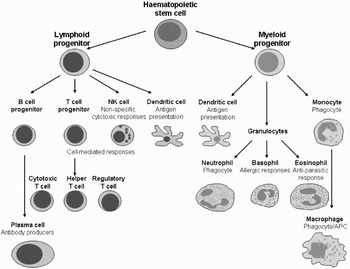
There are two major, overlapping groups of immune cells, known as the myeloid and lymphoid systems. Each contains a distinct repertoire of leukocytes (white blood cells) and proteins which mediate specific roles. Cells of the myeloid system are involved in both the innate and adaptive immune responses, whereas cells of the lymphoid system are primarily involved in the adaptive immune response (Figure 1). The key link between the innate and adaptive immune systems is the specialised myeloid cells that present small parts of the foreign organism in a specific conformation with host cell expressed major histocompatibility complex molecules, which allows the cells of the adaptive arm to respond appropriately.
Basic organisation and function of cells in the immune system. NK = natural killer; APC = antigen-presenting cell

Within the lymphoid system, the two main sub-groups of cells, B and T lymphocytes, express distinct forms of antigen-specific receptors which recognise antigens in similar but unique ways. These different antigen recognition systems are necessary because of the diverse ways foreign antigens can be encountered, for example as whole bacteria or on a virally infected host cell. The B lymphocyte antigen receptor is in the form of a cell surface immunoglobulin (also termed antibody). The binding of antigen to this receptor initiates an antibody-mediated (or humoral) immune response, with the production of vast amounts of soluble antibody of the same specificity as the original B cell receptor. The binding of antigen by T cells, which requires prior processing and presentation of the foreign protein by antigen-presenting cells, initiates a cell-mediated immune response in which T cells play the principal role. Both forms of adaptive immunity, and the cooperation between the systems, are discussed below.
Components of the Immune System
All leukocytes are derived from haematopoietic stem cells in the bone marrow. These stem cells are pluripotent, having the potential to differentiate into any type of specialised immune cell.Reference Delves, Martin, Burton and Roitt1 Cells become specifically committed to differentiate into distinct types of leukocyte (i.e. they form a distinct colony-forming unit) due to the influence of colony-stimulating factors, e.g. granulocyte macrophage colony stimulating factor, present in the bone marrow milieu.
In addition to many different functions, including signalling, binding and proteolytic digestion, molecules on the leukocyte surface can also be used to define subpopulations of cells. The cluster of differentiation (CD) numbering system originates from the late 1970s when monoclonal antibodies first became available to identify surface antigens, resulting in a steady increase in the number of catalogued molecules.Reference Bernard and Boumsell2 The most recent workshop, in 2006, extended this system to include 350 members.Reference Zola, Swart, Banham, Barry, Beare and Bensussan3 Some molecules are present on virtually all leukocytes, e.g. CD43, whereas other molecules are restricted to a single cell type or even a sub-population. For example, mature T cells will display CD2, CD3, CD4 or CD8, CD18, CD28, CD43, and CD49d, amongst other markers, whereas mature B cells will express CD19, CD20, CD21, CD22, CD43 and CD49d.
Cytokines
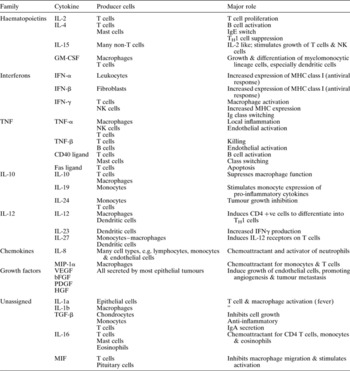
Cells of the immune system communicate either by ligand surface receptor interactions or via secreted molecules called cytokines. Cytokines produced by lymphocytes can be sub-divided on the basis of reported function (for example, the interleukins (ILs)) or on the basis of the cells that produce them (i.e. cytokines produced by lymphocytes are sometimes termed lymphokines, and those produced by monocytes or macrophages are termed monokines). The term cytokine covers a collection of more than 200 small proteins, most having molecular weights of less than 20 kDa in humans. These molecules primarily act as intercellular messengers, with their effects usually being directed at cells in the immediate environment or organ, rather than systemically. Cytokines can be divided into groups according to structure or function. Table I shows six broad families of cytokines, defined by their structure, plus a seventh category comprising an assortment of important, unassigned molecules. (For a more detailed and comprehensive listing of cytokines, see http://www.hcdm.org/Home/tabid/36/Default.aspx or http://www.exactantigen.com/review/cd.html.) It must be noted that cells are not normally exposed to a single cytokine, and that in general they act synergistically or antagonistically, or most probably both, at any one time depending upon their relative concentrations. Therefore, any cell response depends on the combination of cytokines to which the cell is exposed and the receptors it is currently expressing. Important cytokine functions are described in more detail in their relevant context throughout this article.
Cytokine sub-families and their major functions

Table includes a selection of representative cytokines with key functions (note that certain cytokines are grouped due to structure as opposed to function, e.g. GM-CSF). IL = interleukin; Ig = immunoglobulin; TH1 = T helper-1 cell; TH2 = T helper-2 cell; NK = natural killer; GM-CSF = granulocyte macrophage colony stimulating factor; IFN = interferon; MHC = major histocompatability complex; TNF = tumour necrosis factor; CD = cluster of differentiation; +ve = positive; MIP = monocyte inducible protein; VEGF = vascular endothelial growth factor; bFGF = basic fibroblast growth factor; PDGF = platelet-derived growth factor; HGF = hepatocyte growth factor; TGF = transforming growth factor
A number of recent studies have focussed on the specific roles of cytokines in head and neck squamous cell carcinoma (SCC), as (1) factors that affect tumour growth,Reference Douglas, Tracy, Tan, Yu, Hicks and Rigual4–Reference Pries and Wollenberg6 (2) prognostic markersReference Lathers and Young7, Reference Druzgal, Chen, Yeh, Thomas, Ondrey and Duffey8 and (3) possible immunotherapeutic targets in gene therapy trials.Reference van Herpen, van del' Laak, de Vries, van Krieken, de Wilde and Balvers9, Reference Nakano, Kishida, Asada, Shin-Ya, Shinomiya and Imanishi10 The small scale gene therapy research undertaken in head and neck SCC to date, although having shown both stimulation of specific components of the immune response and some clinical responses, still requires further work in order to develop non-toxic therapies that achieve a sustained response.
A growing number of cytokines have been acknowledged as having particular relevance in the field of tumour immunology, since the discovery that many malignancies have the ability to secrete cytokines that cause marked immunosuppression or immune evasion. One such cytokine, transforming growth factor β, was first identified from cultured tumour tissue, hence the name, and acts broadly to suppress cell-mediated immunity.Reference Pardali and Moustakas11 Many different types of tumour, including head and neck SCC, have also been shown to produce cytokines, for example IL-10 which can reduce antigen presentation by dendritic cells and also reduce the phagocytic activity of monocytes–macrophages.Reference Karcher, Reisser, Daniel and Herold-Mende12
Lymphoid system
The lymphoid system comprises the central lymphoid organs, consisting of the thymus and the bone marrow, and the secondary peripheral lymphoid organs, encompassing the lymph nodes, spleen, and mucosal and submucosal tissues of the alimentary and respiratory tracts. The structure of the secondary lymphoid tissue is broadly similar wherever it is located in the body with antigen-presenting cells trapping foreign antigens and immune complexes, and subsequently presenting these to T cells in a manner that facilitates an immune response if required. In addition, lymphocytes, particularly T cells, recirculate between blood, organs, lymphatics and lymph nodes, regulating antibody production and cellular immunity whilst being available to meet the specific foreign antigen to which their receptors bind. Lymphocytes are guided to appropriate sites within the body by changes in adhesion molecules on the endothelium of blood vessels, due to cell activation or infection.
T cells
In the thymus, a subset of lymphocytes that originated in the bone marrow differentiate into thymus-dependent lymphocytes (hence the name T lymphocytes), undergoing a rigorous process of selection. The T cell precursors generate a specific clonal receptor, the T cell receptor. T cell receptor specificities are formed during T cell development in the thymus, by a process of random rearrangement of germline deoxyribonucleic acid gene segments, from which a huge and diverse repertoire of receptor specificities can be created. The T cell receptor consists of two glycoprotein chains (α and β chains) which are each composed of a constant domain (situated nearest to the cell membrane) and a variable domain (at the opposite end). The variable domain contains the antigen-binding site within its hypervariable portions.Reference Delves, Martin, Burton and Roitt1
In addition to the T cell receptor, immature T cells also express both CD4 and CD8 molecules on their cell surface, which play a critical role in the cell maturation pathway. In order to survive their ‘education’ in the thymus, immature T cells must bind to either major histocompatibility complex class I or class II molecules, expressed by epithelial and stromal cells of the thymus. If the T cell receptor recognises major histocompatibility complex class I, the T cell receives a second stimulatory signal through co-binding of the CD8 molecule. Conversely, if the T cell receptor recognises major histocompatibility complex II, the CD4 marker provides the additional signal. Immature T cells that do not recognise the host cell (or ‘self’) major histocompatibility complex molecules, together with those cells that bind too tightly, are deleted by apoptotic cell death. Apoptosis is an active, controlled form of cell death that does not cause an inflammatory response. Those T cells with T cell receptors that bind major histocompatibility complex molecules inappropriately (i.e. either too strongly, too weakly or not at all) are destroyed to prevent them from causing autoimmune responses.
Mature T cells that leave the thymus express either CD4 or CD8, having lost the molecule not involved in the T cell receptor major histocompatibility complex binding event in the selection process. Having left the thymus, mature T cells become localised in the cortical areas of lymph nodes and the perivascular area of the splenic medulla, where they receive essential survival signals, before leaving to recirculate continually between the blood and peripheral lymphoid tissues.
The majority of mature circulating T cells have not yet encountered their specific antigens and are termed naïve. Only if these T cells encounter their specific antigen in the presence of the correct accessory stimulatory molecules are they stimulated to proliferate, differentiate and ultimately participate in an adaptive immune response. The most efficient delivery of the co-stimulatory signals is by the antigen-presenting cells, hence their key role in regulating the immune response. The restrictions on T cell activation prevent uncontrolled T cell activation and subsequent damage to the host, i.e. autoimmunity. The activated T cells are termed ‘effector’ T cells.
The innate inflammatory response against a foreign organism prompts the delivery to lymph nodes of antigen-presenting cells, enabling presentation of foreign peptides to naïve T cells. Antigen-presenting cells comprise a variety of cell types, including macrophages and B cells, as well as so-called ‘professional’ antigen-presenting cells such as Langerhan's cells or follicular dendritic cells. The latter carry relatively large amounts of co-stimulatory molecules and are highly efficient at processing antigens and presenting the degraded products on their cell surface in the form of a major histocompatibility complex peptide antigen complex. The co-stimulatory signal is typically delivered by the glycoprotein B7 molecule on the antigen-presenting cell's surface, which binds CD28 and CTLA4 on T cells. A variety of other molecules are involved in increasing the strength of the antigen-presenting cell T cell interaction, e.g. vascular cell adhesion molecule one and intracellular adhesion molecule one on the antigen-presenting cells, which recognise counter-receptors on the T cells. Co-stimulation usually results in the synthesis of interleukin 2 (IL-2) by the activated T cell, which drives proliferation in an autocrine manner, resulting in the production of numerous identical T cell progeny. After four or five days of rapid growth, activated T cells differentiate into primed effector T cells, ready to combat the infection that stimulated their production. The most potent activators of naïve T cells are mature dendritic cells.Reference Maldonado-Lopez and Moser13 It has been shown that such cells, loaded with antigens from tumours, can induce a tumour-specific response and therefore have the potential to be used as a form of active immunotherapy against head and neck SCC.Reference Dunn, Oliver, Loke, Stafford and Greenman14–Reference Nicolette, Healey, Tcherepanova, Whelton, Monesmith and Coombs16 A subsequent article in this series is devoted to the current status of immunotherapy in head and neck SCC, with a focus on the potential of dendritic cells.Reference Agada, Alhamarneh, Stafford and Greenman17
Antigens presented in combination with major histocompatibility complex class I molecules are recognised by naïve T cells that express CD8 antigen (termed cytotoxic T cells). When cytotoxic T cells bind a self major histocompatibility complex I molecule expressing foreign antigen, they cause lysis of the target cell by release of toxic molecules such as perforin and granzymes, which form pores in the target cell's plasma membrane and induce cell death by apoptosis. Major histocompatibility complex class I molecules are expressed on all mature nucleated cells and normally present peptides arising from intracellular sources; in terms of infections, this means viral antigens or intracellular bacteria such as Mycobacterium tuberculosis. Reduced levels of surface major histocompatibility complex class I expression have been found in head and neck SCC (and in many other tumours), and this is thought to be a key mechanism by which many tumours escape cytotoxic T cell lysis; the malignant cells are not recognised in a way that stimulates T cell activation as described above, hence the tumour mass continues to grow unchecked.Reference Vora, Rodgers, Parker, Start, Rees and Murray18
Almost all mature T cells that express CD4 (termed T helper cells) have T cell receptors that recognise foreign peptides presented bound to major histocompatibility complex class II molecules. T helper cells are programmed to become cytokine-secreting cells on recognition of their specific antigen together with the correct co-stimulatory molecules. Naïve CD4 T cells may differentiate into either T helper-1 or T helper-2 cells, which differ in the cytokine repertoire they produce and therefore their function. The nature of the foreign antigen, the type of dendritic cells and the initial innate response are all significant factors which determine whether naïve CD4 cells differentiate into either T helper-1 or T helper-2 cells.Reference Moser and Murphy19 In general, a T helper-1 cell response results in activation of macrophages, neutrophils and cytotoxic T cells, causing a cell-mediated response, as well as B cells producing antibodies which effectively cover (or opsonise) extracellular pathogens for phagocytic uptake by the activated cells. A T helper-2 cell response primarily causes a humoral immune response through the production of high titres of neutralising antibody, as well as causing inhibition of cell activation. In summary, the T helper-1 and T helper-2 CD4 positive T cells act in an antagonistic manner.
The presence of solid tumours can significantly alter serum levels of certain T helper-1 and T helper-2 cell cytokines in the body. In head and neck SCC, as in many other tumours, there appears to be an imbalance towards the T helper-2 cell cytokine repertoire.Reference Pries and Wollenberg6, Reference Sparano, Lathers, Achille, Petruzzelli and Young20, Reference Jebreel, Mistry, Lake, Dunn, Hough and Oliver21 Some of these T helper-2 cell cytokines, particularly IL-10, suppress the cellular immune response – this response is generally considered desirable in combating malignancies – and therefore may permit tumour growth. This is one of the reasons why the majority of head and neck SCC research has concentrated on generating immunotherapies which promote T helper-1 cells.Reference Whiteside22
Regulatory T cells are a recently recognised subpopulation of CD4 T cells which also express a distinct repertoire of molecules, including CD25 and FOXP3 (forkhead/winged-helix) P3. Their physiological role is to prevent autoimmunity (when the discrimination between self and non-self breaks down), by suppressing the immune responses of other T cells.Reference Shevach23 Interestingly, a number of studies on patients with various malignancies have reported an increase in the circulating regulatory T cell population, which could be responsible for the immunosuppression observed in these patients.Reference Cesana, DeRaffele, Cohen, Moroziewicz, Mitcham and Stoutenburg24–Reference Strauss, Bergmann and Whiteside26 Reducing total regulatory T cell numbers or altering the functions of a specific subset are considered by many as potential immunotherapeutic strategies for malignancy, including head and neck SCC.Reference Alhamarneh, Amarnath, Stafford and Greenman27
B cells
The second major class of lymphocytes is B cells, also known as antibody-forming cells. These cells develop in the bone marrow, independent of the thymus. Mature B cells express immunoglobulin on their surface, which acts as their specific antigen receptor (in an analogous way to the action of T cell receptors on T cells, described above). Deletion of self-reactive B cells occurs in the bone marrow, again by apoptosis, to prevent auto-antibody production. Those cells that complete the maturation process, leave the bone marrow and migrate to specific regions within the peripheral lymphoid tissues where they tend to remain, circulating far less than their T cell counterparts. When the specific antigen binds to the specific antigen receptor, accompanied once again by co-stimulatory signals provided either by cell–cell interaction or cytokines, this stimulates mature B cells to produce soluble antibody with the same antigen specificity.Reference Delves, Martin, Burton and Roitt1
Typically, T helper-2 CD4 cells are involved in B cell activation, although a small subset of T helper-1 cells can also provide the necessary help. These activated T helper cells need to have been produced previously or earlier in the infection, in response to the same antigen. The T helper cells recognising major histocompatibility complex antigen complexes are stimulated to upregulate surface molecules such as CD40 ligand, which binds to CD40 on B cells. In addition, a number of cytokines, including interleukin 4 (IL-4), are secreted. These combined signals cause B cell activation, leading to clonal expansion and differentiation into antibody-secreting cells, termed plasma cells. During differentiation, a second process occurs – somatic hypermutation – in which random mutations are introduced into the antibody-binding region and those B cells producing the highest affinity antibodies are selected. Finally, a proportion of activated B cells become long-lived memory cells which remain stored in the lymphoid tissue ready for subsequent infection; this is similarly the case for T cells.
Finally, recruitment and activation of phagocytic cells from the innate immune system is another important function of T helper cells, via the production of haematopoietic growth factors (including granulocyte macrophage colony stimulating factor and IL-3) and the promotion of phagocyte production in the bone marrow. The T helper cells also produce tumour necrosis factor α and β, which alters the surface properties of endothelial cells such that phagocytes can bind more strongly and hence extravasate more efficiently into tissues or to the site of an immune reaction.
Immunoglobulins
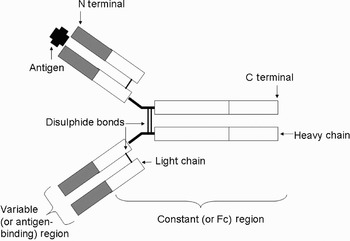
The basic antibody molecule is represented as a Y-shaped structure consisting of four glycoprotein chains (Figure 2). Each molecule contains a pair of identical heavy chains and a pair of shorter, identical light chains. The heavy chains are linked by one or more disulphide bridges formed between key cysteine amino acids. Each heavy chain is also covalently joined to one light chain by a similar disulphide linkage. Immunoglobulins are composed of 4 to 18 per cent carbohydrate, depending on the antibody type, and account for approximately 20 per cent of total plasma proteins.Reference Delves, Martin, Burton and Roitt1 The amino acid sequence of the C-terminal end of the antibody is highly conserved, and is termed the fragment constant region. This conservation is necessary because the fragment constant portion of the molecule interacts with effector molecules such as complement and immunoglobulin receptors on cells. The N-terminal domain of each chain, the variable region, makes up the specific antigen-binding site of the antibody, using hypervariable regions, in an analogous way to the T cell receptor (see above). The total number of antibody specificities available to an individual is known as their antibody repertoire; the human antibody repertoire is thought to comprise at least 1011 different clones.Reference Fanning, Connor and Wu28 As individual B cells only produce a single specificity of antibody, the human repertoire is limited solely by the total number of B cells within an individual.
Immunoglobulin G plus antigen. Two identical heavy chains and two identical light chains form a bivalent molecule with two antigen-binding sites.

There are five different classes of immunoglobulin (IgM, IgG, IgA, IgD and IgE), each of which has a subtly different structure and function, allowing the antibody to work optimally in diverse anatomical locations and against different types of infective organism. The first class of antibody to be produced by an activated B cell is IgM. This immunoglobulin class is produced before somatic hypermutation has occurred and so tends to be of relatively low affinity. Immunoglobulin M is found mainly in the blood, where its principal role is activation of the complement cascade against bacterial infections (see below). During B cell differentiation and repeated antigenic encounters, in addition to affinity maturation, the antibody class can be altered. The resulting class of antibody is strongly influenced by the cytokine environment generated by the T helper cells in the secondary lymphoid tissue. For example, the primary role of IgA is to protect mucosal surfaces by blocking the binding of infective agents or their products to target cells; they are thus termed neutralising antibodies. In contrast, IgG is principally localised in the blood, where it opsonises foreign particles for phagocytosis, acts as a neutralising antibody and, to a lesser degree than IgM, activates the complement cascade.
A large number of studies have considered the potential uses of murine, and more recently human engineered, monoclonal antibodies as diagnostic and therapeutic agents in the treatment of different cancers.Reference Liu, Pop and Vitetta29 Antibodies that target tumour-specific antigens can be attached to drugs or radioactive substances in order to deliver them directly to cancer cells, with the aim of minimising non-specific cell death. Antibody-coated tumour cells can also trigger a cytotoxic response by macrophages and natural killer cells, termed antibody-dependent cell-mediated cytotoxicity, in which the effector cells recognise antibodies via the array of exposed fragment constant portions and lyse the targeted cells.Reference Iannello and Ahmad30 Cetuximab, a recombinant human monoclonal antibody, has recently received U.S. Food and Drug Administration approval for the treatment of head and neck SCC in conjunction with radiotherapy.Reference Bonner, Harari, Giralt, Azarnian, Shin and Cohen31 Cetuximab binds to epidermal growth factor receptors, which are over-expressed in many head and neck SCC tumours. Cetuximab treatment in conjunction with radiotherapy has been shown to reduce mortality compared with radiotherapy alone. The antibody works synergistically with the radiation, both by preventing stimulation of tumour growth (by inhibiting the binding of the epidermal growth factor ligand to its receptor) and by mediating an efficient antibody-dependent cell-mediated cytotoxicity response against the head and neck SCC.
Natural killer cells
Natural killer cells develop entirely in the bone marrow from a lymphoid progenitor cell common to T, B and natural killer cells, and then circulate in the blood. They are morphologically larger than T and B cells, but act in a complementary way to cytotoxic T cells by lysing target cells that have reduced or absent major histocompatibility complex class I. Natural killer cells, unlike B and T lymphocytes, do not have antigen-specific receptors and do not undergo clonal expansion on activation. However, they can be stimulated into a greater state of cytotoxic activity (up to 100-fold has been reported) by specific cytokines such as interferon α and β, and interleukin 12. These three cytokines are usually produced early in an infection, and again illustrate how the initial, innate immune response contributes to generating the focussed and aggressive adaptive immune response. Cell cytotoxicity is again mediated by the release of granules containing perforin and granzymes, which penetrate the plasma membrane of the target cell and induce apoptosis.Reference Delves, Martin, Burton and Roitt1
Although possessing a similar killing mechanism to T cells, natural killer cells have two distinct cell surface receptors to enable cell recognition. The first type is an ‘activating’ receptor, triggering natural killer cell killing (e.g. NKG2D (CD314), which is a calcium-binding, c-type lectin that binds a variety of carbohydrate ligands present on many cell types). The second type is a class of inhibitory receptors, known as killer inhibitory receptors, which generate a ‘negative’ signal on binding to self major histocompatibility complex class I. Therefore, natural killer cells can kill tumour cells that will evade the T cell immune response by down-regulating major histocompatibility complex class I. Although it would appear that the complementary activity of natural killer cells and T cells should be capable of dealing with all changes in the surface receptors of tumour cells, this is obviously not the case. As has already been described for T cells, there are numerous reports describing down-regulation of both natural killer cell number and function in cases of malignancies, either due to tumour cell products or immune dysregulation.Reference Bose and Baral32, Reference González, Vargas, López-Cortijo, Castejón, Gorriz and Ramírez-Camacho33
Phagocytic cells
A variety of different cell types phagocytose micro-organisms and in some cases malignant cells during an immune response. Once ingested, degradation occurs inside specialised vesicles known as phagolysosomes, which can contain extremely toxic preformed compounds such as lytic enzymes and pore-forming proteins, as well as newly formed reactive O2 and N2 species. A highly active process known as the respiratory burst can be induced, causing a dramatic increase in consumption of oxygen and activation of membrane-associated oxidase. This oxidase reduces molecular oxygen to a superoxide anion which reacts to form hydrogen peroxide. Superoxide and hydrogen peroxide subsequently interact to give rise to hydroxyl radicals and halogenated compounds, which, although being less potent than the reactive O2 and N2 radicals, are more stable and exert potent antimicrobial and anti-tumour effects in the local environment. Phagocytic cells are protected from these damaging metabolites by glutathione peroxidase and catalase enzymes which remove excess toxic moieties.Reference Delves, Martin, Burton and Roitt1
Mononuclear cells
Monocytes, in common with all leukocytes, originate in the bone marrow from the common pluripotent stem cells and are released fully developed into the blood. Tissue macrophages arise by maturation of monocytes when they migrate from the circulatory system into the tissues. Mitogens (i.e. cytokines that induce cell division, such as granulocyte macrophage colony stimulating factor) play an important role in the proliferation and development of immature macrophages. A major physiological function of monocytes and macrophages is to remove antigen–antibody complexes, which often also incorporate complement components. The capability of macrophages to recognise opsonised particles, debris or whole cells resides largely in their receptors, which bind either the fragment constant portion of immunoglobulins or the C3b and C5b components of complement. The role of monocytes–macrophages in tumour eradication remains debatable, with some studies reporting defective monocyte responses in terms of cytokine production and phagocytic activity.Reference Heimdal, Aarstad, Klementsen and Olofsson34
Macrophages are also important for the initiation and regulation of the immune response. For example, macrophages that produce relatively large amounts of interleukin 12 (IL-12) increase bronchial responsiveness associated with eosinophil migration. In contrast, macrophages that produce increased levels of IL-l generally stimulate T-cell function and act as efficient antigen-presenting cells, as described above. The presence of increased IL-l also induces the production of: prostaglandins and leukotrienes (which can alter vascular permeability and bronchial tone); acute-phase proteins (including complement components and fibrinogen); and blood-clotting factors.Reference Delves, Martin, Burton and Roitt1 The presence of increased IL-1 also generally increases the activity of adhesion proteins on vascular endothelium and naïve leukocytes, contributing positively to a generalised inflammatory response.Reference Delves, Martin, Burton and Roitt1
Polymorphonuclear cells
Polymorphonuclear cells, also called granulocytes because of their abundance of distinct cytoplasmic granules, are the most abundant leukocytes in the blood. As shown in Figure 1, there are three types of polymorphonuclear cells, listed in order of prevalence: neutrophils, eosinophils and basophils.
Blood neutrophils comprise approximately 70 per cent of all leukocytes and are composed of two interchangeable sub-pools: the circulating and the marginal pool. One of the early events in acute inflammation is an increase in neutrophil margination and adherence to the vascular endothelium, caused by various cytokine factors such as interleukin 1. Neutrophils, a major part of the innate immune system, are especially good at phagocytosing bacteria. Unlike macrophages, they are relatively short-lived cells and, rather than present antigen in the context of self major histocompatibility complex, they undergo cell death during digestion of the phagocytosed bacteria. This results in the content of the cells and phagolysosomes being released locally, further enhancing the pro-inflammatory stimulus of infection. The anti-tumour effects of neutrophils have been demonstrated in vitro, particularly when targeting the cells via specific fragment constant receptors. However, their physiological role in vivo is not currently considered to be of great importance.
Eosinophils have fragment constant receptors for IgG and IgE and are particularly effective against parasitic infections. This function is attributed to the unique contents of their cellular granules, e.g. major basic protein and eosinophil cationic proteins. In a similar manner to neutrophils, eosinophils have been shown to mediate anti-tumour cytotoxicity in both human and animal studies in vitro; however, harnessing this potential in vivo has proved hard. Induction of apoptosis appears to be the principal killing mechanism, as murine eosinophils express messenger ribonucleic acid (mRNA) for perforin, granzyme B and Fas ligand, supporting the hypothesis that eosinophils elicit anti-tumour activity via a granzyme B dependent mechanism.Reference Costain, Guha, Liwski and Lee35 Whether tissue invasion by eosinophils is a good or bad prognostic feature remains unclear, as reports exist (using similar experimental approaches) both supportingReference Goldsmith, Belchis, Cresson, Merritt and Askin36 and refutingReference Alrawi, Tan, Stoler, Dayton, Anderson and Mojica37 the benefits of tumour-associated tissue eosinophilia.
Basophils are the least abundant granulocyte and are best described as a circulating form of mast cell. Both types of cell possess high-affinity IgE receptors and granules containing histamine, leukotrienes and a plethora of other pro-inflammatory mediators (including cytokines) which when released are responsible for the inflammatory response of redness, heat and pain. These cells are not known to have any direct cytotoxic effects against foreign organisms or malignant cells, but can help defend against both by allowing rapid and efficient recruitment of other immune cells to a reactive site.
Complement
The complement system is a set of at least 30 chemically and immunologically distinct plasma proteins which can interact with each other and with cell membranes to opsonise and lyse extracellular pathogens.Reference Macor and Tedesco38 The complement system can be activated by three distinct mechanisms: the classical pathway (antibody-mediated), the alternative pathway (spontaneous cleavage of C3) or the lectin pathway (recognition of bacterial cell wall carbohydrate sequences). Once activated, complement activity is expanded by key enzymatic steps and is effective in three ways.
First, complement proteins opsonise foreign particles. Specific cellular receptors for these complement proteins on phagocytic cells can then mediate the binding and uptake of the opsonised particles. Similar receptors on lymphocytes and antigen-presenting cells bind complement-opsonised antigen in the form of immune complexes and enhance specific adaptive immune responses.
Second, small fragments formed from proteolytic cleavage of the key complement proteins C3a and C5a (the anaphylatoxins) diffuse readily and can bind to neutrophils and macrophages, causing both chemotaxis and cell activation.
Third, complement causes cell death directly by the insertion of a hydrophobic ‘plug’ into the lipid membrane bilayer of the foreign organism, in a manner analogous to that of perforin-mediated lysis, which allows osmotic disruption of the target pathogen.Reference Delves, Martin, Burton and Roitt1
Membrane-bound complement inhibitors protect mammalian cells from inadvertent bystander complement attack. These inhibitors are often up-regulated on tumours, including head and neck SCC, representing another adaptation by which tumour cells escape elimination by a host's anti-tumour immune response.Reference Ravindranath and Shuler39, Reference Caragine, Okada, Frey and Tomlinson40
A number of other plasma proteins exist, known collectively as the acute phase proteins (e.g. C-reactive protein and mannose-binding lectin). The concentration of these proteins rises dramatically after infection with a micro-organism, acting as a general alert and causing all components of the immune system to be activated in a non-specific manner. Although individual components of this part of the immune system may show changes in concentration when a tumour is present, there is little evidence that acute phase proteins as a group play any major role in anti-head and neck SCC immunity. This is most probably because the development of malignancies is a chronic process resulting in cells expressing altered-self molecules over months or years, as opposed to an acute assault with a completely foreign organism.
Conclusion
Clearly, in an article of this length and nature it has not been possible to explain fully our current understanding of the human immune system. However, we have provided an overview of the major systems, both cell- and fluid-based, which comprise an integrated defensive unit ready to combat a diverse array of micro-organisms and also the more subtle malignancies that arise as altered-self. Over the past two decades, knowledge of the immune system has expanded radically and there have been accompanying attempts to use this insight to design novel screening, prognostic and therapeutic interventions. It is hoped that this review will allow clinicians to appreciate the ongoing such work relating to head and neck SCC.