The deceased, who was almost completely cut off from his three sons, bequeathed all his property to the caregiver who had cared for him and his wife during the last twenty years. The caregiver had received payment for her work, but her care extended beyond working hours and, according to her statement, she became “part of the family.” The sons contested the will, arguing that it was written under the caregiver’s undue influence. The court ruled to nullify the will (probate case 1580-07).
INTRODUCTION
The law reflects and constructs cultural understandings of the relationship between inheritance and elder care. Through rulings, such as the judgment cited above, courts reveal and further define social conceptions about the role of the family in caring for the elderly, the meaning and value of that care, and the right of older persons to use inheritance as compensation for the care given them. These rulings are especially pertinent because they are rendered in the midst of ongoing social transformation. Over the last few decades, family members have provided less and less long-term care for the elderly (Lowenstein and Katz Reference Lowenstein, Katz, Dannefer and Phillipson2010; Stuifbergen and Delden Reference Stuifbergen and Van Delden2011). The changing roles of family members, coupled with the perception of inheritance as a system of reciprocities (e.g., Sussman et al. Reference Sussman, Cates, Smith and Clausen1970; Cox Reference Cox1987; Leslie Reference Leslie1998; Zelizer Reference Zelizer2005; Brown Reference Brown2006; Tate Reference Tate2008; Hartog Reference Hartog2012; Finch and Mason Reference Finch and Mason2013), raise questions about the justification for older persons continuing to bequeath their property to their surviving relatives rather than to their caregivers. In this article, I examine how Israeli legal actors view familial responsibility for elder care in cases in which the deceased has bequeathed property to a caregiver. My empirical analysis of seventy-one court decisions and twenty-one in-depth interviews of lawyers involved in these cases unveils cultural justification for the long-standing practice of inheritance law to “keep the money in the family.” I show that interviewees and court rulings rationalize this practice by narrowing the meaning of familial care. They do so by presenting the family as a pristine domain of unconditional love, but one that is emptied of the ongoing caregiving.
A growing strand of legal scholarship argues that inheritance law is best understood as a social mechanism aimed at securing the institution of the traditional family (Friedman Reference Friedman and Edward1977; Leslie Reference Leslie1996; Madoff Reference Madoff1996; Frolik Reference Frolik1996; Foster Reference Foster2001, Reference Foster2008; Spivack Reference Spivack2009; Hartog Reference Hartog2012; Kreiczer-Levy Reference Kreiczer-Levy2013). Studies have demonstrated that inheritance law is deeply rooted in a family paradigm that gives preference to formal family members, leading courts to validate wills that reflect the expected norms and to annul wills that deviate from accepted familial relations (Sherman Reference Sherman1980; deFuria Reference deFuria1989; Thornley Reference Thornley1995; Leslie Reference Leslie1996; Madoff Reference Madoff1996; Leslie Reference Leslie1998; Foster Reference Foster2001; Barnes Reference Barnes2003). According to Madoff (Reference Madoff1996) and Leslie (Reference Leslie1998), court protection of the traditional family unit stems from cultural understandings that juxtapose conceptions of the family with conceptions of the market. While the family is perceived as a realm of inherent warmth, dependence, and care, the market is perceived as a realm of calculated self-interest, in which compensation for services is based solely on monetary value (Olsen Reference Olsen1983; Millman Reference Millman1991; Zelizer Reference Zelizer2005). Dependency relationships with family members are consequently perceived by inheritance case law as natural, while dependency relationships with nonrelatives are suspect; this perception underlies the invalidation of wills that transfer money to an “outsider” caregiver. We can, therefore, find ample evidence supporting the notion that inheritance law does tend to “keep the money in the family.”
To better understand the role of the law in preserving the long-standing practice of “keeping money in the family,” I build on Sewell’s (Reference Sewell1992) theory of social structures. Sewell (Reference Sewell1992) argues that every social structure is composed of resources and what he calls cultural schemas that justify allocation of the resources. In the context of succession disputes, the system allocates resources (e.g., inheritance) and justifies that allocation through cultural schemas regarding familial relations and elder care. Israeli courts and lawyers reflect and construct a cultural schema of the family that enables justifying the accepted allocation of inheritance despite the changing reality of elder care. I demonstrate that the examined interviewees and rulings represent and shape a cultural understanding of the role of the family in such a way that legitimizes its deservedness for inheritance and for the most part resists the transfer of wealth to outsiders who directly provide care. In so doing, they resist the schema of commodification and discourage older persons from trading their resources for care. This finding reveals how the law supports and enhances class reproduction. This is in line with a growing strand of literature that views the family and inheritance as core stratification institutions that primarily benefit the wealthy (Miller and McNamee Reference Miller and McNamee1997; Semyonov and Lewin-Epstein Reference Semyonov and Lewin-Epstein2001; Crompton Reference Crompton2006; Hacker Reference Hacker2014).
METHODS
My research is designed in the discourse analysis mode (Phillips and Hardy Reference Phillips and Hardy2002; Paltridge Reference Paltridge2012), meaning that I examine patterns appearing across texts produced by courts and lawyers, with each individual court ruling and each interview transcription representing a single text. These texts are read within the social and cultural context of elder care in an era in which family and market services routinely coalesce.
I chose to investigate legal discourses because of the significant role legal actors play in the expression and construction of cultural schemas (e.g., McAdams Reference McAdams2000; Scheingold Reference Scheingold2010; Albiston Reference Albiston2012). Moreover, legal cases born of conflict provide a rich arena for exploring social transitions and developments as both parties bring to court their unique understanding of the issue in question, with differences assumed to reflect diverse or changing social norms. Hence, legal proceedings are effective sites for exposing the social renegotiation of those cultural schemas guiding the norms of elder care.
The findings and analysis presented in this article are based on a qualitative study, conducted between January and March 2017, incorporating seventy-one court rulings regarding cases of succession disputes, and twenty-one in-depth individual interviews with some of the lawyers involved. My sample includes all published rulings rendered between 1991 and 2017 involving a will bequeathing property to a caregiver. Footnote 1 I have also included two unpublished rulings provided to me by one of the interviewees. My sample thus accurately reflects the courts’ perceptions regarding the published cases during this time period. Apart from these two cases, the sample does not include unpublished cases, cases that were settled, or cases that did not receive a reasoned judgment on their merits. Because published rulings influence the development of law, they must be viewed as the more significant cases and are most worthy of inclusion in the analysis. Supporting this conclusion are the comments of the lawyers interviewed, who viewed the sample as typical of cases of undue influence.
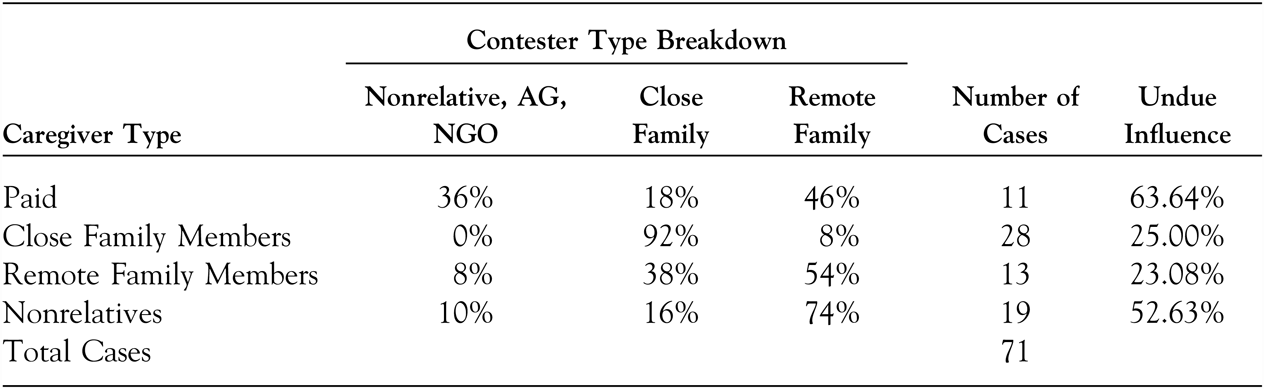
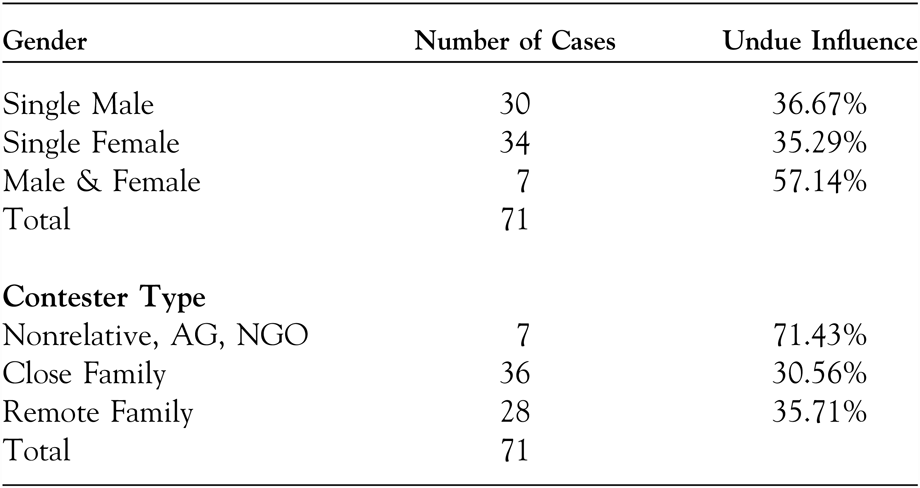
The sample of seventy-one court rulings address wills contested on the basis of a caregiver’s alleged undue influence. Among those cases, eleven (15 percent) involved a paid caregiver, twenty-eight (40 percent) a caregiver who was a close family member, thirteen (18 percent) a caregiver who was a remote family member,Footnote 2 and nineteen (27 percent) a caregiver who was a nonrelative, such as a neighbor or a friend. In terms of gender, thirty-five (49 percent) cases involved female caregivers, and twenty-nine (41 percent) cases involved male caregivers.Footnote 3 In seven (10 percent) cases, both female and male caregivers were involved. This sample includes three different types of contesters: a close family member (thirty-six cases or 52 percent); a remote family member (twenty-seven cases or 39 percent); or an entity outside of the family, such as the Attorney General, an NGO, or a nonrelative (six cases or 9 percent). In one case, the contesters included both a remote relative and an unpaid, nonrelative friend.
All but one of the caregivers in this research sample are Jewish-Israeli citizens, and all provided care within Jewish families. Hence, the conclusions of this research are limited to the Jewish population only. In Israel, the vast majority of elder care (paid care, informal care, institutional care, and in-home care) is provided by Israeli citizens (Natan, Reference Natan2011).Footnote 4 Employing migrant workers as caregivers requires a state permit,Footnote 5 which is provided only when an elderly person requires care in the home 24/7. However, the state covers only about one-third of the cost of employing a migrant caregiver, a condition that limits the number of elderly employers who can afford such care irrespective of their requirements. Among the elderly requiring home care and receiving state benefits, about 55 percent are assisted by paid Israeli caregivers and 45 percent by paid migrant caregivers who provide 24/7 care (Moshe, Reference Moshe2013). The fact that there are almost no migrant paid caregivers represented in the sample of rulings may be explained by the discomfort older persons may feel when bequeathing their property to non-Israeli caregivers. Another explanation might be that due to the huge power and economic disparities between the parties, cases involving a migrant caregiver are successfully challenged as a result of the migrant-worker legatee not challenging the contesters’ claims, and as a result, never lead to a detailed judicial decision.Footnote 6
I was able to obtain contact information and reached out to 55 of the 149 lawyers involved in the research sample of cases. Of this group, six (10 percent) could not be reached,Footnote 7 and nineteen (34 percent) were willing to be interviewed in the context of the research. Another two lawyers that have been involved in similar but unpublished cases were also interviewed. Hence, the total of twenty-one lawyers interviewed does not provide a statistically representative sample of the lawyers participating in the rulings analyzed. At this point I should stress that these interviews were conducted to supplement the data retrieved from the judicial opinion databases. The interviews also provided access to lawyers’ perceptions regarding elder care, thereby enabling discovery of the role lawyers may play in framing inheritance disputes. I have made every attempt to ensure that most of the lawyers included in the sample (72 percent) regularly represent clients in inheritance disputes and thus tend to represent either the family member contesting the will or the caregiver beneficiary.Footnote 8 Among the interviewees, there were fifteen men and six women. I could not identify any meaningful gender-based differences in their perceptions.
The interviews were conducted according to a semi-structured interview guide and included two parts. I first asked a few general questions regarding the interviewee’s experience in diverse succession disputes and their perceptions regarding the legal checks for undue influence. I then asked questions regarding the specific case they were involved in for the purpose of obtaining a fuller picture of the case with information excluded in the court’s ruling. In addition, I inquired about the interviewees’ views of their clients, the opposing party, and the relationships in question.
In the second stage, I presented interviewees with three distinct scenarios. Each scenario was based on the circumstances cited in various legal rulings and a different type of caregiver. The first scenario involved a paid caregiver who provided extensive and devoted care to an older person during the latter’s final two years. The older person was in touch with his three children, and they were totally uninvolved in providing for their father’s daily needs. The caregiver brought the elderly person to the lawyer for the drafting of the will but was not present at the meeting. The will endowed the bulk of the older person’s property to the caregiver and the cash saved in a bank to his children, in equal shares. The second scenario involved a childless older person who had isolated himself from the world, including his remaining relatives, since his wife’s passing ten years previously. A volunteer from the IDF’s disabled veterans association had visited him regularly during the last few years of his life. The older person’s connection with the world was maintained exclusively through the volunteer caregiver. The deceased left a will bequeathing all his property to this person. The deceased’s relatives, previously unaware of his death, were notified by the attorney general, who intervened with a request to annul the will, claiming undue influence of the caregivers. The third and final scenario involved an older person, cared for by a devoted son for over two years. This older person seeks the legal advice from a lawyer (the interviewee) for the purpose of modifying his will so as to bequeath most of his property to this son.
I then asked the interviewees questions about whether the facts mentioned in each scenario might indicate undue influence, their reasoning, what else they felt should be examined in such a case, and what conditions might change their opinion. The interviews were open-ended and conducted as casual conversations. This structure gave me as well as the interviewees sufficient leeway to take the interview down unexpected paths (Patton Reference Patton2002).
When analyzing the data, I initially examined the distribution of undue influence rulings according to several case characteristics. I then conducted a qualitative discourse analysis of both court rulings and my interview transcripts while searching for recurring themes, which were then categorized. Each interview was assigned to one of the categories obtained. Using these categories as “index keys,” I created a table enabling cross-comparison of the interviews and identification of relationships among categories. With additional interviews and my deepening understanding of the issue, some analytic categories were abandoned; others were refined as subcategories or redefined.
THE LEGAL FRAMEWORK
Similar to the US case, the guiding notion dominating inheritance law in Israel (see Barak Reference Barak1992; Corinaldi Reference Corinaldi2012) is individual autonomy. This idea manifests itself, first and foremost, in the principle of freedom of testation, according to which people have an almost absolute right to decide how and to whom to divide their property after death without providing any justification for that decision. Accordingly, every will is presumed to be valid, and the burden of proof lies on the person contesting the will. Moreover, a decision to revoke a will rests first and foremost on the notion that the will does not reflect the testamentary intent of the deceased.
In accordance, Section 30 of Israel’s Succession Law states that a will is invalid when written under duress, threats, or undue influence.Footnote 9 Such undue influence does not prohibit all types of influence but only influence that is considered “unfair,” to the extent it has impaired the deceased’s freedom of testation. Israeli case law has developed four main checks evaluated holistically to determine whether the testator’s dependence on the beneficiary was exhaustive to the extent it is reasonable to presume that it denied him of his free will (Marom v. Attorney General 1998): (1) whether the deceased was thoroughly and exhaustively dependent on others for his basic needs; (2) whether the beneficiary of the will in question had provided the testator with the basic assistance she required; (3) whether the testator was isolated from others, excluding the caregiver providing him the need assistance; and (4) whether the will’s beneficiary had been involved in preparing the will.Footnote 10 Legal rhetoric addresses these tests as objective measures aimed at protecting the testator’s personal autonomy. Thus, in cases where most of these checks are met, it follows that the circumstances suggest that the will does not reflect the testamentary intent of the deceased, and the burden of proof is consequently transferred to the beneficiary, the caregiver.
Hence, with some caveats, Israeli law addresses the property transmitted through inheritance as if it were like any other property, to be given or traded at will, regardless of family relations. Unlike most of Europe, US and Israeli Inheritance Laws provide only limited direct protection of family relationships. The latter do not include clauses mandating transmission of at least some property to family members; they merely permit courts to allow maintenance to be distributed from the estate to the decedent’s spouse, children, and, under some circumstances, parents in need (Shocat et al., Reference Shocat, Finebrg and Flumin2014; Isr. Succession Law §§ 56–65 (1965)). However, in both countries, the doctrine of undue influence may provide an indirect means of protecting family relationships.
FINDINGS
Normative Judgments Regarding the Type of Relationship
While indeed the principle of individual autonomy is emphasized in court decisions, it does not seem to promote our understanding of the forces driving undue influence cases. First, because undue influence implies harm to one’s autonomy, the principle cannot dictate decisions in specific cases in which a claim for undue influence is made. Therefore, both type of decisions—decisions revoking a will due to undue influence and decisions upholding a will while rejecting claims of undue influence—use freedom of testation rhetoric and claim to promote the principle of individual autonomy. Second, legal checks for undue influence do not reflect objective measures of the deceased’s freedom of testation but rather normative perceptions of the relationship between the deceased and the successor. The legal checks regarding level of dependence, degree of isolation, and level of beneficiary involvement in preparing the will tend to be interpreted according to a normative assessment of the kind of relationship a caregiver should have with the elderly person in her charge. For example, in probate cases 109920-04 and 7770-10-11, the circumstances involved extensive care given during the last few weeks before the elderly person’s passing. In both cases, the caregiver was living with the deceased during that period, and effectively assisting him with all his most basic needs twenty-four hours a day. Nonetheless, in probate case 109920-04, where the caregiver was a family member, the court ruled that the dependency between the daughter-in-law and the deceased was neither thorough nor exhaustive. In contrast, in probate case 7770-10-11, involving a caregiver who, while a neighbor, had maintained a close relationship with the deceased for many years, the court ruled that these circumstances constituted thorough and exhaustive dependency, strongly indicating the presence of undue influence.
Such normative assessments of the relationship in question may lead to conflicting judgments. Circumstances that are objectively much more severe with respect to the level of dependency may be interpreted as less problematic than circumstances involving significantly less extensive care. For instance, in probate case 1981-06, the court lengthily describes how the daughter of the deceased—who was the main beneficiary of the will—never left her father’s bedside, responded to all his needs, and was sometimes found sleeping in a chair beside his bed. These circumstances strongly suggest fulfilment of the criterion of thorough and exhaustive dependency. And yet, the court ruled that this type of care is natural in a relationship between a father and a daughter and thus does not establish the legal condition of undue influence. Conversely, in probate case 23835-02, the caregiver—a volunteer from the IDF’s Disabled Veterans Organization—provided significantly less extensive assistance: helping the elderly person during periods of hospitalization, serving as his contact person, assisting in the submission of requests for assistance from different organizations, occasionally bringing him meals, and inviting him to his house. Although the volunteer did not live with the deceased nor spend all his time with him, the court ruled that thorough and exhaustive dependence existed between the caregiver and the deceased.
In sum, my preliminary argument states that the Israeli court rulings in these succession disputes do not reflect the testator level of individual autonomy and freedom of testation; instead, they reveal the courts’ cultural attitudes regarding issues of who should care for the elderly and how to compensate for this care. Therefore, subsequent sections focus on disclosing the underlying cultural schemas embodied in legal actors’ understanding of what older persons might autonomously do with their money.
It’s All About Who Is the Caregiver
Among the seventy-one court rulings analyzed, in forty-four (62 percent) cases the court ruled that the will was valid. In twenty-seven cases (38 percent) the court nullified the will because of undue influence exercised by the caregiver. Among cases involving a paid caregiver, 63 percent of the wills were nullified based on undue influence of the caregiver. The percentage of undue influence rulings decreased to 52 percent in cases involving an unpaid nonrelative caregiver and dropped to 24 percent in cases involving a family member caregiver. In cases involving a paid caregiver, a nonrelative caregiver, or a remote family member caregiver, it was more likely to have a remote family member contest the will (see Table 1). However, differences in the distribution of undue influence cases according to who contests a will seem less important. Thirty percent of cases involving a close family member contester versus 35 percent of cases involving a remote family member contester were ruled void. Footnote 11 In addition, there was almost no difference in the distribution of undue influence rulings according to the gender of the caregiver (see Table 2).
Caregiver by Contester and Undue Influence

Gender and Contester by Undue Influence

In the following section, while drawing on the qualitative analysis of court rulings and interviews, I describe the ways in which the sample’s Israeli legal actors justify these findings. I show that the dominant legal discourse promotes and defends the idea of “keeping the money in the family,” a discourse that undermines cultural schemas supporting the commodification of care.
The Conflict Between Competing Cultural Schemas
Family Discourse: “Keeping the Money in the Family”
The dominant discourse used by the interviewees and the rulings in the sample, which I term as “family discourse,” reflects a cultural schema vindicating the practice of “keeping the money in the family.” This schema is comprised of three core elements: (1) compensation contradicts “authentic” loving care; (2) the family is idealized, with only family members or those persons “transformed” into “family”’ providing this loving care; and (3) inheritance belongs to the family regardless of whether the family has provided care to the elderly relative or not.
(1) Compensation Contradicts “Authentic” Loving Care
According to family discourse, the issue of whether a caregiver receives compensation is fundamental to assessing whether the care embodies “authentic” loving care. Footnote 12 This idea plays out in several ways, first, in the notion that receiving compensation changes the meaning and value of the care provided. Accordingly, interviewees often address similar circumstances differently, based only on whether the caregiver received payment for the care provided:
A neighbor who comes to assist is not the same as a person who was hired [to do so]. (Attorney Cohen) Footnote 13
In line with this view, many interviewees strictly distinguish between “work” and “care,” based on compensation for service. Moreover, once money is involved, it changes the value of the care provided, with a tendency to devalue formal paid care, an attitude captured in how Attorney Bachmeir addresses the hypothetical case presented:
She devotedly provided care, but still, she was doing her job, she wasn’t there [providing care] because of an emotional or familial relationship, it was merely done, part of the job [for her].
Based on this criterion, Attorney Brenner compares elder care to the care provided by a doctor in a hospital while emphasizing that in both cases, the respective individuals are merely performing a job:
He did his job. If it weren’t him, it would have been someone else, right? It’s not because of his personality. … The same goes for the [migrant] caregivers who come to Israel to work in elder care. They are assigned to one elderly person or the other by chance. They are simply doing their job.
Second, “authentic” loving care is considered an act of altruism in contrast to monetary compensation, most often to the detriment of the caregiver’s financial interests.Footnote 14 Monetary compensation for caregiving is perceived, accordingly, as a negative factor, associated with greed, exploitation, and manipulation. In probate case 23835-02-10, the court frames receiving high compensation for care as an immoral act:
The very close relationship with the deceased greatly “improved” the claimant’s situation,Footnote 15 hinting at more than impropriety, at least in the moral sense.
Thus, despite the fact that legal doctrine assigns no wrongdoing to the expectation of compensation, both sides to legal proceedings, including the court, frequently address the caregiver’s monetary motivation as a significant element in deciding the presence of undue influence. And so, when challenging a will, parties contesting the bequest often argue that the caregiver’s “motivation was greed, not altruism,” (probate case 1580-07), or that the caregiver acted manipulatively in the hope of receiving an inheritance:
[She was like] a person “wrapping himself around the deceased, around him and his family, like a tightly knotted rope” in order to position herself as the only one who cared for the deceased, … all that to facilitate the writing of a will in her favor (probate case 5690-99).
Alternatively, petitioners requesting a grant of probate stressed that the care provided was not motivated by economic interests. For example, Attorney Zoker invoked her personal experience with a caregiver who assisted her in caring for her dying husband to support her perception of the ideal caregiver as a person not motivated by money:
Rami had a caregiver for a week, a Philippine woman. She was amazing … She massaged his feet…. When I wanted to pay her, she told me: “Money isn’t everything.” [She] touched my heart. She actually pushed the money away with her hands.
The ultimate caregiver is, moreover, described as someone who sacrifices her own interests in order to care for older people. For example, in one case, the court addresses the caregiver’s motivation for care, stressing that she cared for the deceased even when it contradicted her own financial interests:
The claimant did not do what she did out of financial interests. I believe her because in 1996 she told the [deceased person’s] guardian to sell his apartment, an apartment she knew was hers [according to the will] … in order for the deceased to have the funds to enable him to move to the nursing home where he [eventually] lived (probate case 5690-99).
Another example for this perspective can be found in probate case 1981-06, in which the court stressed the enormous sacrifice made by a daughter when caring for her elderly father:
The daughter lived with the deceased for three years, until he passed away, caring for him daily, almost never going out of the house, sacrificing her life for him, because she resisted her brother’s desire to place him in a nursing home. Everything was done according to the needs of the deceased, not her own.
By addressing economic compensation as a negative factor, the quoted statements reflect the notion that “authentic” loving care is an act of sacrifice, intrinsically compensation-free. At the same time, it constructs a notion of elder care as an unrewarding activity that involves heavy burdens and immense sacrifice that can be enacted only out of love. This notion paves the way for idealization of family relations by introducing the idea that only the family can provide such care.
(2) The Family Is Idealized
The idealization of family relations promotes the notion that the family constitutes a unique and sacred sphere consisting of inherently different forms of relations and services. Footnote 16 At the core of the family’s exceptionality stands its supposedly fundamental, unique ability to provide “authentic” loving care. Attorney Modai summarizes this perspective by presenting the family as a metaphysically distinctive sphere where angels—who care out of pure love—still exist:
Let’s say that today, except for close family members [emphasis added], a person who is doing a favor to another person expects something in return, and that is very reasonable. The Angels that existed in the past don’t exist anymore.
As I illustrate below, establishing the family as an exceptional sphere entails, first of all, a clear separation between family and outsiders. Second, it requires delineating the basic functions and characteristics that make these relations exceptional.
Family Versus Outsiders
The family discourse applies clear criteria of “good” and “evil” when distinguishing between the two supposedly distinct categories of family members and outsiders (nonrelatives). The family is, accordingly, portrayed as a secure haven, sharply contrasting with the malicious external world. Hence—despite strong evidence suggesting that exploitation of the elderly is quite common among family members (e.g., Greenberg, McKibben, and Raymond Reference Greenberg, McKibben and Raymond1990; Lev and Anson Reference Lev and Anson2008)—the family discourse promotes the idea that “only the family can guard against exploitation of an older person” (Attorney Tzoker).
Outsiders, moreover, are viewed as unable to withstand the inherent hardships of elder care, making them readily suspect of wrongdoing. Attorney Levy expresses this ready suspicion of outsiders as prone to abuse or stealing:
[Family care] is ideal for everyone, because it is less likely that you’ll discover that the caregiver is hitting your father when the caregiver is your brother … since my dad needed a caregiver … the kitchen cabinets are somehow getting emptier and emptier.
The built-in suspicion of outsiders was found to be relatively strong; nineteen out of twenty-one interviewees remarked that should a will favor an outsider, it may be an indication of exploitation, and the case should be thoroughly investigated. Moreover, the interviewees suggested that this attitude is not merely the outcome of professional experience; it is also prevalent among lay persons. For instance, Attorney Brenner related that many clients come to him for legal advice as soon as an outsider is employed, stating that they are worried over whether he or she will exploit or manipulate their charge. This is also supported by the fact that 57 percent of the cases in the sample involving an outsider resulted in an undue influence judgment.
Building on this distinction between family and outsiders, and to reinforce the exceptionality of family relations, we next explore how the courts and the interviewees define the role characterizing the family.
Constructing the Pure Role of the Family
Legal actors in this study, as we will soon see, reinforce the pristine characteristics of the family in two ways: by separating love from physical care and by demarcating the boundaries of the family unit. They thereby maintain the basic distinction between family members and outsiders while simultaneously using the meaning of family care to justify “keeping the money in the family.”
(a) Separating Love from Physical Care
According to the family discourse, relations between members represent feelings of love, compassion, and concern, while relations with outsiders focus on physical needs. While love cannot be bought, the opposite holds when meeting the physical needs of elderly persons. Several interviewees elaborated on this distinction when addressing the employment of caregivers:
Today it is acceptable for family members not to be the ones caring for the elderly. … If you have [small] children at home, you can’t simultaneously care for [them and for] a drooling old man who often screams. So, … you pay a person to do the job. (Attorney Yaacobi)
Attorney Bachmeir, like others, began by differentiating between what is expected of family members and what of paid caregivers while stressing the physical tasks performed by the latter:
Children today lead their own lives within their own families. It might not be nice to say so, but when their parents become burdens, they need real supervision. The caregiver may even serve as [the old person’s] arms and legs, as an escort. [His job is] to physically care [for the elderly].
In line with this notion, the arguments of both parties in probate case 26220-09 revolved around whether cessation of a claimant’s provision of physical care signified the demise of the familial relationship between the claimant, a common-law wife, and the deceased. The claimant, who lived with and cared for the deceased for three years, argued that the physical care she provided went beyond what was expected of a common-law spouse. To highlight the inappropriateness of her provision of such care, she compared her life to that of a slave, that she had been disgracefully taken advantage of by the deceased.
Due to this disagreement over the extent of care, the claimant moved out to a nearby apartment. However, she argued that her leaving did not change the close and intimate relationship she maintained with the deceased. In other words, her refusal to provide physical care was not fundamental to their relationship. She also stated that upon her departure, the deceased began to employ a migrant caregiver, a fact meant to sharpen the distinction between services integral to familial relations and those appropriate in relationships maintained with outsider care providers. To highlight this distinction, the claimant declared that the deceased had told her that he was “not receiving the care and cooking [of meals] he desired” from the migrant caregiver. According to this narrative, then, familial relations require inherently different types of care services from those bought in the market; they are not interchangeable.
Similarly, in probate court 3230-00, the will of the deceased included an article stating that she wished to bestow her estate to “the person who will support me in the last period of my life—at least one year before my death.” A cousin of the deceased, contested the will, trying to convince the court that the word “support” does not refer to daily physical care:
The support of or concern, accorded to the will’s article 3, refers to all support but certainly not to the daily care provided by the claimant, for which she received payment.
Hence, the idealization of family relations as portrayed in the court cases and by the interviewees delivers an image of the family sphere as a domain of pure and unconditional love, with love conceptualized as divorced from the substantial, daily care older persons require. Concomitantly, this separation between love and physical care denigrates the value of the latter, portraying it as a technical, emotionally insignificant activity.
The purity of family love and the denigration of physical care provided by outsiders is accentuated through highlighting the association between providing physical care and providing sex services. In probate case 27794-11-09, the person contesting the will directly accused the caregiver of providing sex services and brought two witnesses to attest to the fact that the deceased had told them as much.Footnote 17 Moreover, seven out of twenty-one interviewees, such as Attorney Yaacobi for example, directly referred to this suspicion:
Many times, the foreign [e.g., non-Israeli]Footnote 18 caregiver fulfils the sexual needs of the elderly man, … I know this from experience…. If she pleasures him and he gives her money for this service, it isn’t proper.
Attorney Brenner, too, mentioned an extreme case he encountered regarding a romantic relationship between a seventy-six-year-old woman—diagnosed with cancer—and her forty-year-old caregiver lover. The woman had come to ask for his legal advice because a family court judge had refused to approve a pre-nuptial agreement between the two; instead, the judge informed the police, which opened an investigation. Attorney Brenner resolved the predicament by addressing the person his client viewed as “the love of her life” as a gigolo:
And I asked myself, … what does a forty-year-old man find in a seventy-six-year-old woman who has cancer? … she tells me: “Listen, I’m like a teenager in love.” It probably involves physical contact of some sort, so as a lawyer, I don’t know what to make of it…. In the end I said to him: “Ok, fine. You know what? You’re a gigolo, how much does it cost? How much does this service cost?”
Attorney Bachmeir likewise referred to a case suggesting that the woman caregiver subtly used her sexuality to exploit his client:
The issue was that she winked at him and caressed him…. It wasn’t [overtly] sexual, but something between a man and a woman.
Relatedly, Attorney Spector stated that he believes that suspicion of outsiders is common among lawyers, an attitude that may impact on court rulings. When referring to a case in which he represented a caregiver coming from Russia, he suggested that his client lost the case because of the public’s biased image of Russian women:
The image of foreign [e.g., non-Israeli] workers from Russia is … that they bring them here to be [either] prostitutes or caregivers.
The connection between care work and the provision of sexual services thus creates an image of the physical care provided as something repugnant, immoral, and shameful.Footnote 19 Such attributions represent the extreme opposite of idealization of family love, manifested in the notion that outsiders provide the dirty physical care.Footnote 20 In the following, I discuss how this conception of the family is reinforced by demarcating the boundaries of the family.
(b) Demarcating the Familial Roles
In some cases, the family discourse incorporates outsiders by “transforming” them into “family”Footnote 21 or excludes formal relatives from being considered “family.” Hence, in such cases, the boundaries marking who is included and who is excluded from the “pristine” sphere of family relations reflects the behaviors conceived as maintaining this sphere’s purity as well as those perceived as contaminating it. By demarcating the family’s boundaries, legal actors reinforce what roles individuals must play to be considered family.
The notion that family membership can be determined through “kinning” (e.g., Ball Reference Ball1972; Baldassar, Ferrero, and Portis Reference Baldassar, Ferrero and Portis2017) or becoming “fictive kin” has long been explored in the context of elder care (e.g., Gubrium and Buckholdt Reference Gubrium and Buckholdt1982; Karner Reference Karner1998; Dodson and Zincavage Reference Dodson and Zincavage2007; Mazuz Reference Mazuz2013). In these studies, scholars have focused on the social process in which non-kin caregivers are categorized as family by caregivers and their clients. I build on this more flexible notion of family as an institution determined by more than blood relations and focus on the functions and characteristics that legal actors mark as signifying the transformation of caregivers into family.
First, the construction of an outsider as “family” hinges on the fact that the outsider did not receive compensation for the care provided. Hence, money not only differentiates between “work” and “care,” it also sets the boundary between those considered family and those not. For example, Attorney Rosenblatt commented:
The servant receives money, he is therefore not part of the family [emphasis added], and thus, sir, not part of the inheritance. You provided a service; you received compensation for doing so; now get out.
Following this line of argument, when justifying the claimant’s transformation into “family” in probate case 5690-99, the court superficially distinguishes between the cleaning and cooking the claimant provided during her official workday, and the cooking and assistance she provided on other days, when she received no compensation. Hence, a defining characteristic of the family is the provision of unconditional love without monetary compensation. This notion strengthens the social conception of the family as a pure intimate domain completely separated and hostile to egoistic economic behavior (Zelizer Reference Zelizer2005).
In addition, to establish that an outsider has indeed become “family,” claimants as well as the courts stress the caregiver’s participation in symbolic events: such as inviting the elderly person to holiday dinners and family celebrations, visiting them during their hospitalization, participating in the client’s funeral, and participating in the mourning period. Among the thirty court rulings involving a caregiver who is formally not a family member, fifteen included references to the caregiver’s participation in such uniquely familial events. For instance, in probate case 57331-01-11, the claimant ignored the daily work she performed when caring for the deceased and his wife for seventeen years but did base her claim on symbolic events (e.g., spending religious holidays together, either at home or at hotels).
However, legal actors can also set the boundaries of the family by specifying the conditions under which a family member might be prevented from continuing to be considered “family.” In other words, banishment from the deceased’s “family” points to conduct viewed as polluting the familial sphere. According to the court rulings and the majority of interviewees, only extreme events justify such ostracism. Hence, to meet the standards of “normative” family relations, it is enough to be in touch with the family and “perform” those symbolic “rituals.” For example, in probate case 1580-07, the claimant stressed that the deceased’s son did not invite his father to his own son’s wedding, an omission on which she based her claim that the son did not meet the standards of family membership. In probate case 27794-11-09, the claimant and the court likewise stressed the unacceptable behavior exhibited by the deceased’s daughter, who refused to fulfill her symbolic filial duties. To demonstrate, the court cited a witness’s testimony stating that “she was shocked not to see the daughter at her father’s funeral.”
Analysis of familial boundaries thus reveals that daily caring for the deceased—preparing meals, helping with personal hygiene, assisting with grocery shopping, etc.—is not construed as a definitive criterion for the existence of “family relations.” Both types of these cases noted—those where an outsider is “transformed” into family and those where biological family members are banned from the family—highlight consummately symbolic familial events rather than daily routine care. The emphasis on symbolic events—weddings, holidays, funerals, and mourning periods—that all carry a culturally shared religious meaning seem to underpin once again the pure sacred nature of the family.Footnote 22
This discourse therefore offers a self-contradictory, incongruous image of elder care. On the one hand, elder care tends to be perceived as burdensome and ungratifying to the extent that only family can provide “authentic” loving care. On the other hand, in definitions of the fundamental role of family, the daily, routine act of caring for the elderly, the very activity that constitutes a substantial part of what makes care so difficult and ungratifying, is often left unmentioned. That is, according to the family discourse, family relations are, for the most part, devoid of any normative demand to provide routine physical care to older persons.Footnote 23
(3) Inheritance Belongs to the Family
The final element in the schema justifying “keeping the money in the family” is the idea that inheritance belongs, first and foremost, to family members or to those transformed into family members, irrespective of whether or not they had provided physical care to the now deceased family member.
One example of this was articulated by Attorney Yaakobi. His clients in this case, distant relatives of the deceased, had been disinherited in favor of the latter’s close friends. Yaakobi stated that he was convinced that these friends supported the deceased for years and that their relationship was candid. Moreover, he assumed that the will reflected the deceased’s wishes to provide for those who had cared for him so attentively. He nevertheless justified his clients’ deservedness merely on the basis of being family: “[If you can] state: ‘I am a family member,’ nothing more need be said.”
This notion was reflected in the court ruling in which, despite its recognition of the claimants’ request of a grant of probate as the persons caring for the elderly deceased person, the court annulled the will, which allowed family members to inherit the deceased’s property despite having provided none of the care warranted. For example, in probate case 104910-04, the judicial opinion includes a long quotation from the claimants’ testimony describing the devoted care they provided the deceased. According to their testimony, they were the ones who made sure the deceased would employ a caregiver; they visited her regularly; they assisted her with special errands; they accompanied her to doctors and visited her every day during her hospitalizations. The court’s ruling also cites testimony describing the somewhat distant relationship between the deceased and her relatives, who were in continuous telephone contact and visited the deceased in the hospital once every week or two. Nonetheless—and despite the fact that the care provided appeared to deviate substantially from the four tests establishing the dependency presumption—the court ruled that as the relatives did not ignore the deceased, and as no evidence indicated that the deceased wished to disinherit them, it was annulling the will bequeathing the property to the caregivers.Footnote 24 Attorney Rosenblatt clearly described the disconnection between physical care and family deservedness in such cases:
And if they brought the caregiver, they saw it as a way to do the minimum regarding the burden of physical care, which may be unpleasant and inconvenient…. But if they stayed in touch with him and took care of his physical and emotional needs, there should be no reason for him to deny them his property [i.e., the will].
The notion that inheritance belongs to the family exclusively also plays out in other, more subtle ways. First, it is expressed in how the interviewees frame the concept of inheritance and the issues at stake in succession disputes. For instance, if family relations are about feelings of affection rather than physical care, inheritance reflects love rather than the disposition of money and property. As Attorney Amsalem explained, he believes that a parent should bequeath his property equally among his children because “a person allegedly loves all his children equally,” a point repeated by Attorney Margolis when addressing a case in which she represented a brother and sister who were contesting a will bequeathing all the parent’s property to the third sibling, a sister:
They all took care of their father. He came to all of their family events. He loved all three of his children equally.
Going further, Attorney Dagan argued that cases of undue influence are actually about recognizing the fact that the family members contesting the bequest acted as family members should:
Undue influence [cases] are about something deeper than money … the [two] sisters … wanted a note from their “teacher” stating that … [they] cared for [their] father, that we are good [souls] and that they [the other siblings] are not.
In line with this argument, Attorney Katz presented his own view of inheritance, specifically, as a reflection of feelings rather than acts. He thus disconnected routine care from feelings of caring, which resulted in the detachment of care provision from deservedness to inherit:
Sometimes a child is more available to give care, and sometimes less. It doesn’t mean that I [he/she] don’t care about my [their] parents. The giving of care isn’t always an indication of closeness or concern, or a justification for a larger inheritance.
Second, the idea that inheritance is not a form of compensation for care emerges from the reframing of the relationship between inheritance and time. To justify their separation of caregiving from inheritance, interviewees often extended the period of time thought relevant for inheritance either forward, to the far future, or backward, to the distant past. For example, Attorney Levy extended the temporal relevance of inheritance into the far future, arguing that inheritance is relevant to grandchildren, not to children. That is, due to the increased life expectancy of older persons, the grandchildren of the deceased are those who, in effect, will derive its benefits; hence, the grandchildren’s deservedness cannot be related to their parents’ behavior:
The inheritance skips [a generation]. De facto, when you bequeath your property to your child, he is not necessarily the one who enjoys its benefits…. Hence, the person who actually enjoys the inheritance is the grandchild. He is the one we need to think about.
To the same end, other interviewees disconnected inheritance from care by conceiving of inheritance as representing a life-long endeavor that cannot be undone due to a short-term experience at life’s end:
He was a father to children, worked for many years, saved a lot of money, acquired an apartment and a mortgage, all his accumulated life’s work; then, at the end, someone [the caregiver] comes and in two years’ time takes it all. (Advocate Bachmeir)
To sum up, the previous excerpts, taken from the interviews, represent the various ways that interviewees and the court rulings in this study disengaged inheritance from actual caregiving. This step represents the last element needed to justify the practice of “keeping the money in the family.”
As I have shown, the family discourse first constructs elderly care as an act of pure love that contradicts the idea of compensation for care. It then idealizes family relations as the only model capable of providing this “authentic” pure loving care while simultaneously separating the notion of love from its manifestation in daily caregiving. Last, the same discourse frames inheritance as something belonging exclusively to the family, regardless of whether they provided the older person with what might be considered “authentic loving care” at the end of her life. We now move on to the next section, where I describe the alternative “market discourse,” which supports commodification of care.
The Market Discourse: Supporting the Commodification of Care
The “market discourse” is significantly less prevalent in the Israeli inheritance deliberation. Footnote 25 Only four out of twenty-one lawyers, and only four out of thirty court decisions involving a nonrelative caregiver (paid or unpaid), abide by this discourse. The same is also apparent in sporadic claimant statements, witness testimonies, and minority judicial opinions. At the foundations of the market discourse lies the “commodification of care” schema, comprised of three central components: (1) the view that care is a service that can be bought in the market, and should always be compensated for; (2) the deconstruction of the familial ideal by recognizing that family members do not provide elder care; and (3) constructing inheritance like any other market resource of which the older person can use as he wishes, including as a form of compensation for caregiving.
(1) Care Can be Bought in the Market
The basic notion elaborated in the market discourse is that compensation for care does not define the type of relationship maintained nor diminishes the quality of care provided. As such, paid care is viewed as substantially similar to unpaid care, and compensation does not signify devaluation of the relationship or the services provided. In probate case 57331-01-11, for instance, the court rejected the family discourse as argued by those contesting the will:
It should be noted that those who object to the will emphasize the fact that the claimant received payment for her work. I don’t find that this fact detracts from the warm, close relationship formed between the two families.
In a different case (probate case 49160-08), the court openly accepted the notion that familial relationships and feelings of “being at home” could be bought with money:
Even if the deceased chose in his old age to regularly financially support the claimant and her daughter in return for their acting as his home and his family for six years … and even if he chose to shower the claimant with large sums of money in order to make her happy and win her attention and affection, these facts are insufficient to unequivocally prove that the claimants exerted undue influence.
Moreover, the market discourse also supports the idea that care should be rewarded, a notion shaped by the simple assumption that all individuals expect some kind of recompense that reflects their efforts. Attorney Rosenberg stressed this notion by drawing attention to the fact that a caregiver’s average salary “does not represent sufficient compensation for a job like caring for the elderly.”
The market discourse thus ignores the issue of motivation for providing care. In probate case 9707-01-12, the contesters to the will drew a negative portrait of the son, who received compensation for his costs when caring for his mother, what they considered a sign of his selfish motivations and greed. The court nonetheless completely overturned the perception of this fact by focusing not on the compensation-accepting son but, rather, on the mother’s practice of compensating others for any of the costs they incurred when caring for her, which it framed as a positive virtue.
Seen from the other side, that of the caregiver, the market discourse maintains that people can provide loving care and nonetheless expect and even request compensation:
The fact that a person takes care of a lonely person in the hope that he will change his will in his favor … isn’t enough to disqualify the will, even if he asked him [the deceased] to revise his will (probate case 57331-01).
In probate case 9707-01-12, the court took this notion even further by ruling that even if the beneficiary demanded—rather than requested—that the testament will be revised in his favor, it does not constitute undue influence.
Resting on the idea that care is a commodity, and that paid care is not substantially different from unpaid care, the market discourse rejects the idea that such care can be provided only by the family, as I detail below.
(2) Deconstructing the Idealized Family
In its current form, the market discourse recognizes the changing norms surrounding caring for seniors, especially the unwillingness of adult children to care for their elderly parents:
Children don’t want to take care [of you], perhaps rightfully. … They aren’t willing to sacrifice themselves [for them]. They have their own lives, so they have to expect that the parents may feel grateful to her [the caregiver]. (Attorney Rosenberg)
Following the same line of argument, Attorney Magen directed a rhetorical question to me, stressing the notion that it is unthinkable for children to care for their elderly parents in today’s world:
All the children are busy and she [the caregiver] is with her 24/7. They want to thank the caregiver. The law allows it. Would it be preferable to donate to Libi [a fund helping soldiers] than to give [bequeath] it to the caregiver? Would you give up your life to take care of them? [emphasis added].
Hence, the market discourse avoids drawing boundaries between the family and outsiders, and accepts care provided by an outsider without requiring any “transformation” of that caregiver into family. A powerful example of this approach can be found in the minority opinion handed down by Supreme Court Justice Mishal Heshin in the case of Attorney General v. Marom (1995). Justice Heshin authorized the will without demanding the caregiver to “act like family.” He emphasized that his decision applied even if the caregiver was doing her job unwillingly, without any emotional ties to the deceased:
The only one caring for and nursing him in his illness was a stranger. She did her job unwillingly and without any compassion towards the deceased. However, the deceased, as a person fully dependent upon her, wanted to bequeath all his property to her on account of this dependency and for the little care he did receive from her in his last days.
Legitimization of care provided by outsiders is prominent in the manner in which the interviewees addressed non-Israeli workers, the ultimate outsider, and their deservedness to inherit. Only two among the twenty-on interviewees thought it completely irrelevant whether the caregiver was a migrant worker. Attorney Magen, for instance, justified a Philippine caregiver’s deservedness by declaring that the woman’s origin and whether she received a salary was irrelevant to the court’s judgment. Similarly, Attorney Shimoni, despite her representation of distant relatives who contested a will in favor of a migrant worker, concurred:
I’m fine with the fact that she [the migrant caregiver] received a large portion of the inheritance (NIS one million). She is the one who took care [of the deceased], not the relatives. Why should it stay in the family?
Hence, the above statements support the lack of any substantial difference between family members and outsiders with respect to elder care and reject the idea of family as a unique and exceptional source of care. This idea consequently severs the link between inheritance and family while denying that the family intrinsically embodies a unique value capable of justifying the automatic receipt of an inheritance. Attorney Shimoni expresses this perspective in her blunt labeling of the notion that inheritance belongs to the family as primitive and outdated.
In order to complete the commodification schema and construct inheritance as a legitimate means of compensation, the market discourse veritably reinforces the link between inheritance and care, as we will now see.
(3) Constructing Inheritance Like Any Other Market Resource
Deconstruction of the idealization of the family eliminates the basic justification for keeping inheritance in the family, that is, it constructs inheritance into just another market resource. If you can buy “authentic” loving care, if the family does not embody unique features required for the provision of such care, and if family members are generally reluctant to provide that care, it follows that the elderly can and should use inheritance to purchase care like any other commodity:
He [the deceased] could have [named] … any other person but he felt that this man was helping him…. I don’t know how to repay you, so I leave you my house. It is a form of gratitude, not unfair influence. (Attorney Modai)
Conceptualization of inheritance as a form of compensation for care is also evident in the phrasing of one section in the will contested in probate case 3230-00. The section revealed the author’s wish to bequeath her money neither to her relatives nor to an outsider acting as family during a long-lasting relationship, but to whomever cared for her during the last year of her life. Likewise, in Attorney General v. Rina Marom (1995), Justice Heshin, in a minority opinion, justified using inheritance to obtain care:
However, an old, lonely, forgotten man is entitled to purchase attention … by bequeathing his possessions … to the person he became acquainted with in the last weeks of his life.
This idea is supported in five out of the thirty court rulings involving a will favoring a nonrelative caregiver. In only four of these cases did the court rule in favor of an outsider and affirm removal of family members from the will, without relying on the family discourse. For example, consider the ruling in Steinbok v. Mizrahi (1991), where the court justified ruling in favor of an outsider based on the care provided to the deceased:
It is reasonable that the deceased preferred to bequeath his possessions to the person who helped him and whom he could rely upon, rather than to the claimant [the person contesting the will] who, although a relative, did not stand by or support him during his last days.
In Dayan v. Sabag (2012) as well, the relationship between the deceased and the beneficiary of the contested will was not portrayed as familial but merely as “familiarity.” The court stressed the physical and financial assistance provided by the beneficiary, who had found lodgings for the deceased without requiring payment. The court was, moreover, willing to accept the idea that the will in favor of the claimant was part of an implicit transaction involving payment for having provided him a place where he was to live until his passing.
In a different instance, probate case 49160-08, the court plainly stated its doubts about the claimant’s candor regarding the relationship she had maintained with the deceased:
There is no doubt that it is hard to understand and accept the claimant’s choice, a woman under forty, a single mother of a small child, to [promise] to marry the deceased, who was a lonely old man, close to seventy, neglected and obese, with many medical conditions—as a choice based on true love.
Moreover, the court lengthily describes the economic benefits the claimant received by maintaining the relationship with the deceased, suggesting that the relationship was a market transaction in which the deceased paid money and the claimant provided love and a feeling of family in return:
I was indeed convinced that the deceased gave the claimant large sums of money during his lifetime, and that he may have done so because of her promise to marry him, among other things. However, in exchange, the deceased received from the claimant and her family a bit of warmth, sympathy and affection in his final days, and found with them a substitute home and family [emphasis added].
Hence, despite the previously mentioned doubts regarding the veracity of the relationship as described by the deceased’s sister who contested the will, the court approved the will favoring the caregiver, a ruling legitimizing the use of bequests to buy love and care.
To conclude, this section has demonstrated the workings of the market discourse as an alternative view of the relationship between inheritance and elder care. In complete contrast to the family discourse, it constructs inheritance as a legitimate form of compensation for caregiving.
CONCLUSION
In this article, I have shown that the vast majority of Israeli legal actors in the cases studied justify the long-standing practice of “keeping the money in the family” by reinforcing and constructing a cultural schema that establishes the family as an exceptional sphere entitled to inheritance regardless of their participation in elder care. This cultural schema presents the family as a pristine domain of unconditional love, but one that is emptied of the everyday responsibilities of fulfilling the elderly person’s basic physical needs. This schema is reinforced by separating love from physical care, separating love from monetary compensation, and focusing on symbolic familial events as the fundamental activities defining family membership. As a result, the construct allows family members that maintained very weak relations with the deceased to nonetheless be considered as entitled to inheritance. In parallel, it typically prevents transmission of an inheritance to the outsiders who actually provide daily physical care. It is only at the margins that outsiders are considered entitled to an inheritance. Moreover, the few cases legitimizing outsiders’ deservedness to inheritance actually work to enforce the cultural schema of the family by emphasizing the more pristine characteristics of their acts rather than the daily provision of routine physical care. Such a cultural schema diminishes the scope of what family means in order to comply with present circumstances of elder care while continuing to justify the practice of “keeping the money in the family.” Hence, this finding reveals how inheritance law supports and enhances class reproduction through the institution of the family. Overall, it ensures and justifies the preservation of wealth in its current allocation, within primarily wealthy families (i.e., those that have accumulated property that can be bequeathed). Footnote 26
Moreover, it seems that the family discourse disempowers older persons by diverting attention away from their needs and experiences. Preliminary evidence suggests that the conception of elder care as resting primarily on a metaphysical, emotional connection, often detached from the actual daily physical relationship, is a superficial construct, disconnected from the experiences and needs of older persons. Mazuz (Reference Mazuz2013) describes how the provision of the most basic physical needs represents the cornerstone of the deep emotional relationship woven between caregivers and older persons. Her research indicates that the bodily forms of care are the ones creating—in the eyes of the older person and her caregiver—the kind of intimacy associated with family and, it follows, the “transformation” of the caregiver into family. Karner (Reference Karner1998) likewise suggests that the emotional ties underlying the status of “fictive kin” are rooted in such ongoing daily care. Therefore, any synthetic separation between love and physical care, such as that revealed by this research, appears to sustain the myth of familial love at the expense of acknowledging the actual experiences of older persons. This construction maintains the view of family relations as unique in a reality where that conception has been largely emptied of the obligation to provide the physical care older people need.
And yet, the alternative market discourse does appear on occasion in the legal sphere. This discourse counteracts the family discourse by legitimating the elderly person’s use of bequests to compensate for or “buy” the desired care by reinforcing the association between inheritance and care. This step has been taken through the discourse’s dissolution of the link between inheritance and family, and its rejection of the notion that care cannot be purchased in the market and that the family carries unique care-oriented features. The existence of this alternative discourse, although only rarely used, may reflect an initial challenge to the family discourse that no longer fits well in a society that needs to provide sustained and lengthy personal care functions to older people.
The findings of this study call for further investigation of the current relationship between inheritance and elder care. In particular, there is need to explore the perceptions of older persons, family members, and caregivers about this relationship. For example, do older persons view the role of family as a domain of pristine love detached from the responsibility to provide daily care? How do older persons perceive inheritance? Is it viewed as another market resource at their disposal or does it represent a different form of resource unrelated to elder care? How do family members perceive their obligations to care for older relatives, and do they link such obligations to their sense of entitlement to inheritance? Are there gender differences in the ways that family members view these relationships? Also, how do caregivers view their intimate relationships with older persons while being almost completely excluded from the family when it comes to inheritance? And are there differences in perceptions between migrant caregivers versus Israeli caregivers in this respect?
Moreover, the findings of this research suggest a number of possible directions for further inquiry into the social implications of constructing family love as detached from physical care. How does such a construction shape ideas about the wages caregivers should receive for their work? Does the separation of emotional care from physical care support higher wages or the opposite? How does this construction fit in with feminist literature that demonstrates that care jobs are devalued because they are seen as emotional and domestic, characteristics associated with the feminine (e.g., England, Budig, and Folbre Reference England, Budig and Folbre2002)? Are there other legal contexts in which love and physical care are superficially separated and what are the implications of this construct in that context? How do people perceive the link between love and physical care when addressing paid care of children?
This article sheds important light on the roles that legal actors play in shaping the relationship between inheritance and elder care in Israel as well as on the ways in which the law reinforces and promotes class reproduction more generally. Going beyond the legal rhetoric of individual autonomy and focusing on the cultural schemas reflected and constructed by the law, exposes the juncture between elder care and inheritance as replete with conflict in presence of competing core cultural schemas that legitimate the class structure on the one hand and promote capitalism on the other. Although capitalism and class hierarchies tend to support one another, they clash with respect to the relationship between elder care and inheritance. The family discourse, which tends to support the current class structure by justifying the preservation of wealth in its current distribution among primarily wealthy families nevertheless contradict, and perhaps counteract, capitalism’s encouragement of the monetization of care also outside of the family. The case of bequest rulings therefore provides a clear example of how the law enhances the role of the family in class reproduction by reinforcing and constructing cultural schemas legitimizing the family’s continued hold on its resources (inheritance). At the same time, the appearance of the market discourse may indicate an initial challenge to the longstanding practice of “keeping the money in the family” as care needs of older persons change.
A CLOSING PERSONAL NOTE
I started thinking about this project almost four years ago, when my father passed away. At the time, my mother had been diagnosed with Alzheimer’s disease for over eight years, and my parents had Lovelyn, a paid migrant caregiver, living with them. While I was deeply involved and present in my parents’ lives—living only a five-minute walk from them—I could not overlook the major impact and profound effect Lovelyn had on their lives. Despite the fact that she lived with my parents for only a few months, it sometimes seemed that she shared a higher level of intimacy with them than I ever remembered having. She was there for them in their hardest and darkest times: helping with cooking, cleaning, going to the grocery store, or fetching a bottle of water or a pair of slippers. I also could not escape noticing the very intimate bodily gestures of helping my mom put on her earrings, holding her hand, bathing her, helping her with the toilet, or just sitting next to my parents in bed after bringing my father the newspaper on a Saturday morning.
So, as I was handling the legal issues of my father’s will, while also being on the verge of starting a research project on the value of elder care, the question of how I would have felt if my father had bequeathed his property to Lovelyn inevitably occupied my mind. It was clear to me that despite my deep appreciation of Lovelyn and admiration for her work, I would have been conflicted had my father bequeathed his property to her. For me, this raised a number of complex emotional, normative, and moral questions. Should inheritance be closely linked to elder care responsibilities? What is the current social meaning of inheritance? Does it reflect the deep responsibility of parents to their children? Does it reflect a parent’s need to leave something behind and continue the family legacy? Can a short-term intimate relationship at the most difficult period of time in life be compared to a life-long relationship? Should we compensate for elder care through wages or through inheritance? How should we compensate for the enormous sacrifices that caregivers—many times from disadvantaged groups—make in order to provide society’s care needs? I hope this article helps stimulate further discussion on such important questions.