Significant outcomes
A systematic literature search was conducted using the search databases Pubmed, Embase, and PsychINFO. Twenty-one original studies were singled out, in which the main objective was addressed: interaction between variation in eight HPA-axis genes and CM in depression.
We found that genetic variation in four HPA-axis genes (CRHR1, FKBP5, NR3C1, and NR3C2) is likely to influence the effects of CM in depression. The best studied genes and polymorphisms were CRHR1:rs110402 and FKBP5:rs1360780.
No relevant literature was identified for AVP, ACE, CRH, and CRHR2.
Limitations
In spite of strictly following the Preferred Reporting Items for Systematic reviews and Meta-Analyses (PRISMA) guidelines, we cannot exclude potential exclusion of relevant literature.
The majority of the identified studies lacked control for confounders, and it is worth considering whether some of the gene–environment (GxE) interactions were in fact gene–environment correlations (rGE) or combinations of GxE and rGE.
The majority of GxE studies currently consist of candidate gene studies. Future research is highly probable to shift towards genome wide environment interaction studies (GWEISs).
Introduction
Stressful life events have consistently been linked with the development of depression (Kendler et al., Reference Kendler, Karkowski and Prescott1998, Reference Kendler, Karkowski and Prescott1999; Paykel, Reference Paykel2003; Stroud et al., Reference Stroud, Davila and Moyer2008; Normann & Buttenschon, Reference Normann and Buttenschon2019). Especially, childhood maltreatment (CM) has drawn attention in previous research (Heim & Nemeroff, Reference Heim and Nemeroff2001; Heim et al., Reference Heim, Plotsky and Nemeroff2004; Harkness et al., Reference Harkness, Bruce and Lumley2006; Pariante & Lightman, Reference Pariante and Lightman2008; Ehlert, Reference Ehlert2013; Peyrot et al., Reference Peyrot, Milaneschi, Sullivan, Hottenga, Boomsma and Penninx2014; Mazurka et al., Reference Mazurka, Wynne-Edwards and Harkness2015): CM is a behaviour towards a child that is outside the norms of conduct, and entails substantial risk of causing physical or emotional harm. Within the research literature, there is a general consensus of four subtypes of CM: neglect, emotional, sexual, and physical abuse (Pekarsky, Reference Pekarsky2015). A multitude of clinical and epidemiologic studies have provided evidence of an association between CM and depressive symptoms (Chapman et al., Reference Chapman, Whitfield, Felitti, Dube, Edwards and Anda2004; Nanni et al., Reference Nanni, Uher and Danese2012; Kim & Lee, Reference Kim and Lee2016). This finding has also been supported in twin studies (Thapar & McGuffin, Reference Thapar and McGuffin1996; Thapar et al., Reference Thapar, Harold and McGuffin1998). The fact that some individuals exposed to severe stress like CM never develop depression, while others do, has led to the diathesis–stress theory, suggesting that the interaction between stress and an individual’s vulnerability (diathesis) is key in the development of depression (Arnau-Soler et al., Reference Arnau-Soler, Adams, Clarke, MacIntyre, Milburn, Navrady, Hayward, McIntosh and Thomson2019). GxE interactions may comprise a significant contribution to the aetiology of depression (Sullivan et al., Reference Sullivan, Neale and Kendler2000; Saveanu & Nemeroff, Reference Saveanu and Nemeroff2012; Binder, Reference Binder2017), and continued research in this field is of great importance, as it might be key to a better understanding of the psychopathology and is likely to ease diagnosis and treatment of depression in the future. The neuroendocrine stress response system (Heim et al., Reference Heim, Newport, Mletzko, Miller and Nemeroff2008) is represented by the hypothalamus–pituitary–adrenal (HPA) axis, and in depression this system is reported to be hyperactive (Aborelius et al., Reference Aborelius, Owens, Ploysky and Nemeroff1999; Bremmer et al., Reference Bremmer, Deeg, Beekman, Pennix, Lips and Hoogendijk2007; Starr & Huang, Reference Starr and Huang2018). The association between HPA-axis genes and stressful conditions (such as CM) has also been supported by a large amount of non-clinical data (Sanchez, Reference Sanchez2006; Rogers et al., Reference Rogers, Raveendran, Fawcett, Fox, Shelton, Oler, Cheverud, Muzny, Gibbs, Davidson and Kalin2013; Matosin et al., Reference Matosin, Halldorsdottir and Binder2018). The brain reacts to stress by hypothalamic secretion of arginine vasopressin (AVP) and corticotrophin-releasing hormone (CRH). The anterior pituitary is activated by these hormones and responds by secreting adrenocorticotropic hormone (ACTH). In the adrenal cortex, ACTH stimulates the release of corticosteroids (van Bodegom et al., Reference van Bodegom, Homberg and Henckens2017). The effects of corticosteroids are mediated through binding to two types of receptors – glucocorticoid receptors (GR, NR3C1) and mineralocorticoid receptors (MR, NR3C2), and the whole system is based on negative feedback. FK506-binding protein (FKBP5) regulates the sensitivity of the GR (van Bodegom et al., Reference van Bodegom, Homberg and Henckens2017) and ultimately decreases the GRs affinity for corticosteroids (Binder, Reference Binder2009).
Another important system is the renin–angiotensinogen–angiotensin system (RAAS), which upregulates blood pressure, and includes conversion of angiotensin 1 into active angiotensin 2 by the angiotensin converting enzyme (ACE). The relationship between the stress response and the RAAS system has been established by a multitude of studies, and angiotensin 2 has been thought to have an impact on the HPA-axis (Aguilera et al., Reference Aguilera, KissLuo, Luo and Akbasak1995; Armando et al., Reference Armando, Volpi, Aguilera and Saavedra2007; Dempster et al., Reference Dempster, Burcescu, Wigg, Kiss, Baji, Gadoros, Tamás, Kapornai, Daróczy, Kennedy, Vetró, Kovacs and Barr2009), for which reasons the ACE gene is also included in our review.
Several studies have investigated whether variants in HPA-axis genes increase the risk for stress-related disorders, in the event of adverse life events (Assary et al., Reference Assary, Vincent, Keers and Pluess2017; Maglione et al., Reference Maglione, Caputi, Moretti and Scaini2018; Wang et al., Reference Wang, Shelton and Dwivedi2018). The results have generally shown that GxE interactions between HPA-axis genes and stressful life events such as CM influence the risk of depression (Maglione et al., Reference Maglione, Caputi, Moretti and Scaini2018; Wang et al., Reference Wang, Shelton and Dwivedi2018). However, to the best of our knowledge, no systematic review has been published, focusing on GxE interactions between HPA-axis genes and CM in depression. Thus, the present study aimed to utilise the Preferred Reporting Items for Systematic Reviews and Meta-Analyses (PRISMA) guidelines (Welch et al., Reference Welch, Petticrew, Tugwell, Moher, O’Neill, Waters and White2012) in order to identify all relevant original studies investigating the interaction between genetic variation in eight genes involved in the HPA-axis and CM in depression.
Methods
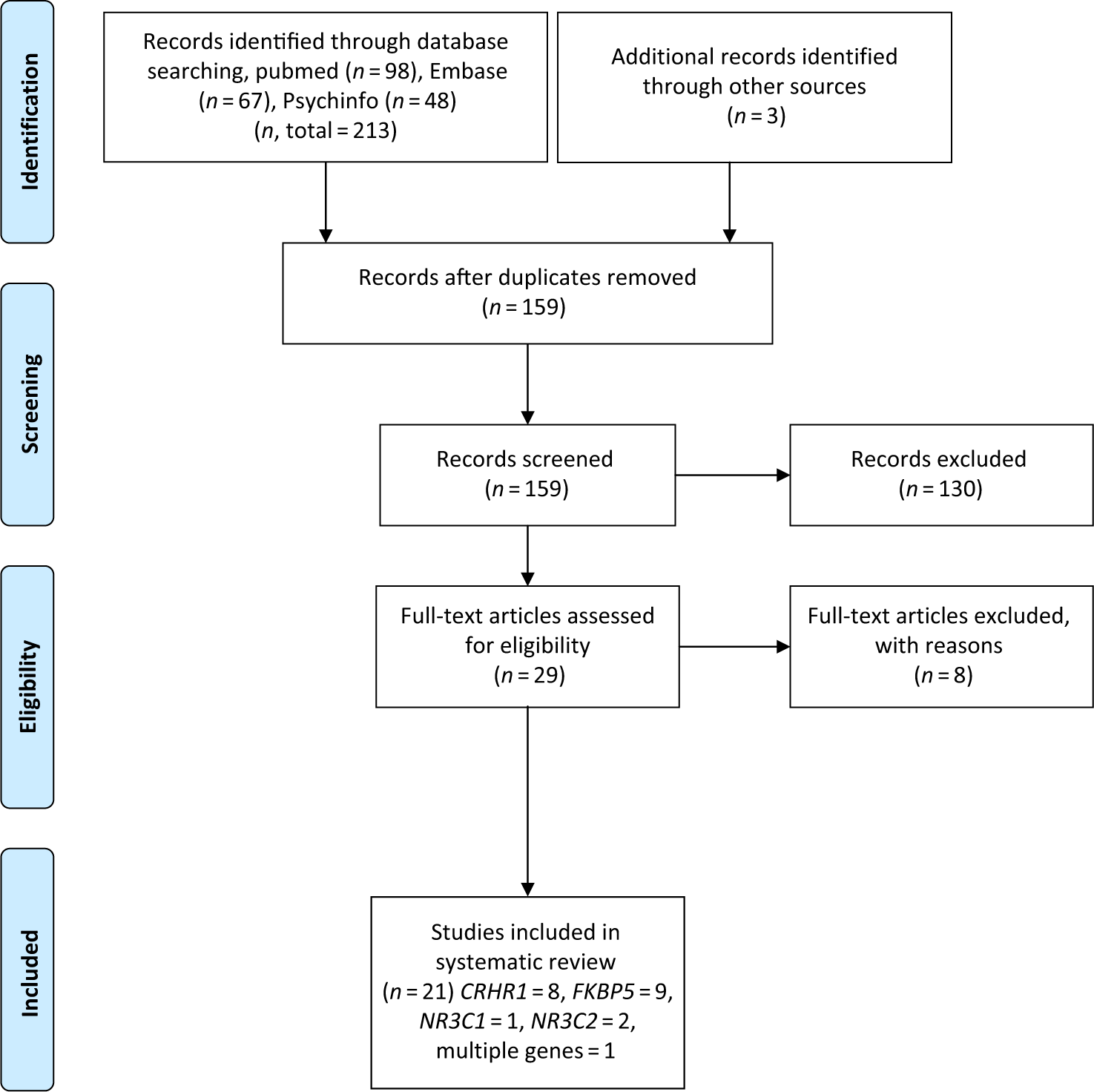
A systematic literature search was performed, following the recommended PRISMA guidelines (Welch et al., Reference Welch, Petticrew, Tugwell, Moher, O’Neill, Waters and White2012). The searches were conducted using the Pubmed, Embase, and PsychINFO databases on 17 October 2018. Keywords were combined covering the eight selected genes involved in the HPA-axis, CM, and depression: ((((((‘Gene-Environment Interaction’ [MeSH]) OR (‘Genetic predisposition to disease’ [MeSH]) OR (HPA-axis) OR (‘Polymorphism, Single Nucleotide’ [MeSH])) AND (AVP OR ACE OR CRH OR CHRH1 OR CRHR2 OR NR3C2 OR NR3C1 OR FKBP5)) AND (((((childhood maltreatment) OR childhood adversement) OR early life stress) OR adult survivors of child adverse events [MeSH]) OR life change events [MeSH])))) AND ((((mood disorders [MeSH]) OR (affect [MeSH]) OR depression) OR depressive disorder*). Filters: Publication date from 01 January 2000 to 31 December 2018. Moreover, an individual search for each gene was performed, using the gene name in abbreviation as well as fully spelled. Firstly, screening of titles and abstracts were made, and secondly evaluation of full-text versions of relevant records followed. Finally, reference lists from the included papers were scanned. Main inclusion criteria were articles with the involvement of at least one of the eight selected genes involved in the HPA-axis and consideration of GxE interactions with CM in depression. Furthermore, the included studies had to be original human research and published in a peer-reviewed journal in English. The following information were extracted from each included study: author, publication year, gene, single nucleotide polymorphism (SNP) identification numbers, number of study participants, study design, type of exposure, assessment of exposure, outcome assessment, assessment of depression severity, p-values, and major findings. After applying the aforementioned criteria, 21 studies remained to be included in the review (Fig. 1). Of these, three were identified by scanning reference lists from the included studies. The eligibility was performed independently by both authors, and any differences were addressed by discussion.
PRISMA flowchart illustrating the literature search with identification, screening, eligibility, and inclusion of final papers.

Results
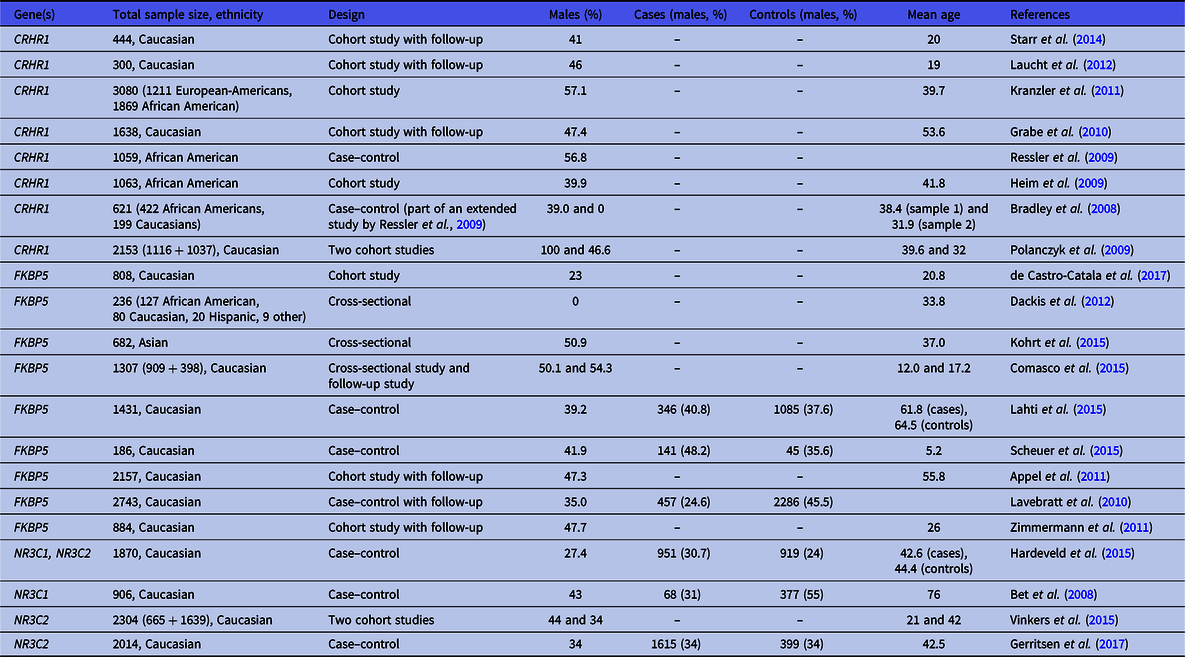
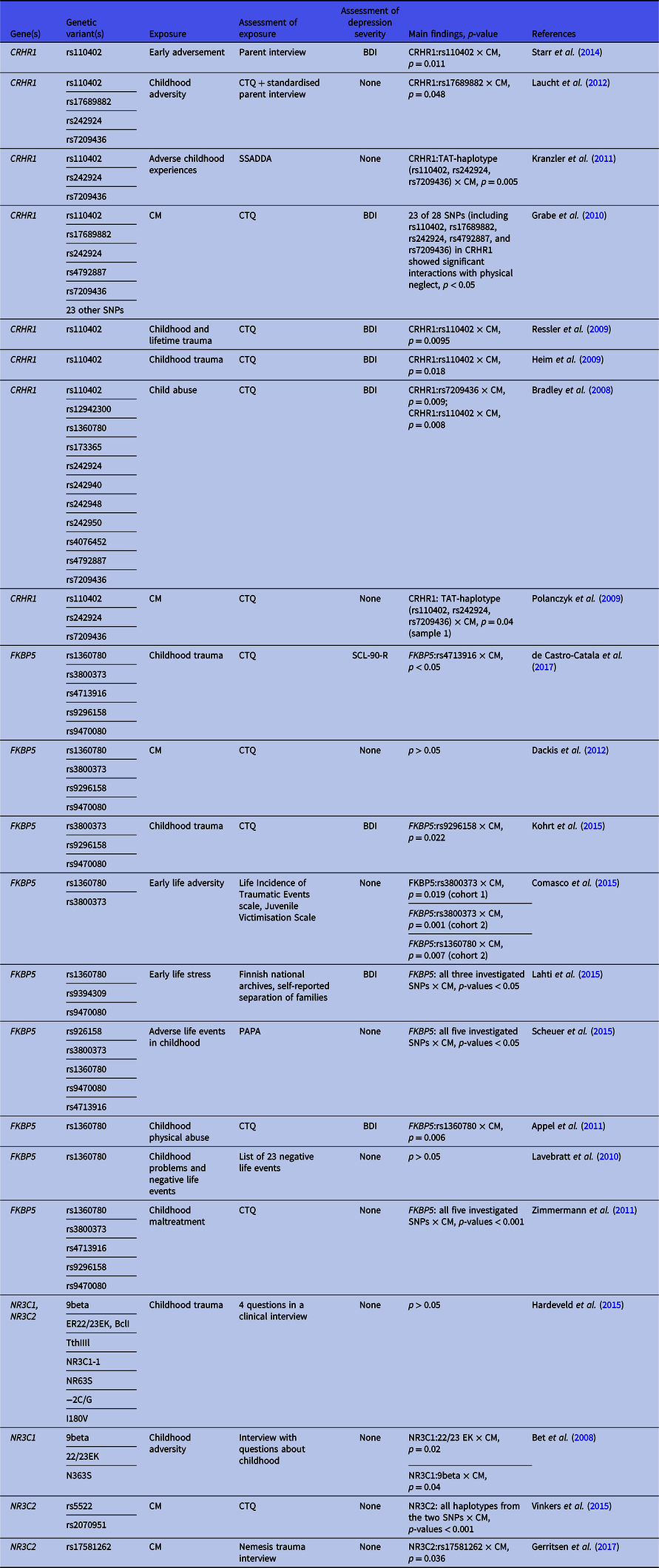
The 21 included studies examined a total of 51 SNPs in 4 different genes. Table 1 depicts the population characteristics from each included study, and the main findings are displayed in Table 2.
Population characteristics

Studies of GxE interactions involving childhood maltreatment and depression

The interaction between genetic variants in CRHR1 and CM in depression was investigated in eight studies. These studies included 34 SNPs in total (Bradley et al., Reference Bradley, BinderEpstein, Epstein, Tang, Nair, Liu, Gillespie, Berg, Evces, Newport, Stowe, Heim, Nemeroff, Schwartz, Cubells and Ressler2008; Heim et al., Reference Heim, Bradley, Mletzko, Deveau, Musselman, Nemeroff, Ressler and Binder2009; Polanczyk et al., Reference Polanczyk, Caspi, Williams, Price, Danese, Sugden, Uher, Poulton and Moffitt2009; Ressler et al., Reference Ressler, Bradley, Mercer, Deveau, Smith, Gillespie, Nemeroff, Cubells and Binder2009; Grabe et al., Reference Grabe, Schwahn, Appel, Mahler, Schulz, Spitzer, Fenske, Barnow, Lucht, Freyberger and John2010; Kranzler et al., Reference Kranzler, Feinn, Nelson, Covault, Anton, Farrer and Gelernter2011; Laucht et al., Reference Laucht, Treutlein, Blomeyer, Buchmann, Schmidt, Esser, Jennen-Steinmetz, Rietschel and Banaschewski2012; Starr et al., Reference Starr, Hammen, Conway, Raposa and Brennan2014). CRHR1:rs110402 was investigated in all studies, and the interaction was furthermore significant in seven of eight studies (Bradley et al., Reference Bradley, BinderEpstein, Epstein, Tang, Nair, Liu, Gillespie, Berg, Evces, Newport, Stowe, Heim, Nemeroff, Schwartz, Cubells and Ressler2008; Heim et al., Reference Heim, Bradley, Mletzko, Deveau, Musselman, Nemeroff, Ressler and Binder2009; Polanczyk et al., Reference Polanczyk, Caspi, Williams, Price, Danese, Sugden, Uher, Poulton and Moffitt2009; Ressler et al., Reference Ressler, Bradley, Mercer, Deveau, Smith, Gillespie, Nemeroff, Cubells and Binder2009; Grabe et al., Reference Grabe, Schwahn, Appel, Mahler, Schulz, Spitzer, Fenske, Barnow, Lucht, Freyberger and John2010; Kranzler et al., Reference Kranzler, Feinn, Nelson, Covault, Anton, Farrer and Gelernter2011; Starr et al., Reference Starr, Hammen, Conway, Raposa and Brennan2014). Five studies (Bradley et al., Reference Bradley, BinderEpstein, Epstein, Tang, Nair, Liu, Gillespie, Berg, Evces, Newport, Stowe, Heim, Nemeroff, Schwartz, Cubells and Ressler2008; Polanczyk et al., Reference Polanczyk, Caspi, Williams, Price, Danese, Sugden, Uher, Poulton and Moffitt2009; Grabe et al., Reference Grabe, Schwahn, Appel, Mahler, Schulz, Spitzer, Fenske, Barnow, Lucht, Freyberger and John2010; Kranzler et al., Reference Kranzler, Feinn, Nelson, Covault, Anton, Farrer and Gelernter2011; Laucht et al., Reference Laucht, Treutlein, Blomeyer, Buchmann, Schmidt, Esser, Jennen-Steinmetz, Rietschel and Banaschewski2012) found significant interactions between CRHR1:rs242924 × CM and CRHR1:rs7209436 × CM. CRHR1:rs17689882 (Grabe et al., Reference Grabe, Schwahn, Appel, Mahler, Schulz, Spitzer, Fenske, Barnow, Lucht, Freyberger and John2010; Laucht et al., Reference Laucht, Treutlein, Blomeyer, Buchmann, Schmidt, Esser, Jennen-Steinmetz, Rietschel and Banaschewski2012) and CRHR1:rs4792887 (Bradley et al., Reference Bradley, BinderEpstein, Epstein, Tang, Nair, Liu, Gillespie, Berg, Evces, Newport, Stowe, Heim, Nemeroff, Schwartz, Cubells and Ressler2008; Grabe et al., Reference Grabe, Schwahn, Appel, Mahler, Schulz, Spitzer, Fenske, Barnow, Lucht, Freyberger and John2010) were investigated in two studies. The remaining 29 SNPs were investigated in a single study by either Grabe et al. (Reference Grabe, Schwahn, Appel, Mahler, Schulz, Spitzer, Fenske, Barnow, Lucht, Freyberger and John2010) or Bradley et al. (Reference Bradley, BinderEpstein, Epstein, Tang, Nair, Liu, Gillespie, Berg, Evces, Newport, Stowe, Heim, Nemeroff, Schwartz, Cubells and Ressler2008). The study by Bradley et al. (Reference Bradley, BinderEpstein, Epstein, Tang, Nair, Liu, Gillespie, Berg, Evces, Newport, Stowe, Heim, Nemeroff, Schwartz, Cubells and Ressler2008) found two significant interactions after correction for multiple testing (CRHR1:rs110402 and CRHR1:rs7209436), and the study by Grabe et al. (Reference Grabe, Schwahn, Appel, Mahler, Schulz, Spitzer, Fenske, Barnow, Lucht, Freyberger and John2010) found significant interactions in 23 of 28 SNPs.
The interaction between genetic variants in FKBP5 and CM was investigated in nine studies. These studies examined six SNPs in total (Lavebratt et al., Reference Lavebratt, Åberg, Sjöholm and Forsell2010; Appel et al., Reference Appel, Schwahn, Mahler, Schulz, Spitzer, Fenske, Stender, Barnow, John, Teumer and Biffar2011; Zimmermann et al., Reference Zimmermann, Brückl, Nocon, Pfister, Binder, Uhr, Lieb, Moffitt, Caspi, Holsboer and Ising2011; Dackis et al., Reference Dackis, Rogosch, Oshri and Cicchetti2012; Comasco et al., Reference Comasco, Gustafsson, Sydsjö, Agnafors, Aho and Svedin2015; Kohrt et al., Reference Kohrt, Worthman, Ressler, Mercer, Upadhaya, Koirala, Nepal, Sharma and Binder2015; Lahti et al., Reference Lahti, Ala-Mikkula, Kajantie, Haljas, Eriksson and Räikkönen2015; Scheuer et al., Reference Scheuer, Ising, Uhr, Otto, von Klitzing and Klein2015; de Castro-Catala et al., Reference de Castro-Catala, Pena, Kwapil, Papiol, Sheinbaum, Cristobal-Narvaez, Ballespi, Barrantes-Vidal and Rosa2017). The best studied SNP was FKBP5:rs1360780, as it was investigated in eight (Lavebratt et al., Reference Lavebratt, Åberg, Sjöholm and Forsell2010; Appel et al., Reference Appel, Schwahn, Mahler, Schulz, Spitzer, Fenske, Stender, Barnow, John, Teumer and Biffar2011; Zimmermann et al., Reference Zimmermann, Brückl, Nocon, Pfister, Binder, Uhr, Lieb, Moffitt, Caspi, Holsboer and Ising2011; Dackis et al., Reference Dackis, Rogosch, Oshri and Cicchetti2012; Comasco et al., Reference Comasco, Gustafsson, Sydsjö, Agnafors, Aho and Svedin2015; Lahti et al., Reference Lahti, Ala-Mikkula, Kajantie, Haljas, Eriksson and Räikkönen2015; Scheuer et al., Reference Scheuer, Ising, Uhr, Otto, von Klitzing and Klein2015; de Castro-Catala et al., Reference de Castro-Catala, Pena, Kwapil, Papiol, Sheinbaum, Cristobal-Narvaez, Ballespi, Barrantes-Vidal and Rosa2017) of nine studies. All but three studies (Lavebratt et al., Reference Lavebratt, Åberg, Sjöholm and Forsell2010; Dackis et al., Reference Dackis, Rogosch, Oshri and Cicchetti2012; de Castro-Catala et al., Reference de Castro-Catala, Pena, Kwapil, Papiol, Sheinbaum, Cristobal-Narvaez, Ballespi, Barrantes-Vidal and Rosa2017) reported significant interactions between FKBP5:rs1360780 × CM: One study did not find a significant interaction (Lavebratt et al., Reference Lavebratt, Åberg, Sjöholm and Forsell2010), and two studies investigated the SNP as part of two different haplotypes both containing rs3800373, rs9296158, and rs1360780 (Dackis et al., Reference Dackis, Rogosch, Oshri and Cicchetti2012; de Castro-Catala et al., Reference de Castro-Catala, Pena, Kwapil, Papiol, Sheinbaum, Cristobal-Narvaez, Ballespi, Barrantes-Vidal and Rosa2017). Additional five SNPs in FKBP5 (rs3800373, rs4713916, rs9296158, rs9394309, and rs9470080) were included in significant GxE (Appel et al., Reference Appel, Schwahn, Mahler, Schulz, Spitzer, Fenske, Stender, Barnow, John, Teumer and Biffar2011; Zimmermann et al., Reference Zimmermann, Brückl, Nocon, Pfister, Binder, Uhr, Lieb, Moffitt, Caspi, Holsboer and Ising2011; Comasco et al., Reference Comasco, Gustafsson, Sydsjö, Agnafors, Aho and Svedin2015; Lahti et al., Reference Lahti, Ala-Mikkula, Kajantie, Haljas, Eriksson and Räikkönen2015; Scheuer et al., Reference Scheuer, Ising, Uhr, Otto, von Klitzing and Klein2015). Eight SNPs in NR3C1 were investigated in two studies (Bet et al., Reference Bet, Penninx, Bochdanovits, Uitterlinden, Beekman, van Schoor, Deeg and Hoogendijk2008; Hardeveld et al., Reference Hardeveld, Spijker, Peyrot, de Graaf, Hendriks, Nolen, Penninx and Beekman2015), of which one found significant GxE (Bet et al., Reference Bet, Penninx, Bochdanovits, Uitterlinden, Beekman, van Schoor, Deeg and Hoogendijk2008). Three SNPs in NR3C2 were investigated in three studies totally (Hardeveld et al., Reference Hardeveld, Spijker, Peyrot, de Graaf, Hendriks, Nolen, Penninx and Beekman2015; Vinkers et al., Reference Vinkers, Joëls, Milaneschi, Gerritsen, Kahn, Pennix and Boks2015; Gerritsen et al., Reference Gerritsen, Milaneschi, Vinkers, van Hemert, van Velzen, Schmaal and Penninx2017) of which two studies found significant interactions (Vinkers et al., Reference Vinkers, Joëls, Milaneschi, Gerritsen, Kahn, Pennix and Boks2015; Gerritsen et al., Reference Gerritsen, Milaneschi, Vinkers, van Hemert, van Velzen, Schmaal and Penninx2017), whereas one did not (Hardeveld et al., Reference Hardeveld, Spijker, Peyrot, de Graaf, Hendriks, Nolen, Penninx and Beekman2015). As regards the ACE, AVP, CRH, and CRHR2 genes, no relevant literature was identified.
The 21 included studies counted analyses of a pooled total of 27 886 participants. Fifteen studies investigated 22 635 participants of Caucasian origin, and six studies investigated 5251 subjects of Asian (Kohrt et al., Reference Kohrt, Worthman, Ressler, Mercer, Upadhaya, Koirala, Nepal, Sharma and Binder2015), African American (Bradley et al., Reference Bradley, BinderEpstein, Epstein, Tang, Nair, Liu, Gillespie, Berg, Evces, Newport, Stowe, Heim, Nemeroff, Schwartz, Cubells and Ressler2008; Heim et al., Reference Heim, Bradley, Mletzko, Deveau, Musselman, Nemeroff, Ressler and Binder2009; Ressler et al., Reference Ressler, Bradley, Mercer, Deveau, Smith, Gillespie, Nemeroff, Cubells and Binder2009; Kranzler et al., Reference Kranzler, Feinn, Nelson, Covault, Anton, Farrer and Gelernter2011; Dackis et al., Reference Dackis, Rogosch, Oshri and Cicchetti2012), Hispanic (Dackis et al., Reference Dackis, Rogosch, Oshri and Cicchetti2012), or other (Dackis et al., Reference Dackis, Rogosch, Oshri and Cicchetti2012) origins. The mean age of the included populations in the 21 studies varied considerably from 5.2 to 77 years (Table 1). Furthermore, the sample sizes in each study varied considerably, with inclusion from 186 to 3080 participants. Three different study types were represented; hence, 14 831 participants were analysed in cohort studies (Heim et al., Reference Heim, Bradley, Mletzko, Deveau, Musselman, Nemeroff, Ressler and Binder2009; Polanczyk et al., Reference Polanczyk, Caspi, Williams, Price, Danese, Sugden, Uher, Poulton and Moffitt2009; Grabe et al., Reference Grabe, Schwahn, Appel, Mahler, Schulz, Spitzer, Fenske, Barnow, Lucht, Freyberger and John2010; Appel et al., Reference Appel, Schwahn, Mahler, Schulz, Spitzer, Fenske, Stender, Barnow, John, Teumer and Biffar2011; Kranzler et al., Reference Kranzler, Feinn, Nelson, Covault, Anton, Farrer and Gelernter2011; Zimmermann et al., Reference Zimmermann, Brückl, Nocon, Pfister, Binder, Uhr, Lieb, Moffitt, Caspi, Holsboer and Ising2011; Laucht et al., Reference Laucht, Treutlein, Blomeyer, Buchmann, Schmidt, Esser, Jennen-Steinmetz, Rietschel and Banaschewski2012; Starr et al., Reference Starr, Hammen, Conway, Raposa and Brennan2014; Vinkers et al., Reference Vinkers, Joëls, Milaneschi, Gerritsen, Kahn, Pennix and Boks2015; de Castro-Catala et al., Reference de Castro-Catala, Pena, Kwapil, Papiol, Sheinbaum, Cristobal-Narvaez, Ballespi, Barrantes-Vidal and Rosa2017), 10 830 in case–control studies (Bet et al., Reference Bet, Penninx, Bochdanovits, Uitterlinden, Beekman, van Schoor, Deeg and Hoogendijk2008; Bradley et al., Reference Bradley, BinderEpstein, Epstein, Tang, Nair, Liu, Gillespie, Berg, Evces, Newport, Stowe, Heim, Nemeroff, Schwartz, Cubells and Ressler2008; Ressler et al., Reference Ressler, Bradley, Mercer, Deveau, Smith, Gillespie, Nemeroff, Cubells and Binder2009; Lavebratt et al., Reference Lavebratt, Åberg, Sjöholm and Forsell2010; Hardeveld et al., Reference Hardeveld, Spijker, Peyrot, de Graaf, Hendriks, Nolen, Penninx and Beekman2015; Lahti et al., Reference Lahti, Ala-Mikkula, Kajantie, Haljas, Eriksson and Räikkönen2015; Scheuer et al., Reference Scheuer, Ising, Uhr, Otto, von Klitzing and Klein2015; Gerritsen et al., Reference Gerritsen, Milaneschi, Vinkers, van Hemert, van Velzen, Schmaal and Penninx2017), and 2225 in cross-sectional studies (Dackis et al., Reference Dackis, Rogosch, Oshri and Cicchetti2012; Comasco et al., Reference Comasco, Gustafsson, Sydsjö, Agnafors, Aho and Svedin2015; Kohrt et al., Reference Kohrt, Worthman, Ressler, Mercer, Upadhaya, Koirala, Nepal, Sharma and Binder2015).
Nine studies in total adjusted for multiple testing using a Bonferroni correction (Bradley et al., Reference Bradley, BinderEpstein, Epstein, Tang, Nair, Liu, Gillespie, Berg, Evces, Newport, Stowe, Heim, Nemeroff, Schwartz, Cubells and Ressler2008; Ressler et al., Reference Ressler, Bradley, Mercer, Deveau, Smith, Gillespie, Nemeroff, Cubells and Binder2009; Zimmermann et al., Reference Zimmermann, Brückl, Nocon, Pfister, Binder, Uhr, Lieb, Moffitt, Caspi, Holsboer and Ising2011; Comasco et al., Reference Comasco, Gustafsson, Sydsjö, Agnafors, Aho and Svedin2015; Hardeveld et al., Reference Hardeveld, Spijker, Peyrot, de Graaf, Hendriks, Nolen, Penninx and Beekman2015; Scheuer et al., Reference Scheuer, Ising, Uhr, Otto, von Klitzing and Klein2015) or other ways (Bet et al., Reference Bet, Penninx, Bochdanovits, Uitterlinden, Beekman, van Schoor, Deeg and Hoogendijk2008; de Castro-Catala et al., Reference de Castro-Catala, Pena, Kwapil, Papiol, Sheinbaum, Cristobal-Narvaez, Ballespi, Barrantes-Vidal and Rosa2017; Gerritsen et al., Reference Gerritsen, Milaneschi, Vinkers, van Hemert, van Velzen, Schmaal and Penninx2017) in order to counteract the problem of multiple comparisons; however, 12 studies (Heim et al., Reference Heim, Bradley, Mletzko, Deveau, Musselman, Nemeroff, Ressler and Binder2009; Polanczyk et al., Reference Polanczyk, Caspi, Williams, Price, Danese, Sugden, Uher, Poulton and Moffitt2009; Grabe et al., Reference Grabe, Schwahn, Appel, Mahler, Schulz, Spitzer, Fenske, Barnow, Lucht, Freyberger and John2010; Lavebratt et al., Reference Lavebratt, Åberg, Sjöholm and Forsell2010; Appel et al., Reference Appel, Schwahn, Mahler, Schulz, Spitzer, Fenske, Stender, Barnow, John, Teumer and Biffar2011; Kranzler et al., Reference Kranzler, Feinn, Nelson, Covault, Anton, Farrer and Gelernter2011; Dackis et al., Reference Dackis, Rogosch, Oshri and Cicchetti2012; Laucht et al., Reference Laucht, Treutlein, Blomeyer, Buchmann, Schmidt, Esser, Jennen-Steinmetz, Rietschel and Banaschewski2012; Starr et al., Reference Starr, Hammen, Conway, Raposa and Brennan2014; Kohrt et al., Reference Kohrt, Worthman, Ressler, Mercer, Upadhaya, Koirala, Nepal, Sharma and Binder2015; Lahti et al., Reference Lahti, Ala-Mikkula, Kajantie, Haljas, Eriksson and Räikkönen2015; Vinkers et al., Reference Vinkers, Joëls, Milaneschi, Gerritsen, Kahn, Pennix and Boks2015) did not apply any corrections.
Different questionnaires were used to assess the exposure to CM. The child trauma questionnaire (CTQ) was used in 11 studies (Bradley et al., Reference Bradley, BinderEpstein, Epstein, Tang, Nair, Liu, Gillespie, Berg, Evces, Newport, Stowe, Heim, Nemeroff, Schwartz, Cubells and Ressler2008; Heim et al., Reference Heim, Bradley, Mletzko, Deveau, Musselman, Nemeroff, Ressler and Binder2009; Polanczyk et al., Reference Polanczyk, Caspi, Williams, Price, Danese, Sugden, Uher, Poulton and Moffitt2009; Ressler et al., Reference Ressler, Bradley, Mercer, Deveau, Smith, Gillespie, Nemeroff, Cubells and Binder2009; Grabe et al., Reference Grabe, Schwahn, Appel, Mahler, Schulz, Spitzer, Fenske, Barnow, Lucht, Freyberger and John2010; Appel et al., Reference Appel, Schwahn, Mahler, Schulz, Spitzer, Fenske, Stender, Barnow, John, Teumer and Biffar2011; Dackis et al., Reference Dackis, Rogosch, Oshri and Cicchetti2012; Laucht et al., Reference Laucht, Treutlein, Blomeyer, Buchmann, Schmidt, Esser, Jennen-Steinmetz, Rietschel and Banaschewski2012; Kohrt et al., Reference Kohrt, Worthman, Ressler, Mercer, Upadhaya, Koirala, Nepal, Sharma and Binder2015; Vinkers et al., Reference Vinkers, Joëls, Milaneschi, Gerritsen, Kahn, Pennix and Boks2015; de Castro-Catala et al., Reference de Castro-Catala, Pena, Kwapil, Papiol, Sheinbaum, Cristobal-Narvaez, Ballespi, Barrantes-Vidal and Rosa2017), other lists of adverse events were also utilised (Lavebratt et al., Reference Lavebratt, Åberg, Sjöholm and Forsell2010; Comasco et al., Reference Comasco, Gustafsson, Sydsjö, Agnafors, Aho and Svedin2015). Eight studies (Bet et al., Reference Bet, Penninx, Bochdanovits, Uitterlinden, Beekman, van Schoor, Deeg and Hoogendijk2008; Kranzler et al., Reference Kranzler, Feinn, Nelson, Covault, Anton, Farrer and Gelernter2011; Zimmermann et al., Reference Zimmermann, Brückl, Nocon, Pfister, Binder, Uhr, Lieb, Moffitt, Caspi, Holsboer and Ising2011; Starr et al., Reference Starr, Hammen, Conway, Raposa and Brennan2014; Hardeveld et al., Reference Hardeveld, Spijker, Peyrot, de Graaf, Hendriks, Nolen, Penninx and Beekman2015; Lahti et al., Reference Lahti, Ala-Mikkula, Kajantie, Haljas, Eriksson and Räikkönen2015; Scheuer et al., Reference Scheuer, Ising, Uhr, Otto, von Klitzing and Klein2015; Gerritsen et al., Reference Gerritsen, Milaneschi, Vinkers, van Hemert, van Velzen, Schmaal and Penninx2017) applied various types of interviews, and one study utilised the national archives in addition to self-reports (Lahti et al., Reference Lahti, Ala-Mikkula, Kajantie, Haljas, Eriksson and Räikkönen2015).
Depression was assessed by either diagnostic interviews such as Composite International Diagnostic Inventory (Reed et al., Reference Reed, Gander, Pfister, Steiger, Sonntag, Trenkwalder, Sonntag, Hundt and Wittchen1998; Zimmermann et al., Reference Zimmermann, Brückl, Nocon, Pfister, Binder, Uhr, Lieb, Moffitt, Caspi, Holsboer and Ising2011; Hardeveld et al., Reference Hardeveld, Spijker, Peyrot, de Graaf, Hendriks, Nolen, Penninx and Beekman2015; Gerritsen et al., Reference Gerritsen, Milaneschi, Vinkers, van Hemert, van Velzen, Schmaal and Penninx2017), Structured Clinical Interview according to DSM-IV (First et al., Reference First, Spitzer, Gibbon and Williams1995), other types of interviews (Bet et al., Reference Bet, Penninx, Bochdanovits, Uitterlinden, Beekman, van Schoor, Deeg and Hoogendijk2008; Polanczyk et al., Reference Polanczyk, Caspi, Williams, Price, Danese, Sugden, Uher, Poulton and Moffitt2009; Kranzler et al., Reference Kranzler, Feinn, Nelson, Covault, Anton, Farrer and Gelernter2011; Scheuer et al., Reference Scheuer, Ising, Uhr, Otto, von Klitzing and Klein2015), self-rating questionnaires on depression [Major Depression Inventory (Lavebratt et al., Reference Lavebratt, Åberg, Sjöholm and Forsell2010), Beck Depressive Inventory (BDI) (Bradley et al., Reference Bradley, BinderEpstein, Epstein, Tang, Nair, Liu, Gillespie, Berg, Evces, Newport, Stowe, Heim, Nemeroff, Schwartz, Cubells and Ressler2008; Heim et al., Reference Heim, Bradley, Mletzko, Deveau, Musselman, Nemeroff, Ressler and Binder2009; Grabe et al., Reference Grabe, Schwahn, Appel, Mahler, Schulz, Spitzer, Fenske, Barnow, Lucht, Freyberger and John2010; Appel et al., Reference Appel, Schwahn, Mahler, Schulz, Spitzer, Fenske, Stender, Barnow, John, Teumer and Biffar2011; Dackis et al., Reference Dackis, Rogosch, Oshri and Cicchetti2012; Laucht et al., Reference Laucht, Treutlein, Blomeyer, Buchmann, Schmidt, Esser, Jennen-Steinmetz, Rietschel and Banaschewski2012; Starr et al., Reference Starr, Hammen, Conway, Raposa and Brennan2014; Kohrt et al., Reference Kohrt, Worthman, Ressler, Mercer, Upadhaya, Koirala, Nepal, Sharma and Binder2015; Lahti et al., Reference Lahti, Ala-Mikkula, Kajantie, Haljas, Eriksson and Räikkönen2015)], or other self-rating questionnaires (Lavebratt et al., Reference Lavebratt, Åberg, Sjöholm and Forsell2010; Comasco et al., Reference Comasco, Gustafsson, Sydsjö, Agnafors, Aho and Svedin2015; Vinkers et al., Reference Vinkers, Joëls, Milaneschi, Gerritsen, Kahn, Pennix and Boks2015; de Castro-Catala et al., Reference de Castro-Catala, Pena, Kwapil, Papiol, Sheinbaum, Cristobal-Narvaez, Ballespi, Barrantes-Vidal and Rosa2017). Depression severity was assessed by BDI-scores in 8 (Bradley et al., Reference Bradley, BinderEpstein, Epstein, Tang, Nair, Liu, Gillespie, Berg, Evces, Newport, Stowe, Heim, Nemeroff, Schwartz, Cubells and Ressler2008; Heim et al., Reference Heim, Bradley, Mletzko, Deveau, Musselman, Nemeroff, Ressler and Binder2009; Ressler et al., Reference Ressler, Bradley, Mercer, Deveau, Smith, Gillespie, Nemeroff, Cubells and Binder2009; Grabe et al., Reference Grabe, Schwahn, Appel, Mahler, Schulz, Spitzer, Fenske, Barnow, Lucht, Freyberger and John2010; Appel et al., Reference Appel, Schwahn, Mahler, Schulz, Spitzer, Fenske, Stender, Barnow, John, Teumer and Biffar2011; Starr et al., Reference Starr, Hammen, Conway, Raposa and Brennan2014; Kohrt et al., Reference Kohrt, Worthman, Ressler, Mercer, Upadhaya, Koirala, Nepal, Sharma and Binder2015; Lahti et al., Reference Lahti, Ala-Mikkula, Kajantie, Haljas, Eriksson and Räikkönen2015) of 21 studies. One study (de Castro-Catala et al., Reference de Castro-Catala, Pena, Kwapil, Papiol, Sheinbaum, Cristobal-Narvaez, Ballespi, Barrantes-Vidal and Rosa2017) used another term for depression severity.
Four studies performed gender-specific GxE interaction analyses (Heim et al., Reference Heim, Bradley, Mletzko, Deveau, Musselman, Nemeroff, Ressler and Binder2009; Lavebratt et al., Reference Lavebratt, Åberg, Sjöholm and Forsell2010; Kranzler et al., Reference Kranzler, Feinn, Nelson, Covault, Anton, Farrer and Gelernter2011; Vinkers et al., Reference Vinkers, Joëls, Milaneschi, Gerritsen, Kahn, Pennix and Boks2015), and significant differences between gender were reported in CRHR1 (Heim et al., Reference Heim, Bradley, Mletzko, Deveau, Musselman, Nemeroff, Ressler and Binder2009; Kranzler et al., Reference Kranzler, Feinn, Nelson, Covault, Anton, Farrer and Gelernter2011) and NR3C2 (Vinkers et al., Reference Vinkers, Joëls, Milaneschi, Gerritsen, Kahn, Pennix and Boks2015).
Discussion
The present study is a comprehensive review of publications investigating the interactions between eight HPA-axis genes and CM in depression in strict adherence to the PRISMA guidelines (Welch et al., Reference Welch, Petticrew, Tugwell, Moher, O’Neill, Waters and White2012). However, despite our profound search strategy, relevant literature may have been missed. Our search period was confined to studies published in the period between 01 January 2000 and 17 October 2018, which implies that potentially relevant studies conducted before or after these dates were not included in this paper.
In summary, the 21 included studies examined a total of 51 SNPs in four different genes – of these, 34 SNPs were located in the gene region of CRHR1, 6 SNPs in FKBP5, 8 SNPs in NR3C1, and 3 SNPs in NR3C2. The most prevalent polymorphisms were CRHR1: rs110402 and FKBP5:rs1360780. No relevant literature was identified as regards the ACE, AVP, CRH, and CRHR2 genes.
Two recent systematic reviews are similar to the present study (Maglione et al., Reference Maglione, Caputi, Moretti and Scaini2018; Wang et al., Reference Wang, Shelton and Dwivedi2018). In spite of overlap between the studies, they differ substantially in important parameters such as search periods, the use of PRISMA guidelines, outcome, and the included genes. Firstly, our study is most recent, with search periods until the end of 2018 compared to 2017. Secondly, our study was the only one to use the search database Embase. Furthermore, the study by Maglione et al. (Reference Maglione, Caputi, Moretti and Scaini2018) did not follow the PRISMA guidelines. We chose to focus on depression, whereas Maglione et al. (Reference Maglione, Caputi, Moretti and Scaini2018) also investigated other outcomes such as internalising symptoms and anxiety. Wang et al. (Reference Wang, Shelton and Dwivedi2018) studied post-traumatic stress disorder (PTSD) and depression. In contrast to the studies by Wang and Maglione, the focus of present review was GxE interactions between genes in the HPA-axis and CM. More specifically, the current review focused on eight genes in the HPA-axis, whereas Wang et al. (Reference Wang, Shelton and Dwivedi2018) only focused on the FKBP5 gene, and Maglione et al. (Reference Maglione, Caputi, Moretti and Scaini2018) included FKBP5 and CRHR1 from the HPA-axis in addition to other genes. The studies included in the present review investigated six SNPs in FKBP5 (Lavebratt et al., Reference Lavebratt, Åberg, Sjöholm and Forsell2010; Appel et al., Reference Appel, Schwahn, Mahler, Schulz, Spitzer, Fenske, Stender, Barnow, John, Teumer and Biffar2011; Zimmermann et al., Reference Zimmermann, Brückl, Nocon, Pfister, Binder, Uhr, Lieb, Moffitt, Caspi, Holsboer and Ising2011; Dackis et al., Reference Dackis, Rogosch, Oshri and Cicchetti2012; Comasco et al., Reference Comasco, Gustafsson, Sydsjö, Agnafors, Aho and Svedin2015; Kohrt et al., Reference Kohrt, Worthman, Ressler, Mercer, Upadhaya, Koirala, Nepal, Sharma and Binder2015; Lahti et al., Reference Lahti, Ala-Mikkula, Kajantie, Haljas, Eriksson and Räikkönen2015; Scheuer et al., Reference Scheuer, Ising, Uhr, Otto, von Klitzing and Klein2015; de Castro-Catala et al., Reference de Castro-Catala, Pena, Kwapil, Papiol, Sheinbaum, Cristobal-Narvaez, Ballespi, Barrantes-Vidal and Rosa2017), whereas the review by Wang et al. (Reference Wang, Shelton and Dwivedi2018) merely studied three SNPs in FKBP5 (rs1360780, rs3800373, and rs9470080). The review by Maglione et al. (Reference Maglione, Caputi, Moretti and Scaini2018) only identified one study investigating FKBP5 (Scheuer et al., Reference Scheuer, Ising, Uhr, Otto, von Klitzing and Klein2015). In contrast, our study included nine studies (Lavebratt et al., Reference Lavebratt, Åberg, Sjöholm and Forsell2010; Appel et al., Reference Appel, Schwahn, Mahler, Schulz, Spitzer, Fenske, Stender, Barnow, John, Teumer and Biffar2011; Zimmermann et al., Reference Zimmermann, Brückl, Nocon, Pfister, Binder, Uhr, Lieb, Moffitt, Caspi, Holsboer and Ising2011; Dackis et al., Reference Dackis, Rogosch, Oshri and Cicchetti2012; Comasco et al., Reference Comasco, Gustafsson, Sydsjö, Agnafors, Aho and Svedin2015; Kohrt et al., Reference Kohrt, Worthman, Ressler, Mercer, Upadhaya, Koirala, Nepal, Sharma and Binder2015; Lahti et al., Reference Lahti, Ala-Mikkula, Kajantie, Haljas, Eriksson and Räikkönen2015; Scheuer et al., Reference Scheuer, Ising, Uhr, Otto, von Klitzing and Klein2015; de Castro-Catala et al., Reference de Castro-Catala, Pena, Kwapil, Papiol, Sheinbaum, Cristobal-Narvaez, Ballespi, Barrantes-Vidal and Rosa2017). Both studies included the study by Scheuer et al. (Reference Scheuer, Ising, Uhr, Otto, von Klitzing and Klein2015).
Interestingly, interactions between HPA-axis genes and CM have likewise been identified in other psychiatric disorders and conditions. Thus, the following SNPs in FKBP5 have been shown to interact with CM as a predictor of adult PTSD symptoms: rs9296158, rs3800373, and rs1360780 (Binder et al., Reference Binder, Bradley, Liu, Epstein, Deveau, Mercer, Tang, Gillespie, Heim, Nemeroff, Schwartz, Cubells and Ressler2008). These SNPs also showed significant GxE interactions in the studies included in the present review (Appel et al., Reference Appel, Schwahn, Mahler, Schulz, Spitzer, Fenske, Stender, Barnow, John, Teumer and Biffar2011; Zimmermann et al., Reference Zimmermann, Brückl, Nocon, Pfister, Binder, Uhr, Lieb, Moffitt, Caspi, Holsboer and Ising2011; Comasco et al., Reference Comasco, Gustafsson, Sydsjö, Agnafors, Aho and Svedin2015; Kohrt et al., Reference Kohrt, Worthman, Ressler, Mercer, Upadhaya, Koirala, Nepal, Sharma and Binder2015; Lahti et al., Reference Lahti, Ala-Mikkula, Kajantie, Haljas, Eriksson and Räikkönen2015; Scheuer et al., Reference Scheuer, Ising, Uhr, Otto, von Klitzing and Klein2015). Likewise, in CRHR1, the haplotype consisting of rs7209436, rs110402, and rs242924 (also referred to as the TAT-haplotype) has been shown to moderate the association between CM and neuroticism (DeYoung et al., Reference DeYoung, Cicchetti and Rogosch2011). The highly prevalent SNP in our study, FKBP5:rs1360780, has shown to interact with CM in the cortisol response to stress (Tyrka et al. Reference Tyrka, Price, Gelernter, Schepker, Anderson and Carpenter2009; Buchmann et al., Reference Buchmann, Holz, Boecker, Blomeyer, Rietschel, Witt, Schmidt, Esser, Banaschewski, Brandeis, Zimmermann and Laucht2014) – these findings suggest a functional involvement of FKBP5 in long-term alteration of the neuroendocrine stress regulation related to CM. This has been proposed to represent a premorbid risk or resilience factor in the context of stress-related disorders.
HPA-axis gene variation and environmental stress-related factors may be important in individual differences in responsivity to negative emotional stimuli (Pagliaccio et al., Reference Pagliaccio, Luby, Bogdan, Agrawal, Gaffrey, Belden, Botteron, Harms and Barch2015) or negative memory bias (Vogel et al., Reference Vogel, Gerritsen, van Oostrom, Arias-Vásquez, Rijpkema, Joëls, Franke, Tendolkar and Fernández2013; Vrijsen et al., Reference Vrijsen, Vogel, Arias-Vasquez, Franke, Fernandez, Becker, Speckens and van Oostrom2015). Finally, epigenetic modifications of the NR3C1 gene in response to CM have been proposed to alter the HPA-axis function and ultimately lead to psychopathology (Perroud et al., Reference Perroud, Paoloni-Giacobino, Prada, Olie, Salzmann, Nicastro, Guillaume, Mouthon, Stouder, Dieben, Huguelet, Courtet and Malafosse2011; Zannas & Binder Reference Zannas and Binder2014). Thus, both molecular and system-wide mechanisms have been suggested as explanatory models. An establishment of the responsible processes (or combinations of processes) for a given phenotype, among a large amount of potential models, continues to constitute a challenge for the empirical investigation of the interactions between genes and environment. However, the importance of continued research in this field must be emphasised, as it is still lacking behind other research fields, and an understanding of the biological effects of GxE interactions is clinically highly relevant, as it may lead to novel therapeutic approaches.
The findings of this study must be interpreted in the context of its limitations. The studies were based on various study designs, which implied a greater flexibility and concurrently decreasing specificity of our study. Furthermore, exposure to CM was assessed differently, for example, some studies used broad definitions such as adverse childhood experiences, whereas others applied abuse as the chosen exposure. Future research may profit from utilising narrower definitions of exposure, as this would entail greater external validity – yet, we chose a broad definition of adversity in order to include all feasibly relevant studies. Moreover, as the vast majority of the studies succeeded in identifying GxE interactions, possible publication bias must also be considered. Another potential issue is the heterogenic nature of psychiatric disease, and it has been argued that different subtypes of depression exist depending on whether one has experienced CM or not (Thapar et al., Reference Thapar, Harold and McGuffin1998). In the current study, we did not distinguish between different types of depression.
The level of detail in the assessment and interpretation of the statistics in the studies varied greatly. Accordingly, it cannot be excluded that some of the GxE interactions investigated in this review were in fact GxE correlations (rGE) or combinations of rGE and GxE (Briley et al., Reference Briley, Livengood, Derringer, Tucker-Drob, Fraley and Roberts2018a,b). A combination of the two types of interplay may have been a benefit in our analysis.
Controlling for confounders is another potentially problematic aspect in the interpretation of our results, as the majority of the studies did not control for the possible confounding influence each confounding variable could have on the interaction term in the statistical models used to test GxE interactions (Keller, Reference Keller2013). Merely one (Lahti et al., Reference Lahti, Ala-Mikkula, Kajantie, Haljas, Eriksson and Räikkönen2015) of the studies included in this review used this method to ensure proper control for confounders.
The vast majority of current GxE research is based on candidate gene studies, where a limited number of polymorphisms are chosen for investigation (Uher, Reference Uher2013). This is a hypothesis-driven approach, which will induce selection bias. Furthermore, this method is criticised for the limited ability to include all possible causative genes and polymorphisms, and for the lack of replication of results (Ioannidis et al., Reference Ioannidis, Ntzani, Trikalinos and Contopulos-Ioadinnis2001; Tabor et al., Reference Tabor, Risch and Myers2002). Moreover, the statistical power is a general challenge in GxE research. Another problem which have proven itself difficult, is the assessment of environmental variables (Uher, Reference Uher2013) – that is, it is difficult to gather information about CM in very large samples. Finally, a large number of genes influence the phenotype in psychiatric disorders, and the polygenic character of depression makes it more complex to study (Videbech & Rosenberg, Reference Videbech and Rosenberg2013). To the best of our knowledge, only a handful of genome wide gene–environment interaction studies (GWEISs) exist with stressful life events as exposure (Dunn et al., Reference Dunn, Wiste, Radmanesh, Aimli, Gogarten, Sofer, Faul, Kardia, Smith, Weir, Zhao, Soare, Mirza, Hek, Tiemeier, Goveas, Sarto, Snively, Cornelis, Koenen, Kraft, Purcell, Ressler, Rosand, Wassertheil-Smoller and Smoller2016; Ikeda et al., Reference Ikeda, Shimasaki, Takahashi, Kondo, Saito, Kawase, Esaki, Otsuka, Mano, Kubo and Iwata2016; Otowa et al., Reference Otowa, Kawamura, Tsutsumi, Kawakami, Kan, Shimada, Umekage, Kasai, Tokunaga and Sasaki2016; Coleman et al., Reference Coleman, Purves, Davis, Rayner, Choi, Hübel, Gaspar, Kan, Van der Auwera, Adams, Lyall, Peyrot, Dunn, Vassos, Danese, Grabe, Lewis, O’Reilly, McIntosh, Smith, Wray, Hotopf, Eley and Breen2018) and none to date with CM as exposure. However, a large (n = 5765) recent meta-analysis by Peyrot et al. (Reference Peyrot, Van der Auwera, Milaneschi, Dolan, Madden, Sullivan, Strohmaier, Ripke, Rietschel, Nivard, Mullins, Montgomery, Henders, Heat, Fisher, Dunn, Byrne, Air, Baune, Breen, Levinson, Lewis, Martin, Nelson, Boomsma, Grabe, Wray and Penninx2018) was not able to find evidence for interactions between polygenic risk and CM in depression.
The important next step in GxE research will imply a GWEIS approach with a systematic characterisation of multiple environmental factors in ample sample sizes (Ioannidis, Reference Ioannidis2005; Uher Reference Uher2013). Moreover, employment of a uniform definition of CM will improve the possibility of performing future meta-analyses and ease interpretation and comparisons of GxE papers. Collaborative work between countries and research departments is prerequisite in order to obtain these goals (Peyrot et al., Reference Peyrot, Milaneschi, Sullivan, Hottenga, Boomsma and Penninx2014).
Conclusion
In conclusion, the present literature search suggests that genetic variation in four HPA-axis genes interacts with CM in depression. More specifically, our results support GxE interactions between genetic variation in FKBP5, CRHR1, NR3C1, and NR3C2, respectively, and CM in depression. FKBP5 and CRHR1 were particularly well investigated, and studies of these genes generally support GxE interactions with CM in depression. Future research will be strengthened by making use of uniform assessments of environmental factors, larger sample sizes, and conduction of GWEIS.
Author contributions
CN created the first draft of the paper and made a considerable contribution to the design of the study. The manuscript was revised by HNB, who also designed the study. Comprehensive and systematic literature searches were executed by both authors, and the final version of the manuscript was likewise approved by both.
Conflicts of interest
The authors have no conflicts of interest.