Introduction
The study of written language use in the public sphere has become a prominent area of sociolinguistic research in recent years, conceptualized as studies of linguistic landscapes (Shohamy & Gorter Reference Shohamy, Ben-Rafael, Barni and Gorter2009; Shohamy, Ben-Rafael, & Barni Reference Shohamy, Ben-Rafael and Barni2010; Gorter, Marten, & van Mensel Reference Gorter, Marten and van Mensel2012; Blommaert Reference Blommaert2013), semiotic landscapes (Jaworski & Thurlow Reference Jaworski, Thurlow, Jaworski and Thurlow2010), or of language display (Coupland Reference Coupland2012). Such research has yielded new insights into language ideologies (Jaworski & Thurlow Reference Jaworski, Thurlow, Jaworski and Thurlow2010; Coupland Reference Coupland2012; Hornsby & Vigers Reference Hornsby, Vigers, Gorter, Marten and van Mensel2012) and into relationships of power and inequality between speakers of different languages, as the relative distribution of multiple languages in a given locality is seen not only as a reflection of demographic, social, and cultural patterns, but also as shaping language use by demarking spaces as ‘belonging’ to certain languages, that is, spaces where their use is sanctioned (Landry & Bourhis Reference Landry and Bourhis1997). Linguistic landscape (LL) studies often employ a quantitative methodology, such as counting all instances of signs in which a particular language is used (e.g. Backhaus Reference Backhaus2007), and thus scholars tend to treat languages as their unit of analysis, or, in semiotic terms, as signs that index particular social meanings. In doing so, LL studies often assume that texts can unambiguously be attributed to specific languages. As Kroon, Dong, & Blommaert (Reference Kroon, Dong, Blommaert, Stroud and Prinsloo2015:3) note, however, signs may ‘look English’ without truly being ‘in English’. Furthermore, given the wide availability of machine translation tools like Google Translate, multilingual texts can be produced by authors who do not speak or understand (some of) the languages in them. Such uses of machine translation may result in ungrammatical or unidiomatic texts, to the point that their attribution to particular languages becomes questionable. Scholars in LL studies, however, do not always pay attention to such processes (but see e.g. Lou Reference Lou, Shohamy, Ben-Rafael and Barni2010).Footnote 1
The use of translation is in fact widespread in the linguistic landscapes that have been studied, especially in contexts where governments and other institutions engage with newcomers who lack proficiency in the language of the state. As Blommaert (Reference Blommaert2013:15) points out, recent trends of migration have given rise to ‘superdiverse’ spaces of multilingualism that are unstable and dynamic, where ‘groups that are present today can be gone tomorrow’. This is particularly true in the context of migrations of refugees, where the unexpected arrival of new groups of people can rapidly transform the sociolinguistic reality ‘on the ground’. Institutions may perceive such changes as challenging the public order, and may use translated signage to control newcomers’ behavior, to prohibit transgressions, or warn against dangers. Such ‘public-order’ signs thus present an opportunity for LL research to observe local transformations of sociolinguistic realities, and to investigate the social meanings that they index.
Some LL studies with a quantitative focus tacitly assume that the social meaning of languages is consistent across signs and in the eyes of all readers. In contrast, Jaworski & Thurlow (Reference Jaworski, Thurlow, Jaworski and Thurlow2010:11) note that ‘the presence or absence of a language on public signage’ needs to be investigated ‘in combination with the type (or genre) of signs, their contents and style’ to yield an understanding of language ideologies at play. Coupland (Reference Coupland2012) presents such a content- and genre-based approach, drawing on Goffman's (Reference Goffman1974:20) frame analysis to identify different frames of public display of English and Welsh that relate to ‘different language-ideological stances’ on bilingualism in Wales. The development of LL approaches to indexicality bears parallels to the study of codeswitching, where early approaches (e.g. Blom & Gumperz Reference Blom, Gumperz, Gumperz and Hymes1972; Myers-Scotton Reference Myers-Scotton1993) treated languages as having stable social meanings within multilingual communities. By contrast, later studies by Auer (Reference Auer, Milroy and Muysken1995), Li Wei (Reference Wei2005), and others demonstrated that the social meaning of specific instances of codeswitching has to be investigated with close attention to the sequential context in which they occur. Unlike conversational codeswitching, signs in the linguistic landscape do not lend themselves to a sequential analysis, but like spoken utterances they do project a participation framework in Goffman's (Reference Goffman1981) sense, where text production involves an array of different social roles and where recipients (here sign readers) can be addressed or unaddressed.
In line with the above considerations and with Jaworski & Thurlow's (Reference Jaworski, Thurlow, Jaworski and Thurlow2010:14) call for genre- and context-specific analysis, this article presents an analysis of a specific type of signs, namely public-order signs, that takes into account the perspectives of different viewers, as well as the processes of sign production. In doing so, this article pursues an ethnographic investigation of the range of indexical meanings that specific multilingual signs (and the linguistic forms on them) have in the mind of specific participants who differ in their respective linguistic repertoires and in the cultural frames in which indexical meanings arise for them. It presents a case study of signage found in Toronto that is addressed to Roma refugee claimants from Hungary. Drawing on interviews with sign producers and readers, the study relates local meanings to broader contexts about Canadian institutional responses to immigration and asylum on the one hand, and discrimination of Roma in Central and Eastern Europe on the other. In the next section of this article, I begin by briefly sketching the historical, political, and sociolinguistic context of Roma migration to Canada, before turning to an empirical investigation of the Roma presence in the linguistic landscape of Toronto's Parkdale neighborhood. In the following section, I focus on the dual indexicality of multilingual public-order signs, and then on the use of machine translation and on the indexical and pragmatic implications of ungrammatical forms that such translation produces. I then briefly contrast these findings with a discussion of signs that are different in both their function and their linguistic form, showing that these two aspects converge in the production of indexical meanings for addressees.
Discrimination and exclusion of Roma in Europe
The history of Roma people in Europe is marked by racial discrimination and persecution, including periods of enslavement and genocide, as an estimated 200,000 to 500,000 Roma died in Nazi concentration camps during World War II. Roma continue to experience discrimination today, especially in Central and Eastern European countries, where social exclusion has often led to conditions of systemic poverty and where many Roma face harassment from individuals and vigilante groups, as well as discrimination by police and other authorities (Guglielmo Reference Guglielmo1996; Human Rights Watch n.d.). Across Europe, anti-Roma resentment is often rationalized as a response to alleged criminal activity, of which Roma are widely suspected (see e.g. Goodman & Rowe Reference Goodman and Rowe2014). In Central and Eastern Europe, anti-Roma prejudice has regularly led to incidents of harassment and violence. Hungary in particular has been the site of several high-profile violent anti-Roma crimes, including several murders and two pogrom-like incidents where Roma people were shot to death after fleeing from their fire-bombed homes (Amnesty International 2009; European Roma Rights Centre 2012). In 2012, the Hungarian Red Cross evacuated 277 Roma women and children from their hometown of Gyöngyöspata after they had been subjected to threats and harassment from vigilante groups while the police failed to intervene (Westhead Reference Westhead2012). Meanwhile, an openly anti-Roma extreme right party received 20% of the vote in 2014 parliamentary elections.
Over the past two decades, some Roma from Hungary and other Central or Eastern European countries have sought to migrate to Canada, often taking advantage of visa waiver policies for European tourists, and then requesting refugee status upon arrival (Tóth Reference Tóth, Bigo, Carrera and Guild2013). Since 2009, approximately 10,000 Hungarian citizens have requested asylum in Canada, making Hungary the most common country of origin of refugees to Canada between 2010 and 2012.Footnote 2 In December of 2012, the Harper government changed its refugee policies by instituting a list of ‘Designated countries of origin’ which are deemed to respect human rights, so that they ‘do not normally produce refugees’. The Czech Republic, Hungary, and Slovakia are included on this list, and refugee claims by their citizens are now subject to a streamlined process that presumes that the claims are unfounded.Footnote 3 To further discourage Roma migration, the Canadian government advertised this changed asylum policy in early 2013 with large billboards in the eastern Hungarian city of Miskolc, from where many refugee claimants originated (Keung Reference Keung2013). The billboards displayed text in Hungarian that can be translated as ‘The Canadian Government informs: Canada's refugee system has been changed to deter abuse. People with unfounded asylum requests are quickly sent home’ (emphasis in the original through larger white font on red banner). While not explicitly mentioning Roma people, the billboard addresses would-be asylum applicants, and thus it is clear in the local context that the addressees are Roma (Keung Reference Keung2013). The billboard clearly states the government's belief that refugee claims by Hungarian citizens are ‘unfounded’, ignoring the fact that some claims have in fact been granted by the refugee board. Moreover, the city of Miskolc itself has been the site of violent attacks on Roma by right-wing extremists, and its police chief has publicly claimed that Roma are responsible for all burglaries that occur in the city (Westhead Reference Westhead2012). Finally, the billboard is likely to further stoke anti-Roma sentiments among those Hungarians who feel that Roma are giving Hungary a bad name by asking for asylum in Canada (Keung Reference Keung2013).
The Canadian government's billboard can be interpreted as a warning sign to deter Roma people from migrating to Canada, following a long tradition of such excluding messages in the Central European linguistic landscape. For example, it has a historical precursor in signs that were erected at the borders of the Habsburg Empire in the eighteenth century, barring Roma people from entering the land. As described by Crowe (Reference Crowe2007:72–73),
[a]n anti-Habsburg uprising in Hungary prompted new anti-Gypsy legislation in 1697 and 1701. Leopold I declared the Rom outlaws and threatened them with severe punishment if they tried to enter Habsburg domains. A similar regulation in 1706 ordered the erection in public places and along major thoroughfares of taffeln (warning placards) to inform Gypsies of these regulations. Four years later, Leopold's successor, Joseph I. (r. 1705–1711), ordered that Gypsies who entered Hungary illegally were to be branded to enable authorities to identify those who had violated the new restrictions. Since illiterate Roma claimed that they could not read the taffeln, new taffeln with vivid pictures of mutilated Gypsies were erected for Rom who could not read.
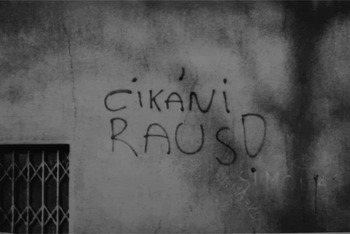
Contemporary European governments generally refrain from such overt, threatening messages of exclusion. Instead, the desired exclusion of Roma may be manifested in the linguistic landscape through racist graffiti, such as the one documented in Figure 1. This bilingual graffiti, photographed by the author in Prague in 1995, combines Czech cikáni ‘gypsies’ with German raus! ‘out (with)!’, echoing the German Nazi slogan Juden raus! ‘Out with the Jews!’ and its Neo-Nazi counterpart Ausländer raus! ‘Out with the foreigners!’. In the Czech context, this use of German can be understood as an allusion to the Nazi genocide, and the graffiti thus constitutes a clear threat of anti-Roma violence, in addition to its literal call for the exclusion of Roma people. As such, it illustrates the violent nature that anti-Roma sentiment may take in Europe, and which continues to drive many Roma people to seek a better life elsewhere.
Bilingual Czech/German anti-Roma graffiti (‘Out with the gypsies!’), Prague, 1995.

Roma in Toronto
Despite the efforts by the Canadian government to prevent Roma immigration, Toronto has become home to a Roma community, albeit one that has been unstable and partially transient, as some families have returned to Hungary after their refugee claims were denied (Brown Reference Brown2013). Upon arrival, many Roma migrants settled in the downtown Toronto neighborhood of Parkdale, an area with low income housing in large post-war apartment buildings. The average household income of Parkdale is about 70% of the citywide average,Footnote 4 and the neighborhood is home to many social-service institutions, including ones that provide services for new immigrants. Parkdale can be characterized as ‘superdiverse’ (Vertovec Reference Vertovec2007), as a ‘polyglot globalized neighborhood’ (Collins & Slembrouck Reference Collins and Slembrouck2007), where languages such as Tibetan, Tamil, Vietnamese, Tagalog, and others are spoken and are visible in the linguistic landscape.
The arrival of Roma has introduced Hungarian into the linguistic landscape, as public institutions and businesses seek to communicate with newcomers who arrive with little or no command of English. Most Hungarian Roma in Toronto do not speak the ancestral language of Romani (an Indo-Iranian language), but speak Hungarian in their families, a consequence of language shift in Hungary and other former areas of the Habsburg Empire (Matras Reference Matras2002:242).Footnote 5 To communicate with Roma newcomers, schools and other institutions have relied on the use of Hungarian, either in writing, or by employing interpreters or Hungarian-speaking social workers. To investigate the presence of Hungarian in the linguistic landscape of Parkdale, I conducted ethnographic fieldwork between 2010 and 2014, regularly observing and documenting multilingual signage in public community centers, schools, and a public library, as well as in other spaces such as apartment buildings and offices of various organizations. In addition, I conducted interviews with institutional agents as well as with neighborhood residents to investigate how such signs are produced and how they are understood by different groups of readers. In this I follow studies such as Malinowski (Reference Malinowski2009) and Papen (Reference Papen2012) who draw on interviews to investigate the production and reception of texts in the linguistic landscape.
Of the many multilingual signs that I documented in Parkdale during this period, a total of thirty signs were addressed to Hungarian speakers. All but two of these were produced by and for institutions in which English is the dominant language. As is evident from Figures 2–5 below, these signs varied by medium and permanence, from temporary texts on paper, to professionally produced signs printed on durable surfaces. Five signs were monolingual signs in Hungarian only, ten signs were bilingual in Hungarian and English,Footnote 6 and fifteen were multilingual signs that included other languages alongside English and Hungarian, such as Tibetan, Tamil, Vietnamese, Tagalog, Spanish, French, or Chinese. Where two or more languages co-occurred, this was almost always in the form of ‘parallel texts’, as in Sebba's (Reference Sebba2013) typology of multilingual writing (see also Coupland Reference Coupland2012:9). These are parallel monolingual texts ‘where language-spatial relationships are symmetrical [and], language-content relationships are equivalent’ (Sebba Reference Sebba2013:108–9). As we show below, however, such parallel texts may only appear to have equivalent content, especially when machine translation is used.
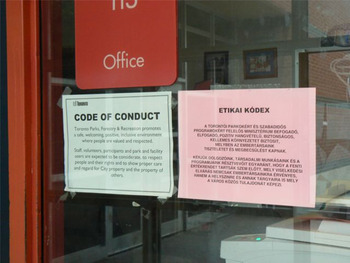
Public notice of code of conduct displayed inside public recreation center; parallel texts on parallel signs in English and Hungarian.

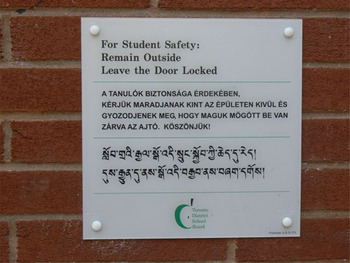
Sign at side entrance to public school; parallel texts on same sign in English, Hungarian, and Tibetan.

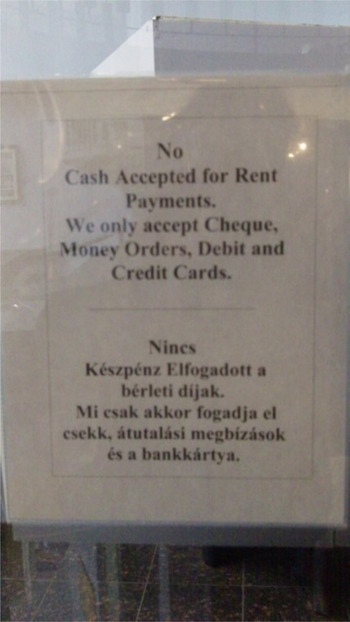
Notice in the lobby of a large apartment building; parallel texts in English and ‘Hungarian’ (produced with Google Translate).

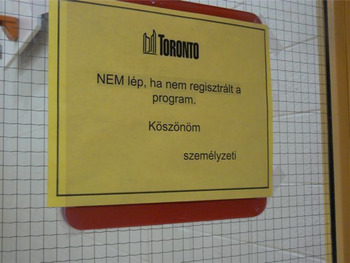
Monolingual directive sign, produced with Google Translate (edited to remove the name of the institution).

The use of parallel multilingual texts is a routine occurrence in institutional contexts in Toronto and Canada more generally. For one, federal and provincial legislation mandates the display of parallel texts in English and French in many public contexts, such as the postal service or the provincial health service. Furthermore, beyond official bilingualism, multiculturalism and multilingualism can be considered to be part of Canada's state ideology (see e.g. Haque Reference Haque2012), particularly in institutional contexts relating to immigration. The city of Toronto has a multilingual services policy that specifies criteria for the provision of interpreting and the translation of documents into certain languages.Footnote 7 Such a routine deployment of multilingual resources was evident in interviews with institutional agents. For example, the director of a community center noted that “if I do (.) notice that we have an influx of residents that speak a particular language (.7) then I just go through (.) maybe local agencies to find out who has translation services (.) and who can provide me (.9) with the signage I need in that language”.Footnote 8 Similarly, the manager of an apartment building reported that a letter informing residents about renovations was sent in multiple language versions: “We did that in all the languages that I felt were stronger (.) and then everybody else just (.) got one in English”. Both quotes articulate a language ideology in which multilingual texts arise from a desire to communicate with addressees who are perceived as lacking proficiency in English.
Of the bilingual or multilingual signs in Parkdale that included Hungarian versions, many were information signs, for example, about opening hours of a business or institution. Some signs with parallel texts, however, could also be classified as public order signs with directive or prohibitory messages, directing the reader to follow instructions about what is or is not allowed in the respective location. This is illustrated in Figures 2 and 3 with signage from inside a public recreation center and from a side entrance to a public elementary school, respectively.
LL studies do not always make distinctions between different types of signs (see e.g. Landry & Bourhis Reference Landry and Bourhis1997; Gorter Reference Gorter and Chapelle2013), or if they do, don't base them on functional criteria (e.g. the distinction between top-down vs. bottom-up, following Shohamy et al. Reference Shohamy, Ben-Rafael and Barni2010). As a consequence, there is no consistent terminology to describe signs such as those shown in Figures 2 and 3. In their typology of signs, Spolsky & Cooper (Reference Spolsky and Cooper1991:76–81) identify a category of warning notices and prohibitions. By contrast, Scollon & Scollon (Reference Scollon and Wong Scollon2003:184) speak of public notices, which ‘inform the public either about conditions or regulations that are present in that place’. More recently, Mautner (Reference Mautner2012:190) uses the term directive signs, and, as noted above, Kroon et al. (Reference Kroon, Dong, Blommaert, Stroud and Prinsloo2015:4) speak of public-order signs, which they define as signs that are ‘manufactured by a public authority with the intention of informing the public about an aspect of public order’. They add ‘such signs are important and consequential: they often specify what is legally appropriate (and consequently sanctionable in the event of transgression) and are thus strictly normative; they are legally binding both for the authority producing them and for the audiences consuming them’. The legal relevance of such signs makes them prime sites for the investigation of power in multilingual settings. As Mautner (Reference Mautner2012:190) notes, such signs ‘speak to us of social inclusion and exclusion’ and of ‘the power to control space’. At the same time, Kallen (Reference Kallen, Jaworski and Thurlow2010:49) notes that they may be ‘a point of entry in the official domain for languages that lack official status’.
Taken together, studies about public-order signs suggest that an institution's desire to exclude particular people from a controlled space may lead to the inclusion of their language in the linguistic landscape. This is illustrated by the monolingual sign in Figure 5 in the following section (the earliest one documented in the corpus). This sign asserts the recreational center's right to control access to its facilities and to exclude unauthorized Roma users. In so doing, it introduces Hungarian into the linguistic landscape where it previously had not been present. This finding contrasts with much LL research on minority languages that assumes that signage in minority languages either results from officially sanctioned language rights, or is authored by speakers of the language itself (Gorter et al. Reference Gorter and Chapelle2013). Instead it suggests that multilingualism may appear specifically in contexts where it is to facilitate the exclusion or punishment of deviant others. Thus, drawing on Coupland's (Reference Coupland2012) frame-analysis approach, multilingual public-order signs as in Figures 2 and 3 can be understood as exemplifying a particular frame, in what could be called punitive multilingualism.
All of these public order signs have in common that they are produced by institutions for their own purposes (as noted by Kroon et al. Reference Kroon, Dong, Blommaert, Stroud and Prinsloo2015), and can thus be characterized as examples of top-down signage (Shohamy et al. Reference Shohamy, Ben-Rafael and Barni2010). In the multilingual context, this generally implies that the institutional representatives who are involved in the production of the sign are not in fact literate in some of the languages that are included. Consequently, the production of the sign involves translational processes, which is addressed in the following section.
Dual indexicality of public-order signs in Parkdale
As noted in the previous section, Kroon et al. (Reference Kroon, Dong, Blommaert, Stroud and Prinsloo2015:4) observe that public order signs specify what behavior counts as ‘sanctionable in the event of transgression’ (see also Mautner Reference Mautner2012). At the same time, the existence of a given public-order sign serves to index the transgression itself. A similar point is made by Kulick (Reference Kulick2003) in his study of the word no in different contexts marked by violence and/or sexual desire. Drawing on performativity theory and Althusser's (Reference Althusser and Althusser1971) notion of interpellation, Kulick (Reference Kulick2003:145) argues for a dual indexicality of no, which on the surface manifests a denial, but simultaneously affirms the existence of that which is denied: ‘A “no” is not just a refusal of that subjection. It is also an acknowledgement of it; a response to the interpellative call that even in disputing it affirms it’. Such a dual indexicality is arguably also present in public order signs, as the signs do not merely index a prohibition, but also index that the transgressive behavior has previously occurred or is expected to occur at the particular location. For example, readers of the ‘Code of conduct’ in Figure 2 may assume that the presence of the sign is motivated by the prior occurrence of incidents in which participants did not ‘show proper care and regard for City property and the property of others’. Moreover, such signs address (or interpellate) persons who may engage in this transgression and need to be instructed not to do so (consider, for example, the use of the imperatives leave and remain in Figure 3).
This dual indexicality points to the fact that signs produce a range of meanings, rather than a simple, general meaning (see Kroon et al. Reference Kroon, Dong, Blommaert, Stroud and Prinsloo2015:5). This point is emphasized by Ochs (Reference Ochs, Gumperz and Levinson1996:418), who argues for the need to distinguish potential from actual indexicality ‘in a particular instance of use (in the mind of any participating interlocutor – speaker, addressee, overhearer, etc.). The indexical potential of a form derives from a history of usage and cultural expectations surrounding that form’. Following Ochs, an investigation of the indexicality of signage in the linguistic landscape thus requires ethnography and attention to different participant roles. Adapting Goffman's (Reference Goffman1981) model of the participation framework, different positions of producer and recipient of signage can be distinguished. Public-order signs are written by specific authors, but also represent the voice of an institution (the principal, in Goffman's terms). Furthermore, they may be read by addressees as well as by unaddressed recipients, ‘overreaders’, so to speak (corresponding to overhearers, as in Ochs’ quote above). This is especially relevant in parallel-text multilingual signs, where each language version has a different set of addressees, while the presumed translation equivalence facilitates the ‘overreading’ of other-language versions. To illustrate, English-speaking readers of the trilingual sign in Figure 3 are addressed by the English text at the top, but are overreaders of the Hungarian and Tibetan versions, whose propositional content they may presume to be equivalent to the English text. This notion of overreaders can also be illustrated with the case of the Hungarian-language billboards that the Canadian government posted in the city of Miskolc (see the earlier section on the discrimination and exclusion of Roma in Europe). While these monolingual billboards were addressed to Hungarian citizens who considered applying for refugee status in Canada, their unaddressed recipients include members of the Canadian public who read about them in the Canadian press.
Empirical evidence of divergent indexicalities
In order to investigate the indexicalities of Hungarian signs in Toronto ‘in the mind of participating interlocutors’ (in Ochs’ terms), I conducted structured audio-recorded interviews as well as informal unrecorded interviews with people in the neighborhood who occupied different participant roles: authors and/or principals of signs (managers or employees of institutions and businesses), addressees of Hungarian-language signs (Roma migrants), and overreaders of these same signs (neighborhood residents who did not speak Hungarian or Hungarian speakers who were not Roma and did not frequent the locations where the signs were placed). During these interviews, I presented photos of signs in Hungarian and other languages to the interviewees and asked questions about them, for example, what motivation they ascribed to the sign's author, or how they explained the choice of languages. As anticipated, this yielded evidence of social meanings that these signs may take for different participants. In addition, the interviews with institutional representatives also provided information about the production of the signs with machine translation, which is discussed below.
As mentioned above, several institutional agents described multilingual signs as a commonplace response to linguistic diversity. Interviewees such as the director and staff of recreational centers or the manager of an apartment building felt that by providing information in Hungarian, they were accommodating to Roma migrants and helping them. For these interviewees, the production of multilingual signage thus has the potential to contribute to a positive self-image of the business or institution as tolerant and open-minded towards ‘newcomers’, in line with ideologies of Canadian national identity that embrace multiculturalism and the claim to being a ‘kindler, gentler nation’ than the United States (Haque Reference Haque2012:23).
Such potential positive indexical meanings contrast strongly with the meanings that are available to other participants. To gain insight into the potential indexicalities of such signs for Hungarian-speaking Roma residents, I interviewed three young Roma residents and showed them photographs of signs that I had documented. The interviews were conducted in English at Toronto's Roma Community Centre (located near Parkdale). The reactions of these three interviewees varied sharply by type of sign, and they reacted negatively to the use of machine translation, which is discussed in the following section. All three interviewees viewed prohibitory or warning signs as indexical of anti-Roma stereotypes and consequently as discriminatory. On the code of conduct (Figure 3 above), one interviewee commented “so, if- if I go there (.) so I feel like ‘Oh my God,’ it's a discrimination for me (.) because they- they already think that I will doing something bad for them”. Another interviewee viewed the same sign as condescending, because it instructed Roma youth about basic, commonplace behavioral rules (“don't break, don't steal”), as “if you just get off from the tree that you have to know”. All three interviewees felt that public-order signs stereotyped Roma youth as troublemakers (“They already make a box for the Hungarian people in Parkdale”). This was true especially when signs were bilingual or in Hungarian only, which made them feel singled out (“Why just for the Hungarian?” “Only the Hungarian have to understand?”). Speaking about the monolingual sign shown in Figure 5 below (which was intended to restrict access to a sports facility), one interviewee linked the sign to anti-Roma prejudice on the part of the author: “so that's why we can't enter, because we are uh (.) “gypsy” kids or something. So it's again it's for me like a discrimination, like back home”. In contrast, another Roma interviewee declined to attribute prejudice to the author of a directive sign about rent payments at an apartment building, but noted that the sign could have a discriminatory effect nonetheless.Footnote 9 “It's not a bad intention. So maybe the landlord put it (.) the sign so people can see (.) and they know how it's gonna go. (.) But for us (.) to see this kind of thing (.) it's getting back to our life when we started (.) and we see- and we saw this startening (.) like we saw (1.0) how can it be escalating … so it can start discrimination I think”. Both quotes illustrate that Roma addressees may interpret Hungarian-language signs against the backdrop of their experience in Hungary, reminiscent of Ochs’ (Reference Ochs, Gumperz and Levinson1996:418) point that ‘[t]he indexical potential of a form derives from a history of usage and cultural expectations surrounding that form’. Given the Roma's history of exclusion and discrimination and of being stereotyped as criminals, Hungarian-language public-order signs thus clearly have the potential to index such meanings for young Roma addressees.
The Roma interviewees’ fear of being stereotyped by public-order signs is echoed by the comments of ‘overreaders’, that is, interviewees who commented on Hungarian-language signs of which they were neither the author nor the addressee. Overreaders include neighborhood residents who frequent some of the same public spaces where signs were displayed, but also institutional representatives who commented on other signs in addition to their own. Speaking generally about multilingual signage, some overreaders felt that other-language texts did not concern them, and that they would not necessarily pay attention to them in daily life, nor always recognize which languages were used. One interviewee noted that “if I can't read it I'm not looking at it”. However, whether interviewees were able to identify specific languages or not, they viewed multilingual signs as indexical of the presence of people with limited proficiency in English. This is illustrated in the following interview in excerpt (1), in which an interviewee is reacting to the sign shown in Figure 3 above.
-
(1) The other part of me thinks, oh wow (.) it's amazing that you would need these (.9) language- like these are for students to read and- and their parents, and you have to think, wow, like that's- what a complicated school system, to have people- (.) It's obvious that you need- of course you're gonna have people who are very limited with English. (1.1) And you wonder what goes on inside a building that needs this on the front door.
The recurrence of the word need in the quote shows the interviewee's assumption that languages other than English are used only when intended readers do not understand English. Furthermore, the quote demonstrates that such public-order signs may be interpreted as an institutional response to problematic circumstances, as they index such problems in the mind of the overreader. For example, when shown the recreational center's sign of its code of conduct, which asks the reader to respect other people's property (see Figure 2), the same interviewee speculated that “maybe there's a lot of men in this environment that are (1.0) contravening certain rules”. For other interviewees, images of such signs prompted rationalization that relied specifically on beliefs about cultural differences between Roma migrants and other residents, beliefs that were at least in part based on personal experience. One public-school teacher stated that young Roma needed to learn to be respectful of others, and this was echoed by a Hungarian-speaking social worker, as shown in (2).
-
(2) I think- I think these- these kind of uh signs are important, especially for newcomers. (.) Because the- these people come from an environment where they were not respected by (xxx), and if somebody doesn't respect you why would you respect somebody else. (.) So they have to- some of them really have to learn how to- how to respect, not just people, but everything, the school, uh the- the- even the property of the school here.
Of course, as discussed above, all three Roma interviewees viewed these very same signs as disrespectful, condescending, and/or stereotyping, but these indexicalities did not seem to be available to the social worker. Despite being a native speaker of Hungarian, she did not see herself as a potential addressee of any of these Hungarian-language signs. Furthermore, her apparent inability (or unwillingness) to recognize the signs’ potential to index discrimination may stem from the fact that unlike the Roma interviewees, she does not have the experience of being habitually stereotyped as a criminal.
The responses of the interviewees clearly support Ochs’ contention that linguistic forms (here signs in the linguistic landscape) have the potential to index different social meanings to different participating interlocutors, because of different cultural expectations and histories of usage, including different experiences with stereotypes and discrimination. For Roma interviewees, public-order signs have the potential to index stereotypes that echo discrimination “back home”. For overreaders, by contrast, the interpretation of signage is influenced by the availability of stereotypes about Roma. These may be less pervasive in Canada than they are in Europe, or at least this is suggested by the fact that some interviewees consistently referred to Roma newcomers as “the Hungarians”, thus not identifying them as Roma. At the same time, the comments show that public-order signs do have the potential to index the existence of ‘public disorder’, independent of the availability of negative stereotypes about targeted populations.
Indexicalities of ungrammatical ‘Google Hungarian’
As noted above, interviewees who were representatives of institutions or businesses were asked not only about the social meanings of multilingual signage, but also about the production of signs. In the process, I determined that several signs were produced by machine translation, a fact that had also been suggested by several Hungarian-speaking consultants who evaluated and translated the signage. This was typically the case with signs that were printed on a piece of paper and displayed in the windows of offices or store fronts. One example is given in Figure 4, showing a sign posted at the door to the rental office of a large apartment building in Parkdale where several Roma families live. The sign is a bilingual sign with two parallel monolingual texts, with English displayed on top.
-
(3) Grammatical Hungarian translation of English text in Figure 4.
Nem fogadunk el készpénzt lakbér fizetésre.
‘We do not accept cash for rent payment.’
Csak csekket, pézes utalványt, betéti kártyát és hitel kártyát fogadunk el.
‘We only accept cheque, money order, debit card and credit card.’
The English text in Figure 4 was written by the manager of the building's rental office (whom I interviewed), and then used as input for machine translation into Hungarian using Google Translate. The resulting version ‘looks’ Hungarian (cf. Kroon et al. Reference Kroon, Dong, Blommaert, Stroud and Prinsloo2015), but it is arguably not ‘in Hungarian’, because it is ungrammatical to the point of being incomprehensible, according to several native speaker consultants. For comparison, a grammatical and contextually appropriate Hungarian translation of the English source text is given in (3). The ungrammaticality of the machine translation results from incorrect or unidiomatic word choices and from a failure to mark syntactic relations between words in the target text, as inflectional markings are either absent or misused. For example, in both sentences, direct objects fail to be marked with the suffix -t for accusative case (Készpénz ‘cash,’ csekk ‘cheque’, bankártya ‘bank card,’ and megbizások ‘orders’ instead of készpénzt, csekket, bankkártyát, or megbizásokt, respectively). In addition, the noun dijak ‘fees’ is lacking the causal-final case suffix -ert. In the second sentence, inflectional morphology is found in the third-person singular suffix -ja on the verb fogadja ‘accepts’. However, it does not agree in number and person with the subject mi ‘we’, which would require mi fogadunk (see the translation in (3)). Furthermore, the machine translation appears to treat line breaks in the input as syntactic boundaries, as no cash is not translated as a syntactic unit, but as two separate phrases (nincs ‘there is not’ is a plausible translation of English sentential no, but not of the determiner no). The intended meaning would be best rendered in Hungarian as nem fogadunk el készpénzt ‘we don't accept cash,’ as shown in (3). Both sentences also include unidiomatic uses of the definite article a, in a bérleti díjak ‘the rental fees’ and a bankkártya ‘the bank card,’ as well as inappropriate lexical choices (dijak ‘fees’ and átutalási megbizások ‘transfer orders’ instead of pénzes utalvány ‘money order.’) Finally, the placement of the quantifier csak ‘only’ causes it to scope over the verb (as if to restrict the conditions under which cheques are accepted), rather than over the following noun phrases, as intended (compare its placement before the noun phrase in (3) above, or, alternatively, in mi csak csekket fogadunk el ‘we accept only a cheque’).
Other documented signs were similarly produced with Google Translate, and likewise marked by considerable ungrammaticality. Like the sign in Figure 4, these were paper signs posted on walls or windows of institutions, such as two community recreation centers and a legal aid office, and they were either directive signs or information signs (e.g. posting opening hours).Footnote 10 With the exception of one monolingual sign, they displayed parallel texts in English and ostensible Hungarian, that is, ‘Google-Hungarian’, and sometimes also in other languages. The monolingual sign is shown in Figure 5. It is the earliest documented sign in the corpus, from November 2010, when it was posted at the entrance to a gym inside a public recreation center. While Hungarian-speaking consultants struggled to make sense of the text, the sign was likely intended to inform the reader that access to the gym is restricted to users who have preregistered for a program. The first two words, Nem lép, in particular are again ungrammatical to the point of being incomprehensible, as they could be translated as ‘is not making a step’ (lép is third singular of lépni ‘to move/make a step’, nem ‘not’), but omit a subject.Footnote 11 As in Figure 4, syntactic roles are unmarked, so that it is unclear how a program ‘the program’ relates to the rest of the sentence. Finally, köszönjük ‘we thank you’, would be pragmatically more appropriate than köszönöm ‘I thank you’ (which machine translation programs are likely to treat as the default translation of English thank you). At the same recreation center, another sign posted alongside an English version was intended to inform readers about the hours during which the swimming pool was open to the public, rather than reserved for classes. In English, this was conveyed by the phrase Leisure swim, which had been translated into Hungarian as pihenés úszni ‘rest to swim.’ Several native speakers judged this to be nonsensical, and suggested alternatives such as szabadidős úszás ‘recreational swimming.’
Machine translation: Uses and indexicalities
Google Translate is a widely used machine-translation service that is available for free to any person with internet access. In April 2015 it was available in ninety languages.Footnote 12 Google Translate uses statistical machine-translation technology, searching large corpora of parallel texts to match source language words or word combinations with their most common target-language equivalents. This requires the existence of very large corpora of aligned parallel texts, and consequently such systems ‘increase their accuracy as more parallel data allow for the implementation of better statistics, and as statistical methods are integrated with human post-editing’ (Zanettin Reference Zanettin and House2014:191). Consequently, the quality of machine translation (however defined) depends on the size of the corpus that is available for a given language. It is likely to be comparatively weak for Hungarian, compared to other languages with larger number of speakers.
Research on machine translation has focused on evaluating translation quality and assessing it as a tool for professional translators (Garcia Reference Garcia2010; Pym Reference Pym2011), but has not investigated practices of lay users. But while the limitations of machine translation are well known to experts, many lay users turn to Google Translate in the expectation that it reliably produces comprehensible output. The building manager proclaimed that she was satisfied with machine translation, which she preferred over having to pay professional translators: “I do all my- my stuff with Google (.) …. I think it's easier that way and it's been working”. When asked if she was aware of comprehension problems, she argued that people sometimes pretend not to understand, but that “they understand, they just feel that they can get away with it”. By contrast, one young Roma interviewee argued that “for sure the Hungarian people, if someone it's not speak English, they don't understand”.Footnote 13 Another interviewee worried about the results of the ungrammaticality of the sign in Figure 5, suspecting that it would lead to misunderstanding and thus failure to follow the directive, without the institution being aware of the communication problem.Footnote 14
Linguistic landscape research has so far rarely considered ungrammaticality or machine translation (but see Kroon et al. Reference Kroon, Dong, Blommaert, Stroud and Prinsloo2015:12).Footnote 15 In fact, the posting of signs made with machine translation goes against Spolsky's (Reference Spolsky, Shohamy and Gorter2009:32) widely cited ‘sign-writer's skill’ condition of language choice (‘write a sign in a language you know’). In their study of bilingual top-down signage in Wales, Hornsby & Vigers (Reference Hornsby, Vigers, Gorter, Marten and van Mensel2012:69–71) note the frequent occurrence of erroneous or unidiomatic Welsh forms and analyze this as symptomatic of an ‘ideology of contempt’ in which English forms matter, but Welsh ones do not.
The analysis of Hornsby & Vigers (Reference Hornsby, Vigers, Gorter, Marten and van Mensel2012) points to the fact that ungrammaticality does not simply impede the comprehensibility of signs, but also has the potential to index social meanings. The interview data suggests that this indexicality varies again by type of signs and by the corresponding frame. Both Roma interviewees and Hungarian language consultants viewed ungrammaticality in some information signs as amusing (e.g. Pihenés úszni ‘rest swim’ elicited laughter from several interviewees). By contrast, the three Roma interviewees viewed ungrammaticality in public-order signs as disrespectful and offensive, particularly in the case of the sign shown in Figure 5, which was evaluated as not “polite language”, “like to a dog”. While these reactions can be attributed to the indexical value of specific nonidiomatic or ungrammatical linguistic forms, the ungrammaticality itself was seen by one interviewee as indexical of a failure to engage in face-to-face interaction, particularly if it was attributed to machine translation. One Roma interviewee asked “so why the Canadian people is not finding (.) the right person (.) and asking help? … So it's, you know, it's like, ‘I don't care. I using this translator. It's easy for me and I'm just putting out the door and on the wall and (.) that's it’ ”. In this quote, the young Roma interviewee speaks in the imagined voice of the building manager, and in the process echoes several points that the building manager herself raised in her interview with me. As quoted above, she preferred Google Translate because it enabled her to act independently, without having to rely on the help of a professional (paid) translator, or without having to ask a bilingual resident for a favor: “Most of the time I- (.) I try not to ask anybody for anything”.
These findings echo observations made by the translation scholar Anthony Pym (Reference Pym2011:4), who notes that machine translation produces translations of successive text fragments, rather than of a single linear, coherent text. This leads to less consideration of pragmatics or of the needs of the addressee. In short, Pym finds that ‘[t]he more technology, … the less we tend to see translation as communicating between people’. This observation seems especially relevant in the context of public-order signs. As noted above, these signs presuppose and project an addressee who engages in transgressive behavior. Consequently, asking a bilingual community member for help in the production of public-order signs draws attention to this presupposition, whereas machine translation protects the sign author from the need to engage in such a potentially face-threatening act.
As a form of nonnative ungrammatical language use, ‘Google Hungarian’ also bears a partial resemblance to the phenomenon of Mock Spanish, first described by Hill (Reference Hill1998; Reference Hill2008), in which White American English speakers use pseudo-Spanish phrases in ways that index negative stereotypes about Spanish speakers in the United States. Mock Spanish is often used jokingly among American English speakers, which is not the case with ‘Google Hungarian’. However, Mock Spanish is also documented in intercultural contexts where Spanish speakers are addressed, and this includes public order signage, such as the common use of ungrammatical Lava sus manos instead of lavarse las manos for ‘wash your hands’ in public bathrooms (Peñalosa Reference Peñalosa1981; Barrett Reference Barrett2006). Barrett (Reference Barrett2006:186) also notes the use of machine translation for Spanish language notices in the restaurant where he conducted fieldwork. Importantly, Mock Spanish produces a similar range of indexical meanings to those of the Google Hungarian signs shown in this study. Hill (Reference Hill2008) argues that Mock Spanish has multiple functions, as it simultaneously indexes white English speakers as congenial and open-minded towards multilingualism, while at the same time indexing racist stereotypes. Moreover, the carelessly nonstandard nature of Spanish use in Mock Spanish (evident, for example, in the deliberate omission of diacritics, Hill Reference Hill1998:682) indexes an ideology of contempt for the language and its speakers, where correct language use is unnecessary (see also Barrett Reference Barrett2006:187). Similarly, the multilingual public order signs in this study may function as a positive index of Canadian institutions as embracing multilingualism, and simultaneously as a negative index of stereotypes about Roma as people who engage in deviant behavior and who do not require careful language use.
Indices of exclusion and belonging
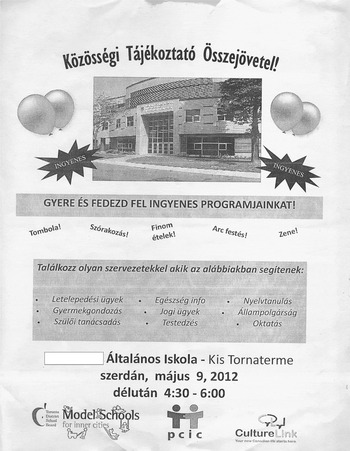
The preceding sections have addressed the indexicality of multilingual public-order signs and of ungrammatical language use produced with machine translation. Some of the signs that were documented for this study, however, do not fall into either of these categories, but rather provide information in grammatically correct and pragmatically appropriate Hungarian. These were found particularly in the context of public schools attended by Roma children, for example, multilingual wayfinding signs inside school buildings, and bilingual signs with information about school events and procedures, such as registration for kindergarten classes. An example is shown in Figure 6, an advertisement for a school fair that was shown in Hungarian, alongside an English version with parallel content and layout. The poster invites the reader to attend a free party at the school (sponsored by several organizations) and advertises attractions such as music, food, kids’ activities, and a raffle, as well as a number of community services available for parents.
Advertisement for school fair; Hungarian version displayed alongside English version (edited to remove the name of the institution).

Such signs elicited very different reactions from interviewees than the signs discussed above. When shown the sign in Figure 6, one Roma interviewee stated that the sign made him happy. Two interviewees noted that the text was in ‘proper’ Hungarian, and this fact contributed to their positive assessment of the sign. In contrast to the signs discussed above, they attributed this sign to a Hungarian-speaking author (“I don't think so it's a Google translator”) who took the time to produce a carefully crafted text and who cared about Roma children at the school (“It's made by heart”). As in the case of the signs made with Google Translate, the specific linguistic forms thus clearly contribute to the social meanings that are indexed by the sign. While users of machine translation proclaim to be content with getting a basic meaning ‘across’, and appear to believe that it is possible to do so without concern for grammaticality and pragmatic appropriateness, addressees use both the form and the content to evaluate signs and to ascribe motives to their authors, especially if the evaluations of form and content converge. Thus, as discussed earlier, the ungrammaticality of machine translation is evaluated more negatively on public-order signs than on information signs, whereas the use of grammatically and pragmatically appropriate language on an invitation to a public event has the potential to index acceptance and belonging more strongly than it would on public-order signs.
Conclusion
While LL studies have generally interpreted the presence of minority languages on signage as indicative of a group's ethnolinguistic vitality (Landry & Bourhis Reference Landry and Bourhis1997) and as making a language ‘visible’ (Gorter et al. Reference Gorter, Marten and van Mensel2012), the findings of this study show that the indexical meaning of the use of minority languages in multilingual signage depends strongly on the function of signs, the frame in which they are interpreted, and on the specific linguistic forms that are employed. The study converges with other recent LL studies in showing that it is fruitful to investigate how multilingual signs are produced and how they are read, rather than assume that all instances in which a particular language is being used can be counted as functionally equivalent tokens for a quantitative analysis. As shown in this study, this often means that scholars need to consider processes of translation, which may be involved in both the production and the reading of signs. In particular, machine translation is increasingly relevant in multilingual contexts, given the ubiquitous availability of translation programs on mobile internet devices.Footnote 16 As noted by Rampton, Blommaert, Arnaut, & Spotti (Reference Rampton, Blommaert, Arnaut, Spotti, Arnaut, Blommaert, Rampton and Spotti2015:4), ‘faster and more mobile communication technologies and software infrastructures’ are among the characteristics of superdiversity that affect both migrants and ‘host’ communities. Despite these developments, LL studies have so far rarely considered translation as a process. In light of the observations in this article, however, theories of linguistic landscape need to allow for the possibility that authors of signs are not competent in the languages used, but instead rely on machine translation or other dictionary resources. Of course, such translation resources are not available to an equal extent in all languages, and this fact is liable to have an impact on linguistic landscapes. For example, Google Translate is available for certain standardized languages, mainly official languages of nation states. It is not available for Romani or Tibetan, thus making their inclusion in multilingual frames in Parkdale more difficult than that of Hungarian, Filipino, Tamil, or Vietnamese, for which it is available.Footnote 17 Moreover, unfamiliar writing systems represent an additional barrier for the production of signage by nonspeakers, for example, due to problems with reproducing fonts. In Parkdale, this would discourage the inclusion of Tamil or Tibetan, in contrast to Filipino, Hungarian, or Vietnamese, which use the Roman alphabet. This study further suggests that the use of machine translation is not distributed evenly across types of signs, but may be attributable to a variety of factors, such as constraints of time and budget, and the sign writer's attitude towards the language and its speakers. Furthermore, as hypothesized above, the face-threatening potential of public-order signs may motivate sign authors to avoid interaction with native speakers and opt for machine translation instead.
Finally, the study shows that public-order signs that communicate warnings, directives, or prohibitions represent a genre of signs that warrant specialized attention from scholars in LL studies, because they have particular semiotic properties. By projecting addressees who engage in transgressive behavior, such signs have the potential to function as a covert racist discourse that stigmatizes speakers of particular languages as social deviants. At the same time, the study shows that the indexical meanings of such multilingual signs can be different for different participants, for addressees and overreaders, as well as for principals in Goffman's sense. Superdiversity thus includes not only a diversity of linguistic forms, but also a diversity of meanings produced by them.
APPENDIX: TRANSCRIPTION CONVENTIONS
- if-
-
cut-off or self-interruption
- you
-
emphasis
- (xxx)
-
inaudible segment
- (.)
-
brief pause
- (.7)
-
timed pause (in seconds)