INTRODUCTION
This paper describes the presence of spinner dolphins, Stenella longirostris (Gray, 1828), in the coastal Red Sea area off southern Egypt, and their diurnal resting behaviour within a coral reef located six km offshore, near the town of Marsa Alam. Spinner dolphins are among the most common cetaceans in the Red Sea (Notarbartolo di Sciara et al., Reference Notarbartolo-di-Sciara, Addink, Baldwin, Rudolph and Smeenk2007). In several tropical locations of the world's oceans, such as Hawai'i (Norris et al., Reference Norris, Würsig, Wells and Würsig1994), Midway Atoll (Karczmarski et al., Reference Karczmarski, Würsig, Gailey, Larson and Vanderlip2005), Polynesia (Gannier & Petiau, Reference Gannier and Petiau2006) and Fernando de Noronha, Brazil (Silva et al., Reference Silva, Silva and Sazima2005), spinner dolphins are known to move inside the protected and shallow waters of particular reefs during the daylight hours, probably to reduce the chances of deepwater shark predation (Norris & Dohl, Reference Norris and Dohl1980), after having foraged cooperatively at night over the shelf waters on the mesopelagic boundary micronekton community (Perrin, Reference Perrin1998; Benoit-Bird & Au, Reference Benoit-Bird and Au2003). Such behaviour is also known to occur in the Red Sea (e.g. in coral reefs off the Sudanese coast; G. Notarbartolo di Sciara, unpublished observations), including off the coast of southern Egypt.
In our study area one of the reefs in particular, locally known as Samadai, has been known for years as a reef regularly visited by spinner dolphins. The predictable presence of dolphins in a locality easy to reach has attracted, in recent years, a considerable number of visitors to Samadai (Sarhan et al., Reference Sarhan, Hanafy and Fouda2004). Tourism in the area of Marsa Alam is rapidly developing, with a large number of new hotels and resorts being built along the coast. The predominant attraction for tourists in Marsa Alam is the tropical marine environment, with its impressive coral reefs and associated marine fauna. However, diving locations are not very numerous along this stretch of coastline, and Samadai is one of the most attractive.
When inside the reef, spinner dolphins are found in very shallow water (most of the time <20 m), and are best seen when snorkelling as opposed to during dives. Until approximately 2000, spinner dolphins in Samadai were mostly a side attraction for divers, who would watch them while snorkelling between dives. In the early 2000s, however, a number of new factors dramatically changed the situation: (1) the word spread across the tourist community at large and specialized Red Sea tour operators in particular, that the presence of dolphins in a conveniently reachable and scenic situation afforded a rare opportunity for close encounters with charismatic marine fauna; (2) the increased volume of tourists in the Marsa Alam area brought there a large number of visitors with little or no diving expertise but with sufficient snorkelling capabilities; and (3) the fame of the Samadai dolphins attracted day-trip tourists from as far as Hurghada (260 km to the north), with several buses bringing to the reef hundreds of people per day, in addition to the Marsa Alam-based tourists.
Due to these circumstances, human pressure within Samadai reef and on the dolphins grew rapidly, sharply peaking in summer 2003, reportedly with >800 swimmers being present in the small lagoon on a single day (Sarhan et al., Reference Sarhan, Hanafy and Fouda2004). Hordes of tourists are said to have come into close contact with the resting dolphins, with little or no concern for safety aspects, for the ecological fragility of the situation, and for the need of respectful behaviour in the presence of the resting wild mammals. Excessive numbers of swimmers and documented objectionable behaviour of some visitors within the reef was said to be causing noticeable distress to the dolphins, and there was general agreement that the situation had to be brought under strict control without delay if the continued presence of the dolphins in Samadai was to be ensured.
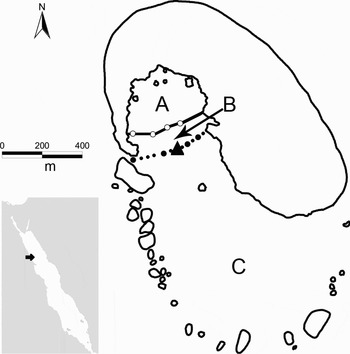
As a consequence, in December 2003 a decision was adopted by the local governing authorities to suspend all visits to Samadai reef until a management scheme was in place. A provisional management scheme was thus implemented starting in January 2004, based on the scant knowledge available at the time and on a precautionary approach (Notarbartolo di Sciara, Reference Notarbartolo di Sciara2003). Measures included: the subdivision of the reef into three zones (Figure 1); a daily ceiling of 100 snorkellers and 100 divers visiting the reef aboard a maximum of 10 large boats; time limits for visits (from 10.00 to 14.00); limiting admission of swimming visitors to a restricted zone adjacent to what was considered a critical dolphin habitat, under the guidance of certified guides; the adoption of a code of conduct; and the payment of an entrance fee. Meanwhile, the collection of data on dolphins and swimmers' presence in Samadai was seen as a much needed action to provide knowledge to inform future management. Rangers from the Red Sea Protectorates (RSP, Nature Conservation Sector of the Egyptian Environmental Affairs Agency) were trained on data collection techniques and protocols by one of us (G.N.S.), and the collection of the data started on 15 January 2004. This paper provides a summary of the data collected during a two-year period, from 15 January 2004 to 14 January 2006.
Samadai Reef: GPS-derived map with Zones A, B and C. White dots indicate the locations of buoys separating Zone A from Zone B; black dots indicate buoys separating Zone B from Zone C; the black triangle indicates the location where the observers' vessel was moored.

MATERIALS AND METHODS
Samadai Reef is located at 24° 59′ N 034° 59′ E, approximately 6 km from the Egyptian coast at its nearest point, and 12 km south-east of Marsa Alam. This horseshoe-shaped reef, 1.4 km long and 1 km wide, is oriented east–west forming a natural lagoon open to the south, well-sheltered from the prevailing northerly winds. A provisional management plan in force since January 2004 subdivided the lagoon waters into three zones (Figure 1): Zone A (a no-entry zone approximately 90,000 m2 wide, containing the lagoon area preferred by the dolphins when resting; Zone B (a 44.000 m2 wide zone where swimmer visits are conducted and no boats are allowed); and Zone C (the remainder of the lagoon, 693.000 m2 wide, containing the moorings of the large boats, where small inflatables are allowed and snorkelling and diving may occur freely).
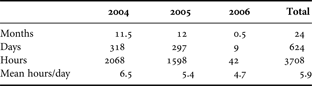
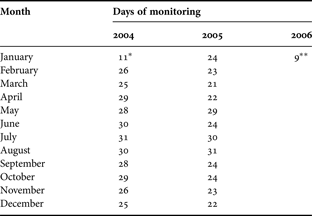
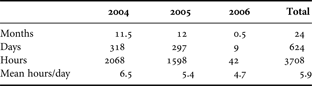
Monitoring of the dolphins' use of the various reef zones and of the snorkellers' presence was conducted by trained RSP rangers since January 2004. This paper presents monitoring data for the first two years, until 14 January 2006 (Tables 1 & 2).
Monitoring effort in Samadai between 15 January 2004 and 14 January 2006.
Number of days spent each month in Samadai between 15 January 2004 and 14 January 2006.
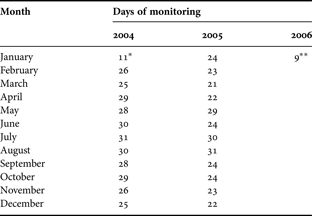
* data collection began on 15 January 2004; **, data collection ended on 14 January 2006.
Observations, conducted on a daily basis from a small vessel (a 5 m RIB) anchored in the centre of the reef (Figure 1, black triangle), started between 7.30 and 10.00 and lasted until 15.00–16.00 (depending on length of day). Mean daily observation time over the two years was slightly below six hours (Table 1). Sighting conditions were always excellent given that when inside the reef the waters were relatively calm even on windy days and the distance of the dolphins from the boat was never >400 m, and usually much less. Data collected included: the dolphins' presence or absence in the reef and its various zones, the presence and numbers of swimmers in Zone B, and the presence and numbers of small vessels in Zone C. At 0 and 30 minutes of each hour, the number of dolphins in each zone (including a fourth zone, outside the reef) was recorded, as well as the number of the swimmers in Zone B, of small boats and of large vessels anchored in the pre-set mooring sites in Zone C.
Relevant events and environmental conditions were also recorded and reported in chronological order on a separate form. Events included: time of the dolphins' entering or leaving the lagoon, noticeable reactions of the dolphins to the swimmers and possible interactions, and other relevant occurrences. Wind speed, cloud cover and sea-surface temperature were also collected on a regular basis.
Dolphin group size was estimated from above-water only, by averaging minimum and maximum estimates. Observations of the same dolphin group over periods of hours improved such estimates during the course of the day. Occasional underwater counts provided by swim guides allowed ground-truthing of above-water counts; however only the above-water estimates were retained in the data. Dolphins were considered calves when their size was estimated at less than 75% of the average adult length and swam in close association with an adult. No distinction was made between calves and newborn animals.
RESULTS
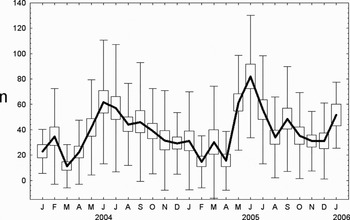
Mean daily dolphin presence in Samadai was 39.2 (SD = 39.34, range 0–210), with no significant differences between 2004 and 2005 (Table 3). The mean presence of dolphins in the reef showed a seasonal pattern roughly consistent in both years, with low numbers between February and April, a sharp peak in May–July with numbers increasing 6- to 8-fold compared to the winter minimum, and a progressive decrease during autumn ending the cycle in the following winter (Figure 2).
Seasonal changes in mean daily dolphin presence in Samadai (all zones combined) from January 2004 to January 2006 (included). n, mean daily number of dolphins present per month; box, standard error; bar, standard deviation.

Descriptive statistics of the daily presence of dolphins in Samadai in the different zones in different years. Differences between years were insignificant (Mann–Whitney U-test, P = 0.583).

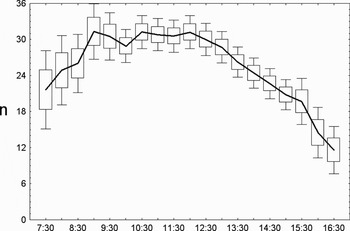
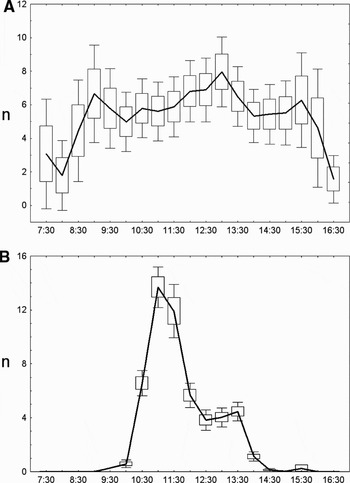
The daily pattern of dolphin presence in the reef showed a numerical increase during the morning hours from 7.30 until 9.30; numbers remained high until 12.30, and then progressively declined until the end of the day's observations (Figure 3). Local knowledge indicated that dolphins are absent from the reef during the night. Mean dolphin presence in Zones B and C was much lower than in Zone A, indicating a greater presence of the animals within the latter, which obviously offered to the animals choice habitat for resting and socializing (Table 3; Figure 4A). Zones B and C appeared to serve as a corridor between the open sea and Zone A.
Variation of dolphin presence in Samadai (both years and all zones combined). n, mean number of dolphins present in the reef during each half hour; box, standard error; bar, standard deviation.

Variation of dolphin and swimmer presence in the reef with time of day. (A) n, mean number of dolphins present during each half hour in Zones B and C combined, all years; (B) n, mean number of swimmers present during each half hour in Zone B, all years. Box, standard error; bar, standard deviation.

A changing pattern of reef use with time of day was consistent with observations made during the monitoring process. In the afternoon hours, dolphins increased their activity patterns, frequency of aerial behaviours and unpredictability of swimming direction with respect to their stereotyped behaviour in the morning, and were more inclined to frequently trespass from Zone A into the remainder of the reef area, including Zone B, where they would be swimming among snorkellers (Figure 4A). Considering that swimmers were allowed in the water in Zone B between 10.00 and 14.00, a temporal mismatch occurred between the peak presence of swimmers in Zone B (Figure 4B) and the increasing presence of dolphins outside of Zone A (Figure 4A). This lack of synchronization between the timing of swimmers' visits and dolphin behavioural changes was not conducive to the optimization of dolphin encounters by tourists, particularly considering that during the afternoon hours dolphins are more alert, curious and available to interact with swimmers.
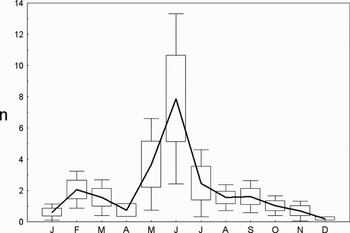
Although calves were observed year-round, a marked seasonality of the presence of calves within the groups in the lagoon was observed, with a distinct peak in June (Figure 5).
Seasonality of presence of calves within the dolphin groups in Samadai (all years and zones combined). n, monthly mean of the numbers of calves observed; box, standard error; bar, standard deviation.

DISCUSSION
Ecological aspects
While the monitoring activities described in this paper provide a first description of the behavioural ecology of spinner dolphins in the Red Sea, and show remarkable similarities with other S. longirostris populations in other oceans, a number of questions about the species' ecology in the region remain still open and will need to be addressed through further research. The main unknown aspects concern the seasonal variability of the dolphins' use of Samadai, and whether such variability affects the entire population or only part of it. In turn, these aspects raise questions about the social structure of S. longirostris in the Red Sea.
Spinner dolphins are thought to seek refuge in sheltered reefs to rest in locations where they can more easily protect themselves from the dangers of shark predation (Norris & Dohl, Reference Norris and Dohl1980). However, the seasonal variability of their presence in Samadai may mean that: (a) when not in Samadai, dolphins rest in other reefs; (b) the dolphins' ability to use the reef may be curtailed during part of the year, e.g. by their prey's ecology; or (c) the dolphins' need for protection from predators is seasonally variable. This last option may be due either to a possible (although undemonstrated) seasonal variability of predation pressure in the area, or to seasonal changes in the degree of vulnerability to predation by the dolphins themselves (e.g. due to a well-marked calving season). This seems to be corroborated by the coincidence between the month of highest presence of dolphins in Samadai and the month of highest number of calves counted within the dolphin groups.
The seasonal variability of the dolphin presence in Samadai may more easily be supported by a fission–fusion social pattern, similar to that observed along the Kona coast in Hawai'i (Norris & Dohl, Reference Norris and Dohl1980; Norris et al., Reference Norris, Würsig, Wells and Würsig1994; Lammers, Reference Lammers2004), and Polynesia (Gannier & Petiau, Reference Gannier and Petiau2006), than by a stable bisexually bonded society of long-term associates, with strong geographical fidelity, no obvious fission–fusion, and limited contacts with other populations, such as that observed in Midway Atoll (Karczmarski et al., Reference Karczmarski, Würsig, Gailey, Larson and Vanderlip2005).
Management aspects
Although not formally established as a protected area to protect the dolphins, Samadai Reef is in practice a specially managed marine area. At the onset of the monitoring programme described in this paper, a provisional management plan was implemented in Samadai Reef by the RSP, having two objectives: ‘(a) to constrain the extent of human presence in the reef within limits that are clearly acceptable to the dolphins, and will not cause the quality of their habitat to degrade, and the dolphins’ abandonment of the reef; and (b) to allow the continuation of a tourist activity involving a respectful interaction with the dolphins which is important for the local economy and which has, if properly conducted, a high educational value potentially enhancing human attention, attraction and care for the marine environment at large' (Notarbartolo di Sciara, Reference Notarbartolo di Sciara2003). Whale-watching tourism is fast expanding throughout the world (Hoyt, Reference Hoyt2001), and programmes in which tourists are brought in the water to interact with free-ranging cetaceans (also known as ‘swim-with’ activities) are increasing in popularity in many different locations. However, whether these encounters constitute a threat to the animals involved, and whether swim-with activities can be sustainable, is a matter of considerable controversy (Samuels & Bejder, Reference Samuels and Bejder2004).
Mammals exposed to frequent contact with tourists (e.g. chimpanzees Pan troglodytes and grey whales Eschrichtius robustus) are known to habituate and become tolerant of benign human presence (Constantine et al., Reference Constantine, Brunton and Dennis2004); however, instances are known in which animals (e.g. common bottlenose dolphins Tursiops truncatus, killer whales Orcinus orca and mountain gorillas Gorilla gorilla beringei) have become particularly sensitive to human presence in situations which they perceived as threatening (Constantine, Reference Constantine2001). Constantine et al. (Reference Constantine, Brunton and Dennis2004) found that the effects of dolphin-watching boats on common bottlenose dolphin (Tursiops truncatus) resting behaviour in the Bay of Islands, New Zealand, were substantial, and suggested that the current national legislation was not affording this isolated population protection from human disturbance. Neumann & Orams (Reference Neumann and Orams2006) investigated interactions between short-beaked common dolphins (Delphinus delphis) and snorkelling tourists off the eastern coast of New Zealand over a three-year period, and found that the dolphins' initial attraction by swimmers was typically followed by neutral behaviour and eventually replaced by boat avoidance; those authors concluded that the animals were likely to be negatively affected by tourism. Among cetaceans, spinner dolphins have been a tourist attraction in a growing number of sites in the Pacific Ocean (Courbis, Reference Courbis2007), and while Delfour (2007) was unable to detect human effects on the dolphins in Hawai'i, Danil et al. (Reference Danil, Maldini and Marten2005) and Gannier & Petiau (Reference Gannier and Petiau2006) did provide evidence of possible effects, respectively, in Hawai'i and Polynesia. Therefore, allowing the continuation of a ‘swim-with’ programme in Samadai raises considerable concern for the sustainability of this activity, also considering that even dolphin–human interactions that may at first glance appear ‘positive’ can ultimately have negative impacts on dolphin fitness (Janik & Thompson, Reference Janik and Thompson1996).
However, ‘swim-with’ activities with cetaceans occur in a variety of situations involving different habitats, species and life history phases, some of which are amenable to be more effectively and sustainably managed than others (Barradell & Ritter, Reference Barradell and Ritter2007). For example, ‘swim-with’ operations based on dwarf minke whales (Balaenoptera acutorostrata) in the Great Barrier Reef, an increasingly popular tourist activity in northern Queensland, Australia (Valentine et al., Reference Valentine, Birtles, Curnock, Arnold and Dunstan2004), are carefully managed and monitored and, being based on voluntary approaches by the whales, appear to be having a minimal (if any) impact on the whales themselves (Arnold & Birtles, Reference Arnold and Birtles1999). The spatial configuration of Samadai Reef, with a well-defined, easily identifiable and predictable core area used by the dolphins for their resting needs, allows for unambiguous zoning of the site and effective enforcement of the management measures. Although no significant variation in dolphin numbers was detected between the two years of this study, an impact assessment should be conducted through the longitudinal monitoring of the dolphins' presence in the reef across several years (Constantine, Reference Constantine2001).
Anecdotal evidence exists that spinner dolphins are clearly easier to approach in Samadai than in other reefs along the southern coast of Egypt, suggesting that in Samadai dolphins are more used to being in the vicinity of people than elsewhere. Samuels & Bejder (Reference Samuels and Bejder2004), studying the effects of ‘swim-with’ activities on the behaviour of common bottlenose dolphins (T. truncatus) in waters near Panama City Beach, Florida, found that a particular subset of the dolphins studied permitted people to swim near them, suggesting individual habituation. The fact that no obvious signs of avoidance were displayed by the dolphins in Samadai during the study period cannot, however, be considered proof that no impact exists (Gill et al., Reference Gill, Norris and Sutherland2001).
While the knowledge produced by two years of monitoring showed that the management provisions implemented in January 2004 appeared to be sound, the data indicated a mismatch between the timing of the presence of swimmers in Zone B and the availability of dolphins to trespass from Zone A to Zone B and interact with them (Figure 4). These data would suggest that the entry time in Zone B for swimmers seeking to be in the vicinity of the dolphins could be delayed from 10.00 to 12.00, and prolonged throughout the afternoon, to facilitate the staggering of human presence in the water across time (thus decreasing the number of people simultaneously in the water), and to encourage visitors to be in the water in a time of day in which the dolphins are awake, alert and amenable to swim near the people out of curiosity.
In conclusion, the preliminary information collected through the RSP monitoring programme indicates that the management measures implemented in Samadai have gone in the right direction, by devoting a large core area of the reef to the exclusive use by the dolphins, while allowing tourists to experience a controlled contact with the animals in a less important area. We suggest the next steps to be undertaken to further improve management should involve ensuring:
(a) continued compliance of the management prescriptions supported by the constant presence of enforcement officers in Samadai. When assessing the extent to which tourism affects cetaceans, investigators should consider whether tourist operations comply with existing regulations or guidelines (Scarpaci et al., Reference Scarpaci, Dayanthi and Corkeron2003);
(b) that guides leading the swimming tours in Zone B are well-trained in the task through a regular training and certification programme (Samuels & Spradlin, Reference Samuels and Spradlin1995); and
(c) the implementation of educational interpretation and outreach education to nearby communities. Results from a study conducted in ‘swim-with-dolphin’ tours at three locations in New Zealand support the demand for structured interpretation programmes on marine mammal tours, with clear indications from the interviewed tourists that they would have liked to receive more information, in particular about the wider marine environment (Lück, Reference Lück2003).
ACKNOWLEDGEMENTS
We wish to thank Red Sea rangers Ahmed Shawky, Beshoy Morise, Amgaad El-Shafaay, Ahmed Abd El-Khalik, Mohamed Abd El-Ghany, Sayed Khodary, Mohammed Bessar, Hamed Fathy, Sameh El-Masry, and Mukhtar Beher for their enduring effort in the collection of the data and for enforcing the law protecting the dolphins in Samadai. Logistic support and the friendly encouragement by Diving Ocean, and in particular by Pierpaolo Campanini, Angela Donati, and Vittoria Giannattasio, are also gratefully acknowledged.