Acinetobacter baumannii is a Gram-negative cocobacillus frequently recognized as a cause of infections, especially in patients admitted to intensive care units.Reference Munoz-Price and Weinstein 1 Treatment of infections due to this pathogen is challenging due to its resistance to most commercially available antibiotics.Reference Chopra, Marchaim and Awali 2 Furthermore, delays in administration of appropriate antibiotic therapy for Acinetobacter infections have been associated with higher morbidity and mortality.Reference Lee, Chen, Wu, Huang and Chiu 3 We previously reported that growing carbapenem-resistant A. baumannii on surveillance cultures increases the risk of developing subsequent clinical infections with this pathogen.Reference Latibeaudiere, Rosa, Laowansiri, Arheart, Namias and Munoz-Price 4 However, we do not know how positive surveillance cultures influence the choice of empirical antibiotics in a high endemicity unit. Therefore, we aimed to assess the association between results of surveillance cultures and the use of appropriate empirical antibiotics among patients with carbapenem-resistant A. baumannii infections.
METHODS
This is a nested case-control study within a previously reported cohort,Reference Latibeaudiere, Rosa, Laowansiri, Arheart, Namias and Munoz-Price 4 performed in a trauma intensive care unit (TICU) of a 1,500-licensed bed county teaching hospital in southern Florida. Since 2009, all patients admitted to the TICU underwent surveillance cultures to assess colonization status with carbapenem-resistant Gram-negative bacilli, including A. baumannii. As previously described,Reference Munoz-Price, Namias and Cleary 5 surveillance cultures were obtained upon unit admission and weekly thereafter. Anatomical sites of surveillance included rectal swab, and lower respiratory tract secretions among mechanically ventilated patients. Details on sample processing have been previously published.Reference Latibeaudiere, Rosa, Laowansiri, Arheart, Namias and Munoz-Price 4
The original cohort consisted of consecutive patients admitted to the TICU from November 1, 2010, to November 30, 2011, with at least 1 surveillance culture performed during the study period. Carbapenem-resistant A. baumannii clinical infections were defined using the Center for Disease Control and Prevention (CDC) definitions.Reference Horan, Andrus and Dudeck 6 The latter determinations were made by 2 independent reviewers using information available from the electronic medical records.Reference Latibeaudiere, Rosa, Laowansiri, Arheart, Namias and Munoz-Price 4 Patients with either rectal or respiratory secretions growing carbapenem-resistant A. baumannii on surveillance cultures were considered surveillance-positive, the remaining patients were considered surveillance-negative. The results of both surveillance cultures and of clinical cultures were displayed in the microbiology section of the electronic medical record. Results were available to all healthcare workers managing unit patients.
In addition to baseline demographics, antibiotic data collected included choice of empirical antibiotic used on the day of clinical onset of infection (date of occurrence of the first signs or symptoms that prompted the use of antibiotics) as prescribed by the treating TICU physician. Empirical antibiotic therapy was considered appropriate (concordant therapy) based on the antibiotic susceptibility panel and consisted of colistin, tobramycin, or tigecycline. A log-rank test was performed to assess for differences in time-to-appropriate antibiotic therapy. We defined “time zero” as the date of onset of signs or symptoms of infection. Administration of concordant therapy was the event. Patients who did not receive appropriate antibiotic therapy were censored at the time of unit discharge. All analyses were performed using SAS 9.3 (SAS Institute, Cary, NC). The protocol for this study was reviewed and approved by the University of Miami’s Institutional Review Board.
RESULTS
During the study period, 479 patients were admitted to the TICU. A total of 93 patients were excluded due to lack of surveillance cultures; these patients either failed to have orders for surveillance cultures or orders were entered incorrectly in the system. In addition, 22 patients were excluded due to evidence of infection with A. baumannii prior to their first surveillance culture. Of the remaining cohort, 60 patients (16.5%) were found to have carbapenem-resistant A. baumannii clinical infections. Of these 60 cases, 34 (56.7%) were surveillance-positive prior to the onset of infection and 26 (43.3%) remained surveillance-negative.
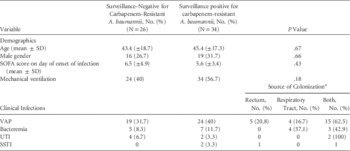
Baseline demographic characteristics and the distribution of clinical infections due to carbapenem-resistant A. baumannii are displayed in Table 1. The mean Sequential Organ Failure Assessment (SOFA) scores on the day of onset of clinical infection were 6.5 (±4.9) and 5.6 (±3.4) among surveillance-positive and surveillance-negative patients, respectively (P=.43). Additionally, patients who received appropriate empirical antibiotic therapy, irrespective of surveillance status, were just as ill (SOFA score=6.1 ±4.4) as patients without appropriate empirical antibiotic therapy (SOFA score=5.9±3.9; P=.88).
Baseline Demographic Characteristics and Distribution of Clinical Acinetobacter baumannii Infections Based on Surveillance Status Prior to the Onset of Infection

NOTE. SD, standard deviation; SOFA, sequential organ failure assessment; VAP, ventilator-associated pneumonia; UTI, urinary tract infection; SSTI, skin and soft-tissue infection.
a Sources of colonization based on the type of clinical infection among the surveillance-positive group.
Susceptibility patterns among A. baumannii isolates were 95% to colistin and 37% to tobramycin. Only 7 of the isolates were tested for tigecycline; 2 (28%) were reported as susceptible, 4 (57%) were intermediate, and 1 (15%) was resistant.
Of the 34 surveillance-positive patients, appropriate empirical antibiotic therapy was administered to 13 (38.2%). Of those who remained surveillance-negative prior to the onset of clinical infection, 13 (50%) received appropriate empirical antibiotic therapy (P=.36). The proportion of patients with in-hospital mortality was 26.7% and was not associated with receiving appropriate empirical therapy (P=.53).
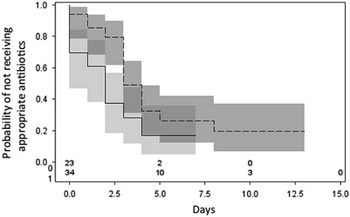
Overall, 46 of 60 patients (76.7%) received concordant therapy. The median number of days to concordant therapy among surveillance-negative patients was 2 days, and among those who were surveillance-positive the median number of days to concordant therapy was 3 days (log-rank 4.67, P=.03) (Figure 1).
Probability of receiving appropriate antimicrobial therapy (concordant) against carbapenem-resistant Acinetobacter baumannii based on results of surveillance cultures. Curves represent the probability of not receiving concordant therapy. Days represent the days from onset of signs and symptoms of infection until concordant therapy was started. Solid line represents the group that remained surveillance-negative. Dashed line represents the group that was surveillance-positive. Shaded area depicts the 95% confidence intervals.

DISCUSSION
In this cohort of TICU patients, having a surveillance culture positive with carbapenem-resistant A. baumannii was not associated with the use of appropriate empirical antibiotic therapy or with shorter time to initiation of concordant therapy for clinical infections with carbapenem-resistant A. baumannii.
The Centers for Disease Control and Prevention (CDC) has identified carbapenem-resistant A. baumannii as a serious health threat to the US population. 7 Results from a national survey of hospitals in the United States showed that 52% of A. baumannii isolates from ICUs are carbapenem-resistant.Reference Shlaes, Sahm, Opiela and Spellberg 8 Effective therapy against these strains requires the use of polymixins or tigecycline.Reference Spellberg and Bonomo 9 Moreover, delays in concordant therapy of up to 48 hours have been associated with differences in mortality of 60% vs 20% in those who receive appropriate initial therapy.Reference Lee, Chen, Wu, Huang and Chiu 3
In a previous study,Reference Rosa, Arheart and Depascale 10 we demonstrated that environmental exposure to A. baumannii increases the risk of colonization with this pathogen. Furthermore, patients with surveillance cultures positive for carbapenem-resistant A. baumannii had a 15.2 times greater risk of developing clinical infections with this pathogen.Reference Latibeaudiere, Rosa, Laowansiri, Arheart, Namias and Munoz-Price 4 Thus, in patients who are known to be colonized with carbapenem-resistant A. baumannii with subsequent development of signs and symptoms of infection, empirical therapy should include antimicrobials with activity against these isolates while results from clinical cultures are awaited.
Several limitations of our study include its retrospective design conducted at a single center, in a specialized population, and during a hyperendemicity situation with A. baumannii. Also, the small study size might have affected our ability to evaluate the effect of empirical antibiotic therapy on mortality. Additionally, we failed to use PFGEs to assess whether isolates from surveillance cultures matched the clinical isolates.
In conclusion, patients with surveillance cultures growing carbapenem-resistant A. baumannii were not more likely to receive appropriate empirical antibiotic therapy for the treatment of clinical infections caused by this pathogen, and significant delays in initiation of concordant therapy occurred. Moreover, only 76.7% of patients received concordant therapy. Because patients colonized with carbapenem-resistant A. baumannii are known to be at an increased risk of developing clinical infections with this organism, results of surveillance cultures should be taken into consideration when choosing empirical antibiotic therapy if clinical deterioration occurs. Studies aimed at addressing physician perception and interpretation of surveillance cultures with A. baumannii are needed. Additionally, the impact of positive surveillance cultures on antibiotic use in the absence of proven infection represents an area of interest.
ACKNOWLEDGMENTS
Financial support. No financial support was provided relevant to this article.
Potential conflicts of interest. All authors report no conflicts of interest relevant to this article.