Introduction
The cowpea weevils Callosobruchus maculatus (Coleoptera: Bruchidae) is a serious pest of stored products ranked as the principal post-harvest pest of several pulses such as chickpea and cowpea. It is a holometabolic insect in which all the immature stages from eggs to pupae are living inside the grain. In the early stage of C. maculatus attach, the only symptoms are the presence of egg cemented to the surface of pulses. The development of immature stages occurs entirely within the seed. The adult emerges through windows in the grain, leaving round holes that are the main evidence of damage. Larvae feeding on the cotyledons cause substantial losses (Singh, Reference Singh, Singh, Van Emden and Talor1978; Steel et al., Reference Steel, Allen, Summerfield, Summerfield and Robert1985). They are widely distributed in Egypt and other Asian and African countries. Over 90% of the insect damage to cowpea seed is caused by this insect.
Traditional controls of insect pests in the majority of agricultural commodities in Egypt are primary based on the use of chemical insecticides which have many disadvantages including harmful residues, environment contamination and development of resistance in certain insects (Phillips et al., Reference Phillips, Fleischhauer, Mair, Walsworth and Lukin2001; Hallman, Reference Hallman2011). The most effective management tool used in the disinfection of commercial quantities of cowpeas was fumigation with chemical fumigants such as methyl bromide and phosphine (Mbata et al., Reference Mbata, Shu, Phillips and Ramaswamy2004; Heather and Hallman, Reference Heather and Hallman2008). However, owing to its damaging effects on the ozone layer and potential residues in the treated commodities, methyl bromide is banned for all purposes including phytosanitary and reshipment uses in the European Union (Cannon et al., Reference Cannon, Hallman and Blackburn2012). The use of phosphine has been challenged by the development of pests' resistance. For example, resistance of C. maculatus to different insecticides was reported by Bogamuwa et al. (Reference Bogamuwa, Weerakoon and Karunaratne2002). Therefore, alternative quarantine treatment to safety more the commodities out of quarantine are needed. In recent years, phytosanitary treatments of agricultural commodities to disinfest insect's pests have expanded rapidly (Hallman and Blackburn, Reference Hallman and Blackburn2016). About doses used for phytosanitary treatment, irradiation causes damage to insect cellular macromolecules such as deoxyribonucleic acid and ribonucleic acid and thereof, it is effective regard to all stages of insect development. Phytosanitary irradiation (PI) is approved for stored products in many countries (Hallman, Reference Hallman2013).
Some recently conducted research still use acute mortality as the criterion for efficacy of irradiation. For most uses of irradiation to control insects, including stored products, this is unnecessary and can lead to adverse quality outcomes from the excessive doses applied to achieve high levels of acute mortality. Prevention of reproduction (prevention of oviposition, egg hatching, larval development, pupation, adult emergency and development of eggs in F1 generation) is an adequate criterion for the efficacy of irradiation. Irradiation has potential as a method to control cowpea weevil started by Dongre et al. (Reference Dongre, Harwalkar, Llene and Padwal-Desai1997) and approved by Hallman (Reference Hallman2013). The data which neither have the same trend on the effectiveness of irradiation to prevent the reproduction or adult emergence of C. maculatus in Egypt neither enough nor documented for establishing the phytosanitary generic dose of gamma irradiation that needs to be developed before a quarantine treatment can be recommended.
The main objective of this study is (1) to assess gamma radiation effects on the different stages of development (eggs, larvae, pupae and adults) of C. maculatus, (2) to determine the most radiation tolerant stage and to establish the criterion for phytosanitary efficacy, (3) to confirm the PI dose using a large scale confirmatory test and (4) to evaluate the effect of irradiation such as phytosanitary dose levels on the quality attributes of cowpea.
Materials and methods
Irradiation process
All irradiation processes were carried out at Indian Co60 Gamma Chamber (4000A) located at National Center for Radiation Research and Technology (NCRRT), Nasr City, Cairo, Egypt. The average dose rate was between 22 and 24 Gy/h. Alanine dosimeters (Traceable to National Physical Laboratory, UK) were used for dose calibration of the irradiator and for measuring the average absorbed dose. Detailed dose mapping was conducted by Department of Radiation Protection and Dosimetry at NCRRT.
Laboratory rearing technique
C. maculatus culture was obtained from Entomology Laboratory at Plant Protection Research Institute, Dokki, Giza, Egypt. The cowpea seeds used for the bioassay were kept in the freezer for 10 days to eliminate infestation from the field. C. maculatus was reared on cowpea seeds in glass jars (500 ml). Each jar was provided with 300–400 adults (male and female) of C. maculatus (0–2 day-old) for laying eggs and covered with muslin by a rubber band to prevent insect escape. The jars containing insects were incubated at 28 ± 2°C and 75 ± 5% RH for 1 week. Then the parent adults were sieved out and discarded.
Irradiation of eggs stage
Five grams of cowpea seeds were infested by five couples of tested insect. After 1 or 3 days the adult was removed, then the cowpea seeds infested with 1 and 3 days old eggs were exposed to 0, 50, 100, 150, 200, 250, 300, 350, 400, 450 and 500 Gy of gamma radiation (three replicates for each treatment were used). The irradiated 1 and 3-–day old eggs in each replicate were counted. The hatchability and adult emergency percentages were also estimated.
Irradiation of larvae and pupae stages
Four hundred grams of cowpea seeds were infested by 200 of tested insect. Three days later cowpea seeds were sieved thoroughly and the weevils were discarded. Five grams of infested cowpea were separated for each treatment. Insects irradiated 13 days after infestation were treated by 0, 50, 100, 150, 200, 250, 300 until 850 Gy as larvae. Insects irradiated 17 days after infestation were treated by 0, 50, 100,150, 200, 250, 300– until 1250 Gy as pupae. Adult emerging and reduction percentage from irradiated larvae and pupae were estimated. Five couples (males and females) resulting from each irradiated dose was separated and put on 3 g of cowpea. Infested cowpea was stored in a controlled environment cabinet (28 ± 2°C and 75 ± 5 RH). The adult weevils that emerged (F1 progeny) were counted, and the percentage of insects' reduction was estimated.
Irradiation of adult stage
Five grams of cowpea seeds were infested by 50 couples of C. maculatus. One day old adults were exposed to 0 (control), 50, 100, 150, 200, 250, 300, 350 until 1350 Gy of gamma radiation (three replicate for each treatment were used). The mortality percentage of irradiated adults was estimated after 24 h. Five alive couples resulting from the each irradiated dose were separated and put on 3 g of cowpea seeds. After 3 days, the cowpea seeds were sieved thoroughly in each treatment and the adult weevils were discarded. The eggs were counted in each treatment and the number of emerging adult was estimated.
Large-scale confirmatory tests
Confirmatory tests were conducted by treating 27,745 male and female adults of C. maculatus stock colony at a single proposed irradiation dose (650 Gy) producing no F1 adults. In this experiment, ~700 1-day old adults (male and female) were put on 100 g of cowpea seeds in ventilated containers for 1–2 days and irradiated at 650 Gy. This was repeated 39 times. As unirradiated control, 190 adults (male and female) were also put in 100 g of cowpea seeds, and this was repeated 5 times. Parent adults were removed from the containers after 7 days, and the cowpea seeds were stored at 28°C ± 2 and 75 ± 5 RH% for more 60 days. Any emergence of F1 adults was counted. The level of confidence associated with treating a large number of C. maculatus with zero survival was estimated by the equation: C = 1−(1−Pu)n where Pu (0.0001) is the acceptable level of survivorship and n is the number of treated insects (Couey and Chew, Reference Couey and Chew1986).
Effect of phytosanitary irradiation dose of 650 Gy on chemical, physical and microbiological quality of cowpea seeds
Moisture, protein, lipids, ash and carbohydrate contents of irradiated and unirradiated cowpea seeds were determined according to the method of AOAC (1990).
Groups' 25 cowpea seeds (irradiated and unirradiated) were put into each dish on top of the moist paper. The three dishes were placed under the lights to allow the seeds' germination. After 4 and 8 days, the numbers of germinating seeds were counted and expressed as percent germination.
Hardness testing was carried out by the Penetrometer system (Digital Force Gauge Model FGN-20G, Nidec-Shimpo Corporation, Japan).
Two hundred of (irradiated and unirradiated) cowpea seeds were soaked for 1 h in tap water, after then they were cooked in 1250 ml of water. The average cooking time (min) for three replicate was recorded.
The colour quantity of cowpea seeds in terms of hunter's L (lightness), a × (red−green coordinate, redness), b × (blue−green coordinate, yellowness) was determined according to Nieto-Sandoval et al. (Reference Nieto-Sandoval, Fernández-López, Almela and Muñoz1999).
Total aerobic bacterial counts (TABC) were determined using the pour plate technique according to APHA (1992). The inoculated plates were poured with plate count agar medium (Difco, USA) and incubated at 30°C for 72 h. The colony-forming unit (cfu/g) was enumerated and expressed as log cfu/g.
Total mould and yeast counts (TM ∝ Y) were determined using the same pour plate technique but the plates were poured with Czapek's agar medium and incubated at 25°C for 72 h.
Total coliform bacteria and E. coli were counted on the Charm peel plate EC microbial test (kit: code: PP-EC-100 k) according to Charm Operators Manual. The inoculated plates were incubated at 35°C ± 1 for 24 h. At the end of incubation, the plates were observed for coloured colonies. Red and blue colonies represent total coliform bacteria, while blue-black colonies represent E. coli. This test has been certified by AOAC research institute as performance tested method #061501.
Statistical analysis
All variables were tested for meeting the assumption of normality and equality of variance and all variables have met the assumptions except for four variables. The non-parametric variables have been subjected to various transformation techniques, but normality remained unsolved. Therefore, non-parametric analysis was used to analyse the data. Parametric variable distributions have been expressed in tables in the form of Mean ± Standard Error of mean (SE) while non-parametric variables distributions were expressed in tables in the form of Median (first quartile–third quartile). Three statistical analyses have been used all over the data. The two independent samples t test was used for comparing the two levels factors with a parametric response while One Way ANOVA has been used for >2 levels factors with a parametric response while >2 levels factors with a non-parametric response, Kruskal Wallis One-way ANOVA on Ranks has been used for this purpose. Post hoc tests were done for both parametric and non-parametric data at P-value <0.05. Significant results obtained from the ANOVA test was further tested for multiple comparison testing using the Holm–Sidak test as it is recommended over Tukey and Bonferroni tests. A significant result obtained from the Kruskal Wallis ANOVA on Ranks was further tested for multiple comparisons testing using the Dunnett test for non-parametric data. All multiple comparisons were vs. the control group. An asterisk was assigned for all significant groups against the control group (P-value <0.05). Different assumptions testing and statistical data analyses were carried out using Sigmaplot 12.5.
Results
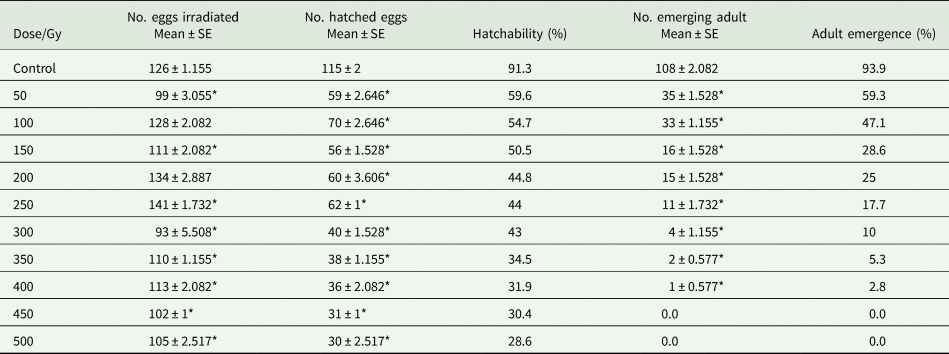
As irradiation dose increased the percentage of hatchability decreased (table 1). The hatching percentage of 1 day old eggs in cowpea seeds irradiated at 100 Gy was 54.7% and at the highest irradiation dose used (500 Gy) decreased to 28.6%. The emergence of adults from irradiated eggs in cowpea seeds decreased with the increasing irradiation dose. Adult emergence at 100 Gy was 47.1%. Only one adult emerged at 400 Gy and no adult emerged after irradiation at 450 Gy, indicating that the dose 450 Gy resulted in non-completion of the development of immature stages of C. maculatus.
Effect of gamma irradiation on 1-day old eggs of C. maculatus

* The mean difference is significant at the 0.05 level compare with control.
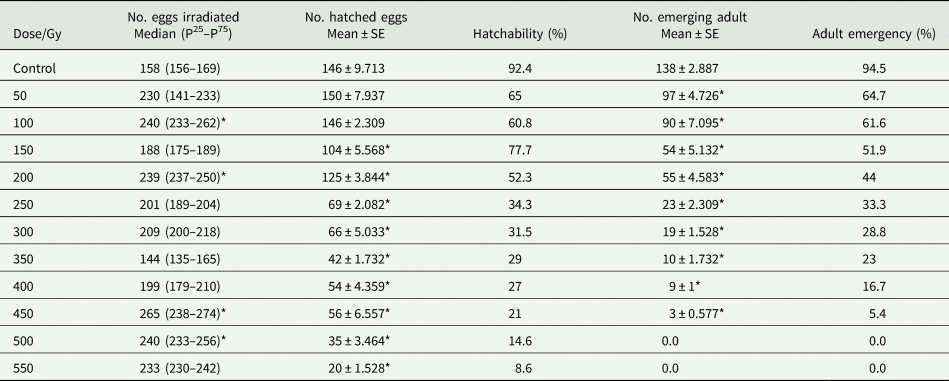
The results in table 2 indicate that 3-day-old eggs were more tolerant to radiation than 1-day-old eggs. In other words, the radiation sensitivity of eggs decreased with increasing the age of eggs. The irradiation dose of 100 Gy decreased the hatchability of 3 day old eggs to 60.8% and 500 Gy reduced hatchability to only 14.6% corresponding to 54.7 and 28.6% in the case of 1 day old eggs, respectively. No adult emerged after irradiating infested cowpea seeds with 3 days old eggs at 500 Gy, indicating that this radiation dose resulted in non-completion of 3 day old eggs development.
Effect of gamma irradiation on 3-days old eggs of C. maculatus

* The mean difference is significant at the 0.05 level compare with control.
It is obvious that irradiation doses of 450 and 500 Gy prevented adults' emergence from 1 day and 3 day old eggs, respectively.
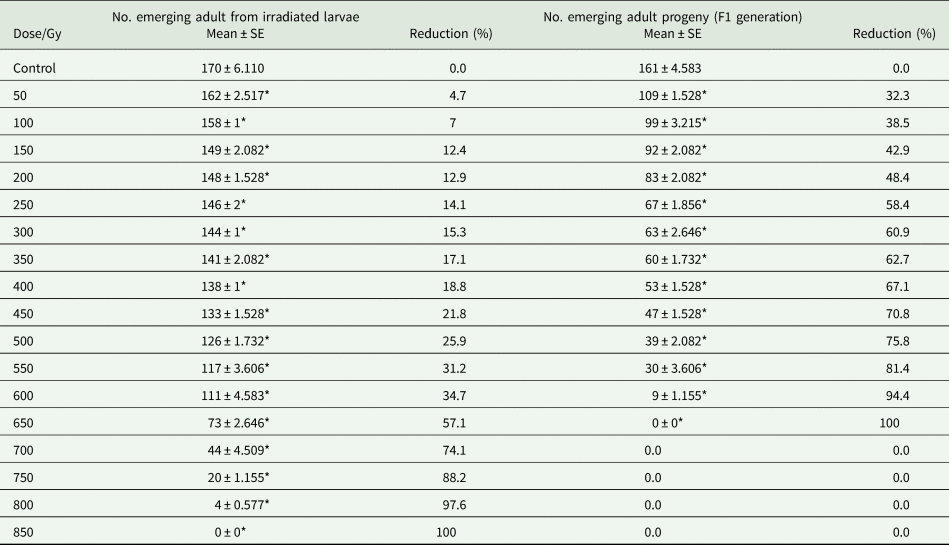
The data in table 3 indicate that the reduction percentage of emerging adults from irradiated larvae in cowpea seeds decreased with the increasing irradiation dose. The reduction percentage of emerging adults from the irradiated larvae in cowpea at 100 Gy was only 7%. No emerging adults have been seen at 850 Gy, indicating that the larval stage of C. maculatus was more tolerant to radiation even than 3-days-–old eggs. The number of emerging adult progeny (F1 generation) was counted and the percentage of reduction was calculated. No emerging adult progeny (F1 generation) was seen at 650 Gy.
Effect of gamma irradiation on maturation of C. maculatus-13 days old (larval stage)

* The mean difference is significant at the 0.05 level compare with control.
According to the previously obtained results, the inherited harmful impacts of gamma radiation were observed in the parental and continuous F1 generation. Moreover the levels of the number of emerging adults in the F1 generations were less than those of parental generation.
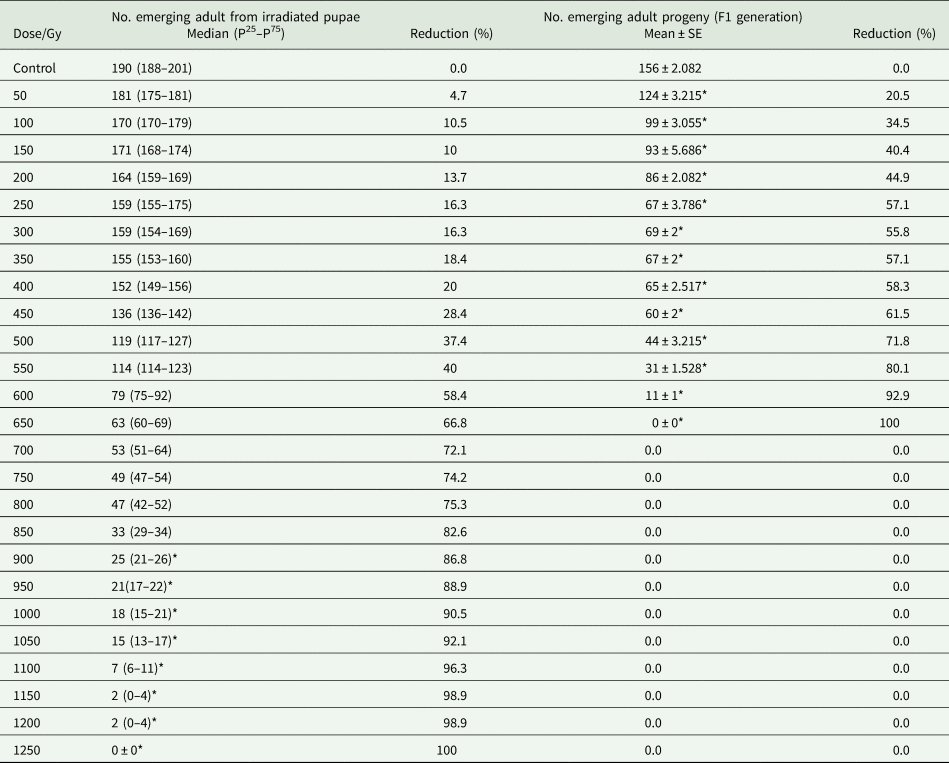
The data in table 4 revealed that by increasing the irradiation dose to the pupal stage from 50 to 1250 Gy the reduction percentage of adult emergence increased. No emerging adults have been seen in irradiated pupae at 1250 Gy (100% reduction), indicating that this irradiation dose prevents pupae from development. It is clear from tables 1–4 that the pupae stage was more tolerant to radiation than the larval stage. The sequence of the tolerance to radiation in the immature stages, such as pupae > larvae > eggs, and the pupae stage was estimated to be the most tolerant stage.
Effect of gamma irradiation on maturation of C. maculatus-17 days old (pupae stage)

* The mean difference is significant at the 0.05 level compare with control.
On the other hand, in the F1 generation, the number of adult emerging decreases by increasing irradiation and the adult emerging stops at the dose level 650 Gy. The obtained results indicate that the inherited harmful impacts of gamma radiation continued to include F1 generation.
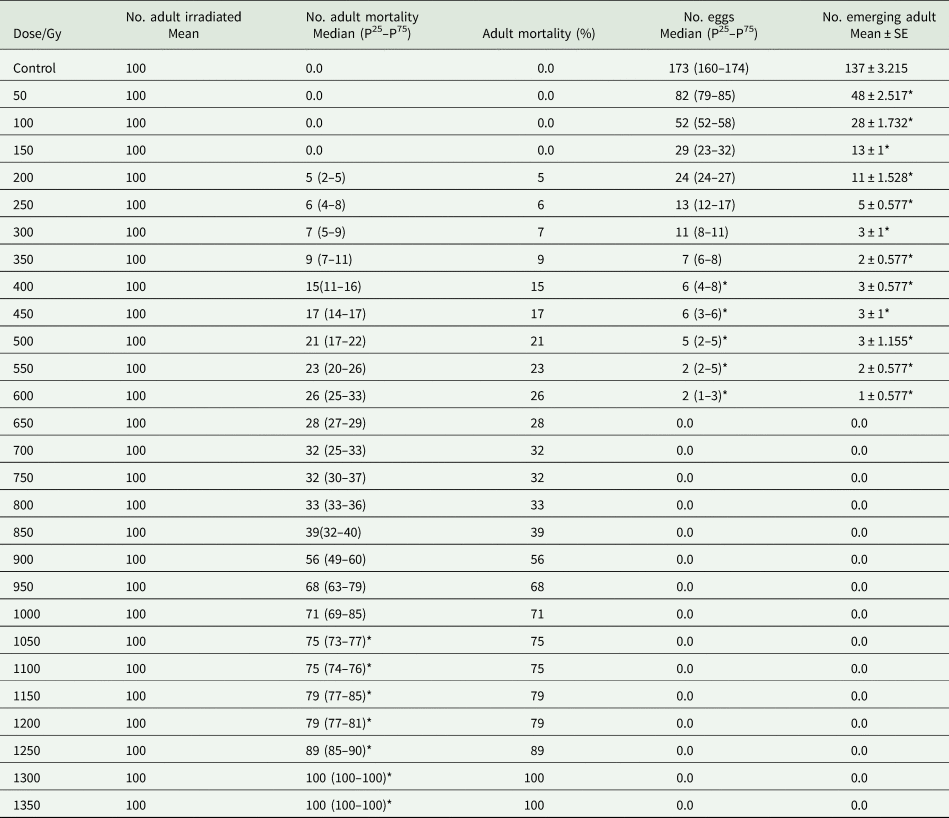
In the adult cowpea weevil dose–response test, the data tabulated in table 5 revealed that the radiation dose level up to 150 Gy caused no adult mortality. The mortality percentage of adult reached 21 and 71% at the dose level of 500 and 1000 Gy, respectively. The highest irradiation dose of 1300 Gy and above resulted in 100% adult mortality, indicating that the complete killing of C. maculatus weevils in cowpea seeds required a relatively higher radiation dose. The number of eggs laid by the surviving adult and the number of adult emerging was counted and observed. Only two eggs were laid by the surviving adult irradiated at the dose level, 600 Gy. No emerging adults have been seen from the parental generation at the dose level of 650 Gy, indicating that radiation treatment of C. maculatus adult at 650 Gy achieved sterility and prevented reproduction.
Effect of gamma irradiation on maturation of the C. maculatus adult stage

* The mean difference is significant at the 0.05 level compare with control.
The irradiation dose of 650 Gy, which prevented the adult emergence applied to 27,754 C. maculatus adults in cowpea seed, resulted in no survival to the adult stage, this shows that this dose is sufficient to control this insect and to provide quarantine security. The calculated confidence level was 93.77%. Non-irradiated control samples of infected cowpea with 950 C. maculatus adults produced an average of 13,015 adults (table 6).
Large-scale confirmatory tests irradiating adult stage of C. maculatus in cowpea

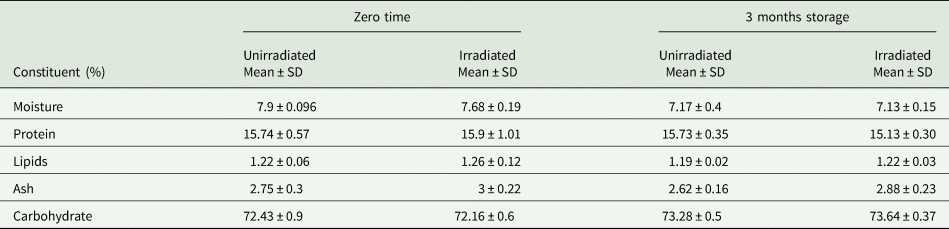
The cowpea seeds treated with PI dose (650 Gy) generally had no effect on the major chemical constituents either at zero time of storage or after 3 months of storage (table 7).
Effect of PI dose (650 Gy) on the major chemical constituents of cowpea

*The mean difference is significant at the 0.05 level compare with control.
The average of germination percentage in the non-irradiated control cowpea seeds at zero time of storage was 60.0% and those which were irradiated by 650 Gy was 54.7%. This indicates that the PI dose used decreased germination percent by only 13%. But after 3 months of storage, the average germination percent of cowpea seeds, whether irradiated or non-irradiated decreased but the decrease in irradiated samples was higher (table 8).
Effect of PI dose (650 Gy) on some properties of cowpea seeds

*The mean difference is significant at the 0.05 level compare with control.
The average hardness (texture) of the non-irradiated control samples was 60.2 N, and that for irradiated samples was 60.4 N. It is clear that neither irradiation at 650 Gy nor storage for 3 months significantly changes the hardness of cowpea seeds (table 8).
Also, the cooking time of non-irradiated control cowpea seed samples at zero time of storage was 48 min and that of irradiated samples was 45 min, indicating that irradiation with 650 Gy decreased cooking time by only 6.3%. But the storage for 3 months almost had no significant effect on the cooking time (table 8).
The data of hunter's colour in table 9 indicate that the PI at 650 Gy did not change the hunter's colour of cowpea seed samples.
Effect of PI dose (650 Gy) on the colour of cowpea seeds immediately after irradiation

Table 10 shows that the log initial TABC of unirradiated control samples of cowpea seeds was 4.86 and that of irradiated samples was 4.76, indicating that irradiation dose at 650 Gy very slightly reduced the TABC. After 3 months of storage these counts slightly increased to 4.95 and 4.84, respectively. The same trend of changes was observed with total moulds and yeasts and total coliform bacteria (table 10). However, irradiation by 650 Gy eliminated E. coli such as the counts of this microbe was below the detectable level at zero time and after 3 months of storage.
Effect of PI dose (650 Gy) on the log microbial counts (log cfu/g) of cowpea seeds

Discussion
PI using gamma rays, X-rays and electron beam can be an alternative to fumigation for controlling insect pests in agricultural commodities. The ionizing radiation breaks nucleic acid strands by transforming energy directly to the molecules (Lavelle and Foray, Reference Lavelle and Foray2014). Additionally, irradiation induces production reactive oxygen species that damage cellular structures, impairing multiple cellular pathway processes (Pryor, Reference Pryor1986). The use of irradiation to facilitate trade in quarantine commodities is an active area of food irradiation with yearly increases in the number of countries, commodities, volume and quarantine pests treated. PI differs from all other commercial treatments in one important technical consideration; the end point of the treatment is not acute mortality but an attempt for preventing future biological development and reproduction (Hallman, Reference Hallman2011).
Callosobruchus maculatus attacks cowpea seeds in many countries and this causes deficits for export and great losses and makes the local market of cowpea unattractive and unprofitable. Ionizing radiation can be used to solve those problems. Studies into the effects of gamma irradiation on the different developmental stages of C. maculatus are very important to determine the most tolerant stage to gamma irradiation. The effects of gamma radiation on egg hatching (tables 1 and 2) show that the radiation sensitivity of C. maculatus eggs decreased as the age increased. Although irradiation of 1-day and 3-day old eggs at 450 and 500 Gy failed to prevent egg hatching, they completely prevented adult emergence. This indicates that these doses prevent completion of the development of immature stages. The larval stage was more tolerant to radiation treatment than eggs (table 3). Based on the prevention of adult emerging as a result of irradiating larvae, the effective irradiation dose to control C. maculatus in cowpeas was 850 Gy. When suppression of F1 generation is used for measuring effective irradiation dose, 650 Gy was required. The results regarding the gamma radiation effects on the pupae stage showed that no emerging adults had been seen at 1250 Gy. When suppression of the F1 generation is used for determining the effective irradiation dose, a dose of 650 Gy is required. Irradiating adults at different irradiation doses show that high irradiation dose of 1300 Gy (1.3 KGy) resulted in 100% mortality, indicating that adult was the most tolerant stage. As for irradiation of the adults at the dose level, 650 Gy prevented the emergence of adults. Many other researchers studied the effect of different irradiation doses on C. maculatus and other closely related insects.
Tilton (Reference Tilton1974) reported that the dose 500 Gy would virtually control all stored product pests by preventing their reproduction or adult emergence instead of providing acute mortality which would require much higher doses. Sang et al. (Reference Sang, Speakmon, Zhoul, Wang, Lei, Pillai and Zhu-Salzman2015) found that irradiation of C. maculatus adults to 2 kGy (2000 Gy) resulted in ~50% acute mortality. They added that until 1000 Gy (1 kGy) they did not start to observe immediate deaths. Darfour et al. (Reference Darfour, Ocloo and Wilson2012) irradiated adults of C. maculatus on different varieties of cowpea seeds (Asontem, Nhyira, Nigerian and Togo varieties) and found that 100% mortality was achieved at 750 Gy for Asontom variety, while irradiation doses of 1.0 and 1.5 kGy did not achieve 100% mortality for other varieties. Our results revealed that no successful reproduction or completion of development was found after irradiating larvae, pupae adults of C. maculatus with a dose of 650 Gy. Since C. maculatus occurs in cowpea in storage as eggs, larvae and pupa, the recommended effective irradiation dose to control this insect in cowpea could be 650 Gy. These results were similar to those reached by Sutantawong (Reference Sutantawong1991) who reported that 100% of pupae mortality of C. maculatus and C. chinensis was found at 500 and 800 Gy, respectively. In contrast to these results, Ignatowicz (Reference Ignatowicz2004) irradiated the immature rice weevil Sitophilus oryzae (eggs, larvae, pupae) at 80 and 100 Gy and observed no development to the adult stage. However, he added that the immediate killing of rice weevil and other stored product insects may require much higher doses in the range of 1–3 kGy. Early, Dongre et al. (Reference Dongre, Harwalkar, Llene and Padwal-Desai1997) found that the irradiation dose for preventing reproduction of C. maculatus adult was 100 Gy.
In our experiment no emerging adult progeny (F1 generation) was seen at 650 Gy. Therefore, this irradiation dose was proposed to conduct large-scale tests to confirm the efficacy of that dose as a quarantine treatment. These tests were conducted on a large number (27,745) of C. maculatus adults in cowpea seeds at 650 Gy. This irradiation dose resulted in no adult emergency from F1 generation (no survivors in the adult stage) with a confidence level of 93, 77% (table 6). These results indicate that the irradiation dose level was sufficient to provide quarantine security with high confidence. Almost similar results were reached by Sutantawong (Reference Sutantawong1991) who reported that no C. maculatus and C. chinensis adult emerged at 500 and 800 Gy, respectively. The irradiation dose of 650 Gy in our experiment was higher than the sterilizing doses proposed by other investigators (Tilton et al., Reference Tilton, Burkholder and Cogburn1966; Ignatowicz, Reference Ignatowicz2004; Follett et al., Reference Follett, Snook, Janson, Antonio, Haruki, Okamura and Bisel2013). The different results may be due to different environmental and physical factors that affect irradiation efficacy such as temperature and humidity, as reported by Molin (Reference Molin2001). Darfour et al. (Reference Darfour, Ocloo and Wilson2012) found that the percent of mortality of C. maculatus in cowpea was a result of irradiation that varied according to the cowpea cultivar.
The effect of PI dose (650 Gy) on the major chemical composition of cowpea seeds (moisture, protein, lipid, ash and carbohydrate content) of irradiated and non-irradiated cowpea seeds at zero time and after 3 months of storage was determined. The results indicate that there was no significant effect of irradiation at this dose level either at zero time or after 3 months of storage at ambient temperature and humidity (table 7). Many other researchers reported that the irradiation dose used for insect control in stored products (grains or legumes) had no significant effect on the major chemical constituents. At the irradiation dose required for controlling stored products insects a few negative effects have been reported (Gao et al., Reference Gao, Wang, Li and Zhang2004; Li et al., Reference Li, Gao, Li and Yu2007; Aylangan et al., Reference Aylangan, Erhan and Ozyardimci2017).
The effect of PI dose (650 Gy) on some properties of cowpea is very important for demonstrating the quality attribute of cowpea seeds.
The irradiation dose (650 Gy) decreased cowpea seeds germination by only 4% in comparison with non-irradiated control (table 8). Many researchers reported that seeds for plating should not be irradiated because irradiation reduces the germination ability of seed stocks and they will not grow normally (Hasan and Khan, Reference Hasan and Khan1998; Gao et al., Reference Gao, Wang, Li and Zhang2004). Also, irradiation of cowpea at 650 Gy had no significant effect on its hardness, while the cooking time of cowpea reduced by 6.3%. Applying the PI dose of 650 Gy did not change hunter's colour of cowpea (table 9). From our results, it is clear that irradiation at the phytosanitary dose level (650 Gy) did not significantly affect the major chemical constituents or properties of cowpea. Many researchers reported that the irradiation dose used for control insects did not significantly change the quality of the food material or stored products (Li et al., Reference Li, Gao, Li and Yu2007; Darfour et al., Reference Darfour, Ocloo and Wilson2012; Aylangan et al., Reference Aylangan, Erhan and Ozyardimci2017). Ocloo et al. (Reference Ocloo, Darfour, Ofosu and Wilson2012) found that irradiation at dose levels of 0.25, 0.5, 0.75, 0.10 and 1.5 kGy had no significant (P > 0.05) effect on the sensory quality attributes like flavour, taste, texture, softness and colour of the cowpea seeds. Aylangan et al. (Reference Aylangan, Erhan and Ozyardimci2017) found that in the case of irradiation at 250, 500 and 1000 Gy for chickpea, kidney beans and green lentils did not have a significant effect on the level of riboflavin and thiamine. The sensory evaluation testers were not able to differentiate between the irradiated and the unirradiated control samples.
As for the microbial load of cowpeas such as TABC, total moulds and yeasts and coliform bacteria were slightly reduced at the phytosanitary dose level 650 Gy (table 10). E. coli mostly completely was eliminated at this irradiation dose besides providing quarantine security against phytosanitary treatment; irradiation can provide additional benefits to some agricultural commodities. Irradiation of agricultural products at less than 1 kGy delays the ripening of some fruits, increases the shelf-life by reducing spoilage bacterial and controlling moulds and improves safety through inactivation of the possible presence of radiosensitive pathogens (Singh and Pal, Reference Singh and Pal2009; Hallman, Reference Hallman2011; Bustos Griffin et al., Reference Bustos Griffin, Hallman and Griffin2012). Irradiation at 650 Gy slightly reduced the initial microbial level not only immediately after irradiation, but also during storage at ambient temperature for 3 months. This irradiation dose could reduce the count of E. coli contaminating cowpea seeds to a below detectable level according to the methodology used.
Conclusion
Irradiation is an alternative to toxic fumigants as a quarantine treatment for control of cowpea seeds weevil, C. maculatus. No successful reproduction or completion of development was found after irradiating eggs, larvae, pupae and adults of C. maculatus with the dose level, 650 Gy. Since C. maculatus occurs in stored cowpea seeds as eggs, larvae and pupae, 650 Gy is recommended as an effective PI dose for quarantine security to control cowpea weevil.
Acknowledgement
This work was conducted as part of International Atomic Energy Authority (IAEA) coordinates research project (Development of Electron Beam and X-rays Application for Food Irradiation D 61024). The authors acknowledge partial financial support from International Atomic Energy Agency (IAEA) under the Coordination Research Project D 61024 contract No. 19247∕RO.