Introduction
Population projections indicate that the world population will reach about 9 billion by 2050 and feeding them will require the development of new methods for growing food (van Huis et al., Reference van Huis, Van Itterbeeck, Klunder, Mertens, Halloran, Muir and Vantomme2013). Approximately 1 billion people have already been believed to be food insecure worldwide (van Huis et al., Reference van Huis, Van Itterbeeck, Klunder, Mertens, Halloran, Muir and Vantomme2013). The current food security challenges present an opportunity for insects to be used as human food, especially in the developing world (FAO/WUR, Reference Vantomme, Mertens, van Huis and Klunder2012). In the developed world, insects are gaining increased recognition as alternative sources of proteins for both food and feed. For example, the black soldier fly Hermetia illucens L. (Diptera: Stratiomyidae) and the mealworm Tenebrio molitor L. (Coleoptera: Tenebrionidae) have been used to develop food and feed in Europe (van Huis et al., Reference van Huis, Van Itterbeeck, Klunder, Mertens, Halloran, Muir and Vantomme2013).
In sub-Saharan Africa, van Huis (Reference van Huis2003) reported about 250 edible insect species with the potential to alleviate hunger. In southern Africa and south-eastern districts of Zimbabwe characterized by low annual rainfall and low fertility soils (Chikodzi et al., Reference Chikodzi, Zinhiva, Simba and Murwendo2013), there are edible insects, mostly in the orders Lepidoptera, Isoptera, Hymenoptera, Orthoptera, Hemiptera and Coleoptera (Chavunduka, Reference Chavunduka1975). In traditional practices and customs, communities in these districts consume the seasonally occurring Henicus whellani Chopard (Orthoptera: Stenopelmatidae). This species resembles H. monstrosus Herbst (Orthoptera: Anostostomatidae) found in the mountainous region of western and eastern Cape regions of South Africa (Toms, Reference Toms and Field2001).
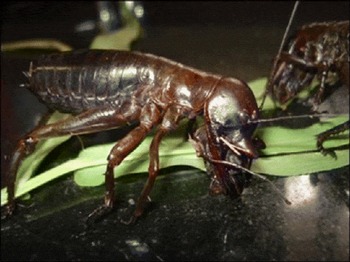
The biology and ecology of H. whellani (Fig. 1) has been poorly documented in Zimbabwe. Morphologically, this ground cricket bears the general characteristics of the family Stenopelmatidae from Costa Rica, as described by Rentz (Reference Rentz and Solís1997). Adults have heavily sclerotized heads and mouthparts, usually dark with variable colour patterns on the pronotum (area between the thorax and the head) depending on sex. Females are less mandibulate than males, and the pronotum is characteristically oxblood red as opposed to dirty-white for males. Both nymphs and adults are wingless and live in shallow burrows with a sex ratio of approximately one male to four females (D. Musundire, personal observation).
(colour online) Lateral view of the edible ground cricket. The head bears long filamentous antennae and strong mandibles. Brown-red heads are the characteristic of females.

The behaviour of H. whellani resembles that of stone crickets (Orthoptera: Stenopelmatidae) in the USA (Weissman, Reference Weissman2005). Annually, mature H. whellani adults appear outside their burrows at the onset of the rainy season (December to January). Documented information is scarce on harvesting and consumption practices for these insects in Zimbabwe.
There are several examples of entomophagy in Zimbabwe and consumption of H. whellani is assumed to assist in attaining household nutritional security during the periods when the insects occur. However, their nutritional value is not known, and thus it is difficult to assess their suitability for a good human diet.
Therefore, this study investigated the nutritional and phytochemical composition of H. whellani in order to implement structured interventions on their large-scale utilization as food in marginalized communities.
Materials and methods
Insects
Henicus whellani adults were collected from Bikita (approximately 20°05’20.4’’S and 31°69’57.9’’E, 1512 m above sea level) in south-eastern Zimbabwe (Fig. 2) during the beginning of the summer season in 2013/2014. Insects were collected once from a large flat pasture and bush veldt of approximately 3000 m2, which represented the general environment and landscape in which the insects are found. The sampling area was divided into four quadrants of approximately 100 m2 and approximately 2500 m apart. Within each quadrant, adults of both sexes were hand-picked or dug out using a traditional hoe (metal base 25 cm and wooden handle 80 cm). A mean of 450 adults using both sources were gathered per quadrant and mixed. Insects collected from different quadrants were kept separate in clean polythene bags and transported alive in cool boxes (20 litre) at ambient temperature.
Map showing the south-eastern districts of Zimbabwe, located in southern Africa. Henicus whellani is harvested and consumed in Bikita District (coordinates 20°15′00″S and 31°49′59″E). These edible ground crickets are found in microhabitats, with an annual rainfall of 650–800 mm and a general altitude >1000 m, and pastures.

Processing of insects
A total of 300 live H. whellani of mixed sexes from each of the sampled quadrants were randomly selected and killed by dissecting the last abdominal segment. All digestive contents were cleaned with running cold water to yield a weight of 500 g. The cleaned insects were parboiled in water for 5 min (the procedure being similar to traditional processing) and oven-dried at 60°C overnight, and then ground separately with a pestle and mortar. The pulverized materials were stored in glass vials at 4°C.
Proximate composition analyses
The methods and techniques of the Association of Official Analytical Chemists (AOAC, 1990) were adopted for the analyses. Crude protein was determined by using the Kjeldahl method and multiplying the percentage of nitrogen by a constant factor of 6.25 (AOAC, 1990; Melo et al., Reference Melo, Garcia, Sandoval, Jiménez and Calvo2011; Igwe et al., Reference Igwe, Ujowundu, Nwaogu and Okwu2011). In a study by Finke (Reference Finke2007) on insect species raised commercially for insectivores, the amount of chitin nitrogen was found to be small (as a percentage of total nitrogen) and therefore crude protein (nitrogen × 6.25) gave a reasonable estimate of the true protein contents of the species assessed. Therefore, the Kjeldahl method was adopted for estimating the protein content of H. whellani in this study.
Moisture content was determined using the oven set at 105°C for 24 hr (AOAC, 1990; Okedi, Reference Okedi1992). Ash, crude fibre, carbohydrates and fat were also determined using the standard methods (Kirk et al., Reference Kirk, Sawyer and Pearson1981; AOAC, 1990). Parameters were determined in triplicate per sampled quadrant, and are expressed as a percentage. Mean values and standard deviations were calculated for each parameter. All methods were verified for reproducibility by repeating standard-addition pilot experiments.
Preparation of aqueous and methanol extracts
For phytochemical and antioxidant analyses, aqueous and methanol extracts were prepared by soaking 10 g of powdered insect samples in 100 ml of aqueous or methanol solution. Part (20 ml) of the solution was used as the liquid extract and 80 ml of the solution was dried in a rotary evaporator (Buchi Rotavapor R11, Switzerland) at 40°C and used as the dried extract.
Phytochemical screening
Chemical tests were carried out on both aqueous and methanol extracts depending on the standard procedure used for the identification of the constituents, with three replications for each parameter per sampled quadrant. Phytochemicals were recorded as either positive (present) or negative (absent).
Steroids and terpenoids were assessed using the Liebermann–Burchard test (De et al., Reference De, Dey and Ghosh2010; Dey and Ghosh, Reference Dey and Ghosh2010) and the Salkowski test (Edeoga et al., Reference Edeoga, Okwu and Mbaebie2005; De et al., Reference De, Dey and Ghosh2010) in a 50 mg dried sample.
Cardiac glycosides were assessed with the 50 mg dried sample according to Kedde's test (Harborne, Reference Harborne1973; Sofowora, Reference Sofowora1993) and with 1 ml of both aqueous and methanol extracts using the Keller–Kiliani test (Edeoga et al., Reference Edeoga, Okwu and Mbaebie2005; De et al., Reference De, Dey and Ghosh2010). Anthraquinones were assessed with the 50 mg dried sample according to Borntrager's test (De et al., Reference De, Dey and Ghosh2010).
The presence of flavonoids was determined in the aqueous and methanol extracts using the alkaline reagent test (De et al., Reference De, Dey and Ghosh2010; Sharma et al., Reference Sharma, Agarwal, Chaudhary and Singh2013). Tannins were assessed using the Ferric chloride test (Edeoga et al., Reference Edeoga, Okwu and Mbaebie2005). Alkaloids were assayed using the Tannic acid and Mayer's tests with 0.5 ml of the aqueous and methanol extracts. Proteins and amino acids were tested using the ninhydrin test where a mixture of 0.5 ml of test sample and 1 ml of 0.2% (w/v) ninhydrin was boiled until it changed colour. Formation of a violet colour indicated the presence of proteins and amino acids (De et al., Reference De, Dey and Ghosh2010). Reducing sugars were tested using Benedict's test. Five drops of the Benedict's reagent (alkaline solution containing cupric citrate solution) were added to 1 ml test insect samples. The mixture was boiled in a water bath (Ika-Combitherm HCB, Janke & Kunkel KG). Presence of sugars was indicated by formation of a reddish brown precipitate (De et al., Reference De, Dey and Ghosh2010).
Quantitative determination of phytochemicals
A total of three replications were carried out for all the assessed parameters per sampled quadrant.
Determination of total phenolics, flavonoids and tannins
Pulverized samples (5 g) were defatted by Soxhlet extraction once with petroleum ether and transferred to a 250 ml glass beaker, followed by the addition of 50 ml methanol. The contents were shaken in an ultrasonic ice-water bath for 30 min and later centrifuged for 10 min at 3000 g. The supernatant was used for the determination of phytochemicals.
Total phenolics were determined using the Folin–Ciocalteu method with gallic acid (0.5 mg/ml; Sigma-Aldrich Chemie, Steinheim, Germany) as the standard (Peñarrieta et al., Reference Peñarrieta, Alvarado, Bergenståhl and Åkesson2007). Total flavonoids were determined by the method described by Jimoh et al. (Reference Jimoh, Adedapo, Aliero, Koduru and Afolayan2010), whereby 0.5 ml sample extracts were mixed with 0.5 ml of hydrated aluminium chloride (AlCl3.6H2O (0.1 m/l)) in the ethanol solution. Total flavonoids were evaluated from a standard of catechin (5 mg/ml; Sigma-Aldrich Chemie, Steinheim, Germany), and are expressed as catechin equivalents mg/g dry weight.
Tannins were determined by the modified vanillin-HCl method using catechin (5 mg/ml; Sigma-Aldrich Chemie, Steinheim, Germany) as the standard (Price et al., Reference Price, Van Scoyoc and Butler1978).
Determination of saponins and alkaloids
Dried samples (2 g) were extracted with 10 ml of 80% (v/v) aqueous methanol for 24 hr. The mixture was centrifuged at 3000 g for 15 min and the supernatant was used for saponin analysis. Total saponin content was determined by the vanillin-sulphuric acid method (Hiai et al., Reference Hiai, Oura and Nakajima1976). Results are expressed as diosgenin equivalents calculated from the calibration curve of diosgenin (Sigma-Aldrich Chemie, Steinheim, Germany) prepared in 80% (v/v) aqueous methanol.
Alkaloids were determined by a gravimetric method (Harborne, Reference Harborne1973). Dried insects (5 g) were weighed and mixed with 50 ml of 10% (v/v) acetic acid solution in ethanol. The mixture was allowed to stand for 4 hr with constant stirring before it was filtered. The filtrate was evaporated to one-quarter of the original volume on a hot plate. Concentrated ammonium hydroxide was added in drops to precipitate alkaloids. A pre-weighed filter paper was used to filter the precipitate, washed with 1% (v/v) ammonium hydroxide solution, dried in an oven at 60°C for 30 min, transferred to a desiccator to cool, reweighed and reheated until a constant weight. The weight of alkaloids was determined by the weight difference of the filter paper and expressed as g/100 g dry weight of the sample.
Determination of phytates, oxalates and cyanogenic glycosides
Pulverized samples (1 g) were extracted with 10 ml of 0.5 m HCl for 1 h at room temperature, diluted, centrifuged and analysed for phytic acid by the addition of 1 ml of Wade reagent (0.3 g of ferric chloride (FeCl3.6H2O) and 3 g of sulphosalycylic acid dissolved in 1 litre of distilled water) to 3 ml of the sample extract (Vaintraub and Lapteva, Reference Vaintraub and Lapteva1988). Absorbance was read at 500 nm on a Jenway 6405 UV/VIS spectrophotometer (Jenway Ltd, Essex, UK). The concentration of phytic acid was calculated by comparison with the standard solutions of phytin (5 mg/ml; Sigma-Aldrich Chemie, Steinheim, Germany).
Oxalates were extracted and determined by titration (Amoo and Agunbiade, Reference Amoo and Agunbiade2010). Pulverized samples (2 g) were digested with 50 ml of 0.75 m H2SO4 for 2 h, stirred and filtered using Whatman No. 1 filter paper (Macherey-Nagel MN). Aliquots of 125 ml of the filtrate were heated until near the boiling point (80–90°C) and titrated against the standard 0.5 m KMnO4 solution to a faint pink colour.
Bioassaying for 2,2-diphenylpicrylhydrazyl radical-scavenging activity
Free radical-scavenging activity of methanol extracts was measured by the decrease in the absorbance of the methanol solution of 2,2-diphenylpicrylhydrazyl (DPPH) (Pracheta et al., Reference Pracheta, Paliwal and Sharma2011). A stock solution of DPPH (33 mg in 1 litre; Sigma-Aldrich Chemie, Steinheim, Germany) was prepared in methanol, and 5 ml of the solution were added to 1 ml of the extract solution at different concentrations (100–1000 μg/ml). Ascorbic acid and butylated hydroxyanisole (BHA) (100–1000 μg/ml) were used as standards. Radical-scavenging activity expressed as a percentage was obtained from the equation:
 $$\begin{eqnarray} \%\,Activity\, = \,(OD_{control} - OD_{sample})\times 100/OD_{control} \end{eqnarray}$$
where OD is the optical density.
Statistical analysis
Statistical analysis was performed using GraphPad Prism 5.03 software. One-way ANOVA was carried out on the data of the percentage of DPPH after log transformation and means were separated using Tukey's multiple comparison tests at P< 0.05.
Results
Proximate composition analyses
There was no significant variation in proximate constituents (P>0.05) for the insects sampled in the four different quadrants. The mean protein content of H. whellani was 53.6% compared with ash (13.4%), crude fibre (10.6%), fat (4.3%) and carbohydrate (4.0%) (Table 1). Moisture content was recorded at 14.0% and energy was 268.3 kcal/100 g (Table 1).
Proximate constituents of Henicus whellani

Phytochemical screening
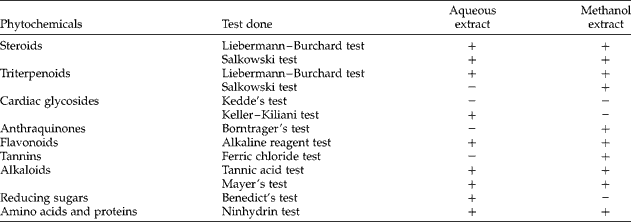
Qualitative assessments showed that steroids and alkaloids were present in both aqueous and methanol extracts of H. whellani samples despite the assessment method (test) used (Table 2). However, observations varied due to the test method used for triterpenoids where aqueous extracts showed negative responses to the Salkowski test and positive responses to the Liebermann–Burchard test for both aqueous and methanol extracts (Table 2). The type of extract and the test method used also resulted in variable responses for cardiac glycosides. A positive outcome was observed only in the aqueous extracts using the Keller–Kiliani test.
Qualitative phytochemical screening of the aqueous and methanol extracts of Henicus whellani

+, Present; − , absent.
Anthraquinones and tannins were observed only in the methanol extracts; reducing sugars were observed only in the aqueous extracts. Flavonoids, amino acids and proteins were found in both aqueous and methanol extracts.
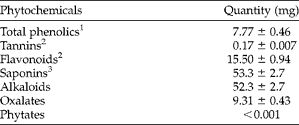
The extracts of H. whellani had more saponins (53.3 mg/g) and alkaloids (52.3 mg/g) than flavonoids (15.50 mg/g), oxalates (9.31 mg/g), total phenolics (7.77 mg/g) and tannins (0.17 mg/g) (Table 3). Phytates were not recorded.
Phytochemical composition (mg/g) of the extract of Henicus whellani

1 Gallic acid equivalents.
2 Catechin equivalents.
3 Diosgenin equivalents.
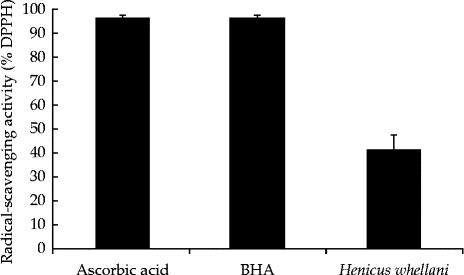
The value of DPPH radical-scavenging activities was < 50% and significantly lower than that of the standards ascorbic acid and BHA (Fig. 3).
Percentage of DPPH radical-scavenging activity of the methanol extracts of Henicus whellani. The standards ascorbic acid and BHA had significantly higher antioxidant levels compared with the methanol extracts.

Discussion
Compared with other insects such as the mopane worm Gonimbrasia belina Westwood (Lepidoptera: Saturniidae) and Encosternum delegorguei Spinola (Hemiptera: Tessaratomidae), which also occur in the study area, H. whellani has a protein composition (Teffo et al., Reference Teffo, Toms and Eloff2007; van Huis et al., Reference van Huis, Van Itterbeeck, Klunder, Mertens, Halloran, Muir and Vantomme2013) higher than that of beef and several species of fish (Pellet and Young, Reference Pellet, Young, Pearson and Dutson1990; Murray and Burt, Reference Murray and Burt2001; FAO/WUR, Reference Vantomme, Mertens, van Huis and Klunder2012; Devi and Sarojnalini, Reference Devi and Sarojnalini2012), and is a good candidate for the development of protein-fortified products for food and feed.
Another important attribute was the ash content, which was more than 10%, and almost comparable to that reported in some studies of dried beef (Pellet and Young, Reference Pellet, Young, Pearson and Dutson1990; Akhter et al., Reference Akhter, Rahman, Hossain and Hashem2009) and fish (Obemeata and Ndome, Reference Obemeata and Ndome2012; Devi and Sarojnalini, Reference Devi and Sarojnalini2012). Ash content provides a measure of the total amount of minerals, including calcium, phosphorus, sodium, potassium and magnesium within a food (Womeni et al., Reference Womeni, Tiencheu, Linder, Chouatcho Nabayo, Tenyang, Tchouanguep Mbiapo, Villeneuve, Fanni and Parmentier2012). Assessment of these minerals requires further investigations since they are generally considered as macronutrients, which play vital roles in various human physiological processes and thus constitute an important diet component (Alamu et al., Reference Alamu, Amao, Nwokedi, Oke and Lawa2013).
Henicus whellani is heavily sclerotized (Fig. 1). This could be explained by the high fibre content observed when compared with other insect species (Finke, Reference Finke2005; Teffo et al., Reference Teffo, Toms and Eloff2007), and is probably caused by higher chitin content in the exoskeleton (Finke, Reference Finke2005; van Huis et al., Reference van Huis, Van Itterbeeck, Klunder, Mertens, Halloran, Muir and Vantomme2013). Fibre content is related to exoskeleton hardness (Bukkens, Reference Bukkens and Paoletti2005). The presence of fibre is desirable in the diet as it has been shown to improve human health by changing intestinal viscosity, nutrient absorption, rate of passage of food under digestion and production of gut hormones (Lattimer and Haub, Reference Lattimer and Haub2010). It has also been shown to cause laxation with evidence of both protective (Sanjoaquin et al., Reference Sanjoaquin, Appleby, Spencer and Key2004) and therapeutic effects (Topping and Clifton, Reference Topping and Clifton2001). According to the National Nutrition Survey of Australia (2006), adult human males aged between 19 and >70 years require 30 g/day of dietary fibre; females in the same age range require 25 g/day. Based on the proportional composition of fibre in H. whellani and assuming complete conversion, consumption of approximately 250–300 g of insect material would satisfy the daily dietary fibre requirements.
The fat content was lower than that in insects such as termites (Macrotermes sp.), edible grasshopper (Ruspolia differens Serville (Orthoptera: Tettigoniidae)), saturniid caterpillars (Imbrasia sp.) (Womeni et al., Reference Womeni, Linder, Tiencheu, Mbiapo, Villeneuve, Fanni and Parmentier2009) and edible stinkbug (E. delegorguei) (Teffo et al., Reference Teffo, Toms and Eloff2007). From a dietary perspective, this might be of little significance to current consumers of these insects, and limits the energy value that could be used for alternative applications. Newton et al. (Reference Newton, Watson, Dove, Sheppard and Burtle2005) suggested that energy could be recovered from processing prepupae of the black soldier fly (H. illucens) with high fat or oil content, leading to a refined animal protein.
The energy value was comparable to that of beef (Finke, Reference Finke2005). Therefore, these insects are a satisfactory source of energy if consumed daily (FAO/WHO/UNU, 2001). This source of energy, if found to be sustainable, would be considerably cheaper and less harmful to the environment than livestock and arable crops that require external inputs.
Flavonoids are a group of polyphenolic compounds that occur naturally in fruits, vegetables, nuts, seeds and flowers, and are important in the human diet (Cook and Samman, Reference Cook and Samman1996). Their presence in both aqueous and methanol extracts points to a possibility that H. whellani acquire and store these compounds from plant sources, and sequester or make small modifications for various purposes (such as in defence) as reported in more than 250 insect species associated with at least 40 plant families (Opitz and Müller, Reference Opitz and Müller2009). Investigation on the composition of dietary flavonoids in edible insects is needed. This could be vital in determining the appropriate insect diet if mass production of H. whellani is to be carried out.
From the perspective of human and animal nutrition, flavonoids have been shown to exhibit antibacterial, antiviral, anti-inflammatory, anti-allergic and vasodilatory activities (Duarte et al., Reference Duarte, Pérez Vizcaíno, Utrilla, Jiménez, Tamargo and Zarzuelo1993; Middleton and Kandaswami, Reference Middleton, Kandaswami and Harborne1993; Hanasaki et al., Reference Hanasaki, Ogawa and Fukui1994; Hope et al., Reference Hope, Frost, Gardiner and Ghazoul2009). These chemical components, as found in this study, clearly indicate possible hidden benefits associated with the consumption of H. whellani, apart from the usual dietary proteins, fibre, energy and carbohydrates. This aspect is of importance in the marginalized communities of Zimbabwe where these insects occur and are consumed (Chavunduka, Reference Chavunduka1975), and where more cereals (grain crops) are produced than vegetables and fruits (Chikobvu et al., Reference Chikobvu, Chiputwa, Langyintuo, La Rovere and Mwangi2010).
Saponins have beneficial anticarcinogenic properties, but have been shown to impair the digestion of protein and the uptake of vitamins and minerals in the gut and cause hypoglycaemia (Francis et al., Reference Francis, Kerem, Makkar and Becker2002). More saponins were recorded than oxalates and tannins. Oxalates bind calcium and other minerals, and consumption of excess oxalic acid may cause stone formation in the urinary tract when the acid is excreted (Noonan and Savage, Reference Noonan and Savage1999). Tannins have been reported to have both positive and adverse effects depending on the quantities ingested. When consumed in large amounts, they can cause cancer or a decrease in feed intake, growth rate, feed efficiency, net metabolizable energy and protein digestibility (Chung et al., Reference Chung, Wong, Wei, Huang and Lin1998). Thus, hidden undesirable attributes from consumption of H. whellani are also to be expected. If value-added products are to be developed from this species, there is a need to devise techniques to remove or reduce the quantities of these undesirable compounds.
The percentage of DPPH radical-scavenging activity was significantly lower than the standards from another edible insect species E. delegorguei (Musundire et al., Reference Musundire, Zvidzai and Chidewe2014). However, it would be useful to investigate whether the 42% value recorded from these insects could be a better alternative to other cereal foods from crops such as maize, sorghum and millet produced in this marginalized region (Chikobvu et al., Reference Chikobvu, Chiputwa, Langyintuo, La Rovere and Mwangi2010).
Conclusions
Henicus whellani can be exploited as an alternative commercial source of proteins, fibre and minerals pending further studies on the bioavailability of the constituents. Further characterization of flavonoids is required through advanced analytical techniques such as high-performance liquid chromatography and liquid chromatography–mass spectrometry. Hidden risks in consumption are associated with the presence of tannins, oxalates, saponins and alkaloids.
Acknowledgements
This work was supported by funds from the office of the Directorate of Research and Resource Mobilisation, Chinhoyi University of Technology, Zimbabwe (project no. SERC/12/07/12). The authors express their gratitude to Ms Dorothy Madamba of the Natural History Museum, Bulawayo, Zimbabwe, for confirming the taxonomic identity of H. whellani, and thank two anonymous referees for their constructive comments.