Introduction
Red rice, a noxious weed when present in crop fields, is widespread in the USA, Latin America and Europe. Red rice is considered to be the same species as cultivated rice (Oryza sativa L.), but possesses unfavourable agronomic characters such as shattering, red pericarp and seed dormancy (Noldin et al., Reference Noldin, Chandler and McCauley1999). The shattered dispersal units remain in the soil and perpetuate the weed in subsequent years (Goss and Brown, Reference Goss and Brown1939). Environmental factors triggering its field germination are not known, but induction of secondary dormancy and dormancy cycling have been reported (Teekachunhatean, Reference Teekachunhatean1985), and the magnitude of the red rice soil seed bank suggests that such mechanisms should be important for field survival. A better comprehension of seed bank ecology and dormancy cycling may be a key to improved forecast modelling for red rice weed management, as has been demonstrated for other weeds (Forcella et al., Reference Forcella, Wilson, Dekker, Kremer, Cardina, Anderson, Alm, Renner, Harvey, Clay and Buhler1997; Forcella, Reference Forcella1998).
In Polygonum persicaria, temperature exerts a dual role in regulating germination, first controlling changes in dormancy status, and thereafter modulating germination of the non-dormant seeds (Bouwmeester and Karssen, Reference Bouwmeester and Karssen1992). In rice cv. Kasalath, completely afterripened florets were induced into secondary dormancy after imbibition and incubation at temperatures between 8 and 19°C (particularly at 10 and 15°C) when subsequently tested for germination at 25°C (Miura and Araki, Reference Miura and Araki1996). With imbibition at 5°C, no dormancy developed, and florets germinated 99% when transferred to 25°C. However, secondary dormancy was only partially induced at 8°C (Miura and Araki, Reference Miura and Araki1996), suggesting a steep increase in the induction of secondary dormancy between 5 and 10°C. Roberts (Reference Roberts1962) also observed that stratification at 3°C broke primary dormancy of some cultivated rice varieties. In contrast, red rice florets stratified at 5°C immediately after harvest did not germinate when subsequently incubated at 30°C (Cohn, unpublished data). Therefore, we investigated the effect of incubation temperature on imbibed red rice having different intensities of dormancy (i.e. with different degrees of dry-afterripening). We further attempted to verify whether afterripening increased the range of temperatures suitable for red rice germination, as reported in other species (Baskin and Baskin, Reference Baskin and Baskin1998).
Materials and methods
Strawhulled red rice was harvested in 1996 at the LSU Agricultural Center Rice Research Station, Crowley, Louisiana, USA. Mature florets (dispersal units: caryopses enclosed in the hull) were obtained by hand-shattering of individual plants, dried in open trays at room temperature (22 ± 2°C) for 4 d and stored at − 18°C in sealed glass Mason™ jars until the start of experiments in March, 1999. Floret moisture content at the start of experiments was 10.8 ± 1.0% (fresh weight basis). The florets were dry-afterripened (dry AR) at 30°C for 0, 1, 2, 3, 4, 6, 8 and 10 weeks, and then incubated for 2 weeks at 1, 5, 15, 20, 25, 30, 35 and 42.5°C (treatment 1). All florets that did not germinate during the initial period were transferred to 30°C for two additional weeks (treatment 2). Germination was recorded after 7 and 14 d during both temperature regimes. Florets that had not germinated at the end of the second treatment were assayed for viability by growth of isolated embryos (Cohn and Hughes, Reference Cohn and Hughes1986) at 30°C. Total viability among treatments averaged 97 ± 1% (mean ± SD), except for seeds incubated at 42.5°C after each dry AR period, which were 86–100% non-viable (data not shown). Germination treatments were performed in plastic square (9 × 9 cm) Petri dishes maintained in humidity boxes during incubation. Twenty florets were placed in each dish containing three sheets of brown germination paper (Anchor Paper Co., St. Paul, Minnesota, USA) and then covered with a thin tissue (Kimwipe™). Seven replicates were used for each temperature and dry AR time combination. The complete experiment was performed twice for imbibition temperature conditions of 1, 15 and 25°C (first treatment). Humidity boxes were kept wrapped with aluminium foil, and all seed manipulations were performed under a dim green safelight. Data from germination tests in water were also analysed according to Roberts (Reference Roberts1961). The mean dormancy period (for an initially dormant population corresponding to t AR(50), the afterripening time to reach 50% germination) was used as an index of dormancy.
Results
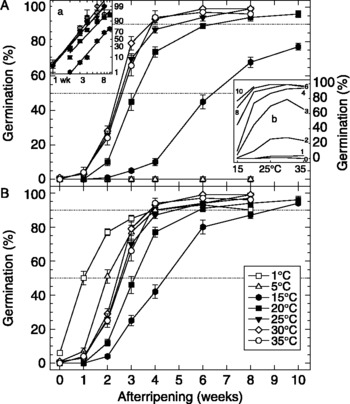
After 4–6 weeks of dry AR at 30°C, dormant red rice (initial germination ≤ 1% at 30°C) germinated ≥ 90% when incubated for 14 d at 25–35°C (Fig. 1A). A slightly longer dry AR time was required to obtain 90% germination when tests were performed at 20°C (Fig. 1A). However, at 15°C, the germinative capacity slowed versus dry AR time; only 77% germination was obtained at 15°C following 10 weeks of dry AR (Fig. 1A) and 88% after 16 weeks of dry AR (data not shown). The germination rate of afterripening red rice at 15°C was slower than at 20–35°C, where final germination percentages were reached within the first week of incubation; at 15°C, only 0–8% germination occurred during the first week of the germination period (data not shown), and most germination occurred during the second week at 15°C. No germination was detected when florets were imbibed at 1 and 5°C.
Interactions between dry-afterripening and two subsequent, sequential germination temperature regimes on red rice germination. Effects of (A) various incubation temperatures upon germination after 14 d (treatment 1), and (B) cumulative germination after 14 additional days at 30°C (treatment 2). Germination data are reported with bars representing standard errors. Inset (a): data of Fig. 1A (1% ≤ g ≤ 99%) are plotted using a probability scale for germination and a natural logarithm scale for weeks of afterripening; solid lines are linear regressions. Inset (b): germination percentages obtained after incubation at various temperatures (treatment 1) for 14 d are plotted against temperature of incubation (treatment 1), for increasing times of dry-afterripening (0–10 weeks).

Germination percentages at different temperatures versus times of afterripening (except for 1°C and 5°C, where no germination occurred) were linear when plotted using a probability scale on a ln-scale for time of afterripening (inset a in Fig. 1A). R 2 values for linear regressions of data from 15, 20, 25, 30 and 35°C were 0.99, 0.95, 0.99, 0.97 and 0.93, respectively.
As florets dry-afterripened, germinative capacity increased over a broader temperature range (inset b in Fig. 1A). This change consisted of an initial increase in germination at the optimum incubation temperature range (particularly steep between 2 and 3 weeks of dry AR), followed by a later increase at suboptimal temperatures as florets afterripened (inset b, Fig. 1A).
The imbibition temperatures employed in the first treatment of this study ranged from those that were suitable (20–35°C), restrictive (15°C) and unsuitable (1–5°C) for germination of afterripened red rice, with an optimum of about 30°C. Following the initial treatments at the optimal temperature range (20, 25, 30 and 35°C) (Fig. 1A), little further germination ( ≤ 1–3%) was obtained after the two additional weeks at 30°C (Fig. 1B). Suboptimal incubation temperatures differed considerably in their effects upon the subsequent performance of dormant red rice at 30°C (2 weeks at different temperatures plus 2 weeks at 30°C) (Fig. 1B). For florets initially imbibed at 1°C, a stimulation of germination was subsequently observed at 30°C (Fig. 1B) when they were partially afterripened; cumulative germination reached 50 and 77% after 1 and 2 weeks of dry AR. In contrast, after the same 1–2 week AR period, followed by a 4-week moist incubation at 30°C, red rice germinated only 3–29%. A smaller stimulative effect was also observed for incubation at 5°C (Fig. 1B). Florets initially treated at 1°C reached maximum germination after 6 weeks of dry AR, about the same time as at 25–35°C; the stimulatory effect of 1°C was reduced after the second week of afterripening (Fig. 1B).
For 0- and 1-week afterripened florets, a 1 week stratification period at 1°C yielded only 3 and 31% germination at 30°C (data not shown), respectively, in comparison to 2 weeks of stratification (8 and 50% germination, respectively) (Fig. 1B). Four weeks of stratification increased germination percentages further (40 and 66%, respectively), but the resulting seedlings were injured, indicated by some root necrosis and reduced growth (data not shown).
An opposite trend was observed for florets that had been initially incubated at 15°C, followed by incubation for 2 weeks at 30°C (Fig. 1B). An inhibitory effect of the 15°C pretreatment was evident following 2–6 weeks of dry AR, and particularly at 3–4 weeks, when final germination percentages (at the end of both incubations) were 25 and 42%, while after the same afterripening periods and 4 weeks of incubation at constant 30°C, they were 79 and 93%, respectively (Fig. 1B). A slight inhibitory effect on subsequent germination at 30°C also occurred after initial 20°C incubation (Fig. 1B). So, preincubation at 15–20°C inhibited germination compared to 25–35°C (Fig. 1A), and this inhibition was not fully relieved by subsequent incubation for 2 weeks at 30°C (Fig. 1B).
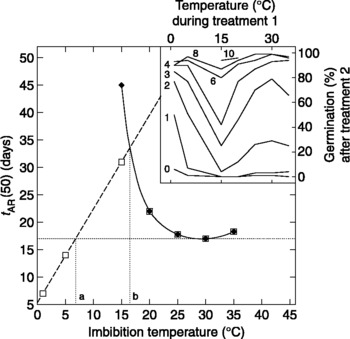
Median time to afterripening, t AR(50), is an index of dormancy (Roberts, Reference Roberts1961; Gianinetti and Cohn, Reference Gianinetti and Cohn2007). Figure 2 shows the values of t AR(50) obtained by graphical interpolations from the curves of dry-afterripening (at 30°C) reported in Fig. 1A and B. Values of t AR(50) from the initial incubations at 15–35°C showed a fast decline from the lower temperature to the optimal range for germination, which was also evident after the second constant 30°C treatment. Values of t AR(50) at 20–35°C overlapped for each of the two sequential treatments (Fig. 2), as almost no additional germination was achieved during the second treatment after incubation at these temperatures. However, after the first incubation at 1–15°C, t AR(50) showed a linear increase for the second treatment (Fig. 2, open squares). The inset in Fig. 2 shows the promotive effect of low temperature (1°C) on germination of dormant and partially dormant florets, and the inhibiting effect of the intermediate temperature (15°C), in comparison to the optimum temperature for red rice germination (30°C).
Days of dry-afterripening at 30°C to obtain 50% germination [t AR(50)] of red rice after 14 d of moist incubation at various temperatures from Fig. 1A (♦, treatment 1), and after 14 additional days of incubation at 30°C from Fig. 1B (□, treatment 2). Points marked by both symbols together represent data from both Fig. 1A and 1B. The dashed line is the linear regression for the t AR(50) values relative to 1, 5 and 15°C obtained after the second germination treatment at 30°C (y = 5.35+1.71x). On the x-axis, point a is the threshold temperature (6.8°C) for the thermal effect of removal/induction of dormancy with respect to the germination test at 30°C; point b is the temperature at which the two lines cross (16.5°C). Inset: cumulative percentage of germination after treatment 2 is plotted against temperature of incubation during the treatment 1, for increasing times of dry-afterripening (0–10 weeks).

It is important to note that t AR(50) assumes a different meaning when referring to the first versus the second incubation treatment. In the latter case (open squares, Fig. 2), values of t AR(50) have been obtained after the seeds from all the treatments were germinated at the optimum temperature (30°C, Fig. 1B), and viability was not affected (data not shown); these t AR(50) values reflect the changes in the dormancy status as a consequence of the temperature during the first incubation. On the other hand, when the index is directly derived from the germination tests at different temperatures in the first treatment (black rhomboids in Fig. 2), t AR(50) values refer to loss of primary dormancy expressed as a function of the temperature during germination. Increasing values of t AR(50), below the optimal temperature range (25–30°C; curve in Fig. 2), reflected an increasing resistance to germination. This is especially evident at 15–20°C, where t AR(50) increased to high values when approaching the lower limit for germination [between 10 and 13°C in japonica rice, according to Akemine (Reference Akemine1914)]. The possibility of an increased t AR(50) above 30°C is less clear because we had data for 35°C only, and higher temperatures induced a loss of viability [42.5°C in our experiments (not shown), and above 40°C in japonica rice (Akemine, Reference Akemine1914)]. Although we cannot exclude the occurrence of a low plateau t AR(50) at 25–30°C that is maintained at higher temperatures until viability is lost, stronger dormancy might be expected also at supraoptimal temperatures, because it occurs in indica rice (Roberts, Reference Roberts1962).
Final t AR(50) values obtained after both temperature regimes (treatments 1 plus 2) could be described according to two different patterns (Fig. 2). A linear increase of t AR(50) from 1°C to 15°C indicated that the intensity of dormancy was directly proportional to incubation temperature over this range, while at 20–35°C, t AR(50) values were identical to the first treatment, suggesting that a more stable condition evolved during the first treatment.
Discussion
The gradual loss of dormancy in a seed population is commonly associated with a widening of the range of temperatures suitable for germination (Baskin and Baskin, Reference Baskin and Baskin1998), i.e. an opening of the ‘temperature window’ for the process. For some species, usually summer annuals, this extension expands towards suboptimal temperatures (Baskin and Baskin, Reference Baskin and Baskin1998). Red rice behaviour is consistent with this pattern: germination was almost complete after 6 weeks of dry-afterripening at 30°C when germination tests were performed at 20–35°C, while at a lower germination temperature (15°C), some dormancy was resident in the population for at least 16 weeks (data not shown). This is the reverse of the trend observed, for example, by barley, another extensively studied dormant cereal. Newly harvested mature barley grains promptly germinate only at lower temperatures, with germination at higher temperatures eventually occurring if the caryopses are dry-afterripened for several weeks (Corbineau and Côme, Reference Corbineau and Côme1996; Leymarie et al., Reference Leymarie, Bruneaux, Gibot-Leclerc and Corbineau2007).
Germination percentages on a probability scale were linear versus the natural logarithm of afterripening time at all temperatures at which germination occurred, extending the finding of Gianinetti and Cohn (Reference Gianinetti and Cohn2007) for germination at 30°C (Fig. 1A, inset a). This suggests that the theoretical basis underlying this transformation (i.e. the interpretation of the afterripening process according to decay kinetics) is independent of the germination test temperature. The similar slopes of the regression lines indicated a constant standard deviation of the distribution of dormancy periods (on a ln-scale) at different temperatures of incubation. Germination differences among temperatures were then essentially due to changes in t AR(50), corresponding to modifications in the observed mean base water potential for germination (i.e. the characteristic water potential allowing 50% germination of the seed lot; Gianinetti and Cohn, Reference Gianinetti and Cohn2007), which is associated with the expressed level of primary dormancy. The long persistence of dormancy observed when germination was tested at 15°C (towards the minimum germination temperature for red rice) was then associated with both a high t AR(50) expressed at such low temperature [implying a high (more positive) mean base water potential] and the decay kinetics involving a logarithmic scale for afterripening time (inset a, Fig. 1A; Gianinetti and Cohn, Reference Gianinetti and Cohn2007).
Comparing curves obtained after the first (Fig. 1A) and second (Fig. 1B) temperature regimes yields new information about the germination behaviour of red rice. First, almost all the viable red rice florets that did not germinate at optimal temperatures within the initial 2 weeks of incubation (actually within 1 week for the range 20–35°C, data not shown) persisted in a dormant state. These ungerminated florets would be able to survive in this state for months or years (Goss and Brown, Reference Goss and Brown1939; Cohn, in preparation). Secondly, cold stratification at 1 and 5°C was effective in promoting subsequent germination, particularly after partial dry AR, as observed with other species, such as Ambrosia trifida (Davis, Reference Davis1930), Amelanchier canadensis (Crocker and Barton, Reference Crocker and Barton1931), Sorbus aucuparia (Flemion, Reference Flemion1931), and Rhodotypos kerrioides (Flemion, Reference Flemion1933). Thirdly in contrast, intermediate-low temperatures (15°C) induced secondary dormancy. These data are also consistent with previous results obtained with cultivated rice varieties (Roberts, Reference Roberts1962; Miura and Araki, Reference Miura and Araki1996). The induction of secondary dormancy by moderate, suboptimal temperatures has been observed in many other species (Baskin and Baskin, Reference Baskin and Baskin1998). Since there is no known light requirement for field germination of red rice (Cohn, unpublished), an interaction between depth of dormancy (degree of afterripening) and temperature may play an essential role in regulating the extent of the germination window. The inset in Fig. 2 shows the changing effects of initial temperature of incubation after various durations of afterripening. Both the stimulating action of low temperature and the inhibiting effect of intermediate temperature were no longer evident following an extended dry storage period of 8–10 weeks.
Red rice is a summer weed that can be injured by untimely emergence. The differential germinative capacities at optimal and suboptimal temperatures, as a function of dry AR, could represent ecological adaptations for attuning emergence to the beginning of the growing season. Notwithstanding the lack of knowledge about the real significance of dry AR under most field conditions, it is reasonable to suppose that weed dispersal units on, or near, the soil surface may be subjected to afterripening whenever the soil dries and the moisture content of the grain falls below a temperature-dependent moisture content threshold (Leopold et al., Reference Leopold, Glenister and Cohn1988; Foley, Reference Foley1994; Bair et al., Reference Bair, Meyer and Allen2006). In Bromus tectorum, the effect of fluctuating temperature on dry AR has been proposed to be equivalent to a summation of the effects of short constant temperature intervals (Bauer et al., Reference Bauer, Meyer and Allen1998).
In addition, based upon a summation of field temperature data collected at our red rice production facilities (Table 1), stratification may operate as a dormancy-breaking trigger under field conditions, even in a subtropical climate (Louisiana). Maximum daily air temperature remained ≤ 5.6°C (a threshold assumed to produce an appreciable stratification effect, based upon our laboratory experiments) for 10 d each winter, and minimum daily air temperature was ≤ 5.6°C for 60 d each winter. Although air temperatures are buffered by the soil, they could act on unburied florets on the soil surface. Stratification of red rice dispersal units buried in the soil may also occur, as minimum soil temperatures ≤ 5.6°C (10 cm depth) were recorded for an average of 13 d each winter, although almost never was a maximum daily soil temperature ≤ 5.6°C recorded at this depth (data not shown). At lesser soil depths, intermediate durations of low temperatures could readily provide a sufficient exposure to effect stratification. In Table 1, data relative to 0°C are reported as well, as we can not exclude the possibility that stratification is inactive below such a temperature.
Days per year with temperatures less than or equal to given thresholds. This summation of field temperature threshold duration originated from climatic station 162212 Crowley 2 NE (Crowley, Louisiana, USA) with data furnished by the US National Oceanic and Atmospheric Administration (NOAA) National Climatic Data Center. The number of days less than or equal to given thresholds are the mean ± standard deviation among years. Air temperatures are means from ten winters (November–March) (1989/90–1998/99); soil temperatures, at a 10 cm depth, are means from eight winters (1991/92–1998/99). The 5.6°C (42°F, available weather data were in °F) threshold was chosen because it represents a value slightly lower than the calculated stratification cut-off (6.8°C, see Fig. 2), at which no dormancy-breaking effect of cold temperature would be expected, so that only days with an effective capability to promote germination were counted

From a physiological viewpoint, it is remarkable to observe the reverse effects of 1 and 15°C upon germination (Fig. 1B), where a dormancy response transition point is evident, similar to that observed in rice cv. Kasalath (Miura and Araki, Reference Miura and Araki1996). Analogously, Pritchard et al. (Reference Pritchard, Tompsett and Manger1996) found that there was a linear increase in the rate of dormancy loss as the temperature was lowered from 12°C to 2°C during stratification of Aesculus hippocastanum seeds. Totterdell and Roberts (Reference Totterdell and Roberts1979) found that a critical temperature below which dormancy is rapidly lost must be between 15°C and 20°C for the Rumex species studied. Roberts and Smith (Reference Roberts, Smith and Khan1977) found such a critical temperature to be defined precisely at 17°C for barley. Bouwmeester and Karssen (Reference Bouwmeester and Karssen1992) suggested that temperatures around 15°C were a crucial threshold for dormancy relief and induction for some summer annuals. More recently, stratification of Polygonum aviculare was shown to be effective proportionally to the stratification thermal time accumulated under a temperature threshold for dormancy loss to occur, so that lower storage temperatures produced higher rates of change than higher storage temperatures (Batlla et al., Reference Batlla, Verges and Benech-Arnold2003).
Indeed, during pre-germination incubation, simultaneous occurrence and temperature dependence of both primary dormancy breaking and secondary dormancy induction have been observed for seeds of apple (Abbott, Reference Abbott1955), Arabidopsis thaliana (Cone and Spruit, Reference Cone and Spruit1983), Sitka spruce (Jones et al., Reference Jones, Ellis and Gosling1997), Orobanche (Kebreab and Murdoch, Reference Kebreab and Murdoch1999), and Bidens species (Brändel, Reference Brändel2004). To interpret similar results, Totterdell and Roberts (Reference Totterdell and Roberts1979) proposed a model to describe the ability of Rumex species to germinate as a combination of the relief and induction of dormancy during a pre-germination incubation. Some assumptions of such a model are relevant here: (1) both the loss of primary dormancy and the induction of secondary dormancy were independent processes, normally distributed within the seed population; (2) cold stratification reduced primary dormancy (although induction of secondary dormancy could also occur during stratification, overlapping with the loss of primary dormancy); (3) the rate of induction of secondary dormancy increased with temperature. So, the lower the stratification temperature within the range of 1.5°C and 15°C, the greater was the subsequent germination (Totterdell and Roberts, Reference Totterdell and Roberts1979).
To quantify the effect of incubation temperature on dormancy, we determined the afterripening time required to reach 50% germination [t AR(50)], which has been used as a relative index of dormancy (Roberts, Reference Roberts1961; Gianinetti and Cohn, Reference Gianinetti and Cohn2007). By definition, this index should correspond to the time for the mean base water potential ( ) to reach 0 MPa; therefore, under given afterripening conditions, the initial values of t AR(50) and are directly linked to the depth of dormancy (Roberts, Reference Roberts1961; Gianinetti and Cohn, Reference Gianinetti and Cohn2007). Plotting t AR(50) for the two sequential incubation tests (Fig. 2) revealed the existence of two different responses of dormancy to imbibition temperature.
Although secondary dormancy induction has generally been observed under conditions preventing germination (Totterdell and Roberts, Reference Totterdell and Roberts1979; Cone and Spruit, Reference Cone and Spruit1983; Jones et al., Reference Jones, Ellis and Gosling1997; Kebreab and Murdoch, Reference Kebreab and Murdoch1999; Brändel, Reference Brändel2004), secondary dormancy was induced in red rice under restraining, but permissive, conditions for germination: incubation at non-optimal temperatures (Fig. 2, compare final t AR(50) values at 15–20°C versus 25–35°C) and at low water potentials (Gianinetti and Cohn, Reference Gianinetti and Cohn2007). This suggests that secondary dormancy induction can occur at the same time as germination processes under suboptimal conditions. In addition, percentages of germinating seeds increase (Fig. 1A), and percentages of seeds that are induced into secondary dormancy decrease (Fig. 1B) with increasing temperatures of imbibition in the 15–25°C range. This suggests that each seed is potentially able to follow one of the two alternative routes according to the incubation temperature. Therefore, a balance of the two simultaneously competing processes is deduced to occur within each individual seed, depending on its own degree of dormancy. Before germinating, each seed has a specific position in the depth of dormancy continuum at each time of afterripening, and also a different degree of inducibility into secondary dormancy (Gianinetti and Cohn, Reference Gianinetti and Cohn2007). As one or the other of these processes has finally to prevail in every seed, their dynamic equilibrium becomes manifest at the level of the seed population in terms of the corresponding seed fractions that are the net outcome of the two processes. We hypothesize that, although secondary dormancy was induced in imbibed florets proportionally to temperature (as proposed by Totterdell and Roberts, Reference Totterdell and Roberts1979), this could be observed only when germination was absent or strongly reduced, i.e. until the temperature at which the linear regression crosses the curvilinear regression (point b in Fig. 2). Above this temperature, germination would preclude secondary dormancy induction with increasingly intensity up to 25–30°C, representing an ‘escape’ from secondary dormancy induction.
At 15°C, a substantial part of the seed population was induced into secondary dormancy during the initial 2 weeks of incubation. However, the additional germination period at 30°C, following the 15°C incubation, showed that dormancy could not be reimposed in all of the seeds that did not germinate at 15°C. Thus, we suggest that the induction of secondary dormancy starts to become less efficient at temperatures ≤ 16.5°C (threshold b in Fig. 2), primarily because the induction process becomes slower with decreasing temperatures, rather than because germinating seeds ‘escape’ dormancy induction.
Samimy and Khan (Reference Samimy and Khan1983) proposed that the differences between primary dormancy and secondary dormancy could be quantitative rather than qualitative. Considering the final t AR(50) values at 1–15°C, the breaking of dormancy following cold stratification and secondary dormancy induction at intermediate temperatures can be viewed as part of a linear continuum of dormancy versus temperature (Fig. 2). As 30°C is the standard optimum temperature for germination, the final t AR(50) value obtained at this temperature can be used as the reference for the level of dormancy and compared with that obtained after any other treatment that affects dormancy. Therefore, extrapolating from the minimum t AR(50) value at 30°C, the optimum temperature for germination, a transition temperature (point a, 6.8°C in Fig. 2) can be predicted, below which the increasing impact of stratification [lower t AR(50)] should be observed. Above this low transition temperature, increased secondary dormancy induction (higher t AR(50)) should occur until germination-related events start to become dominant as temperatures increase above 16.5°C (point b in Fig. 2). This interpretation would be consistent with Bouwmeester and Karssen (Reference Bouwmeester and Karssen1992), who viewed changes in the level of dormancy during a temperature pretreatment as a net result of the two simultaneous sub-processes of dormancy relief and dormancy induction, as defined by Totterdell and Roberts (Reference Totterdell and Roberts1979).
According to Totterdell and Roberts (Reference Totterdell and Roberts1979), the times of induction should be normally distributed, so that if enough time was allowed for incubation at 15°C, all the seeds that did not germinate should have been induced into secondary dormancy, and final t AR(50) would increase to coincide with the t AR(50) relative to the first incubation regime. Moreover, for an infinite time of incubation, the induction of secondary dormancy in all the seeds that do not germinate should occur at every temperature above the minimum temperature for germination. On the other hand, for longer times of stratification at 1°C, more seeds should theoretically have been removed from dormancy, although this can not actually be observed because of the concomitant loss of viability. Consequently, final t AR(50) should decrease to zero when seeds are incubated at temperatures below the transition temperature (point a in Fig. 2) and increase to the limit defined by the solid curve (Fig. 2), where every seed that does not germinate becomes dormant, for all the temperatures above the transition point. Thus, based on our current experiments, for an infinite time of incubation, the theoretical fate of the seeds would be predicted to be: (1) complete breaking of dormancy at temperatures below 6.8°C (neglecting any injuring effect); (2) induction of secondary dormancy in all the seeds at temperatures above 6.8°C but below minimum temperature for germination (no seed can germinate and all the afterripened seeds are re-induced into dormancy); and (3) either induction of dormancy or germination, at temperatures above minimum temperature for germination, depending upon the competition between the two processes in the context of the physiological state of each seed. Hence, at least at temperatures permissive for germination, germination itself could be considered as a process competing with the induction of secondary dormancy.
Our interpretation of thermal responses of red rice dormancy suggests that: (1) germination and induction of secondary dormancy can be concurrent processes, with germination becoming dominant as afterripening proceeds; (2) the seed population has an initial level of dormancy (primary dormancy) that is expressed in relation to germination temperature, with a minimum potential dormancy at the optimal germination temperature (30°C); (3) dormancy can be increased or decreased, with respect to incubation at 30°C, depending upon incubation temperature and in relation to a physiological temperature threshold (point a in Fig. 2); (4) this change is linear with respect to temperature under conditions not permissive for germination, until the temperature at which induction of dormancy equals the expressed level of primary dormancy (point b in Fig. 2); (5) at higher temperatures, induction of dormancy is limited because the germination processes occur more rapidly than dormancy induction; (6) the developmental fate of the floret represents a balance between these two concurrent, temperature-dependent processes, and, in terms of the seed population, it manifests itself as a definite proportion of germinating seeds; so that (7) the different levels of dormancy [t AR(50)] observed after incubation at various germination temperatures are the result of such a balance. The hypothesized independence of primary dormancy breaking and secondary dormancy induction implies that a seed with primary dormancy may have secondary dormancy induced in it (Kebreab and Murdoch, Reference Kebreab and Murdoch1999). In this way, (conditional) primary dormancy could be a means to permit induction of (stabilized) secondary dormancy. As suggested by Samimy and Khan (Reference Samimy and Khan1983), dormancy would then appear to facilitate its own reinforcement.
The interaction between dry-afterripening and the efficacy of stratification reported here also suggests an important strategy for conducting investigations of the mechanisms of cold stratification at the molecular level. When conducting such studies, the common approach is to use an unchilled, unimbibed control, or one that is imbibed at ambient, non-dormancy breaking temperatures. Neither of these controls is truly satisfactory, because they do not take into account the ‘generic’ effects of low temperatures upon seed metabolism, e.g. the effects of chilling that have no relationship to dormancy-breaking events. In the present study, non-afterripened red rice was unresponsive to cold stratification, while seeds that were slightly dry-afterripened respond to this moist chilling by subsequently germinating. Therefore, the application of the same chilling treatment to two populations of the same seed batch results in a differential expression of the transition from a dormant to a germinable state, and only a short afterripening period is required to establish this differential effect. The stratified grains without dry-afterripening represent a true control for the housekeeping effects of moist chilling.
In summary, our findings clearly demonstrate that incubation temperature during a germination test and the extent of afterripening not only influence germination of red rice, but also its dormancy status, with a contrasting action at intermediate (15°C) and low (1°C) temperatures. Stratification may be an ecologically relevant aspect of the regulation of red rice germination; however, interplay with opposing effects of intermediate temperatures (theoretically, from point a in Fig. 2 to around 30°C) should be properly assessed under field conditions. In many weeds, dormancy cycling has been described (Baskin and Baskin, Reference Baskin and Baskin1985, Reference Baskin and Baskin1998) as part of seed survival strategies under natural and agricultural field conditions. This behaviour has also been demonstrated in red rice (Teekachunhatean, Reference Teekachunhatean1985). However, to apply this knowledge to an understanding of germination behaviour of this weed in the field and to develop a dormancy modelling method for red rice emergence forecasting, it will be necessary to acquire a better definition of the effects of incubation time and fluctuating temperatures and of response variability among red rice ecotypes. Interactions with other factors operating in the field (particularly moisture content and anaerobic conditions) should also be ascertained.
Acknowledgements
This research was supported in part by Regional Research Project W-168. A. Gianinetti was supported by a fellowship from the National Research Council of Italy. We thank our undergraduate student, F. David Gatz, for assistance in the laboratory. We appreciate the efforts of Dr Phil Allen (Brigham Young University) for his critical evaluation of the manuscript prior to its submission, and to Dr Kent Bradford (University of California – Davis) for his patient, helpful mentoring and editorial work. Approved for publication by the Director of the Louisiana Agricultural Experiment Station as paper 05-38-0458.