Background
The National Pediatric Cardiology Quality Improvement Collaborative has succeeded in lowering interstage mortality for infants with hypoplastic left heart syndrome across 60 participating centres.Reference Anderson, Anderson and Beekman 1 Despite the challenges inherent in comparing rare outcomes in small populations, there is some evidence that mortality outcomes differ across collaborative sites.Reference Bates, Yu and Lowery 2 It remains unknown whether this variation in mortality outcomes is due to implementation of specific practices advocated by the collaborative, such as the formation of single-ventricle clinics or use of a structured discharge conference call. Many such practices have not been recorded in the collaborative registry and, therefore, are unavailable for comparison with mortality rates. However, these centre-level practices may have significant unmeasured effects on outcomes that have not been previously explored across the collaborative.
To explore whether there are best practices for interstage care – in other words, practices that are associated with lower interstage mortality – we started with a positive deviance approach that has been previously used to explore differences in survival after myocardial infarctionReference Krumholz, Curry and Bradley 3 as well as public health outcomes.Reference Sternin and Choo 4 , Reference Walker, Sterling, Hoke and Dearden 5 Positive deviance methodology assumes that knowledge about best practices exists in organisations with consistently exceptional performance. Using both quantitative and qualitative methodology, the positive deviance approach consists of the four steps – identifying “positive deviants” or high-performing organisations; studying these organisations in-depth using qualitative methods to develop hypotheses about best practices; testing these hypotheses in larger samples of organisations; and disseminating evidence about best practices by working in partnership with key stakeholders.Reference Bradley, Curry, Ramanadhan, Rowe, Nembhard and Krumholz 6 Using the positive deviance approach to identify best practices used more commonly by collaborative centres with lower mortality rates could inform future collaborative improvement efforts, further reducing interstage mortality.
In previously published work, we identified lower mortality centres (positive deviants) and higher mortality centres (control centres) and compared patient characteristics between these centre groups.Reference Bates, Yu and Lowery 2 The purpose of this study was to complete the qualitative evaluation and hypothesis testing steps of the positive deviance methodology. First, we interviewed positive deviant and control centres to specify their interstage practices, then we analysed results to identify potential best practices that were more commonly used by positive deviant centres. Finally, to answer our main question, we used survey methodology to compare the use of potential interstage best practices to centre mortality rates.
Methods
The National Pediatric Cardiology Quality Improvement Collaborative includes a voluntary registry that receives data from 60 paediatric cardiac programmes who have joined on a rolling basis since its inception in 2008. There is a standard dataset with data definitions, online web-based data entry, and data quality checks. The deidentified data are housed in a secure server at Cincinnati Children’s Hospital Medical Centre. Institutional Review Boards of each institution reviewed and approved participation in the registry. Infants followed at participating centres are eligible for enrolment into the registry if they meet the criteria, which are diagnosis of single-ventricle disease requiring Norwood stage 1 procedure or variant; survival to, and discharge from, the hospital before stage 2 procedure or transplant. If required by individual centre Institutional Review Boards, families of each individual patient provide consent before enrolment. This study, including both use of registry data and prospectively collected interview and survey data, was approved by the Institutional Review Board of the University of Michigan.
Identification of positive deviant centres
As previously reported, all collaborative centres with at least 25 patients enrolled in the registry were eligible for inclusion in this analysis. Using individual centre g charts, a statistical process control chart designed for sensitive detection of changes in rates of rare events such as mortalities,Reference Benneyan, Lloyd and Plsek 7 we identified those centres with >25 consecutive interstage survivors at the time of the query in March 2015 as positive deviant sites with lower mortality. Based on the historical collaborative mortality rate of 9.5%,Reference Anderson, Anderson and Beekman 1 those centres with an aggregate mortality rate >10% at the time of the query were selected as higher mortality sites to serve as controls for comparison of qualitative data. This definition created significantly different groups with an interstage mortality rate of 2.7% in the seven positive deviant centres versus 13.3% in the four control centres (p<0.0001).Reference Bates, Yu and Lowery 2
Qualitative evaluation of positive deviant centres
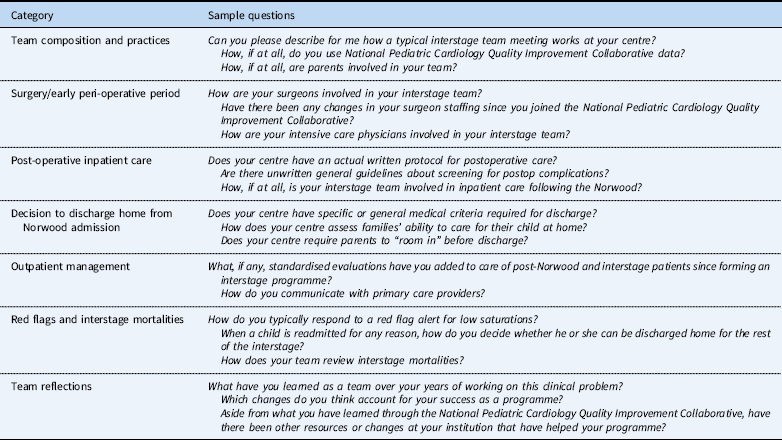
The semi-structured interview guide was based on a recent collaborative centre practices questionnaire as well as clinical and programmatic knowledge of interstage home monitoring programmes. The interview guide was tested on team members from a site that was not eligible for inclusion in either the lower mortality or higher mortality control group. Based on feedback from interviewees, the script was modified iteratively. The interview guide included questions on team practices, standardisation of inpatient care practices, discharge decision making, and interstage outpatient follow-up (Table 1). Semi-structured group interviews were conducted via telephone between January 2016 and March 2016 by study team members (K.E.B. and K.U.). Key contacts from the 11 positive deviant and control centres were provided with a topic outline and asked to invite as many members as needed to answer the questions, with a minimum of two members required. Transcribed interviews were coded by two researchers (K.E.B. and K.U.) using principles of grounded theory analysis.Reference Flick 8 Discrepancies were resolved via consensus. Interviewers and coders were blinded to the mortality group of participating sites. Additional data were collected via an initial questionnaire sent to centres to collect information on topics that were more amenable to brief written answers, for example professional roles represented on interstage team (Appendix). Results from both the interview and initial questionnaire analysis were compared by two members of the investigative team (K.E.B. and K.U.), to identify potential interstage best practices that were more prevalent in positive deviant centres as compared with the control centres.
Interview guide outline and sample questions.

Testing the use of hypothesised interstage best practices across the National Pediatric Cardiology Quality Improvement Collaborative
To assess the use of potential interstage best practices identified in the interviews, a follow-up best practices questionnaire assessing the use of each best practice was written and refined iteratively. The final best practices questionnaire was then distributed electronically to one key contact at each of the 60 collaborative centres in April 2017. To focus attention on the effect of collaborative participation on centre mortality, we analysed questionnaire results from only those centres who had enrolled at least 10 patients after their first year of participation. Questionnaire answers were scored using Likert scales and the overall score was linearly transformed to a 0–100-point scale with higher scores indicating more frequent use of potential best practices. For questions where respondents could select “Other” and write in details, responses were reviewed and scored relative to the provided answers.
To assess for bias in results, centre characteristics, including years in the collaborative, total number of patients enrolled after the first year of participation, and mortality rate were compared between centres who completed the best practices questionnaire versus those who did not, using Wilcoxon rank-sum test. Pearson correlation coefficient was used for continuous variables to examine the correlation between the overall questionnaire result and individual centre mortality rates after a centre’s first year in the collaborative. Centre mortality rates were also divided into tertiles and the use of individual best practices for the low mortality tertile were compared with the other tertiles combined using χ2-test, Fisher’s exact test, or χ2-test for trend, as appropriate. All analyses were performed using SAS version 9.4 (SAS Institute, Cary, NC, USA). A p-value <0.05 considered statistically significant.
Results
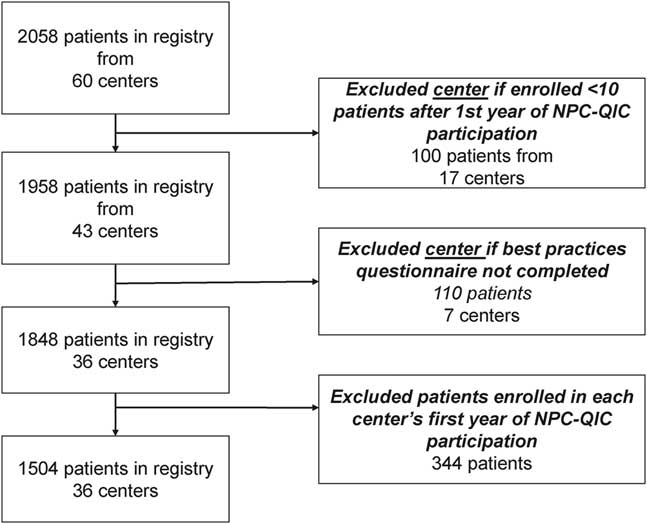
Seven positive deviant centres and four control centres were identified for inclusion in the qualitative data collection. A total of 11 group interviews were conducted via phone with 2–6 participants per site. All 11 sites also returned the initial questionnaire. A total of 20 potential best practices identified through qualitative analysis of the interviews and questionnaires were included in the follow-up best practices questionnaire, which was completed by 36/43 (83.7%) eligible centres. The average survey score was 50.2 (SD 13.4) and the median survey score was 50.4, indicating a near-normal distribution of scores. There were 1504 patients included in the analysis (Fig 1). The average centre mortality was 6.1% (SD 4.1). There were no differences in length of collaborative participation or mortality rate between responding and non-responding centres; however, non-responding centres had lower total enrolment numbers after the first year of participation compared to responding centres (Table 2).
Patient flow diagram.

Characteristics of responding versus non-responding centres in potential best practices survey.

Data are presented as median (interquartile range). p-value from Wilcoxon rank-sum test
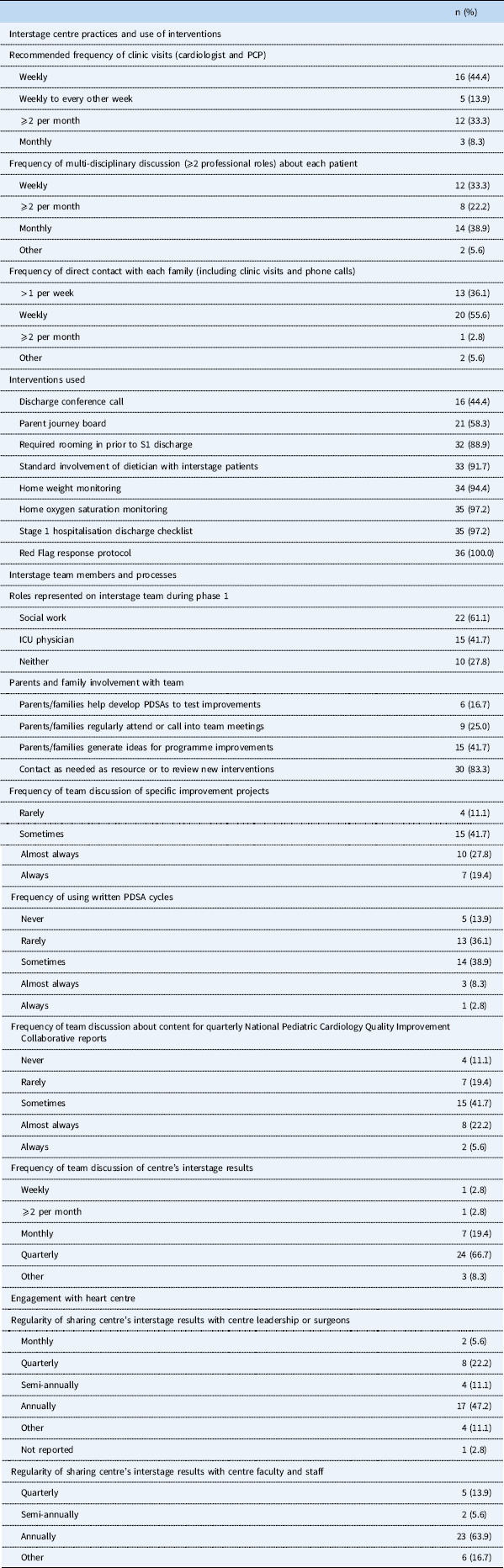
Centres varied widely in their use of the potential best practices, illustrating the variability in interstage programme structure and practice (Table 3). Most centres recommended at least two clinic visits per month, monthly multidisciplinary discussion of patients, and at least weekly contact with interstage families. Over 90% of responding centres reported using some interventions recommended or highlighted by the collaborative, including home weight and oxygen saturation monitoring, a stage 1 hospitalisation discharge checklist, and a Red Flag response protocol. Other interventions had lower rates of use. Inclusion of social work and intensive care physicians into the teams was variable, as was the type of parent involvement, although most centres reported having some parent participation. Team practices around quality improvement, preparation of collaborative reports, review of data, and sharing of data within their heart centres were also variable.
Use of hypothesised best practices across centres

PDSA=Plan-Do-Study-Act cycle
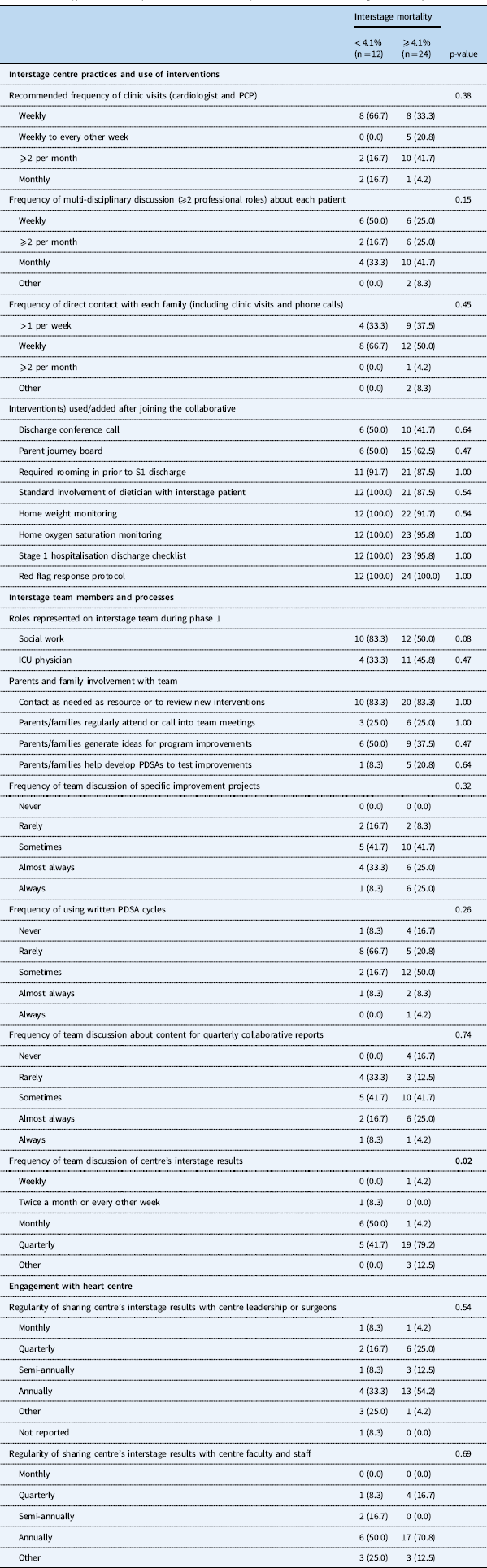
When potential best practices survey results and centre mortality were compared, there was no significant association between the overall best practice questionnaire score and mortality as a continuous variable (r=0.14, p=0.41). When the lowest mortality tertile with cumulative mortality <4.1% was compared with the other two tertiles, there was a significant difference in the frequency of interstage team discussion of centre results. Over half of lowest mortality tertile centres discussed results at least monthly, as compared to 8.4% of the other tertiles (p=0.02, Table 4).
Use of hypothesised best practices in lowest mortality tertile versus middle and highest mortality tertiles.

PDSA, plan-do-study-act
Discussion
We used a positive deviance approach to explore best practices for interstage care in National Pediatric Cardiology Quality Improvement Collaborative centres. Although many potential best practices were identified through centre interviews and questionnaires, neither the summary questionnaire score nor any individual practice had a significant association with mortality rates as a continuous outcome when tested across all centres with a representative sample responding. When the lowest mortality tertile was compared with the other two tertiles, the one practice that differed significantly was the frequency of interstage team discussion of centre results, which was more common in the lowest mortality group. In contrast, there was no difference in the frequency of team discussions about improvement projects, which most centres reported doing at least sometimes. Although it is somewhat surprising that discussion of centre results was the only significant difference identified, it is possible that centre teams that regularly review outcome data in addition to discussing efforts to improve care processes achieve better results than centres that focus only on improvement processes. Indeed, in a review of successful teams participating in a collaborative, Lannon and Peterson highlighted attention to key processes and outcomes as a key characteristic, along with reliable data and measurement, support of senior leadership, and alignment of institutional and collaborative goals.Reference Lannon and Peterson 9
One possible explanation for why we did not find more associations between interstage practices and mortality rates is that there are statistical challenges inherent in comparing small but variable numbers of interstage outcomes across dozens of centres.Reference Bates, Yu and Lowery 2 , Reference Birkmeyer, Dimick and Birkmeyer 10 , Reference Dimick, Welch and Birkmeyer 11 Furthermore, given the focus of the National Pediatric Cardiology Quality Improvement Collaborative on reducing variation in practice across centres,Reference Kugler, Beekman and Rosenthal 12 it is perhaps to be expected that few significant differences in the fundamentals of interstage team and care processes were identified. For example, each centre we interviewed had a multi-disciplinary team focussed on interstage care, a fundamental practice encouraged by National Pediatric Cardiology Quality Improvement Collaborative. There was variation in the specific professional roles represented on each multi-disciplinary team in the best practices questionnaire, but there was no association between those roles and centre mortality rates.
Another possible reason for the lack of associations with mortality is that our methodology may not have been sufficiently precise to identify key differences in practices between programmes. We relied on self-reporting of interventions and interactions, which may be inaccurate as individual teams may not have sufficient awareness of the field to identify unique or critical facets of their programs. Moreover, interstage team members may underestimate practice variation within their own clinical sites, which may have obscured real differences between groups. In addition, centre responses likely reflected current practices, some of which may have been implemented recently and therefore would not have affected mortality outcomes over the full study period. Finally, we were only able to assess the use of an intervention, not the quality of its application. Given the importance of social processes to quality improvement work,Reference Davidoff, Batalden, Stevens, Ogrinc and Mooney 13 observational methods used in anthropology might more effectively identify key differences between centres.
Considering these results in conjunction with our earlier comparison of patient characteristics at the seven positive deviant and four control centres,Reference Bates, Yu and Lowery 2 it is possible that interstage outpatient care practices have less impact on interstage outcome than inpatient care practices. In our previous study, we found no significant differences in patient characteristics on admission between lower and higher mortality National Pediatric Cardiology Quality Improvement Collaborative centres.Reference Bates, Yu and Lowery 2 Interestingly, multiple differences between populations, such as need for pre-operative mechanical ventilation and type of stage 1 performed, developed in the peri-operative period, raising the possibility that variation in peri-operative care practices across centres might contribute to differences in interstage outcome.Reference Bates, Yu and Lowery 2 However, neither study was designed to assess the association between inpatient care practices and outcomes.
On the contrary, the fact that we did not identify specific interstage best practices suggest that there is likely no single formula for providing high-quality interstage care. In the absence of proven best practices, each centre should perhaps examine its own practice patterns, resources, and culture when evaluating potential new interstage practices to determine whether the practice will add value to their programme. For example, creating a dedicated single-ventricle clinic for all interstage outpatient visits may not be feasible for a centre with a broad geographic referral base, but that centre may benefit from improving care coordination across settings by establishing a rigorous process for multi-disciplinary discharge conference calls between inpatient and outpatient providers and families. In short, effective variation in interstage care may be at the level of the centre in addition to at the level of the patient.
Limitations
Our method for choosing positive deviant and control sites is limited by small numbers and the continuous nature of practice improvement. Centres with only one death may have been disqualified from inclusion in the positive deviant group despite having excellent practices. Similarly, control sites were chosen based on an aggregate mortality rate, which may have obscured recent improvements in mortality at an individual centre. Collecting qualitative data at a specific time point may not allow for changes in programmes over time. Answers to the best practices survey may not accurately reflect variation in practice within a given centre and therefore may be misleading. Importantly, because the National Pediatric Cardiology Quality Improvement Collaborative previously enrolled only those patients who were discharged alive during the interstage period,Reference Kugler, Beekman and Rosenthal 12 it has not been possible to fully evaluate hospital outcomes as well as outpatient interstage outcomes using this registry. This comparison will be possible in future studies since the National Pediatric Cardiology Quality Improvement Collaborative expanded its eligibility in August 2016 to include all infants with hypoplastic left heart syndrome who are anticipated to undergo a stage 1 procedure.
Conclusion
Low mortality centres more frequently discuss their interstage results than higher mortality centres. Although we identified no interstage best practices associated with mortality as a continuous variable and no additional practices associated with the lowest mortality tertile, heightened awareness of outcomes may be an important contributor to quality improvement. Without clearly identified best practices, individual centres should consider how potential interventions would work in the context of local resources and culture. Further study is needed to explore variation in process and outcomes across the National Pediatric Cardiology Quality Improvement Collaborative.
Acknowledgements
The authors would like to thank the National Pediatric Cardiology Quality Improvement Collaborative executive leadership, project staff, and participating centres for their assistance in completing this study.
Financial Support
This research received no specific grant from any funding agency, commercial or not-for-profit sectors. Current funding sources for the National Pediatric Cardiology Quality Improvement Collaborative include participation fees from enrolled centres; a grant from the Children’s Heart Association of Cincinnati; a federal grant to the Pediatric Centre for Education and Research in Therapeutics at Cincinnati Children’s Hospital Medical Centre, funded by the Federal Agency for Healthcare Research and Quality [#U19HS021114 AHRQ].
Conflicts of interest
None.
Appendix
INTERSTAGE TEAM COMPOSITION AND PRACTICES
Please indicate how many of the following providers are a part of your interstage team:

Who typically joins in for National Paediatric Cardiology Quality Improvement Collaborative (NPC-QIC) action period calls? Please specify roles rather than names (i.e., nurse practitioner rather than Susan).
How are updates from NPC-QIC shared with the rest of the group?
SURGEONS/PERI-OPERATIVE PERIOD
How would you describe your surgical referral base for Norwood or stage 1 procedures?
For example, do you have a certain regional area where you are the dominant centre?
Do you get a lot of referrals from different states, regions, or countries?
Describe any local factors that affect your centre’s fetal diagnosis rates. For example, centres with large rural areas nearby may have lower rates, etc.
For the last 2–3 years, please complete the table below. This may require accessing local STS data or other surgical databases at your centre

How does your team decide what type of surgical Norwood an individual patient should get? That is, is it based on individual surgeon preference or patient characteristics? If patient characteristics are considered, which ones influence the decision?
INPATIENT CARE
How many physicians are on staff in your intensive care unit?
How long is a typical service period for an intensivist?
a. >2 weeks
b. 2 weeks
c. 1 week
d. <1 week
Are interstage patients transferred out of the ICU before discharge?
IF YES: How many physicians are on staff in your cardiology ward?
How long is a typical service period for a ward attending?
a. >2 weeks
b. 2 weeks
c. 1 week
d. <1 week
How does your team screen for vocal cord paralysis?
How does your team screen for neurologic deficits or seizures?
OUTPATIENT MANAGEMENT
How does your team use home health care or visiting nurses?
a. For all patients
1. How often does the nurse visit the home?
2. What activities does the home nurse perform?
b. For selected patients (please specify criteria)
1. How often does the nurse visit the home?
2. What activities does the home nurse perform?
If applicable, describe the feeding team at your centre.
When does your centre perform the stage 2 procedure scheduling process?
a. Before Norwood discharge
b. At a specific time point after discharge: (please specify)
c. After pre-stage 2 cath.
d. Other: (please specify)