

Introduction
The Thoroughbred industry is one of the largest and most profitable sectors of the equine industryReference Cassidy1. The ownership of racehorses has recently seen a rise; in 2007, there were 15 294 racehorses owned, a 3.4% increase from the 14 795 racehorses owned in 20062, 3. Prospective buyers spend thousands and sometimes millions of pounds at Thoroughbred auctions with the hope that their purchase will prove successful4. Two of the leading yearling sales venues are Tattersalls, Newmarket, UK and Goffs, County Kildare, Ireland. Tattersalls is the oldest firm of Thoroughbred auctioneers in the world, as well as the largest in Europe, accounting for approximately 70% of yearlings sold within the British market5, Reference Parsons and Smith6. Goffs is currently Ireland's leading Bloodstock Sales Company7.
Sale price is dependent upon many factors, including pedigree and conformation; predicting the sale price of a Thoroughbred can be extremely difficultReference Parsons and Smith6, Reference Cassidy8. Yearlings are purchased for prices ranging from 800 guineas (gns) to exceptionally high prices such as Diaghilev, the Sadler's Wells colt, purchased for 3 400 000 gns from Tattersalls in 2000; the highest-selling Thoroughbred yearling in Europe to date9.
Once yearlings have been purchased, they normally enter training with the intention of racing at 2 years of age. However, for a number of reasons, including injury, death and poor performance, a large proportion of horses never make it to the racetrack. Wilsher et al. Reference Wilsher, Allen and Wood10 established that 45% of the 1999 foal crop never entered training, while Jeffcott et al. Reference Jeffcott, Rossdale, Freestone, Frank and Towers-Clark11 reported 38%. The true worth of the Thoroughbred is determined on the racetrack. Its performance may be measured in a number of ways, including prize money wonReference Cassidy1. However, a number of authorsReference Gaffney and Cunningham12, Reference Williamson and Beilharz13 have advocated the use of rating systems as a more definitive way of measuring true performance, arguing that rating systems do not suffer from some of the non-linear, hypogeometric and exponential problems that are apparent when prize money is used as a measure of performance. Within the UK, the Timeform rating is perceived as one of the most definitive rating systems used to measure racing meritReference Gaffney and Cunningham12, 14.
This study investigated whether price paid for Thoroughbred yearlings is related to performance on the racetrack as 3-year olds. The study was based upon the hypothesis that there is a significant association between the sale prices of Thoroughbred yearlings sold and their performance on the racetrack (flat racing) as 3-year olds, measured via end-of-year Timeform ratings.
Materials and methods
The population sample consisted of 5749 yearlings. This was made up of all sales returns from: Tattersalls October Yearling Sale Part 1 (2004 and 2005); Tattersalls October Yearling Sale Part 2 (2004 and 2005); Tattersalls October Yearling Sale Part 3 (2005); Goffs Orby Sale (2004); Goffs Millions Sale (2005); and Goffs Sportsman's Sale (2005). Data collected for each individual yearling were discriminated by lot number, sex, sire, dam, vendor, purchaser and price. Sale prices from Goffs were converted from Euros to gns using the standard exchange rates used by Weatherbys in 2004 (€1.42: 1 gns) and 2005 (€1.41: 1 gns)4, 9. The Racing Post database was used to examine all yearlings that were sold to identify whether they went on to race in Britain on the Flat turf as a 3-year old (Racing Post, 2008). Those that had were then searched for within the Timeform annual publications, Racehorses of 2006 and Racehorses of 2007, to obtain their end-of-year Timeform rating at the age of three14, 15.
Yearlings that were withdrawn, not sold, unnamed, did not race on the Flat turf in Britain as a 3-year old or did not receive an end-of-year Timeform rating at the age of three were excluded from the statistical analysis. The final sample population included 1735 yearlings (1329 from Tattersalls and 406 from Goffs).
The statistical package SPSS, version 15.0, was used to produce descriptive statistics of both yearling sale price and end-of-year Timeform ratings at the age of three16. Pearson's skewness values were produced to examine the distribution of the data; the sales price data were not normally distributed and a LOG transformation was performedReference Zar17. Comparative analysis of total LOG sales returns for each sales venue was performed via independent Student's t-testReference Zar17. Pearson's product moment correlation coefficient (r) was used to assess the association between LOG yearling sale price and end-of-year Timeform ratings. A linear regression analysis was performed using the enter method, where LOG yearling sale price was the independent variable and end-of-year Timeform rating was the dependent variable.
Results
Study sample size
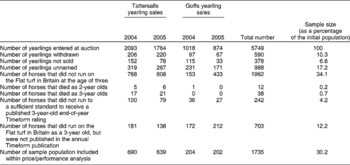
The total population size for this study consisted of 5749 yearlings that were sold at Tattersalls October Yearling Sales and Goffs Yearling Sales during 2004 and 2005. However, 69.8% of these yearlings were not used within the statistical analysis as they did not meet the study criteria, resulting in a final sample size of 1735 yearlings (Table 1). The largest proportion (34.1%, n = 196) of horses excluded from the analysis, where horses that did not run in Britain at the age of 3 years. The smallest proportion (0.9%, n = 50) was 2- and 3-year-old horses that died. In some instances, it was possible for an individual horse to be discriminated by more than one group.
Study population size

Yearlings may be part of more than one group, e.g. unnamed and did not run on the Flat turf in Britain at the age of three.
Sale price
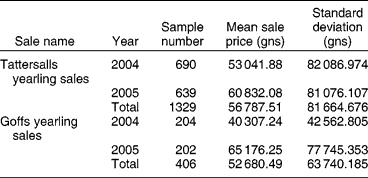
Table 2 shows the variation in mean sale prices seen at both Tattersalls and Goffs Yearling sales during 2004 and 2005 for those yearlings that went on to race as 3-year olds and receive a published Timeform rating. The mean sale price increased by 7790.20 and 24 869.01 gns for Tattersalls and Goffs, respectively, from 2004 to 2005. The mean sale price varied among individual sales; however, Tattersalls October Sale Part 1 had the largest mean sale price for both 2004 (95 006.31 gns) and 2005 (104 890.51 gns). Goffs Millions Sale 2005 had the highest mean sale price (77 725.24 gns) among the Goffs yearling sales in 2004 and 2005.
Descriptive statistics and measures of dispersion: yearlings sold at Tattersalls and Goffs sales in 2004 and 2005

The sale prices of all 1735 yearlings included in this study, sold from both Tattersalls and Goffs in 2004 and 2005, did not follow a normal distribution and produced a Pearson's skewness value of 4.524. The yearling sale prices were transformed using a log transformation and the log of the yearling sale prices had a Pearson's skewness value of − 0.255, therefore following a normal distribution. The Pearson's skewness values for the end-of-year Timeform ratings of yearlings sold at Tattersalls and Goffs were 0.364 and 0.361, respectively, thus following a normal distribution. Comparative analysis of the sales returns for all lots sold for each sales venue showed a mean value of 56 787.51 gns for Tattersalls and 52 680.49 gns for Goffs (LOG of sales returns, T = − 2.327, n = 1735, P < 0.05).
End-of-year Timeform ratings
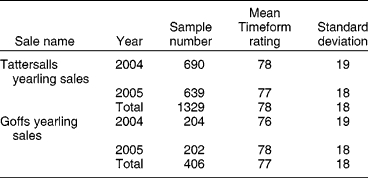
Little variation was seen in the end-of-year Timeform ratings (age three) between those yearlings sold from Tattersalls in 2004 and 2005 and those sold from Goffs (Table 3). The mean end-of-year Timeform ratings varied more with individual sales, with yearlings sold from Tattersalls October Sale Part 1 (2004 and 2005) achieving the highest average end-of-year Timeform rating at the age of three (82) compared with those sold from Tattersalls October Sale Part 3 (2005), which achieved the lowest average end-of-year Timeform rating at the age of three (67), emphasizing the high quality of the yearlings sold at Tattersalls October Part 1.
Descriptive statistics and measures of dispersion: Timeform ratings at the age of 3 years

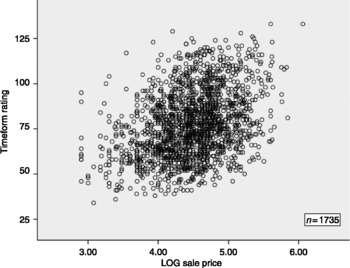
No yearlings achieved an end-of-year Timeform rating higher than 133 (Fig. 1). The two yearlings that achieved a rating of 133 at the age of three were purchased for very different amounts: one for 400 000 gns and the other for 1 150 000 gns. The latter purchased for 1 150 000 gns was not only the highest rated horse within this study, but also the second highest priced horse; the highest priced horse was purchased for 1 250 000 gns, achieving an end-of-year Timeform rating of 93. One notable purchase (Sir Percy, 2006; Epsom Derby winner at the age of three) sold for 16 000 gns and achieved an end-of-year Timeform rating of 129 at the age of three. Other notable purchases include a yearling purchased for 3500 gns that achieved a rating of 117, a yearling purchased for 2000 gns that achieved a rating of 104 and two yearlings purchased for 420 000 gns and 320 000 gns that achieved ratings of only 69 and 57, respectively.
The association between LOG yearling sale price (2004–2005 Tattersalls and Goffs sales) and end-of-year Timeform rating

Correlations and regression analysis
A very highly significant correlation between LOG yearling sale price and end-of-year Timeform rating was observed across the whole population (Fig. 1; r = 0.363, n = 1735, P < 0.001). Individual sales showed varying levels of correlation. The highest level of association at an individual sale was observed at Goffs Orby Sale 2004 (r = 0.389, n = 202, P < 0.01). Two sales, Tattersalls October Sale Part 3 2005 and Goffs Sportsman's Sale 2005, returned no statistical significance in their sales price versus Timeform rating correlations.
Regression analysis was performed on the whole population (n = 1735) to establish a prediction of end-of-year Timeform rating via LOG yearling sale price. The analysis returned an r 2 = 0.133 (n = 1735, P < 0.01), unstandardized β-coefficient of 13.118 and a constant (y) of 18.775. Using these variables with a standard regression equation (a = y+βx), it was estimated that on average a yearling with a sale price of 10 000 gns (LOG = 4) would return an end-of-year Timeform rating of 71 at the age of three.
Discussion
As yearling sale price increases, the performance on the racetrack does not increase proportionately; however, a low–medium correlation (r = 0.363, n = 1735, P < 0.001) was found for the whole population between LOG yearling sale price and end-of-year Timeform rating at the age of three (Fig. 1). This indicated some level of association. Standard linear regression analysis shows that end-of-year Timeform rating at the age of three can to an extent be predicted from yearling sale price; yearling price accounts for 13.3% of the variation in end-of-year Timeform rating. There are probably many environmental factors that affect racehorse performance. CunninghamReference Cunningham18 stated that racecourse performance is approximately 65% due to environmental factors. Environmental factors include, among other things, handicap weight, track condition, year, season, class of race, post-position, distance, trainer, jockey and race effectReference Thiruvenkadan, Kandasamy and Panneerselvam19. The yearling's environment after being sold at auction is probably a key factor in determining its racetrack performance.
Seventy per cent of yearlings purchased at Tattersalls October Yearling sales and Goffs Yearling sales in 2004 and 2005 did not go on to run on the Flat turf in Britain and obtain an end-of-year Timeform rating at the age of three. The reasons for this effective culling from the population are probably multifactorial. They may include death or injury. SobczyńskaReference Sobczyńska20 studied 1759 Polish Thoroughbreds that raced from 1998 to 2005 and found that 28% of those that first raced as 2- or 3-year olds did not continue to race for more than 1 year. A large number of the yearlings within the presented study were purchased by foreign buyers to train and race abroad. A higher percentage of the yearlings sold at Goffs in 2004 and 2005 did not run on the Flat turf in Britain and achieve an end-of-year Timeform rating at the age of three, compared with those sold from Tattersalls. This may be due to anecdotal evidence of more foreign buyers at the Goffs yearling sales.
Additionally, non-performance to an expected level probably accounts for a large proportion of the excluded yearlings within this study. Of the yearlings sold from Tattersalls and Goffs in 2004 and 2005 that went on to be named, 34% either did not run on the Flat turf in Britain at the age of 3 years or did not run to a sufficient standard to achieve an end-of-year Timeform rating. Not all the yearlings sold went on to race on the Flat turf: a number became hurdlers (n = 105) or ran on all-weather racetracks (n = 109), and were excluded from the statistical analysis.
In conclusion, there is a significant relationship between Thoroughbred yearling sale price and racetrack performance at the age of three, when end-of-year Timeform ratings are used. However, the study has confirmed that the high prices paid for yearlings at auction are often not justified by their performance on the racetrack, with many performing worse when compared with less expensive yearlings. There are a number of factors affecting yearling sale price: principally, conformation and pedigree are considered most important by buyers. There are a great number of yearlings sold at auction that do not succeed in achieving an end-of-year Timeform rating at the age of three, either due to never having raced or racing to an insufficient standard. The reasons for such failures are not clear; however, they are probably dependent on environmental factors such as the effect of the trainer and jockey, or the inability of buyers to value yearlings accurately.
The hypothesis for this study was accepted: yearling sale price does have a significant effect on end-of-year Timeform rating at the age of three. However, although the horses in this study showed a statistically significant correlation, the actual biological strength of this relationship is moderate to weak. Consequently, the use of any predictive modelling needs to be treated with considerable caution. Further work requires the inclusion of other factors that are likely to affect racetrack performance within the modelling process. This is likely to achieve a greater amount of accountable variation with the predictive model and therefore greater confidence in any prediction made.