Every fight consists of two parts. (1) The few individuals who are actively engaged at the center and (2) the audience that is irresistibly attracted to the scene (E.E. Schattschneider, The Semi-Sovereign People Reference Schattschneider1960)
Election campaigns work to get supporters to the polls and persuade the few voters who have not decided. Political messaging plays a big role in these efforts across a variety of communication platforms: TV and internet ads, candidate speeches, campaign emails and phone calls, and door-to-door canvassing. But the messages that mobilize one kind of supporter may be ineffective or even counter-productive with another. Learning how different types of supporters respond to messages is therefore critical to any campaign’s success. So how do personality traits condition the mobilizing effects of campaign messages?
Recent political participation studies reveal the power of campaign messages and the influence of core personality traits, illuminating the psychology behind political action. Message content can mobilize or demobilize participation depending on tone and timing (Ansolabehere and Iyengar Reference Ansolabehere and Iyengar1995; Freedman and Goldstein Reference Freedman and Goldstein1999; Lau et al. Reference Lau, Sigelman, Heldman and Babbitt1999; Krupnikov Reference Krupnikov2011), emphasis on social costs of abstention or benefits of action (Gerber, Green and Larimer Reference Gerber, Green and Larimer2008), and emotions evoked by message styles (Marcus, Neuman and MacKuen Reference Marcus, Neuman and MacKuen2000; Brader Reference Brader2006; Valentino et al. Reference Valentino, Brader, Groenendyk, Gregorowicz and Hutchings2011). Likewise, personality traits distinguish citizens who are more or less likely to participate in politics, with more action found among extraverted citizens, for example (Mondak et al. Reference Mondak, Hibbing, Canache, Seligson and Anderson2010; Gerber et al. Reference Gerber, Huber, Doherty, Dowling and Panagopoulos2013). But only two studies experimentally test the interaction between messages and traits—whether the mobilizing effects of campaign appeals depend on the personality traits of the audience (Gerber et al. Reference Gerber, Huber, Doherty, Dowling and Panagopoulos2013; Weinschenk and Panagopoulos Reference Weinschenk and Panagopoulos2014).
This article tests the mobilizing effects of messages that incorporate mild aggressive metaphors (e.g., “fight”) regularly heard on the campaign trail, with theoretical and empirical attention to the personality trait of aggression that distinguishes citizens for whom aggressive language resonates most and least. I expect aggressive people will respond with enthusiasm to aggressive metaphors because they tend to find aggressive entertainment appealing in general (Bushman Reference Bushman1996; Bushman Reference Bushman1998). In contrast, citizens low in trait aggression will find this language off-putting and anxiety-producing, even in its mild forms. Given how political emotions alter the impact of predispositions on political judgment (e.g., Brader Reference Brader2006), I look for aggressive metaphors to reinforce the impact of voting motivations like partisan strength and external efficacy in aggressive citizens, but to weaken the motivations in low-aggression people.
To test these expectations, I fielded two nationally representative US survey experiments during the 2010 midterm election campaigns, randomly assigning participants to read short campaign ad content with aggressive metaphors (e.g., “fight hard”) or non-aggressive synonyms (e.g., “work hard”). Results closely match expectations. Thus, aggressive metaphors mobilize some citizens but demobilize others based on trait aggression levels.
This work shows the mobilizing power of metaphors and their dependence on personality traits for resonance, advancing interactive participation frameworks in current research (Mondak et al. Reference Mondak, Hibbing, Canache, Seligson and Anderson2010; Gerber et al. Reference Gerber, Huber, Doherty, Dowling and Panagopoulos2013; Weinschenk and Panagopoulos Reference Weinschenk and Panagopoulos2014). Moreover, these studies focus on trait aggression, a new personality factor in political science. In so doing, this work highlights the surprising impact of common campaign message styles and reveals the hidden role of aggression in non-violent political behavior. Finally, I provide advice for practitioners seeking to predict the net effects of aggressive metaphors depending on average traits in an audience.
AGGRESSIVE METAPHORS IN POLITICAL CAMPAIGNS
Candidates on the campaign trail often frame messages with mild aggressive metaphors. They promise to “fight” for their constituents, declare “war” on national problems, denounce “attacks” by unscrupulous opponents, and exhort citizens to join in the “battle.” The language may arise naturally, reflecting conflicts at the heart of politics (Pitney Reference Pitney2000) or the traits of leaders who use them (Winter Reference Winter1987), but aggressive metaphors may also proffer electoral advantage as a mobilizing force.
Aggressive political metaphors are figures of speech that cast non-aggressive campaigning and governing in aggressive terms, that portray leaders or groups as combatants, that depict political objects (e.g., legislation, money) as weapons, or that describe sites of politics (e.g., Congress) as places of violence.Footnote 1 Scholars have previously conceptualized aggressive metaphors as one kind of strategic news frame, but not as a distinct conceptual force in political behavior. Strategic frames in news promote cynicism and depress participation (Cappella and Jamieson Reference Cappella and Jamieson1997), especially among citizens with low propensity to participate (Valentino et al. Reference Valentino, Beckmann and Burr2001). Only one study isolated the voting effects of aggressive metaphors in an analysis limited by small samples (Valentino et al. Reference Valentino, Beckmann and Burr2001). They speculate that war language distracts from issue content, especially among the less-engaged. Here, I treat aggressive metaphors as its own conceptual category with different mechanisms and consequences for political behavior.
Aggressive campaign metaphors are often paired with calls for action. For example, during the 2010 midterm election campaign, President Barack Obama rallied students at the University of Wisconsin with a speech using a dozen aggressive metaphors, like “I am going to get out there and fight as hard as I can – and I know you are too.” He concluded:
Get out there and fight for it. I need your help, Madison. We need you to commit to vote. … We need you to knock on doors. We need you to talk to neighbors. We need you to make phone calls. We need you to bring energy and passion and commitment. Because if we do, … we will not just win this election – we are going to restore our economy, we are going to rebuild the middle class. We will reclaim the American Dream for this generation (9/28/10, emphasis added).
Two years earlier, Senator John McCain ended his presidential nomination acceptance speech, laden with dozens of aggressive metaphors, with a similar call to Republicans: “Fight with me. Fight with me. Fight for what’s right for our country. Fight for the ideals and character of a free people. Fight for our children’s future. Fight for justice and opportunity for all. … Stand up, stand up, stand up, and fight” (9/4/08, emphasis added).
Given the frequent use of aggressive metaphors in campaigns, we might reasonably infer that campaigns view the language as a means to improve their electoral chances. But whether (and how) aggressive metaphors serve this purpose remains to be seen.
DIVERGENT REACTIONS TO AGGRESSIVE METAPHORS
Political participation levels are a function of electoral structure and conditions, individual resources, mobilization by elites and peers, and psychological engagement in politics (e.g., Rosenstone and Hansen Reference Rosenstone and Hansen1993; Verba et al. Reference Verba, Schlozman and Brady1995; Burns et al. Reference Burns, Schlozman and Verba2001). Aggressive metaphors fit into this mix as mobilization efforts that interact with psychological engagement, a connection I explain below.
Metaphors actively shape how people make social judgments (see Landau et al. Reference Landau, Meier and Keefer2010 for a review). They help people “understand and communicate abstract and elusive ideas” by reference to more concrete objects and processes (Landau et al. Reference Landau, Meier and Keefer2010, 1046). And they generally increase attention and interest in persuasive arguments, motivating more systematic processing, especially among people interested in the metaphorical domain (Johnson and Taylor Reference Johnson and Taylor1981; Ottati et al. Reference Ottati, Rhoads and Graesser1999). Political metaphors are important frames structuring political attitudes (Johnson and Taylor Reference Johnson and Taylor1981; Schlesinger and Lau Reference Schlesinger and Lau2000; Lau and Schlesinger Reference Lau and Schlesinger2005; Bougher Reference Bougher2012; Hartman Reference Hartman2012), but no studies test their impact on political action.
As with other violent or aggressive media, individuals react differently to aggressive words depending on their own aggressive traits (see Anderson et al. Reference Anderson, Carnagey and Eubanks2003; Kalmoe Reference Kalmoe2014).Footnote 2 I expect aggressive campaign metaphors to appeal to people with aggressive personalities who enjoy other violent or aggressive representations (e.g., entertainment), who tend to seek out that content, and who respond to it with a mix of enthusiasm, anger, and aggressive behavior (Caprara et al. Reference Caprara, Renzi, Alcini, D’Imperio and Travaglia1983; Bushman Reference Bushman1995; Bushman Reference Bushman1996; Bushman Reference Bushman1998; Felsten and Hill Reference Felsten and Hill1999; Anderson and Bushman Reference Anderson and Bushman2002; Marshall and Brown Reference Marshall and Brown2006). In contrast, low-aggression individuals tend to avoid aggressive content and may therefore be turned off by aggressive metaphors. In this group, exposure to aggressive content can produce anxiety and repulsion, known as aggression–anxiety (e.g., Anderson and Ford Reference Anderson and Ford1986; Bushman Reference Bushman1996; Moise-Titus Reference Moise-Titus1999; Carnagey et al. 2007).
These relationships point to two potential routes for aggressive campaign metaphors to have effects on electoral participation. In the first, aggressive metaphors mobilize electoral participation among trait-aggressive citizens, attracting interest and focusing attention on the content of mobilizing messages (Hypothesis 1). This language casts electoral politics as aggressive conflict, which aggressive people are likely to find appealing. Conversely, aggressive metaphors would be uninteresting or even off-putting for citizens low in trait aggression. This is similar to other studies on the congruence of messages and personality traits, though these works address neither aggressive metaphors nor aggression (e.g., Lavine et al. Reference Lavine, Borgida and Sullivan2000; Kam and Simas Reference Kam and Simas2010; Gerber et al. Reference Gerber, Huber, Doherty, Dowling and Panagopoulos2013; Weinschenk and Panagopoulos Reference Weinschenk and Panagopoulos2014).
An alternative route focuses on how aggressive metaphors might evoke distinct emotional responses, thereby altering the impact of predispositions for participation. Emotions serve as signals about the surrounding environment and encourage adaptive responses by promoting habitual responses or by motivating a search for new approaches (Marcus et al. Reference Marcus, Neuman and MacKuen2000). In politics, enthusiasm reinforces habits and predispositions while anxiety weakens them (Marcus et al. Reference Marcus, Neuman and MacKuen2000; Brader Reference Brader2006). Anger functions much like enthusiasm by reducing deliberation (Huddy et al. Reference Huddy, Feldman and Cassese2007) and increasing habit-based judgment (Brader and Valentino Reference Brader and Valentino2007).Footnote 3
In this way, aggressive metaphors would condition the impact of participation motives on campaign behavior through similar affective mechanisms, dependent on trait aggression. Aggressive metaphors reinforce participatory motives of high-aggression citizens but weaken them for those low in trait aggression. In other words, exposure to mild aggressive metaphors will make motivations to participate a stronger factor in predicting electoral participation for high-aggression citizens but a weaker factor for low-aggression citizens (Hypothesis 2).
I focus on two kinds of participatory motives: strength of partisan attachment and external efficacy, tapping distinct dimensions of instrumental, identity, and expressive motives (Miller and Saunders Reference Miller and Saunders2016).Footnote 4 Partisan strength routinely predicts higher levels of participation through perceptions of higher stakes, a need to be heard, and social rewards (e.g., Rosenstone and Hansen Reference Rosenstone and Hansen1993; Verba et al. Reference Verba, Schlozman and Brady1995). And those who view elections and leaders as instruments of democracy are more likely to participate while those more distrustful are demobilized (e.g., Niemi et al. Reference Niemi, Craig and Mattei1991; Rosenstone and Hansen Reference Rosenstone and Hansen1993; Burns et al. Reference Burns, Schlozman and Verba2001). Thus, for example, these psychological foundations suggest that aggressive metaphors will mobilize strong partisans with aggressive personalities but demobilize strong partisans who are not aggressive.
Notably, these predictions align closely with patterns found in recent experiments on aggressive metaphors and partisan polarization in issue attitudes (Kalmoe, Gubler and Wood Reference Kalmoe, Gubler and Wood2017). In those studies, exposure to aggressive metaphors increased the weight of partisanship among aggressive citizens but sometimes decreased it among low-aggression people, leading to more polarization among aggressive people and less polarization among those who find conflict aversive. Similar differential effects, if found here, would extend the relationships from mass issue attitudes to mass political action.
Other Personality Frameworks for Campaign Mobilization
Only two prior articles experimentally test mobilizing appeals conditioned by personality traits. Gerber et al. (Reference Gerber, Huber, Doherty, Dowling and Panagopoulos2013) and Weinschenk and Panagopoulos (Reference Weinschenk and Panagopoulos2014) each employ the Big Five framework, which posits five core dimensions of personality: openness, emotional stability, extraversion, agreeableness, and conscientiousness. Observational studies show mixed relationships between Big Five traits and participation, but extraversion has consistently been linked to more action (e.g., Mondak et al. Reference Mondak, Hibbing, Canache, Seligson and Anderson2010). With survey and field experiments, Gerber and colleagues find that messages stressing the social costs of non-participation are especially strong vote mobilizers for citizens scoring high on openness who had no other eligible voters living in their home. Weinschenk and Panagopoulos employ a survey experiment design to find that campaign negativity is demobilizing for more agreeable individuals but mobilizing for more extraverted individuals across a variety of campaign behaviors.
Trait aggression is conceptually distinct from each of the Big Five traits, but it overlaps empirically with multiple Big Five dimensions, loading most strongly and negatively on agreeableness and emotional stability, and negatively on extraversion and conscientiousness to a lesser extent (Sharpe and Desai Reference Sharpe and Desai2001; Tremblay and Ewart Reference Tremblay and Ewart2005; Bettencourt and Miller Reference Bettencourt and Miller1996). However, these correlations are about the same size as those between the independent Big Five traits themselves. The observational effects of agreeableness and emotional stability on political participation tend to be null or mixed (Mondak et al. Reference Mondak, Hibbing, Canache, Seligson and Anderson2010; Gerber et al. Reference Gerber, Huber, Doherty, Dowling and Panagopoulos2013).
EVIDENCE FROM TWO NATIONALLY REPRESENTATIVE EXPERIMENTS
To test the conditional effects of aggressive campaign metaphors on electoral participation, I designed and fielded two nationally representative internet survey experiments during the 2010 midterm campaigns. Both studies began with items measuring political and social predispositions, including trait aggression and participation motivations, followed by text-based campaign ads for unidentified US House candidates. Participation intentions were assessed shortly after the randomized treatments. In Study 1, subjects viewed one campaign message. In Study 2, subjects viewed two ads for competing candidates, with aggressive metaphors used by neither candidate, by one candidate or the other, or by both candidates. The designs and results are similar, so I present them together.
Data for Study 1 were collected through Knowledge Networks (KN) (now GfK) from July 29 through August 10, 2010, with 512 US general population adults participating (267 men, 245 women; 78 percent non-Hispanic White; ages: 18–91 years, mean=47.3, SD=16.3). Study 2 was also conducted through KN with 412 US general population adults (207 men, 205 women) between July 2 and July 20, 2010 (77 percent non-Hispanic White; ages: 18–94 years, mean=48.6, SD=16.8). Completion rate among invited panelists was 55 percent in Study 1 and 68 percent in Study 2.
Probability-based internet samples are more representative than phone surveys, even after weighting, and they have less random error and satisficing (Chang and Krosnick Reference Chang and Krosnick2009). The online format also allowed subjects to complete the survey at a time and place of their choosing, which means subjects were exposed to treatments in the same environments where they receive real political messages. In sum, the quality of the sample and the study design provide reasonable grounds for generalizing the experimental findings to the national adult population.
Operationalizing Aggressive Campaign Metaphors
To simulate exposure to aggressive campaign metaphors, participants in Study 1 were presented with text from an ostensible TV advertisement for a US House candidate, which contained several aggressive metaphors or non-aggressive synonyms, randomly assigned. The candidate was not identified by name or party. Texts are presented in Appendix A with bolded words indicating differences across treatments. The text for both versions was drawn from high-profile, real-world speeches but is unlikely to be recognized. The text is non-partisan and the design is realistic, reflecting common political language that is used interchangeably.
In Study 2, participants were presented with text from two ostensible television advertisements for US House candidates, representing both competitors in the race. Each subject read an aggressive or non-aggressive ad for Candidate A, and then read an aggressive or non-aggressive ad for Candidate B, both randomly assigned. Exposure to aggressive metaphors is coded 0 when neither message had aggressive metaphors and is coded 1 when one or both messages had aggressive metaphors. Alternative coding counting the number of aggressive ads viewed (i.e., 0, 1, 2) produces similar results (see Online Appendix, Table A5). As in Study 1, both candidates express broad platitudes rather than divisive issue positions, and neither candidate is identified by name or party. Ads in both studies include mobilizing appeals encouraging electoral participation.Footnote 5
Measuring Participation Intentions
The focus of this study in on voting participation in particular, but I also present results for non-voting participation. Prior studies sometimes find differences in the ingredients driving voting and non-voting participation (Valentino et al. Reference Valentino, Brader, Groenendyk, Gregorowicz and Hutchings2011), but I have no a priori expectations for differences regarding voter turnout intentions and other kinds of campaign activity.
Both studies measured midterm voter turnout intention with five-point response scales ranging from “very unlikely” to “very likely,” coded 0–1, plus an ineligible option excluded from analysis (Study 1: mean=0.82, SD=0.28, N=499; Study 2: mean=0.80, SD=0.30, N=401). Study 1 included one five-point non-voting participation item that combined the activities of volunteering time and contributing financially to a campaign, coded 0–1 (mean=0.24, SD=0.27, N=505). Study 2 included the volunteer/contribute item plus four more activities—posting a yard sign, attending a rally, persuading others who to vote for, and talking about politics in general—which were summed in a 0–1 index (α=0.88, mean=0.34, SD=0.23, N=401). Question wording is presented in the Online Appendix; Table A7 there presents models for individual non-voting participation items disaggregated from the index, with similar results.
Participation intentions provide a valid and practical measurement strategy for assessing communication effects on political behavior. Voting intentions before the election strongly predict self-reported voting behavior after the election (Achen and Blais Reference Achen and Blais2010), the predictors for intended and reported behavior are similar in kind and effect size (Achen and Blais Reference Achen and Blais2010), and studying intentions focuses on the psychological processes motivating behavior (Hillygus Reference Hillygus2005).
Measuring Trait Aggression
Trait aggression is measured with the short form of the Buss–Perry Aggression Questionnaire (BPAQ; Buss and Perry Reference Buss and Perry1992; Bryant and Smith Reference Bryant and Smith2001). The BPAQ is the most widely used self-report measure in aggression research, validated as a predictor of aggression and its antecedents in the lab and real life (see Bushman and Wells Reference Bushman and Wells1998), and as a moderator of media violence effects (e.g., Bushman Reference Bushman1995). The BPAQ short form used here (BPAQ-SF; 12 items) exhibits excellent psychometric properties that surpass the original BPAQ including internal reliability, test-retest and over-time stability, and convergent and discriminant validity (Harris Reference Harris1997; Bryant and Smith Reference Bryant and Smith2001).
Trait aggression items are presented in the Online Appendix. The order of items in both studies was randomized. For each, subjects were asked to indicate whether the statement is true or false for them on a six-point scale. The summed responses create reliable indices coded from 0–1 (Study 1: α=0.91; mean=0.27; SD=0.19; Study 2: α=0.92; mean=0.28; SD=0.21). Figure A2 in the Online Appendix presents trait aggression histograms for both studies. The data collections here are unique in that they measure the important psychological trait of aggressive personality in nationally representative US adult samples for the first time.
Measuring Participation Motives
Participation motivations are measured in two ways. In the Online Appendix (Tables A3 and A4), I estimate partisan strength and external efficacy as moderators in separate models, producing substantively and statistically similar results. In the main text, I combine partisan strength and external efficacy in a single index since both constructs appear to operate empirically in the same way, as would be expected conceptually. The two constructs could be considered distinct dimensions of participatory motives, and so their similar responsiveness to aggressive metaphors is a stronger indication of robustness.
Study 1 includes partisan strength and one external efficacy item on electoral responsiveness. Study 2 has partisan strength and two external efficacy items. In addition to the electoral responsiveness question, subjects were also asked if officials care about people like them. Party strength items are four-point folded scales, and the efficacy items have five-point agree–disagree response options. In both studies, the combined motivation index was rescaled between 0 and 1 (Study 1: α=0.21; mean=0.53, SD=0.22, N=512; Study 2: α=0.42; mean=0.46, SD=0.19, N=412).Footnote 6
As in experiments on political emotions and on priming (e.g., Iyengar and Kinder Reference Iyengar and Kinder1987; Brader and Valentino Reference Brader and Valentino2007), the key test is whether the treatment alters coefficients for motivation predicting participation, and whether that effect differs for low- versus high-aggression people.
Results: Voting Participation
To review, I expect to see one of two routes to aggressive metaphor effects: (1) direct effects of aggressive metaphors on participation that depend on levels of trait aggression, or (2) more nuanced effects that depend on participation motives for their direction. For the first, aggressive metaphors might increase participation among aggressive individuals. For the second, aggressive metaphors might alter the impact of participation motives depending on whether trait aggression is high or low. Whether that impact was mobilizing or demobilizing would depend on whether motives to participate were high or low.
For the first hypothesis, I estimate ordinary least squares (OLS) models predicting voter turnout intention as a function of exposure to aggressive metaphors, trait aggression, and the interaction between them.Footnote 7 This shows whether aggressive metaphor effects differ at low and high levels of aggression. We will look first at the treatment variable to see whether aggressive metaphors have an effect when trait aggression is 0. Then we will look to the interaction term to see whether the effect of aggressive metaphors was substantively and statistically stronger among high-aggression people.
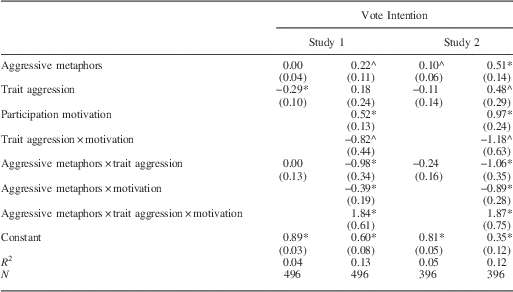
For tests involving motives, I re-estimate the same models after adding a term for participation motives and all two- and three-way interactions between motives and the other variables in the model. To judge whether the treatment effect on participation intentions depends on participation motives as well as trait aggression, the model must include all three variables plus their full factorials in two- and three-way interactions (see Brambor, Clark and Golder Reference Brambor, Clark and Golder2006, 64–6). Without them, the estimation would lack the flexibility needed to test the motives hypothesis. Table 1 presents the results for both studies and both specifications.
Conditional Effects of Aggressive Metaphors, Trait Aggression, and Participation Motives on Voter Turnout Intentions

Note: Ordinary least squares (OLS) models for vote intention. Results are equivalent with ordered probit (see Online Appendix), but presented as OLS for consistency with non-voting participation models. “Aggressive Metaphors” in Study 1 represents the effect of randomized exposure to a single message with aggressive language (0, 1). In Study 2, the variable represents the randomized effect of exposure to one or two messages with aggressive language (0, 1). *p<0.05, ^p<0.10, two-sided.
The results for the two-way interaction models for voting show no consistent treatment effects (Hypothesis 1). In contrast, we see evidence of a significant conditional impact of exposure to aggressive metaphors on voter turnout intention in the three-way interaction models (Aggressive metaphors×trait aggression×motivation) for both studies (Hypothesis 2).
Given the difficulty of interpreting two- and three-way interactions, these tests are more comprehensible in graphical form. I present the marginal effects of aggressive metaphors—that is, whether the aggressive metaphors treatment is statistically significant in the voting model in graphical form. The first step in that direction is presented in Figure A1 (Online Supplement), located there because a second step is needed to provide a clear hypothesis test.
Briefly, Figure A1 presents the marginal treatment effects of aggressive metaphors on voter turnout intentions for both studies at varying levels of trait aggression and motivation, using adaptations of the Brambor, Clark and Golder (Reference Brambor, Clark and Golder2006) code by Joel Selway and Joshua Gubler. The y-axis indicates the change in turnout intentions caused by exposure to aggressive metaphors. The solid line shows estimated treatment effects for those with high participation motives (1), and the dashed line shows the same for those with low motivation (0). These estimates are calculated at each level of trait aggression (x-axis). Regions of 95 percent confidence (one-sided) are indicated with an asterisk on the line, while regions of 90 percent confidence are indicated with a plus. Figure A1 shows large treatment effects on turnout intentions that depend on the interaction of both trait aggression and motives for their direction.
But a direct test of Hypothesis 2 requires finding the difference between these two lines—whether the participation gap between low- and high-motivation people grows or shrinks due to aggressive metaphors, at each level of trait aggression. A growing gap indicates an increased impact of motives on participation while a shrinking gap indicates decreased impact. Figure A1 already shows this dynamic at work: aggressive citizens who are highly motivated are mobilized by aggressive metaphors while aggressive citizens with low motivation are demobilized by the same language, expanding the gap. The reverse is clear among low-aggression citizens.
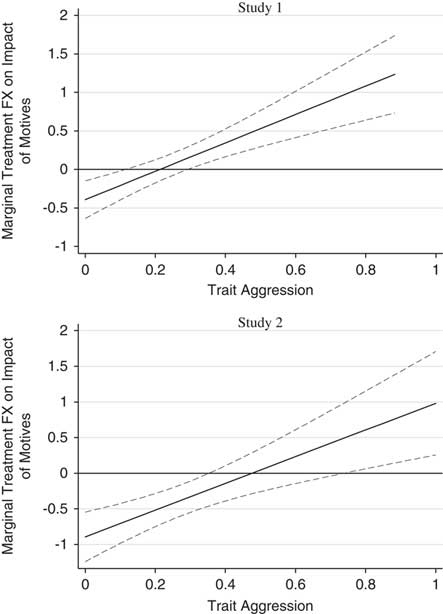
Figure 1 presents the marginal effects of aggressive metaphors on the impact of participation motives in turnout decisions across levels of trait aggression. In other words, the y-axis is the difference between the solid and dashed lines seen in Figure A1, at varying levels of trait aggression. Positive effects indicate that aggressive metaphors increase the impact of motives in turnout decisions, and negative effects show declining influence of motives. The dashed lines around the estimate are 95 percent confidence intervals.Footnote 8 All figures use p-value notation based on one-sided t-tests given the directional hypotheses.
Marginal effects of aggressive metaphors on the impact of motives: voting Note: The graphs are based on the second and fourth columns of coefficients in Table 1 (three-way interaction models). The y-axis shows the marginal treatment effect of aggressive metaphors on the impact of participatory motives (coefficient size) in vote participation intentions (compared to the control) at each level of trait aggression (x-axis). This is the difference in treatment effects at high versus low motivation, shown in Figure A1 (Online Appendix). Dashed lines represent 95% confidence intervals (one-sided). Effects are statistically significant in regions where confidence intervals do not contain 0 (reference line). “Aggressive Metaphors” in Study 1 represents the effect of randomized exposure to a single message with aggressive language (0, 1). In Study 2, the variable represents the randomized effect of exposure to one or more messages with aggressive language (0, 1).

Figure 1 provides ample support for the shifting impact of participatory motives in turnout decisions. As the plot illustrates, aggressive metaphors substantially and significantly increase the influence of participatory motives on turnout intentions among citizens who score high on trait aggression in both studies. In contrast, aggressive metaphors substantially and significantly decrease the impact of participatory motives in voter turnout decisions among low-aggression citizens in both studies. In other words, a strong partisan would ordinarily be more motivated to vote than a weak partisan. Aggressive metaphors make the strong partisan even more likely to vote if they are aggressive, but reduce their voting likelihood if low in aggression.
Study 1 effects are statistically significant across almost the whole breadth of trait aggression, first negative and then positive. The estimates in Study 2 essentially mirror those in Study 1, though the negative effects persist further up the trait aggression scale and do not become significantly positive until higher values as well. These are ultimately slight differences in studies that clearly replicate each other.Footnote 9 In sum, Hypothesis 2 is supported: aggressive metaphor effects on vote intention depend on both trait aggression and participatory motives.
Results: Campaign Participation Beyond Voting
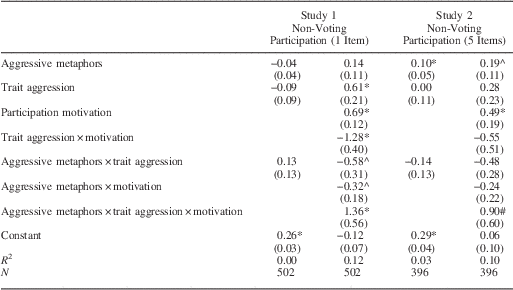
Next, I test aggressive metaphor effects on campaign participation beyond voting, including financial contributions/volunteering, attending a meeting, putting up a campaign sign or wearing a button, persuading others who to vote for, and discussing politics with friends and family during the campaign. This analysis shows the breadth of effects since voting differs from other kinds of campaign (Valentino et al. Reference Valentino, Brader, Groenendyk, Gregorowicz and Hutchings2011). Nonetheless, I expect similar aggressive metaphor effects. Table 2 presents results for OLS models predicting the campaign participation index with the same model specifications as Table 1.
Conditional Effects of Aggressive Metaphors, Trait Aggression, and Participation Motives on Non-Voting Participation

Note: Ordinary least squares (OLS) models for non-voting participation. “Aggressive Metaphors” in Study 1 represents the effect of randomized exposure to a single message with aggressive language (0, 1). In Study 2, the variable represents the randomized effect of exposure to one or two messages with aggressive language (0, 1).
*p<0.05, ^p<0.10, #p<0.15, two-sided.
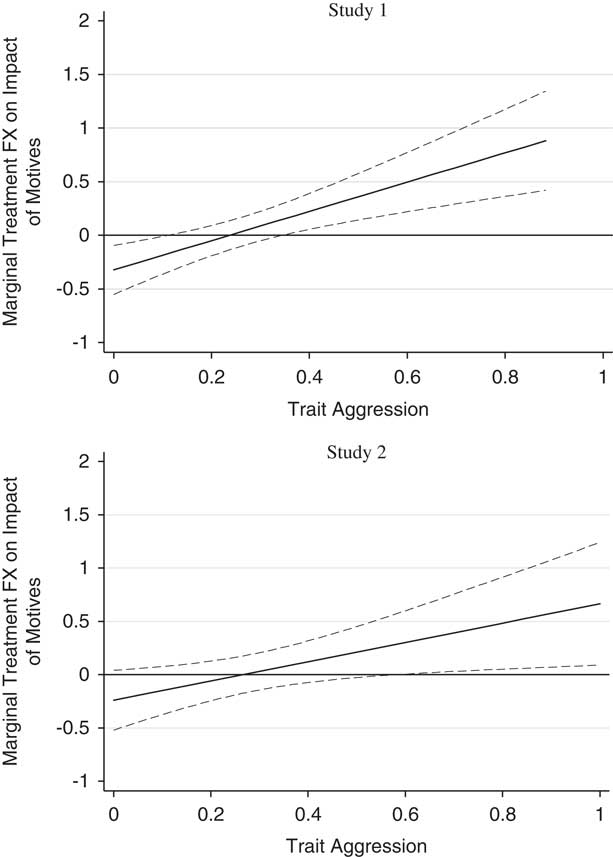
These tests for campaign participation strongly resemble voting intention results in Table 1, though the substantive size and statistical significance are diminished in comparison. Once again, we see no consistent results until we account for participatory motives in the models. Figure 2 provides a clearer look at the marginal treatment effects, showing the change in impact of participatory motives on non-voting participation intentions. The graphical view is especially helpful because it reveals statistically significant treatment effects even when individual coefficients for the treatment and its interactions do not reach statistical significance for the Study 2 estimates (see e.g., Brambor et al. Reference Brambor, Clark and Golder2006).
Marginal effects of aggressive metaphors on the impact of motives: participation beyond voting Note: The graphs are based on the second and fourth columns of coefficients in Table 2 (three-way interaction models). The y-axis shows the marginal treatment effect of aggressive metaphors on the impact of participatory motives (coefficient size) in participation intentions beyond voting (compared to the control) at each level of trait aggression (x-axis). This is the difference in treatment effects at high versus low motivation, similar to Figure A1 (Online Appendix). Dashed lines represent 95% confidence intervals (one-sided). Effects are statistically significant in regions where confidence intervals do not contain 0 (reference line). “Aggressive Metaphors” in Study 1 represents the effect of randomized exposure to a single message with aggressive language (0, 1). In Study 2, the variable represents the randomized effect of exposure to one or more messages with aggressive language (0, 1).

As with the results for voter turnout intentions, exposure to aggressive metaphors substantially increases the impact of participatory motives on non-voting campaign participation among high-aggression people. These reinforcement patterns are statistically significant in Study 1 and marginally significant in Study 2.
Predictions of motivational disruption among low-aggression people are supported for non-voting campaign participation in Study 1, with large and significant estimates. Study 2 estimates for this group fail to reach marginal significance (see Figure 2, when trait aggression is 0). These results suggest that aggressive metaphor effects extend beyond voter turnout intentions to influence other forms of campaign activity, though perhaps to a lesser extent.
Overall, the results strongly support expectations for voting behavior and for campaign activism. Exposure to aggressive metaphors generally reinforces the impact of participatory motives in high-aggression citizens but weakens them for low-aggression citizens. The results for high-aggression citizens are strong and significant for vote intentions and non-voting participation. Strong and significant effects in the opposite direction were found for low-aggression citizens in vote intentions but were much weaker for campaign participation.
DISCUSSION and CONCLUSION
How do personality traits condition the effects of campaign messages meant to mobilize voters? With two nationally representative US survey experiments, I showed that common aggressive metaphors mobilize or demobilize voters depending on their traits.
I found that the effects of exposure to aggressive campaign metaphors on voter turnout intentions and other campaign actions depend on aggressive personality traits that resonate (or clash) with the language and participatory motives that direct the effects. Although the balance of aggressive metaphor effects was neutral in the two national samples—reflecting the diversity of the nation as a whole—the language substantially altered who was more or less likely to participate by shifting the impact of participatory motivations in decisions to act in politics. This led some citizens to be mobilized while others were demobilized, belying the illusion of no change in the aggregate.
The results support a general model of trait resonance in which aggressive metaphors reinforce the role of predispositions among high-aggression citizens and disrupt the same predispositions among low-aggression citizens. This conclusion is consistent with other studies on the congruence of messages and personality traits, though the present study is the first to examine this particular language and trait—despite their commonality and importance in everyday life (e.g., Lavine et al. Reference Lavine, Borgida and Sullivan2000; Kam and Simas Reference Kam and Simas2010; Gerber et al. Reference Gerber, Huber, Doherty, Dowling and Panagopoulos2013; Weinschenk and Panagopoulos Reference Weinschenk and Panagopoulos2014). More broadly, these findings emphasize the key moderating role of personality in campaign message effects, the power of metaphors, and the surprising role of aggression in political behavior.
Strategic Communication
Practitioners would like to direct the participatory effects of aggressive metaphors, but they may wonder about the practical implications of this research since they are unlikely to have aggression measures for audiences. Additionally, audiences are often addressed as groups rather than individuals. These two factors complicate targeting efforts. Here I describe, how practitioners can seek net effects from aggressive metaphors to mobilize (or demobilize) individuals and groups based on likely audience traits.
Even without direct measures of trait aggression, communicators can make reasonable inferences about aggression levels in individuals based on other characteristics often known to campaigns. Trait aggression is higher among young adults and people with less education, on average, and aggression is somewhat higher among men than women (Kalmoe Reference Kalmoe2015). That means, for example, that a young man without a college education is likely to be substantially more aggressive than an older college-educated woman.
Participation motivations are also vital for directing aggressive metaphor effects. People who have conspicuously demonstrated their motivation by attending a rally or signing up for campaign emails may be safely classified as high-motivation. Attributes like older age and higher education may help inferences about partisan strength and external efficacy as well (e.g., Campbell et al. Reference Campbell, Converse, Miller and Stokes1960; Craig et al. Reference Craig, Niemi and Silver1990). For individual communications like emails, mail, and door-to-door canvassing, this may be sufficient for targeting messages.
Group audiences are more challenging. As the experiments show, the more diverse the audience, the less likely any net effects will accrue from using aggressive metaphors. Consequently, broad-audience messages like TV ads that include aggressive metaphors are unlikely to produce net effects on electoral participation. However, more homogenous groups may be open to mobilizing influence with aggressive metaphors. As with individuals, average traits can be inferred for groups.
Aggressive metaphors are likely to mobilize individuals and groups with higher aggression and strong participatory motives. Aggressive metaphors may also be useful for mobilizing low-aggression, low-motivation people. For all other trait combinations, aggressive metaphors should be avoided (unless the intention is to demobilize). Unfortunately, these demographic inferences are complicated by the fact that trait aggression is negatively correlated with participation motivations. But that challenge can be reduced if motivations are pinned down with more certainty by demonstrated levels of individual or group commitment to politics.
In sum, conditional aggressive metaphor effects are important not just for academic understandings of political behavior; they also inform campaigns about opportunities for micro-targeting. Some leaders may already intuit some of these dynamics—particularly by using more aggressive language with more aggressive audiences—but the nuanced participatory effects clearly require more careful attention to produce the desired outcomes.
Limitations and Opportunities
Of course, these studies include limitations that present opportunities for future research. For example, although the interaction of aggressive cues and trait aggression is known to produce enthusiasm, anger, and anxiety among different people, and while the results here resemble the moderating role of emotions on the political impact of predispositions, these studies did not include direct measures of emotion’s mediating role. It is possible that alternative cognitive or physiological mediators related to aggression could explain the connection between randomized exposure to aggressive metaphors and the participatory effects observed here (e.g., aggressive thoughts, physiological arousal). Future studies could include both self-reports and physiological measures to nail down these mechanisms.
Related, the political communication literature is split on mechanisms for priming and framing effects that are driven variously by unconscious mental accessibility, conscious shifts in perceived importance, or information cues from trusted sources (e.g., Nelson, et al. Reference Nelson, Clawson and Oxley1997; Miller and Krosnick Reference Miller and Krosnick2000; Chong and Druckman Reference Chong and Druckman2007). In contrast, the aggression psychology literature tends to focus entirely on what we would call priming effects, in which changes in cognitive and affective accessibility are the mediating forces that drive aggressive behavior. Given these debates and no way to adjudicate between them in the current data, I remain agnostic on these points and look to future tests for more definitive answers.
Similar questions may be raised regarding the role of mild aggressive metaphors. Although the real-world aggressive and non-aggressive language is designed to be interchangeable and passes an empirical test for comparable strength, alternative accounts might not be ruled out to the satisfaction of all. Nonetheless, the strong results and the design’s close correspondence to common campaign rhetoric establish the presence of consequential effects, and the theoretical foundation laid here provides a strong explanatory fit for the patterns that emerge in both national experiments.
Future studies could also test the duration of effects and individual differences in real-world message exposure. While effects likely wane with time (Chong and Druckman Reference Chong and Druckman2010; Gerber et al. Reference Gerber, Gimpel, Green and Shaw2011), they may be reinforced with repetition over campaigns. Implications of real-world message exposure also matter for generalizing communication effects (Kinder Reference Kinder2007; Arceneaux and Johnson Reference Arceneaux and Johnson2013). Exposure to political messages is greatest among the most motivated citizens (Zaller Reference Zaller1992), and, among this group, the present studies show statistically significant substantial effects mobilize high-aggression citizens and demobilize those low-aggression citizens across participation types.
Contributions
This work identifies important new dynamics of message-based campaign mobilization, advancing participation research on the psychology of political behavior. Given the widespread use of aggressive metaphors in campaigns, strategists likely employ the language with strategic goals in mind, though they may not fully comprehend its conditional effects.
More broadly, these findings support models of political behavior that theorize interactive effects between fundamental personality traits and features of the political environment (Stenner Reference Stenner2005; Mondak et al. Reference Mondak, Hibbing, Canache, Seligson and Anderson2010; Gerber et al. Reference Gerber, Huber, Doherty, Dowling and Panagopoulos2013; Weinschenk and Panagopoulos Reference Weinschenk and Panagopoulos2014). This article reinforces the moderating role of individual differences in personality in response to messages, and it does so with trait aggression rather than the Big Five traits.
This work also extends recent findings on metaphorical reasoning and metaphorical frames (Schlesinger and Lau Reference Schlesinger and Lau2000; Lau and Schlesinger Reference Lau and Schlesinger2005; Bougher Reference Bougher2012; Hartman Reference Hartman2012) by providing the first test of metaphor effects on political participation. And while other scholars have examined conditional effects of metaphors—particularly related to political sophistication—this work goes farther in identifying individual traits that shape how citizens think and feel about the metaphors they hear, resonating differently across citizens.
Finally, this work breaks new ground by introducing aggression into forms of political behavior that have no obvious ties to aggression. No matter the normative conclusions to be drawn from these findings about aggressive language in politics, this work reveals new ways of understanding political behavior through the fundamental behavioral lens of human aggression (Wilson Reference Wilson2004), through the participatory impact of campaign metaphors, and through the critical moderating role of a vital new personality trait in politics research.
Appendix A: Experimental Campaign Message Treatments
Study 1
“Fighting/Working for You
Americans today are fighting/struggling to keep their jobs and their homes. All you ever asked of government is to stand on your side and fight/stand up for your future. That’s just what I intend to do. I will fight/work hard to get our economy back on track. I will fight/work for our children’s future. And I will fight/work for justice and opportunity for all. I will always fight/work for America’s future, no matter how tough it gets. Join me in this fight/effort.”
Study 2
[Candidate A’s Aggressive and Non-Aggressive Ad Text]
“Fighting/Standing Up for America’s Future
Americans today are fighting/struggling to keep their jobs and their homes. All you ever asked of government is to stand on your side and fight/stand up for your future. That’s just what I intend to do. I will fight/work hard to get our economy back on track. I will fight/work for our children’s future. And I will fight/work for justice and opportunity for all. I will always fight/work for America’s future, no matter how tough it gets. Join me in this fight/effort.”
[Candidate B’s Aggressive and Non-Aggressive Ad Text]
“Fighting/Working for You
For almost 25 years, I’ve been fighting/working hard for you. And with your support, I will continue to fight/work for you in Washington. In these tough times, we need to fight for/do what’s right for our country. That means fighting/working hard to ensure equal opportunities for everyone in life. As your representative, I promise to fight/work for all the people, not the powerful interests. But I can’t win this battle/race without your help. Together, we can build a better future.”
Note: key treatment text is bolded here for emphasis, but was not distinguished in treatment text viewed by participants.