Introduction
Scholars argue that democratic governance has become a key principle underlying international order, particularly since the end of the Cold War.Footnote 1 Yet we lack understanding of the extent to which the salience of democratic governance has waxed and waned in international society over time. Evidence from the United Nations General Assembly (UNGA) General Debates offers unique empirical insights into these trends, both in terms of the salience of democratic governance (a) as an issue, and (b) as a dimension (or basis) of international social status.
This article makes a case for increased attention to the salience of specific dimensions of social statusFootnote 2 in international organisations (IOs). Despite the rising interest in status concerns in international politics in recent years, there is a dearth of evidence of fluctuations in the strength of specific bases of social status, including in formal international organisations. Scholars have typically analysed statusFootnote 3 as a multidimensional concept, combining military, economic, demographic, sociopolitical, and diplomatic components. Yet disaggregating the concept of social status according to particular dimensions – such as status based on democratic governance – facilitates new perspectives into evolutions in key components of international order.
The recent revival of scholarship on status in IR has provided valuable insights into effects of status concerns on the foreign policies of rising and great powers.Footnote 4 Of the few studies that explore social status in the context of formal international organisations, scholars have tended to focus on ‘socialisation’,Footnote 5 the UN Security Council,Footnote 6 or on the behaviour of specific states in multiple international institutions.Footnote 7 By contrast, this article highlights trends in the use of symbols of status among the full UN membership. Positive distinctiveness is sought by powerful and small states alike. The article also offers a new method for assessing the salience of a particular dimension of social status in international organisations. While the main focus is on trends in the salience of democratic governance over time, and therefore is most relevant to international organisations with democratisation mandates, the approach could be applied to alternative dimensions of international social status. The arguments would be most easily generalisable to policy areas for which an international organisation has a mandate and has codified and institutionalised a norm set, thereby rendering social stratification in terms of compliance and non-compliance more visible,Footnote 8 and for which status markers are readily expressed, such as the policy areas of gender equality, humanitarian arms control, environmental protection, or development assistance.Footnote 9
Social status in terms of democratic governance is based on more than a state’s perceived level of democracy which is often measured with democracy indices; it is also negotiated at international level, as governments are recognised as democratic by international organisations and their member states. This article examines factors influencing variation in the salience of democratic governance as a dimension of social status, rather than processes of status attribution.Footnote 10
It is important to study the salience of particular status dimensions in the UNGA for a few additional reasons. First, salient status dimensions help to structure patterns of inter-state cooperation and discord in multilateral organisations.Footnote 11 During the Cold War, US-Soviet relations influenced global status considerations and states typically sought status with either of the two superpowers.Footnote 12 Yet in the early 1990s, many developing countries lost their support based on alliance loyalty,Footnote 13 and thus sought alternative ways of being recognised. Status as a democratic state became significant for developing countries seeking partnerships or investment,Footnote 14 and also became a component of international leadership and respect as a major power.Footnote 15 As democratic governance became central to the international order, many states publicised their democratic credentials. Democratising states viewed the UN as comparatively neutral, and demand for UN democracy support increased.Footnote 16 Scholarship has tended to view the salience of democratic governance as high in the post-Cold War era, yet this article adds a fine-grained approach and illustrates significant fluctuations in the international normative environment over time.
Second, shifts in the salience of democratic governance can subsequently affect international support for democratisation. Normative commitments made in the UNGA are used by civil society actors in ‘boomerang patterns of advocacy’ to increase political pressure on their home states to comply with international norms.Footnote 17 Although beyond the scope of this article, the salience of democratic governance can affect ‘linkage’ (the density of ties and cross-border flows with democratic countries and IOs that support democratic development), which, according to Stephen Levitsky and Lucan Way, enhances support for democratic opposition groups, undermines domestic support for autocratic leaders, and affects the balance of power in autocratic parties.Footnote 18 In high linkage cases, these scholars argue, ‘because so many domestic actors held a stake in their country’s international status, the specter of external punitive action often generated considerable domestic opposition, which magnified the boomerang effect’.Footnote 19 Margaret Keck and Kathryn Sikkink similarly argue that ‘moral leverage may be especially relevant where states are actively trying to raise their status in the international system’.Footnote 20 Yet we know little about how changes in the salience of democratic governance may affect actors’ attempts to raise their country’s international status. This article assesses the former process – fluctuations in the salience of democratic governance at the international level.
The following section introduces an approach to the study of salience of democratic governance, both as an issue and as a basis of international social status. The explanatory focus of the article is primarily on the latter. I then lay out a conceptual framework with factors from social psychology to supplement IR approaches and to explain evolutions in the salience of a given status dimension. Subsequent sections examine empirical findings based on a manually-coded content analysis of the UNGA General Debates between 1992 and 2014, with comparison to 1982. The final section presents conclusions.
Salience of democratic governance as an issue and as a basis of international social status
In political science scholarship, salience often refers to the importance of issues, for example, to voters during an election campaign.Footnote 21 When this perspective is applied to the context of international organisations, it leads to a preliminary question: how salient has democratic governance been as an international issue to UN member states over time? Yet this provides only a partial response to the larger question of trends in the salience of democratic governance as a dimension of social status and as an underlying principle of international order.
This is because state representatives not only advocate their issue preferences and interests in international fora, they also express and assert their states’ identities, as well as attempt to improve their states’ positions in various status dimensions. Literature in social psychology adds a distinctive element to the concept of salience, proposing that the salience of a particular group membership refers to ‘its current psychological significance’.Footnote 22 Yet salience of an identity not only reflects internal characteristics; structural influences are simultaneously at work. When a state representative publicly asserts an aspect of a state’s identity (for example, as democratic) in international fora, on display is not only the state’s domestically-held or internal identity. The representative is also sensitive to externally-held perceptions and to the likelihood that his or her claims will be accepted by others.Footnote 23 Although identifying the perceptions and salience of democratic identity to individual UN member states is beyond the scope of this article, an aim here is to identify aggregate trends in the salience of democratic governance. This entails observing patterns of representations such as symbols, speech, and status claims in states’ communications and statementsFootnote 24 in the UNGA. Considering salience in this way leads to the question: how salient has democratic governance been as a basis of international social status within the UN General Assembly, as reflected in the General Debates over time? The following paragraphs outline an approach to these two questions, while the subsequent section presents explanatory factors influencing the salience of a given status dimension.
As a first step in ascertaining the salience of a status dimension, we should ask: What are the status symbols in a particular social environment such as the UNGA? In Moscow, a mink coat might be a symbol of status, but not in San Francisco because of differences in climate or environmental values. Actors may activate any of multiple self-categorisations depending on the context.Footnote 25 Although many states have highlighted their domestic democratic credentials in the UNGA since the 1990s, they have also enthusiastically publicised other markers of status such as percentage of female parliamentarians,Footnote 26 number of contributed UN peacekeepers, percentage of state’s territory covered in national parks, providing over 0.7 per cent of GNP in official development assistance, proportion of state’s energy derived from renewable sources, human development index ranking, or voluntarily relinquishing weapons of mass destruction. Since status symbols may differ between IOs and between fora within an IO, it is important to confirm that democratic governance has been a salient dimension of status in the UNGA. Indicators include references to democracy in key conference documents, resolutions, and declarations. Secondary literature documents these indicatorsFootnote 27 and confirms that democratic governance has been a significant basis of international social status since the end of the Cold War.Footnote 28
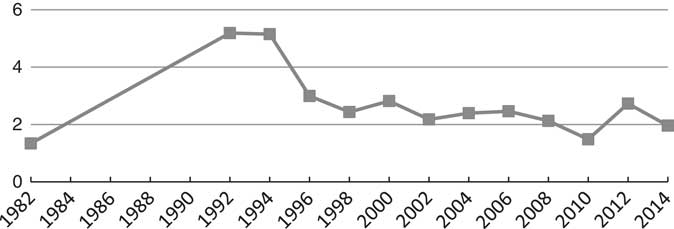
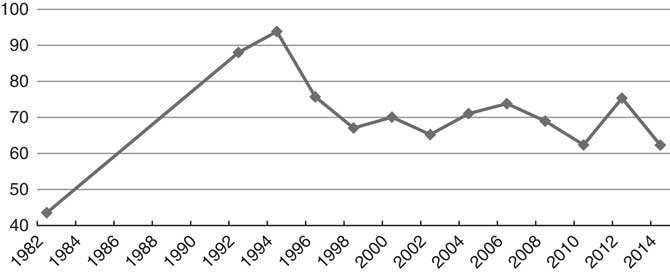
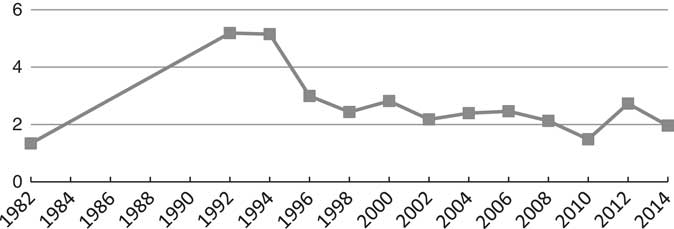
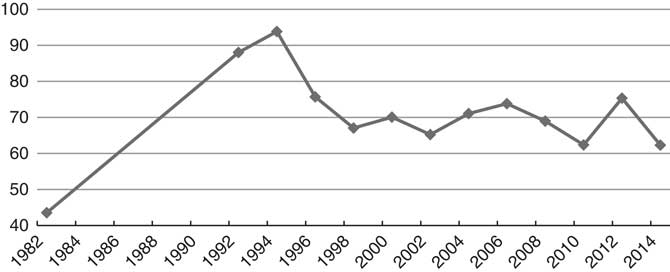
Second, we must know approximately how strong the status symbols are in a setting at a particular time. A BMW SUV may connote high status in certain years in a given society, yet may be less appealing in the same society if gasoline prices rise or values about emissions change. In the UNGA, indicators of the salience of democratic governance as an issue include the overall frequency of state representatives’ references to democracy or democratisation (see Figures 1, 2, and 3).
Average number of mentions of democracy or democratisation by UN member states’ representatives in the UNGA General Debates, 1982–2014.57
Percentage of UN member states’ representatives making at least one mention of democracy or democratisation in their UNGA General Debate statements, 1982–2014.
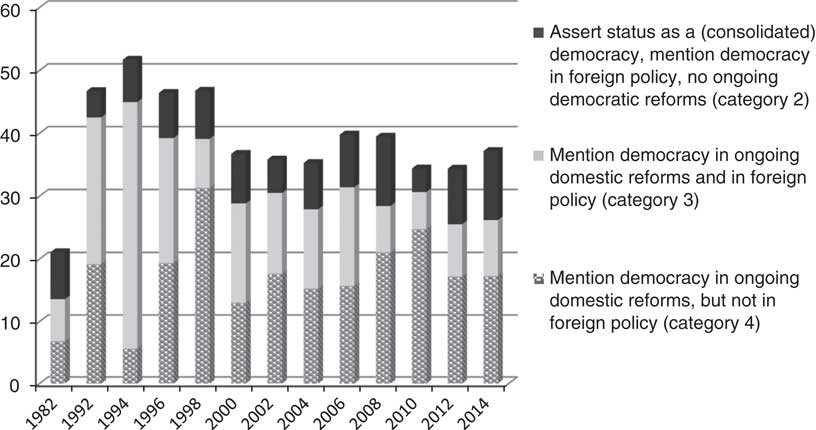
Yet a finer-grained analysis is needed to capture trends in the salience of democratic governance as a basis of social status. Measuring this requires indicators that are a subset of the above expressed by frequency. Therefore, as a third step, we must disaggregate the content and ways in which state representatives reference or make use of democratic governance as a status symbol in their rhetoric in the UNGA. Evidence includes state representatives’ explicit reference to democratic status markers (for example, highlighting international recognition of free and fair elections, successful democratic constitutional reforms, or explicit assertions that their country has democratised or has a consolidated democratic regime, see Figure 4). This approach draws on Pierre Bourdieu’s insight that skilled speakers are able to identify and ‘produce expressions which are highly valued on the markets concerned’.Footnote 29 Similarly, Ian Hurd argues that ‘the intensity of interest by other actors in gaining access to the symbol reveals the underlying value of the good’.Footnote 30 Therefore, we can view salience as an important, yet potentially fluctuating aggregate reflection of how highly a symbol is valued among the community of states.
Explaining evolutions in the salience of a given status dimension
What factors influence the salience of a dimension of social status? The following analysis blends insights from social psychology and IR scholarship. Prominent among factors proposed by social psychologists are ‘accessibility’, or the readiness of an actor to identify with the category, and ‘fit’, or the degree to which an actor’s characteristics correspond with the criteria that define the category.Footnote 31 The concept of ‘fit’ is interesting because it implies that democratic states will be more likely to find a social category based on democratic governance salient than will non- or partially democratic states. However, examples abound of non-democratic states using language of democracy in the UNGA, and conversely, of democratic states not reinforcing the salience of democratic governance in the UNGA, as will be illustrated. The concept of ‘fit’ potentially offers a bridge to IR studies of compliance and norm development. Although it seems logical that states in compliance with certain norms would be most likely to publicly advocate them, evidence suggests that alternative factors are also influential.
While this article analyses variation in the aggregate salience of democratic governance rather than status seeking per se, social identity theory (SIT) is valuable for highlighting conditions under which states attempt to enhance their international image. For example, drawing on SIT, Deborah Larson and Alexei Shevchenko provide important insights into status-seeking behaviour of states through strategies of social mobility, social creativity, and social competition. In strategies of social mobility, states attempt to gain status through emulation.Footnote 32 Strategies of social creativity on the issue of democratic governance involve attempting to shift the basis of comparison to a different status dimension, while strategies of social competition involve ‘spoiler behaviour’.Footnote 33 Social identity theorists emphasise factors such as the permeability of elite group boundaries and the stability and legitimacy of status hierarchies as affecting states’ selection of strategies.Footnote 34
The question of utility in a state’s self-identification with a group of (established) democratic states has some overlap with the SIT proposition that strategies of social mobility are more likely when elite group boundaries are perceived as permeable.Footnote 35 In particular, the concept of ‘accessibility’ suggests that an actor is more likely to identify with a social category when it corresponds with the actor’s goals.Footnote 36 These goals may be material or ideational. State representatives are more apt to showcase successful democratic reforms when it is likely that their states will be recognised as democratic or successfully democratising. Evidence from UN member states suggests that the concept of social mobility could be expanded, since many countries are not seeking full membership in the group of established democratic states,Footnote 37 but rather use democracy-related rhetoric to gain opportunities for investment or partnership, or to strengthen their voice in multilateral negotiations,Footnote 38 among other goals.
The salience of democratic governance as a basis of social status is also affected by the extent to which states anticipate that the relative status of the group of democratic states will change, as well as to actual changes in the status hierarchy.Footnote 39 Again, literature in social psychology offers insights attuned to actors’ characteristics and structural influences. As Bertjan Doosje, Russell Spears, and Naomi Ellemers argue: ‘whereas low identifiers only express solidarity with their group to the extent that the improvement of group status constitutes a likely prospect, high identifiers maintain a commitment even if their group faces an uncertain or bleak future’.Footnote 40 The rhetoric of states that weakly identify with a democratic identity is likely to be more instrumental than that of high identifiers, for whom status as a democratic or democratising state is more fundamental to their identity. Moreover, ‘displays of in-group identification for low identifiers depend upon the current status position of their group’.Footnote 41 Applied to the UNGA context, we would expect that if the general status position of (established) democratic states decreases (or is expected to decrease) in relative terms, representatives of states that identify more weakly with democratic governance as a core component of their identity will be less likely to showcase domestic political reforms in their statements. In other words, trends in the use of democracy as a symbol of social status in the UNGA (see Figure 4) are partially influenced by how the group of (established) democratic states is perceived internationally at the time.
Antecedent variables affecting international perceptions of (established) democratic states, and thus the salience of the status dimension, include variations in the prestige of prototypes, the appeal of countervailing group memberships, and the effectiveness of contestation. A prototype, or group member holding the most common characteristics of the group, is influential when states perceive their similarities.Footnote 42 When there are changes in prototypical democratic states, such as due to war, economic crisis, hypocrisy,Footnote 43 or controversial elections, this can diminish their appeal, and thus negatively affect the salience of the status dimension. Moreover, increases in economic growth, power, prestige, and standards of living in states with alternative political development trajectories (for example, China, Russia), can negatively affect the relative status of (established) democratic states. In the empirical section, the above-mentioned factors are compared with shifts in the salience of democratic governance .
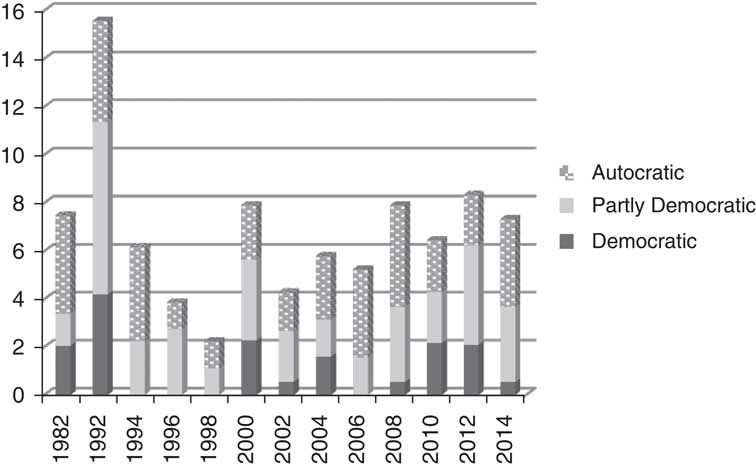
Rivalry or contestation is generally portrayed as accentuating the relative ‘separateness’ and ‘clarity’ of a given dimension of social status and as potentially increasing identification among core group members.Footnote 44 However, the historically flexible definition of democracy in the UN system has contributed to the use of democracy as a symbol of status among non- or partially democratic states, particularly in the 1990s, since states with varied degrees of compliance can claim to be democratic with low risk of repercussions. Although ‘identity threat’ or intergroup competition is likely to increase social category salience among high identifiers,Footnote 45 the rhetoric of low identifiers can reflect greater instrumentality, as alternative social comparisons gain relevance, thus negatively affecting the salience of democratic governance. In the empirical section, this is illustrated by comparing trends in the salience of democratic governance as a basis of social status (in Figure 4) and contestation (in Figure 5).
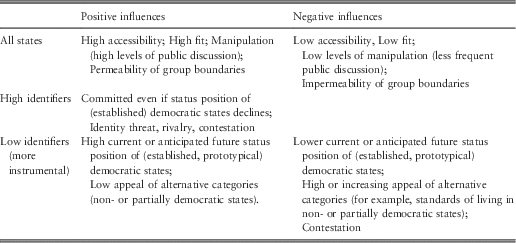
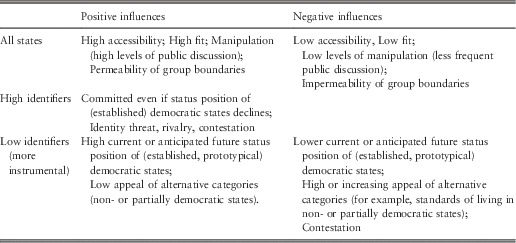
Both political scientists and social psychologists view salience as manipulable. For example, salience can be enhanced by increasing public discussion of the relevant category.Footnote 46 ‘When a particular social identity is made salient, individuals are likely to think of themselves as having characteristics that are representative of that social category’, write social psychologists Marilynn Brewer and Norman Miller.Footnote 47 Experiments have shown that when a category or social identity is made more salient, individuals increasingly identify with the group and a rise in category-related behaviours is observed.Footnote 48 Applied to the UN context, the higher the salience of democratic governance as a basis of social status in the UNGA, the more likely it is that non- or partially democratic states will try to improve their position in this status dimension. In the empirical case study, this is evaluated by comparing trends in the salience of democratic governance as a basis of social status (in Figure 4) and trends in the frequency of references to democracy (in Figures 1–3). Table 1 summarises the above discussion.
Factors influencing the salience of democratic governance as a basis of international social status: Insights from social psychology.
International Relations scholarship complements the above-mentioned social-psychological explanations of variations in the salience of a status dimension, and enhances theoretical traction at the structural level. Liberal and constructivist insights are particularly helpful. For example, the extent to which democratic governance is highly salient in a smaller regional IO (for example, EU, OAS, AU) is likely to influence a member state’s democratic rhetoric in a larger IO such as the UN.Footnote 49
Offering another explanation of state representatives’ international rhetoric, Rebecca Adler-Nissen emphasises stigma management, as non-democratic states respond to international shaming.Footnote 50 Bourdieu similarly argues that ‘anticipation of the sanctions of the market helps to determine the production of the discourse’.Footnote 51 While compelling, in the UNGA General Debates, representatives of UN member states are typically not responding to direct accusations of non-democratic behaviour or international shaming, but rather attempt to project a positive identity. Making reference to successful democratic reforms is more compatible with pursuing positive distinctiveness than expressing regret for non-democratic behaviour, although the distinction may be subtle in relevant cases. Moreover, states have greater incentives to repair a stigma if the salience of a status dimension is high and less incentive to do so if the salience of a status dimension is low in a particular forum. The use of democratic status symbols in a strategy of ‘stigma recognition’ may be more likely among a subset of states, such as those affected by sanctions or significant international pressure, whereas ‘stigma rejection’ or ‘counter-stigmatisation’Footnote 52 may be observed among some representatives engaging in contestation. Offering additional arguments on the use of democracy-related rhetoric in the UN system, Susan Hyde notes the significance of benefits flowing to democratic states,Footnote 53 the volume of which arguably changes over time. There are also ideational motivations for state representatives to use status-related democracy rhetoric when they identify with, belong to, or seek to be viewed (domestically and internationally) as belonging to a group of democratic states.
How do IR approaches relate to social psychological explanations? Realists’ emphasis on the influence of power politics on status considerations partially corresponds with social psychologists’ attention to groups’ current and future status positions; in this case, how the standing of established, prototypical democratic states is perceived and affected by changes in groups with alternative political trajectories. Neoliberals’ emphasis on states’ instrumental interests partially corresponds with material aspects of the social psychological concept of accessibility and instrumental behaviour of low identifiers. Liberals’ attention to domestic politics and constructivists’ attention to identity partially correspond with ideational aspects of the social psychological concepts of accessibility and fit and committed behaviour of high identifiers.
On their own, realist, liberal, or constructivist arguments fail to capture the complexity underpinning fluctuations in the salience of democratic governance as a basis of international social status. My argument would be falsified if alternative explanations such as power politics or domestic politics were found to explain all of the observed variation. States promote themselves as democracies in the UNGA for a wide range of reasons. Explaining trends in the salience of democratic governance as a basis of social status requires sensitivity to both structure and agency, blending insights from social psychology and IR. This article does not seek to demonstrate the pre-eminence of a single factor. Rather, the article contributes to theory development by analysing the interrelation between the above-mentioned factors proposed by social psychologists and IR scholars, and offers plausible explanations for observed changes.
The United Nations General Assembly General Debates provide a unique source of evidence to analyse trends in the salience of democratic governance as a basis of social status among the entire community of states. In this distinctive annual forum with high political and symbolic significance, leaders communicate and convey information about their states’ identities and domestic and foreign policy priorities to the international community and the global public. Leaders attempt to influence international perceptions of their states, aiming to position their states favourably, as well as to influence the perceptions of other states. In so doing, they make frequent references to international status symbols.
One might ask if it is viable to apply social psychological concepts developed at the level of individuals to IR. Is this not effectively anthropomorphising the state? Several IR studies have demonstrated the value of drawing on social psychology.Footnote 54 Certainly the contexts are not identical; however, scholars conclude that it is the role of empirical research to clarify the significance of insights from social psychology for IR,Footnote 55 to which we now turn.
Trends in the salience of democratic governance as an issue and as a basis of international social status: Evidence from the UN General Assembly General Debates
Each September in New York, the Heads of State or Government, foreign ministers, or other representatives of UN member states articulate their foreign policy interests and domestic priorities and advocate issues they consider important for the future work of the UN. Representatives’ statements therefore address a wide range of topics, including nuclear non-proliferation, conflict resolution and prevention, development and international aid, terrorism, climate change, crises in specific states and regions, domestic challenges, UN reform, and democratic development. As mentioned above, representatives also express and assert their states’ identities and attempt to improve their states’ positions in multiple status dimensions. The frequency and content of delegates’ references to democracy and democratisation in the UNGA General Debates therefore serve as indicators of the salience of democratic governance both as an issue and as a basis of international social status within the wider range of international concerns.
To analyse the salience of democratic governance in the UNGA General Debates after the Cold War, I created an original data set and manually coded and counted each mention of the terms democracy, democratic, and democratisation in all statements made by representatives of UN member states in the UNGA General Debates in alternate years between 1992 and 2014, as well as in 1982 as a sample from the Cold War for comparison. Statements were initially coded for the presence or absence of the above-mentioned terms. These terms were not counted in two contexts: in proper nouns such as the Democratic Republic of Congo or the Democratic People’s Republic of Korea, and when raised by states seeking greater democracy in IR or UN Security Council reform (for example, expressions of sovereign equality or egalitarian voting procedures as in ‘one state one vote’). In other words, the coded mentions of democracy and democratisation refer exclusively to domestic characteristics of states (not of IOs).
A total of 2,356 statements were coded and analysed, representing all statements from the full number of UN member states participating in the UNGA General Debates in each respective year.Footnote 56 The analysis focuses primarily on trends during the post-Cold War years, since status markers and the underlying principles of international order changed significantly after 1989 and with the collapse of the Soviet Union in 1991.
Salience of democratic governance as an issue in the UNGA General Debates
An initial step is to analyse the salience of democratic governance as an issue (salience of democratic governance as a basis of social status is a subset of this, analysed in the following section). Figure 1 illustrates the average number of mentions of democracy and democratisation by representatives of UN member states in the UNGA General Debates between 1982 and 2014. The average number of mentions of democracy rose from a minimum of 1.3 in 1982, to a maximum above 5 in 1992 and 1994, declining to 3 in 1996 and fluctuating around 2 between 1998 and 2014, with a distinct uptick in 2012 in response to the Arab Spring. Figure 2 controls for potential effects of variations in statement length. States holding democracy as a priority in this forum will likely find the time within their statements to make at least one mention, regardless of variation in time available. Both figures represent trends in the salience of democratic governance as an issue and illustrate similar trends. Figure 2 shows that the percentage of UN member states making at least one mention of democracy rose from 44 per cent in 1982 to 88 per cent in 1992, peaking at 94 per cent in 1994, declining to 75 per cent in 1996 and fluctuating between 62 per cent and 75 per cent from 1998 onwards.Footnote
One significant change from the Cold War-era UNGA statements in 1982 was a much greater amount of time devoted in the 1990s and 2000s to domestic-level topics and ongoing reforms, particularly among developing countries’ representatives. A decrease in mentions of democracy after 1994 is surprising when the number of democratic states generally increased in these years. We might assume that leaders of democratic (or partially democratic) states would be more likely than their non-democratic counterparts to discuss democratic development in neighbouring states, to mention UN or other international democracy support efforts, or to highlight their ongoing domestic democratic reforms. Once states become democratic, do they talk about it less? In 1992 and 1994, in addition to the immediate post-Cold War triumphalism and posturing influencing rhetoric, a large number of non- or partially democratic states also supported democratic change in South Africa. The lower values from 1996 onwards can be interpreted in two ways: (a) democratic norms had partly assumed a taken-for-granted character; or (b) democracy had become less salient as an issue in relation to other concerns. The former is supported by the ability of UN member states to codify a common basic understanding of democracy in 1999–2000,Footnote 58 and the high levels of participation in both the Community of Democracies and the International Conferences of New and Restored Democracies in 2000. In 1998, there were fewer high priority cases of democratisation attracting the attention of all UN member states, whereas in 2004 the cases of Iraq and Afghanistan and in 2012 the Arab Spring returned issues of democratic governance to the debate statements of a greater number of states (see Figure 2).
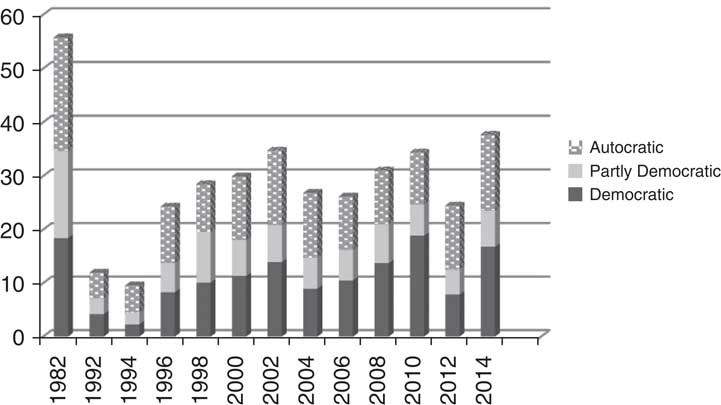
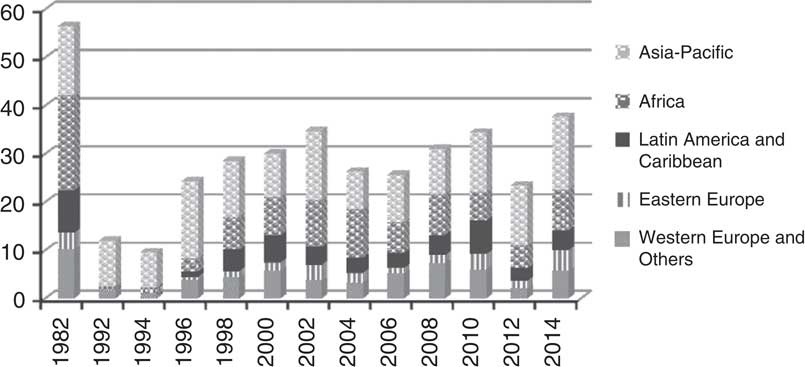
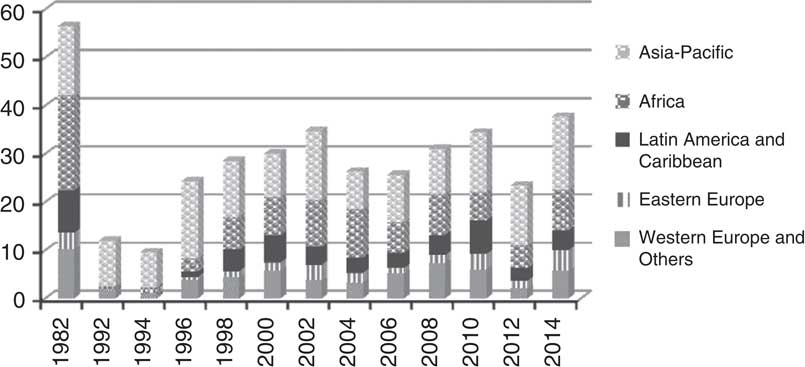
Another surprising trend has been the high number of democratic states that make no mention of democracy in their statements, particularly in 2010 and 2014, as is shown in Figures 3a and b, disaggregated by level of democracy and geographic region. In 1982, 55 per cent of UN member states did not make any reference to democracy; 18 per cent of UN member states both did not mention democracy and were democratic. By contrast, democratic states making no mention of democracy in their UNGA General Debate statements in 1992 and 1994 were 4 per cent and 2 per cent of the UN membership in the respective years, yet this increased to nearly 9 per cent in 1996. Between 1998 and 2014, this percentage fluctuated between 9 per cent and 19 per cent. States from the Western European and Other, Eastern European, Latin American and Caribbean, and African groups were nearly absent from Figure 3b in 1992 and 1994. In general, Figure 3 illustrates that democratic states have inconsistently reinforced democratic governance both as an issue and as a basis of social status, thereby also undercutting its salience.Footnote Footnote
One might argue that the degree to which Footnote democratic governance is viewed as important may vary according to the extent to which other issues are viewed as more important at a specific point in time.Footnote 62 In the UNGA General Debates, the increased salience of environmental issues, the international poverty eradication agenda, a particular conflict, or other issues could negatively affect the salience of democratic governance as an issue in a given session. Figure 2 partially addressed this concern by measuring the percentage of UN member states making at least one reference to democracy, because even if other issues are more prominent in a given session, states holding democracy as a priority will likely find the time in their statements to make at least one mention, regardless of the other important issues of the day.
Yet for this reason it is important to more closely examine the specific content of references to democracy in order to gain a finer-grained understanding of the salience of democracy as a dimension of international social status. In political science research on electoral behaviour, Christopher Wlezien notes that salience is often measured through surveys asking voters about the most important problem facing their country, a measurement that is conceptually distinct from the number of voters viewing the issue as important.Footnote 63 This is raised here to highlight that the indicators presented in Figures 1–3 arguably encompass both the degree to which states view democratic governance to be an important issue for international cooperation as well as a problem (or opportunity) in specific locations (for example, South Africa, Iraq) in a given year. As previously discussed, the above-referenced indicators also combine the degree to which states view democratic governance as an important issue, and the degree to which they are invoking references to democracy as a means of self-description and self-presentation. Therefore, the following section disaggregates this data to reveal patterns in the salience of democratic governance as a basis of social status.
Self-categorisation and the salience of democratic governance as a dimension of social status in the UNGA General Debates
The content of state representatives’ references to democracy provides important insights into the salience of democratic governance as a basis of social status in the UNGA. I identified seven general ways in which states speak about democracy in the UNGA General Debates. Each statement was coded as belonging to one of the following Footnote categories.Footnote 65 Specifically, some states:
-
(1) Mention democracy as an aspect of their foreign policy, express support for democracy in other states, or for UN action to support democratic development, but make no mention of current domestic democratic reforms;
-
(2) Assert explicitly that they are democracies or have consolidated democratic regimes. These states also mention democracy in their foreign policy, support for democratisation in other states, or for UN action, but do not mention ongoing domestic democratic reforms;
-
(3) Mention ongoing domestic democratic reforms and also mention democracy in their foreign policy or express support for democracy in other states, including support for related UN efforts;
-
(4) Mention ongoing domestic democratic reforms but make no mention of support for democratisation in their foreign policy or support for democracy in other states;
-
(5) Mention democracy vaguely as a positive or neutral norm;
-
(6) Challenge the international implementation of democracy support, related UN practices, or bilateral or multilateral conditions placed on aid; (see Figure 5) or
-
(7) Make no mention of democracy or democratisation in their statements (see Figure 3).
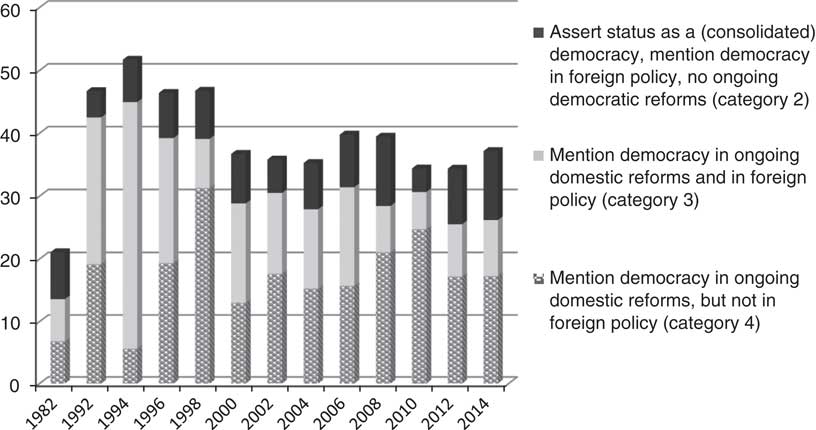
There is an important and unique complementarity between the statements in categories 2, 3, and 4, since they – unlike states in the other categories – make reference to domestic democratic characteristics that convey that they are a particular type of (democratic) state. Figure 4 presents the percentage of UN member states in categories 2, 3, and 4 over time. The graph indicates trends in the salience of democratic governance as a dimension of social status in the UNGA General Debates between 1982 and 2014.
Before explaining significant trends in Figure 4, it is important to clarify how states have used democracy as a symbol in the three categories. States in category 2 explicitly declare a status as having democratic (or consolidated democratic) regimes and express support for democracy in other states without reference to ongoing domestic democratic reforms. Representative of this category is the statement made by Mr Young of Saint Vincent and the Grenadines in 1992: ‘We in the English-speaking Caribbean, where democracy and constitutional order have long been institutionalized, are anxious to play our legitimate part, with full recognition of our condition and the requirements for global integration … We now look forward to sharing fairly in the dividends of a durable peace to which we have contributed by our stability and resolute commitment to liberty and democracy.’Footnote 66 Several states emphasise their active contributions to supporting democratic development. For example, Alberto Romulo, minister of foreign affairs for the Philippines, stated in 2004 that his country ‘is prepared to provide technical support and training in the areas of governance, the administration of justice, electoral processes and similar subjects, with third-party support. We will share our knowledge – a result of our own experiences as Asia’s first democracy – since we have had to struggle to regain and preserve that very same democracy.’Footnote 67
States in categories 3 and 4 convey a status as successfully democratising. These statements differ from those in category 2 because both mention ongoing democratic reforms. Unlike statements in category 4, category 3 statements also mention (rhetorical or material) support for democracy in another state, the broader region or through UN or international efforts. An example of a coding decision of a statement placed in category 3 is the statement by Pierre Osho, minister of foreign affairs and cooperation for Benin, in 1996, who expressed support for democratic development in Liberia and Burundi, requested international assistance ‘to complete its programme of building a State based on the rule of law’, and stated:
We in Benin have continued to strive to consolidate our new democratic experience which has been in place since the National Conference of Active Forces of the Nation in February 1990 … The generally correct and normal conduct of the ballot, the peaceful behavior of the vast majority of our political classes, the courageous and responsible attitude of the people of Benin and the unwavering stance taken continually by the Constitutional Court are all signs which demonstrate genuine political maturity and an irrevocable commitment to building a truly democratic society in the Republic of Benin.Footnote 68
States in category 4 make no reference to democracy beyond their borders in their statements in a given year. Similar to states in category 3, they often invoke democracy as a symbol of status and seek financial assistance for their transition efforts, increased investment, or partnerships. An example of a statement in category 4 is made by Sidi Mohamed Ould Boubacar, prime minister of the Islamic Republic of Mauritania, in 2006:
After the changes of 3 August 2005, the Islamic Republic of Mauritania ushered in a new era in its political history. The new era started with the creation of a pluralist, democratic system based on the guarantee of equality and justice for all … It includes constitutional reform, reform of the administration of justice, administrative reform to combat corruption, and reform of the electoral system by creating an independent national electoral commission on the basis of transparency and by encouraging the participation of women … On behalf of the Mauritanian people, I would like to thank sincerely all fraternal and friendly countries and international organizations and bodies that have supported our reform process.Footnote 69
Returning to Figure 4, we observe an increase in the percentage of UN member states using democratic governance as a symbol of social status from 21 per cent in 1982 to 47 per cent in 1992, peaking at over 51 per cent in 1994, and then declining from an average of 48 per cent between 1992 and 1998 to an average of 36 per cent between 2000 and 2014. Why?
Insights from social psychology and IR help to explain these trends. During the Cold War, democracy served as a principle underpinning more geographically-limited international orders. In 1982, 45 per cent of the states represented in categories 2, 3, and 4 were from Latin America or the Caribbean, where concerns about intervention existed.Footnote 70 The dramatic increase in 1992 in states’ use of democracy as a symbol of status reflects the fundamental shift in the significance of democratic governance in the post-Cold War international order.
Between 1992 and 1998, a consistently high percentage (between 46 per cent and 51 per cent) of UN member states mentioned successful ongoing democratic reforms or asserted status as a (consolidated) democracy in their UNGA General Debate statements. While this data cannot precisely determine whether states’ use of democracy-related rhetoric is motivated by material or ideational factors, it is clear that a combination of both is at work. For example, invoking democracy within his state’s identity alongside other objectives, Andris Šķēle, prime minister of the Republic of Latvia, stated in 1996;
Our country belongs to the European family of democratic States, sharing common values and cooperating for their protection. Integration in the European and transatlantic structures is the highest priority for Latvia … Latvia is a country that is attached to the ideals of peace, democracy and human rights. It identifies itself with the efforts of the global society to maintain and realize these ideals … This, we are convinced, is the genuine road to security and social and economic prosperity for our country and for the world.Footnote 71
This example shows that state representatives’ use of symbols in the UNGA also reflect status concerns in groups beyond the UN (for example, the EU, OSCE, OAS, NATO), as they simultaneously speak to multiple audiences. Illustrating a link between publicising democratic credentials and investment, Adrien Sibomana, prime minister of the Republic of Burundi, stated in 1992; ‘The political reforms that have taken place within the framework of strengthening national unity and of democratization of institutions have created in our country a political and social environment which is very favorable to business.’Footnote 72 Consistent with Table 1, in the 1990s we observe a higher salience of democratic governance as a basis of social status in Figure 4 when the current and future status positions of established, prototypical democratic states were generally viewed as high and when the comparatively lower appeal of alternative forms of governance encouraged many states to self-identify as successfully democratising.
Among low identifiers, which are a subgroup of states within categories 3 and 4, instrumental use of status-related democracy rhetoric is more likely and is suggested by the context. The following example offers additional insights into states’ motivations. In 1996, of the 71 states in categories 3 and 4, within one paragraph of mentioning their successful democratic reforms or elections (which are typically also conveyed as domestically beneficial), 34 state representatives sought UN or international support for democratic or economic development and/or expressed gratitude for the international community’s prior support; 13 states sought integration into international economic structures or enhanced partnerships or relations with Europe or the US; 12 states expressed a general interest in economic development or poverty reduction; 5 states expressed a general interest in increased investment; 3 states sought a supportive external environment; and 2 states sought the lifting of sanctions on their country.Footnote 73 The two representatives requesting the lifting of sanctions on their states and reduced international pressure in tandem with their use of democracy-related rhetoric could be simultaneously interpreted as responding to stigma. In 1996, 11 states in categories 3 and 4 expressed no particular interests within one paragraph of mentioning their democratic reforms, suggesting potential limits to instrumental explanations.
Turning to the 2000s, Figure 4 illustrated a significant decline in the percentage of UN member states using democracy as a symbol of status in 2000, remaining comparatively low through 2014. Why? Do these trends reflect decreased support among UN member states for democratic governance as a principle underpinning international order?
The decrease and plateau in the use of democracy as a symbol of status after 2000 are partly explained by decreased accessibility, or the extent to which the social category of a (successfully) democratising state corresponded (or did not correspond) with states’ other key goals of economic development, as well as frustration with less-than-anticipated international recognition of democratic reforms. Representatives of some democratising states expressed disappointment that democratic reforms did not generate more benefits and resources. As Clément Rohee, minister of foreign affairs for the Republic of Guyana, stated in 2000: ‘Despite the fact that many have embraced market-based reforms and democratic governance, they have had limited success in improving the socio-economic conditions of their people. Their efforts to undertake important reforms … have been rewarded by a denial of much-needed assistance to sustain the progress achieved.’Footnote 74 This frustration was echoed by Jakaya Mrisho Kikwete, minister of foreign affairs and international cooperation for the United Republic of Tanzania, in 2002, who argued that ‘most of our countries have made serious efforts to meet these ideals (of good governance, democracy, rule of law and human rights) with reasonable success. However, it is frustrating to note that there is little appreciation of these achievements. Instead, there is amplification of the little that is yet to be overcome. Many of us feel that we deserve to be treated better.’Footnote 75 The above examples suggest that not only were democratisation strategies (and foreign policy use of democracy-related rhetoric) rewarded with fewer benefits than anticipated, there was also less permeability in the group of democratic states than some states expected, likely contributing to the decline in the salience of democratic governance as a status dimension in Figure 4.
The utility of states’ self-identification as successfully democratising or having a consolidated democratic regime arguably decreased in the 2000s. China’s significance as an international donor in the 2000s reduced the overall percentage of development assistance with democratic conditions.Footnote 76 Whereas in the 1990s, many countries viewed democratic governance as highly compatible with economic growth and development, in the 2000s, alternative governance models offered a wider range of political arrangements favourable to investment flows. Further inhibiting status-related democratic rhetoric after 11 September 2001, cooperation against terrorism became more important in US aid allocations, thus partially displacing democratic conditionality. Nevertheless, Euro-Atlantic integration and economic development continued to motivate the use of democracy as a symbol in states’ rhetoric. As Bamir Topi, president of the Republic of Albania, stated in 2010: ‘As a full-fledged member of NATO and in the light of its internal democratic stability, Albania is now seeking greater standing in the world as a way to bolster its development in the long term.’Footnote 77 Similarly, Elias Antonio Saca González, president of the Republic of El Salvador, stated in 2006:
My country has been recognized for having adopted a series of measures to strengthen democratic institutions, economic freedoms and social investment. This has gained us the confidence of the international community, which we believe is indispensable for establishing an environment conducive to mobilizing alternative sources of funding that can make possible social programmes aimed at reducing poverty.Footnote 78
The trends in Figure 4 also reflect some states’ responses to changes in the anticipated or current relative standing of the group of democratic states. Low identifiers are more sensitive to the actual and anticipated status position of the group and are more likely than high identifiers to use rhetoric instrumentally.Footnote 79 Decreases in the use of status-related democratic rhetoric in 2010 and 2012 can be interpreted as partially reflecting low identifiers’ reactions to the financial crisis in the US and Europe. Yet status is also a non-instrumental end in itself. Some states are proud of the history of their democratisation processes and are pleased to publicise these successes or share their experience. For example, Elbegdorj Tsakhia, president of Mongolia, stated in 2014: ‘To support emerging democracies, Mongolia has set up an international cooperation fund. We have nothing to preach, but we have experience and lessons learned. We therefore shared with Kyrgyzstan our experience in parliamentary democracy and legal reform, and we held training sessions for Afghan diplomats and Myanmar journalists.’Footnote 80 Higher identifiers are more likely to continue using democratic governance as a status symbol in their rhetoric, even if the status of the group of democratic states declines. The following paragraphs turn to the question of potential effects of contestation on the salience of a status dimension.
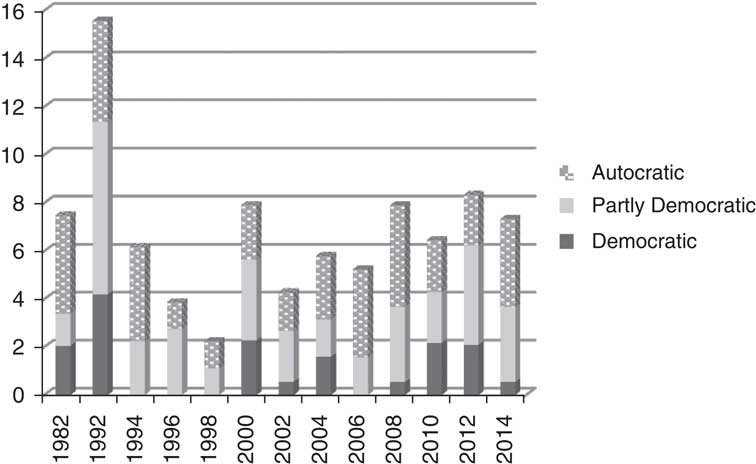
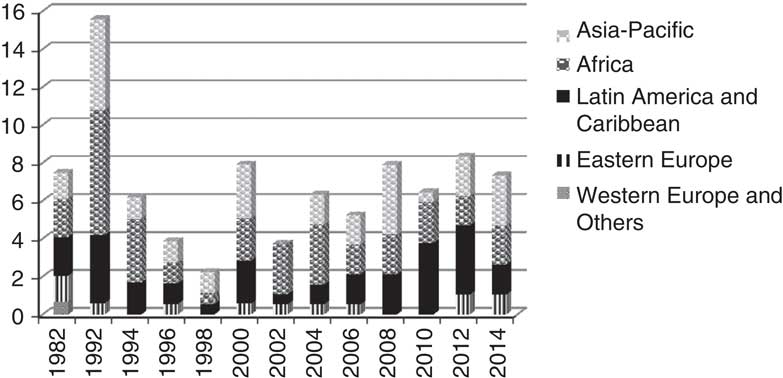
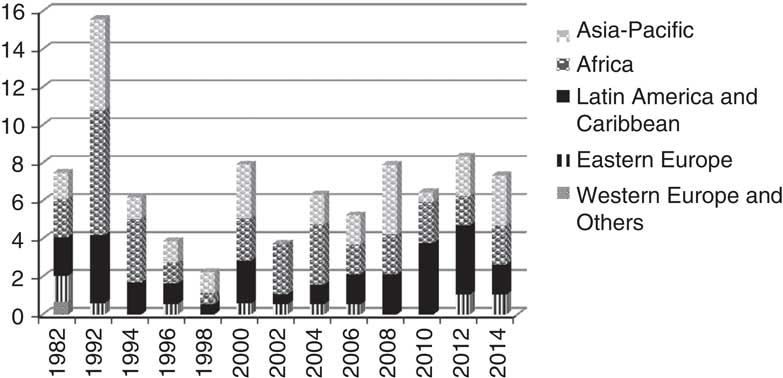
An indicator of discontent with how international society has operationalised democratic governance as a principle of international order is reflected in the percentage of UN member states in the UNGA General Debates challenging implementation practices of multilateral or bilateral democracy support or democratic conditionality on aid Footnote Footnote Footnote (category 6). Figures 5a and b illustrate these trends, disaggregated by level of democracy and world region. From a baseline of 7.5 per cent of UN member states in 1982, contestation peaked at nearly 16 per cent in 1992 and decreased monotonically during the 1990s to a minimum value of 2.2 per cent in 1998. These figures rose again in the 2000s, averaging 6.7 per cent of UN member states between 2000 and 2014, yet with substantial fluctuations. Notably, state representatives have not challenged the core content of democratic norms in their statements, but rather have contested multilateral and bilateral implementation policies and practices.
What has motivated these trends in contestation? In 1982, states in this category typically challenged aspects of US democracy promotion. By 1992, democracy’s prominence at global level intensified sovereignty concerns, and the high number of states challenging international democracy support (including UN electoral assistance)Footnote 84 or democratic conditionality stemmed from the recent expansion of these practices and states’ uncertainty about the extent of their application. Many UN member states in 1992 were suspicious and asserted that no country ‘should use its power to dictate its concept of democracy and of human rights or to impose conditions on others’, as expressed by Soeharto, president of the Republic of Indonesia, on behalf of the 108 members of the Non-Aligned Movement.Footnote 85 By 1998, expression of these critiques vastly decreased, with representatives of Zimbabwe and Cuba among the few dissenters.
In 2000, an upswing in contestation was concurrent with prominent debates on humanitarian intervention and the responsibility to protect, which raised concerns for sovereignty and non-intervention; the launch of the Community of Democracies in June 2000; inclusion of democracy as a key principle of the UN Millennium Declaration (Section V); and codification of a resolution on ‘Promoting and Consolidating Democracy’ in the Commission on Human Rights in April 2000.Footnote 86 A comparable UNGA resolution (55/96), which was the most comprehensive statement of democratic norms and attributes of democratic regimes in the UNGA at the time, was adopted in December 2000.Footnote 87 Challenges in the 2000s in part aimed to prevent the further institutionalisation of democratic norms (for example, specifying attributes of democratic regimes with indicators), which would potentially reinforce categories of stratification and make gaps in non-democratic states’ ‘fit’ with the social category more visible. Moreover, some states objected to promotion of what they perceived as a single model of democracy.
It is significant that representatives of states with democratic and partly-democratic regimes have engaged in contestation, alongside their more autocratic counterparts. Statements indicate that some sought greater respect for local traditions, cultures, and differences in approaches to democracy support, or made claims of double standards. In 2010, 2012, and 2014, the tone of critical statements became more antagonistic and entailed a greater degree of specificity than in previous years, while several states again appealed for greater respect and dignity in international democracy support. Use of these terms strongly indicates status motivations, suggesting a reaction against democratic governance as a basis of international social status in an example of social creativity. For example, Mohamed Waheed, president of the Republic of Maldives, stated in 2012 that international cooperation ‘should not be used as an excuse for larger countries to interfere in the domestic politics of small states … Respect for us and our small nation requires that our external partners not underestimate our capacity to contribute to the shaping of our own destiny.’Footnote 88 It makes sense that states will attempt to reduce international pressures if they perceive a political opportunity.
Realists would expect increased contestation to correspond with geopolitical power shifts. Yet, counter to realist expectations, there was not a consistent increase in contestation over the 2000s, and discordant behaviour was not limited to the most powerful, less democratic states. Moreover, neoliberalism fails to predict that challenges against international democracy support and democratic conditionality on aid would be more numerous in 1992 than in 2012, when states such as China and Russia had greater material resources. Contestation in 1992 is better explained as a response to the new emphasis on democracy in the international order and concern about the extent of associated practices. In the 2000s, while contestation generally increased when levels of aid without democratic conditionality rose, a systematic correlation is not observed. Contestation patterns fluctuated considerably in the 2000s and also reflect some state representatives’ interests in preventing democratic status markers from gaining increased traction in the UN system and in the wider international community.
Why do the trends in Figure 5 regarding contestation not correlate even more closely with the trends in Figure 4, especially since contestation is expected to negatively influence the salience of a basis of social status? For example, Figure 4 illustrated a much higher salience of democratic governance among UN member states in 2014 than in 1982, yet patterns in contestation are similar in 2014 and 1982, suggesting multipolarity in the international system. However, whereas contestation is expected to negatively influence the use of a status symbol among low identifiers, among high identifiers contestation is expected to increase the salience of their (democratic) identity. Low identifiers are more sensitive to contestation than high identifiers. As discussed above, ‘identity threat’ and contestation can bind together the more highly committedFootnote 89 democratic states, increasing the salience of democratic governance as a basis of social status for this group in particular.
Conclusion
This article has made a case for increased attention to the salience of specific status dimensions, which reveal important trends in support for principles underpinning international order. The analysis illustrated significant variations in the salience of democratic governance both: (a) as an issue and (b) as a basis of social status in the UNGA General Debates over time and presented plausible explanations. First, the study revealed a substantial increase in the salience of democratic governance as an issue (Figures 1 and 2) in the UNGA General Debates between 1982 and a peak in 1992–4, after which levels decreased and plateaued between the extremal values. Figure 3 showed the surprising trend that a significant number of democratic states have not used democracy-related rhetoric in their statements over time, in part undercutting the salience of democratic governance in this forum.
To gain insight into the salience of democratic governance as a basis of social status, the article then presented a fine-grained content analysis of UN member states’ references to democracy. It was found that from an average of 48 per cent between 1992 and 1998, the percentage of UN member states using democratic governance as a symbol of status in their General Debate statements decreased to an average of 36 per cent between 2000 and 2014. Explaining these trends were a combination of material and ideational factors emphasised in social psychological (Table 1), and constructivist and liberal IR scholarship. The salience of democratic governance as a basis of social status was higher in the 1990s when the current and future positions of established democratic states were generally viewed as high and when the comparatively lower appeal of alternative forms of governance encouraged many states to self-identify as successfully democratising. The varied ideational and material motivations for state representatives’ use of symbolic democracy-related rhetoric included interests in international assistance, investment, expression of democratic identity, recognition of democratisation successes, integration into global or regional economic structures, or international partnerships.
In the 2000s, the decreased salience of democratic governance as a basis of social status was in part explained by changes in accessibility, as status as a democratising state became less clearly linked with goals of economic development, particularly when fewer rewards (material and recognition) were forthcoming than anticipated, states with alternative political models increased their standards of living, aid without democratic conditionality was increasingly available, and the financial crisis contributed to views of a current or future decline in the relative standing of democratic states, particularly among low identifiers. However, the stability between 2000 and 2014 in the percentage of states continuing to use democratic governance as a symbol of status (Figure 4) despite contestation (Figure 5) as well as considerable fluctuations in contestation, contradict realist expectations of the exclusive influence of international power shifts on status politics and suggest continued resolve among a core group which also includes high identifiers. Evidence from 2012 suggests that manipulation, or higher levels of public discussion of democracy (Figures 1 and 2), was less influential than expected, since a corresponding increase in status-related democracy rhetoric (Figure 4) was not observed in 2012. Future research might examine this further and perhaps specify if there is a particular type or source of increased public discussion that does influence the use of status symbols in international organisations.
A liberal IR scholar might argue that state representatives speak largely to domestic audiences in their UNGA General Debate statements. This would not weaken the article’s claims because in this highly public forum leaders are simultaneously appealing to international audiences. Leaders who invoke democracy as a symbol of status in international fora may assume that their domestic constituencies care about the state’s international democratic image. Future research might make comparisons with similar trends at the level of individuals.
Although the UNGA General Debates are public, there is an absence of mechanisms to prevent states from making false claims about their democratic characteristics. It is ‘possible to define oneself on the basis of a category when one fulfills few of the criteria traditionally considered to define that identity’, argue Manuela Barreto and Naomi Ellemers.Footnote 90 This typically occurs under conditions of anonymity,Footnote 91 although the UN system’s historically flexible understanding of democracy has contributed to the use of democracy in the rhetoric of all types of states. Implications of a gap in the ‘fit’ between domestic practices and rhetoric remain an interesting topic for further examination. Future research could also delve more deeply into foreign policy considerations behind status-related democracy rhetoric of individual UN member states over time, as well as make additional comparisons to trends in the salience of alternative issue areas and dimensions of social status. This article has suggested benefits of classifying states as low- and high identifiers in the study of status dimensions in world politics, which would also be a promising area for more systematic analysis. Finally, the methods proposed here for assessing trends in the salience of a status dimension could be fruitfully applied to other status dimensions in the UN system or in other international organisations.
Undercutting the salience of democratic governance: Percentage of UN member states making no mention of democracy in their UNGA General Debate statements, 1982–2014.59Disaggregated by level of democracy.60
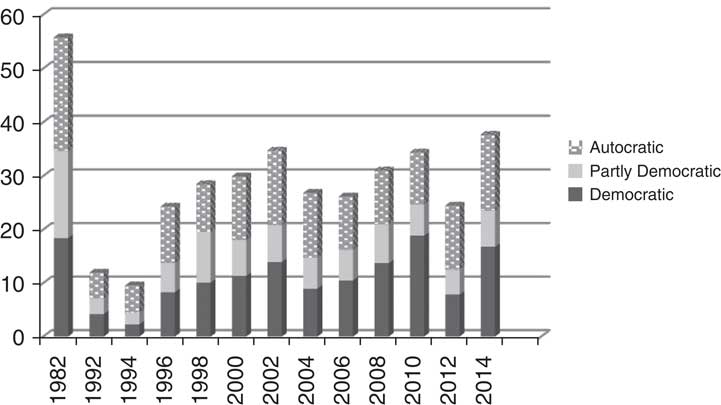
Percentage of UN member states making no mention of democracy in their UNGA General Debate statements, 1982–2014. Disaggregated by region.61
Variation in the salience of democratic governance as a basis of social status: Percentage of UN member states mentioning ongoing domestic democratic reforms or asserting status as a democracy in their UNGA General Debate statements, 1982–2014.64
Trends in contestation: Percentage of UN member states challenging the implementation of international democracy support or democratic conditionality on aid in their UNGA General Debate statements (category 6).81 Disaggregated by level of democracy.82
Disaggregated by region.83
Acknowledgments
For helpful comments, I am grateful to Max Cameron, Katia Coleman, Alex Dukalskis, Petru Dumitriu, Maria Fanis, Payam Foroughi, Beatrix Futák-Campbell, Michael Jasinski, Markus Kornprobst, Deborah Larson, Clare McGovern, Dirk Peters, Roland Rich, Lisa Sundstrom, Thomas Volgy, Hans Winkler, Jacob Wobig, the anonymous reviewers, participants at American Political Science Association, International Studies Association and European International Studies Association conferences, and to all those who graciously agreed to be interviewed. This research was supported by the Social Sciences and Humanities Research Council of Canada. Responsibility for any errors rests solely with the author.