INTRODUCTION
Foraging habits contribute to the basic description of the ecology of species (Sih & Christennsen, Reference Sih and Christennsen2001), influence the organization (Paine, Reference Paine1966) and functioning of marine ecosystems (Sih et al., Reference Sih, Englund and Wooster1998; Shears & Babcock, Reference Shears and Babcock2002). Predation plays an important role in structuring the trophic levels of a community through a progression of direct and indirect effects of predators across successively lower trophic levels (top-down control) (Loeuille & Loreau, Reference Loeuille and Loreau2004). In marine environments, top-down control can determine the distribution and abundance of algae and invertebrates in both coral reefs (Miller & Hay, Reference Miller and Hay1998; Verges et al., Reference Verges, Alcoverro and Ballesteros2009; Hoey & Bellwood, Reference Hoey and Bellwood2011) and in macroalgae-dominated habitats (Sala & Boudouresque, Reference Sala and Boudouresque1997; Davenport & Anderson, Reference Davenport and Anderson2007; Newcombe & Taylor, Reference Newcombe and Taylor2010). Characterizing the feeding habits of the predatory species allows us to understand both aspects of their biology and ecology and the relationship to their habitats (Hajisamae et al., Reference Hajisamae, Chou and Ibrahim2003; Pérez-Matus et al., Reference Pérez-Matus, Pledger, Díaz and Ferry2012).
An important aspect of an organism's diet is its feeding strategy, which determines the degree of selectivity when capturing prey. Dietary selectivity is a component of the optimal foraging theory (OFT), which is based on prey items that are different in terms of energy and time that the predator takes in capturing them (Sih et al., Reference Sih and Christennsen2001). The OFT, coined by MacArthur & Pianka (Reference MacArthur and Pianka1966) and reviewed by Pyke (Reference Pyke1984), suggests that organisms follow behavioural strategies to maximize the biological adaptation for foraging. This strategy is related to and mediated by the abundance of prey, where predators can respond in two ways: first, by changing its own abundance relative to that of its prey, a situation known as the predator numerical response (Taylor, Reference Taylor1984). Secondly, by changing its rate of consumption of that prey, known as a functional response (Solomon, Reference Solomon1949). Thus, we expect that in habitats with low diversity of prey, or oligotrophic areas with abundant prey, predators will favour a stenophagic and selective foraging strategy (Pyke et al., Reference Pyke, Pulliarn and Charnov1977; Medina et al., Reference Medina, Araya and Vega2004; Griffin et al., Reference Griffin, Pearce and Handy2012).
Oceanic island ecosystems are expected to have lower prey availability when compared to continental systems (Andrews, Reference Andrews1976). Species richness on an island is the result of a balance between immigration and extinction events (MacArthur & Wilson, Reference MacArthur and Wilson1967), where larger islands have a lower extinction rate and in some cases greater immigration (Mora et al., Reference Mora, Chittaro, Sale, Kritzer and Ludsin2003), while small islands and distant continents have a reduced immigration, and low species richness (Sandin et al., Reference Sandin, Vermeij and Hurlbert2008). For these biogeographic conditions, oceanic island ecosystems are expected to have lower prey availability compared to continental systems (Andrews, Reference Andrews1976). Similarly, structured habitats tend to support more species than less structured habitats, and some oceanic islands are characterized by low habitat complexity. For instance, an absence of large brown macroalgae and mussel beds can result in low habitat complexity, since they provide structured habitat for a myriad of small organisms (Angel & Ojeda, Reference Angel and Ojeda2001; Pérez Matus et al., Reference Pérez-Matus, Ferry-Graham, Cea and Vasquez2007, Reference Pérez-Matus, Pledger, Díaz and Ferry2012; Fariña et al., Reference Fariña, Palma, Ojeda, McClanahan and Branch2008; Villegas et al., Reference Villegas, Laudien, Sielfeld and Wearntz2008). These habitats are considered to be nursery zones for both coastal and oceanic fish (Landaeta & Castro, Reference Landaeta and Castro2004). The absence of these habitats in oceanic island ecosystems may indicate a low presence of potential prey for reef fish (Taylor, Reference Taylor1998).
There is a strong relationship between the morphology of organisms and their natural history (Wainwright & Bellwood, Reference Wainwright, Bellwood and Sale2002). The study of morphology from an ecological context has become a useful tool for understanding how organisms with different body shapes and structures sizes acquired different abilities (Goatley & Bellwood, Reference Goatley and Bellwood2009). For example, morphological differences in the components of the pectoral fins and the relationship with caudal fins determine differences in locomotion (Wainwright et al., Reference Wainwright, Bellwood and Westneat2002; Collar & Wainwright, Reference Collar and Wainwright2006) and adaptations to the life of fish at sites of varying wave exposure and current flow (see Floeter et al., Reference Floeter, Krohling, Gasparini, Ferreira and Zalmon2007). On the other hand, morphological differences associated with mandible structures suggest different feeding strategies (Ferry-Graham et al., Reference Ferry-Graham, Wainwright, Hulsey and Bellwood2001; Wainwright & Bellwood, Reference Wainwright, Bellwood and Sale2002; Horn & Ferry-Graham, Reference Horn, Ferry-Graham, Allen, Horn and Pondella2006). The size of the jaw opening, diameter of eyes (Ferry-Graham et al., Reference Ferry-Graham, Wainwright, Hulsey and Bellwood2001; Goatley & Belwood, Reference Goatley and Bellwood2009) and surface of the pectoral fins (Wainwright & Bellwood, Reference Wainwright, Bellwood and Sale2002; Wainwright et al., Reference Wainwright, Bellwood and Westneat2002; Denny, Reference Denny2005) are essential to the understanding of the functional biology associated with foraging behaviour of fish. Another important sensory mechanism in fish is vision (Guthrie & Muntz, 1993; Myrberg & Fuiman, Reference Myrberg, Fuiman and Sale2002), and from early larval stages fishes have the ability to detect prey at low light intensities (Job & Bellwood, Reference Job and Bellwood2000). A measurement of the diameter of the eye may be a good parameter to describe visual ability, because the diameter of the eye corresponds to the size of the retina and lens, which determines light sensitivity and acuity to hunt prey at low light intensities (Protas et al., Reference Protas, Conrad, Gross, Tabin and Borowsky2007).
Feeding and locomotion are closely related in different animal groups (Rice & Westneat, Reference Rice and Westneat2005; Vincent et al., Reference Vincent, Herrel and Irschick2005; Higham, Reference Higham2007). In fish, individuals with greater stopping capability have great ability to stabilize their movement while feeding (Higham, Reference Hyslop2007); this stabilization is achieved by having an extension of its pectoral fins (Rice & Westneat, Reference Rice and Westneat2005), thus a greater success in capturing benthic prey (Higham, Reference Higham2007). Another important morphological component for understanding the foraging behaviour of fish aspect ratio of the pectoral fin (AR) with respect to the swimming ability of each species (Wainwright et al., Reference Wainwright, Bellwood and Westneat2002). Fin measurements can be linked to the environment where fish species inhabit, for example in deep waters and with low flow we expect to find low values of AR while in shallow zones with more flow high values of AR are expected (Bellwood & Wainwright, Reference Bellwood and Wainwright2001; Fulton et al., Reference Fulton, Bellwood and Wainwright2001).
Consequently, the aim of this study is to identify the foraging ecology by coupling the diet with the feeding morphology of the most abundant component of the reef fish assemblage at Isla (Island) Robinson Crusoe. Secondly, we characterize the trophic structure of the coastal fish assemblage at the Juan Fernandez Archipelago.
MATERIALS AND METHODS
Sampling
STUDY AREA
The Juan Fernandez Archipelago is a group of three islands, formed six million years ago (Burridge et al., Reference Burridge, Melendez and Dyer2006), and is located in the eastern South Pacific, 700 km west of Valparaiso, Chile (Haase et al., Reference Haase, Mertz, Sharp and Garbe-Schonberg2000). Islas (Islands) Robinson Crusoe and Santa Clara are the nearest to the continent, with areas of 47.9 and 2.2 km2, respectively, while Isla Alexander Selkirk, is 49 km2 and is located 178 km west of Isla Robinson Crusoe. This small group of islands has relatively low species diversity compared to continental Chile. The coastal fish fauna of the Juan Fernandez Archipelago is composed of 42 species, 12% of which are endemic to Isla Robinson Crusoe (Dyer & Westneat, Reference Dyer and Westneat2010).
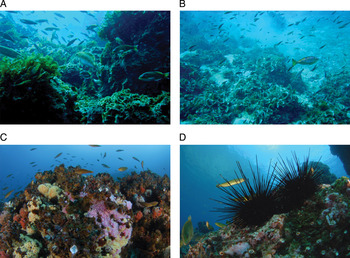
The subtidal habitat in the Juan Fernandez Archipelago, is characterized by a rough topography and is dominated by rocky bottoms, allowing for the settlement of foliose brown algae Padina fernandeziana (Skottsberg & Levring, 1941) and Dictyota kunthii ((C.Agardh) Greville, 1830) (Eddy et al., Reference Eddy, Ramírez and Pérez-Matus2008). A gastropod from the Vermetidae family (Serpulorbis sp.), and echinoderm Centrostephanus rodgersii (Agassiz, 1863) are both common in the rocky subtidal environments of these islands (Figure 1; see Eddy et al., Reference Eddy, Ramírez and Pérez-Matus2008). The Juan Fernandez Archipelago is characterized by the absence of large brown macroalgae and mussel beds (Ramírez & Osorio, Reference Ramírez and Osorio2000).
Major habitats of subtidal environment of the island of Robinson Crusoe. (A) (date: 9/18/2007, depth: 8 m, visibility: 12.5 m, bottom temperature: 13.3°C) and (B) (date: 10/1/2007, depth: 9 m, visibility: 16 m, bottom temperature: 13.4°C) correspond to habitats dominated by foliose brown algae. (C) (date: 9/27/2007, depth: 15 m, visibility: 10 m, bottom temperature: 13.6°C) and (D) (date: 9/14/2007, depth: 11 m, visibility: 17 m, bottom temperature: 13.2°C) correspond to those habitats dominated by sessile invertebrates. Photographs A and B Fabián Ramírez, C and D Eduardo Sorensen.

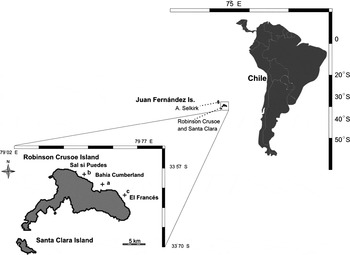
This study was carried out on the reef systems surrounding the Juan Fernandez Archipelago, during the austral spring (September and October) 2007 and summer (February) 2008. Our research focuses on Isla Robinson Crusoe (33°37′S–78°51′W) due to limited access to Islas Alejandro Selkirk and Santa Clara. We selected three sampling sites, located northeast of the Isla Robinson Crusoe (Figure 2). The first was Cumberland Bay, which is semi-protected from wave energy and is characterized by highly eroded substrata. This site has a sandy bottom with small rock formations, allowing for the settlement of macroalgae such as D. kunthii, P. fernandeziana, Colpomenia sinuosa (Mertens ex Roth) Derbès and Solier, 1851 and Ulva lactuca (Linnaeus, 1753), which dominate the subtidal environment. The second site was Sal si Puedes, which is semi-protected from wave action with shallow rocky reef topography (Eddy et al., Reference Eddy, Ramírez and Pérez-Matus2008). At this site, some reefs were completely covered with foliose algae and sessile invertebrates, represented by brown algae, cnidarians and gastropods of the family Vermetidae such as Serpulorbis sp., which is very common in the subtidal environment of these islands and reaches the highest abundance at this site. The third sampling site was El Frances, which is more wave exposed compared to the other sites and is characterized by two reef platforms at different depths. The shallower reef (10 m) is closer to the coast and is characterized by eroded substrate, represented by soft bottom and a high abundance of the sea cucumber, Mertensiothuria platei (Ludwig, 1898). The deeper reef platform (15 m) is characterized by a rocky topography and is dominated by algae and invertebrates, such as brown algae: D. kunthii, P. fernandeziana and C. sinuosa, Serpulorbis sp., gastropods, and the black urchin, C. rodgersii (Eddy et al., Reference Eddy, Ramírez and Pérez-Matus2008).
Map of study sites at Isla Robinson Crusoe: Bahía Cumberland (a) fishing community; Sal si Puedes; and el Francés. Major continental ocean currents also depicted.

Abundance of reef fish
At each sampling site we placed a transect of 40 m perpendicular to the coastline to conduct ten monitoring stations, which were separated by 4 m each, between the depths of 5–30 m. Surveys were conducted by one diver who surveyed each station for 2 min, counting, identifying and estimating the size of fish that passed through the sampling station area (4 m wide by 4 m long), resulting in an area of 160 m2 surveyed for each site.
Collection of fish
We collected the most abundant fish (in order to avoid harmful effects on the population of unknown fish species). The collection of specimens was performed by two ways: Bahía Cumberland fishers performed hand-line fishing for the species (P. chilensis, P. chilensis, M. reticulatus, H. semicintum and N. gayi) at the same sites and depths as above. It is important to note that the fishers exploit these species during the season of the Juan Fernandez lobster fishery Jasus frontalis (Milne Edwards, 1837) (Eddy et al., Reference Eddy, Gardner and Pérez-Matus2010). Secondly, experienced fishers used a speargun to collect juvenile and adult S. chilensis individuals.
Subtidal habitats and zonation
Percentage cover of sessile organisms was obtained using 50 cm by 50 cm quadrats (0.25 m2) with equally spaced points of intersection (CPI), which were randomly placed in two positions at each sampling station along the transect (as above). At each transect swats we performed 20 quadrats. The count of sessile species was recorded in situ, and was identified to the lowest possible taxonomic level. Unidentified organisms were collected and stored in buffered formalin (5%) for later identification in the laboratory.
Due to logistical constraints, we performed three transects (60 quadrats) at Bahía Cumberland and Sal si puedes and four (80 quadrats) at El Francés characterizing the subtidal habitat at Isla Robinson Crusoe.
Dietary analysis
Collected specimens were identified and measured for total length (TL) and standard length (SL) in the laboratory. Digestive tracts were removed from the oesophagus to the anus and were fixed in 5% formalin for subsequent dietary analysis. Stomach contents were placed in a Petri dish, separated and identified to lowest possible taxonomic level using a dissecting microscope.
To determine the diet of subtidal fish from Isla Robinson Crusoe, we calculated the relative abundance of prey (measured in volume), mass or number and estimated as a proportion of total prey consumed (Hynes, Reference Hynes1950; Hyslop, Reference Hyslop1980). First, we calculated the satiety index of each individual, using a scale from 0 to 1 where 0 indicates a completely empty stomach and 1 indicates a completely full stomach (Platell & Potter, Reference Platell and Potter2001). Subsequently, prey items were scored according to presence in the sample of stomach contents for each individual fish on a scale of 0 to 10; where 0 indicates an absence of the prey item and 10 indicates that all of the stomach contents corresponded to that prey item (Feary et al., Reference Feary, Wellenreuther and Clements2009). Finally, prey content was calculated by volume (%V), which was obtained by multiplying the satiety index with the rate of presence of each prey item (Krebs, Reference Krebs1999). To assess the importance of each group of prey in the diet, we calculated the frequency of occurrence of each prey item (%FO), which indicates the percentage of each prey item in the stomachs analysed. This is calculated by multiplying the number of stomachs where prey item appeared by 100 and dividing by the total number of stomachs analysed per species (Hyslop, Reference Hyslop1980).
Morphological analysis
Morphological analysis was carried out in 46 individuals, belonging to three of the most abundant species in the Juan Fernandez Archipelago (M. reticulatus, H. semicintum and S. chilensis). Measures were taken for: total length (TL), standard length (SL), horizontal opening of the mouth (OM), eye diameter (ED), upper jaw length (LMS), lower jaw length (LMI) pectoral fin area (PA) and caudal fin area (CA). OM was measured as the greatest horizontal distance that can be measured internally without visible distortion of the mouth (Goatley & Belwood, Reference Goatley and Bellwood2009). Eye diameter (ED) was measured as the maximum eye width extension outside of the globe. All measurements were made using digital calipers, with an accuracy of 0.05 mm. The aspect ratio of the pectoral (AR) fin was measured using the relationship:
AR = L 2/a
where, L is the length of the upper edge of the fin, and a is the area of the pectoral fin (Wainwright et al., Reference Wainwright, Bellwood and Westneat2002). To measure the area of the pectoral fin, we removed the right fin and traced the outline on graph paper. The AR with respect to the swimming ability of the species is positively correlated with swimming performance (Wainwright et al., Reference Wainwright, Bellwood and Westneat2002); if values of AR are low, it will indicate a round-finned fish which will indicate swimming at low speeds, with greater manoeuvrability (Fulton et al., Reference Fulton, Bellwood and Wainwright2001), while edged fins with high values of AR will indicate higher and sustained swimming abilities (Denny, Reference Denny2005).
Statistical analysis
The dietary similarity of species was estimated by non-parametric statistics, using analysis of similarity (ANOSIM) to determine the average contribution of each prey item (%V). We also tested if diet differed among species. To determine the percentage contribution of each prey item, similarity indices were analysed using SIMPER (similarity percentage) analysis (Clarke, Reference Clarke1993; Clarke & Warwick, Reference Clarke1994).
According to Berg (Reference Berg1979) and Medina et al., (Reference Medina, Araya and Vega2004) high and low values of Shannon–Wiener diversity index (H′) of prey consumed indicate euriphagic or stenophagic strategies, respectively. We calculated this index using the volumetric composition of prey items in the species studied. In order to test differences in diversity (H′) of prey consumed by different species, a one-way analysis of variance (ANOVA) was conducted. The assumptions of evenly distributed variances and normal distribution were tested using Fligner–Killeen and Cochran tests, respectively (Crawley, Reference Crawley2007). A Tukey's post hoc test was performed to determine if differences in dietary diversity were observed for the species studied.
To compare the dietary similarity among species we conducted a Bray–Curtis similarity analysis (Bray & Curtis, Reference Bray and Curtis1957), using %V of each prey item. This result was illustrated with a dendrogram using the weighted average distance of individual nodes (group average), which established the common prey consumption of fish, which ultimately determines the formation of trophic groups; the formation of trophic groups was estimated by averaging the triangular matrix of Bray–Curtis similarity as per Robertson & Cramer (Reference Robertson and Cramer2009).
To determine if fish utilized cranial or pairs (pectoral fins) structures in foraging, we utilized the relationship between OM, ED, PA, and CA, which were analysed using least squares linear regression models. We also performed analysis of covariance (one-way ANCOVA) for these parameters (Zar, Reference Zar1999). To determine whether differences in the aspect of the pectoral fin in the fish studied, we performed an analysis of variance (one-way ANOVA). To test for the assumptions of ANOVA such a homoscedasticity of variances and normal distribution we performed the analysis of Fligner–Killeen and Cochran tests, respectively (Crawley, Reference Crawley2007). We performed a posteriori test (Tukey post hoc test) to determine differences in the aspect ratio of the pectoral fin of the species studied.
RESULTS
Fish abundance
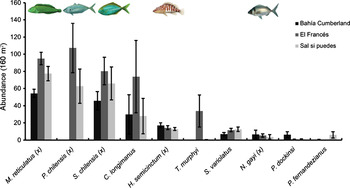
The visual census was carried out in eight different transects per site (N = 24) and indicated that the wrasse (‘vieja’) Malapterus reticulatus was the most abundant species followed by Juan Fernandez mackerel, Pseudocaranx chilensis. The third most abundant species was the sweep (‘pampanito’), Scorpis chilensis. Caprodon longimanus (Ghünther, 1859) abundance was variable in abundance and present in large schools. The serranid, ‘Juan Fernandez cabrilla’, Hypoplectrodes semicinctum had low abundances but present at all sites. The jack mackerel Trachurus murphyi (Nichols, 1920) was not observed in Bahia Cumberland. The blenny (‘borrachilla’), Scartichthys variolatus (Valenciennes, 1836), presented similar abundance at all study sites. Whereas the morwong (‘breca’), Nemadactylus gayi had low abundance but was present in most of the surveys. The sand perch (‘rollizo de Juan Fernandez’), Parapercis dockinsi (McCosker, 1971), the Paratrachichthys fernandezianus (Günther, 1887) where frequently present but in low abundances (Figure 3). Species such as Lotella fernandeziana (Rendahl, 1921), Girella albostriata (Rendahl, 1921), Seriola lalandi (Valenciennes, 1833), Amphichaetodon melbae (Burgess & Caldwell, 1978), Chironemus bicornis (Steindachner, 1898), Gymnothorax porphyreus (Guichenot, 1848), Scorpaena fernandeziana (Steindachner, 1875), Scorpaena thomsoni (Günther, 1880), Callanthias platei (Steindachner, 1898), Paralichthys fernandezianus (Steindachner, 1903), Chironemus delfini (Porter, 1914) and Umbrina reedi (Günther, 1880), were observed but with an average abundance less than 1 at all three sites.
Mean (± SE) abundance of coastal fish at Isla Robinson Crusoe. ‘X’ correspond to species studied.

The abundances of catches recorded a total of 144 individuals; of these, 81 were collected in spring 2007 and 63 in summer 2008, which were represented by five species belonging to five families. Congruently with the visual surveys, the most abundant species in the catch was M. reticulatus (56 individuals), followed by juveniles and adults S. chilensis (37 individuals), which together contributed to the 65% of total number of captured fish (Table 1).
Family, species and total number of juvenile (J) and adult (A) individuals analysed, number of individuals with empty stomachs and average total (TL) and standard (SL) lengths in centimetres (cm) ± standard error (SE).

Subtidal habitat
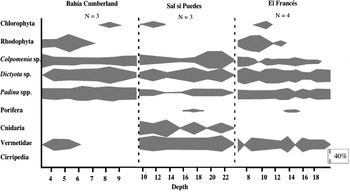
The habitat was characterized by the abundance of brown algae Padina fernandeziana, Colpomenia sinuosa and Dictyota kunthii, which were distributed at all study sites. Vermetids (Serpulorbis sp.) were also present at all study sites, but abundant in Sal si puedes. Red algae, were present in low presence measured in percentage cover at Bahia Cumberland and el Frances, and absent at Sal si puedes. The green algae had low abundance in percentage cover at all study sites. Sessile invertebrates such as cnidarians (Parazoanthus juanfernandezi (Carlgren, 1922) and Corynactis spp.) were present in low abundance at Sal si puedes and el Frances, were almost absent at Bahia Cumberland Bay (Figure 4).
Kite diagrams of benthic species zonation by depth at the three study sites. Scale bar represents 40% of cover in 0.25 m2 quadrats. Number of transects (N) are given per site.

Trophic structure
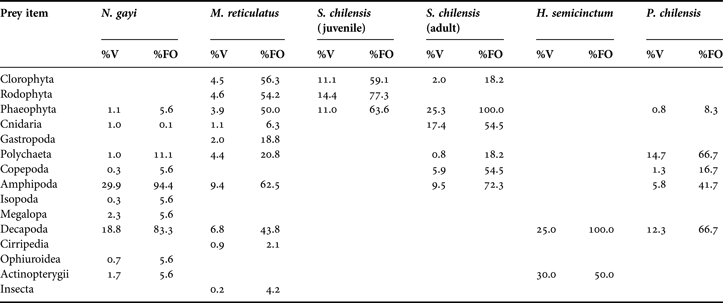
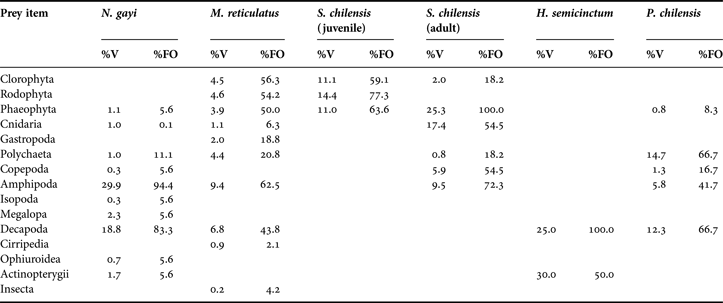
The most important prey item by volume was the gammarid amphipods, which were the main prey species of N. gayi and M. reticulatus. Brown algae, were the main prey item of adults S. chilensis, polychaetes, are the main prey of P. chilensis, while red algae which were the main prey item of juvenile S. chilensis, meanwhile the main prey items of H. semicinctum were fishes. The most important secondary prey items were decapod crustaceans present in the diet of N. gayi, M. reticulatus, P. chilensis, and H. semicinctum. Prey items such as cnidarians and green algae were also important in adults S. chilensis, (Table 2).
Mean of the volumetric composition (%V) and frequency of occurrence (%FO) of the diet categories of five coastal fish from Robinson Crusoe Island.
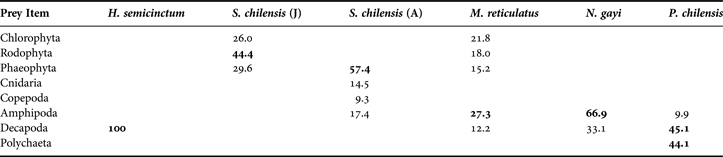
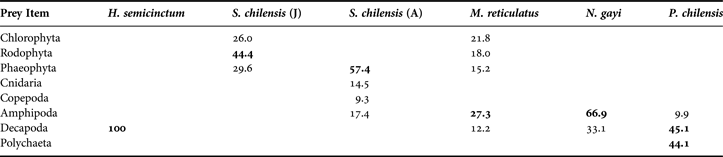
The dietary composition of each species was significantly different (ANOSIM, R = 0.4, P < 0.001). SIMPER analysis, found that algae were important and contributed to the diet of S. chilensis juvenile and adult, where red algae were the most important in juvenile S. chilensis and contributed to 44.4% of their diet. Brown algae contributed most to the diet of adult S. chilensis with a 57.4% of contribution. Other important prey were amphipods in the diet of adults S. chilensis, M. reticulatus, P. chilensis and N. gayi, in the latter species is the most important prey, and contributed 67% of their diet. The decapod crustaceans were important in the diet of four other species, being of primary importance in H. semicinctum and P. chilensis, with a contribution rate of 100% and 45.1%, respectively. Polychaetes were important in the diet of P. chilensis, contributing over 44% of the diet of this species only (Table 3).
Percentage contribution among species using volumetric composition of diet and calculated using SIMPER analysis. Prey items that contributed most to the differences are shown in bold type.
Dietary diversity
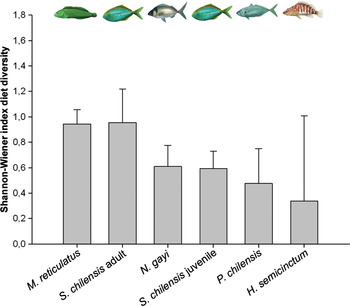
Fish with the greatest diversity of prey species were the wrasse M. reticulatus (H′ ~ 1), followed by the adult S. chilensis with H′= 0.92 (Figure 5). Both species consumed a wide variety of taxa, from algae to decapod crustaceans. Fish from Isla Robinson Crusoe differ significantly in dietary diversity (H′) (ANOVA, df = 5, F = 5.72, P = 0.0001). The Tukey post hoc test suggests that M. reticulatus has higher dietary diversity in comparison to other members of the fish assemblage.
Shannon–Wiener diversity index of diet composition for five fish species at Isla Robinson Crusoe with error bars (± 2 SE).

Trophic groups
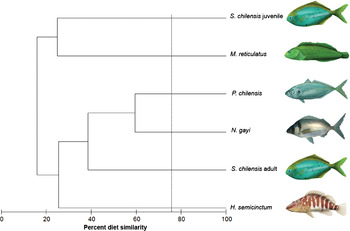
No objective trophic groups were formed among the fish assemblage at the study sites. The cut-off was set at 24% of diet dissimilarity (76% of diet similarity). However, two clusters were identified in the fish assemblage at Juan Fernandez. The first group was constituted by the juvenile S. chilensis and M. reticulatus. A second cluster was formed by adults S. chilensis, N. gayi and P. chilensis, the latter two species form a subgroup, this group is characterize by sharing amphipods and decapod crustacean (Figure 6).
Cluster showing the Bray–Curtis similarity index of diet for fish assemblages at Isla Robinson Crusoe. Cut off represents the 76% of similarity; see Materials and Methods section for more information.

Morphological analysis
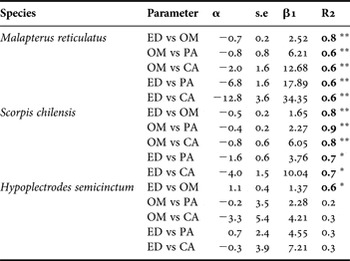
Morphological analysis indicated a positive relationship between all parameters measured in the species M. reticulatus and juvenile S. chilensis. Meanwhile, in H. semicinctum there was a positive relationship only in the ED vs OM relationship (Table 4). However, no significant differences between species were detected on parameters ED vs OM (ANCOVA df = 2, F 2,40 = 3.23, P > 0.05), OM vs PA (ANCOVA df = 2, F 2,40 = 3.18, P > 0.05), ED vs PA (ANCOVA, F 2,40 = 3.23, P > 0.05), ED vs CA (ANCOVA, F 2,40 = 3.23, P > 0.05) and parameter OM vs CA (ANCOVA, F 2,40 = 3.23, P > 0.05).
Results of the linear regression analysis on the main morphological parameters associated with coastal fish species and feeding structures, the parameters marked with (**) are those with P < 0.001 and those marked with (*) correspond to P < 0.05 statistical significance. ED, diameter of the eye; OM, horizontal opening of the mouth; CA, area of the caudal fin; PA, pectoral fin area.

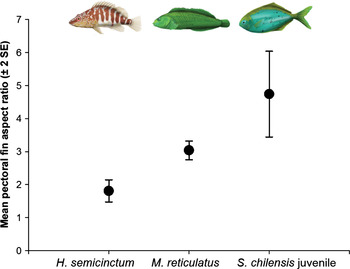
The pectoral fin shape, expressed as the aspect ratio (AR), ranged from an average of 1.81 in H. semicinctum to 4.74 in S. chilensis and this was variation significant among the study species (one-way ANOVA, F = 19.51, P < 0.001). The posteriori test revealed that AR parameter on S. chilensis was significantly higher than in H. semicinctum and M. reticulatus (post hoc Tukey, both P < 0.001). The AR was also higher in M. reticulatus than H. semincuntum (post hoc Tukey, both P < 0.01) (Figure 7).
Mean pectoral fin aspect ratio (2 ± SE) for three fish species of the Robinson Crusoe island.

DISCUSSION
Herein the most abundant fish have been studied and these species are the numerous representatives of shallow subtidal habitats at Robinson Crusoe Island. Our results indicate the following.
(a) The wrasse, Malapterus reticulatus is an abundant species in the sites studied.
(b) Subtidal habitats are characterized by the dominance of brown algae (Dictyota kunthii, Colpomenia sinuosa and Padina fernandiazina) and secondly by encrusting invertebrates (vermetids and cnidarians).
(c) Decapod crustaceans and amphipods were prey items that contributed in number and volume in the diet of four of the five studied species.
(d) According to Shannon diversity index (H′), the coastal fish assemblage of Robinson Crusoe presented a low diversity of prey in comparison with other temperate reef fish assemblages (see Medina et al., Reference Medina, Araya and Vega2004). In turn the low trophic diversity in reef fishes at Juan Fernandez Islands may be related to the low complexity of the subtidal habitats of this island.
(e) With respect to feeding habits, there are one herbivorous, four omnivorous and one carnivore species.
(f) Objective trophic groups were not formed among fish assemblage.
(g) Morphological parameters indicated that all species use a foraging strategy that integrates cranial morphological structures (eyes and mouth) with paired structures such as pectoral fins, except for Hypoplectrodes semicinctum who use cranial structures for foraging.
The fish assemblage of Robinson Crusoe is composed of a small number of species (species richness), which are mostly endemic to the biogeographic province of the Juan Fernandez and Desventuradas Archipelagos (see Dyer & Westneat, Reference Dyer and Westneat2010). Our research highlights the high presence of wrasses, which are one of the most important components of the fish fauna of coral reefs and other subtropical reefs of the world (Russell, Reference Russell1988). This family features a wide variety of feeding habits (Ferry-Graham et al., Reference Ferry-Graham, Wainwright, Westneat and Bellwood2002) and achieved a greater ability to adapt to different conditions that characterize coastal reef habitats. The subtidal habitat on the island Robinson Crusoe was mainly characterized by two types of habitats, the first dominated by brown algae (Dictyota sp. Colpomenia sinuosa and Padina spp.), and the second by encrusting invertebrates (Serpulorbis sp., Parazoanthus juanfernandezi and Corynactis spp.). The habitat type that is dominated by Dictyota kunthii was more evenly distributed and the most abundant; this may be due to the wide distribution of this alga in the Pacific Ocean, which manages to be mostly abundant in tropical and temperate regions (Clerck et al., Reference Clerck, Leliaert, Verbruggen, Lane, De Paula, Payo and Coppejans2006). The dominant habitat type at each site determined the presence of fish per study site. For example, el Frances was the most abundant in fish species and the two habitat types that dominate the subtidal of Robinson Crusoe were present herein, which eventually may provide a complex habitat which contributes to the greater abundance of fish in this site compared with others, and possibly also a greater abundance of prey. In terms of composition and dominance of wrasses, the coastal fish assemblage of Robinson Crusoe is more closely related to eastern Pacific regions than continental Chile, despite its closer proximity to continental Chile.
The oceanic island fish assemblage we studied revealed the dominance of omnivores, one herbivore and one carnivore. Omnivorous species (N. gayi, M. reticulatus, P. chilensis and S. chilensis adult) fed mainly on small invertebrates (isopods and amphipods) and brown algae. The only carnivore (H. semicinctum), fed on larger organisms such as macroinvertebrates (decapod) and fish. Moreover, these species feed on mobile benthic organisms (isopods, amphipods, decapods, annelids and brittle stars) and some sessile species such as algae, cnidarians, barnacles and vermetids. These observations contradict results obtained in northern Chile, where subtidal fish assemblages in the absence of large brown algae consume prey items that live in pelagic environments (Angel & Ojeda, Reference Angel and Ojeda2001). The low transport of pelagic species from nearby inland areas and the advective transport of plankton from ocean coastal areas, which can reach up to 200 nautical miles, do not reach the shores of the Juan Fernandez Archipelago, and may explain the absence of pelagic prey in the diet of the coastal fish assemblage at Isla Robinson Crusoe (Correa-Ramirez et al., Reference Correa-Ramirez, Hormazábal and Yuras2007). In other oceanic islands of the Pacific and Atlantic Oceans, planktivorous fish, dominate these ecosystems (Eddy, Reference Eddy2011; Krajewski & Floeter, Reference Krajewski and Floeter2011), while omnivorous and carnivorous characterize the fish assemblage at Isla Robinson Crusoe.
The most important prey items were decapod crustaceans and amphipods, which is similar to observations from the coast of continental Chile (Medina et al., Reference Medina, Araya and Vega2004; Fariña et al., Reference Fariña, Palma, Ojeda, McClanahan and Branch2008; Pérez-Matus et al., Reference Pérez-Matus, Pledger, Díaz and Ferry2012). Amphipods are considered one of the most important prey in the diet of coastal fish (Muñoz & Ojeda, Reference Muñoz and Ojeda1998; Taylor, Reference Taylor1998; Boyle & Horn, Reference Boyle and Horn2006). The effects of mesograzers (amphipods and isopods) on macroalgae are often regulated by fish via trait and density mediated effects. The possible outcomes of the predatory effects from this island can be estimated (Pérez-Matus & Shima, Reference Pérez-Matus and Shima2010; Reynolds & Sotka, Reference Reynolds and Sotka2011). The important presence in volume of amphipods present in the diets of N. gayi and P. chilensis could indicate important trophic control of this prey population.
Dietary diversity was low for most species, and significant differences in diversity indicated that only M. reticulatus and S. chilensis adults have a generalist diet, while other species concentrate their diet on small prey. According to Russell (Reference Russell1983), this describes the diet of Scorpis aequipinnis (Richardson, 1848) off the coast of New Zealand, this fish is phylogenetically close to S. chilensis. Scorpis aequipinnis is a carnivore that feeds mainly on zooplankton, which does not coincide with those obtained in the present study, because S. chilensis adult has an omnivorous diet. This difference in feeding may be associated with the reduced availability of planktonic food in the island of Robinson Crusoe (Correa-Ramirez et al., Reference Correa-Ramirez, Hormazábal and Yuras2007). For diet of P. chilensis stands diet whose main prey polychaetes, a situation similar to what occurs on the coasts of Australia with Pseudocaranx dentex (Bloch & Schneider, 1801), (Kailola et al., Reference Kailola, Williams, Stewart, Reichelt, McNee and Grieve1993) and Pseudocaranx wrighti (Whitley, 1931), (Platell et al., Reference Platell, Sarre and Potter1997; Platell & Potter, Reference Platell and Potter2001).
The morwong N. gayi had a large trophic spectrum (10 prey items), but with a marked selectivity for amphipods and decapods crustaceans, similar to what happens in the north and central coast of continental Chile, which describes the diet of such as Cheilodactylus variegatus (Valenciennes, 1833), a species phylogenetically close to N. gayi. The C. variegatus is a carnivore with a diet very diversified, which feeds mainly on macroinvertebrates as decapods and molluscs in northern Chile (Medina et al., Reference Medina, Araya and Vega2004; Pérez Matus et al., Reference Pérez-Matus, Pledger, Díaz and Ferry2012) and amphipods and gastropods in coastal central Chile (Muñoz & Ojeda, Reference Muñoz and Ojeda1997; Pérez Matus et al., Reference Pérez-Matus, Pledger, Díaz and Ferry2012). It also highlights the trophic characteristic of the species juvenile S. chilensis, which feeds exclusively on algae, the only strictly herbivorous fish analysed. This features an ontogenetic shift on adults S. chilensis, which has a higher trophic spectrum, and is considered an omnivore. Ontogenetic changes in diet are common on kyphosids from northern Chile as it has been documented in Girella laevifrons (Tschudi, 1846) (Aldana et al., Reference Aldana, Pulgar, Ogalde and Ojeda2002; Pulgar et al., Reference Pulgar, Aldana, Bozinovic and Ojeda2003), Graus nigra (Philippi, 1887) on the coast of Chile Central (Muñoz & Ojeda, Reference Muñoz and Ojeda1998) and Kyphosus incisor (Cuvier, 1831) on a reef subtropical Brazil (Silvano & Güth, Reference Silvano and Guth2006).
The low diversity of prey in the diet of the species may be related to the low complexity of the subtidal habitats of this island, due to the absence of brown kelp forests that allow the settlement of potential prey, such as small benthic invertebrates (Angel & Ojeda, Reference Angel and Ojeda2001; Farina et al., 2004; Pérez-Matus et al., Reference Pérez-Matus, Ferry-Graham, Cea and Vasquez2007, Reference Pérez-Matus, Pledger, Díaz and Ferry2012). In nearby areas, such as on the north and central coasts of continental Chile, habitats dominated by brown kelp forests result in a greater dietary diversity of the coastal fish assemblage (Quijada & Cáceres, Reference Quijada and Caceres2000; Medina et al., Reference Medina, Araya and Vega2004).
The morphological parameters among species indicated that fishes integrate the cranial morphological structures (eyes and mouth) with pairs like pectoral fins while feeding. Except the serranid, H. semicinctum, which only had a positive relationship in cranial parameters with feeding the other two species (juvenile S. chilensis and M. reticulatus) integrate both morphological regions. This foraging strategy is associated with different subtidal zones, for species found deepest in the subtidal, where energy and water flow is less, we would expect that species may use cranial structures for feeding as we found in H. semicinctum. On the contrary, species living in shallow areas where the flow and current is greater, both sectors (head and the pectoral fins) were used for feeding (Fulton et al., Reference Fulton, Bellwood and Wainwright2001, Reference Fulton, Bellwood and Wainwright2005). Concomitantly, the aspect ratio of the pectoral fin can give us further insight into foraging tactics along a depth gradient. Species found in shallow subtidal areas such as, S. chilensis, where energy is higher, have an aspect ratio that is related to their diet, as they feed exclusively on algae present mostly on shallow habitats. On the contrary, H. semicinctum had the lowest aspect ratio and was associated with habitats of greater depth, and also this was the only carnivore species studied. Finally M. reticulatus had intermediate aspect ratio values, which could indicate a more generalist diet, consistent with observations of wrasses in northern New Zealand (Denny, Reference Denny2005). The parameters of niche space offer a useful description of the coexistence of fish in subtidal environments (Davis & Wing, Reference Davis and Wing2012), and diet is an indicator to describe the biological niche space. In this respect the differences in the diet of the studied species and their vertical distribution suggest important adaptive changes in subtidal environments (see Krajewski et al., Reference Krajewski, Floeter, Jones and Leite2011). The potential trophic niche segregation among species may be the result of adaptations mediated by abiotic factors such as depth and flow of ocean currents of the ocean action (Fulton et al., Reference Fulton, Bellwood and Wainwright2005).
The oceanic islands of the Juan Fernandez Archipelago provide an important platform for testing hypotheses of diversity in modes of feeding and adaptations to foraging. Consideration of other selective pressures on persistent features in foraging behaviour is central to understanding ecological communities. The niche segregation of species with different feeding habits could provide empirical examples of coexistence. To our knowledge this research provides the first contribution to the understanding of the feeding behaviour of coastal fish at the Juan Fernandez Archipelago, Chile.
ACKNOWLEDGEMENTS
We thank M. Rossi for logistical assistance in the field and for providing boat access and SCUBA gear. TE PAPA TONGAREWA museum of New Zealand (Dr C. Roberts and Dr A. Stewart), CONAF (Corporación Nacional Forestal) provided support during the field expedition at Isla Robinson Crusoe. We also thank Eduardo Sorensen for their assistance in the field and the photographs of the habitat types. Dr R. Melendez (UNAB) for collaboration during the dietary analysis and P. Diaz (UNAB) collecting samples; M. Paz and F. Sanchez for assistance in the laboratory. Dr J. Pulgar (UNAB) and two anonymous referees provided significant contributions to improve the present manuscript. Finally, we gratefully thank the fishers of the Juan Fernandez Archipelago, especially W. Chamorro for help collecting fishes for this study.
FINANCIAL SUPPORT
T.D. Eddy was supported by a Victoria University of Wellington Doctoral Scholarship. A.P.M. and T.D.E. received a grant from Education New Zealand Postgraduate Study Abroad Award.