Introduction
In this paper, I examine one very anomalous work of art (anomalous as in at the time of its creation it engendered a debate over whether it was art or merely entertainment)- the panorama: ‘Siege of Seringapatam by the English East India Company in 1799’. By examining the context and content of the original panorama and following the trajectories of its exhibitions in various geographical locations, the subsequent reception and review in art periodicals, their afterlife into museums and art collectors’ repositories and their final destination in the digitized avatars, this paper unravels the theoretical paradigms of narrativity and temporality in art history in the current times. In doing so, the paper resurrects the question of ‘when is art?’Footnote 1. While artistic objects can slip in and out of their aesthetic being, the picture gets complicated with the visual rendition of historical episodes. Before we get into unentangling the finer nuances of heuristic analysis of the artwork in question, let us take a brief look at the artwork under consideration.
On 17th April 1800, the general public in London were invited to view ‘The Grand Historical Picture of the Storming of Seringapatam by the British Troops and Their Allies, May 4th, 1799’ at Lyceum, painted by Robert Ker Porter. Spread over a semi-circular canvas 21feet high and 120 feet long, the panorama showcased the moment of the storming of Seringapatam in 1799— an episode which marked the culmination of the Anglo-Mysore wars eventually ending in the victory of the English East India Company. This moment was one of the most significant turning points in the history of British imperialism in India in the eighteenth century. The panorama was exhibited in London from 17th April 1800 to the 10th January 1801 and generated a profit of 1,202 pounds and 14 shillings. Thereafter, it was exhibited in Edinburgh, Dublin, Liverpool, Plymouth, Glasgow, Belfast, among others, and in 1805 it reached Philadelphia. In 1825 the exhibition reached Bristol and two years later, to Nottingham.
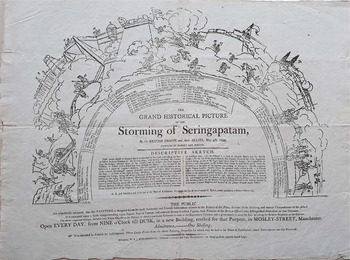
Although the panorama does not survive, what we do have is a descriptive key for the panorama meant to guide the publicFootnote 2. The key was integral to the viewing of the panorama. It described in detail the context of the image, the personnel in the battle and the scale of the panorama. While itself a motionless giant painting, the panorama captured several separate events of the battle. The text describing the panorama is very revealing in terms of what exactly the panoramist wanted the audience to look at and the sequence of viewing he intended. The key identified 46 people, each of whom were assigned a numerical identity for the viewers to follow the narrative of the event.
The Grand Historical Picture of the Storming of Seringapatam by the British Troops and Their Allies, May 4th, 1799: Painted by Robert Ker Porter, 1800, woodcut and letterpress, Yale Center for British Art, Paul Mellon Fund, Folio A 2016 3h.

At the center of the panorama is General Baird who was surrounded by his staff, and at the foot of the bastion is the party of Tipu's soldiers. On the bastion to the right stands Colonel Sherbrook with his men moving to the assault. To the left of the grand breach lay Captain Owen of the 77th, supported as he is dying, on one of the Tyger Guns taken from the enemy. On the ramparts stands Tipu Sultan himself. The key describes in detail the action going on in different sections of the panoramaFootnote 3.
Panoramas were a turning point in the global art market. They allowed for a large audience to simultaneously view a visual rendition of an historical moment. As much as the large canvas captured a moment in time, it was also a movement at the same time. The simultaneity in viewing of the visual depiction of a historical moment created imagination in the audience which resulted in the construction of ‘future pasts’Footnote 4. However, unlike other paintings of the times, the uniqueness of the panorama lay in the accompanying metadata produced by the panoramist as described in the above paragraphs. By producing the narrative in text, the artist precluded any room for speculation of the image at the time of viewing and provided an ‘authentic’ version of the event that occurred in the then recent past. However, no matter how authentic the claim of the artist might be, there is a modification of the actual reality when transformed into a representational art form through the use of memory and imagination in the process of artistic renditionFootnote 5. Given the fact that the panorama was made within a year of the event having occurred and during the peak of British imperialism in India, it can be said, albeit only in a limited way, that the image was made in the same historical present. As such, the visual image was not merely for an aesthetic pleasure but it also evoked feelings, conveyed information and constructed collective imaginations and perceptions regarding the Anglo-Mysore wars among the viewers. By using the medium of panorama to create spatial and temporal coherence and show several moments of the story of the battle, the panorama created a simultaneity as well as motion in time.
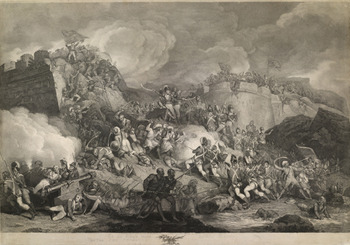
The panorama also created a market for printed depiction of the same. The exhibition also advertised the intended prints and that those interested in getting them could subscribe. Subsequently, several paintings and engravings were made on this panorama and thus the episode was circulated widely among the general public across time and space. Several British officers had died during the initial attack which is depicted in the panorama and Tipu Sultan, the ruler of Mysore, is shown still in action. The most notable panoramic representation in print form after this exhibition was by Giovanni Vendramini. This print was a three-part stipple engraving, each section being three feet wideFootnote 6. Long before the era of digital technology which allowed for reproduction of faithful copies of an original artwork, as early as early nineteenth century onwards, chromolithography and engravings had already begun to allow for mass reproduction and consumption of art. In a very fascinating way, the reproduction of a small portion of the panorama is reminiscent of the present-day digital tool of capturing a section of an image and reproducing the same.
Giovanni Vendramini, The Storming of Seringapatam, 1802, engraving, British Library, BL P779. (Wikimedia Commons).

While the contemporary periodicals reviewed the panorama exhibition with as much awe as it drew criticism from art experts, the mass media spread the image exponentially with millions of people using this medium of pictorial art in the industrial era. The most interesting criticism of the panorama was whether or not it was art at all. It would be interesting to recall in this context that even when the advent of photography changed everything, similar questions were posed – did photography qualify to be art or not? Both panoramas and photography altered profoundly the ways in which art was produced, exhibited and receivedFootnote 7. Panorama could be referred to as ‘mass art’ rather than ‘entertainment’ as it allowed for a large audience to view the artwork. Digital avatars of paintings/panoramas are also forms of mass art but the difference lies in that the viewing experience enabled by technology robs the audience of the ‘sociability’ associated with mass artFootnote 8.
While the panorama might appear to be a moment frozen in time, it also has a characteristic of motion. One viewer described his experience of this panorama as: ‘I can never forget its first impression upon my own mind. It was a thing dropped from the clouds- all fire, energy, intelligence and animation. You looked a second time, the figures moved, and were commingled in hot and bloody fight…you longed to be leaping from crag to crag with Sir David Baird, who is hallowing his men on the victory. Then again you seemed to be listening to the groans of the wounded and the dying- and more than one female was carried out swooning. The accessories--- rock, earth and water… half choked up with the bodies of the dead, made you look on with a shuddering awe, and retreat as you shuddered. The public poured in by hundreds and by thousands for even a transient gaze- for such a sight was altogether as marvelous as it was novel. You carried it home, and did nothing but think of it, talk of it and dream of it.’Footnote 9 Therefore, the question is not so much about whether panoramas were art objects or not, but rather in what ways aesthetic production and viewing were altered by the medium itself. Artworks can slip in and out of their aesthetic being and so was the case with panoramas. In fact, panoramas were not merely optical objects but also narrative instruments of creative mimesis in imperialist Britain. They had the character of both an experiential ephemeral moment as well as of a permanent object of art which survived until today for use by historians.
Is the transformation of art through digital means a phenomenon unique to the present times? The modern period saw technology being used for the creation of art and its reproduction. Poised between the era of oil paintings and the age of photography and subsequent motion picture, panorama as a medium of mass viewing of art had already transformed the way of seeing things. Transformation was further fast forwarded through faithful reproductions using chromolithography. Photography enabled further capturing of original artworks, albeit in another medium. Digitization is another step in technological innovation in reproduction of artwork and storing them for posterity. As such, transformation of artwork in the digital age is yet another stage in the ongoing process. However, the distinctness of the digital age lies in its homogenizing process of art collections. The scale, color and texture of the original medium can only be imagined based on the accompanying metadata in the digital repositories. The digitized version of the original prints in circulation in the virtual world are considerably alienated from the original context of the image. It can be argued that even in the collections of the museums and art galleries, art objects are alienated from their historical context and researchers need to be mindful of situating the art object in its appropriate historical and temporal context. While museums and specialized art galleries provide detailed information on the origins of the artwork and to some extent its journey to the gallery/exhibition, the internet is replete with digital stocks of historical paintings and lithographs that are quite often dissociated from its contextual content. The latter then has the possible danger of being misrepresented in its historical veracity. Therefore, for an historian using images in the digital form, it becomes imperative to foremost determine the accuracy of the information in the digital repository. Digital resources also have the advantage of offering the possibility to corroborate the information from multiple repositories.
The most profound way in which the digitized art work is distinct from the original is the aesthetic experience of the viewer. Adorno pointed out all ‘authentic’ artworks are truth bound in so far as their ‘epiphanic quality’ upsets and shocks us. The digital replicas take away the uniqueness of the image, or as John Berger would put it: the original when viewed in a gallery or museum, acquires a new significance in the light of the reproduced imageFootnote 10. Digital repositories have indeed democratized the access to art objects, but the same has also denied the agency the art objects had over the viewers. Given the fact that the reproduction is in a different cultural context, the unique authority of the original artwork is diminished. In the context of the panorama of the siege of Seringapatam, the power and agency the viewers experienced over the distant colonial land — India— by merely viewing the giant spectacle, the illusion of reality that it created and the manner in which it colored imaginations of the viewers about the valor and sacrifices of the English East India Company's soldiers, is something that cannot be replicated through digital copies. Any such imagination has to be based on the textual information accompanying the image. Looked at from this perspective, doing art history in the digital age encounters a reversal of the process of aesthetic experience. Ordinarily, viewing comes before wordsFootnote 11, but when researching with digital images, viewing has to be accompanied with, if not preceded by textual narrative and image description.
From the time that the event occurred to the moment it was made, and finally when the image was viewed in the form of a panorama exhibition, the temporal layersFootnote 12 can be discerned within the seeming ‘illusion of sequence’. Even though there may appear a linear sequence in the process of viewing and the narrative, the artist need not be copying the linearityFootnote 13. However, it is also possible to argue that since the image was produced and viewed within a very short period of the event having occurred, there was a ‘nowness’ of the event. The panoramist limning image of the siege of Seringapatam received a huge reception because of the robust art market, owing to the feeling of ‘nowness’ of the historical episode. The robustness of the art market is also evident in the number of reprints made after the original panorama in the early nineteenth century. Given the sheer volume of multiple copies of digital artworks on this historical moment available on the internet, it is imperative to look at artworks from the perspective of both temporality and simultaneity. In fact, for historians using images depicting a historical moment/episode, a solipsistic interpretation of the artwork is not enough no matter how individualistic the viewing experience or the digital screen may be. The metadata for the image is either provided by the artist himself or the historical context is very explicit in the exhibition and hence the future pasts created through the image is given. Centuries later when historians use the digital image, the same cannot be dissociated from the historical context no matter how far in time the viewing experience might be. Thus, accessing historical images in contemporary times creates a cyclical narrative in going back to the moment of the event having occurred, it being conceptualized and reproduced in artistic form, it being viewed and reviewed and reproduced copies stored for posterity.
Historians rely on artefacts left behind to interpret history and digital repositories of artworks provide them the ease of access to visual sources. As much as it is desirable to accept the ephemerality of momentary aesthetic experience by falling back upon doxographic traditions such as that of Heraclitus who pointed out that ‘one cannot swim in the same river twice, for other waters are continually flowing on’Footnote 14, when historians look at historically significant artworks like the panorama described above, it becomes imperative to capture the context, if not the precise moment of the aesthetic creation and experience. While the panorama might seem to be a momentary artistic work, it is also immortally frozen in time through a historical time scale. At the peak of imperialist expansion by Britain, this panorama was a visual rendition of the historic moment that created a consciousness about the British struggle and valor in India among the paying viewers on both sides of the Atlantic. In fact, a product of imperialism itself, the panorama democratized the viewing public and at the same time placed them in position of power during the viewingFootnote 15. The question arises: do digital images invoke similar sentiments? More importantly, in what way does the same image produce similar/dissimilar sentiments in different geographical locations?
For meaningful research in art history using technology, it is not merely the availability of a digitized version of the historical image that is enough. It is the accuracy of the metadata in the digital repository that is required for contextual art historical research. There are digital collections which provide the metadata and historical journey of the image in detail. But there are others which only provide the digital scan but no context.
Coming to the question of whether digital tools can provide newer perspectives on historical pasts, it is fair to say that in many ways yes, they can. Just like in the discipline of Digital Humanities, computer aided technology can allow for locating the trajectories of art objects and their multiple copies across space and time. However, this exercise would of course depend on the strength of the metadata in the digital repository and not merely the digitized image in the collection. The digital image of the key to the panorama at the beginning of the paper was dependent on the accompanying textual description for a meaningful understanding of the image. In addition to the visual image, textual sources (newspaper reporting and art journals) are integral to this process. While the original images have been translated into digital copies, the diachronic and synchronic aspects of the image need to be underscored. This is crucial because while the original panorama was meant to be viewed in a particular sequence, modern museums and digital platforms rescue us from that sequence. The digital image shown above is both diachronic and synchronic at the same time.
The mediation of history through the digital platform might appear easy, the question of time and temporality makes it a complex task. While digital research has opened new possibilities in historical research, it has also opened a whole gamut of challenges. An interdisciplinary approach to an art object in a digital collection, like the panorama and its associated digital data can help us grapple with the question of time and temporality further in historical narrativity. Digital tools can enable re-creation of the original panorama in the virtual world and even a possible three-dimensional version. The point to be driven home is that technological innovation in the production of art since the 1780s has altered considerably the ways of aesthetic experience. Even before photography and motion picture captured the imaginations of viewers and critics alike, panorama exhibitions had swept audiences off their feet with the grand spectacle of near life portrayal of imperialist battles. Lithography had rendered possible the making of multiple faithful copies of small portions of the giant panoramas. Digitization is yet another stage in the process of mechanical reproduction and its resultant democratization of art objects. While the panorama exhibition was meant to be viewed by a large mass of audience at the same time creating a homogenous aesthetic experience, digitized images also allow for a large number of viewers to experience the art object, but the viewers are disparate entities in their aesthetic experience. It befits to conclude this with the following section in Ways of Seeing by John Berger: ‘The visual arts have always existed within a certain preserve; originally this preserve was magical or sacred. But it was also physical: it was the place, the cave, the building in which, the work was made. The experience of art, which at first was the experience of ritual, was set apart from the rest of life- precisely in order to be able to exercise power over it. Later the preserve of art became a social one. It entered the culture of the ruling class, whilst physically it was set apart and isolated in heir palaces and houses. During all this history the authority was inseparable from the particular authority of the preserve. What modern means of reproduction have done is to destroy the authority of art and to remove it- or, rather, to remove its images which they reproduce- from any preserve. For the first time ever, images of art have become ephemeral, ubiquitous, insubstantial, available, valueless, free. They surround us in the same way as a language surrounds us. They have entered the mainstream of life over which they no longer, in themselves, have power.’Footnote 16