INTRODUCTION
Since the 1960s, the main international strategy to preserve biodiversity has been the establishment of a mosaic of natural protected areas (PAs) in regions of high biodiversity and endemism (Myers et al. Reference Myers, Mittermeier, Mittermeier, Fonseca and Kent2000). PAs have been successful in maintaining biodiversity (Bruner et al. Reference Bruner, Gullison, Rice and Fonseca2001; Oliveira et al. Reference Oliveira, Asner, Knapp, Almeyda, Galvan-Gildemeister, Keene, Raybin and Smith2007), but they have generally resulted in negative impacts on the livelihood of local residents (De Boer & Baquete Reference De Boer and Baquete1998; Ferraro Reference Ferraro2002; Schmidt-Soltau Reference Schmidt-Soltau2003; Adams et al. Reference Adams, Aveling, Brockington, Dickson, Elliott, Hutton, Roe, Vira and Wolmer2004; Berkes Reference Berkes2004; Roth Reference Roth2004; West et al. Reference West, Igoe and Brockington2006), although positive impacts of PAs on local residents have also been noted (Udaya Sekhar Reference Udaya Sekhar2003; Wittemyer et al. Reference Wittemyer, Elsen, Bean, Burton and Brashares2008).
Originally, research on the impact of PAs on local livelihoods adopted an outsider's perspective, but recent research has focused on local residents’ attitudes and perceptions of PAs. Four main findings stem from this literature. First, more often than not, local residents are supportive of PAs (Infield Reference Infield1988; De Boer & Baquete Reference De Boer and Baquete1998; Infield & Namara Reference Infield and Namara2001).
Second, associations between socioeconomic characteristics of informants and variation in attitudes towards PAs are inconsistent. Younger and more educated people tend to display more positive attitudes towards PAs than older and less educated people (Infield Reference Infield1988; Heinen Reference Heinen1993; Akama et al. Reference Akama, Lant and Burnett1995; Fiallo & Jacobson Reference Fiallo and Jacobson1995; Mehta & Heinen Reference Mehta and Heinen2001), but there are conflicting patterns in association between other important socioeconomic characteristics of informants and attitudes towards PAs. For example, some studies have found that men have more positive attitudes toward PAs than women, but others have found the contrary (Gillingham & Lee Reference Gillingham and Lee1999; Mehta & Kellert Reference Mehta and Kellert1998). Wealth may be positively associated with attitudes toward PAs (Nepal & Weber Reference Nepal and Weber1995; Infield & Namara Reference Infield and Namara2001) or inversely related (Arjunan et al. Reference Arjunan, Holmes, Puyravaud and Davidar2006).
Thirdly, local residents’ attitudes are contingent on livelihood interests. Negative attitudes toward PAs often arise from livelihood deterioration, such as through wildlife attacks or hunting bans (Arjunan et al. Reference Arjunan, Holmes, Puyravaud and Davidar2006), or problems with distribution of benefits to local populations (Infield Reference Infield1988; Newmark et al. Reference Newmark, Leonard, Sariko and Gamassa1993; De Boer & Baquete Reference De Boer and Baquete1998; Holmes Reference Holmes2003).
Researchers have also found that positive attitudes towards PAs are contingent on local residents’ perceptions of the impact of PAs. For example, in Burma, positive attitudes toward PAs were associated with perceptions of economic costs generated by wildlife damage to crops (Allendorf et al. Reference Allendorf, Swe, Oo, Htut, Aung, Allendorf, Hayek, Leimgruber and Wemmer2006). In the Selous Game Reserve (Tanzania), the perception of inequitable distribution of benefits generated negative views of the conservation project among local residents (Gillingham & Lee Reference Gillingham and Lee1999).
In this paper, we examine the association between local residents’ perceptions of impacts generated by a PA and their attitudes towards it in two innovative ways. First, we compare urban and rural residents’ perceptions of the impact of a PA. Second, since PAs generate a myriad of positive and negative economic, social and environmental impacts, we differentiate between types of impact to analyse their relative importance in shaping local residents’ attitudes towards PAs. Because of their short-term effects on people's livelihoods, we expect that perception of economic impacts might have a more significant association with attitudes towards the PA than the perception of social or environmental impacts. For the empirical analysis, we use information collected among urban and rural residents living near the Dandeli Wildlife Sanctuary (DWS) in the Western Ghats (India).
The topic has important policy implications. Researchers, governments and conservation organizations recognize that the long-term integrity of PAs in low-income nations depends upon the support of indigenous and rural communities that live adjacent to them (West & Brechin Reference West and Brechin1991; Struhsaker et al. Reference Struhsaker, Struhsaker and Siex2005). Understanding residents’ perceptions and how those perceptions relate to people's attitudes towards PAs might provide guidance in the design, implementation and evaluation of this strategic form of biodiversity conservation.
Study site: Dandeli Wildlife Sanctuary and surrounding population
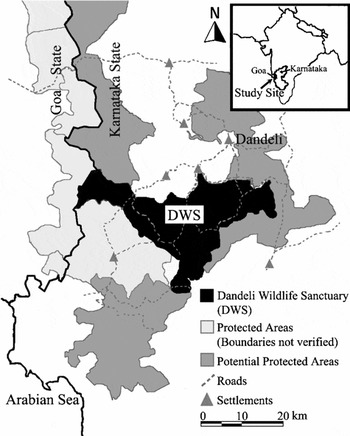
The DWS is located in the Western Ghats (Fig. 1), one of the six biogeographic zones of India (Rodgers et al. Reference Rodgers, Panwar and Mathur2002) and one of the eight hottest hotspots of the world (Myers et al. Reference Myers, Mittermeier, Mittermeier, Fonseca and Kent2000). The area was officially declared a wildlife sanctuary in 1975 and its actual demarcation dates from 1987. DWS covers an area of only 475.16 km2, but is linked to six other PAs in the neighbouring states of Goa and Maharashtra, establishing a continuous forest of about 5000 km2 in a high priority tiger conservation area (Hedge & Gubbi Reference Hedge and Gubbi2004). DWS and its neighbouring PAs support a rich biodiversity (Daniels Reference Daniels1992).
Study site

For management purposes, DWS and the Anshi National Park together form the Dandeli Wildlife District, managed by the Karnataka Forest Department. The management plans of the Forest Department include the prevention of encroachments, illicit cutting of timber, curtailment of fire, eradication of weeds and the maintenance of wild populations of large mammals. In addition to the Forest Department, local and international non-governmental organizations support conservation activities in the area. The work of those organizations includes the implementation of environmental education programmes in schools and community awareness programmes (such as slide shows and nature camps).
Although India has pioneered the participatory approach to forest management (Rishi Reference Rishi2007), local residents are not actively included in decisions regarding the management of DWS. Unlike other PAs in India, where the Forest Department has implemented joint forest management programmes (Murthy et al. Reference Murthy, Murali, Hegde, Bhat and Ravindranath2002; Kumar Reference Kumar2007; Rishi Reference Rishi2007; Nayak & Berkes Reference Nayak and Berkes2008), at the time of the research we did not come across any programme to foster local residents’ participation in the management of DWS.
The livelihoods of rural farmers and several indigenous groups were affected by the regulations on the use of forests and forest products that came with the declaration of the DWS as a wildlife sanctuary. The current inhabitants of DWS (c. 16 000 people in 43 settlements) and its surrounding areas (c 26 000 people in settlements within 5 km from the border) are traditional rural dwellers of differing ethnicities (Singh Reference Singh2003) and farmers who arrived as result of resettlement projects in nearby areas (Gadgil et al. Reference Gadgil, Hedge and Shetty1986; Bose Reference Bose2001). There are also two state-owned infrastructures within the limits of the DWS: the Kali hydroelectric project and the Kaiga nuclear power project. Rural dwellers’ income and consumption depend on wage labour, settled agriculture, cattle-breeding for commercialization of dairy products, gathering of timber and non-timber forest products for consumption, and gathering of non-timber forest products for sale to authorized cooperatives, all them legal activities for traditional dwellers living in wildlife sanctuaries and reserved forests in India (Seetharaman Reference Seetharaman2001).
The closest and largest city in the area, Dandeli, is c. 7 km from DWS (c. 53 000 inhabitants) (Bose Reference Bose2001). Historically, the economic development of Dandeli was dependant on the natural resources in the area. During the 1940s and 1950s, Dandeli city underwent rapid growth associated with the establishment of magnesium mines and furniture and paper industries (Gadgil et al. Reference Gadgil, Hedge and Shetty1986). In 1997, mining activities were completely banned in DWS. Massive timber extraction stopped after the Indian Environment Protection Act of 1986 (Divan & Rosencranz Reference Divan and Rosencranz2001), although regulated timber extraction continues. Restrictions in mining and logging activities generated a flow of migration in the first decade of the 21st century reducing the population of the area. Over the last decade, Dandeli city residents have become increasingly reliant on another source of income generated by DWS and the neighbouring PAs, namely the tourist sector.
METHODS
We collected data during March–May 2008. Data collection included exploratory semi-structured interviews and free listings, and a survey constructed with information gathered through the exploratory methods. The same team collected all the data. We worked with translators fluent in English and Kannada (Karnataka's official language).
Free listing
We conducted free listings to enhance our understanding of the benefits and costs associated with DWS as perceived by the local population. Free listing is an elicitation exploratory technique that allows researchers to obtain list elements in a cultural domain and ascertain their saliency, or relative importance (Weller Reference Weller and Bernard1998). To select informants for free-listing, we used a stratified sampling strategy, selecting informants from various groups with expected variation in their attitudes towards the PA; these included men, women, people living at differing distances from the PA and people with different levels of schooling (Bernard Reference Bernard2005). The total sample for free listing was 36 respondents (20 from Dandeli city and 16 from DWS and surrounding areas).
Specifically, we conducted two free listing tasks. In the first task we asked informants ‘What are the benefits that DWS has brought to your village?’ We probed respondents to list as many reasons as they could think of. In the second free listing task we asked informants to list the problems associated with DWS. Specifically we asked ‘What are the problems that DWS has caused to your village?’ After informants stopped listing, we asked them to explain why they had listed each of those particular topics.
To analyse free listing responses, we separated respondents living in DWS and surrounding areas from respondents living in Dandeli city. For each group, we calculated the saliency of each benefit and cost, as Sj = (n-rj)/n, where rj equals the position of item j in the list, and n is the number of items in the list. To compute the overall saliency index of j, we took the average Sj across the respondents. Our index of saliency ranged from 0 to 1 and proxied the overall importance of an item taking into account the number of respondents that mentioned an item and the order of the item in the lists (Weller Reference Weller and Bernard1998; Bernard Reference Bernard2005). We used respondents’ explanations for listing those particular reasons to classify responses from the first free listing tasks as economic, social or environmental benefits and responses to the second free listing tasks as economic, social or environmental costs.
Survey
To assess the association between overall attitudes towards PAs and the perceptions of their economic, social and environmental impacts, we collected data through a survey.
The sample for the survey included 438 adults (≥ 18 years of age) randomly selected in the 30 districts of Dandeli city (n = 256) and in 33 villages in and around and DWS (n = 182). Each respondent belonged to a different household. The number of interviews in a district was proportional to its population (min = 2, max = 31). In each district we started in the street furthest from the centre and moved along streets by flipping a coin to decide sides and directions. We selected one in every nine houses for interview, interviewing the person who opened the door (if an adult willing to answer the survey) or any adult from that household willing to participate. We collected information in 33 villages in and around DWS. The selection of villages in DWS was based on accessibility criteria. Within a village, households and individuals were selected at random with a protocol similar to the one used in Dandeli city. The refusal rate was low.
To measure attitude towards DWS, we followed Allendorf et al. (Reference Allendorf, Smith and Anderson2007) and defined attitude as the human psychological tendency expressed by evaluating a particular entity with favour or disfavour. Specifically, we asked informants ‘Are you pleased with DWS?’ We coded responses in a scale from 1 (not pleased at all) to 5 (very pleased).
To evaluate informants’ perceptions of economic, social and environmental benefits and costs generated by DWS we used questions based on responses to free listings. For example, we selected the most salient economic benefit in DWS, as per free listing results, and asked survey respondents to evaluate its impact on their household. Specifically, tourism was the most salient economic benefit associated to DWS for free listing respondents in DWS (see results below); therefore, we asked survey respondents in DWS ‘How much does the increase in tourism due to DWS benefit your family?’ We coded responses on a 1 (nothing) to 4 (a lot) scale. We followed the same procedure to select questions related to economic, social and environmental benefits and costs in DWS and surrounding villages and in Dandeli city, so that each respondent was asked six perception questions.
We collected information on the sex, age, education, caste, occupation and residency duration of the person responding to the survey. We also collected information on household size and land and motor-vehicle ownership.
Data analysis
For the empirical analysis, we assessed the association between attitude towards the PA (dependent variable), and three indices that proxy economic, social and environmental impact of the PA (explanatory variables), while controlling for individual and household variables that are known to be associated with overall attitudes towards PAs.
To create a variable that measures overall attitude towards DWS, we transformed responses to the question on attitudes into a dummy variable that took the value of 1 if people responded that they were pleased or very pleased with DWS, and 0 otherwise.
To create our three explanatory variables (economic, social and environmental perception) we combined the answers to questions on benefits and costs. For example, to create the economic perception index, we subtracted responses to the most salient economic cost from responses to the most salient economic benefit. The economic perception index ranges from −3 to 3, with negative values indicating that the respondent gave more weight to the economic cost than to the economic benefit. We followed the same procedure to elaborate an overall social and environmental perception index.
For the estimation we used a multivariate logistic regression model with STATA 9.1 software. We ran regressions with clustering of individuals by area of residency because individuals from the same area are more likely to experience the same benefits and costs than individuals from different areas. Since our logistic regression model estimates odds ratio, numbers <1 should be read as negative associations whereas numbers >1 should be read as positive associations.
Potential biases and caveats
Potential biases in our estimations relate to measurement error, omitted variables bias and reverse causality. First, we might have random measurement error in our economic, social and environmental perception indices. To generate each index, we subtracted the response of the most salient cost to the response of the most salient benefit. We acknowledge several potential problems in the approach. Six questions (three benefits and three problems) might not entirely capture people's perceptions. Additionally, our indices might suffer from random measurement error if informants placed different weight on each cost and benefit. Furthermore, because our measures of economic, social and environmental perception are based on ordinal rankings, the magnitude of the associations should be read with caution. For example, the relative magnitude of the coefficients across the three indicators cannot be compared, as a variation of the average might represent a different percentage of the actual variation in the sample for each of the three explanatory variables. Because of this bias, when discussing results from multivariate analysis we focus on the sign and statistical significance of the coefficients rather than on their magnitude. Additionally, our dependent variable, attitude, might suffer from complacency bias, namely in response to questions asked by a third party, many people may answer according to what they think is socially correct. For example, the social importance of nature conservation might have generated systematic measurement error in our measure of overall attitude towards the PA. However, complacency bias is a systematic error and as such should not affect the parameters of the multivariate regressions.
Second, our estimations may be biased by the role of omitted variables. For example, previous research has pointed at the association between attitude towards PAs and the relation of informants with PA managers (Weladji et al. Reference Weladji, Moe and Vedeld2003; Arjunan et al. Reference Arjunan, Holmes, Puyravaud and Davidar2006). It is possible that economic, social and environmental perceptions are influenced by the relation of informants with PA managers, but unfortunately we did not collect data on the topic. Failure to control for this or other variables that influence attitudes might bias our estimations in an unknown magnitude and direction.
Lastly, we do not have convincing instrumental variables to control for the potential endogeneity of economic, social and environmental perception of benefits and costs of PAs. It is possible that the perception of benefits and costs contribute to improve the overall appreciation, but the causality could also run in the other direction. Therefore, we cannot speak about causality and limit our discussion to the association between the variables explored.
This work has also two important caveats. Firstly, the use of brief surveys and statistical analysis might not capture sensitive information as other more participatory methods do. Because of the sensitivity of the topic analysed and the choice of the methodology, our estimations might be biased. The second caveat relates to potential links between several types of impacts. In the analysis presented here we classify each listed impact only in one of the three categories (economic, social or environmental). However some of the impacts could be potentially classified in a different way. For example, wildlife protection can be classified as an environmental benefit, but it could also be classified as an economic benefit if local populations perceive the value of wildlife for tourism and therefore for the local economy. Although our classification was based on respondents’ explanations, we cannot discard the possibility that there are hidden links between items in different categories.
Results
Benefits and problems perceived by local population
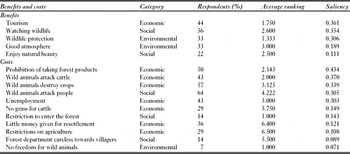
From 16 respondents to free listing in DWS, seven (44%) said that the creation of the PA did not generate any benefits. The other nine respondents listed 19 different benefits associated with DWS. On average, informants from DWS listed 3.2 benefits associated with DWS (Min = 1, Max = 6). The most salient benefit listed was the increase in ‘tourism’ as a type of economic benefit, followed by ‘watching wildlife’ (social) and ‘wildlife protection’ (environmental benefit) (Table 1).
Benefits and costs associated with the Dandeli Wildlife Sanctuary by residents living within and around the sanctuary (n = 16).

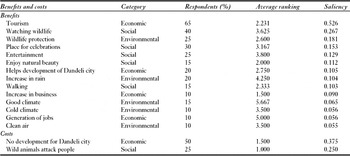
The 20 respondents in Dandeli city mentioned an average of 4.3 benefits associated with DWS (Min = 1; Max = 11); none said that the creation of the PA had not generated any benefits. Thirty-six benefits were associated with DWS by Dandeli city residents. The most salient economic, social and environmental benefits listed coincided with those cited by people living in or around DWS (Table 2). Other benefits cited by at least two respondents from Dandeli city included three economic (i.e. increase in business), four social (i.e. to enjoy natural beauty) and four environmental benefits (i.e. increase in rain, good climate) (Table 2).
Benefits and costs associated with the Dandeli Wildlife Sanctuary by residents living in Dandeli City (n = 20).
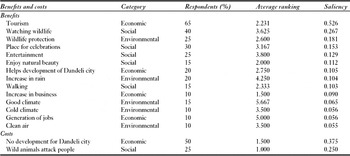
Only two (13%) of the 16 respondents in DWS reported that the creation of the PA did not generate any costs. The other 14 respondents listed a total of 28 different costs associated with DWS. On average, informants listed 5.1 different costs (Min = 1, Max = 12) associated with DWS. The ban on extracting forest products was singled out as the most salient economic cost to people in DWS (Table 1), whereas the most salient social cost was attack by wildlife of humans and the most salient environmental cost was the restriction of animals’ movements. From the lists of 10 costs associated with DWS listed by at least two respondents in DWS, seven were economic and the other three were social. Only one informant mentioned environmental cost.
From the 20 respondents in Dandeli city, 16 (or 80%) said that DWS did not generate any costs. The other four Dandeli city informants gave a list of only five costs associated with DWS, from which the restriction to industrial development was considered the most salient economic cost. Only one respondent from Dandeli city mentioned wildlife attacks on humans as a social cost associated with DWS, and none of the informants mentioned environmental costs (Table 2).
Descriptive statistics of variables used in multivariate analysis
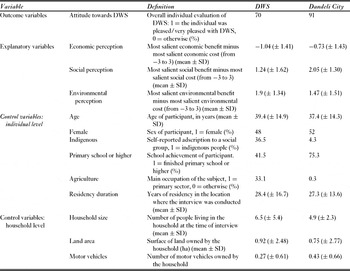
In the survey sample 82.42% of the respondents had positive attitudes towards DWS. A higher percentage of people had positive attitudes in Dandeli city (91%) than in DWS (70%) (Table 3). The difference in attitude towards DWS was statistically significant in a χ2 test (Pearson χ2 = 35.8; p < 0.001).
Descriptive statistics of variables used in the regression analysis. DWS: n = 182, Dandeli City: n = 256.
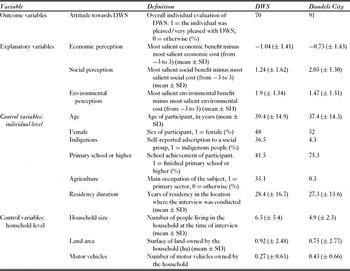
The perception indices varied between Dandeli city and DWS. The economic perception index was negative in both areas, suggesting that people associate economic costs with DWS more than economic benefits. The average economic perception index value was more negative for respondents in DWS than for respondents in Dandeli city (Table 3), suggesting that people in DWS perceived larger economic costs than people in Dandeli city. The social and environmental perception indices were positive, suggesting that people associated social and environmental benefits to the PA.
There were substantial socioeconomic differences between respondents living in Dandeli city and respondents living in the DWS and surrounding areas (Table 3). Respondents living in DWS and surrounding areas had lower levels of education, larger families, more land area, fewer motor vehicles and more jobs in the primary sector than respondents living in Dandeli city. Only 11 respondents (out of 256) in our Dandeli city sample were of indigenous origin, whereas 65 respondents (or 36% of the sample) in DWS and surrounding villages were indigenous.
Factors affecting perceptions and attitudes
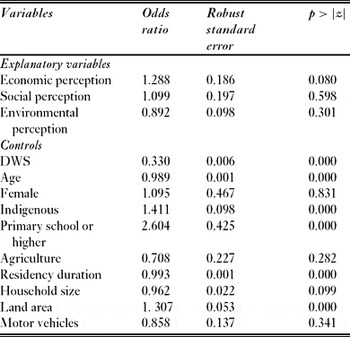
We found a statistically significant positive association between the economic perception index and the attitude towards DWS (Table 4). The regression indicated on average a one-point increase in the economic perception index multiplied the odds of showing an overall positive attitude towards DWS by 1.28 (p = 0.08). We did not find a statistically significant association between the social or environmental perception indices and attitude towards the PA.
Logistic regression with robust standard error and clustering by area of residency of relation between economic, social and environmental perception indices and overall attitude towards the DWS (dependent variable, 1 = pleased, 0 = otherwise) (n = 416).
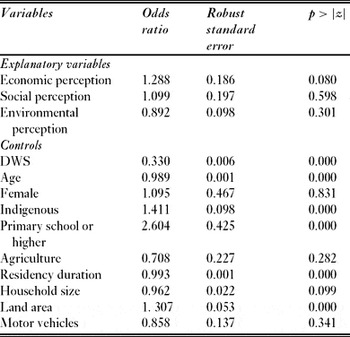
Place of residency, age and residency duration tended to reduce the odds ratio of having a positive attitude towards the PA, whereas education and indigenous origin increased it. Living in DWS reduced the odds of having a positive attitude towards the Wildlife Sanctuary by about 77% (p < 0.001). Each year of age tended to reduce the odds of having a positive attitude towards the PA by 2% (p < 0.001). Having completed primary school multiplied the odds of having a positive attitude towards the PA by 2.6 (p < 0.001) and indigenous origin multiplied the odds of having a positive attitude by 1.4 (p < 0.001).
Household variables also affected an individual's overall attitude towards DWS. Each additional household member reduced the odds ratio of positive attitude towards the PA by 4% (p = 0.099), and each hectare of land owned by the household multiplied the odds of having a positive attitude by 1.31 (p < 0.001).
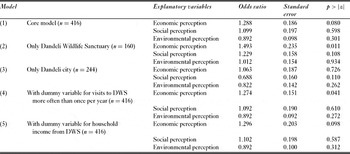
A series of sensitivity analyses (Table 5) allowed us to assess how well core model (Table 4) held up.
Sensitivity analyses. Logistic regressions with robust standard error and clustering by area of residency of relation between economic, social and environmental perception indices and overall attitude towards the DWS (dependent variable, 1 = pleased, 0 = otherwise).
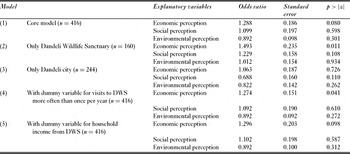
Models 2 and 3 (Table 5) were logistic regressions similar to the core regression (Table 4), but for informants living in the DWS or surrounding areas only (model 2) and those living in Dandeli city (model 3). Model 2 showed a strong positive association between the economic perception index and the overall attitude towards the PA (Table 5). For people in DWS, a one-point increase in the economic perception index multiplied the odds of expressing a positive attitude towards DWS by 1.49 (p = 0.01). The social perception index and attitudes towards DWS were positively associated. Each point increase in the social perception index multiplied the odds of a positive attitude by 1.22 (p = 0.108). For the Dandeli city model (model 3), we found no statistically significant association between the economic perception index and an overall attitude towards DWS; rather, the association between the social perception index and overall attitude towards the PA tended to be negative.
Models 4 and 5 added two variables that previous research suggested might affect attitudes toward a PA: the use of the PA, proxied by frequency of visits to DWS, and a dummy variable that captured whether the household received income from DWS. The results were similar to the core model (Table 5).
DISCUSSION
Three main findings emerge from our work. The attitude of local residents towards the DWS was positive overall. The perceptions of PA impacts differed between urban respondents, who reported more benefits and fewer costs associated with the PA, and rural respondents, who reported more costs and fewer benefits. Only the perception of economic costs was associated with overall negative attitudes towards the PA; this trend was especially strong among rural dwellers.
Our first finding dovetails with previous empirical research on the topic. Rural and indigenous people living inside or around PAs tend to agree with the importance and value of wildlife and support conservation efforts (Infield Reference Infield1988; De Boer & Baquete Reference De Boer and Baquete1998; Infield & Namara Reference Infield and Namara2001; Udaya Sekhar Reference Udaya Sekhar2003; Allendorf et al. Reference Allendorf, Swe, Oo, Htut, Aung, Allendorf, Hayek, Leimgruber and Wemmer2006). In our study, acceptance was higher among urban than among rural dwellers, but it was high in both cases.
However, our first finding clashes with estimated costs of PA impacts on local livelihoods (Ferraro Reference Ferraro2002; Schmidt-Soltau Reference Schmidt-Soltau2003; Adams et al. Reference Adams, Aveling, Brockington, Dickson, Elliott, Hutton, Roe, Vira and Wolmer2004; West et al. Reference West, Igoe and Brockington2006), the surge of local movements against PAs (Marshall et al. Reference Marshall, White and Anke2007) and campaigns for the democratization of PAs (Mannigel Reference Mannigel2008; Mendez-Contreras et al. Reference Mendez-Contreras, Dickinson and Castillo-Burguete2008). PAs can negatively impact local livelihoods through the loss of rights, bans on the use of natural resources, displacement from traditional lands (Ferraro Reference Ferraro2002; Schmidt-Soltau Reference Schmidt-Soltau2003; Adams et al. Reference Adams, Aveling, Brockington, Dickson, Elliott, Hutton, Roe, Vira and Wolmer2004), damage generated by wild fauna (De Boer & Baquete Reference De Boer and Baquete1998; Rao et al. Reference Rao, Rabinowitz and Khaing2002), changes in power structures (Berkes Reference Berkes2004; West et al. Reference West, Igoe and Brockington2006) and Western cultural impositions (Roth Reference Roth2004). However, our data suggest that, despite those potential costs, local residents display positive attitudes towards DWS.
Local residents’ attitudes towards PAs may be positive because they possess traditional cultural practices aimed at the sustainable exploitation of natural resources that tie up with conservation values (Infield Reference Infield1988; Allendorf et al. Reference Allendorf, Smith and Anderson2007). We offer two additional explanations for the overall local positive attitude towards DWS. First, it is possible that our measure is inflated by complacency bias, or answers given according to what people think is socially correct, not to what they really think. If so, negative attitudes towards DWS are in fact more prevalent than shown. Second, permission to partially use some of the natural resources in the area for subsistence activities may also explain the overall positive attitudes. Conflicts over PAs have been documented when the PA deeply affects local livelihoods (Arjunan et al. Reference Arjunan, Holmes, Puyravaud and Davidar2006). Because, as in other PAs in India (Robbins et al. Reference Robbins, McSweeny, Chhangani and Rice2009), people in the DWS can de facto continue using natural resources (Hedge & Gubbi Reference Hedge and Gubbi2004), they might not have developed overall negative attitudes towards the PA.
The two other noteworthy findings from this work are related and highlight differences in perception between urban and rural dwellers. Our data suggest that urban residents perceived the PA as socially and environmentally desirable, whereas rural residents were more concerned with its economic costs. For example, despite the historical impact of the PA in the economic development of Dandeli city, respondents in Dandeli city listed five social and five environmental benefits and only four economic costs, whereas respondents in DWS listed seven economic costs and only two social and two environmental benefits. Furthermore, we found that the economic costs generated by the PA were associated with negative attitudes towards the area, whereas the social and environmental impacts were not. In other words, the more economic benefits a respondent perceived from the PA, the higher the odds that the respondent reported a positive attitude towards the PA.
Those two related findings mesh with results from previous research on the costs of PAs for local residents (Ferraro Reference Ferraro2002; Bonaiuto et al. Reference Bonaiuto, Carrus, Martorella and Bonnes2002; Arjunan et al. Reference Arjunan, Holmes, Puyravaud and Davidar2006). People living within or on the edges of PAs show less satisfaction with the establishment of such areas than the urban population because people living near PAs bear most of the costs generated by PAs but enjoy less of their potential benefits. For example, as in other areas in India (Davidar et al. Reference Davidar, Arjunan and Puyravaud2008), people living in DWS and surrounding areas are more dependent on forest resources for their livelihood than people in Dandeli city, so they are more likely to be affected by bans and restrictions associated with the use of natural resources on DWS. In contrast, residents of Dandeli city are more likely to enjoy the economic benefits associated with the increase in tourism in the area (associated to wildlife watching and rafting outside DWS). Dandeli city economic activities were also affected by the restrictions on mining and logging that came with the establishment of DWS. We do not have a clear explanation of why economic costs are not more evident in responses from urban dwellers, but we think it might have to do with the fact that those costs occurred several decades ago, whereas rural dwellers continued bearing the economic costs of restrictions in the use of natural resources at the time of the interview.
A potential alternative explanation for the larger negative attitude of rural dwellers towards the PA relates to their exclusion from forest management. The free listing suggests that people in the area did not consider the relation with DWS management staff as an important problem (it appeared in 17th position of problems generated by DWS), probably because the two groups do not interact much. In other Indian PAs, attitudes of rural communities towards PAs improve with their inclusion in management, for example through the implementation of participatory forest management programmes (Rishi Reference Rishi2007). The lack of initiatives to involve the local population in the management of DWS might partially explain the larger negative attitude of rural versus urban dwellers.
As mentioned before, social, environmental and economic costs or benefits are linked, and many items in our lists could be classified under two or the three categories; different individuals might categorize a single item in different ways. For example, some might consider ‘watching wildlife’ as a social benefit, some others as an economic benefit because it is a tourist attraction and still others as an environmental benefit. Our results on the effects of each category on the overall perception should thus be taken with caution, as they consider each category as independent. Furthermore, the categorization itself is problematic since it might impose a Western view of the relations between nature and society that might not reflect the local view (West et al. Reference West, Igoe and Brockington2006). We used this common framework (Barbier Reference Barbier1987) for operational reasons, but we acknowledge that other classifications might provide different results.
CONCLUSIONS
Local residents’ perception of the economic costs generated by the PA increased the likelihood of negative attitudes towards it, especially for residents living within or on its borders. If the long-term integrity of PAs in low-income nations partially depends upon the support of communities that live adjacent to them (see West & Brechin Reference West and Brechin1991; Struhsaker et al. Reference Struhsaker, Struhsaker and Siex2005), then policy makers need to seriously tackle the issue of the unequal distribution of economic benefits and costs generated by PAs. Involving local populations in forest management, while not a panacea, might help improve local people's understanding of the costs and benefits of conservation efforts.
Future research on local perceptions of PAs should improve the measure of overall attitude towards PAs, specifically addressing a complacency bias in the responses. Whether findings presented here represent a general trend needs to be tested in different PAs. Third, further research should address the links between social, environmental and economic costs and benefits, and strengthen understanding of local categorizations of costs and benefits generated by PAs. We studied local residents’ attitudes towards PAs, but the link between attitudes and sustainable behaviours is still ambiguous (Holmes Reference Holmes2003; Arjunan et al. Reference Arjunan, Holmes, Puyravaud and Davidar2006). Future research should address whether positive attitudes translate into more sustainable behaviours.
ACKNOWLEDGEMENTS
Research was funded by a Marie Curie Grant (MIRG-CT-2006–036532) and had the logistic support of the Desphande Foundation. We thank T. Allendorf, C. García, D. Tabara, three anonymous reviewers and ICTA-UAB students for comments on drafts. Francisco Zorondo-Rodriguez acknowledges a ‘Presidente de la Republica’ scholarship (Chile).