Mastitis is a costly disease that impacts the profitability of dairy farms (Cha et al., Reference Cha, Bar, Hertl, Tauer, Bennett, González, Schukken, Welcome and Gröhn2011). The disease is commonly caused by invasion of bacteria, which induces infection and inflammation in the mammary gland. Nutrition can have a great impact on the immune status of animals and plays an important role in the occurrence of mastitis (Ingvartsen and Moyes, Reference Ingvartsen and Moyes2013). Among nutrients, vitamins can have a major impact on the immune system of dairy cows (Sordillo, Reference Sordillo2016), including the ability of the animals to respond to mammary infections. Alpha-tocopherol, the most abundant isomer of vitamin E, is an important antioxidant with a main role in preventing cell membrane damage by free radicals, especially in phagocytes (Barrett et al., Reference Barrett, Hogan, Weiss, Smith and Sordillo1997). Interestingly, clinical mastitis induced by intramammary infusion of lipopolysaccharide or E. coli increased milk α-tocopherol by 32% in Holstein cows (Barrett et al., Reference Barrett, Hogan, Weiss, Smith and Sordillo1997). However, despite initial evidence of an effect of vitamin E supplementation on the reduction of somatic cell count in milk (Batra et al., Reference Batra, Hidiroglou and Smith1992), the overall effect on incidence of mastitis is unclear (Politis, Reference Politis2012). In addition, vitamin A and its precursor β-carotene can decrease infections during the early dry period and reduce somatic cell count (SCC) from week two to eight of lactation (O'Rourke, Reference O'Rourke2009). Retinol is the most abundant isomer of vitamin A in the blood. Plasma concentration of retinol was shown to be lower in cows with mastitis vs. healthy cows whereas the opposite observation was reported for β-carotene (Johnston and Chew, Reference Johnston and Chew1984).
Peroxisome proliferator-activated receptor γ (PPARγ) is a nuclear receptor with known roles in controlling lipid and glucose metabolism and inflammation (Bionaz et al., Reference Bionaz, Osorio and Loor2015). Transactivation of PPARγ requires the formation of a heterodimer with the retinoid-X-receptor (RXR), which also requires to be activated by an agonist. Retinoic acids (RA), the main metabolites of vitamin A, are RXR agonists. These include isomers such as 13-cis RA, 9-cis RA, and all-trans RA [ATRA; (Zhao et al., Reference Zhao, Fu, Liu, Shinohara, Nielsen, Dong, Kanekiyo and Bu2014)]. Among the RA, 9-cis RA has the highest affinity for the RXR compared with other RA isomers, at least in C57BL/6 mice (Xu and Drew, Reference Xu and Drew2006) and it is a potent agonist of RXR (Dawson and Xia, Reference Dawson and Xia2012). In previous research it was found that the rat conceptual homogenates of 9-cis RA are not only generated by carotenoid precursors, but can also be isomerized from ATRA via an alternative pathway (Chen and Juchau, Reference Chen and Juchau1998). In addition, it has been hypothesized that 13-cis RA can be biotransformed to ATRA (Chen and Juchau, Reference Chen and Juchau1998).
In a prior study, we assessed if the response to mastitis could be improved in dairy goats by activation of PPARγ using daily i.v. injection of the putative synthetic agonist 2,4-thiazolidinedione (TZD; Rosa et al., Reference Rosa, Osorio, Trevisi, Yanqui-Rivera, Estill and Bionaz2017). In the same study, it was assessed if activation of PPARγ could improve the milk fat synthesis, because in vitro data strongly supported the role of PPARγ in controlling expression of genes related to milk fat synthesis (Bionaz et al., Reference Bionaz, Osorio and Loor2015). Results from that study indicated that TZD improved the innate immune response of the goats and tended to prevent the milk fat depression induced by mastitis, however, it did not increase milk fat synthesis and did not affect the expression of putative PPARγ target genes, indicating a lack of activation of PPARγ by TZD. The lack of agonistic effect of TZD on PPARγ was confirmed by subsequent in vitro studies suggesting that, at the best, TZD is a weak PPARγ agonist (Bionaz et al., Reference Bionaz, Osorio and Loor2015). The same studies indicated that TZD is a potent activator of PPARγ in the presence of the vitamin A metabolite 9-cis-RA. Therefore, as previously argued (Rosa et al., Reference Rosa, Osorio, Trevisi, Yanqui-Rivera, Estill and Bionaz2017), the lack of activation of PPARγ by TZD was likely a consequence of a low level of vitamin A in the goats used for the experiment.
The original experiment by Rosa et al. (Reference Rosa, Osorio, Trevisi, Yanqui-Rivera, Estill and Bionaz2017) was replicated using goats that were grazed for two years such that they were expected to have a good reserve of vitamin A in the liver. During the experiment the goats received an individual diet according to NRC recommendations, including vitamin A (Jaaf et al., Reference Jaaf, Rosa, Moridi, Osorio, Lohakare, Trevisi, Filley, Cherian, Estill and Bionaz2019). Results indicated that, contrary to the original hypothesis, TZD failed to activated PPARγ in goats with a good amount of vitamin A in the diet (Jaaf et al., Reference Jaaf, Rosa, Moridi, Osorio, Lohakare, Trevisi, Filley, Cherian, Estill and Bionaz2019; Rosa et al., Reference Rosa, Moridi, Osorio, Lohakare, Trevisi, Filley, Estill and Bionaz2019).
Considering all the above, the objectives of the present work were to: (1) Compare the level and pattern of retinoids and various metabolites in the serum of the goats in the first experiment (Rosa et al., Reference Rosa, Osorio, Trevisi, Yanqui-Rivera, Estill and Bionaz2017) with the second experiment (Jaaf et al., Reference Jaaf, Rosa, Moridi, Osorio, Lohakare, Trevisi, Filley, Cherian, Estill and Bionaz2019) and their interaction with TZD treatment; (2) To determine the effect of TZD on milk fatty acid profile in goats treated with TZD. The hypotheses were (1) TZD does not affect the level of retinol in blood, and (2) the fatty acid profile is affected by the interaction between mammary infection and TZD in dairy goats.
Materials and methods
Animals, treatment and experimental design
All animal procedures were approved by the Oregon State University Animal Care and Use Committee (#4448). Details of the two experiments have been published previously (Rosa et al., Reference Rosa, Osorio, Trevisi, Yanqui-Rivera, Estill and Bionaz2017; Jaaf et al., Reference Jaaf, Rosa, Moridi, Osorio, Lohakare, Trevisi, Filley, Cherian, Estill and Bionaz2019). Briefly, the first experiment was a 2 × 2 factorial arrangement of treatments where twenty-four lactating Saanen goats (68.1 ± 7.6 kg of BW, 156 ± 14 DIM, and 1.6 ± 0.5 BCS) were randomly assigned to daily injection of TZD (8 mg/kg BW; Sigma Aldrich, USA) or saline (Henry Schein, USA). A week later, each group were further subdivided to receive intramammary injection with 1.7 × 10⁸ colonies of Streptococcus uberis (IMI) or saline in both mammary glands for a total of 4 treatments (saline + saline = CTRL; saline + IMI = MCTR; TZD + saline = CTZD; and TZD + IMI = MTZD; n = 6/treatment). The second experiment was a 2 × 2 factorial design where twelve lactating Saanen goats (69.2 ± 7.1 kg of BW, 53.6 ± 16.2 DIM, and 2.6 ± 0.6 BCS) were randomly assigned into daily injection of TZD (8 mg/kg of BW) or saline. Two weeks later, all goats received an IMI in the right mammary gland (total of two groups: MTZD and MCTR). For both experiments, all animals were fed ad-libitum with orchard hay and alfalfa, and an extra 150 g of commercial goat grain mix was fed at milking. The second experiment supplied extra vitamins to reach the level recommended by NRC for lactating small ruminants (2001). Eleven goats were used for both experiments and received the same treatments, which allowed us to compare the level of retinol, α-tocopherol and β-carotene between the two experiments. Milking was performed once a day (first experiment) or twice a day (second experiment).
In the first experiment, blood samples were collected on d −7, −2, 1, 2, and 12 relative to IMI by jugular venipuncture. In the second experiment, blood samples were collected on d −15, 0, 1, and 10 relative to IMI. Blood samples were kept at −80°C until analysis. In the first experiment milk samples were collected on d −8, 1, 4, 7 and 12 relative to IMI, and kept at −20°C until analysis.
Analysis of lipid soluble vitamins
Serum samples were analyzed for α-tocopherol, β-carotene, retinol, 13-cis RA and ATRA. Milk samples from the first experiment were analyzed for α-tocopherol, β-carotene, and retinol using high-performance liquid chromatography (HPLC). The serum was acidified by 20 μl of 2 N acetic acid, denatured by adding 420 μl acetonitrile, and extracted by 1.5 ml organic solvents mixture (hexane:2-propanol, 6.5:1.5; v/v). The saponification of the milk samples was performed using 500 μl of 1% pyrogallic acid and 500 μl of 50% KOH, and extracted using petroleum ether (Indyk, Reference Indyk1988). After one-min vortexing and centrifugation at 1000 × g for 3 min, the organic layer in both sample types was transferred to another tube, dried by gentle nitrogen stream, and reconstituted in mobile phase (78.2% acetonitrile, 13.0% dichloromethane, 8.7% methanol and 0.1% n-butanol) for determination of α-tocopherol, β-carotene, and retinol (Tsai et al., Reference Tsai, Rezamand, Loucks, Scholte and Doumit2017).
For 13-cis RA and ATRA the same procedure of lipid extraction was used but samples were reconstituted in a different mobile phase (A: 10 mm ammonium acetate, B: methanol and C: acetonitrile; all solvents contained 1% acetic acid). The HPLC included Waters® Separation Module 2695 with a Symmetry C18 separation column (4.6 × 75 mm, 3.5 μm particle size; Cat: WAT066224), and Photodiode Array Detector (PDA) 2998. Waters 2695 and PDA 2998 were controlled by Empower 3 software (Waters®, Milford, MA, USA). Alpha-tocopherol, β-carotene, and retinol were detected at wavelengths of 290, 450, and 325 nm with retention time of 3.1, 5.6, and 1.6 min, respectively (Supplementary Fig. 1). The temperature of auto sampler was set to 4°C, and the column temperature was constant at 50°C. Mobile phase flow rate was maintained at 1.5 ml/min for a total of 6.5 min of run.
The 13-cis RA and ATRA were detected at 380 nm with retention time of 9.3 and 10.4 min, respectively (Supplementary Fig. 2). Because 9-cis RA and retinol eluted at the same retention time of around 9.8 min, we could not identify 9-cis RA using this method. The temperature of auto sampler was set to 4°C, and the column temperature was constant at 40°C. Mobile phase flow rate was maintained at 1 ml/min for linear gradient curve, starting from 23% A, 32% B and 45% C to 50% B and C at 15 min. The run was performed for a total of 18 min. All of the output results were obtained from area (μV × sec) and compared with linear calibration curve of standard to obtain the concentration of lipid soluble vitamins in the serum (α-tocopherol, β-carotene, retinol, 13-cis RA and ATRA; Cat# T3251, C4582, R7632, R3255, and R2625, Sigma Aldrich, USA). The limit of detection was calculated by 3 × standard deviation of the response divided by the slope of the calibration curve, and limit of quantification was calculated by 10 × standard deviation of the response divided by the slope of the calibration curve (Shrivastava and Gupta, Reference Shrivastava and Gupta2011). The limit of detection for α-tocopherol, retinol, β-carotene, ATRA and 13-cis RA were 42.3 (ng/ml), 12.13 (ng/ml), 0.44 (ng/ml), 0.56 (ng/ml), and 0.33 (ng/ml), respectively. In addition, the limit of quantification values on α-tocopherol, retinol, β-carotene, ATRA and 13-cis RA were detected at 128.1 (ng/ml), 36.7 (ng/ml), 1.34 (ng/ml), 1.68 (ng/ml), and 1.01 (ng/ml), respectively. The coefficient of variation in standard curve was between 6.3 to 15.4%.
Fatty acid profiling of milk fat
Lipids were extracted from the milk samples from the first experiment. The lipid extraction was done by chloroform: methanol (2 : 1) as previously described (Tsai et al., Reference Tsai, Rezamand, Loucks, Scholte and Doumit2017). Briefly, the total lipids in milk were processed with sodium methoxide for methylation (Christie, Reference Christie1982). Lipids were dissolved in 2 ml sodium methoxide and kept in a water bath at 80°C for 10 min with 5% methanolic hydrochloric acid. Methylated lipid samples were analyzed by Agilent 7890A gas-chromatography system (Agilent Technologies®, Santa Clara, CA, USA) equipped with an auto-sampler, a flame-ionization, and an Agilent HP-88 column (100 m × 0.25 mm with a 0.20-μm film thickness, Agilent Technologies). Fatty acids (FA) were identified using a Supelco 37 Component fatty acid methyl esters mix (Cat# 47885U, Sigma Aldrich, St. Louis, MO, USA). Final proportion of FA was determined as percentage of all detected FA.
Statistical analysis
The data were analyzed by Proc Mixed procedure of SAS (Statistical Analysis System; V. 9.4, SAS Inst. Inc., USA). Eleven goats were used with the same treatments for both experiments, which allowed us to compare the level of retinol, α-tocopherol and β-carotene between the two experiments. Fixed effects in the model were experiment, treatment (TZD or saline), and their interaction. Goat was the random effect. The statistical model to assess the effect of TZD and IMI in each experiment separately was:
 $$Y_{ij} = \mu _i + \beta \lpar x_{ij}-\bar{x}..\rpar + e_{ij}$$
where the μ = is the treatment mean, β = is the coefficient for the linear regression of treatment on initiation date, and eij = is the normally distributed random experimental error on repeated measures. The covariance structures included autoregressive (1), compound symmetry, spatial covariance power, and variance components (default) were compared to find the best fit to analyze the data. The AIC and BIC did not drastically differ, so we used variance components (default) to analyze the data. The data on day −7 (i.e. baseline) were used as a covariate. Data are presented as least square means (LSM) and larger standard error of the mean (sem). For 13 cis-RA and ATRA, there were around 33% missing data or non-detected values, therefore means and larger sem without statistical comparison are reported. Statistical significance was declared at P ≤ 0.05, and tendencies were discussed when 0.05 < P ≤ 0.10.
Results
Responses to vitamin supplementation
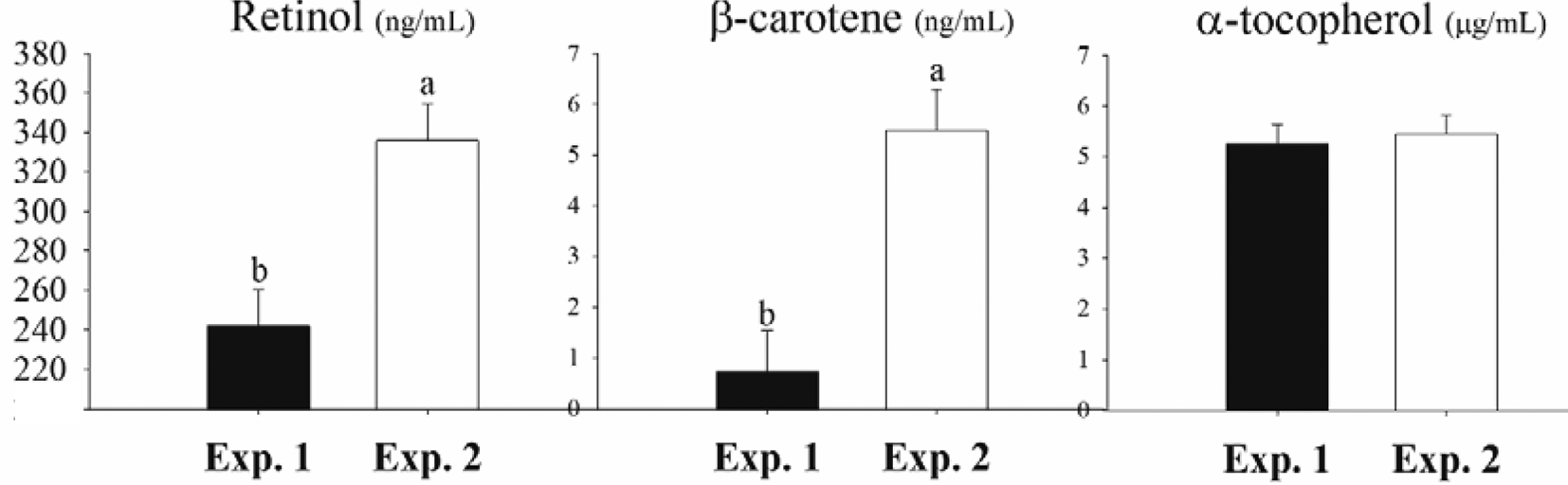
In the second experiment (with vitamin supplementation) the goats had a significantly greater level of retinol and β-carotene in serum compared to that found during the first experiment. In addition, the retinol level detected was 288 ± 76 ng/ml in Saanen goats used for the two experiments (Fig. 1). Serum β-carotene was above the limit of detection in all samples from the second experiment (5.5 ± 3.6 ng/ml; mean ± sd), but below the limit of detection in 8 out of 11 samples in the first experiment. Mean blood serum α-tocopherol was 5.3 ± 1.3 μg/ml in lactating goats in both experiments. No differences were observed for α-tocopherol in blood between the two experiments.
Level of lipophilic vitamins in the same animals used in the two experiments (with and without dietary vitamin supplementation) (n = 11). Different letters denote statistical differences P < 0.01. No treatment or treatment × experiment differences were observed.

Effect of TZD and IMI on lipophilic vitamins in blood serum
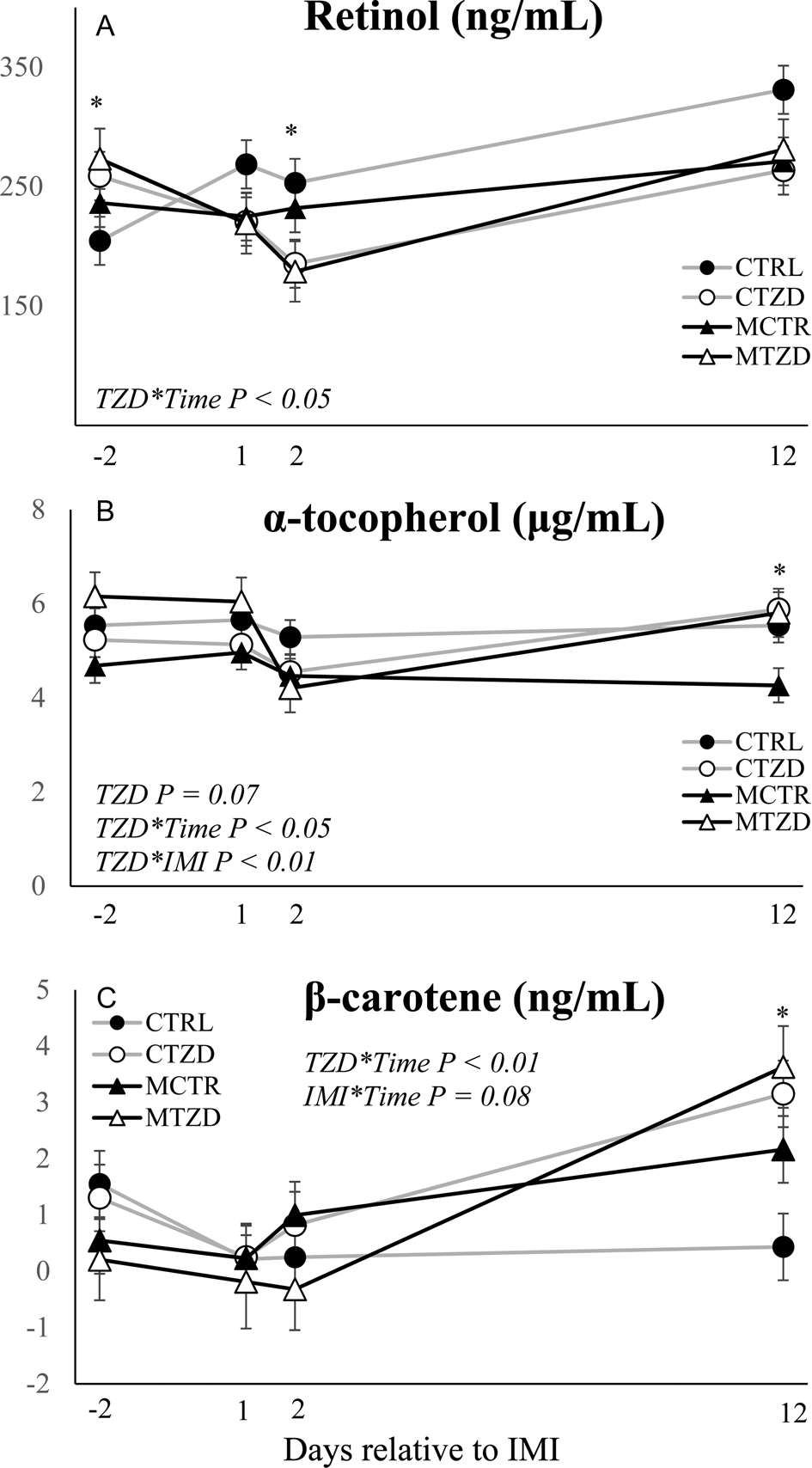
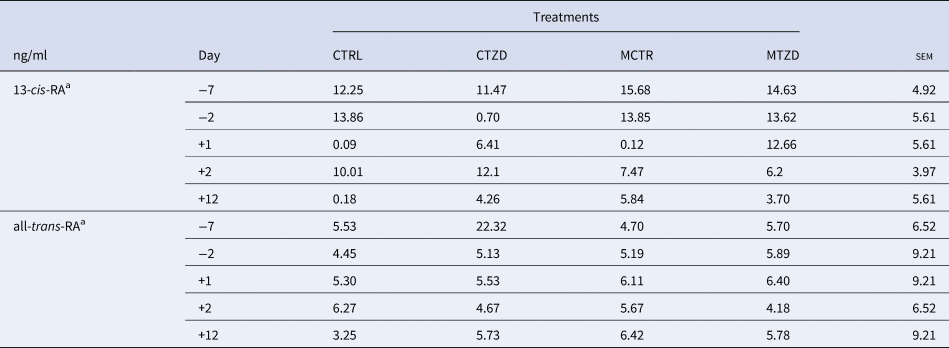
In the first experiment a TZD × time effect (P < 0.05; Fig. 2a) was observed for serum retinol. Goats treated with TZD had a higher level of retinol before IMI but lower level 2 d post-IMI. Alpha-tocopherol did not differ significantly in goats treated with TZD or saline, although was numerically higher in the former, mostly due to a significant TZD × time interaction where goats treated with TZD had significantly higher α-tocopherol 12 d post-IMI (Fig. 2b). Alpha-tocopherol was also affected by a TZD × IMI interaction (P < 0.05) due to an overall larger decrease of the parameter just after IMI in goats treated with TZD but not in saline (Fig. 2b). Beta-carotene was affected by TZD × time (P < 0.01) but not significantly by IMI × time (P = 0.08; Fig. 2c). Similar to α-tocopherol, goats treated with TZD had an overall higher value at 12 d post-IMI. The average values for the 13 cis-RA and ATRA for each group and time points are presented in Table 1.
Effect of daily TZD injection followed by intramammary challenge with Streptococcus uberis on serum retinol (a) α-tocopherol (b) and β-carotene (c) in lactating goats. CTRL: Control, no TZD or challenge. CTZD: TZD without challenge. MCTR: challenge without TZD. MTZD: TZD and challenge.

Concentration of 13-cis- retinoic acid (RA) and all-trans-RA in blood serum collected from dairy goats injected daily with 2,4-thiazolidinedione (TZD) or saline and receiving intramammary infusion of Strep. uberis (M) or saline (CTRL) 7 d into the daily injection (n = 6: data from the first experiment). Data from day −7 were used as covariate for statistical analysis

a 13-cis-RA and all-trans-RA are presented as means with larger sem without statistical comparison because in approx. 30% of samples the parameters were not detected, and value equal 0.
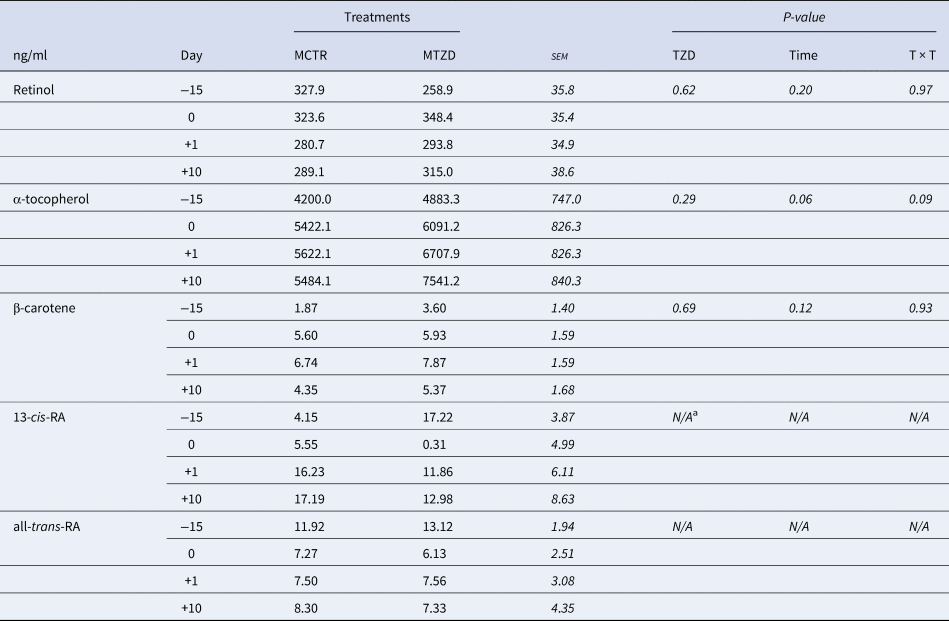
In the second experiment no overall effects between groups for retinol, α-tocopherol, and β-carotene were observed in blood serum (Table 2). The 13 cis-RA was undetectable in 69% of the blood samples, and ATRA was undetectable in 29% of the blood samples. Thus, the average for each group and time points are presented.
Concentration of several lipid soluble vitamins in blood serum collected from dairy goats injected daily with 2,4-thiazolidinedione (TZD) or saline (CTR) and receiving intramammary infusion of Strep. uberis (M) 14 d into the daily injection (n = 6: data from the second experiment)

Data from day −15 were used as covariate for statistical analysis.
a 13-cis-RA and all-trans-RA are presented as means with larger sem without statistical comparison because in approx. 30% of samples the parameters were not detected, and value equal 0.
Milk vitamins
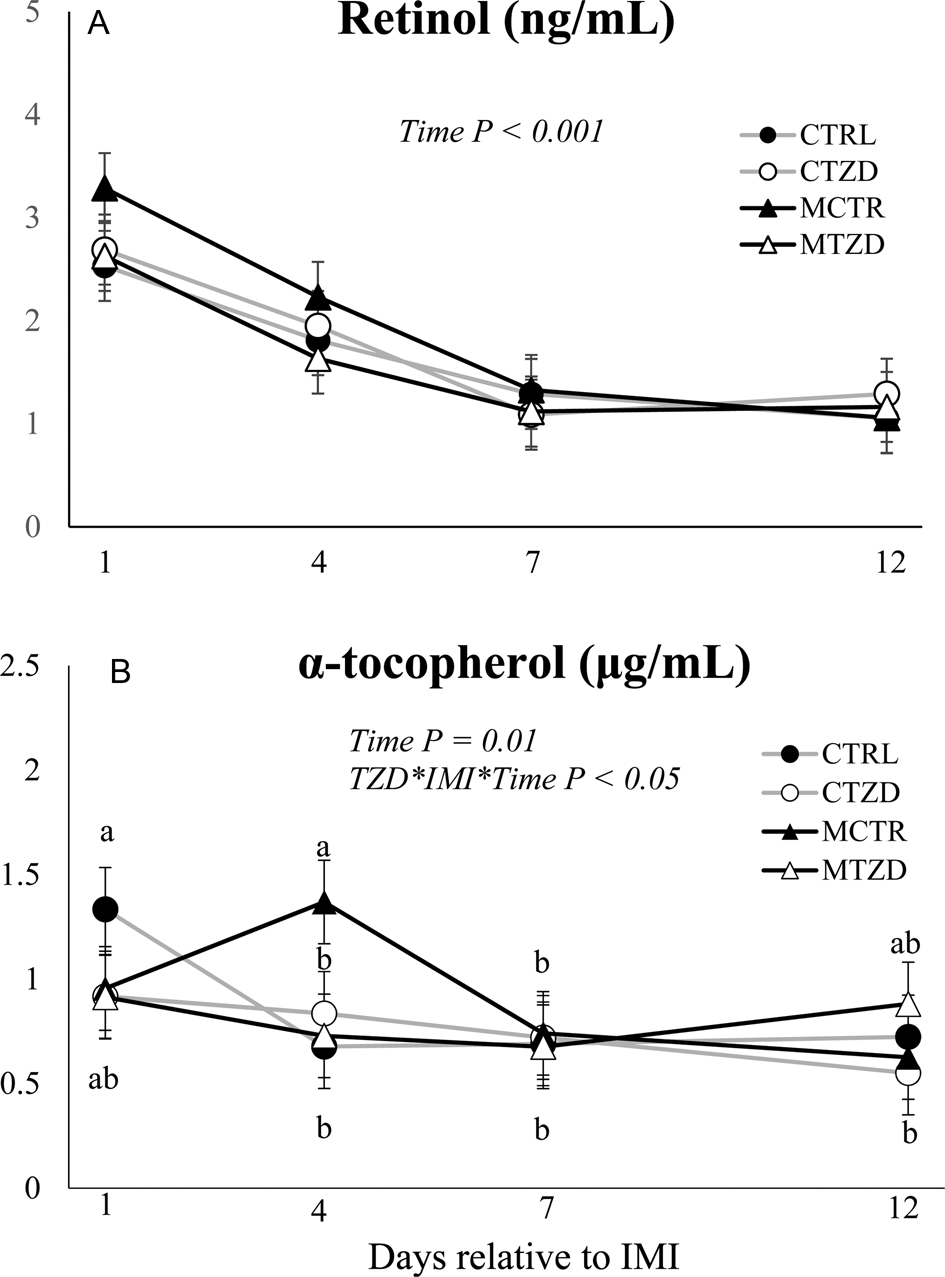
Results of retinol and α-tocopherol in the milk of goats used in the first experiment are shown in Fig. 3. We detected a mean of 1.8 ± 0.9 ng/ml of retinol and 0.84 ± 0.42 μg/ml of α-tocopherol. Retinol in milk was not affected by TZD or IMI, however, the milk α-tocopherol was affected by the TZD × IMI × time interaction (P < 0.05) where a higher level in CTRL was observed compared with the other groups 1 d post-IMI and a higher level in MCTR vs. the other groups 4 d post-IMI (P < 0.05).
Effect of daily TZD injection followed by intramammary challenge with Streptococcus uberis on milk retinol (a) and α-tocopherol (b) in lactating Saanen goats. CTRL: Control, no TZD or challenge. CTZD: TZD without challenge. MCTR: challenge without TZD. MTZD: TZD and challenge.

Milk fatty acid profile
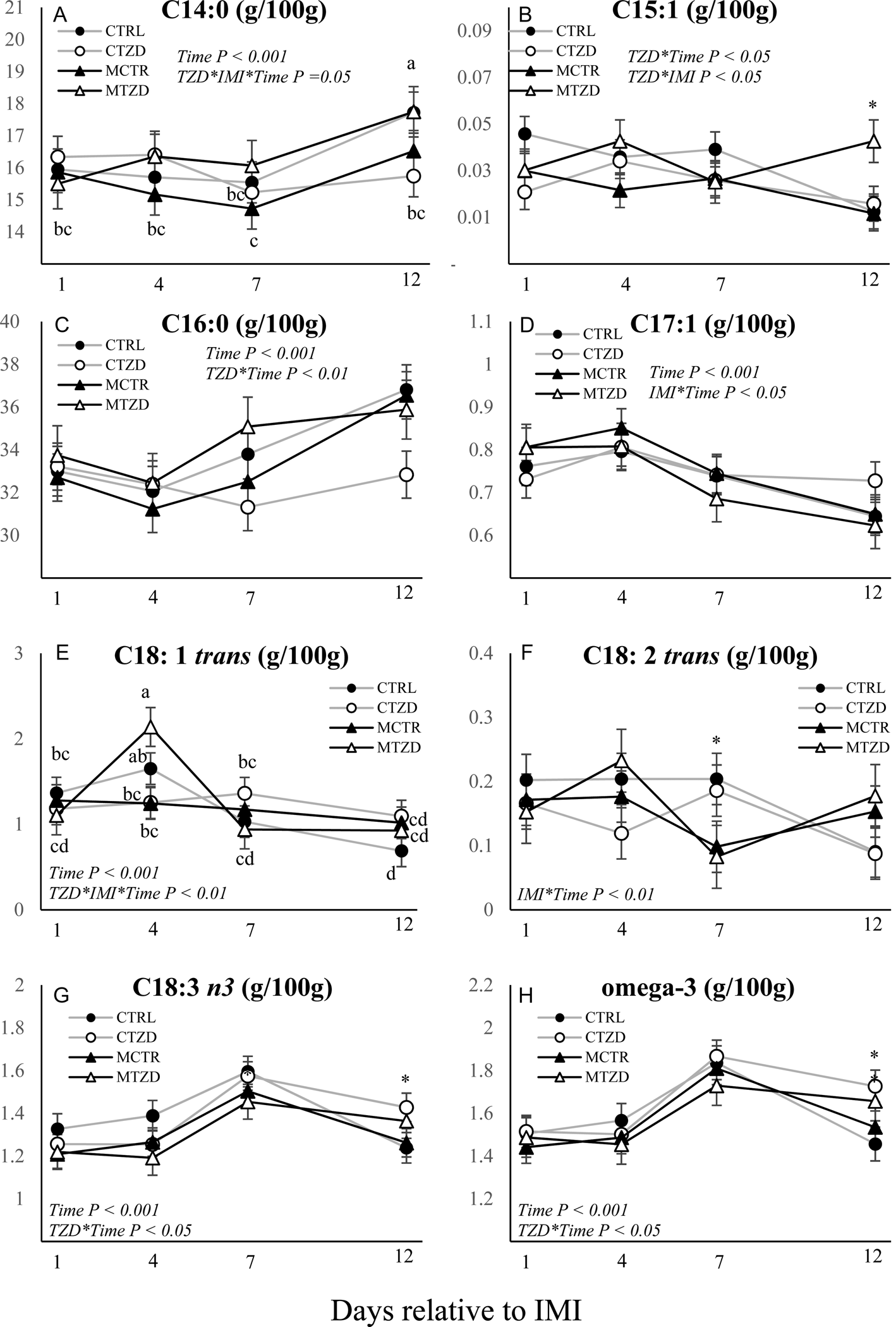
Milk fatty acid analysis was performed only for the first experiment. The complete dataset for the FA profiling is available in online Supplementary Tables 1 and 2. C14 : 0 and C18 : 1 trans had an overall TZD × IMI × time interaction. MCTR and CTZD goats had an overall decrease in proportion of C14 : 0 after IMI (Fig. 4a), while MTZD had an increase in proportion of C18 : 1 trans 4 d post-IMI. A TZD × time effect for C15 : 1, C16 : 0, C18 : 3 n-3, and total n-3 FA was reflected in a higher proportion of C15 : 1, C18 : 3 n-3, and total omega-3 FA at 12 d post-IMI (Fig. 4b, g, h). A numerically lower (non-significant) proportion of C16 : 0 (Fig. 4b) in goats treated with TZD vs. saline 12 d post-IMI was observed. A significant interaction IMI × time was detected for decreased C17 : 1 and C18 : 2 trans (Fig. 4d, f). The proportion of C17 : 1 had a larger decrease after IMI in goats receiving the intramammary infection compared to control. The proportion of C18 : 2 trans decreased 1 week post-IMI only in goats receiving the IMI. No other fatty acids were significantly affected by TZD or IMI.
Fatty acids affected by daily injection of TZD followed by intramammary challenge with Streptococcus uberis. CTRL: Control, no TZD or challenge. CTZD: TZD without challenge. MCTR: challenge without TZD. MTZD: TZD and challenge.

Discussion
The levels of retinol detected in the samples in the two experiments are similar to prior work in goats (Yang et al., Reference Yang, Yang, Wang, Jing, Yang, Zhang, Jiang and Zhang2010). In the same work, a direct relationship between level of supplemented vitamin A and blood retinol was detected where goats not supplemented with vitamin A had blood retinol <200 ng/ml. Considering that threshold, 20% of the samples from goats in the first experiment and 5% of the samples of goats in the second experiment had serum retinol <200 ng/ml.
The level of retinol in milk declined with time relative to IMI (first experiment). We did not observe any main effects and postulated that this may be due to the inadequate supplementation of vitamin A in the daily ration. In contrast to previous research, Rocchi et al. (Reference Rocchi, Caretti, Gentili, Curini, Perret and Pérez-Fernández2016) detected retinol concentrations of 44.8 μg/l. It is possible that there is a positive correlation between the vitamin A supplementation and level of vitamin A in milk as this has been reported in lactating cows (Block and Farmer, Reference Block and Farmer1987). Different from Rocchi et al. (Reference Rocchi, Caretti, Gentili, Curini, Perret and Pérez-Fernández2016), our data do not suggest a relation between level of retinol in serum and milk (r = 0.07; P > 0.1).
There is an inadequacy of data on the level of β-carotene in serum of goats. In a previous study conducted in Angora goats, β-carotene was undetectable in blood (Yang et al., Reference Yang, Larsen and Tume1992). β-carotene is a major pigment transported by high density lipoprotein in the serum of cattle, but lutein is the major pigment that was present in the serum of goats and sheep (Yang et al., Reference Yang, Larsen and Tume1992). Compared to our result, the lower β-carotene concentration in the serum may be caused by the predominant carotenoid pigment content. On the other hand, the level of α-tocopherol in serum observed in this work was in the range expected for lactating goats (Adeyemi et al., Reference Adeyemi, Sabow, Aghwan, Ebrahimi, Samsudin, Alimon and Sazili2016).
The greater level of retinol and β-carotene measured in the second experiment (with vitamin supplementation) suggests that the goats used in the first experiment might have had a lower level of 9-cis-RA. In Rosa et al. (Reference Rosa, Osorio, Trevisi, Yanqui-Rivera, Estill and Bionaz2017), it was argued that the lack of response of PPARγ in mammary epithelial cells and adipose tissue was likely related to a lower level of 9-cis-RA as a consequence of a low level of vitamin A. Despite several attempts, 13-cis and 9-cis-RA were not separated during the HPLC analysis and thus we were unable to measure each individually in the serum of the goats. Despite the increased dietary vitamin A used for the second experiment, samples from the same goats did not show higher activity of PPARγ (Jaaf et al., Reference Jaaf, Rosa, Moridi, Osorio, Lohakare, Trevisi, Filley, Cherian, Estill and Bionaz2019; Rosa et al., Reference Rosa, Moridi, Osorio, Lohakare, Trevisi, Filley, Estill and Bionaz2019).
Role of TZD and IMI on the level of lipophilic vitamins
The concentration of lipid-soluble vitamins can be altered during induced sub-clinical mastitis and TZD treatment. In a study carried out in dry cows by Hosseini et al. (Reference Hosseini, Salman, Zhou, Drackley, Trevisi and Loor2017), injection of TZD increased β-carotene and α-tocopherol concentration in plasma, but only in cows receiving a high energy diet. Our goats had relatively low dietary energy, more similar to the control group in Hosseini et al. (Reference Hosseini, Salman, Zhou, Drackley, Trevisi and Loor2017), nevertheless, an effect of TZD on the level of blood retinol, β-carotene and α-tocopherol was still observed. In particular, in the first experiment TZD-treated goats had reduced retinol but increased α-tocopherol and β-carotene after 19 d of TZD injections (or 12 d post-IMI). The effect of TZD on retinol was unrelated to the effect on β-carotene, despite this being a precursor of retinol. α-tocopherol and β-carotene act as anti-oxidants to protect the cell membranes and remove free radicals (Zhang and Omaye, Reference Zhang and Omaye2001). Given the similar structure between tocopherols and some of the PPARγ activators, it was suggested that tocopherols might activate PPARγ (Nakamura and Omaye, Reference Nakamura and Omaye2009). Also β-carotene may be associated with PPARγ activity, as it increases the PPARγ mRNA and protein level (Cui et al., Reference Cui, Lu, Bai, Shi, Zhao and Zhao2007).
The effect of TZD on the level of retinol in goats in the first experiment is of interest. It has been previously shown that treatment with pioglitazone, a thiazolidinedione molecule, decreased retinol binding protein 4 (RBP) in the serum of rats, as well as decreasing the expression of Rbp4 in 3T3-L1 adipocytes (Zhu et al., Reference Zhu, Xiao, Liu, Han, Zhang, Wei and Jia2015). The reduction of serum retinol by TZD detected in the first experiment can be attributed to the fact that RBP transports retinol in the blood from liver storage to peripheral tissues (Zabetian-Targhi et al., Reference Zabetian-Targhi, Mahmoudi, Rezaei and Mahmoudi2015). However, in the second experiment the level of retinol was higher, which may be due to the effect of the dietary vitamin supplementation.
Milk vitamins
LeBlanc et al. (Reference LeBlanc, Herdt, Seymour, Duffield and Leslie2004) detected a negative association between lipophilic vitamins in serum and mastitis incidence in peripartum dairy cattle, supporting a positive role of these vitamins in helping to prevent mastitis. In the present study, the interaction between IMI and TZD are mostly driven by a sudden increase of the parameters 4 d post-IMI in MCTR group, where the effect of mammary infection in α-tocopherol was prevented by TZD. The increase of α-tocopherol in milk of cows after IMI was not observed in the LeBlanc et al. (Reference LeBlanc, Herdt, Seymour, Duffield and Leslie2004) study. The increase of α-tocopherol in MCTR after IMI is somewhat consistent with its decrease in serum. This suggest that IMI may have caused mobilization of serum α-tocopherol toward the mammary infection as antioxidant, and afterward stored it in the liver for homeostasis.
Milk fatty acid analysis
Thiazolidinedione compounds can decrease FA level in plasma by activating PPARγ in adipose tissue with consequent induction of glyceroneogenesis and esterification of fatty acids (Tordjman et al., Reference Tordjman, Chauvet, Quette, Beale, Forest and Antoine2003). TZD can reduce the blood non-esterified fatty acid (NEFA) with a larger effect observed in the second experiment and in our previous work (Rosa et al., Reference Rosa, Osorio, Trevisi, Yanqui-Rivera, Estill and Bionaz2017; Jaaf et al., Reference Jaaf, Rosa, Moridi, Osorio, Lohakare, Trevisi, Filley, Cherian, Estill and Bionaz2019). Most abundant plasma fatty acids in goat NEFA are stearic acid (C18 : 0) and vaccenic acid (C18 : 1; >30%), followed by palmitic acid (C16 : 0; approx. 20%) and linoleic acid (C18 : 2) and γ-linolenic acid (C18 : 3; between 5 and 8%) (McClelland et al., Reference McClelland, Zwingelstein, Taylor and Weber1995). In contrast, in the present study palmitic acid (>30%) and oleic acid (C18 : 1; approx. 20%) were the most abundant fatty acids in goat's milk. This may be caused by the neutral lipid being the predominant lipid fraction in the milk. In addition, TZD can reduce plasma NEFA, which may affect the fatty acid composition in milk. Accordingly, C16 : 0 was decreased by TZD in milk, however, none of the other abundant fatty acids in milk were affected. These data indicate that lower NEFA was not likely changing other fatty acid composition in milk. Overall, the TZD may affect the plasma NEFA concentration, and may decrease the C16 : 0 in the milk fat.
Alpha-linolenic acid is an omega 3 fatty acid and precursor of EPA and DHA. In this study, α- linolenic acid increased in milk in TZD treated goats. Greater α-linolenic in milk may have a beneficial effect for dairy goats because it may reduce mastitic inflammation, as an antioxidant. It is unclear why omega-3 fatty acids in milk by TZD increased, however, in the second experiment a higher proportion of C18 : 3 in milk of goats treated with TZD was observed (Jaaf et al., Reference Jaaf, Rosa, Moridi, Osorio, Lohakare, Trevisi, Filley, Cherian, Estill and Bionaz2019).
In conclusion, the supplementation of adequate vitamin A in the diet increased serum retinol and β-carotene concentration. Treatment with TZD reduced retinol on 2 d post-IMI but increased α-tocopherol and β-carotene in serum 12 d post-IMI with only a minor effect on preventing a transient increase in α-tocopherol in milk. The latter may indicate an association with higher serum α-tocopherol. It also indicated that the circulating α-tocopherol may increase the α-tocopherol concentration in the milk. Only a few fatty acids in the milk were affected by TZD, primarily long-chain fatty acids with C16 : 0 reduced by TZD while C18 : 3 and total omega 3 fatty acid were increased. These findings support our hypothesis wherein lower retinol and TZD affected the profile of milk fatty acids.
Supplementary material
The supplementary material for this article can be found at https://doi.org/10.1017/S0022029920000941.
Acknowledgements
Funding for analysis was in part provided by the Idaho Agriculture Experiment Station. Animal experiment were performed by funding from USDA Animal Health and Disease and Oregon Beef Council. Authors would like to thank Dr William J. Price, Hao-Che Hung, Yong Chen, Dr Jennifer Spencer and Vanessa Hernandez for assisting with the project.