Introduction
Lichenicolous basidiomycetes are a rather small group compared to ascomycetes living on lichens. Three main groups have been reported: the lichenicolous Agaricales, a heterogeneous group of sclerotial fungi, and the heterobasidiomycetes (Lawrey & Diederich Reference Lawrey and Diederich2003). Lichenicolous heterobasidiomycetes are by far the most diverse group, with Tremella Pers. being the richest genus. In his reference work, Diederich (Reference Diederich1996) reported 46 taxa of lichenicolous Tremella, including 6 not formally described, showing an unexpected diversity within this group. Since then, three new species, and also Tremella sp. 7 growing on the thallus of Flavoparmelia caperata (L.) Hale, have been introduced (Diederich Reference Diederich2007). Two of the species informally described by Diederich (Reference Diederich1996) (i.e., Tremella sp. 4 and Tremella sp. 1) were later formally described or combined in Diederich (Reference Diederich2003) and Sérusiaux et al. (Reference Sérusiaux, Diederich, Ertz and van den Boom2003), respectively. Most lichenicolous Tremella species are commonly inconspicuous and very specialized, growing on monophyletic groups of lichens (Diederich Reference Diederich1996). During recent field work in different localities on the Iberian Peninsula, quite unexpected specimens of a taxon belonging to the genus Tremella were collected. The species grows in the apothecia of the epiphytic lichen Lecanora chlarotera Nyl., in the hymenium at first and forming galls later, and is apparently common. Only Tremella sp. 2, informally described inDiederich (Reference Diederich1996), was previously known to grow on a Lecanora species. A detailed study and subsequent comparison with lichenicolous intrahymenial taxa showed that the material differed from any currently known species of Tremella. Therefore, it is described here as the new species Tremella macrobasidiata.
Materials and Methods
The study was carried out using 24 fresh collections deposited in MA and MAF. Herbarium specimens from VAB and from the private collections of J. Etayo (hb. Etayo, Pamplona) were also studied. Hand-cut sections were analyzed in water, stained with Congo-red in 10 % ammonia or with Phloxin B in 3–5 % KOH, and the measurements were all made in KOH solution. The lichen specimens were examined using a Jeulin or a Zeiss light microscope. Drawings were performed by direct observation. Microscopic photographs were taken in a Zeiss AX10 microscope fitted with differential interference contrast (DIC) and coupled to an AxioCam digital camera. Habit photographs were taken with a Canon EOS 450D, using an EF-S 60 mm f2.8 objective or with a Leica S8 stereomicroscope with a Leica EC3 digital camera. Current mycological terminology is used and generally follows Diederich (Reference Diederich1996) and Kirk et al. (Reference Kirk, Cannon, Minter and Stalpers2008). The hilar appendix (=apiculus) was excluded in basidiospore measurements. The range of dimensions outside parentheses is given after manually rejecting 5% of the highest and the lowest values, extremes are given within brackets. Total number of measurements of the fungal elements is also given in brackets. For spore shape terminology and length:breadth ratio method (l:b, Q), we follow Bas (Reference Bas1969: 321–322), Chen (Reference Chen1998), and Kirk et al. (Reference Kirk, Cannon, Minter and Stalpers2008). Phytoclimatic terminology follows Rivas-Martínez (Reference Rivas-Martínez1987). GPS coordinate data are according to the World Geodetic System datum, WGS84.
Specimens used for comparison. Tremella pertusariae Diederich. Spain: Navarra: San Miguel de Aralar, sobre apotecios de Pertusaria pertusa en Fagus sylvatica, 1991, J. Etayo 6037 (hb. Etayo). Islas Baleares, Mallorca: Escocar, Coll Pelat, sobre Pertusaria pertusa en Quercus ilex, 39°49′N, 02°54′E, 700 m, 2000, M. J. Sanz & V. Calatayud 100 (VAL-Lich 25576).
The Species
Tremella macrobasidiata J. C. Zamora, Pérez-Ortega & V. J. Rico sp. nov
MycoBank No: MB 519969
Fungus lichenicola. Basidiomata in hymenio Lecanorae chlaroterae, primo non visibilia, posteam superficialia. Gallae convexae, tuberculatae ad cerebriformes, brunneae vel atrovirides, 0·2–2 mm diam. efficientia. Hyphidia nulla. Haustoria globosa vel late elipsoidea, 2·5–4 × 2–4 µm, filamentis simplicibus, 2–6 × 0·5–1 µm. Basidia 2–4-cellularia, septa transversa, obliqua vel longitudinalia, 20–51(−55) × (10·5−)12–24 µm, fibulata. Basidiosporae (6·5−)7–12·5(−15) × (6·5−)7·5–13(−15) µm. Asteroconidia, blastoconidia et ballistoconidia adsunt.
Typus: Spain, Castilla y León, Ávila, El Tiemblo, El Castañar, in the apothecia of Lecanora chlarotera, on bark of fallen Castanea sativa, 40°21′26″N, 4°30′34″W, 1120 m, 18 September 2010, B. Zamora & J. C. Zamora (MA-Fungi 80867—holotypus; MA-Fungi 80868 & MAF-Lich 16877—isotypi).
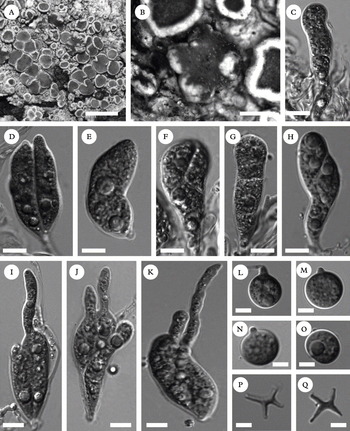
Tremella macrobasidiata. A, wet habit; B, dry habit; C−H, basidia showing different septation patterns; I−K, basidia showing epibasidia; L−O, basidiospores showing the hilar appendix; P & Q, asteroconidia. All photographs except A and B of material mounted in phloxin B after KOH pretreatment (DIC). A−O, (holotype); P & Q, (MA-Fungi 80875). Scales: A = 1·5 mm; B = 0·25 mm; C−K = 10 µm; L−Q = 5 µm.

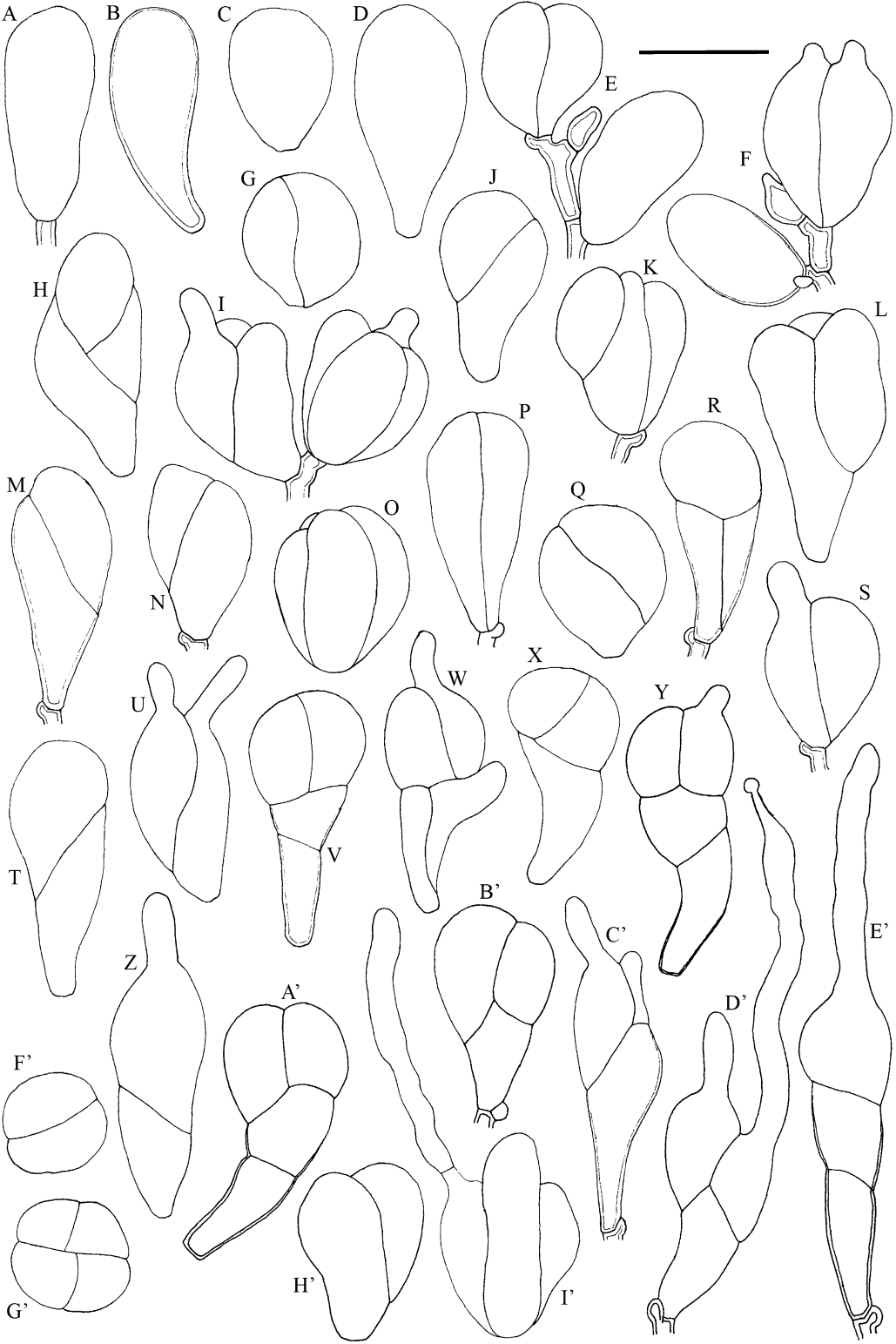
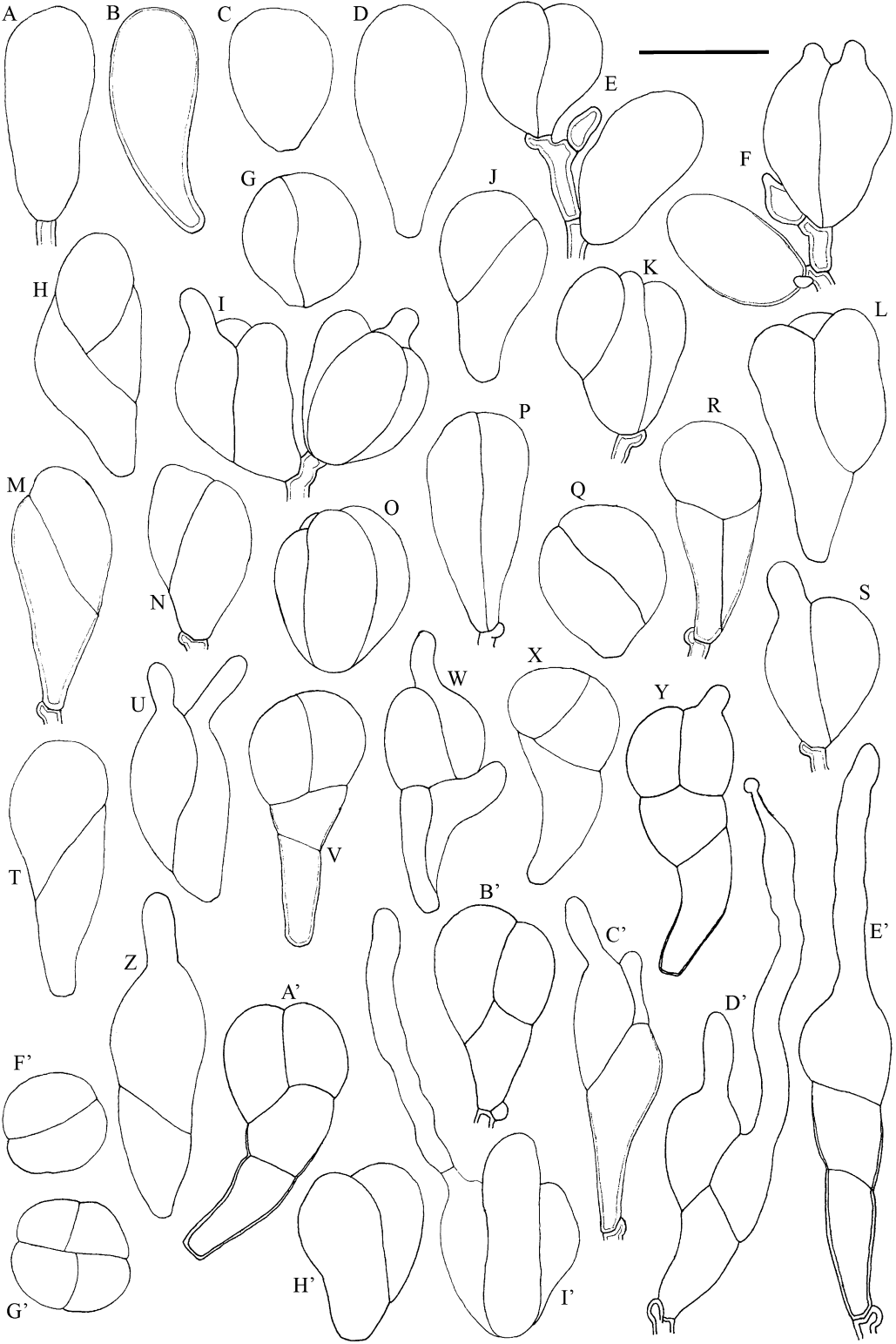
Tremella macrobasidiata, basidia. A−Z, A'–E' and H'−I', side view; F'−G', from above. Y, A', B', D', E' & H' (holotype); A−X, Z, C', F', G' and I' (MA-Fungi 80869). Scale = 20 µm.
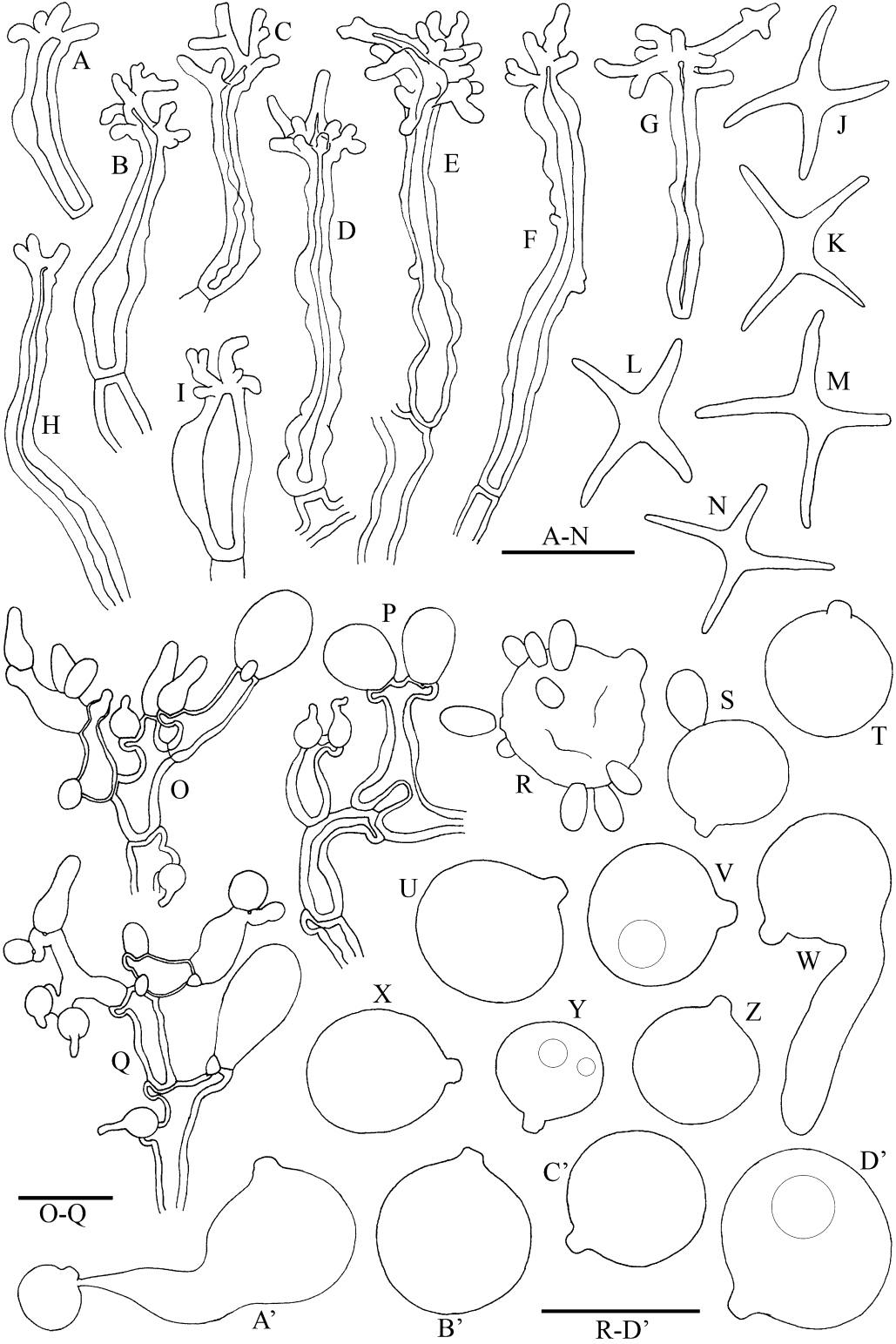
Tremella macrobasidiata. A−I, conidiogenous cells; J−N, asteroconidia; O−Q, subhymenial hyphae with clamps, haustoria and young probasidia; R–D', basidiospores, some germinating by production of blastic conidia (R & S), a hypha (W), and ballistoconidium (A'). A−N (MA-Fungi 80874 and 80875); O−Q, B' and C' (MA-Fungi 80869); S−Z (MA-Fungi 80873); R, A' and D' (holotype). Scales: A−N = 10 µm; O−Q = 10 µm; R−D' = 10 µm.

Lichenicolous fungus that grows in the hymenium of the host, inconspicuous at first but soon inducing the formation of waxy to gelatinous galls on the apothecia.
Basidiomata 0·2–2 mm diam., brownish to dark green, sometimes with ochraceous, greyish, bluish or pale shades, convex to irregular, often tuberculate or cerebriform. Context hyphae 2–3·5 µm wide, thin- to thick-walled, septa frequent, clamps closed or rarely open, with scattered anastomoses; sub-basidial hyphae 2–5 µm wide, with short and thicker walled individual cells. Haustorial mother cells 2·5–4 × 2–4 µm, globose to broadly ellipsoid, haustorial filaments 2–6 × 0·5–1 µm, mainly simple. Hymenium amphigenous, hyaline, with many probasidia, hyphidia not seen. Probasidia globose to narrowly ellipsoid, thin to thick-walled, with basal clamps and thicker walls near the base. Basidia, when mature, 2–4-celled, with transverse, oblique or longitudinal septa, often slightly constricted at the septa, basal clamps often visible, highly variable in shape and size, subglobose, ovoid, broadly ellipsoid, ellipsoid, subfusiform, obpyriform, clavate to narrowly clavate, sessile or with an attenuated stalk-like base, 20–51(–55) × (10·5–)12–24 µm (n = 50, including stalk-like base), stalk-like base 1–15(–21) µm long; epibasidia 40–65 × 3–6(−7) µm, subcylindrical, slightly swollen subapically, with one sterigma at the apex, 3–5 µm long, rarely with two or three sterigmata in the upper third. Basidiospores (6·5–)7–12·5(–15) × (6·5–)7·5–13(–15) µm, Q = 0·8–1·13(–1·2) (n = 100), globose to subglobose or rarely broadly ellipsoid, often broader than long, smooth, hyaline, inamyloid, with or without drops; hilar appendix distinct, never refractive, 1–1·5 µm long. Basidiospore germination shown by formation of hyphae, ballistoconidia (difficult to differentiate from small basidiospores), and blastoconidia of 2–4 × 1·5–2(–2·5) µm (yeast-like cells).
Anamorph: asteroconidia 11–16 µm diam., with 4(–5) arms, 4–7·5 × 0·5–1 µm each arm, rare, mainly in old basidiomata; conidiogenous cells subcylindrical to narrowly fusiform, 14–35 × 2–6·5 µm, slightly to thick-walled, with few to many apical branches, 1–6 µm long, clamps not seen.
Host. Tremella macrobasidiata seems to be restricted to Lecanora chlarotera, as it does not parasitize other species of Lecanora Ach. growing in the vicinity. We follow the L. chlarotera species concept of Ryan et al. (Reference Ryan, Lumbsch, Messuti, Printzen, Śliwa, Nash, Nash, Ryan, Diederich, Gries and Bungartz2004), including specimens with epruinose or slightly pruinose apothecial discs, K+ yellow, C−, KC−, P− or P+ yellow to pale orange thalli and apothecial margins (gangaleoidin chemosyndrome), large amphithecial crystals and a granular epihymenium. The new species appears to be highly pathogenic, as the host fails to produce ascospores when the apothecium becomes infected. Moreover, the infected apothecia usually die soon and often fall off, and commonly, only a few apothecia per thallus are parasitized by T. macrobasidiata.
Etymology. The specific epithet ‘macrobasidiata’ refers to the size of basidia compared with closely related taxa (Table 1).
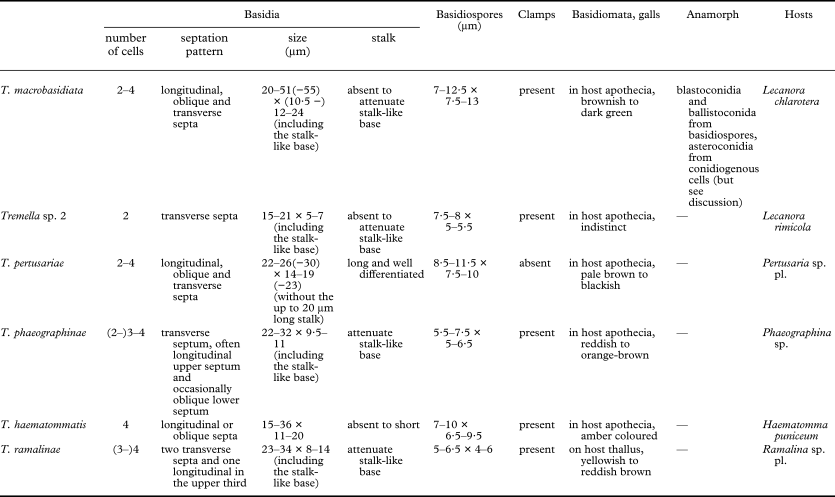
Principal characters distinguishing Tremella macrobasidiata, four lichenicolous intrahymenial Tremella and the possibly closely related T. ramalinae. After Diederich (1996) and data from comparison specimens in this study

Distribution and ecology. As Tremella macrobasidiata is currently known from Spain and seems to be host-specific in Lecanora chlarotera, its distribution mainly depends on that of the host, a cosmopolitan epiphytic lichen with a wide ecological amplitude growing on a wide variety of phorophytes (Nimis Reference Nimis1993; Smith et al. Reference Smith, Aptroot, Coppins, Fletcher, Gilbert, James and Wolseley2009), so new records are expected. In Spain, T. macrobasidiata is not a rare species, having been collected at altitudes ranging from 590 to 1340 m in the Ávila, Cáceres, Jaén, Huesca, Madrid, Orense and Toledo provinces, in humid to subhumid montane forests of the Eurosiberian Region and in dry to subhumid evergreen forest of the mesomediterranean to supramediterranean belts of the Mediterranean Region.
Additional specimens examined (all in Lecanora chlarotera apothecia). Spain: Andalucía, Jaén: Chiclana de Segura, La Muela de Chiclana, on Quercus ilex subsp. ballota branches, 38°18′47″N, 3° 3′23″W, 960 m, 17 viii 2010, B. Zamora & J. C. Zamora (MA-Fungi 80873); Montizón, Venta de los Santos, near Cortijo de Palancares, on Q. ilex subsp. ballota branches, 38°22′3″N, 3°2′49″W, 720 m, 13 viii 2010, B. Zamora & J. C. Zamora (MA-Fungi 80872); ibid. close to Embalse del Dañador, on Crataegus sp. branches, 38°24′19″N, 3°2′30″W, 700 m, 9 viii 2010, B. Zamora & J. C. Zamora (MA-Fungi 80871); Villacarrillo, Sierra de las Cuatro Villas, “Aguascebas Gil-Cobo” recreation area, on Populus x canadensis bark, 38°4′20″N, 2°53′29″W, 1340 m, 20 viii 2010, J. C. Zamora, D. Merino, D. Estrada, B. Zamora, J. Señoret, M. Merino & L. Merino (MA-Fungi 80874); Villanueva del Arzobispo, Sierra de las Cuatro Villas, mirador “El Tapadero [Topadero]”, on Q. ilex subsp. ballota branches, 38°10′2″N, 2°52′3″W, 1146 m, 20 viii 2010, J. C. Zamora, D. Merino, D. Estrada, B. Zamora, J. Señoret, M. Merino & L. Merino (MA-Fungi 80875). Aragón, Huesca: Aísa, Estarrún river, on Crataegus sp. branches, 42°43′ N, 0°36′ W, 1230 m, 9 x 2010, J. C. Zamora, S. Català, P. Tejedor, B. Zamora & J. Señoret (MA-Fungi 80878); Caldearenas, puerto de Monrepós, on Q. × cerrioides bark, 42°20′36″N, 0°23′38″W, 1250 m, 12 x 2010, J. C. Zamora, J. C. Campos, E. Sanz, S. Català, P. Tejedor, B. Zamora & J. Señoret (MA-Fungi 80880); Jaca, San Juan de la Peña, on dead unidentified bark, 42°30′ N, 0°38′ W, 1125 m, 11 x 2010, J. C. Zamora, S. Català & J. Hernanz (MA-Fungi 80879). Castilla-La Mancha, Toledo: Lillo, carretera hacia Villatobas, camino antes del puente sobre el río Testillos, on Q. ilex subsp. ballota, 30SVK7408, 700 m, 10 xi 2004, V. J. Rico (MAF); San Pablo de los Montes, on Q. ilex subsp. ballota branches, 39°29′48″N, 4°18′46″W, 910 m, 11 xii 2010, J. C. Zamora, J. Señoret & B. Zamora (MA-Fungi 80885). Comunidad de Madrid, Madrid: Colmenarejo, calle Prado Ibarra, on Q. ilex subsp. ballota branches, 40°33′10″N, 04°00′59″W, 880 m, 3 × 2010, B. Zamora, J. C. Zamora, F. Prieto, Á. González & J. Señoret (MA-Fungi 80877); Collado Villalba, Canchal de los Moros, on Cistus ladanifer branches, 40°38′36″N, 3°58′24″W, 1020 m, 29 xii 2010, J. C. Zamora, Á. González & F. Prieto (MA-Fungi 80884); Montejo de la Sierra, near Hayedo de Montejo, on a Crataegus monogyna branch, 41°6′10″N, 3°29′24″W, 1260 m, 26 ix 2010, B. Zamora & J. C. Zamora (MA-Fungi 80876); Navas del Rey, on Cupressus sempervirens bark, 40°23′34″N, 4°15′3″W, 730 m, 17 x 2010, J. C. Zamora, B. Zamora & J. Señoret (MA-Fungi 80881); Patones, Dehesa de la Oliva, on Genista scorpius branches, 40°53′6″N, 3°27′3″W, 865 m, 18 xii 2010, J. C. Zamora, J. Hernanz & J. C. Campos (MA-Fungi 80886); San Lorenzo de El Escorial, Silla de Felipe II, on Crataegus sp. branches, 40°34′ N, 4°9′ W, 1000 m, 3 vi 2010, B. Zamora & J. C. Zamora (MA-Fungi 80870); Valdemorillo, Mojadillas, on Cistus ladanifer branches, 40°32′17″N, 4°6′8″W, 900 m, 12 ii 2011, B. Zamora & J. C. Zamora (MA-Fungi 80888); Villaviciosa de Odón, Campodón, on Prunus dulcis branches, 40°21′42″N, 3°53′13″W, 660 m, 23 v 2010, B. Zamora & J. C. Zamora (MA-Fungi 80869). Extremadura, Cáceres: Deleitosa, arroyo de Helechoso, on Q. ilex subsp. ballota branches, 39°40′59″N, 5°42′37″W, 590 m, 7 i 2011, B. Zamora & J. C. Zamora (MA-Fungi 80887). Galicia, Orense: Xares, “El Ciervo” hotel, on Abies sp. branches, 42°14′36″N, 6°55′32″W, 1000 m, 23 x 2010, J. C. Zamora, E. García, S. Pardillo, P. L. Aznar, A. Meléndez, C. Zúñiga, J. M. Delgado, B. Zamora & J. Señoret (MA-Fungi 80882); ibid.: on Tilia tomentosa bark (MA-Fungi 80883).
Discussion
Tremella macrobasidiata is characterized by its intrahymenial growth in Lecanora chlarotera apothecia, forming brownish to dark green galls, sometimes with ochraceous, greyish or even bluish tinges. It develops large and extremely variable basidia, displaying the majority of morphological types in the same gall, and also rather large basidiospores.
Tremella sp. 2 is the only known Tremella found on Lecanora (Table 1), growing in the hymenium of the apothecia of Lecanora rimicola H. Magn. (Diederich Reference Diederich1996). Tremella sp. 2 differs from T. macrobasidiata mainly by its smaller 2-celled basidia and basidiospores, not producing visible galls on the host hymenium (Diederich Reference Diederich1996). As almost all known Tremella species, and also almost all lichenicolous heterobasidiomycetes, are strictly host-specific (Diederich Reference Diederich1996, Reference Diederich2007), the different host species of T. macrobasidiata and T. sp. 2, with quite different ecology and distribution, signify an important character to differentiate them. Lecanora rimicola is a rare saxicolous silicicolous lichen, growing on stony shores from Denmark, Sweden, Greenland and Russia (Andreyev Reference Andreyev2002; Hansen Reference Hansen2004; Santesson et al. Reference Santesson, Moberg, Nordin, Tonsberg and Vitikainen2004;Søchting & Alstrup Reference Søchting and Alstrup2008). In contrast, L. chlarotera is a very common epiphytic lichen, growing mainly on the bark of deciduous trees, with a wide ecological amplitude; it is also a pioneer with a cosmopolitan distribution, known from the holarctic in Europe, Asia, North America and Macaronesia, and also from South America and Africa (Nimis Reference Nimis1993; Smith et al. Reference Smith, Aptroot, Coppins, Fletcher, Gilbert, James and Wolseley2009; Feuerer Reference Feuerer2010). Unfortunately, the material growing on Lecanora intumescens (Rebent.) Rabenh., recorded as Tremella sp. 2 from Huesca province in Spain by Etayo (Reference Etayo2010), was not studied by us. It is probably related to T. macrobasidiata, as its host is close to L. chlarotera and is a member of the L. subfusca group (Smith et al. Reference Smith, Aptroot, Coppins, Fletcher, Gilbert, James and Wolseley2009).
According to Diederich (Reference Diederich1996, Reference Diederich2003, Reference Diederich2007), three intrahymenial lichenicolous Tremella species show 2–4-celled basidia, growing in the apothecia of different hosts (Table 1). Tremella pertusariae has many similarities with T. macrobasidiata, but develops rather large 2–4-celled always stalked basidia, the hymenial hyphae lack clamp connections, the basidiomata are never greenish, and it grows mainly in the hymenium of Pertusaria hymenea (Ach.) Schaer. and P. pertusa (L.) Tuck. (Diederich Reference Diederich1996). Tremella haematommatis Diederich is also able to grow in the host hymenium [Haematomma puniceum (Sw.) A. Massal. from North America]. However, it produces smaller, amber-coloured basidiomata, with not or only slightly stalked, 4-celled, longitudinally or oblique septate basidia (Diederich Reference Diederich1996). Tremella phaeographinae Diederich & Aptroot, growing in the hymenium of Phaeographina Müll. Arg. sp. in North America, develops reddish to orange-brown basidiomata, narrower, mostly 3–4-celled basidia, and smaller basidiospores than T. macrobasidiata (Diederich Reference Diederich1996). A fourth species is Tremella ramalinae Diederich (Table 1), developing obpyriform to clavate basidia, with two transverse septa and one longitudinal in the upper third, as occur in some basidia of T. macrobasidiata and also of T. phaeographinae. However, Tremella ramalinae clearly differs by growing on thalli of Ramalina Ach. sp. pl., and has smaller basidiospores (5–6·5 × 4–6 µm) and yellowish to reddish brown, strongly convex basidiomata (Diederich Reference Diederich1996). Furthermore, asteroconidia are unknown in any of the four previous species.
Asteroconidia and their conidiogenous cells are considered here as belonging to Tremella macrobasidiata, although clamps have not been observed on the base of the conidiogenous cells. This kind of conidium seems to be characteristic and apparently restricted to certain lichenicolous heterobasidiomycetes, as they have not been reported in other species of hetero- or homobasidiomycetes so far (Diederich Reference Diederich1996). Although asteroconidia and conidiogenous cells ascribed to T. macrobasidiata are morphologically similar to those in other lichenicolous Tremella (e.g., Tremella cladoniae Diederich & M. S. Christ. or T. coppinsii Diederich & Marson; but cf. Diederich Reference Diederich1996), it is not entirely clear to us whether or not they belong to T. macrobasidiata, since some other unidentified fungi were observed in the same host hymenium, growing together with asteroconidia of T. macrobasidiata. On the other hand, different types of conidia (blastoconidia and catenate conidia) have also been observed in several old basidiomata of T. macrobasidiata, but it is difficult to say whether or not they are produced by T. macrobasidiata, because old affected apothecia were usually infected by other fungi.
We wish to express our gratitude to J. Etayo (Pamplona), V. Calatayud (Valencia) and V. Atienza (Valencia) for providing Tremella material. SPO is funded by the programme JAE-Doc (Spanish Research Scientific Council). VJR acknowledges support from the Spanish Ministerio de Educación y Ciencia (Flora Liquenológica Ibérica project, CGL2007-66734-C03-01).