Surgical site infections (SSIs) are the most common and costly healthcare-associated infections (HAIs), causing 40% of HAIs in hospitalized patients and costing $1 billion annually in the United States. Reference Lewis, Moehring, Chen, Sexton and Anderson1,Reference Zimlichman, Henderson and Tamir2 Appropriate administration of preprocedural antibiotics reduces the risk of SSIs. Reference Alexander, Solomkin and Edwards3,Reference Bratzler, Dellinger and Olsen4 Beta-lactam antibiotics, and cephalosporins specifically, are the most commonly administered perioperative antibiotics due to their duration of activity, efficacy, safety, and low cost. Reference Bratzler, Dellinger and Olsen4 However, patients who report an allergy to penicillin or cephalosporin antibiotics may receive a non–β-lactam antibiotic for periprocedural prophylaxis because of the concern for an allergic reaction, Reference Epstein, Jacques, Wanderer, Bombulie and Agarwalla5–Reference Zhou, Dhopeshwarkar and Blumenthal7 despite evidence that 90%–99% of patients with a reported penicillin allergy do not have a true allergy and <3% of patients with a penicillin allergy have an allergic reaction upon receiving cephalosporins. Reference Arroliga, Radojicic and Gordon8,Reference Sagar and Katelaris9
Few studies have assessed the risk of SSI among patients reporting a penicillin allergy. Reference Blumenthal, Ryan, Li, Lee, Kuhlen and Shenoy10–Reference Ristić, Maljanović, Harhaji and Milankov13 Furthermore, the generalizability of existing studies is limited by results from single centers and/or analysis of a single surgical procedure type. Finally, few analyses have explored whether the reported association between penicillin or cephalosporin allergy and SSI risk is mediated by antibiotic received. Thus, patients who have a documented penicillin or cephalosporin allergy may have an increased risk of SSI because they receive second-line antibiotic prophylaxis with a non–β-lactam or the risk may be increased due to reasons other than the perioperative antibiotic choice.
The overall objective of this study was to determine whether adult patients with a documented penicillin or cephalosporin allergy have increased odds of SSI following orthopedic, cardiac, and neurosurgical procedures compared to adults who do not have a documented penicillin or cephalosporin allergy. The secondary aim was to determine whether the odds differ between patients who received β-lactam and non–β-lactam surgical prophylaxis.
Methods
Setting
We performed a retrospective cohort study on adult patients undergoing cardiac, orthopedic, and neurological surgery at 3 hospitals in Raleigh–Durham, North Carolina, and affiliated with Duke Health. Duke University Hospital (DUH) is a 957-bed tertiary-care hospital; Duke Regional Hospital (DRH) is a 369-bed community hospital; and Duke Raleigh Hospital (DRaH) is a 186-bed community hospital. All 3 hospitals have active surgery programs that perform neurological and orthopedic procedures. Cardiac procedures are also performed at DUH and DRH.
We included patients who had hip arthroplasty (HPRO), knee arthroplasty (KPRO), spinal fusion (FUSN), craniotomy (CRAN), and cardiac surgeries [coronary artery bypass graft (CAGB), coronary artery bypass graft with both chest and donor site incisions (CBGB), coronary artery bypass graft with chest incision only (CBGC), and other cardiac procedures (CARD)] from July 1, 2013, to December 31, 2017, as defined by the Centers for Disease Control and Prevention (CDC) National Healthcare Safety Network (NHSN) procedure codes. 14 We excluded patients who were aged <18 years at the time of surgery. We also limited our analysis to include only invasive SSIs, which comprised deep incisional and organ-space SSIs, as defined by NHSN guidelines. 14
Data source
Demographics, surgical procedure information, documented allergies, and preoperative antibiotic administration were obtained electronically from a central data warehouse. Antibiotic administration data underwent extensive validation to ensure correct attribution of preoperative antibiotic doses. 15 Patients were evaluated for invasive SSI in accordance with NHSN guidelines by trained infection preventionists at each hospital as part of standard surveillance for SSI. Reference Charlson, Szatrowski, Peterson and Gold16 All three hospitals performed targeted surveillance, and used a positive clinical culture within the surveillance window as an indicator to perform chart review to determine if SSI surveillance criteria were met. Surveillance for invasive SSIs was conducted for 90 days following the surgical procedure.
Exposure, outcome covariates, and confounders
We constructed a multivariable model to estimate the association between penicillin or cephalosporin allergy and invasive SSI. Body mass index (BMI), gender, surgical procedure category, hospital, age-adjusted Charlson comorbidity index (aCCI) Reference Charlson, Szatrowski, Peterson and Gold16 , and surgical prophylaxis class (β-lactam vs non–β-lactam) were considered potential covariates based on published SSI risk factors. Reference Anderson, Podgorny and Berrios-Torres17 The main exposure of documented penicillin or cephalosporin allergy was defined as a documented reaction or allergy in the electronic health record allergy “tab” to any penicillin or cephalosporin antibiotics at the time of the data analysis. Individuals who received any β-lactam antibiotic, including those receiving combination antibiotic prophylaxis (ie, a β-lactam and a non–β-lactam), were categorized as receiving a β-lactam prophylaxis. Similarly, patients who only received alternative antibiotics (eg, clindamycin/ciprofloxacin or vancomycin/ciprofloxacin) prior to surgery were categorized as receiving non–β-lactam prophylaxis. Surgical procedures were identified by NHSN procedure category and grouped by surgical service as follows: orthopedic (hip arthroplasty (HPRO), knee arthroplasty (KPRO)); cardiac (cardiothoracic bypass (CBGB, CBGC) and other cardiac procedures (CARD)); and neurosurgical (craniotomy (CRAN), spinal fusion(FUSN), and laminectomy (LAM)).
Statistical analysis
We compared patient and procedure characteristics in patients with and without reported allergies using Wilcoxon rank-sum tests for continuous variables and the χ2 test or Fisher exact test, as appropriate, for binary or categorical variables. SAS version 9.4 software (SAS Institute, Cary, NC) was used for all analyses and for all descriptive statistics.
We selected variables to introduce in our model based on a priori knowledge and using directed acyclic graphs. Reference Greenland, Pearl and Robins18 We determined the appropriate functional form for the BMI and age variables by comparing linear, quadratic, restricted cubic, and categorical risk models. The predicted risk models were visually assessed by graphing them aside LOESS lines. The Akaike information criterion (AIC) was then used to compare the quality of the fit. The functional form with the lowest AIC and best visual fit was used for the final model.
We then placed all variables in their appropriate forms into the model and removed single variables from the logistic regression model, starting with the variable with the highest P value. Subsequent models were compared using likelihood ratio tests. We considered P < .20 as an indicator to retain the variable in the final model. We assessed the presence of effect measure modification (EMM) on the additive scale by class of periprocedural antibiotic (β-lactam vs non–β-lactam), comparing multivariable models with and without an interaction term for periprocedural antibiotic and reported penicillin or cephalosporin allergy. We considered P < .05 statistically significant.
In addition, we performed separate subanalyses comparing the odds of developing an invasive SSI in patients with only cephalosporin and only penicillin allergies. This study was approved by the Duke University Institutional Review Board.
Results
Overall, 39,972 surgical patients met criteria for inclusion in the analysis. For patients who had multiple procedures during the study period, only the first surgery was included in the analysis. Of these, 1,689 patients (4.2%) had a documented penicillin or cephalosporin allergy and 374 patients (0.9%) suffered an invasive SSI. Also, 34,113 patients (85.3%) received perioperative β-lactam antibiotics. Patients were aged 18–106 years (median, 63.1; interquartile range [IQR], 54–71) and were distributed approximately equally between male (48.7%) and female sex (51.3%) (Table 1). BMI ranged from 12.4 kg/m2 to 90.6 kg/m2 (median, 29.2 kg/m2; IQR, 25.5–33.9 kg/m2). Spinal fusion was the most common procedure (9,657, 24.2%), and craniotomy was the least common procedure (3,905, 9.8%). The academic medical center performed procedures for 20,548 cases (51.4%), and the 2 community hospitals together accounted for the remaining 19,424 cases (48.6%).
Demographics of Total Cohort of 39,972 Patients and Comparison of Demographics Between Patients With and Without Surgical Site Infections

Note. SSI, surgical site infection; SD, standard deviation; IQR, interquartile range.
a Unpaired t test.
b Fisher’s exact test.
c Wilcoxon rank-sum test.
d χ2 test.
We compared the same covariates between patients with and without invasive SSIs (Table 1). Additionally, patients with invasive SSIs had higher BMIs and higher Charlson scores. Patients who underwent knee arthroplasty had the highest incidence of SSI (0.8%). Finally, the proportion of patients who received a β-lactam antibiotic as surgical prophylaxis was not statistically different between patients who developed an invasive SSI and patients who did not develop an invasive SSI.
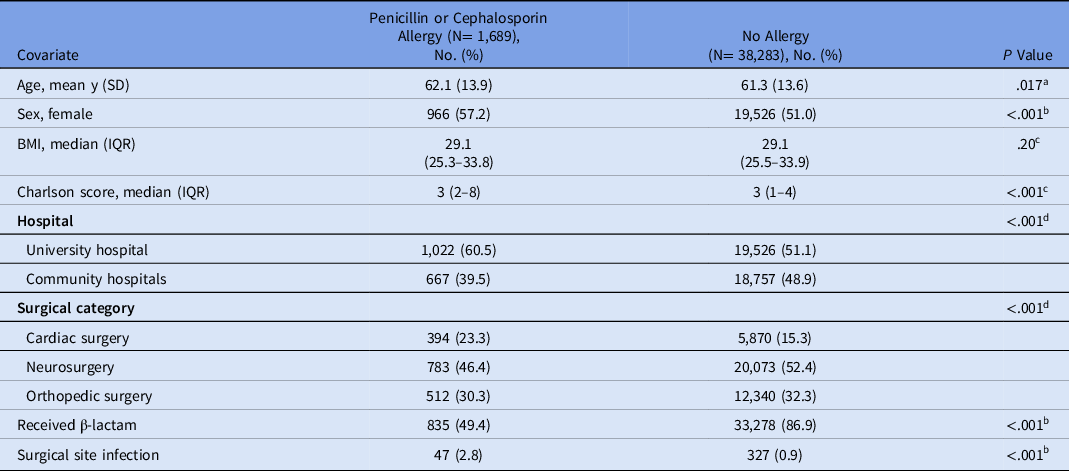
In addition, we compared demographic data between patients with and without penicillin/ cephalosporin allergies (Table 2). The patients with a documented allergy were more often female and had higher Charlson scores compared to patients who did not have reported allergies.
Demographic Comparison Between Patients With and Without Penicillin or Cephalosporin Allergies

Note. SD, standard deviation; IQR, interquartile range.
a Unpaired t test.
b Fisher’s exact test.
c Wilcoxon rank-sum test.
d χ2 test.
Of the 374 patients who developed an invasive SSI, 47 (2.8%) had a documented penicillin or cephalosporin allergy. Conversely, only 327 patients (0.85%) without a documented allergy to a penicillin or cephalosporin developed an invasive SSI. Our unadjusted odds ratio was 3.32 (95% CI, 2.44–4.53). Furthermore, 835 patients (49.4%) had a documented penicillin or cephalosporin allergy and still received a β-lactam as operative prophylaxis.
The final model included the main exposure (documented penicillin/cephalosporin allergy), the main outcome (invasive SSI), age, periprocedural antibiotic (non–β-lactam vs β-lactam), sex, BMI, surgical service, and hospital.
After adjusting for potential confounding, we estimated that patients with a cephalosporin or penicillin allergy had >3 times greater odds (3.26; 95% CI, 2.71–3.93) of developing an invasive SSI within 90 days of surgery compared to patients who did not have a documented allergy to either antibiotic class.
We performed subgroup analyses to understand the separate impact of penicillin and cephalosporin allergies and found similar results for both subgroup: the aOR for patients with reported penicillin allergies was 3.30 (95% CI, 3.17–3.44), and the aOR for patients with only reported cephalosporin allergies was 3.34 (95% CI, 1.82–6.11).
We also evaluated for EMM by type of surgical prophylaxis (β-lactam vs non–β-lactam antibiotic). The odds ratio for SSI comparing reported allergy to no allergy among those who received a β-lactam antibiotic was 3.89 (95% CI, 2.89–5.23), and the odds ratio among those who received a non–β-lactam antibiotic was 3.09 (95% CI, 2.71–3.52). No significant EMM was observed (χ2, P = .83).
Discussion
In this large cohort study of patients who underwent cardiac, orthopedic, and neurosurgical procedures, the odds of invasive SSI in patients with a documented penicillin or cephalosporin allergy was >3 higher than in patients without a documented penicillin or cephalosporin allergy. A large portion of patients who reported an allergy received a β-lactam perioperatively despite this documentation. Furthermore, the antibiotic class used for surgical prophylaxis (β-lactam vs non–β-lactam) did not modify the effect of a documented penicillin or cephalosporin allergy on invasive SSI. This finding suggests that other unmeasured factors may be affecting the observed association between antibiotic allergy and invasive SSI.
Specifically, reported penicillin or cephalosporin allergy may be a surrogate marker for a population at-risk for adverse clinical outcomes. These unmeasured, confounding factors may include increased prior healthcare exposure, patient clinical complexity, or socioeconomic status (SES). Blumenthal et al Reference Blumenthal, Oreskovic and Fu19 found that high-cost, high-need patients had a higher prevalence of penicillin allergies (20%) compared to published rates for the general public. Additionally, high-cost, high-need patients who reported a penicillin allergy had significantly more healthcare resource utilization (adjusted relative risk, 1.13; 95% CI, 1.03–1.25). Reference Blumenthal, Oreskovic and Fu19 Further studies are needed to determine the extent to which these other factors may confound the observed relationship between the SSI and reported penicillin or cephalosporin allergies.
Few studies have examined the risk of SSI in patients reporting antibiotic allergies, and our cohort represents the largest so far. To date, results have been inconsistent. Our results are most consistent with those of Blumenthal et al, Reference Blumenthal, Ryan, Li, Lee, Kuhlen and Shenoy10 who examined 90-day SSI risk among patients undergoing hip arthroplasty, knee arthroplasty, hysterectomy, colon surgery, or coronary bypass surgery. Among 8,835 patients, the odds ratio of 90-day SSI comparing patients with and without reported penicillin allergies was 1.51. Reference Blumenthal, Ryan, Li, Lee, Kuhlen and Shenoy10 Increased SSI risk in patients with antibiotic allergies was also reported in patients undergoing head and neck surgery, Reference Pool, Kass and Spivack12 dental implantation, Reference French, Noroozi, Shariati and Larjava11 and anterior cruciate ligament repair. Reference Ristić, Maljanović, Harhaji and Milankov13 In contrast, in 2 prior studies looking exclusively at patients undergoing hip or knee arthroplasty the researchers found no increase in SSI among patients with reported penicillin allergy. Reference Stone, Kelmer, MacDonald, Clance and King20,Reference Tan, Springer, Ruder, Ruffolo and Chen21
Despite similar findings of increased odds of SSI associated with antibiotic allergy, there are a few important differences between our findings and those of Blumenthal et al. First, our sample size was ∼5 times larger. Second, Blumenthal et al found that the increased risk of SSI was entirely mediated by antibiotic class received perioperatively in their cohort. Specifically, when antibiotic class was introduced into the logistic regression model the odds ratio decreased to 1.0. However, only 12% of patients with an allergy received a β-lactam. Conversely, 48% of patients who reported an allergy in our study received a β-lactam antibiotic. Careful assessment of penicillin allergy history and administration of cephalosporin when deemed appropriate based on the reported allergy history has been an active area of antibiotic stewardship intervention at our hospitals. Regardless, we observed a strong association between reported allergy and SSI that persisted even among patients who did ultimately receive β-lactam antibiotics. Third, we studied both penicillin and cephalosporin allergies versus only penicillin allergies, although penicillin comprised most reported allergies.
Our study has a several limitations. This retrospective study was subject to the typical selection bias and misclassification bias inherent in this type of study. It is possible that not all patients with invasive SSI were identified through our targeted surveillance if their infection diagnosis was not confirmed with a positive culture, they presented to an outside facility for care of their infection, or their infection was diagnosed more than 90 days post-operatively. However, we limited our analysis to only invasive SSI and used the same methods and definitions for surveillance throughout the study period. We were limited by our definition of allergy based on EHR documentation, Reference Moskow, Cook, Champion-Lippmann, Amofah and Garcia22 which included adverse reactions and in tolerances, as well as true allergies, which may explain why a large portion of patients received beta-lactam agents. Our dataset did not include the date that the allergy was recorded, so we were not able to validate if the allergy was entered prior to or following the surgical procedure. In addition, our study may not be generalizable to surgical procedures that were not evaluated in the cohort or hospitals that do not have an active stewardship intervention for patients with reported allergies. Finally, we are unable to control for confounders such as SES covariates or surrogates. Despite these limitations, our study is still the largest cohort to date to examine the association between SSIs and patient reported penicillin/cephalosporin allergies. Future studies should include additional covariates that can capture SES data and healthcare exposure to see how these factors affect the relationship between antibiotic allergy and SSI. In addition, future studies should include additional categories of surgery and drill down on true antibiotic allergies as opposed to including all antibiotic intolerances.
In this study, patients with a reported penicillin or cephalosporin allergy had >3 times greater odds of 90-day deep SSI compared to patients without a reported penicillin or cephalosporin allergy. Although allergy testing and delabeling activities are high value and allow patients to receive first-line therapy more often, the antibiotic administered may not fully explain the increased odds of SSI. If our observed association is confirmed in subsequent analyses, then antibiotic allergy should be factored into the global patient SSI risk assessment at the time of surgical planning. Specifically, patients with reported allergies should be evaluated for additional counseling regarding SSI risk, more frequent postoperative visits, or further social support.
Acknowledgments
Financial support
No financial support was provided relevant to this article.
Conflicts of interest
All authors report no conflicts of interest relevant to this article.