Introduction
Organisations must innovate and successfully implement change if they are to remain competitive in today's global marketplaces (Rafferty, Jimmieson, & Armenakis, Reference Rafferty, Jimmieson and Armenakis2013). Without such adaptation, organisations risk becoming outdated, inefficient and uncompetitive (Firoozmand, Reference Firoozmand2013). However, change is not a guarantee of survival, as change can be so disruptive that it can destroy the organisation (Abrahamson, Reference Abrahamson2000). Clearly, managers need to understand change processes if they are to ensure success. As employees are at the heart of successful change (Goodman & Loh, Reference Goodman and Loh2011), and seem to experience change in individual and unique ways (e.g., Bouckenooghe, Reference Bouckenooghe2010), it is important to understand the factors that influence employees' readiness to change, as such an understanding should help managers design more effective change implementations.
Readiness to change has been defined as the state of a workforce where they can enter the ‘unfreeze’ stage (Lewin, Reference Lewin1947) and begin the transformational process (Armenakis, Harris, & Mossholder, Reference Armenakis, Harris and Mossholder1993). Research into employees' readiness for change has often focused on their perceptions of the change (Claiborne, Auerbach, Lawrence, & Schudrich, Reference Claiborne, Auerbach, Lawrence and Schudrich2013). For example, it has long been recognised that organisational change is likely to fail without a change in employees' beliefs (Björkman, Reference Björkman1989). Indeed, Rogers (Reference Rogers2003) suggested change recipients' beliefs need to be swayed to achieve successful change. If employees do not believe in the necessity and appropriateness of a change, in their abilities to cope with the change, that there are potential benefits of the change or that managers support the change, they are more likely to resist (Armenakis, Bernerth, Pitts, & Walker, Reference Armenakis, Bernerth, Pitts and Walker2007).
Many variables have been suggested as precursors to employee readiness to change, including internal locus of control (Lau & Woodman, Reference Lau and Woodman1995), self-efficacy (Cunningham et al., Reference Cunningham, Woodward, Shannon, MacIntosh, Lendrum, Rosenbloom and Brown2002), coping styles (Ashford, Reference Ashford1988), sense of control (Bordia, Hunt, Paulsen, Tourish, & DiFonzo, Reference Bordia, Hunt, Paulsen, Tourish and DiFonzo2004), dispositional affective states (Oreg, Reference Oreg2006), assessments of coping with the change (Judge, Thoresen, Pucik, & Welbourne, Reference Judge, Thoresen, Pucik and Welbourne1999), commitment (Madsen, Miller, & John, Reference Madsen, Miller and John2005) and trust in the organisation (Kiefer, Reference Kiefer2005). However, the literature has largely ignored the effect perceived values-congruence has on employee readiness to change, despite arguments that the values of the future organisation need to align with personal values to create readiness to change (Branson, Reference Branson2008).
Conceptual Development
In order to better understand what values-congruence is, we must first explore the underlying concept of values. Values are broad motivational goals that refer to what is good and worthy (Rokeach, Reference Rokeach1973; Williams, Reference Williams1970). They serve as ‘guiding principles in the life of a person or other social entity’ (Schwartz, Reference Schwartz1994). As such, values reflect what is important to individuals and guide their attitudes and behaviours (Rokeach, Reference Rokeach1973; Schwartz, Reference Schwartz1992). While values are most often attributed to individuals, they have also been used to characterise social collectives, including nations (e.g., Hofstede, Reference Hofstede2001), social groups (Schwartz & Rubel, Reference Schwartz and Rubel2005) and organisations (Consiglio, Cenciotti, Borgogni, Alessandri, & Schwartz, Reference Consiglio, Cenciotti, Borgogni, Alessandri and Schwartz2016; Trompenaars, Reference Trompenaars1994). At a group level, values are defined as shared (Hofstede, Reference Hofstede2001) or latent (Schwartz, Reference Schwartz2014) normative constructs.
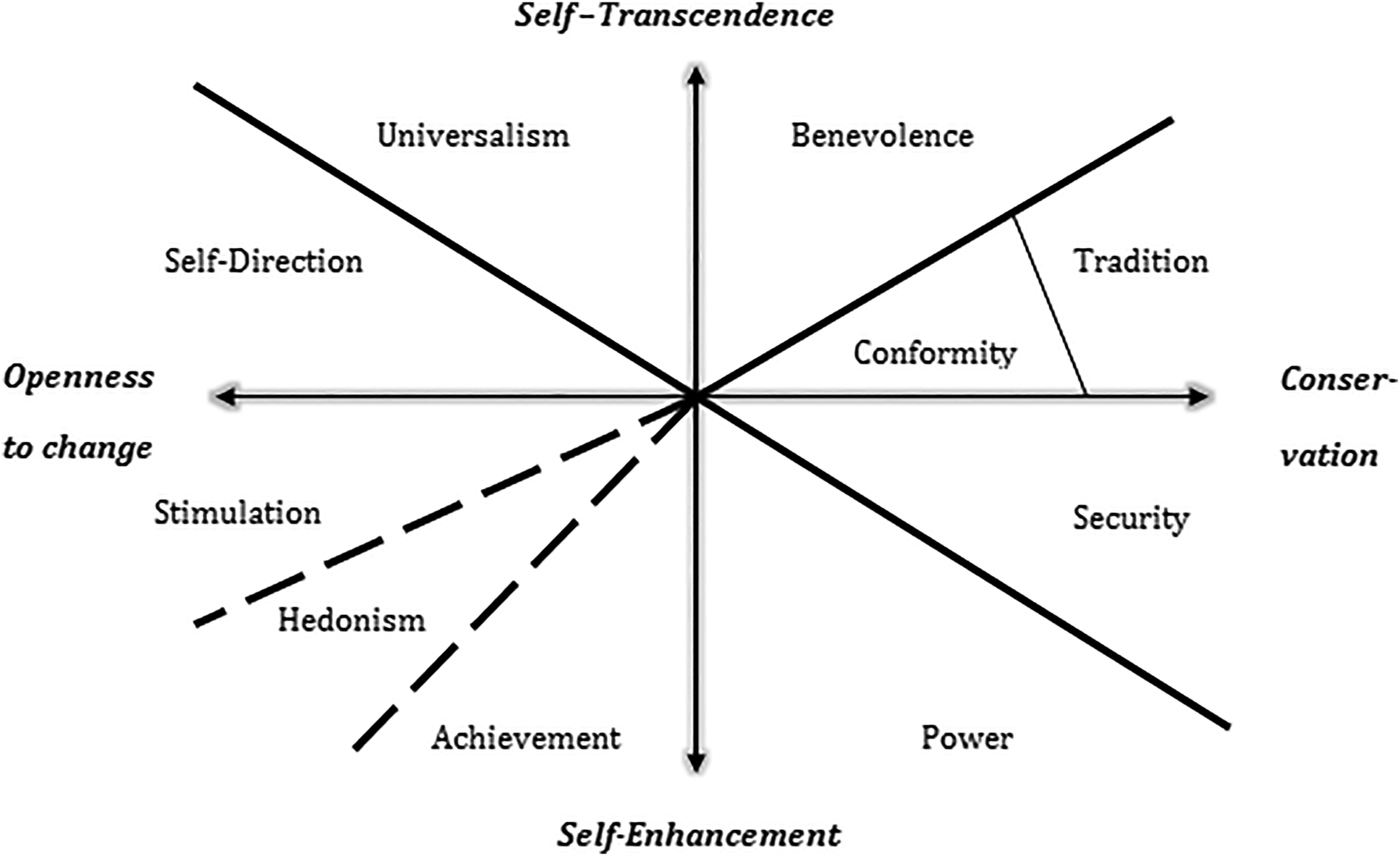
The most widely used theory of human values is that of Schwartz (Reference Schwartz1992), who suggested a circular structure of human values based on an underlying motivational continuum (Figure 1). In this theory, neighbouring values share compatible motivations, whereas opposing values have conflicting motivations. Schwartz (Reference Schwartz1992) divided the motivational continuum into 10 near-universal basic values and described their relationships with four higher-order-values at opposing ends of two bi-polar dimensions (self-transcendence vs. self-enhancement and openness-to-change vs. conservation values) (see Figure 1). Self-transcendence values, which promote the welfare of others over selfish concerns, oppose self-enhancement, which promote the pursuit of self-interests, even at the expense of others (Schwartz, Reference Schwartz1992). Openness-to-change, which promotes the pursuit of freedom and excitement, opposes conservation, which promotes certainty and the preservation of the status quo (Schwartz, Reference Schwartz1992). Schwartz's (Reference Schwartz1992) theory has been supported in hundreds of studies in over 80 countries (Sagiv, Roccas, Cieciuch, & Schwartz, Reference Sagiv, Roccas, Cieciuch and Schwartz2017).
Schwartz's (Reference Schwartz1992) structure of values.

Perceived values-congruence
Value-congruence is commonly defined as the similarity between an individual's values and those in their social environment (Sagiv et al., Reference Sagiv, Roccas and Oppenheim-Weller2015). In general, higher levels of value-congruence are expected to lead to more positive outcomes. Sagiv and Schwartz (Reference Sagiv and Schwartz2000) described two mechanisms by which value-congruence supports these positive outcomes, suggesting such congruence (1) provides more favourable conditions for goal-attainment and (2) provides positive social support rather than negative social sanctions. These mechanisms are likely to lead to positive outcomes for individuals and for organisations.
Extensive research supports positive relationships between values-congruence and job satisfaction, organisational commitment and intentions to stay (e.g., Edwards & Cable, Reference Edwards and Cable2009; Kristof-Brown, Zimmerman, & Johnson, Reference Kristof-Brown, Zimmerman and Johnson2005). Edwards and Cable (Reference Edwards and Cable2009) suggested four potential mediators that may account for these relationships, including trust, quality of communication, predictability and interpersonal attraction. However, they only found support for the mediation of trust and quality of communication on relationships between perceived value-congruence and job satisfaction, organisational commitment and employees' intention to stay.
Value-congruence has also been examined in relation to multiple sub-units within organisations (Kristof-Brown, Zimmerman, & Johnson, Reference Kristof-Brown, Zimmerman and Johnson2005). Boisnier and Chatman (Reference Boisnier and Chatman2014) suggested organisations can have a strong overall culture that reflects pivotal values, and also distinct subcultures within different levels and functions that reflect other values. Adkins and Caldwell (Reference Adkins and Caldwell2004) found perceived value-congruence between individuals and their groups and individuals and their organisations were both related to job satisfaction. Similarly, Astakhova (Reference Astakhova2016) found perceived value-congruence between employees and their supervisor and between employees and their organisation were positively related to organisational commitment.
There is also some preliminary evidence that perceived values-congruence with an organisation may impact on employees' readiness for and acceptance of organisational change. Smollan and Sayers (Reference Smollan and Sayers2009) suggested people who perceived their values to be aligned with those of their organisation would have more positive emotional reactions to change and Burnes and Jackson (Reference Burnes and Jackson2011) suggested value system alignment might be a factor in successful change implementation. Erkutlu and Chafra (Reference Erkutlu and Chafra2016) found an aspect of values-congruence (values-congruence intensity) designed to tap into feelings of attachment, importance and support for the supervisor's core values (e.g., ‘I really support the intent of the core value of my leader’) influenced affective commitment to change. Finally, Lamm, Gordon, and Purser (Reference Lamm, Gordon and Purser2010) found perceived values-congruence as a result of change was associated with support for the change. Together, this research suggests perceived values-congruence may be an important antecedent to an individual's readiness for change.
However, no research was found that examined whether trust and quality of communications mediated the relationships between values-congruence and readiness for change. This led to the decision to undertake the current study. Before discussing the current study, a review and justification for the potential mediating influence of trust and quality of communication on change-related beliefs are examined.
Trust
Trust, commonly defined as a ‘willingness to be vulnerable to another party’, is a multifaceted context specific construct that can vary within people, across relationships and across domains (Schoorman, Mayer, & Davis, Reference Schoorman, Mayer and Davis2007: 347). It is a psychological state that is based on positive expectations of trustworthiness (Fulmer & Gelfand, Reference Fulmer and Gelfand2012). Trust between team members positively influences many outcomes, ranging from job satisfaction and loyalty to an organisation (Matzler& Renzi, Reference Matzler and Renzi2006) to problem solving (Parker, Williams, & Turner, Reference Parker, Williams and Turner2006) and performance (Erdem & Ozen, Reference Erdem and Ozen2003).
Prior research has found employees' perceptions of shared values with an organisation promote trust (e.g., Edwards & Cable, Reference Edwards and Cable2009; Lau, Liu, & Fu, Reference Lau, Liu and Fu2007; Zeffane & Connell, Reference Zeffane and Connell2003). For example, Edwards and Cable (Reference Edwards and Cable2009) suggested and found trust and the quality of communication in an organisation mediated the relationship between values-congruence and job satisfaction, organisational identification and an employee's intent to stay in the organisation. Past research also found values-congruence supported the development of trust in the work environment (e.g., Christiansen, Villanova, and Mikulay, Reference Christiansen, Villanova and Mikulay1997; Enz, Reference Enz1988; Lau, Liu, and Fu, Reference Lau, Liu and Fu2007). Consequently, it seems values-congruence with an organisation and its sub-units is likely to be positively related to trust within an organisation, suggesting:
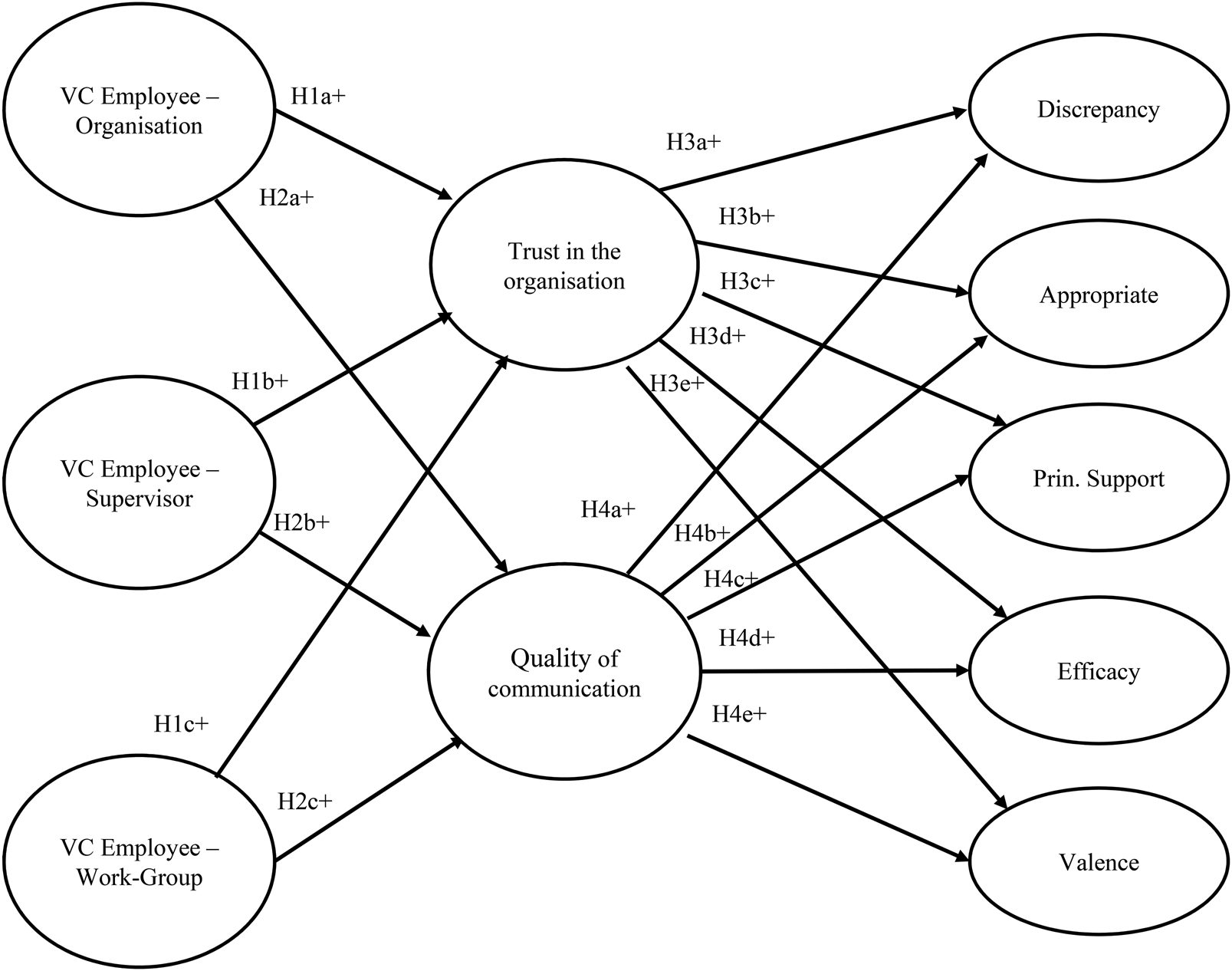
Perceived values-congruence between employees and their organisations (H1a), employees and their supervisors (H1b) and employees and their work groups (H1c) is positively related to trust.
Quality of communication
Quality of communication can be defined as the way in which employees share formal and informal information (Goldhaber, Yates, Porter, & Lesniak, Reference Goldhaber, Yates, Porter and Lesniak1978). The success of a change depends, at least in part, on the quality of the information provided, as what is said and how it is communicated matters (Armenakis & Harris, Reference Armenakis and Harris2002). Bouckenooghe and Devos (Reference Bouckenooghe and Devos2008) suggested the quality of communication plays a major role in justifying the need for change, reducing employee anxiety and ensuring employees are ready for the change.
Supportive and effective change directed information and communication had a strong correlation with change readiness, acceptance and support (e.g., Axtell et al., Reference Axtell, Wall, Stride, Pepper, Clegg, Gardner and Bolden2002; Bernerth, Reference Bernerth2004; Wanberg and Banas, Reference Wanberg and Banas2000). However, Oreg (Reference Oreg2006) found too much information had the potential to increase resistance to change. This was explained by arguing information that provided insights into the negative consequences of a change (i.e., if employees had something to lose from the change, there would be increased resistance). Oreg (Reference Oreg2006) suggested information content was as important as information adequacy. It should be noted that in the current study the quality of communication was viewed at a macro level.
Additionally, Claiborne et al. (Reference Claiborne, Auerbach, Lawrence and Schudrich2013) found a significant correlation between employees' satisfaction with communication about a change and their self-reported readiness to change. This finding was supported by Armenakis, Harris, and Mossholder's (Reference Armenakis, Harris and Mossholder1993) study that found such readiness (i.e., the employee's beliefs, attitudes and intentions towards the change) were positively related to well communicated and understood messages about the reasons for the change.
Quality of communication is likely to benefit from perceived values-congruence, as shared values and their underlying motivational goals help establish a common understanding of events and how to describe, classify and understand them (Erdogan, Kraimer, & Liden, Reference Erdogan, Kraimer and Liden2004; Schall, Reference Schall1983). Further, Edwards and Cable (Reference Edwards and Cable2009) found employees' values-congruence with their organisations was related to the quality of communication. This research suggests:
Perceived values-congruence between employees and their organisations (H2a), employees and their supervisors (H2b) and employees and their work groups (H2c) is positively related to the employing organisation's quality of communications.
Change-related beliefs
A belief is ‘an opinion or conviction about the truth of something that may not be readily obvious or subject to systematic verification’ (Armenakis et al., Reference Armenakis, Bernerth, Pitts and Walker2007: 483). Carlisle and Baden-Fuller (Reference Carlisle and Baden-Fuller2004) suggested beliefs play a major role in rewarding employees' behaviours and, further, that beliefs influenced by employees' intrinsic values may have a significant impact on their acceptance of change.
Armenakis et al. (Reference Armenakis, Bernerth, Pitts and Walker2007) suggested change recipients' beliefs about the necessity, appropriateness and potential benefits of the change, as well as their beliefs about their own and managers' abilities to implement the change (e.g., Bandura, Reference Bandura1986) are key to understanding employees' readiness for change. Armenakis et al. (Reference Armenakis, Bernerth, Pitts and Walker2007) combined many of the pre-change and change antecedent findings to develop a model that suggests five change recipients' beliefs determine employees' cognitive, emotional and intentional reactions to organisational change. These five, arguably essential, beliefs included:
(1) Discrepancy – a belief that there is a need to change.
(2) Appropriateness – a belief that the change will be effective and that the right actions were chosen.
(3) Self-efficacy – a belief that employees can perform the new tasks and duties the change will bring.
(4) Principal support – a belief that management will provide the required resources and are committed to the change.
(5) Valence – a belief that the change will bring positive outcomes for employees.
Prior research also found trust is related to positive organisational outcomes. For example, trust in supervisors and organisations positively influences employees' beliefs about their control over changing circumstances and mediate beliefs about supervisory support and impacts on affective commitment (Neves & Caetano, Reference Neves and Caetano2006). Further, Mishra and Spreitzer (Reference Mishra and Spreitzer1998) argued trust in an organisation and its management positively influenced employee assessments of change during organisational downsizing, suggesting:
Trust in an organisation will be positively related to employees' beliefs about the discrepancy (H3a), appropriateness (H3b), principal support (H3c), self-efficacy (H3d) and valence (H3e) of a change.
Communication within an organisation has also been found to influence employee readiness for change. For instance, employees' satisfaction with communication is related to their readiness for change (Claiborne et al., Reference Claiborne, Auerbach, Lawrence and Schudrich2013) and their response to change throughout the process (Nelissen & van Selm, Reference Nelissen and van Selm2008). Past research found beliefs-directed content of communication during times of change shaped employees' attitudes towards change, resulting in either readiness for change (positive), or resistance to change (negative) (Armenakis & Harris, Reference Armenakis and Harris2002) suggesting:
The quality of change-related communication between an organisation's entities will be positively related to employees' beliefs about the discrepancy (H4a), appropriateness (H4b), principal support (H4c), their self-efficacy (H4d) and valence (H4e) of the change.
These hypotheses led to the model shown in Figure 2 that provided the initial framework for the current study, which is discussed in the next section.
The hypothesised model.

Methodology
Sample and procedures
Respondents were Australian members of a commercial online panel who were paid a small sum of money determined by the panel provider to compensate them for their time taken to complete the survey. All respondents were screened to have been involved in a workplace change in the last 6 months by answering an opening question that asked if this was the case. Of the 1993 people invited to participate, only 18% (351 respondents) had been involved in such a change during this timeframe. This is at odds with some suggestions that organisational change is commonplace (e.g., Bernerth, Reference Bernerth2004). Of these 351 respondents, 100 were excluded because they showed suspicious response patterns, such as choosing the same scale point regardless of the question (Hair, Black, Babin, & Anderson, Reference Hair, Black, Babin and Anderson2010) and/or failed to pass an attention check asking them to select ‘strongly agree’ if they were reading the question. This resulted in a final usable sample of 251 adults who had experienced organisational change in the past 6 months. Of these, 36% had experienced, or were still experiencing, an organisational structure change, 12% a technological system change, 11% a leadership change, 10% a change in organisational culture, 10% a change in mission and strategy, 9% a change in policies and procedures, 8% a change in management practices and 4% a change in work unit climate. It seems people experience many types of organisational change.
The final sample included respondents who were 52% male and of an average age of 48 years. Most had a university level education (54%). Almost all respondents (99%) were still employed (58% full-time, 24% part-time and 17% casual), which was not surprising, given the initial question that asked about a recent change. Most respondents had non-supervisory roles (53%), although some had in supervisory positions (16%) and others held mid-level or senior management roles (31%).
After answering an initial question about the type of change they had experienced, respondents were asked about the focal constructs (i.e., perceived values-congruence, trust, the quality of communication and change-related beliefs). Each of these constructs were measured with existing scales, as follows: Perceived Values-Congruence was measured using three items from Cable and DeRue (Reference Cable and DeRue2002) (e.g., The things I value in life are very similar to the things that my [organisation/supervisor/work group] values; My personal values match my [organisation/supervisor/work group]'s values and culture; My [organisation/supervisor/work group]'s values and culture provide a good fit with the things that I value in life). These items were repeated to measure perceptions of their perceived values similarity with peers, supervisors and the organisation as a whole.
(1) Trust in the organisation was measured with a 7-item scale (e.g., I believe my employer has high integrity) developed by Robinson (Reference Robinson1996), which was based on trust dimensions suggested by Gabarro and Athos (Reference Gabarro and Athos1976).
(2) The quality of communication within the organisation was measured using Edwards and Cable's (Reference Edwards and Cable2009) 6-item scale (e.g., Communication is open with others in this organisation; People in this organisation understand what I say; I have honest discussions with other people in this organisation), which was adapted from earlier research (Goldhaber et al., Reference Goldhaber, Yates, Porter and Lesniak1978).
(3) Respondents' beliefs about the change were measured using 26 items from Armenakis et al.'s (Reference Armenakis, Bernerth, Pitts and Walker2007) organisational change recipients' beliefs (OCRB) sub-scales. These included five items each for valence (e.g., This change will benefit me), appropriateness (e.g., The change that we are implementing is correct for our situation), efficacy (e.g., I can implement this change in my job) and discrepancy (e.g., A change is needed to improve our operations) and six items for principal support (e.g., The top leaders support this change).
The perceived values-congruence, belief and trust items were all measured on 5-point strongly disagree (1) to strongly agree (5) scales, whereas the communication items were measured on a 7-point scale ranging from never (1) to all of the time (7).
The data analysis approach
Descriptive statistics were computed and the means, standard deviations and the variables' measurement properties were examined. The WarpPLS partial least squares (PLS) program (Kock, Reference Kock2017) was used to assess the unidimensionality, reliability, convergent and discriminant validity of the constructs before the structural model was estimated (Hair, Hult, Ringle, & Sarstedt, Reference Hair, Hult, Ringle and Sarstedt2014). A PLS structural equation modelling was chosen over the more traditional covariance-based approach, because PLS makes fewer distributional assumptions and the objective of the current research was in predicting outcomes, rather than confirming structural relationships (Hair, Ringle, & Sarstedt, Reference Hair, Ringle and Sarstedt2011).
The Results
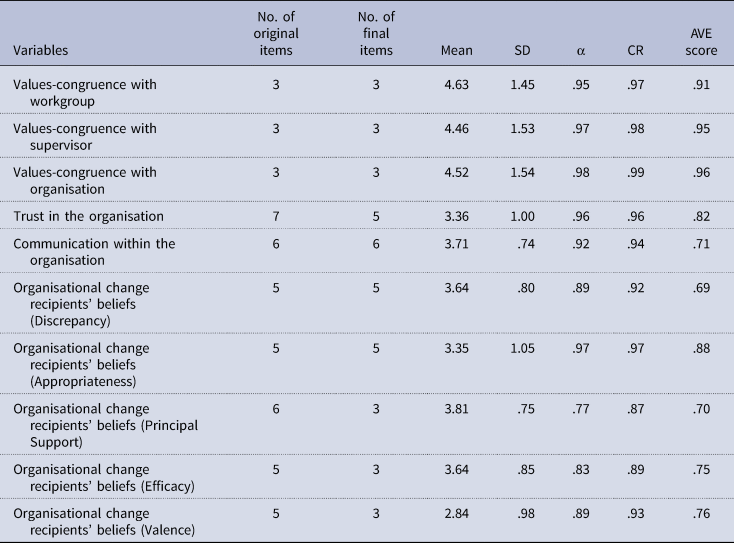
The means and standard deviations of each of the scales are reported in Table 1. Perceived values-congruence scales had the highest means (4.46–4.63), with the lowest means being the items that asked about change recipients' beliefs (2.84 for Valence to 3.81 for Principal Support). Thus, respondents were generally positive about their congruence with the organisation's values, but less positive about their change-related beliefs. However, in each case there was a reasonable amount of variation, with standard deviations ranging from .75 for Principal support beliefs to 1.54 for Values-congruence with the organisation. Thus, it was apparent that there was enough information in the data to make further analysis worthwhile. Consequently, the variables' measurement properties were assessed.
The variables' descriptive statistics and measurement properties

A small number of items did not correlate as well to their variables as expected, with factor loadings of less than .50. These items were removed iteratively until this problem was resolved. The removal of these items did not materially change the nature of the relevant constructs, as the correlations between the original and revised scales ranged from .86 to .98, which suggests the revised scales could be safely used (Thomas, Soutar, & Ryan, Reference Thomas, Soutar and Ryan2001).
As can be seen in Table 1, the final scales had good internal consistency (composite reliability and Cronbach's (Reference Cronbach1951) α coefficients) and convergent validity, with average variance extracted (AVE) scores being considerably higher than the recommended minimum of .50 suggested by Fornell and Larcker (Reference Fornell and Larcker1981). However, not all variables met Fornell and Larcker's (Reference Fornell and Larcker1981) requirements for discriminant validity, with correlations between change recipients' beliefs about the appropriateness and valence subscales being greater (r = .90) than the square root of the valence variable (.82), suggesting multicollinearity may be a problem. Thus, the five change recipients' belief sub-scales might not be as distinct as expected.
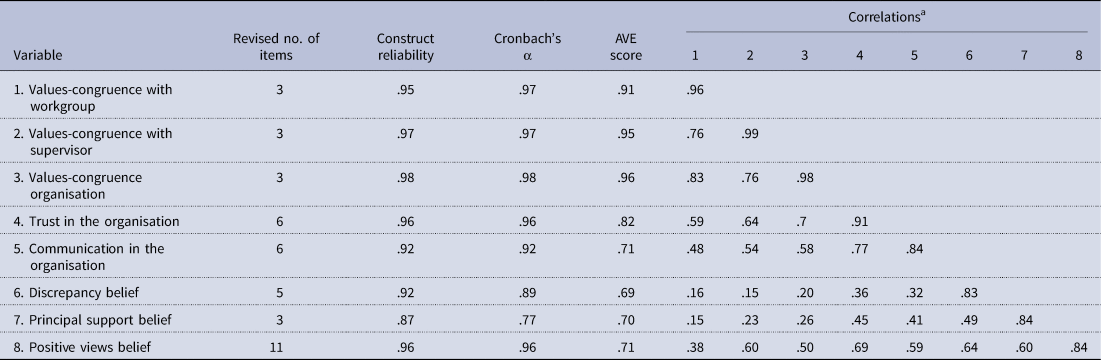
An exploratory factor analysis confirmed this, with only four factors having eigenvalues greater than 1, whereas a parallel analysis (Horn, Reference Horn1965) suggested three factors should be retained, as did Velicer's (Reference Velicer1976) minimum average partial test. Consequently, a three-factor solution was used (as is shown in the Appendix). As is clear from the Appendix, the discrepancy and principal support subscales remained largely intact, but the appropriateness and valence subscales combined with some items from the efficacy subscale to produce a ‘positive views’ factor. All of the constructs included in the analysis now had acceptable measurement properties, as all now had discriminant validity with each other, as their correlations were less than the square root of their AVE scores, as can be seen in Table 2.
The revised variables' measurement properties and correlations

a The figure in the main diagonal is the square root of the AVE score, which was used to test discriminant validity (Fornell & Larcker, Reference Fornell and Larcker1981).
The relationships between employees' perceived values-congruence and their beliefs about organisational change were suggested to be mediated by trust and the quality of communication in the organisation. The direct relationships between the perceived values-congruence constructs and employees' change-related beliefs were estimated first, after which the mediating effects of trust and quality of communication were examined. When all three types of values-congruence were examined in the same model, it produced Simpson's (Reference Simpson1951) paradox situations with two of the change beliefs (i.e., while the correlations between these variables were positive, the relevant path coefficients were negative). Thus, the different types of values-congruence were examined separately. As can be seen in Table 2, each of the change recipients' beliefs was positively related to the other variables in the model.
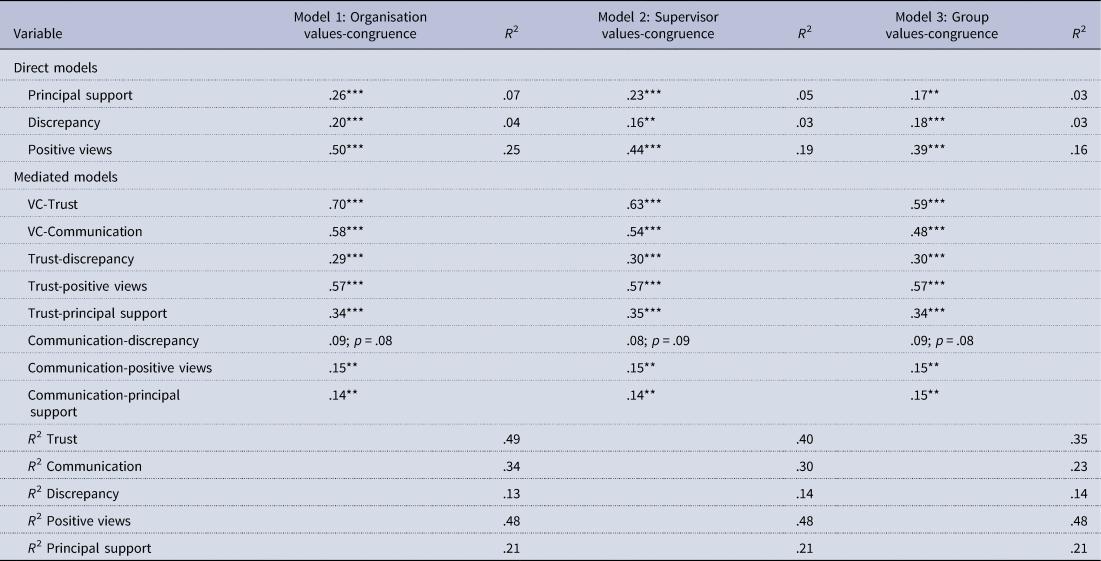
Table 3 shows the results for the direct and mediated models. The direct models suggest employees' perceived values-congruence with the organisation, supervisor and group influence all three beliefs about organisational change. However, there were differences in the explained variance with values-congruence influencing positive views to a greater extent than principal support and discrepancy beliefs. Specifically, positive views combined the beliefs that the change strategy was appropriate (Appropriateness), that employees were able to perform change-related tasks (Self-efficacy) and that the change would lead to positive employee outcomes (Valence). Principal support related to beliefs that management supports the change. Discrepancy related to beliefs about the need for change.
Path coefficients and R 2 statistics for the models

*p < .05; **p < .01; ***p < .001.
The mediated model included direct paths between the values-congruence constructs and the outcome variables that had been significant in the initial analysis. These direct paths were added to see whether these earlier relationships were fully or partially mediated by trust and communication quality.
The results from the mediated model generally supported the relationships suggested in Figure 2. As can be seen in Table 3, Trust and the Quality of Communication were reasonably well predicted by values-congruence with the organisation (R 2 = .70 and .58, respectively), supervisor (R 2 = .63 and .54, respectively) and group (R 2 = .59 and .48, respectively). As can also be seen in Table 3, the results supported the suggestion that the relationships between Perceived Values-congruence and change recipients' beliefs can best be modelled as being fully mediated through Trust and Quality of Communication. The model provides support for H1a and H1b and H2a and H2b, as well as for H3 and partial support for H4, as these paths were all significant and in the expected direction, with the exception of H4a, as the Quality of Communication to discrepancy beliefs path was only directionally supported in all three models. Thus, all but one of the suggested hypotheses were supported.
There were some interesting differences in the explained variance in trust and communication between the types of values-congruence. Specifically, perceived congruence with the organisation was a better predictor of trust than was perceived congruence with the supervisor (p < .05) or perceived congruence with the work group (p < .01), as trust in this model had a significantly higher R 2 value than was the case in the models that included these latter types of values-congruence. Perceived congruence with the organisation was also a better predictor of the quality of communication than was perceived congruence with the work group (p < .05), but this was not the case for perceived congruence with the supervisor. Finally, perceived congruence with the work group and perceived congruence with the supervisor were equally good at predicting trust and the quality of communication.
There were also some interesting differences in the predictive ability of Trust and Quality of Communication. Trust was a stronger predictor of all three change recipient beliefs. It seems Quality of Communications was much less important in understanding beliefs about change than was Trust.
Some socio-demographic variables (gender, age, education and position in the organisation) were also examined. The median was used to split the sample into two groups where appropriate (e.g., older and younger respondents) and moderating impacts were examined. However, no significant differences were found in any of the paths, suggesting these background variables did not have a moderating effect. As these variables were also potentially control variables, models were also estimated with these background variables included as direct influences on the three OCRB variables. However, in each case, the relevant paths were not significant, suggesting these variables had no impact and could be safely ignored in the subsequent discussion.
Discussion
Theoretical implications
The current research sought to answer a number of questions about employees' perceived values-congruence with their organisation and how such congruence influenced their beliefs about an organisational change. These beliefs are important, as they have been found to influence the success or failure of organisational change implementations (e.g., Armenakis et al., Reference Armenakis, Bernerth, Pitts and Walker2007; Self, Reference Self2007; Vakola, Reference Vakola2014). While the current study suggests there were significant relationships, in particular between the perceived values-congruence constructs, trust and change beliefs, the structure of these beliefs suggested by Armenakis et al. (Reference Armenakis, Bernerth, Pitts and Walker2007) was not supported in the investigated context. The combination of three of the five beliefs (appropriateness, efficacy and valence) that was needed might be explainable by employees feeling a change is appropriate (appropriateness) only if they can expect a personal benefit or gain (valence) and if they feel they could perform the new tasks (efficacy). Even though a combination of some of the beliefs was seen as suitable here, it should be noted that the scale items used to measure the OCRBs were largely retained and found to be relevant, as is discussed next.
The results support previous research that values alignment with an organisation had a significant influence on employees' acceptance of change (Burnes & Jackson, Reference Burnes and Jackson2011), but we found perceived values-congruence with an organisation was more important for employee support for organisational change than was perceived values-congruence within supervisors and the work group. This extends our understanding of how different types of values-congruence influence change-related beliefs.
The study extended earlier research into the importance of perceived values-congruence between employees and their organisation to the formation of positive, work-related attitudes and behaviours (Amos & Weathington, Reference Amos and Weathington2008; Seong & Kristof-Brown, Reference Seong and Kristof-Brown2012). As Kroeger (Reference Kroeger1995) has noted, many people seek employment with organisations that reflect their own values, which, in turn, increases their job satisfaction and commitment to the organisation. Indeed, this relationship has been confirmed in a number of studies (e.g., Ostroff, Shin, and Kinicki, Reference Ostroff, Shin and Kinicki2005; Saks and Ashforth, Reference Saks and Ashforth1997). Thus, the current investigation adds support to the suggestion that employees' perceived values-congruence with their organisation has a significant influence on their beliefs about organisational change. Employees' perceived values-congruence with their organisation, supervisor and work group all had a strong direct influence on their Positive Views about change (a combination of the OCRB scale's Appropriateness, Valence and Efficacy subscales). A significant relationship was also found between perceived values-congruence with the organisation, supervisor and work group and employees' beliefs that they received support from their supervisors and managers (Principal Support). However, only directional support was found for the relationship between perceived values-congruence and employees' recognition there was a need for the change (Discrepancy).
The study suggests employees' perceived values-congruence with their organisation strongly influences their trust in their organisation and their perception of the quality of communication in their organisation, supporting Edwards and Cable (Reference Edwards and Cable2009). The results provide an important insight into perceived values-congruence's role and in the development of employees' trust during organisational change. More than half of the variance in employees' trust during such times was explained by their perceived values-congruence with their organisation, supervisor and/or work group. This is an important outcome for organisational change investigators, because, even though previous research suggested trust was enhanced by similarities in values (Mayer, Davis, & Schoorman, Reference Mayer, Davis and Schoorman1995), these results suggest trust in a changing work environment is strongly related to employees' values-congruity with their organisation and/or supervisors.
Perceived values-congruence between employees and their organisation, supervisor and/or work group also had a significant effect on perceptions of the quality of communication during organisational change. This is an important outcome in light of the findings of many change researchers, who agree good communication is essential to the creation of employee involvement and the successful implementation of change (Lies, Reference Lies2012; Tucker, Yeow, & Viki, Reference Tucker, Yeow and Viki2013). These findings are of particular significance because, even though prior investigations found support for the importance of change-related communication (Bernerth, Reference Bernerth2004), no previous research has investigated its antecedents.
The relationships between employees' perceived values-congruence with their organisation, supervisor and work group and their change-related beliefs were fully mediated by their trust in their organisation and their perception of the quality of the organisation's communication, as the direct paths from the various values-congruence constructs to the change belief construct were not significant. Not surprisingly, trust had more influence than the quality of communication on employees' beliefs that the change was appropriate, that they received principal support during the change, that they had the required efficacy to change and that they benefited from the change. The results supported the suggested, mediated, relationships between perceived values-congruence and employee beliefs about a change.
Trust had previously been found to be an important mediator between perceived values-congruence and a range of positive organisational outcomes (e.g., Cazier, Shao, and Louis, Reference Cazier, Shao and Louis2007; Edwards and Cable, Reference Edwards and Cable2009). The results of the current analysis extend these findings by providing support for the suggestion that employees' trust during organisational change is positively related to their beliefs about that organisational change. These beliefs, in turn, have been found to be an important determinant of employees' readiness for change (e.g., Caldwell, Reference Caldwell2011) and whether people were committed to, or resisted a change (Armenakis et al., Reference Armenakis, Bernerth, Pitts and Walker2007; Armenakis, Harris, & Mossholder, Reference Armenakis, Harris and Mossholder1993; Oreg, Vakola, & Armenakis, Reference Oreg, Vakola and Armenakis2011).
The quality of communication during change also influenced employees' beliefs. While these impacts were less than those for trust, they were significant and explained, at least in part, a strengthening of the three change beliefs examined. This outcome is a notable contribution to research investigating the importance of communication during organisational change (Allen, Jimmieson, Bordia, & Irmer, Reference Allen, Jimmieson, Bordia and Irmer2007; Claiborne et al., Reference Claiborne, Auerbach, Lawrence and Schudrich2013). Even though many prior studies considered communication to be important for successful change implementation, no previous research has investigated the mediating effect of the quality of communication. As expected from earlier research (Oreg, Vakola, & Armenakis, Reference Oreg, Vakola and Armenakis2011), none of the socio-demographic factors had a significant influence on any of the organisational change-related outcomes.
In sum, the current study provided strong support for the importance of employees' perceived values-congruence with their organisation, supervisors and work group in the development of change-related trust and perceptions about the quality of communication. In particular, trust had a significant influence on how employees formed positive beliefs about the necessity for change, the principal support they would receive, as well as positive views in relation to the appropriateness of the change, their ability to perform new tasks and the personal rewards they would gain from the change. These results contribute to the organisational change-literature by offering a new perspective on the role perceived values-congruence plays in the development of beliefs about a change, which is a pre-requisite for employees' change readiness (Gondo, Patterson, & Palacios, Reference Gondo, Patterson and Palacios2013; Self, Reference Self2007; Vakola, Reference Vakola2014).
Practical implications
The results suggest employees' perceived values-congruence with their organisations supervisor and work should be considered when planning an organisational change strategy. As perceived values-congruence had a number of positive effects, it should be treated as an important additional change antecedent and measured prior to planning change. Further, trust must be considered, which is not surprising as previous research has found trust to have been important for achieving change-related goals (Morgan & Zeffane, Reference Morgan and Zeffane2003). Importantly, trust reduces employees' anxiety (Mishra & Spreitzer, Reference Mishra and Spreitzer1998), ensuring they are ready and open to organisational change (Devos, Buelens, & Bouckenooghe, Reference Devos, Buelens and Bouckenooghe2007). As perceived values-congruence influences employees' trust (Smollan, Reference Smollan2013), there is an additional reason to be concerned about values alignment.
Change-related communications should include information that supports the formation of positive organisational change beliefs, as this will assist the change process. This recommendation is in line with previous suggestions about the necessity of including these beliefs when composing messages that need to be conveyed during an organisational change (Armenakis et al., Reference Armenakis, Bernerth, Pitts and Walker2007; Bernerth, Reference Bernerth2004; Self, Reference Self2007; Vakola, Reference Vakola2013, Reference Vakola2014).
As previous studies have found people's perceived values-congruence with their organisation can change (Cable & Parsons, Reference Cable and Parsons2001), particularly during organisational transformations (Lamm, Gordon, & Purser, Reference Lamm, Gordon and Purser2010), it is advisable for change leaders to incorporate a picture of a desirable values future for their organisation in their change messages. This is especially true in situations in which there is little values alignment, because, as Neves and Caetano (Reference Neves and Caetano2009) have noted, people who feel intended organisational values after a change would be congruent with their own values are more likely to display increased commitment and enthusiasm.
In addition, human resource managers should target new employees whose values are congruent with the ‘future’ organisation's values (Cable & Judge, Reference Cable and Judge1997). This could be achieved by actively managing the information made available to job applicants (Swider, Zimmerman, & Barrick, Reference Swider, Zimmerman and Barrick2015). Such a strategy, when combined with an internal socialisation strategy designed to align existing employees' values (De Cooman et al., Reference De Cooman, Gieter, Pepermans, Hermans, Bois, Caers and Jegers2009), is likely to result in positive organisational change outcomes (Yu, Reference Yu2014).
Also, the effects of perceived values-congruence with the workgroup should not be neglected. The lack of influence of workgroup perceived values-congruence suggests monies and energy spent on team-building during organisational change might be better spent on ensuring the organisation's values (or the values it wishes to project following the change) are aligned with those of its employees.
In sum, the study made important contributions to our understanding of the role perceived values-congruence plays in the implementation of organisational change. In particular, the study suggested two important change antecedents (trust and quality of communication) were significantly influenced by the values-alignment between employees and their organisations, supervisors and work groups. Consequently, change leaders need to understand perceived values-congruence before planning change and to take appropriate measures to remedy misalignments if they occur. Organisations would also benefit from improved trust and improved perceptions about the quality of communications, which would help develop positive, change-related beliefs.
Limitations and Future Research
As is the case with all research, there were a number of limitations. First, the online data collection method resulted in self-report data and there was no opportunity to probe deeper. This limitation offers an opportunity for future researchers to collect qualitative data to add to the information in this study. Given the relatively high correlations between the different types of perceived values-congruence in the current study, future research is needed to explore the mechanisms that link the different types of value-congruence. Further, respondents were drawn from a range of organisations rather than being from a particular organisation that was implementing a specific type of organisational change. This means respondents likely experienced a range of different types of change. Future research is needed to see whether outcomes are influenced by the context of specific types of change (e.g., organisational conditions or content-related factors). Moreover, the sample was a ‘one-shot’ sample of workers in Australia and longitudinal data and/or data from other locations might be usefully collected to see whether the present results are replicated in those additional settings. A longitudinal study would help us see whether values-congruency changes if the practical recommendations that have been suggested here were implemented. Following this approach, it would also be interesting to see whether long-term change outcomes are affected by changes in perceptions of perceived values-congruence. Lastly, the use of a non-experimental approach to this analysis provides the opportunity that other factors than those investigated might influence the outcomes that were presented here.
Conclusions
The current study provides strong support for the suggestion that organisational change is a complex endeavour. It seems clear that perceived values-congruence has a significant effect on the factors that determine the success or failure of any organisational change implementation and, consequently, needs to be carefully considered. Further, it seems the development of trust and quality communications can significantly influence employees' beliefs about a change process. These factors should, therefore, not be neglected.
Oliver Rahn was awarded his Doctor of Business Administration from the University of Western Australia in 2017. Oliver's field of study is concerned with factors affecting organisational change and transformation. Oliver is currently contributing as a freelance author to research conducted at the University of Western Australia.
Geoffrey Soutar was awarded his PhD from Cornell University. He is a Professor in the Business School at the University of Western Australia. His research interests include the marketing of services, especially educational services, the marketing of technology, the role of design in marketing and service quality management.
Julie Lee was awarded her PhD from the University of Illinois at Urbana-Champaign. She is a Professor in the Business School at the University of Western Australia. Her research interests include the theory, measurement and application of personal and cultural values to a wide range of consumer and tourism behaviours.
Appendix
Factor Loadings of the OCRB Items