INTRODUCTION
Coccidiosis in poultry can be caused by any of 7 species of Eimeria, which are obligate intracellular protozoan parasites, and is clinically and pathologically manifested as intestinal haemorrhage, malabsorption, diarrhoea, reduced body weight gain, and even mortality. The present control strategy against coccidiosis in poultry employs the use of anti-coccidial drugs and live vaccines containing virulent or attenuated strains of Eimeria. However, emergence of drug-resistant parasites and the high cost associated with the development of new drugs have spawned an interest in the development of anticoccidial subunit vaccines composed of protective antigens as an alternative to live vaccines (Vermeulen et al. 1998).
Recent strategies and preliminary observations on the mode of stimulation of the immune responses suggest that DNA-based vaccination may be such a method that can overcome the troubles encountered for coccidiosis control (Shah et al. Reference Shah, Yan, Xu, Song and Li2010). Many publications have demonstrated the efficacy of DNA formulations in protection against virulent challenge with Eimeria spp. in animal models (Min et al. Reference Min, Lillehoj, Burnside, Weining, Staeheli and Zhu2002; Ding et al. Reference Ding, Lillehoj, Dalloul, Min, Sato, Yasuda and Lillehoj2005; Xu et al. Reference Xu, Chen and Wang2006, Reference Xu, Song, Xu, Yan, Shah and Li2008; Song et al. Reference Song, Yan, Xu, Song, Shah, Zhu and Li2010a; Shah et al. Reference Shah, Yan, Xu, Song and Li2010; Geriletua et al. Reference Geriletu and Li2011). It has also been found that DNA vaccines, used as a novel delivery system, can provoke both humoral and cell-mediated immune responses (Liljeqvist and Stahl, Reference Liljeqvist and Stahl1999; Gurunathan et al. Reference Gurunathan, Wu, Freidag and Seder2000; Song et al. Reference Song, Lillehoj, Choi, Yun, Parcells, Huynh and Han2001; Oshop et al. Reference Oshop, Elankumaran and Heckert2002), and co-delivery of cytokines as adjuvants could enhance the potential for DNA vaccines to induce broad and long-lasting humoral and cellular immunity (Min et al. Reference Min, Lillehoj, Burnside, Weining, Staeheli and Zhu2002; Lillehoj et al. Reference Lillehoj, Ding, Quiroz, Bevensee and Lillehoj2005; Song et al. Reference Song, Song, Xu, Yan, Shah and Li2010b).
Eimeria acervulina is one of the 7 recognized species of Eimeria that infect chickens. Until now, only a few genes of this coccidian have been reported and tested for their immunogenicity (Ding et al. Reference Ding, Bao, Liu, Yu, Abdille and Wei2008; Song et al. Reference Song, Yan, Xu, Song, Shah, Zhu and Li2010a; Shah et al. Reference Shah, Yan, Xu, Song and Li2010). The search for new antigens and testing their protective ability against challenge with E. acervulina will facilitate the development of a new generation of vaccines against this parasite.
Expression library immunization (ELI) is a contemporary approach to vaccine production that has the potential to identify novel vaccine antigens. To date this in vivo screening of expression libraries has been utilized to identify protective antigens against a variety of organisms, including bacteria, fungi and parasites (Barry et al. Reference Barry, Lai and Johnston1995; Melby et al. Reference Melby, Ogden, Flores, Zhao, Geldmacher, Biediger, Ahuja, Uranga and Melendez2000; Ivey et al. Reference Ivey, Magee, Woitaske, Johnston and Cox2003; Almazán et al. Reference Almazán, Kocan, Bergman, Garcia-Garcia, Blouin and de la Fuente2003; Stemke-Hale et al. Reference Stemke-Hale, Kaltenboeck, DeGraves, Sykes, Huang, Bu and Johnston2005; Yero et al. Reference Yero, Pajón, Pérez, Fariñas, Cobas, Diaz, Solis, Acosta, Brookes, Taylor and Gorringe2007; Tekiel et al. Reference Tekiel, Alba-Soto, González Cappa, Postan and Sánchez2009).
In the present report, we describe the identification and characterization of a novel cDNA clone, designated cSZ-JN2, and demonstrate its potential as a candidate vaccine for broiler chickens.
MATERIALS AND METHODS
Parasites and animals
Sporulated oocysts of E. acervulina isolated from Jiangsu Province of China (JS) were propagated by repeated passages in 3-week-old chickens at an interval of at least 3 months and were stored in 2·5% potassium dichromate solution at 4 °C.
Sporozoites from E. acervulina oocysts were purified on DE-52 anion-exchange columns using a protocol described previously (Klotz et al. Reference Klotz, Gehre, Lucius and Pogonka2007). Eimeria acervulina merozoites were harvested from the duodenal loops of chickens 54 h and 89 h post-infection (p.i.) and purified using standard methods (Jenkins et al. Reference Jenkins and Dame1987; Martin et al. Reference Martin, Awadalla and Lillehoj1995) before being pelleted and frozen in liquid nitrogen.
Newly hatched 1-day-old Chinese Yellow chickens were raised in a clean cage under coccidia-free conditions until the end of the experiment. Chickens were screened periodically for their Eimeria infection status by microscopic examination of their feces. The chickens were provided with coccidiostat-free feed and water ad libidum and shifted to the animal containment facility prior to challenge with virulent oocysts. The study was approved by the Institutional Animal Experiment Commission in accordance with the Chinese regulations of animal experimentation.
Construction of cDNA expression library and screening
Total RNA and subsequently mRNA were isolated from purified E. acervulina sporozoites by use of TRIZOL Reagent (Invitrogen, USA) and an Oligotex mRNA Kit (Qiagen, USA) according to the manufacturer's instructions. Double-strand cDNA was synthesized as follows: cDNA synthesis was primed with oligo(dT)- Xho I primers and 5-me dCTP was incorporated into both strands without extraction or precipitation between first and second strand synthesis. The cDNA was treated with T4 DNA polymerase to flush the ends and ligated with EcoR I–Not I–BamH I adaptors (TaKaRa Biotech, Dalian, P. R. China). Following adaptor ligation and phosphorylation with T4 polynucleotide kinase, the cDNA was digested with Xho I. The cDNA was passed through a Mini Column Fractionation Kit (Novagen, USA) to remove excess adaptors and small cDNA products (<300 bp). The fractionated cDNA with sizes bigger than 300 bp was ligated to the EcoR I and Xho I digested expression vector pVAX1.0 (Invitrogen, USA). The ligation mixes were transformed into E. coli TOP10 and selected on solid media containing 50 μg/ml kanamycin. The circular pVAX1.0 vector was also transformed to the competent cells TOP10 as a control. After overnight growth, the colonies of E. coli were combined into pools. A total of 15 pools (termed pool 1 to pool 15), each comprising approximately 200 individual clones, were constructed and stored at 4 °C.
Restriction analysis with EcoR I and Xho I showed that all 8 colonies picked randomly from the cDNA library had inserts from 500 to 2000 bp. Subsequently, 15 pools of library were inoculated into chickens to observe the ability of the antigens to induce a humoral immune response and a cell-mediated immune response. The positive pools that stimulated significant immune responses were fractionated sequentially until a single positive clone was screened.
Sequence analysis
The positive clone, confirmed by the last screening was sequenced by Invitrogen Biotech (Shanghai, PR China). Sequence similarity was investigated using using the BLASTP and BLASTX (http://www.blast.ncbi.nlm.nih.gov/Blast.cgi). The signal peptide, secondary structure and protein motifs were predicted using approaches accessible on the Internet: SignalP (http://www.cbs.dtu.dk/services/SignalP/), protein motifscan and second structure (http://www.myhits.isb-sib.ch/cgibin/motif_scan) and (http://www.expasy.org) respectively.
Expression and purification of recombinant cSZ-JN2
The ORF of E. acervulina cSZ-JN2 gene was amplified utilizing the positive plasmid identified by sequence analysis as template by PCR. The forward primer and reverse primer were designed by Primer 5.0 software based on the cSZ-JN2 gene sequences. The primer set contained restriction enzyme sites EcoR I and Xho I in forward primer (5′-CGCGAATTCATGTGCTCGTTAAACG-3′) and reverse primer (5′-GCTCTCGAGCTAGTGAAGGACACAT-3′) (sites for digestion by EcoR I and Xho I are underlined), respectively. The amplicon was digested with EcoR I and Xho I, gel purified and cloned into a frame of expression vector pET28a(+) (Novagen, USA) to generate plasmid pET28a-cSZ-JN2. The recombinant plasmid was sequenced to confirm that the cSZ-JN2 insert was in the proper reading frame.
Recombinant protein expression from E. coli clone was induced using isopropyl-β-D-thiogalactopyranoside (IPTG; Sigma-Aldrich, USA) at OD600 = 0·6. The induced bacterial cells were incubated for 4 h following which the cells were harvested by centrifugation. The cell pellet was lysed using lysozyme (10 μg/ml) (Sigma–Aldrich, USA) followed by sonication and was then analysed by 15% (w/v) sodium dodecyl sulfate polyacrylamide gel electrophoresis (SDS-PAGE).
The recombinant protein was purified by Ni2+-nitrilotriacetic acid (Ni-NTA) column (GE Healthcare, USA) according to the manufacturer′s instructions. The purity of the protein was detected by 15% SDS–PAGE and the concentration of purified protein was determined according to the Bradford procedure (Bradford, Reference Bradford1976), using bovine serum albumin (BSA) as a standard. The purified protein was stored in aliquots at −20 °C until further use.
Antisera against recombinant cSZ-JN2 protein and against Eimeria acervulina
Rat antiserum against recombinant cSZ-JN2 protein was prepared in the Laboratory of Veterinary Parasite Disease, Nanjing Agricultural University, China as described (Zhu et al. manuscript submitted).
The antisera against E. acervulina (chicken antisera) were collected from chickens experimentally infected with E. acervulina 1 week post-infection.
Immunoblotting analysis for the recombinant cSZ-JN2 and native protein of cSZ-JN2
Samples including crude somatic extracts of E. acervulina sporozoites and the recombinant protein were separated by SDS–PAGE. Then the protein was transferred to nitrocellulose membrane (Millipore, USA). After being blocked with 5% (w/v) skimmed milk powder in TBS (Tris-buffer saline)–Tween 20 (TBST), the membranes were incubated with the primary antibodies (rat antiserum and chicken antisera, respectively) for 1 h at 37 °C (dilutions 1:50 to rat antiserum, 1:100 to chicken antisera). Horseradish peroxidase (HRP)-conjugated goat anti-rat IgG, and HRP-conjugated donkey anti-chick IgG (Sigma, USA) were added, respectively. Finally, the bound antibody was detected using 3,3′-diaminobenzidine tetrahydrochloride (DAB) kit (Boster Bio-technology) according to the manufacturer's instructions.
Expression analysis of cSZ-JN2 in sporozoite and merozoite stages of Eimeria acervulina by immunofluorescence
Purified sporozoites and meroziotes were smeared and air-dried on a poly-L-lysine treated glass slide before fixation. Sporozoites and meroziotes were fixed with 2% paraformaldehyde in TBS for 10 min at RT, permeabilized with 1% Triton X-100 in TBS for 10 min, washed 3 times in TBS containing 0·05% Tween-20 (TBS-T), and blocked with TBST containing 5% (w/v) BSA for 2 h at 37 °C. After 3 washes in TBST, rat antiserum against cSZ-JN2 (1:100 dilution) was added and allowed to incubate at 4 °C overnight. After 3 washes in TBST, the cover-slips were maintained in darkness for 40 min in goat anti-rat IgG antibody (Beyotime) labelled with FITC diluted at 1:1000. After washing with TBST, fluorescent mounting medium (Beyotime) was added and cells were examined by fluorescent microscopy (Olympus).
Construction of cSZ-JN2 DNA vaccine
The pET28a-cSZ-JN2 plasmid containing cSZ-JN2 ORF and the pVAX1.0 vector (Invitrogen, Life Technologies) was treated with EcoR I and Xho I enzyme and then the cSZ-JN2 ORF was directionally cloned into the pVAX1.0 vector. Recombinant vector pVAX1.0-cSZ-JN2 was digested with the same restriction enzymes and sequenced by Invitrogen biotech (Shanghai, PR China) for identification. The recombinant plasmids pVAX1.0-cSZ-JN2 acting as DNA vaccines were prepared using Qiagen Plasmid DNA Mid Kit (Qiagen, USA), according to the manufacturer's instructions. The eluted products were dissolved in TE (pH 7·4) at a concentration of 1 mg/ml, and stored at −20 °C until required.
Detection of the expression of proteins encoded by plasmids DNA in vivo by RT-PCR assay and Western blot analysis
Chickens were injected intramuscularly (IM) in leg muscle with 100 μg of recombinant plasmids pVAX1.0-cSZ-JN2. The transcription of cSZ-JN2 DNA vaccine at local muscle injection sites was determined 7 days after the first vaccination by RT-PCR utilizing the above-used gene specific primers with the methods as described previously (Xu et al. Reference Xu, Song, Xu, Yan, Shah and Li2008). Briefly, injected tissues were collected and total RNA was extracted. To remove contaminating genomic DNA or plasmids injected, all RNA samples were treated with RNase-free DNase I (TaKaRa, China). RT-PCR assays were performed with cloning primer pairs of the cSZ-JN2 gene. The PCR products were detected by electrophoresis on 1% agarose gel.
Western blot analysis was performed as described by Xu et al. (Reference Xu, Song, Xu, Yan, Shah and Li2008). Briefly, 7 days after vaccination, injected muscles were ground up and treated with ice-cold RIPA solution (0·1 M phenylmethylsulfonyl fluoride, 150 mM sodium chloride, 1% Nonidet P-40, 0·1% SDS, 50 mM Tris–HCl). Meanwhile, the same site muscles from non-injected and pVAX1.0 plasmid injected chickens were collected as controls. Proteins were separated by sodium dodecyl sulfate-polyacrylamide gel electrophoresis (SDS–PAGE) and then transferred to a nitrocellulose membrane (Millipore, USA). The membrane was incubated with rat anti-rcSZ-JN2 polyclonal antibody as primary antibody and horseradish peroxidase (HRP)-conjugated goat anti-rat IgG (Sigma) as secondary antibody. The bound antibody was detected using 3,3′- diaminobenzidine (DAB).
DNA immunization protocol
Two-week-old chickens were randomly divided into 5 groups of 30 each as shown in Table 1. Experimental group chickens were respectively inoculated with 100 μg plasmids pVAX1.0-cSZ-JN2 and recombinant cSZ-JN2 protein. Plasmid control group was given 100 μg of pVAX1.0 plasmid alone to each chicken. Challenged control group and unchallenged control chickens were injected with sterile PBS at the same injection site. A booster immunization was given 1 week later with the same amount of components as the first immunization. Seven days after the second injection, 20 chickens in each group except the unchallenged control group were challenged orally with 1·2 × 10s sporulated oocysts of E. acervulina. Unchallenged control chickens were given PBS orally. All the chickens were euthanized following protocols approved by the Animal Care and Ethics Committee of Nanjing Agricultural University (Approval No. 200709005) to determine the effects of immunization on the 6th day post-challenge.
Effects of cSZ-JN2 against Eimeria acervulina challenge

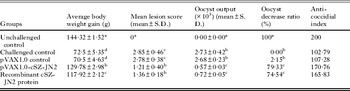
In each column, numbers with the same letter are not significantly different (P > 0·05) and numbers with different letters are significantly different (P < 0·05).
The other 10 chickens in each group were raised in another coccidia-free room and were killed by cardiac puncture to collect blood for determination of cytokine and antibody levels 10 days after the second immunization. The blood was allowed to clot for 1 h at room temperature (RT) and then overnight at 4 °C. The serum was collected by centrifugation (800 g, 10 min), aliquoted, and stored at −20 °C until used.
Serum antibody levels and cytokine concentrations induced by DNA vaccines
The antibody levels in the serum samples were determined by ELISA as described previously (Lillehoj et al. Reference Lillehoj, Ding, Quiroz, Bevensee and Lillehoj2005). Briefly, flat-bottomed 96-well plates (Marxi-Sorp, Nunc, Denmark) were coated overnight at 4 °C with 100 μl per well of the purified recombinant cSZ-JN2 protein (10 μg/ml) in 0·05 M carbonate buffer, pH 9·6. The plates were washed with 0·01 M PBS containing 0·05% Tween-20 (PBS-T) and blocked with 5% skim milk powder (SMP) in PBS-T for 2 h at 37 °C. The plates were incubated for 2 h at 37 °C with 100 μl of the serum samples, diluted 1:50 in PBS-T with 1% SMP in duplicate. After 3 washes, the plates were incubated for 1 h at room temperature with 100 μl/well of horseradish peroxidase-conjugated donkey anti-chicken IgG antibody (Sigma) diluted 1:1000 in 2% SMP in PBS-T. Colour development was carried out with 3, 3′, 5, 5′-tetramethylbenzidine (TMB) (Sigma), and the optical density at 450 nm (OD450) was determined with a microplate spectrophotometer. All serum samples were investigated by ELISA at the same time under the same conditions, and the serum samples collected on each occasion were included on 1 plate. In this study, control wells (PBS and empty vector) were set up in each plate, the positive value was determined by comparing the value of each sample with the controls in the same plate. Plate variation had no effect on determining the positive ones.
The concentrations of interleukin-2 (IL-2), IL-4, γ-interferon (IFN-γ) and β-tumor growth factor (TGF-β) in serum were detected by utilizing an indirect ELISA with the ‘chick cytokine ELISA Quantitation Kits’ (catalogue numbers: I042-01, 1042-02, 1042-03 and 1042-04 for IL-2, IL-4, IFN-γ and TGF-β respectively; GBD Laboratories, USA) in duplicate, according to the manufacturer's instructions.
Protective effect of the DNA vaccines
The efficacy of immunization was evaluated on the basis of lesion score, body weight gain, oocyst output, oocyst decrease ratio and anti-coccidial index (ACI). Body weight gain of chickens in each group was determined by the body weight of the chickens at the end of the experiments subtracting the body weight at the time of challenge. Lesion scores were evaluated as described by Johnson and Reid (Reference Johnson and Reid1970). Additionally, the duodenal content for each group was collected separately and oocysts per gramme of content (OPG) were determined using the McMaster counting technique. The oocyst decrease ratio was calculated as follows: the number of oocysts from the challenged control chickens-vaccinated chickens/ the challenged control chickens × 100%. ACI was a synthetic criterion for assessing the protective effect of a medicine or vaccine and calculated as follows: (relative rate of weight gain + survival rate)-(lesion value + oocyst value).
Statistical analysis
Statistical analysis was performed using the SPSS statistical package (SPSS for Windows 16, SPSS Inc., Chicago, IL, USA). Differences among groups were tested with the one-way ANOVA Duncan test, and P < 0·05 was considered to indicate a significant difference.
RESULTS
Construction and screening of Eimeria acervulina cDNA library
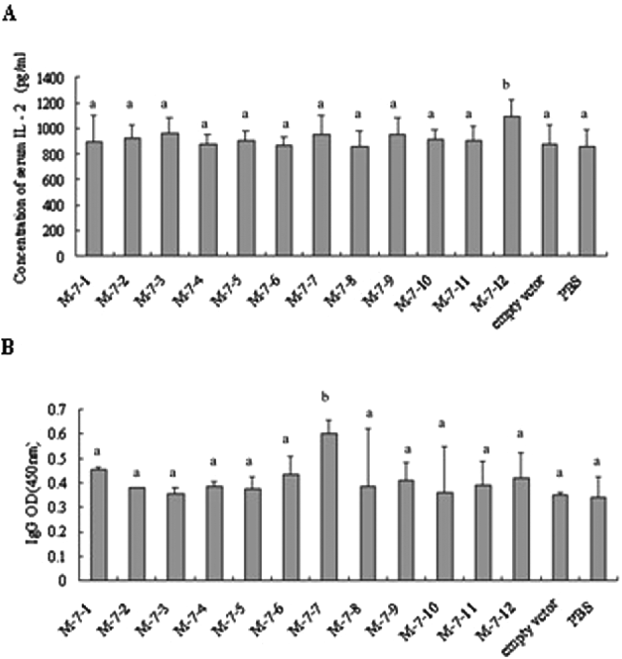
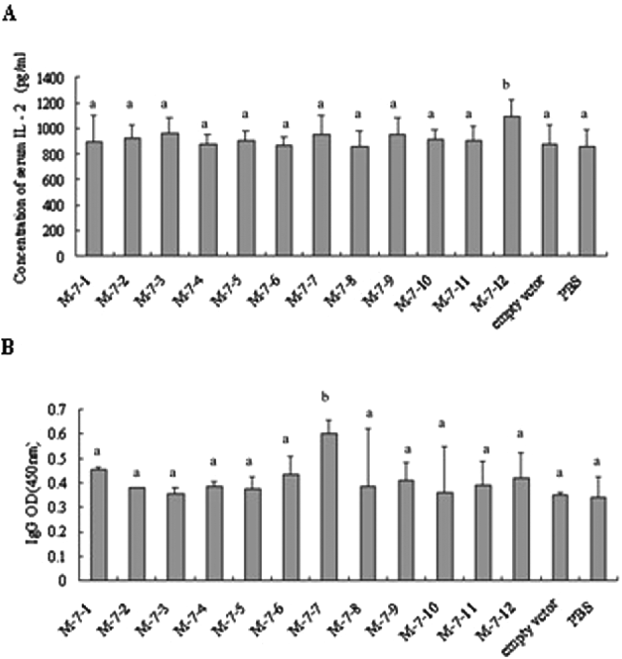
Fifteen primary pools (termed pool 1 to pool 15), each comprising approximately 200 individual clones, were tested in the first round screening. The result showed that pool 1 and pool 2 induced high levels of IgG antibody and cytokines compared with empty vector and PBS. Then the combined pool 1 and pool 2 was fractionated into 12 subpools. The further screening results showed that only Pool M-7 induced significantly high levels of IgG antibody, IL-2, IFN-γ and TGF-β (P< 0·05). Plasmid DNA from an individual clone of Pool M-7 was used to immunize chickens as described previously. The results showed that, of the 12 individual clones, clone M-7-7 significantly increased the antibody response and the M-7-12 resulted in a high concentration of IL-2 in the immunized chickens compared with empty vector and PBS (P < 0·05) (Fig. 1). In the present work, M-7-12 was selected for further research.
Screening sublibraries M-7 of cDNA library. Each subpool contains a single clone. The concentrations of IL-2 (mean ± S.D.) in the serum are expressed in pg/ml. The IgG titres are expressed as mean ± S.D. with respect to absorbance at 450 nm. Bars with different lower-case letters are significantly different (P < 0·05). (A) IL-2 concentration; (B) IgG titre.
DNA sequence analysis
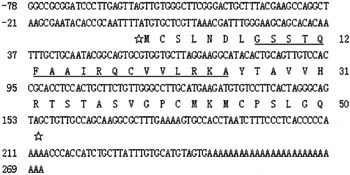
The positive clone, M-7-12, was named as cSZ-JN2 and the insert was sequenced and analysed (Fig. 2). The result of nucleic acid sequencing analysis showed that the cSZ-JN2 clone contained a sequence of 345 bp with an ORF of 153 bp, with a start and stop codon, including the 5′ UTR sequence and the 3′ UTR up to the poly-A tail. Analysis with Expasy and SignalP showed that the ORF encodes a protein of 50 amino acids with a molecular mass of 5·3 kDa. The theoretical pI of the protein was 9·25. No signal peptide was found in the deduced protein. According to the Motifscan database (http://www.myhits.isb-sib.ch/cgibin/motif_scan), a putative casein kinase II phosphorylation site located at position (3SLND6) and a WH2 domain profile (8GSSTQFAAIRQCVVLRKA25) were present in this putative protein. By comparison with the sequences on the GenBank database, the cSZ-JN2 clone had no significant homology with any of the genes deposited in the GenBank database.
Nucleotide sequence and deduced amino acid sequence of clone cSZ-JN2. DNA base numbers are on the left, and amino acid numbers are on the right. The asterisks in the 5′ and 3′ regions are the putative start and stop codons. The 18 underlined amino acids at the beginning of the N-terminus comprise the putative WH2 domain.

The nucleotide sequence and deduced amino acids reported in this paper are available in the GenBank databases under the Accession number: JN857360.
Expression and purification of recombinant cSZ-JN2 protein
The ORF of E. acervulina cSZ-JN2 gene was successfully amplified by PCR as already described. The recovered PCR product was purified and successfully cloned into pMD18-T cloning vector which was confirmed by sequencing. Target fragment sized as 153 bp was observed by enzyme digestion and the sequence analysis showed that the insert in the pET28a(+) vector was the ORF of cSZ-JN2. This indicated that the expression vector pET28a-cSZ-JN2 had been exactly constructed.
Recombinant plasmids, containing the cDNA fragment of cSZ-JN2, were expressed in vitro in Escherichia coli BL21 (DE3). Results indicated that 5 h after the beginning of IPTG induction, a high amount of recombinant protein cSZ-JN2 was obtained. The molecular weight of the recombinant cSZ-JN2 protein was estimated to be approximately 5·3 kDa by SDS–PAGE.
Immunoblot for the recombinant cSZ-JN2 and native protein of cSZ-JN2
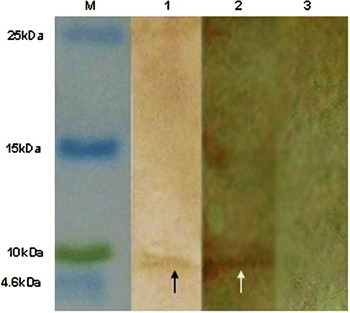
The results of the immunoblot assay (Fig. 3) indicated that the recombinant cSZ-JN2 protein was recognized with a band of about 10 kDa by immune sera of chickens infected with E. acervulina, but no protein of anti-rcSZ-JN2 in the negative control was identified by the serum of normal chickens. Because of the 3·8 kDa fused protein in the vector, the recombinant protein's molecular weight was almost the same as the calculated value of 5·3 kDa based on the deduced amino acid sequence. Western blot analysis also showed that rat anti-rcSZ-JN2 antiserum bound to a band at ∼10 kDa in the somatic extract of E. acervulina sporozoites. It indicated that the native protein of cSZ-JN2 was larger than the calculated value.
Immunoblot for the recombinant cSZ-JN2 and native protein of cSZ-JN2. Lane 1: Recombinant protein cSZ-JN2 probed by serum from chickens experimentally infected with Eimeria acervulina as primary antibody. Lane 2: Somatic extract of E. acervulina sporozoites probed by rat anti-rcSZ-JN2 antiserum as primary antibody. Lane 3: Recombinant protein cSZ-JN2 probed by serum of normal chickens as primary antibody.

Analysis of the expression of native cSZ-JN2 protein by immunofluorescence
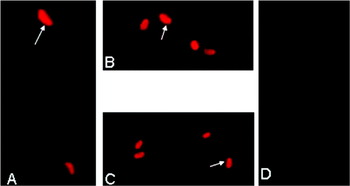
The expression of native cSZ-JN2 protein was detected in sporozoites and merozoites by immunofluorescence staining with rat anti-rcSZ-JN2 serum and fluorescence labelled goat anti-rat IgG (Fig. 4). The results showed that strong red fluorescence was observed in sporozoites and merozoites. In addition, no staining was seen in the negative control sections.
Expression of cSZ-JN2 protein in Eimeria acervulina sporozoites and merozoites by immunofluorescence assay (×100 magnification). (A) E. acervulina sporozoites. The white arrows indicate sporozoites. (B) E. acervulina merozoites (54 h p.i.). The white arrows indicate merozoites. (C) E. acervulina merozoites (89 h p.i.). The white arrows indicate merozoites. (D) Negative control.

Identification of DNA vaccines and expression of cSZ-JN2 gene in vivo
Recombinant plasmid pVAX1.0-cSZ-JN2 produced a fragment of approximately 153 bp of the cSZ-JN2 gene after digestion with EcoR I and Xho I. This indicated that the DNA vaccine pVAX1.0-cSZ-JN2 was correctly constructed.
The results of RT-PCR indicated that the target fragment of cSZ-JN2 (153 bp) was detected from muscle RNA samples injected with pVAX1.0-cSZ-JN2. No specific DNA bands were detected in non-injected control and pVAX1.0 plasmid control samples.
Western blotting of muscle injected with pVAX1.0-cSZ-JN2 revealed a prominent band with the size of 10 kDa, which indicated the expression of cSZ-JN2. In contrast, no corresponding band was detected in the muscle injected with PBS.
Protective effects of vaccination against Eimeria acervulina challenge
The immunization efficacies of the vaccines are described in Table 1. No chicken died from coccidial challenge in any group in this study. Body weight gains were significantly reduced in the challenged control and the pVAX1.0 control group compared with the unchallenged control group (P < 0·05). Chickens in experimental groups displayed significantly enhanced weight gains relative to chickens in the challenged control group and the pVAX1.0 control group (P < 0·05).
The oocyst counts of chickens immunized with vaccines were significantly lower than that of the challenged control group and the pVAX1.0 group (P < 0·05). Significant alleviations in duodenal lesions were observed in the immunized chickens compared with the challenged control group and the pVAX1.0 control group (P < 0·05). The group of chickens immunized with pVAX1.0-cSZ-JN2 resulted in an ACI of more than 165, higher than the recombinant cSZ-JN2 protein vaccinated groups.
IgG titres and concentration of cytokines in sera of immunized chickens
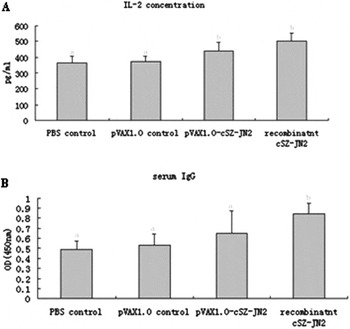
Sera collected 10 days following the second vaccination were assayed for the presence of specific antibodies and cytokine production induced by recombinant plasmid or recombinant protein. As depicted in Fig. 5, compared with PBS or pVAX1.0 vector control groups, significantly higher levels of IL-2 were observed in chickens immunized with recombinant cSZ-JN2 protein and recombinant plasmid pVAX1.0-cSZ-JN2. However, serum from the recombinant cSZ-JN2 protein group showed a highly significant level of IgG antibody response (P < 0·05) whereas IgG antibody was not significantly induced in the group immunized with the recombinant plasmid pVAX1.0-cSZ-JN2 compared with the control groups (P < 0·05).
Serum cSZ-JN2-specific IgG and cytokine levels in chickens. Chickens were immunized intramuscularly with PBS (negative control), pVAX1.0 plasmid (pVAX1.0 control), pVAX1.0-cSZ-JN2 or recombinant cSZ-JN2 protein. The IgG titres are expressed as mean ± S.D. with respect to absorbance at 450 nm. The concentrations of IL-2 (mean ± S.D.) in pg/ml. Bars with different lower-case letters are significantly different (P < 0·05). (A) IL-2 concentration; (B) IgG titre.

DISCUSSION
Several reports revealed that the ELI protocol was an effective method to discover novel antigens that could serve as vaccines from a variety of organisms, including bacteria, fungi and parasites (Barry et al. Reference Barry, Lai and Johnston1995; Almazán et al. Reference Almazán, Kocan, Bergman, Garcia-Garcia, Blouin and de la Fuente2003; Stemke et al. Reference Stemke-Hale, Kaltenboeck, DeGraves, Sykes, Huang, Bu and Johnston2005; Yero et al. Reference Yero, Pajón, Pérez, Fariñas, Cobas, Diaz, Solis, Acosta, Brookes, Taylor and Gorringe2007; Tekiel et al. Reference Tekiel, Alba-Soto, González Cappa, Postan and Sánchez2009). In this research, a new gene of Eimeria acervulina, named cSZ-JN2, was obtained by ELI. The results of sequence analysis from the BLASTN search revealed that the clone had no significant homology with the known genes of E. acervulina deposited in the GenBank database. Animal challenge experiments revealed that the DNA vaccine carrying the cSZ-JN2 gene or recombinant cSZ-JN2 protein was able to induce partial protection against homologous challenge in chickens and predicted that cSZ-JN2 could be a potential vaccine candidate again coccidiosis.
In the screening of the expression library, chickens immunized with cSZ-JN2 (M-7-12) showed high levels of IL-2. In the protective experiment, significantly higher levels of IL-2 were also observed in chickens immunized with recombinant cSZ-JN2 protein and recombinant plasmid pVAX1.0-cSZ-JN2 compared with the control groups (P < 0·05). Generally, IL-2 plays important roles in the development of Th1 (Zhou et al. Reference Zhou, Zhang and Aune2003) and T regulatory (Treg) cells (Malek et al. Reference Malek, Yu, Zhu, Matsutani, Adeegbe and Bayer2008). In the protective immune response to coccidian infection, the cell-mediated response played a major role (Cornelissen et al. Reference Cornelissen, Swinkels, Boersma and Rebel2009) and humoral immunity also functioned in some roles (Wallach, Reference Wallach2010). In the present protective experiment, recombinant cSZ-JN2 and plasmid pVAX1.0-cSZ-JN2 could significantly increase the average body weight gains, decrease the mean lesion scores and the oocyst output of the immunized chickens and presented anti-coccidial indices more than 165. However, the antibody levels of the immunized chickens were not altered. The results suggested that cSZ-JN2 might function predominantly through activating cell-mediated responses.
In the screening of the expression library, the antibody levels of animals immunized with cSZ-JN2 were not increased. In the protective experiment, the chickens immunized with DNA vaccine carrying the cSZ-JN2 gene also demonstrated no significant difference of IgG antibody level compared to that of control groups. On the contrary, the animals immunized with the recombinant protein of cSZ-JN2 produced a high antibody level in the protective experiment. Western blotting assay also showed that recombinant cSZ-JN2 could be detected by the sera of the chicks experimentally infected with E. acervulina, indicating that cSZ-JN2 could be recognized by the animal immune system and stimulate an antibody response in the natural infection. One possible explanation for the contradiction was that, in the screening and the DNA vaccination, the antigen was expressed and presented to the target immune cells by a different pathway and resulted in a different immune response. Another possibility of the contradiction was that DNA vaccination often favoured CD8+ T cell activation and poor antibody responses. But the observations (Song et al. Reference Song, Yan, Xu, Song, Shah, Zhu and Li2010a) on DNA vaccine carrying the E. acervulina lactate dehydrogenase antigen gene indicated that the CD8 + /CD3+ T cell was not significantly altered. However, the exact causes of the contradiction need to be further probed.
Anti-rcSZ-JN2 antisera from rats could detect a band of about 10 kDa in the somatic extract of E. acervulina sporozoites. Western blotting of the muscle of chickens injected with pVAX1.0-cSZ-JN2 also revealed a prominent band of 10 kDa. These results suggested that the native cSZ-JN2 was about 10 kDa, slightly larger than the deduced size. It is possible that post-translational modifications were present in the native cSZ-JN2.
In the present research, cSZ-JN2 was devoid of a typical signal peptide cleavage site at its N-terminal end, indicating that cSZ-JN2 is an intracellular protein or structural protein. However, the rcSZ-JN2 was recognized by the serum of chicken infected with E.acervulina. This indicated that native cSZ-JN2 might be exposed to host tissues and the host immune system during parasite invasion and stimulated the host immune response. However, the mechanisms of its entrance should be further investigated.
By use of the immunofluorescence method, we demonstrated that cSZ-JN2 could be expressed in sporozoite and merozoite stages of the life cycle of E. acervulina. This suggested that the protein was conserved in the life cycle of this parasite and might play some role in the processes of host-cell penetration and invasion and in the host-parasite interactions in the infection. But the expression of this antigen in other stages of the life cycle and its localization in the organelle(s) as well as detailed function are worthy of further research.
In conclusion, cSZ-JN2 was successfully identified from E. acervulina sporozoites by the method of cDNA expression library immunization in this study. It had no significant homology with the known genes of E. acervulina deposited in the GenBank database. Recombinant cSZ-JN2 protein and the DNA vaccine of cSZ-JN2 were able to induce partial protection against homologous challenge in chickens. This suggested that cSZ-JN2 is a novel antigen of E. acervulina and could be an effective antigen candidate for the development of a new vaccine against E. acervulina.
ACKNOWLEDGEMENTS
This work was supported by the Science and Technology Pillar Program (Agriculture) of Jiangsu Province, China (No. BE2009389), Natural Science Foundation of Jiangsu Province of China (No. BK2010446) and a Project Funded by the Priority Academic Program Development of Jiangsu Higher Education Institutions (PAPD).