

1. Introduction
I was honoured to give the 2021 Dow Lecture, where I presented a research paper (Bullard and DiCecio, Reference Bullard and DiCecio2021b). In the paper, we construct a heterogeneous-agents economy featuring aggregate shocks (to total factor productivity, labour supply and aggregate demand), as well as both temporary and permanent idiosyncratic risks at the household level. The model has a simple symmetric structure that allows a paper-and-pencil solution, but it is rich enough to generate Gini coefficients for the distributions of consumption, income and wealth close to their empirical counterparts.
Four policymaking authorities (implementing monetary, fiscal, labour market and education policies) act in concert to attain a first-best allocation of resources by following classic policy prescriptions:
-
1. The monetary authority reacts to shocks each period in order to achieve the Wicksellian natural real rate of interest for the economy.
-
2. The fiscal authority raises revenue via a non-state-contingent linear labour income tax on all households.
-
3. The labour market authority runs an unemployment insurance programme.
-
4. The education authority minimises the variance of beginning-of-life human capital endowments.
The main result—that classic policy prescriptions can achieve the first-best allocation in this heterogeneous-agents economy—may serve as a guide to understand more complicated economies. Bullard and DiCecio (Reference Bullard and DiCecio2021a,Reference Bullard and DiCeciob) provide surveys of the related literature.
2. The model
2.1. Households
In the paper, we construct a quarterly overlapping generations model, where agents live for 60 years (240 quarters). When entering the model, each household is randomly and permanently assigned a personal productivity profile, which is a scaled version of a baseline productivity profile. The scaling factor is drawn from a lognormal distribution. The baseline profile is symmetric: It begins low, rises and peaks in the middle of life and then declines back to the low level.
The assignment of productivity profiles is a stand-in for the human capital development that takes place before age 20 in actual economies (e.g., by schooling). This assumption—that all of the uncertainties in individual productivity are resolved when agents enter the model—is supported by Huggett et al. (Reference Huggett, Ventura and Yaron2011), who find that differences in initial conditions (human capital at age 23) are more important than subsequent shocks in explaining lifetime income.
Households have log–log preferences over consumption and leisure. The utility derived from consuming is affected by a demand shock.
Households can earn income in a competitive labour market by supplying effective units of labour. Each agent reports to work at the beginning of each period. In some periods, the job opportunity is closed and the agent can earn no income via market-based employment. These idiosyncratic shocks are independent and identically distributed, and are uncorrelated with the aggregate shocks. This process leads to a constant aggregate unemployment rate.
All households meet in a competitive market for one-period nominal loans. Households contract by fixing the nominal interest rate on consumption loans—equal to the expected rate of nominal GDP growth—one period in advance. There are two aspects to this assumption:
-
1. The non-state-contingent aspect means that real resources are misallocated via this friction.
-
2. The nominal aspect means that the monetary authority may be able to fix the distortion to the equilibrium through appropriate monetary policy.
There are no borrowing constraints, and there is no default.
2.2. Production technology
Output is produced using a linear technology: Aggregate labour hours are multiplied by an index of the size of the labour force, the state of aggregate demand and the level of total factor productivity. These three multiplying factors follow stochastic processes. Including the same aggregate demand shock that affects households’ preferences in the production function can be justified by a ‘restaurant’ model: While labour (and capital) are set for the evening, labour has to be utilised more intensively if a lot of patrons arrive at the restaurant.Footnote 1
2.3. Four policymakers
There are four policymaking entities. The monetary authority can observe the aggregate shocks at the beginning of each period and then set the price level following a nominal GDP targeting rule.Footnote 2 The fiscal authority sets a linear tax on all labour income earned to raise an exogenously specified fraction of available real output. The labour market authority observes household-specific unemployment shocks and sets a linear tax on all labour income earned that is sufficient to provide appropriate transfers to unemployed households. The education authority can control the initial dispersion of life-cycle productivity profiles by controlling the standard deviation of the scaling factor up to some limit. These policies are broadly similar to actual policies in place in many OECD countries.
3. Equilibrium
Under this policy mix, the real interest rate is equal to the stochastic aggregate output growth rate at every date, and an equal-treatment social planner that discounts at this rate will conclude that this is a social optimum.
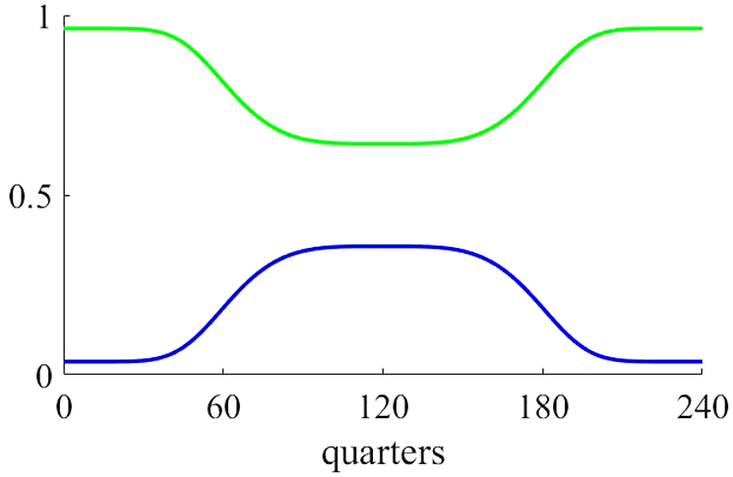
Labour supply over the life cycle depends on the shape of the productivity profile alone (figure 1). High-income households plan to work the same hours as low-income households at each age, and this decision is not affected by taxes on labour income. A certain percentage of the continuum of households in each cohort is unemployed but insured.
Cross section: Leisure decisions (green) and labour supply decisions (blue) depend on age only

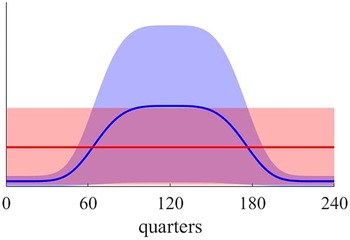
Any two households that share the same productivity profile consume the same amount at each date, and consumption growth is equalised for all households (figure 2). Under optimal monetary policy, the private credit market reallocates uneven labour income into perfectly equal consumption along each productivity profile. When households are young, they are least productive and they do not work as hard (see figure 1). Thus, their labour income is relatively low, and lower than their desired consumption level. The gap is filled in by borrowing, that is, negative financial assets. As households reach the middle of their life cycle and the peak of their productivity, they start repaying their debt and eventually they become net creditors. Without a bequest motive, older households finance consumption in excess of their labour income by decumulating financial wealth.
Cross section: Schematic consumption mass (red) and labour income mass (blue)
Note: For illustrative purposes, the productivity scaling factor is drawn from a uniform distribution.

Education policy can influence what happens to agents before they enter the model and begin making economic decisions by reducing the dispersion of productivity profiles. The solid lines in figure 2 depict the limiting case when the education authority can reduce all the way to zero the dispersion of life-cycle productivity profiles. This would be a perfectly equal economy in that the talent distribution would collapse to just one life-cycle pattern (solid blue line in figure 2) and all households would consume the same amount (solid red line).
Although monetary policy is expressed in terms of a price-level targeting rule, it can be easily interpreted in terms of a more familiar nominal interest rate policy. The monetary authority wants to set the short-term nominal rate to follow the natural rate of growth in the economy as part of the optimal policy. A recession—caused by a negative realisation of any of the aggregate shocks—is associated with lower nominal and real interest rates as part of the optimal policy. The policy also always ratifies the nominal interest rate contract, so that nominal interest rates do not react in the period of the shock but only one period later. In the period of the shock, inflation moves higher as part of the counter-cyclical price-level movement associated with the optimal policy.
The marginal propensity to consume (MPC) depends on age alone, given that both labour income and consumption are linear in the after-tax real wage. The MPC is high for young and old households and low (below 1) for households around the middle of the life cycle. This is reminiscent of the poor and rich hand-to-mouth agents in the literature (Kaplan et al., Reference Kaplan, Violante and Weidner2014).
The model, when calibrated to the U.S. economy, implies Gini coefficients for consumption, income and financial wealth that are close to their empirical counterparts (table 1). The Gini coefficients for the calibrated model are increasing in the dispersion of individual productivity profiles. Perfect consumption equality, that is, a consumption Gini coefficient equal to zero, is achieved if the education authority can reduce to zero the dispersion of personal productivity profiles. However, even with perfect consumption equality, a substantial amount of inequality in income and wealth would remain because of life-cycle effects alone.
Gini coefficients for U.S. data and the calibrated model with a lognormal life-cycle productivity scaling

Note: For the consumption Gini coefficient, we use Heathcote et al. (Reference Heathcote, Perri and Violante2010); for income, we use an estimate from the Congressional Budget Office (2016), for pre-taxes/transfers income and for financial wealth, we use the value in Davies et al. (Reference Davies, Sandström, Shorrocks and Wolff2011).
4. Conclusions
A classic combination of policies can deliver a first-best allocation of resources in this environment even with substantial inequality in income, wealth and consumption.
A monetary policymaker provides period-by-period insurance against aggregate shocks by conducting policy to achieve the Wicksellian natural real rate of interest—the same as in a baseline New Keynesian model. This enables non-distortionary linear labour income taxes to fund government expenditures and an unemployment insurance programme. Education policy can drive the consumption Gini coefficient towards zero, but would leave the income and wealth Gini coefficients at strictly positive levels. These classic benchmarks may be useful in understanding the effects of macroeconomic policy for models in this class going forward.
Two features of the framework I propose are particularly appealing for studying inequality in macroeconomics:
-
1. Overlapping generations models have a long tradition in macroeconomics (Allais, Reference Allais1947; Diamond, Reference Diamond1965; Samuelson, Reference Samuelson1958). The uneven nature of productivity over the life cycle—even under optimal policies that generate perfect consumption equality—induces a significant amount of inequality in income and wealth.
-
2. Non-state-contingent nominal contracting gives rise to the crucial role of monetary policy in assuring the optimal functioning of a large private credit market. The abstract asset in the model can be thought of as representing mortgage-backed securities. The consumption that relatively young households wish to pull forward in the life cycle can be thought of as housing services.
Acknowledgement
Any views expressed are those of the author and do not necessarily reflect the views of others on the Federal Open Market Committee.