Languages use different mechanisms to mark the informational status of elements in the sentence (Gussenhoven, Reference Gussenhoven2008; Vallduví & Engdahl, Reference Vallduví and Engdahl1996). English exploits prosody while Spanish uses different word orders and syntactic strategies (Vallduví & Engdahl, Reference Vallduví and Engdahl1996; Zubizarreta, Reference Zubizarreta1998). The L2 acquisition of such mechanisms is thus crucial to the attainment of nativelike proficiency, as it allows learners to produce felicitous utterances and convey the desired meanings. Previous studies in the field of second language acquisition (SLA), such as Hertel (Reference Hertel2003), Lozano (Reference Lozano2006), and Domínguez (Reference Domínguez2008), have shown that advanced learners observe the constraints placed on word order by information structure in Spanish. The purpose of the present study is to extend the understanding of the acquisition process of said constraints by proposing a representational account following the premises of the Multiple Grammars (MG) model (Amaral & Roeper, 2014), in lieu of just interpreting the phenomenon from a processing perspective in light of the Interface Hypothesis (IH) (Sorace & Filiaci, Reference Sorace and Filiaci2006), as previous studies have done (Lozano, Reference Lozano2006). This will be accomplished using an innovative experimental design that explores the acceptability of each word order separately, including discursive contexts not yet considered (i.e., Verbal Phase [VP] focus). The adequacy of the MG model will become evident after showing how learners have multiple rules available to them, some that come from the L1, and others, not necessarily targetlike, that have been added to their interlanguage, which cause optionality and nonnativelike behavior in ways that could not be predicted considering only their L1 grammar.
LITERATURE REVIEW
INFORMATION STRUCTURE AND ITS SYNTACTIC REPRESENTATION
The interplay between old and new information in discourse is what constitutes the information structure (Halliday & Hasan, Reference Halliday and Hasan1967). The terminology used to refer to the different informational statuses varies considerably in the literature: Information that is already part of the common ground, that is, mutually shared by all the participants in the conversation, is referred to as old, known, given, topic, or background information (Gussenhoven, Reference Gussenhoven2008; Halliday & Hasan, Reference Halliday and Hasan1967; Krifka, Reference Krifka2008; Prince, Reference Prince and Cole1981); information that is unknown to the hearer is described as new, or the focus (Gussenhoven, Reference Gussenhoven1983, Reference Gussenhoven2008; Halliday & Hasan, Reference Halliday and Hasan1967). Based on the extension of the focused constituent, statements can display broad or narrow focus. In broad focus statements, more than one constituent is focalized, as in the answer to the question What happened? (1a). Conversely, in narrow focus statements one constituent (or even a smaller unit) introduces new information (Ladd, Reference Ladd1980). Additionally, narrow focus can be contrastive (1b) or noncontrastive (1c). With contrastive focus, the speaker’s intention is to direct the hearer’s attention and to make her change her background assumptions based on the new information (Zimmermann, Reference Zimmermann2008). However, noncontrastive narrow focus, also referred to as informational focus (Gussenhoven, Reference Gussenhoven2008), is used in response to wh-questions, which may be either overt, that is, explicitly expressed in discourse, or covert, if implicit (Krifka, Reference Krifka2008).
- (1)
a. What happened?
F[Martin found a wallet in the park]
b. Austin found a wallet in the park.
No, F[Martin] Background[found a wallet in the park]
c. Who found a wallet in the park?
F[Martin] Background[found a wallet in the park]
Languages use different mechanisms to mark the status of the information conveyed in a sentence. In short, three strategies can be considered: the use of prosody, the use of syntax, and the use of morphological markings (Gussenhoven, Reference Gussenhoven2008; Vallduví & Engdahl, Reference Vallduví and Engdahl1996). Across languages, however, the focused constituent receives nuclear stress or main prosodic prominence (Jackendoff, Reference Jackendoff1972); said prominence (represented here in bold) is the acoustic result of a combination of prosodic features, namely intensity, duration, and pitch (Cruttenden, Reference Cruttenden1986). By default, and following the Nuclear Stress Rule (Chomsky, Reference Chomsky, Steinberg and Jakobovits1971; Cinque, Reference Cinque1993), nuclear stress is assigned to the most embedded constituent in languages such as English and Spanish (Zubizarreta, Reference Zubizarreta1998). Languages differ, nonetheless, in the mechanisms used to relate nuclear stress and focus. Accordingly, Vallduví and Engdahl (1996) classified languages in two groups: plastic and nonplastic languages. Plastic languages maintain the unmarked word order and shift nuclear stress to the focused constituent (i.e., English and Dutch)—such a mechanism is called stress shift (Reinhart, Reference Reinhart, Wilder, Gaertner and Bierwisch1996, Reference Reinhart2006). As a result, the same word order can have different interpretations, as shown in examples (2a)–(2d).
- (2)
a. F[Martin found a wallet in the park] (Broad focus)
b. Martin found a F[a wallet] in the park. (Object focus)
c. F[Martin] found a wallet in the park (Subject focus)
d. Martin F[found a wallet in the park] (VP focus)
Romance languages, by contrast, are nonplastic, due to their invariable prosodic structure and use of syntactic movement to guarantee that only the focused constituent receives main prominence (Vallduví & Engdahl, Reference Vallduví and Engdahl1996). In Spanish, nuclear stress is assigned to the most embedded constituent, as shown in (3a) and (3b). However, whenever the focused constituent does not receive prosodic prominence by default, Zubizarreta (Reference Zubizarreta1998) argues that Spanish cannot resort to strategies such as stress shift, exemplified in (3c) and (3d). For these situations, Zubizarreta proposes that p-movement (prosodically motivated movement) takes place: Nonfocused constituents move to a higher position, immediately above the focused constituent. As a result, the focused constituent is left in a final position where it receives main prominence, as shown in (3e) and (3f). From her perspective, an utterance like the one in (3g), where prominence has shifted, could only be possible in contrastive focus contexts.
- (3)
a. F[Martín encontró una cartera en el parque] (Broad focus)
b. Martín F[encontró una cartera en el parque] (VP focus)
c. *Martín encontró F[una cartera] en el parque (Object focus)
d. *F[Martín] encontró una cartera en el parque (Subject focus)
e. Martín encontró en el parque F[una cartera] (Object focus)
f. Encontró una cartera en el parque F[Martín] (Subject focus)
g. F[Martín] encontró una cartera en el parque
For the present study, it is important to consider that the syntactic representation of postverbal subjects with unaccusative verbs is different from that of transitives and unergatives. Following the Unaccusative Hypothesis (Burzio, Reference Burzio1986), unaccusative verbs do not have an external argument; instead, their subject is generated as their internal argument and can be licensed in that position in languages such as Spanish and Italian (Belletti, Reference Belletti, Hulk and Pollock2001). Consequently, having a postverbal subject with an unaccusative verb as in (4a) is perfectly grammatical in Spanish (Demonte, Reference Demonte1994; Ocampo, Reference Ocampo, Downing and Noonan1995) but not in English (see (4b)). In English, the canonical word order for an utterance with an unaccusative verb is SV (4c), with main prominence on the subject (Zubizarreta & Nava, Reference Zubizarreta and Nava2011).
- (4)
a. Llegaron turistas
Arrived tourists
Tourists arrived
b. *Arrived tourists
c. Tourists arrived
It is important to note that postverbal subjects are also possible in English in contexts of presentational “there,” as in (5a), and stylistic subject inversion, as in (5b), as long as the subject or the entire statement introduce new information (Birner, Reference Birner1994). Coopmans (Reference Coopmans1989) argues that this type of inversion, which he refers to as an instance of semiprodrop, can be explained following a similar approach to that of Italian or Spanish: The subject never moves and is licensed in the starting position through the insertion of expletive there.
- (5)
a. There arrived tourists
b. Into the museum walked several tourists
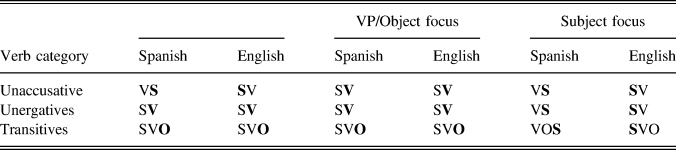
Table 1 presents a summary of the differences between Spanish and English regarding the preferred word orders considering the discursive context (i.e., broad focus, VP focus, and subject focus) and the verb category (i.e., unaccusative, unergative, and transitive verbs). The main differences are due to the different syntactic and pragmatic constraints, as explained in the preceding text.
Preferred word orders

While this study focuses solely on subject position in different focus conditions, there are other strategies available in Spanish to mark the informational status of linguistic material. These include fronting (6a), clefting (6b), or clitic left dislocation (6c), among others. Nonetheless, dialectal variation is found as well regarding the preferred strategies; in this regard, the use of postverbal subjects resulting from p-movement has been shown to be infrequent in varieties such as Buenos Aires Spanish (Gabriel, Reference Gabriel, Hoffmann and Mixdorff2006, Reference Gabriel2010), Mexican Spanish (Hoot, Reference Hoot2012), Andean Spanish (Muntendam, Reference Muntendam2009), and certain varieties of Peninsular Spanish (Vanrell & Fernández-Soriano, Reference Vanrell and Fernández-Soriano2013).
- (6)
a. F[Martín], encontró la cartera.
b. Fue F[Martín] quien encontró la cartera.
c. La cartera la encontró F[Martín].
THE L2 ACQUISITION OF SUBJECT POSITION CONSTRAINTS
Various studies have explored how the syntactic and discursive constraints on subject position presented in the preceding text are manifested in the L2 Spanish of English speakers. All of them make use of a similar methodology consisting of the use of contextualized question-answer pairs as the one presented in (7):
(7) You and your friend Sergio are at a party. Sergio leaves to use the bathroom. While he is in the bathroom, Sara, the life of every party, arrives. When Sergio returns he notices that everyone seems much more festive.
Sergio asks you: ¿Qué pasó?
What do you answer?
Findings from production tasks (Domínguez, Reference Domínguez2008; Hertel, Reference Hertel2003) and acceptability judgment tests using 5-point Likert scales (Domínguez, Reference Domínguez2008; Domínguez & Arche, Reference Domínguez, Arche, Chan, Jacob and Kapia2008, Reference Domínguez and Arche2014; Lozano, Reference Lozano2006) offer conflicting results. Hertel (Reference Hertel2003) considered learners at four proficiency levels and found that only advanced learners were sensitive to differences in word order based on lexical verb class because they produced postverbal subjects with unaccusative verbs in broad focus contexts. With respect to the use of postverbal subjects in subject focus contexts, she found that both high-intermediate and advanced learners performed in a nativelike manner. Lozano (Reference Lozano2006) only considered advanced learners and found nativelike responses in broad focus contexts and optionality in subject focus conditions. These results were consistent with Lozano’s original predictions, based on the IH (Sorace & Filiaci, Reference Sorace and Filiaci2006). According to the IH, phenomena at the syntax-discourse interface (e.g., subject position as a function of focus conditions) are subject to optionality in L2 acquisition due to divergent representation, while properties at the narrow syntax (word order constraints with unaccusative verbs in broad focus contexts) are completely acquirable.
Lozano’s findings were not supported by later studies such as Domínguez (Reference Domínguez2008) and Domínguez and Arche (Reference Domínguez, Arche, Chan, Jacob and Kapia2008, Reference Domínguez and Arche2014), which included transitive verbs and learners at three proficiency levels using production tasks (Domínguez, Reference Domínguez2008) and acceptability judgment tasks (Domínguez, Reference Domínguez2008; Domínguez & Arche, Reference Domínguez, Arche, Chan, Jacob and Kapia2008, Reference Domínguez and Arche2014). All three groups of learners produced utterances with preverbal subjects across conditions. In the acceptability judgment tasks, learners favored preverbal subjects regardless of verb class and even when the subject was focused; this tendency was much stronger for beginner and intermediate learners while advanced learners seemed to be starting to accept postverbal subjects. This led Domínguez and Arche (Reference Domínguez, Arche, Chan, Jacob and Kapia2008) to conclude that syntactic constraints are not necessarily acquired early on. Furthermore, Domínguez and Arche (Reference Domínguez and Arche2014) argue that this is because learners are exposed to conflicting input, which in turn could explain the lack of acceptance of postverbal subjects in their study. This becomes evident when considering the responses provided by native speakers and is in line with results from intonational studies (Gabriel, Reference Gabriel, Hoffmann and Mixdorff2006, Reference Gabriel2010; Hoot, Reference Hoot2012; Muntendam, Reference Muntendam2009; Vanrell & Fernández-Soriano, Reference Vanrell and Fernández-Soriano2013), which have shown that speakers of different dialects of Spanish allow for the realization of focus in situ.
RESEARCH PROBLEM
Previous studies exploring the phenomenon at hand interpreted their results in light of the IH, contrasting the differences in the acquisition of properties at the narrow syntax and at the syntax-discourse interface. The IH, nonetheless, does not account for the representation of these properties in the learners’ grammars. In this study, the MG model proposed by Amaral and Roeper (Reference Amaral and Roeper2014) is followed to explain how these features and the optionality affecting them is represented in the interlanguage. The MG model is an extension of Roeper’s (Reference Roeper1999) Universal Bilingualism, which was originally proposed to explain optionality in adult monolingual grammars (e.g., instances in which English appears to be a prodrop language in expressions such as looks good or seems nice). In its extension to SLA, MG assumes the Full Access/Full Transfer hypothesis (Schwartz & Sprouse, Reference Schwartz and Sprouse1996) and a model of representation by which speakers can access different “parallel rule-sets” and assign different rates of productivity to the rules available to the them.Footnote 1 In this regard, rules can be productiveFootnote 2 (e.g., overt pronouns in English) or lexically triggered (e.g., instances of null subjects). Following the Minimalist Program (Chomsky, Reference Chomsky1995), Amaral and Roeper argue that rules must be simple, without subcategories or complex exceptions. By having these simple rules, establishing comparisons between the L1 and the L2 and predictions for L2 development becomes easier. Furthermore, these rules are not restructured or reanalyzed; instead, speakers create “multiple sub-grammars to accommodate the apparent contradictions in the input” (Amaral & Roeper, 2014, p. 13) and link them to a specific language. According to their model, learners first add new rules to their grammar and then continuously reassess their productivity based on the input they receive; by this process, a productive rule might be blocked but never deleted. By the same process, a rule may be assigned more productivity than deserved, leading to an overgeneralization of a rule (e.g., overgeneralizing the lexically restricted rule that yields expressions like seems nice or looks good in English to allow for expressions like speaks fast, where the deleted pronoun would not be an expletive, as required by the rule). Assuming this model of representation by which multiple subgrammars coexist in a unique repository allows for a better understanding of phenomena like transfer (from the L1 into the L2 and vice versa), attrition, codeswitching, and, most importantly, optionality. Thus, L1 rules coexist with newly added rules and are always available to learners, who may use them for as long as they remain productive.
Amaral and Roeper (Reference Amaral and Roeper2014) provide several examples to support their model of representation. According to them, there are two ways to provide evidence for the existence of multiple coexisting subgrammars: The first one is to show that a lexically triggered rule is productive when it would not be expected; the second is to show how conflicting rules apply differently in production and comprehension tasks. In this regard, Amaral and Roeper show that Spanish learners who obeyed the Overt Pronoun Constraint (OPC) in production (by producing null subject pronouns when the referent was coindexed with a preceding quantified noun phrase) were unable to reject readings that would be blocked by the OPC.
For the phenomenon under study, the following rules may be assumed for the creation of sentences (S) in English (8) and Spanish (9). In English, the most productive rule (8a) would predict the canonical word order (i.e., SV with intransitive verbs and SVO for transitive verbs). However, a lexically restricted and pragmatically constrained rule (8b) accounts for those instances of postverbal subjects with unaccusative verbs where there insertion takes place, limited to contexts of broad or narrow subject focus. The most productive rule in Spanish (9a) is equivalent to that of English. Furthermore, postverbal subjects are also licensed in broad focus contexts with unaccusative verbs by means of rule (9b). Finally, an additional rule (9c) can be proposed for Spanish to account for postverbal subjects in contexts of subject focus.
(8) English
a. S → S Vintr (e.g. Mary came/yelled) / S → S Vtran O (e.g. Mary read a book)
b. S → there F[Vunacc S] / there Vunacc F[S] (e.g. There came Mary)
(9) Spanish
a. S → S Vintr (e.g. María llegó/gritó) / S → S Vtran O (e.g. María leyó un libro)
b. S → F[Vunacc S] (e.g. Llegó María)
c. S → Vintr F[S] (e.g. Llegó/gritó María) / S → Vtran O F[S] (e.g. Leyó un libro María)
Assuming these rules, I propose the following acquisition path: As a result of full transfer from the L1 and access to Universal Grammar, English native speakers learning Spanish will prefer preverbal subjects; however, they will also have a rule that allows them to have postverbal subjects, although limited to unaccusative verbs in broad focus and subject focus contexts, which will play a role in the acquisition process. Taking into consideration that preverbal and postverbal subjects are commonly present in the input in contexts other than the English one (Domínguez & Arche, Reference Domínguez, Arche, Chan, Jacob and Kapia2008, Reference Domínguez and Arche2014), learners may create a rule to accept postverbal subjects in all the other possible contexts, with no restrictions (S → Vintr S and S → Vtran O S). With increased exposure, they will add different rules that constrain the adequacy of postverbal subjects and adjust the productivity of all the available rules to better approximate the native norm.
The acceptability judgment tests used in previous studies presented participants with two options: a preverbal subject and a postverbal subject. This study aims to explore how Spanish learners judge the use of preverbal or postverbal subjects by presenting only one of those structures in context. Thus, this study will determine whether English natives learning Spanish have added rules to their grammars to account for all the different word orders available in Spanish and their pragmatic constraints by exploring their acceptability in three different discursive contexts: broad focus, subject focus, and VP focus. The role of proficiency will also be explored to determine whether increased exposure to the input (both through instruction and experience abroad) results in more nativelike judgments, which would ultimately indicate that the productivity levels of the rules available in learners’ grammars are closer to those of native speakers.
RESEARCH QUESTIONS AND HYPOTHESES
Research Question 1
Do L2 learners of a Spanish pattern like native Spanish speakers in their judgments of sentences containing preverbal and postverbal subjects in contexts of broad focus, subject focus, and VP focus? Is there any difference based on verb category (i.e., unaccusatives, unergatives, and transitives)?
Hypothesis 1
Given the rules presented in the preceding text, native speakers of Spanish will prefer postverbal subjects in two contexts: (a) with unaccusative verbs in broad focus contexts and (b) in subject focus contexts. Learners, however, will accept preverbal and postverbal subjects to a similar extent across contexts, which will suggest that they have added to their grammar a rule that allows them to use/accept postverbal subjects with no restrictions to accommodate for the input received (postverbal subjects are possible in Spanish). As a result, learners will accept postverbal subjects in discursive contexts where native speakers reject them: (a) in broad focus contexts with unergative and transitive verbs and (b) in VP focus contexts. Nonetheless, verb category will play a role: Learners will favor postverbal subjects with unaccusative verbs in broad and subject narrow focus contexts, as a result of having a rule in their L1 grammar that allows for this structure.
Research Question 2
Does proficiency in the L2 affect learners’ ability to judge these sentences in a nativelike manner?
Hypothesis 2
Yes. The acceptability ratings assigned by advanced learners of Spanish will be closer to those of native speakers than those of intermediate learners, as the former have had more exposure to Spanish and therefore have had more chances to add new rules (more specific ones) to their grammar to better account for the variation present in the input.
METHOD
PARTICIPANTS
The experimental task was administered to three groups of 28 participants: native speakers of Peninsular Spanish (NS), intermediate learners of Spanish (IL), and advanced learners of Spanish (AL). IL were L2 Spanish speakers with little experience abroad and still enrolled in undergraduate-level classes (intermediate courses like Advanced Grammar or Spanish Phonetics, for which the only prerequisite is to have taken at least four semesters of Spanish courses). AL were L2 speakers of Spanish with a bachelor’s degree in Spanish and more experience abroad. Descriptive statistics are presented in Table 2.
Participants’ information

MATERIALS AND DESIGN
An acceptability judgment task with a factorial design was created to assess the relevance of the different independent variables (i.e., subject position, verb category, focus condition, and group). Instead of reading the stimuli, participants had to listen to different sets of question-answer pairs that varied in terms of the word order used in the response (preverbal or postverbal subjects), the verb category (unaccusative, unergative, or transitive), and the focus condition (broad focus, VP focus, and subject focus). The example in (10) shows the different question-answer pairs for an utterance with an unaccusative verb and a postverbal subject, including a filler question.
(10) Utterance: Salió Camilo
Left Camilo
“Camilo left”
a. Subject focus context: -¿Quién salió? (“Who left?”)
- Salió Camilo
b. VP focus context: -¿Qué hizo Camilo? (“What did Camilo do?”)
- Salió Camilo
c. Broad focus context: -¿Qué pasó? (“What happened?”)
- Salió Camilo
d. Filler context: -¿Qué perdió Camilo? (“What did Camilo lose?”)
- Salió Camilo
The stimuli, that is, the questions and the answers, were video recorded. The individuals recorded were all native speakers of Northern-Peninsular Spanish. The author produced the answers to be able to better control for the intonation contours used. The contours chosen were the unmarked ones for each word order; examples of them can be found in Appendix B.
After hearing each pair, participants had to judge the naturalness of the answer given that specific question using a 5-point Likert scale ranging from -2 (very strange) to 2 (very natural). As in Lozano (Reference Lozano2006), this scale was used because it favors the elicitation of offline intuitive responses about the acceptability of each question-answer pair in a way that can be operationalized for further analysis (Schütze & Sprouse, Reference Schütze, Sprouse, Podesva and Sharma2013). This design provides a different perspective on how the L2 grammar guides the acceptability of utterances based on subject position and information structure because participants are not being asked to rate the acceptability of different word orders in the same informational context, as was the case in Lozano (Reference Lozano2006) or Domínguez and Arche (Reference Domínguez, Arche, Chan, Jacob and Kapia2008, Reference Domínguez and Arche2014). Instead, participants are required to rate the same word order in four different contexts. Additionally, by presenting the stimuli orally, the imposition of an implicit prosody is avoided. Thus, this new design provides a different perspective on how the L2 grammar guides the acceptability of utterances considering subject position and information structure.
Six different verbs per category were used in the experimental task. All the chosen verbs were used in previous studies due to their high frequency and their early presentation during formal instruction. To obtain data for each verb in the two possible word orders, that is with a preverbal subject (SV for intransitive verbs and SVO for transitive verbs) and with a postverbal subject (VS for intransitive verbs and VOS for transitive verbs), two counterbalanced presentation lists were created, resulting in two versions of the experimental task. Each version consisted of a total of 18 sets, ordered in such a way that participants would not encounter two instances of the same verb category or the same word order successively. The order in which the different questions were presented in each set of question-answer pairs was randomized to avoid a mechanization of the task. A complete list of items can be found in Appendix A.
PROCEDURE
The experiment was presented using an online web-survey platform, and all participants were instructed to use a headset. The assignment of one of the two versions to each participant was arbitrary. The videos for each question-answer pair in a set were presented on the same page, and each one of them was followed by the scale, that is, on each page, participants saw four videos and four scales. Once they had assigned a rating to each pair in the set, they could move on to the next set, on the next page.
Participants were first asked to complete a linguistic background questionnaire, which included questions regarding their previous instruction in Spanish and experience with the language in terms of exposure, either in their home country or in study-abroad programs, as well as their knowledge of other languages. Participants with native/advanced knowledge of other languages were excluded.
After completing the questionnaire, participants were asked to carefully read the instructions, which included two training items with a similar structure to that of the experimental items but with cleft sentences (e.g., Fue Martín quien pasó el examen “It was Martin who passed the exam”), another strategy used for the introduction of new information (Moreno Cabrera, Reference Moreno Cabrera, Bosque and Demonte1999). The questions accompanying the cleft sentence asked about the subject or the object, and one of them was supposed to be infelicitous. Participants were encouraged to decide which pairs were more acceptable.
Finally, high rates (3 out of the 18 items) of positive ratings (1 or 2) for question-answer pairs containing the filler question motivated the exclusion of some participants, as these high rates suggested lack of understanding of the stimuli or random selection of responses. By doing this, it was also guaranteed that learners had the appropriate level to understand the aural input.
DATA ANALYSIS
The dependent variable was the ratings assigned to each question-answer pair. Ratings were transformed into z-scores for normalization. Each response was coded taking into consideration the independent variables: focus condition (broad focus, subject focus, VP focus, or filler question), word order (preverbal or postverbal subject), verb category (unaccusative, unergative, or transitive), and group (native, intermediate, or advanced). Parametric tests were performed using RStudio (RStudio Team, 2016). Even though Shapiro-Wilk tests revealed that the data was not normally distributed, Schütze and Sprouse (Reference Schütze, Sprouse, Podesva and Sharma2013) argue that for the type of data under consideration, that is, continuous data, parametric tests are more sensitive. Nine conditions were created, keeping the focus condition and the verb category constant. Word order and group were the independent variables. Two-way repeated measures ANOVAs were performed to check the main effect of word order and group on the dependent variable in each condition. Subsequently, paired t-tests with Holm correction were run to determine whether one word order was preferred over the other by each of the groups in each condition (within-group comparisons). Additionally, nonpaired t-test with Holm correction were performed to clarify which groups were statistically different from each other in terms of the acceptability ratings assigned to each word order in each condition (between-groups comparisons). To examine differences between verb categories, two-way ANOVAs were run on six different subsets of the data, keeping word order and focus condition constant, to check the effect of verb category and group in each condition. When a main effect of category was found, post-hoc paired t-tests with Holm correction were run for each of the groups to determine where the differences resided (within-group comparisons).
RESULTS
BROAD FOCUS CONTEXTS
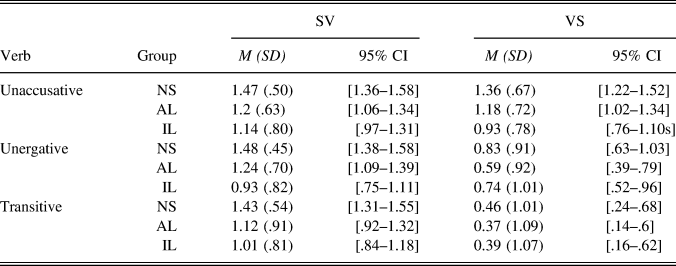
A summary of the mean acceptability ratings is presented in Table 3.
Descriptive statistics of the acceptability ratings assigned to broad focus questions-answer pairs for each word order, verb category and group

Unaccusative Verbs
The results from the two-way ANOVA show no main effect of word order F(1,498) = 3.2, p = .07, η p2 = .006, and a significant main effect of group F(2,498) = 12.77, p < .001, η p2 = .048; the interaction between these two factors was not significant F(2,498) = 0.71, p = .49, η p2 = .002. Within-group comparisons revealed no differences between word orders for any of the groups (NS, p = .26 d = .17; AL, p = .82 d = .03; IL, p = .09. d = .25), although the effect size was larger for IL, who showed a preference for preverbal subjects. Between-groups comparisons of the acceptability of preverbal subjects revealed that NS assigned significantly higher ratings than AL, p = .018, d = .46, and IL, p = .003, d = .49, but there were no significant differences between AL and IL, p = .53, d = .08. With postverbal subjects, no significant differences were found between NS and AL, p = .09, d = .26 or between AL and IL, p = .06, d = .32, although the difference between NS and IL was significant, p = < .001, d = .58 because NS assigned significantly higher ratings. Effect size values indicate that all three groups are somewhat different from each other, with NS assigning higher ratings to postverbal subjects than AL, who in turn assigned higher ratings than IL. These findings go against the predictions because NS accepted both word orders to a similar degree instead of favoring postverbal subjects. Learners were also expected to favor postverbal subjects in this context, given the availability of this word order in their L1, but that was not the case. Nonetheless, the predictions regarding the role of proficiency were confirmed because AL behaved more like NS.
Unergative Verbs
The two-way ANOVA revealed a main effect of word order F(1,498) = 45.42, p < .001, η p2 = .08, a main effect of group F(2,498) = 6.797, p = .0012, η p2 = .026, and a significant interaction F(2,498) = 4.31, p = .013, η p2 = .017). The within-group comparison is significant for NS, p < .001, d = .91, and for AL, p < .001, d = .78 because both groups show a strong preference for preverbal subjects. IL accepted both word orders almost to a similar degree, p = .18, d = .20. The between-groups comparisons revealed that NS assigned significantly higher ratings to preverbal subjects than AL, p = .019, d = .41, and IL, p < .001, d = .82. AL also assigned significantly higher ratings than IL, p = .007, d = .39. Regarding the acceptability of postverbal subjects, there were no statistically significant differences between any of the groups (NS vs. AL, p = .33, d = .25; NS vs. IL, p = .63, d = .09; advanced vs. IL, p = .63, d = .15). These findings confirm the predictions because NS were expected to favor preverbal subjects in this context and AL showed a similar pattern, while IL accepted both word orders to the same degree. Nonetheless, postverbal subjects were not strongly rejected, which led to less differences between groups in this context.
Transitive Verbs
The two-way ANOVA points to a significant main effect of word order F(1,498) = 88.96, p < .001, η p2 = .15, a main effect of group F(2,498) = 3.28, p = .03, η p2 = .013, but no significant interaction F(2,498) = 1.58, p = .20, η p2 = .006. The within-group comparisons support the strong effect of word order, as the preference for preverbal subjects is significant for all three groups (NS, p < .001, d = 1.18; AL, p < .001, d = .74; IL, p < .001, d = .65). Between-groups comparisons considering preverbal subjects show a significant difference between NS and AL, p = .016, d = .42, and between NS and IL, p = .0015, d = .60 because learners assigned significantly lower ratings than NS. There were no significant differences between learners, p = .39, d = .11. No significant differences between groups were found in the acceptability ratings assigned to postverbal subjects (NS vs. AL, p = 1, d = .08; NS vs. IL, p = 1, d = .05; AL vs. IL, p = 1, d = .02). NS behaved as predicted, favoring preverbal subjects. However, the predictions for learners were not confirmed, as they showed a stronger preference for preverbal subjects instead of accepting both word orders to the same degree. In fact, learners rejected postverbal subjects to a similar degree than natives, which suggests that the use of preverbal subjects in this context is favored by all three groups.
Verb Differences
The two-way ANOVA run on the subset of ratings assigned to preverbal subjects in contexts of broad focus revealed no significant main effect of verb category F(2,747) = .82, p = .44, η p2 = .002, and no interaction between verb category and group F(4,747) = .85, p = .49, η p2 = .004. Only the variable group had a significant main effect F(2,747) = 24.47, p < .001, η p2 = .061, but the specific differences between groups have already been discussed for each verb category. With postverbal subjects, by contrast, the two-way ANOVA indicated that there was a main effect of verb category F(2,747) = 41.68, p < .001, η p2 = .10, and a significant main effect of group F(2,747) = 3.29, p = .03, η p2 = .008, but no significant interaction between verb category and group F(4,747) = 1.44, p = .21, η p2 = .007. NS rated all three categories in a significantly different manner (unaccusatives vs. unergatives p < .001, d = .66; unaccusatives vs. transitives, p < .001, d = 1.04; unergatives vs. transitives, p = .007, d = .38), with unaccusative verbs being the ones receiving higher acceptability rates, followed by unergatives. For AL, the ratings assigned to postverbal subjects with unaccusative verbs are significantly higher than those assigned to postverbal subjects with unergative verbs p < .001, d = .70, and transitive verbs, p < .001, d = .87, while these two do not differ significantly from each other, p = .11, d = .22. Finally, IL rated postverbal subjects in utterances with unaccusative verbs similarly to those used with unergative verbs, p = .20, d = .21, while both categories of intransitive verbs received significantly higher ratings than transitive verbs (unaccusative vs. transitives, p = .001, d = .56; and unergatives vs. transitives, p = .04, d = .33). In summary, when looking at the acceptability of postverbal subjects, NS treat verb categories differently, IL do not make such a clear-cut distinction between the two types of intransitive verbs and AL distinguish unaccusatives from the other two categories. Thus, the predictions regarding the differences between verb categories due to the syntactic nature of unaccusative verbs (i.e., postverbal subjects would be favored with this type of verb) are confirmed, but only for NS and AL, which in turn supports the predictions concerned with the role of proficiency.
To summarize the findings concerning the judgments of sentences in contexts of broad focus, NS behaved as expected, showing preference for postverbal subjects with unaccusative verbs but not with other verb categories. AL behaved more like NS while IL rated both word orders similarly when used with intransitive verbs.
VP FOCUS CONTEXTS
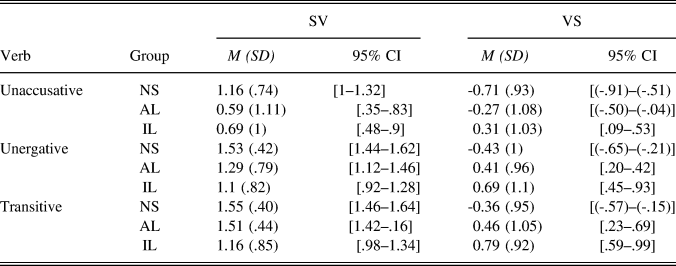
A summary of the mean acceptability ratings is presented in Table 4.
Descriptive statistics of the acceptability ratings assigned to VP focus questions-answer pairs for each word order, verb category, and group

Unaccusative Verbs
The results from the two-way ANOVA revealed a significant main effect of word order F(1,498) = 139.64, p < .001, η p2 = .21, group F(2,498) = 5.74, p = .003, η p2 = .022), and a significant interaction F(2,498) = 25.01, p < .001, η p2 = .09. The within-group comparisons indicate that preverbal subjects are preferred significantly over postverbal subjects by NS, p < .001, d = 2.23, AL, p < .001, d = .79, and IL, p = .016, d = .37, although the effect size decreases from one group to the next. The between-groups comparisons indicate that NS assign significantly higher ratings to preverbal subjects than learners (NS vs. AL, p < .001, d = .60; NS vs. IL, p = .003, d = .53). AL and IL, however, do not differ significantly from each other, p = .50, d = .09. When considering the acceptability of postverbal subjects, all three groups were significantly different from each other (NS vs. AL, p = .005, d = .43; NS vs. IL, p < .001, d = 1.04; AL vs. IL, p < .001, d = .55). NS strongly rejected this word order while learners do so less strongly, and even less so in the case of IL. The prediction that NS would reject postverbal subjects in this context was therefore confirmed. However, contrary to what was predicted, learners also rejected postverbal subjects, although less strongly at lower proficiency levels.
Unergative Verbs
Similarly to what was reported for unaccusative verbs, the results from the two-way ANOVA show a main effect of word order F(1,498) = 190.62, p < .001, η p2 = .27, group F(2,498) = 7.83, p < .001, η p2 = .03, and a significant interaction F(2,498) = 34.58, p < .001, η p2 = .12. The preference for preverbal subjects over postverbal subjects is significant for all three groups (NS, p < .001, d = 2.54, AL, p < .001, d = .99; IL, p = .007, d = .41). In the between-groups comparisons considering preverbal subjects, a statistically significant difference was found when comparing NS and IL, p < .001, d = .65 because IL assigned lower ratings. However, even though there were no significant differences between AL and IL, p = .07, d = .24, or between NS and AL, p = .06, d = .36, the effect size values still point to differences between them such that AL assigned ratings in between the other two groups. In the ratings assigned to postverbal subjects, NS rejected postverbal subjects significantly more than both groups of learners (NS vs. AL, p < .001, d = .86; NS vs. IL, p < .001, d = 1.06). AL and IL, however, did not differ significantly from each other, p = .08, d = .27, although they were still assigning different ratings, as indicated by the effect size value. As was the case with unaccusatives, the predictions were only partially confirmed because learners disfavored the use of postverbal subjects but they did so less strongly than NS.
Transitive Verbs
The results from the two-way ANOVA point to a main effect of word order F(1,498) = 235.94, p < .001, η p2 = .32, a main effect of group F(2,498) = 12.54, p < .001, η p2 = .04, and a significant interaction F(2,498) = 38.34, p < .001, η p2 = .13. The within-group comparisons reveal statistically significant differences for all three groups (NS, p < .001, d = 2.61; AL, p < .001, d = 1.29; IL p = .007, d = .41), as they all significantly prefer preverbal subjects in this context. Between-groups comparisons with preverbal subjects show that NS and AL behaved similarly, p = .63, d = .10. IL, however, assigned significantly lower acceptability ratings than NS, p < .001, d = .59, and AL, p < .001, d = .52. With postverbal subjects, the trend found is similar to the one reported for the previous verb categories, as all three groups are significantly different from each other (NS vs. AL, p < .001, d = .81; NS vs. IL, p < .001, d = 1.22; AL vs. IL, p = .032, d = .33). Once again, NS assigned significantly lower ratings than AL who, in turn, assigned significantly lower ratings than IL. Thus, as was the case with unaccusative and unergative verbs, the predictions were partially confirmed.
Verb Differences
In contexts of VP focus with preverbal subjects, the two-way ANOVA aimed at revealing differences between verb categories points to a main effect of verb category F(2,747) = 42.39, p < .001, η p2 = .10, and a main effect of group F(2,747) = 20.34, p < .001, η p2 = .05, but no significant interaction F(4,747) = 2.92, p = .20, η p2 = .01). NS rated preverbal subjects used with unaccusative verbs significantly worse than preverbal subjects used with unergative verbs, p < .001, d = .61, and transitive verbs, p < .001, d = .66, while unergatives and transitives were rated similarly, p = .78, d = .05. AL behaved like NS, assigning significantly lower ratings to unaccusatives than to unergatives, p < .001, d = .72, and transitives, p < .001, d = 1.08, while unergative and transitives were rated similarly, p = .09, d = .33. Finally, the same pattern was displayed by IL (unaccusatives vs. unergatives, p = .007, d = .44; unaccusatives vs. transitives, p = .002, d = .49; unergatives vs. transitives, p = .66, d = .07). With postverbal subjects, there was also a main effect of verb category F(2,747) = 20.01, p < .001, η p2 = .05, and a main effect of group F(2,747) = 77.51, p < .001, η p2 = .17, but no significant interaction F(4,747) = 1.14, p = .33, η p2 = .006. For NS, there were no significant differences for any verb category (unaccusatives vs. unergatives, p = .11, d = .29; unaccusatives vs. transitives, p = .052, d = .37; unergatives vs. transitives, p = .63, d = .07). For AL, postverbal subjects with unaccusative verbs were rated significantly worse than when used with unergative verbs, p < .001, d = .67, and with transitive verbs, p < .001, d = .69, while unergative and transitive verbs were rated similarly p = .77, d = .04. Finally, IL behaved like AL, rating postverbal subjects with unaccusative verbs significantly worse than those used with unergative verbs, p = .03, d = .35, or transitive verbs, p = .008, d = .48, while no significant differences were found between unergative and transitive verbs, p = .54, d = .09. Although no differences between verb categories were predicted in this context, it is interesting to note that learners treated unaccusative verbs differently, regardless of subject position.
To summarize the findings concerning the judgments of sentences in contexts of VP focus, postverbal subjects are strongly rejected by NS with all three verb categories, as predicted. Learners provided more positive judgments, which suggests that the constraints against this word order are not as rigid as in the target grammar. Nonetheless, differences based on proficiency were significant, with AL behaving more like NS than IL.
SUBJECT FOCUS CONTEXTS
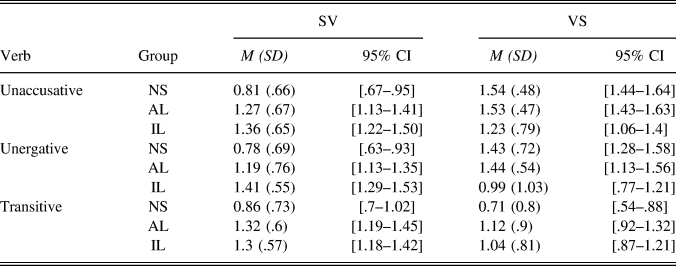
A summary of the mean acceptability ratings is presented in Table 5.
Descriptive statistics of the acceptability ratings assigned to subject focus questions-answer pairs for each word order, verb category, and group

Unaccusative Verbs
The results from the two-way ANOVA point to a main effect of word order F(1,498) = 25.45, p < .001, η p2 = .04, a main effect of group F(2,498) = 5.21, p = .005, η p2 = .02 and a significant interaction F(2,498) = 19.13, p < .001, η p2 = .071. The within-group comparison was significant for NS, p < .001, d = 1.24, and for AL, p = .004, d = .44, but not for IL, p = .25, d = .18. NS and AL showed a preference toward postverbal subjects, while IL rated both word orders almost equally, with a slight preference toward preverbal subjects. Between-groups comparisons for the acceptability ratings assigned to preverbal subjects revealed that AL and IL assigned similar ratings, p = .39, d = .13, but significantly higher than those provided by NS (NS vs. AL p < .001, d = .68, and NS vs. IL p < .001, d = .82). With respect to postverbal subjects, statistically significant differences were found between both groups of learners, p = .002, d = 0.46, as well as between NS and IL, p = .002, d = 0.47 because IL assigned significantly lower ratings to postverbal subjects. No significant differences were found between NS and AL, p = .93, d = .01. The predictions for NS were therefore confirmed because they favored postverbal subjects in this context. A similar pattern was displayed by AL, confirming the predictions concerned with the role of proficiency, although their ratings for preverbal subjects were higher than those assigned by natives. Also as predicted, IL accepted both word orders to a similar degree.
Unergative Verbs
The results from the two-way ANOVA are similar to those reported for unaccusative verbs because there is a main effect of word order F(1,498) = 6.14, p = .013, η p2 = .012, a main effect of group F(2,498) = 3.30, p = .03, η p2 = .013, and a significant interaction F(2,498) = 22.65, p < .001, η p2 = .08. In this context, the within-group comparisons were significantly different for all three groups, although in different directions: a significant preference for postverbal subjects was found for NS, p < .001, d = .92, and AL, p = .015, d = .37, while IL significantly preferred preverbal subjects, p = .0014, d = .50. The between-groups comparisons of the ratings assigned to preverbal subjects in this condition point to significant differences in all three pairings (NS vs. AL, p < .001, d = .56; NS vs. IL, p < .001, d = .99; AL vs. IL, p = .03, d = .32). IL assigned the highest ratings to preverbal subjects while NS assigned the lowest. With respect to postverbal subjects, NS and AL assigned similar ratings, p = .97, d = .005, significantly higher than those assigned by IL (NS vs. IL, p < .001, d = .54; AL vs. IL, p < .001, d = .49). Thus, with unergative verbs, NS and AL also behaved as expected, favoring postverbal subjects. However, as was the case with unaccusatives, AL assign higher ratings to preverbal subjects than NS. In this context, IL showed a stronger preference for preverbal subjects, which contradicts the prediction that they would not distinguish between word orders.
Transitive Verbs
The results from the two-way ANOVA are slightly different than those reported for the other two verb categories. In this case, there is a main effect of word order F(1,498) = 9.56, p = .002, η p2 = .018, and group F(2,498) = 16.79, p < .001, η p2 = .063, but no significant interaction F(2,498) = .21, p = .80, η p2 = .0008. The within-group comparisons revealed that IL rated postverbal subjects significantly worse than preverbal ones, p = .01, d = .37, while there was no significant distinction between them for AL, p = .09, d = .26, or for NS, p = .19, d = .20, just a small preference toward preverbal subjects in the case of AL and toward postverbal subjects in the case of NS, as suggested by the effect size values. The between-groups comparisons indicate that while AL and IL rated preverbal subjects similarly, p = .85, d = .03, they both assigned significantly higher ratings than NS (AL, p < .001, d = .67; IL, p < .001, d = .66). A similar tendency is found for postverbal subjects because no significant difference was found between learners, p = .54, d = .09, while both groups assigned significantly higher ratings than NS (AL, p = .005, d = .47; IL, p = .02, d = .40). In summary, NS behaved differently than learners in this context: As predicted, NS preferred postverbal subjects, but this was not the case for learners, who showed a stronger preference toward preverbal subjects, even though the prediction was that they would accept both word orders to a similar degree. Also, contrary to what was predicted and to what has been reported in other contexts, AL are patterning more like IL.
Verb Differences
The two-way ANOVA run on the subset of preverbal subjects in contexts of subject focus revealed no main effect of verb category F(2,747) = .19, p = .82, η p2 = .0005, and no significant interaction F(4,747) = .77, p = .54, η p2 = .004. The variable group had a significant main effect F(2,747) = 47.11, p < .001, η p2 = .11, but the specific differences between groups for each verb category have already been discussed. With postverbal subjects, nonetheless, there is a main effect of verb category F(2,747) = 26.86, p < .001, η p2 = .067, a main effect of group F(2,747) = 8.52, p < .001, η p2 = .022, and a significant interaction F(4,747) = 6.47, p < .001, η p2 = .033. NS rated the use of postverbal subjects with transitive verbs significantly worse than their use with unaccusatives, p < .001, d = 1.25, and unergative verbs, p < .001, d = .94, while their use with intransitive verbs were rated similarly, p = .31, d = .17. For AL, a similar pattern was found (unaccusative vs. transitive verbs, p < .001, d = .57; unergative vs. transitive verbs, p = .004, d = .43). No significant differences were found when comparing intransitive verbs, p = .35, d = .18. No significant differences were found in the ratings assigned by IL to postverbal subjects across verb categories in this context (unaccusatives vs. unergatives p = .25, d = .25, unaccusatives vs. transitives, p = .33, d = .23, and unergatives vs. transitives, p = .73, d = .05). In summary, it seems that postverbal subjects are being assigned lower acceptability ratings when used with transitive verbs, which was not predicted.
To summarize the findings concerning the judgments of sentences in contexts of subject focus, NS showed the predicted preference toward postverbal subjects regardless of the verb category. AL did so only with intransitive verbs while IL showed a consistent preference toward preverbal subjects. Thus, the differences based on proficiency were only confirmed with intransitive verbs.
DISCUSSION
The first hypothesis predicted that native speakers would prefer postverbal subjects in contexts of subject focus, but this was only the case with intransitive verbs. The fact that no difference between word orders was found with transitive verbs suggests that the pragmatic restrictions on subject position are not as strict as Zubizarreta (Reference Zubizarreta1998) argues, at least across verb categories. Interestingly, native speakers provided lower scores to question-answer pairs displaying transitive verbs, which could be due to the lack of naturalness that results from responding to a question with a full sentence in spontaneous speech, even more so with transitive verbs. Learners, however, do not seem to be affected by this, as they are required to answer questions with full sentences in classroom settings. Advanced learners behaved almost like native speakers, favoring postverbal subjects with intransitive verbs, although preverbal subjects still received high ratings. This suggests that while they seem to observe the discursive constraints that allow for the use of postverbal subjects, they still find the use of the word order that is prevalent in their L1 to be equally acceptable. Intermediate learners, by contrast, displayed a consistent preference toward preverbal subjects, regardless of verb category.
Contrary to what was expected, native speakers did not judge postverbal subjects as more appropriate than preverbal subjects in contexts of broad focus with unaccusative verbs. Instead, they accepted both word orders to the same degree, and so did learners (although intermediate learners showed a slight preference toward preverbal subjects). Thus, as previous experimental studies have shown, the syntactic restrictions on word order are not consistently found in the judgments provided by native speakers. Nonetheless, postverbal subjects in this condition were still found more acceptable than with any other verb category, as judged by native speakers and advanced learners. This will be further discussed in the following text.
Following with the first hypothesis, native speakers were not only expected to prefer postverbal subjects in contexts of subject focus and broad focus with unaccusative verbs, but it was also predicted that they would reject the use of such word order in the remaining contexts, that is, in contexts of VP focus and broad focus with unergative and transitive verbs. Learners, however, were expected to accept postverbal and preverbal subjects to the same degree, as both word orders are present in the input, and they need not have incorporated into their grammar a rule with the appropriate restrictions (i.e., pragmatic or lexical, respectively). The tendencies found in the VP focus condition were in accordance with the predictions for native speakers. Learners also preferred preverbal subjects over postverbal ones for all three verb categories, but their ratings of postverbal subjects were significantly higher than those provided by native speakers across conditions. The ratings assigned by advanced learners were closer to those of native speakers. The predictions for native speakers in broad focus contexts were confirmed, as they preferred preverbal subjects both with unergative and transitive verbs, although postverbal subjects were not strongly rejected. Advanced learners displayed similar tendencies to those of native speakers, favoring preverbal subjects over postverbal ones with both types of verbs. Intermediate learners, nonetheless, performed differently on each verb category, showing no differences with unergative verbs and a stronger preference toward preverbal subjects with transitive verbs.
As part of the first hypothesis, it was also expected that verb category would be relevant for learners in the broad focus condition. As expected, learners assigned higher ratings to postverbal subjects when used with unaccusatives, which is consistent with rule (8b) and the predictions that derive from the Unaccusative Hypothesis (Burzio, Reference Burzio1986). Intermediate learners, however, only differentiated transitive from intransitive verbs, suggesting that the rule from the L1 has not been completely activated for Spanish while other newly created underspecified rules are more productive. Another unpredicted difference was found in the VP focus condition because all three groups assigned lower scores to question-answer pairs including unaccusative verbs. This could be because, semantically, unaccusative verbs are achievements (Levin & Hovav, Reference Levin and Hovav1995), that is, verbal actions with no duration (Shirai & Andersen, Reference Shirai and Andersen1995). Accomplishments and activities, by contrast, do have duration and correspond to unergative and transitive verbs. The lack of duration of these actions could conflict with the question What did X do?, which implies an action that can be extended over time.
The second hypothesis was concerned with the effect that proficiency would have on the acceptability ratings assigned by learners. The main differences between groups were: (a) In contexts of VP focus with postverbal subjects, advanced learners assigned lower ratings than intermediate learners (although not as low as those provided by native speakers); (b) In contexts of subject focus with intransitive verbs, advanced learners performed in an almost nativelike manner because their ratings for postverbal subjects were higher than those assigned to preverbal subjects and higher than those assigned by intermediate learners.
Following the MG’s representation model, I propose the following rules for intermediate (11) and advanced Spanish (12). In addition to the rules from the L1, (11a) and (12a), as a result of their exposure to Spanish and to accommodate the input displaying postverbal subjects, learners would have added rules (11b) and (12b) to their grammar, that is, a rule that licenses postverbal subjects with no pragmatic restrictions. Furthermore, the fact that advanced learners treated unaccusative verbs differently in the broad focus condition suggests that they have added rule (12c), a more specific rule adapted from rule (8b) that accounts for the lexical and pragmatic restrictions regulating the use of postverbal subjects. Intermediate learners treated intransitive verbs differently from transitive verbs in contexts of broad focus, and I thus propose rule (11c), which would be the precursor of rule (12c); because rules are never deleted, this rule is also included in the advanced Spanish rule set (12d). Finally, our findings also suggest that advanced learners have incorporated a rule that regulates the use of postverbal subjects in contexts of narrow subject focus with intransitive verbs (12e).
(11) Intermediate Spanish
a. S → S Vintr / S → S Vtran O (rule from the L1)
b. S → Vintr S / S → Vtran O S (newly added rule without pragmatic restrictions)
c. S → F[Vintr S] (newly added rule with incorrect lexical restrictions)
(12) Advanced Spanish
a. S → S Vintr / S → S Vtran O (rule from the L1)
b. S → Vintr S / S → Vtran O S (newly added rule without pragmatic restrictions)
c. S → F[Vunacc S] (newly added rule, adapted from the L1, with the appropriate lexical and pragmatic restrictions)
d. S → F[Vintr S] (rule added at earlier stages with incorrect lexical restrictions)
e. S → Vintr F[S] (newly added rule with pragmatic restrictions, but limited to intransitive verbs)
While all these rules seem to be present in their grammar, high degrees of optionality were found, which would be due to differences in the productivity levels of a certain rule. As a result, advanced learners are assigning similar ratings to word orders that would be preferred in their L1 and to word orders that are only possible in their L2 in contexts of subject focus and broad focus with unaccusative verbs. The path that advanced learners must have followed was well represented in the responses provided by intermediate learners, who show higher productivity levels of the L1 rules across conditions, and nonnativelike productivity of underspecified L2 rules (11b, 11c). The next step for advanced learners would be to block the productivity of the L1 rule (12a) in said contexts, and to block the productivity of the underspecified L2 rule in those contexts where a postverbal subject would be infelicitous (i.e., in broad focus contexts with unergative and transitive verbs, and in VP focus contexts).
CONCLUSIONS
This study has contributed to the understanding of the acquisition of subject position constraints as regulated by information structure. As previous experimental studies (Domínguez, Reference Domínguez2008; Domínguez & Arche, Reference Domínguez and Arche2014; Hertel, Reference Hertel2003; Lozano, Reference Lozano2006; Vanrell & Fernández-Soriano, Reference Vanrell and Fernández-Soriano2013), the present project shows that the judgments provided by native speakers are not always in correspondence with syntactic theory. Nonetheless, some constraints on word order are clearly inviolable for native speakers: The focused VP must be in final position, as there is no need for movement to occur, and by being in final position, the assignment of nuclear stress is guaranteed. These also pose problems for learners and need to be accounted for when exploring the L2 acquisition of the phenomenon at hand.
This study has provided evidence for the adequacy of the MG model (Amaral & Roeper, Reference Amaral and Roeper2014). Through the proposal of different rules supported by the data, an acquisition path has been proposed to show how L2 speakers of Spanish are able to add to their grammars rules that are not present in their L1 based on the input they receive. The exact constraints (i.e., lexical or pragmatic) for their use, however, may not be fully specified from the very beginning, and more rules that better account for these restrictions can be added at later stages, after more exposure. The optionality found in L2 speech can be explained by the assignment of different productivity levels to each of the rules, which may be consistent with those of the target language. Further research needs to be carried out to determine which factors cause the adjustment in the productivity levels of a specific rule.
Methodological issues concerning the use of question-answer pairs were raised. Future studies should incorporate other possible designs, as well as experimental tasks that elicit more implicit measures, such as self-paced reading or listening-paced reading, to provide further insight on this phenomenon.
SUPPLEMENTARY MATERIAL
To view supplementary material for this article, please visit https://doi.org/10.1017/S0272263118000049