

1. Introduction to Financial Integration
Financial market integration means a platform where the law of one price holds, and where financial assets are traded in a single market. Financial market integration is beneficial for countries and investors. However, harmful effects may result for some countries in the form of macroeconomic volatility and financial contagion.
Financial integration may take various shapes and it includes cross-listing of stocks of companies on different stock exchanges and cross-border linkages between the financial institutions of diverse countries. In financially integrated markets, investors can trade financial assets without any barriers and flow of capital is facilitated among countries. Transaction costs are low and price convergence can be observed. Financial integration may take the form of capital market integration resulting in free flow of capital across borders. Capital market integration includes equity market linkages, offering opportunities for foreign investors to make portfolio investments. In integrated capital markets, the law of one price holds, which means that assets having the same risk should be traded at the same price, i.e. they should provide the same return to investors across the world. The consequences of financial market integration appear in the form of the equalization of prices and returns on financial assets, as has been observed by De Brouwer.Reference De Brouwer 1
Capital Market Integration may be short term as well as long term. This is judged by the co- movements of the returns of the markets. Many researchers, such as Syriopoulos,Reference Syriopoulos 2 – Reference Syriopoulos 5 Semitas et al.,Reference Semitas, Kenourgios and Paltalidis 6 Chen et al.,Reference Chen, Oliver and Rui 7 and Gelos and Sahay,Reference Gelos and Sahay 8 have documented that the factors responsible for long run equity market integration are: financial innovation, deregulation of the market, interest rate movements, economic relations and financial crises resulting in the propagation of shocks. In other words, we may say that financial openness, interest rate differentials, trade relations among the nations and financial contagion may contribute to financial market integration.
In keeping with this, growth is one of the benefits of financial integration. This study investigates whether European nations experienced fruitful financial integration through the channels of trade openness, capital market development and financial depth. As financial depth and level of capital market development vary among European nations, the question arises how these affect the growth of European nations.
1.1. A Look at European Economic Integration
The move for economic integration was started from Western Europe in the early 1950 s. Integration initially happened at the sectoral level. In 1951, an agreement was reached between Belgium, France, Luxembourg, Italy, West Germany and the Netherlands, called the Treaty of Paris. The establishment of the European Payments Union was an important step to facilitate transactions. The European Economic Community (EEC) was formed in 1957 under the Treaty of Rome.
Legislation also played its role to enhance integration. The Treaty of Rome was modified through the Single European Act in 1986, which was aimed at creating an integrated common market in Western Europe to facilitate the free flow of goods and services, including capital flows. With the progress of the single market, European leaders started thinking about monetary union and a single currency. The 1991 Maastricht Treaty became the basis for the European Union and the adoption of the euro as a single currency. In 1999, 12 out of the then 15 EU member states opted for the euro, with only Denmark, Sweden, and the United Kingdom opting out. The member countries opting for the euro fixed their home currencies at a predetermined rate to the euro. The euro was introduced in 2002. The introduction of Target2Securities (T2S) was also a step towards financial market integration.
2. Literature Review
Financial integration has been a growing phenomenon in recent years. Evidence for this is the quantum increase in international assets and liabilities, which have grown to thrice the size of GDPs since the mid-1980 s, as observed by Lane and Milesi-Ferretti.Reference Lane and Milesi-Ferretti9 Global integration needs to be studied from an empirical point of view. Regional integration is more common than global integration. It is empirically known that advanced economies and emerging markets are partially integrated.Reference Johnson and Soenen10 It is yet to be seen whether financial integration across the globe may be beneficial, even in the absence of trade linkages. In this sense, KorajczykReference Korajczyk11 observed that the degrees of equity market integration were influenced by economic growth, financial market development and explicit capital controls. Therefore, these factors matter for capital market integration. Furthermore, AuzairyReference Auzairy12 stressed the need to ascertain the determinants of equity market integration in order to achieve both regional and world financial integration.
The degree of equity market integration has important implications for investors as it may affect their diversification benefits. IbrahimReference Ibrahim13 observed that the degree of equity market integration has major implications for the financial stability of a country. A study of the forces behind market integration is beneficial for international investors so as to understand the risks and returns of diversification. Especially with reference to ASEAN countries, Karim and KarimReference Karim and Karim14 identified the contagion effect, economic integration and capital market characteristics in order to contribute to the research on financial integration. ChuahReference Chuah15 reported that the level of integration of emerging markets is determined by stock market development, trade openness and country risk. That is why trade openness and stock market development may be considered an important factors for financial integration. In addition, Eichengreen and ParkReference Eichengreen and Park16 reported that financial openness may further enhance economic growth.
Financially integrated countries become the recipients of international capital in the form of portfolio flows. The flow of funds is facilitated by removing restrictions on capital accounts. International flow of funds has positive as well as negative effects for the economy. Prasad et al.Reference Prasad, Rajan and Subramanian17 observed that, in the case of developing countries, less reliance on foreign capital for funding investment is helpful for growth. They also observed that even faster growing developing countries are not able to absorb the foreign capital due to underdeveloped financial markets and the appreciation of the local currency caused by capital inflows. This finding has important implications for us since it calls for giving due consideration to the financial market depth for a beneficial financial market integration. Fernandez-Arias and MontielReference Fernandez-Arias and Montiel18 observed that few financially sound economies of Asia and Latin America experienced a considerable increase in international flows in the early 1990 s. Small and less developed countries failed to attract investments despite their investment friendly policies. Low income countries experienced a considerable decline in inflow of funds in the 1990 s as against the top ten countries, which were the major recipients of the capital inflows.19 In spite of their open capital account and investor friendly policies, Sub-Saharan African countries attract a negligible amount of foreign capital. The bulk of capital inflows goes to resource-rich countries such as South Africa, Angola and Nigeria, as appreciated by Bhattacharya and SharmaReference Bhattacharya and Sharma20 and Basu and Srinivasan.Reference Basu and Srinivasan21 It is believed that one of the reasons for the failure to attract foreign capital on the part of these countries may be their underdeveloped financial markets and fragile financial systems.
Financial depth is a channel through which financial integration becomes purposeful. Many empirical studies speak for the role of financial depth in enhancing the economic growth of countries. However, it is interesting to observe that the effect of financial integration on growth is mixed. Therefore, which factor contributes is a relevant question to be answered from both an academic and an applied perspective. It is true that the higher degree of financial openness brings economic fruits for the countries concerned but it is difficult to empirically confirm the positive effects of financial integration on the growth of economies.
The availability of financial instruments to investors and the existence of sound financial institutions is a reflection of financial depth. Developed financial markets facilitate investors in hedging, pooling of risk and trading with minimum transaction costs. This induces investment in the economy, which triggers the growth. The impact of equity market development and credit market development on growth was observed by Levine and Zervose.Reference Levine and Zervos22 It was also reported that capital market development may contribute to growth in the long run.Reference Levine and Zervos23 It is interesting to see that the effects of financial depth on growth are non-linear and not uniform. An important finding was reported by De Gregorio and GuidottiReference De Gregorio and Guidotti24 when they explained that the growth effects of financial depth vary across countries and time. An important research finding came from Rioja and ValevReference Rioja and Valev25, who observed that the relationship between financial depth and growth changes on the basis of the different levels of financial development. They identified different regions of financial development, which may affect the growth effects of financial market integration.
In the context of financial depth and financial integration, the study conducted by Masten et al.Reference Masten, Coricelli and Masten26 is relevant. Using panel data, they observed that growth benefits are attained by countries where the threshold level of financial depth passes 90% of GDP, after which they gradually decline. When the level of financial depth exceeds 160% of GDP, growth benefits become insignificant. Although this was not a rigorous study to capture the threshold effects of financial development, still the general inference may be drawn that positive effects of financial integration accrue to their economies when countries experience financial depth in the range of 60% and 150% of GDP.
Financial development also matters with reference to the net foreign asset position of a country. Vermilion and HaanReference Vermeulen and Haan27 studied the relationship between a country’s domestic financial depth and its net foreign asset position. They reported that financial depth causes net foreign assets of the country to decrease. This means that capital inflows surpass outflows. These scholars added that financial development improves the net equity position of the country and lowers the net debt position.
It is important to appreciate that mere integration does not result in growth. Rather, economic growth is achieved by financial development and integration together. Financial development encompasses both capital market development and financial depth. In fact, Masood and HardakarReference Masood and Hardakar28 observed that in emerging economies both capital market development and financial depth are complementary for the financial development of the economy. An efficient capital market is instrumental for economic development. A developed capital market is able to mobilize capital, provide risk sharing and diversification benefits together with liquidity for the investors.
The above discussion reveals that the role of financial depth and capital market development has been extensively recognized in the literature. This study does not consider the condition precedent for fruitful capital market integration. That is to say, we claim that integration accompanied by financial development (capital market development and financial depth) may be beneficial for countries. Trade openness is a factor that deserves special attention in the context of financial integration. It is well documented that capital market integration follows economic integration. Trade openness is measured as the sum of exports and imports as a percentage of GDP. In this regard, Clausing and DorobantuReference Clausing and Dorobantu29 reported that investors would divert funds to those markets (economies) which are open to trade and enjoy a stable economic environment. Thus, trade openness paves the way for capital market integration. DavisReference Davis30 also incorporated bilateral trade integration in his model. That is why it is justified to study trade openness in the context of financial integration.
3. Data and Method
For the purpose of our study, panel data of diverse European countries were collected. Yearly observations of these countries from 1970 to 2014 were taken. Our data consist of a dynamic heterogeneous panel, since countries differ in their level of financial development, trade openness and the degree of financial openness. Data were taken from World Development Indicators, World Bank publications, and external wealth of nations datasets compiled by Lane and Milesi-Ferretti.Reference Lane and Milesi-Ferretti9 These data contain the yearly observations of our variables of interest. Yearly observations were taken since financial openness is a long-run phenomenon. Moreover, for such variables as growth, financial development, financial openness and trade openness, monthly and quarterly observations would not serve the purpose from an analytical point of view. In the case of macroeconomic variables, yearly observations are deemed more suitable than quarterly or half-yearly ones. As far as measurement of financial openness is concerned, the net foreign asset position of countries was taken into account. We have relied on Lane and Milesi-Ferretti,Reference Lane and Milesi-Ferretti9 who have used ratios of net foreign assets to GDP to measure degrees of financial openness. This measure incorporates foreign assets and liabilities in the form of portfolio investment in equities.
3.1. Variables and Measurement
Our study includes dependent variable growth and independent variables, i.e. Trade Openness (TRADEOPEN), and financial openness (FINOPEN), capital market development and financial depth. Financial depth was measured by taking the ratio of domestic credit to the private sector to GDP. Stock market development was measured by taking the ratio of market capitalization to GDP. Trade openness was worked out by obtaining the ratio of the sum of exports and imports to GDP. Financial openness was worked out by taking the absolute ratio of net foreign assets to GDP. The variables trade openness, financial depth and financial openness are likely to influence growth. As far as measurement of variable growth is concerned, it is measured as a percentage change in GDP.
3.2. Methodology
We chose our methodology with an eye to the attributes and nature of the data as well as our objective of research. We have macro level data of SAARC countries. These countries differ in their level of financial development, trade openness, and degree of market openness. Our variables, financial development, financial openness and trade openness, are time varying. Therefore, our panel is dynamic and heterogeneous. Considering the objective of our study, we have combined the time series and cross-sectional data. This would give us panel data and help us control for country-specific unobservable effects. There is a possibility that such unobservable effects may be correlated with other independent variables. In our case, each country may have some effects which are not observable, and not providing for such effects might lead to inconsistent estimates. That is why we went for a pooling of time series and cross-section data so that we may be able to control for unobservable country specific effects correlated with other independent variables in the specification of a model.
If we used only cross-sectional data, we would not be able to identify and control such individual effects. We have also been concerned with the fact that the correlation of intercept term (country specific effect) with the independent variables is not significant. In the presence of such correlation, ordinary least square estimates of our parameters become biased and inefficient. A similar case may be observed with generalized least squares (GLS). To overcome this problem, one traditional technique is to eliminate the country-specific effects in the sample. This is accomplished by data transformation, i.e. by eliminating deviation from the individual country’s mean.
Yet, the transformation of data to eliminate the country-specific effects is not a satisfactory solution to the problem. This technique suffers from two short-comings. The first is the elimination of those variables which do not change with time. Thus, it would render us unable to measure the time invariant effects which may lessen the explanatory power of the model. The second is when variation across different cross-sections is not taken into account; our estimator then no longer remains an efficient estimator. The first issue is more problematic when the primary objective of the research is to ascertain those parameters that do not depend on time.
Observation of variation across the cross-sections present in the countries under study is very important to us. Historically, it is known that when countries integrate, their level of financial development, growth rates, and financial openness is not the same across the board. The differences in parameters in the long run as well as in the short run are also of great importance to us since it would enable us to appreciate the impact of financial openness and trade openness in respect of each country in the long, as well as in the short, run.
Given the objective of our study, we had to choose among three alternatives, fixed effect estimators, random effect estimators and mean group estimators. We prefer the Pool Mean Group Estimator. In choosing Mean Group Estimation, we have relied on Pesaran et al.Reference Pesaran, Shin and Smith31 The Pool Mean group (PMG) estimator helps us measure common long-run coefficients and cross-section wise short-run coefficients. Our methodology also draws support from Ahn and Schmidt’s notions.Reference Ahn and Schmidt32
Finally, endogeneity is a major issue in panel data and it needs to be accounted for as it risks biasing estimates. One of the advantages of the PMG estimation technique is its ability to deal with potential endogeneity. We have relied on Vermilion and Haan, Reference Vermeulen and Haan27 who applied this method while investigating the relationship between financial development and financial openness. Pesaran et al. Reference Pesaran, Shin and Smith31 also reported that in order to work with pooled data, the conventional methods of estimation – such as fixed effect model, generalized method of movements (GMM) and Instrumental Variables (IV) proposed by Arellano and BoverReference Arellano and Bover33 and Ahn and SchmidtReference Ahn and Schmidt32 – suffer from the problem of inconsistent and misleading estimates in dynamic panel data models when slope coefficients are not identical. Therefore, an estimate with weaker homogeneity assumption would be appropriate. Our selection of the PMG estimator also draws support from Pesaran, Hsiao, and Tahmiscioglu’s theories.Reference Pesaran, Hsiao and Tahmiscioglu34 That is why Pool Mean Group regression was preferred to other estimators.
4. Results and Discussion
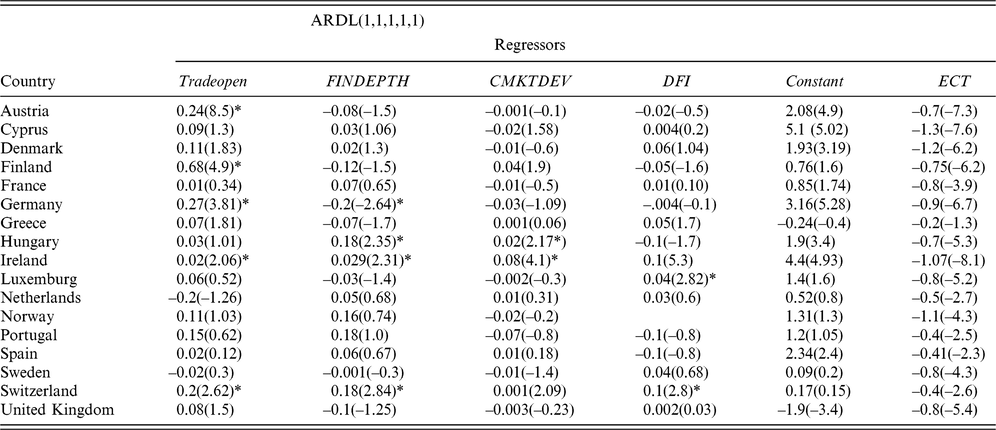
Let us now discuss the results of PMG estimation. First, we should look at short-run coefficients of independent variables. Table 1 shows the results of PMG Estimation results for 17 European countries. The table explains how growth is affected by capital market development, financial depth, and trade openness in the context of financial integration.
Estimated short run coefficients for euro region. Dependent variable: growth.

Note: Values of test-statistics at 5% level of significance have been provided in parenthesis.
For Austria we observe that trade openness has played a significant role in the short run while no role was observed for financial depth. The Degree of Integration, DFI, was proven to be insignificant. For Austria, the average figure for DFI did not exceed 12%, which shows that the country is yet to increase its financial openness with the world. A healthy coefficient for the intercept term shows that the growth of Austria is positively influenced by factors other than financial depth.
For Cyprus, trade openness and financial development played no role in the short run. However, a robust and significant intercept term speaks for other factors to have contributed to growth in the short run. In the case of Denmark, trade openness and domestic financial development, i.e. financial depth (FINDEPTH) had positive coefficients but none was found significant. The Degree of Integration (DFI) of Denmark is not strong and its average growth rate is modest.
Finland experienced satisfactory growth. Its capital market development is above 80% of GDP. In the short run, trade openness was found significant in contributing towards growth. However, financial depth did not contribute to this growth. Finland is well integrated with other EU markets but this integration in the short run does not appear to have been fruitful for growth.
France is the second largest economy of Europe. No variable was found significant in enhancing growth for France in the short run. It may be inferred that the growth of France is not attributed to financial depth in the short run. Germany is the largest economy of Europe. Results show that trade openness contributed significantly to enhancing growth in the short run. However, financial depth did not play any role in effecting growth. Germany had a robust intercept term, which shows the role of other factors in affecting growth. Greece did not experience any role of financial depth and trade openness in enhancing growth in the short run. It is interesting that the average growth for Greece is satisfactory, which may be the result of other macroeconomic factors.
In the case of Hungary, measures of financial development, financial depth (FINDEPTH) and capital market development (CMKTDEV) were found significant. However, trade openness (TRADEOPEN), and the degree of financial integration (DFI) were not found significant. This reflects that in Hungary financial depth and capital market development played a significant role in the short run. Ireland experienced the positive role of trade openness, financial depth and degree of financial integration in the short run. A healthy intercept term shows the role of other factors in enhancing growth. For Luxemburg, only some degree of financial integration was found significant for growth. Other factors, such as trade openness and financial depth, were not found significant. For the Netherlands, mean growth was observed below 1.3%. The slope parameters of financial depth, degree of integration, and trade openness did not influence growth in the short run. Ireland witnessed a significant role of trade openness and financial development.
Norway, Portugal and Spain experienced no role of financial depth and trade openness in the short run. This implies that the growth of these economies has to do with other economic factors. This also reflects the role of other macro-economic factors in the growth of these countries. In the case of Sweden, coefficients for trade openness and financial depth were found to be negative. One interpretation for this may be the adverse trade balance in the short run. However, the degree of integration had a positive coefficient. Switzerland experienced a positive role of trade openness, financial depth and degree of financial integration in the short run. For the United Kingdom no variable was found significant. This implies that the growth of this economy is not dependent on financial development and monetary union in the short run.
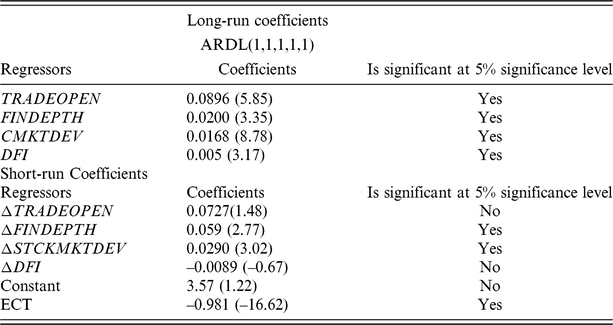
Table 2 shows that, in the long run, both measures of financial development – i.e. financial depth (FINDEPTH) and capital market development (CMKTDEV) – are positively significant. Trade openness (TRADEOPEN) was also found significant. However, the coefficient of Trade openness (TRADEOPEN) was greater than those coefficients of financial depth and capital market development, showing more contribution of trade openness to growth.
Estimated long run and short run coefficients for European countries. Dependent variable: growth.

Note: Values of test-statistics at 5% level of significance have been provided in parenthesis.
In the case of the euro area, both variables – financial depth (FINDEPTH) and capital market development (CMKTDEV) – were found significant. This may be attributed to the increased integration and financial depth. The Degree of Financial Integration (DFI) was also found to be statistically significant. Thus, it may be inferred that in the long run financial depth, stock market development and trade openness contribute to growth in Europe.
In the short run, only capital market development (CMKTDEV) and financial depth (FINDEPTH) were found positively significant and thus contributed to growth. Other variables such as degree of financial integration (DFI), and trade openness (TRADEOPEN) were not found significant in the short run. Trade openness was not found significant. It may be interpreted that financial development has contributed to growth in the short run as well as in the long run for Europe. However, trade openness has contributed to growth only in the long run. Moreover, the contribution of financial depth in the short run is higher than that of the same in the long run since the coefficient of financial depth in the short run is bigger than that of financial depth in the long run. Financial development has played a role for growth in the short run as well as in the long run.
5. Conclusion
Our results show that, for European countries, financial depth and stock market development contributed to long-term growth. However, the contribution of financial depth outweighs that of stock market development. In the short run, financial depth contributed more to growth than stock market development. Therefore, the role of financial depth in enhancing growth is more persistent than that of stock market development. This result implies that a greater focus of European economies on financial depth than on stock market development may prove fruitful for their economic growth.
In summary, from cross-section statistics we can infer that Austria may increase its growth through more trade linkages. By increasing trade linkages and financial depth, Denmark may increase its growth in the short run. For Finland, trade openness may contribute to short-term growth. Hungary may increase its growth in the short run by achieving a higher level of financial depth. The role of stock market development was minor for Hungary. Cyprus experienced a major contribution from trade openness. However, financial depth may yet slightly increase growth. It may be inferred that the role of trade openness and financial depth in the short-run growth of European nations is significant and supportive for long-run growth. Therefore, trade openness and financial depth need focusing on.
About the Authors
Mazhar Mahmood is a PhD Candidate in the Department of Management Sciences, Shaheed Zulfiqar Ali Bhutto Institute of Science and Technology, Islamabad Campus, Pakistan. His areas of interest are international finance and international economics and forensic accounting. He has published on risk management in the International Journal of Business & Economics Research. His PhD research focuses on optimal models of financial integration.
Kashif Ur Rehman is a Professor and Head of Research at the Department of Management Sciences, IQRA University Islamabad Campus, Pakistan. He has supervised more than 20 PhDs in management sciences. In 2011 he received the ‘best university teacher’ award from the Higher Education Commission in Pakistan. He has published over 30 research papers in refereed journals. He has a diverse research experience in all fields of management science, especially marketing, finance, and human resource management, and has participated in many international conferences in these fields.