Introduction
Chlorine gas is a greenish-yellow, highly reactive, irritant, and toxic gas with a characteristic bleach-like odor. It is widely utilized in industrial processes, including water treatment, disinfection, and chemical manufacturing. Despite its industrial utility, chlorine poses significant health and safety risks during accidental and intentional releases, with the potential for mass exposure and serious health consequences in occupational, environmental, or terrorism-related incidents.Reference Morim and Guldner 1
Chlorine gas primarily affects the upper respiratory tract and the mucous membranes of the eyes, mouth, and throat due to its water solubility. Upon contact with moist tissues, chlorine undergoes hydrolysis to form hydrochloric acid (HCl) and hypochlorous acid (HOCl), along with their conjugate bases, including hypochlorite ions. These products cause irritation and tissue damage. Further breakdown of HOCl generates reactive oxygen species (ROS), which induce oxidative stress, cellular injury, lipid peroxidation, and inflammatory responses.Reference Achanta and Jordt 2
The acute health effects of chlorine exposure range from mild irritation of the mouth, throat, eyes, and upper respiratory tract to life-threatening conditions such as acute lung injury (ALI), acute respiratory distress syndrome (ARDS), and in severe cases, death. Some patients develop persistent respiratory complaints from irritant-induced asthma (previously termed Reactive airway dysfunction syndrome). These types and severity of clinical manifestations are directly proportional to the concentration of chlorine and the duration of exposure.
The Acute Exposure Guideline Levels (AEGLs) for chlorine provide critical thresholds for assessing exposure risk. At AEGL-1 (0.5 ppm) concentration, humans experience slight, nondisabling effects such as sensory irritation and minor changes in pulmonary function. At AEGL-2 levels (0.7 to 2.8 ppm, depending on duration), disabling effects that may impair the ability to escape may occur; 1.0 ppm for 4 hours represents the no-observed-adverse-effect level (NOAEL) for asthma-like symptoms in humans. AEGL-3 (7.1 to 50 ppm) represents life-threatening exposure thresholds observed in animal studies. 3 , 4 These thresholds underscore the need for rapid identification, evacuation, and acute medical intervention following exposure.
Chlorine remains one of the most common toxic inhalation exposures worldwide. Large-scale chlorine exposure incidents have been reported globally, resulting in significant morbidity and mortality. A notable example occurred in 2007 in Graniteville, South Carolina, when a railroad tanker collision ruptured a chlorine tank, releasing approximately 90 tons of chlorine gas. This incident resulted in nine fatalities, 72 hospitalizations, and 525 individuals seeking emergency medical care.Reference Wenck, Van Sickle and Drociuk 5 In the Middle East and North Africa (MENA) region, chlorine exposure has emerged as a public health and security concern, particularly in conflict zones such as Iraq and Syria, where chlorine has been weaponized in chemical attacks.Reference Wenck, Van Sickle and Drociuk 5 , 6 Although such large-scale incidents are rare in Oman, the region remains vulnerable due to industrial facilities that handle chlorine in large quantities, underscoring the importance of a robust emergency preparedness and response system.
On May 9, 2023, a chlorine gas leak occurred in an industrial area in Sohar, Oman, resulting in the release of a substantial quantity of chlorine gas into the surrounding environment. Authorities confirmed the source of the release following the discovery of intentionally opened chlorine cylinders. Given the history provided and the patient’s clinical manifestations, chlorine gas was confirmed as the cause of this incident. The incident was attributed to theft; individuals attempting to steal the cylinders opened the valves to reduce the weight of the containers, inadvertently releasing the gas. Although precise data on the volume of chlorine released and ambient concentrations were not available, the clinical presentations of affected individuals and forensic evidence confirmed chlorine gas as the causative agent.
The objective of this study is to comprehensively describe the clinical course of patients acutely exposed to chlorine gas during the Sohar incident, including initial presentation, clinical management strategies, and short-term health outcomes. Additionally, we aim to identify and disseminate key lessons learned from this incident to inform and enhance preparedness, response protocols, and clinical management frameworks for future chlorine exposure events in Oman and similar settings globally.
Methods
Study Design and Setting
We conducted a retrospective observational study following a mass casualty chlorine gas exposure incident that occurred on May 9, 2023, in Sohar, Oman. All cases presenting to the Sohar Hospital emergency department (ED) from the incident scene with a history of chlorine gas exposure were included. Patients treated at other facilities were excluded due to lack of accessible records. The study was conducted at Sohar Hospital, a tertiary care facility in Al Batinah North Governorate that serves as a regional referral center for the area. The hospital’s ED manages over 70,000 patient visits annually and was the primary receiving facility for casualties from the incident.
Study Population
All patients presenting to the Sohar Hospital ED directly from the incident scene with documented history of acute chlorine gas exposure during the specific incident were included in the study. However, patients who were treated at other health care facilities were excluded due to the inability to access their medical records for comprehensive data collection and analysis.
Data Collection
Patient data were retrospectively extracted from electronic medical records (EMR) using a standardized data collection instrument created in Google Forms. The following information was systematically collected: demographic characteristics, including age, sex, nationality, and occupation; exposure details, including time of exposure, duration at the scene, distance from the source, and use of personal protective equipment (PPE) (if applicable); clinical presentation, including initial symptoms, vital signs, and physical examination findings at ED presentation; diagnostic investigations, including laboratory tests, arterial blood gas analysis, chest radiology, and pulmonary function tests (when performed); treatment interventions, including decontamination procedures, pharmacological treatments (bronchodilators, corticosteroids, and supplemental oxygen), and supportive care measures; clinical outcomes, including hospital admission, intensive care unit (ICU) admission, length of stay, complications, and discharge disposition; and follow-up assessments, including clinical status and persistent or new symptoms documented at scheduled follow-up visits.
Follow-up Protocol
As part of the standardized management protocol, all patients were scheduled for 2 outpatient follow-up assessments after discharge: the first at 48 hours post-exposure and the second at 2 weeks post-exposure. During each follow-up visit, patients underwent clinical evaluation including symptom assessment, physical examination, and documentation of any persistent respiratory complaints or functional limitations. No imaging or pulmonary function tests were obtained.
Data Analysis
Collected data were exported from Google Forms and analyzed using IBM SPSS Statistics version 31 (IBM Cop., Armonk, NY, USA). Descriptive statistics were employed to summarize demographic and clinical characteristics. Categorical variables were expressed as frequencies and percentages, while continuous variables were presented as means ± standard deviation (SD) or medians with interquartile ranges (IQR) depending on data distribution. For longitudinal analyses, pairwise changes between assessment intervals were evaluated using the exact McNemar test, while overall changes across multiple assessment intervals were assessed using Cochran’s Q test. A P-value <0.05 was considered statistically significant.
ChatGPT (OpenAI, GPT-5.5) was used between January and June 2026 to assist with data analysis and manuscript language editing. All AI-generated outputs were reviewed, verified, and approved by the researcher, who is responsible for the final content.
Ethical Consideration
This study was approved by the Research and Ethical Review and Approval Committee of North Al Batinah Governorate (Approval No. MoH/CSR/26/31228). Given the retrospective nature of the study utilizing de-identified medical record data, the requirement for informed consent was waived by the ethics committee.
Results
A total of 42 casualties with chlorine gas exposure were reported by local authorities as requiring medical assessment. Of these, 31 patients presented to the ED of the study site and were included in the analysis. Table 1 shows the baseline characteristics of exposed patients. All patients were male (n = 31, 100%), with a mean age of 32.42 ± 9.36 years. Most patients were of Bangladeshi nationality (n = 25, 80.6%), followed by Omani (n = 4, 12.9%) and Indian (n = 2, 6.5%) nationals.
Baseline characteristics of exposed patients (N = 31).

Table 1. Long description
The table presents data for 31 patients, all of whom are male (100 percent).
* Age and Arrival: The mean age plus or minus S D is 32.42 plus or minus 9.36.
* Nationality: Bangladeshi (25, 80.6 percent), Omani (4, 12.9 percent), and Indian (2, 6.5 percent).
* Past Medical History: 1 patient (3.2 percent) has asthma and 1 (3.2 percent) is diabetic.
* Smoking History: 20 smokers (64.5 percent) and 11 non-smokers (35.5 percent).
* Exposure: 24 indoor (77.4 percent) and 7 outdoor (22.6 percent).
* Distance from Source: 26 patients (83.9 percent) were approximately less than 500 meters away, while 5 (16.1 percent) were approximately greater than 501 meters away.
* Occupation: 28 cleaners (90.3 percent), 1 retired (3.2 percent), 1 businessman (3.2 percent), and 1 unemployed (3.2 percent).
* Hospital Arrival Mode: 25 by bystander (80.6 percent), 3 by E M S assistance (9.7 percent), and 3 by own means (9.7 percent).
Note. Data are presented as n (%) or mean ± SD. Percentages were calculated using the total study population (N = 31)
Regarding past medical history, only 2 patients (6.4%) had documented chronic conditions: 1 patient (3.2%) had asthma, and 1 patient (3.2%) had diabetes mellitus. Smoking history revealed that 20 patients (64.5%) were active smokers, while 11 (35.5%) were non-smokers. Notably, most affected individuals were indoors (n = 24, 77.4%), with most exposures occurring within approximately 500 meters of the incident site (n = 26, 83.9%) (Table 1).
Occupational data showed that most patients were employed as cleaners (n = 28, 90.3%), while the remainder included one retired individual, one businessman, and one unemployed person (each 3.2%). The mean arrival time from the estimated time of chlorine gas release was 54.7 ± 30.8 minutes. Regarding mode of hospital arrival, 25 patients (80.6%) were transported to the hospital by bystanders, 3 (9.7%) arrived by emergency medical services (EMS), and 3 (9.7%) arrived by their own means (Table 1). None of the affected individuals were wearing PPE at the time of exposure.
At initial presentation, clinical manifestations ranged from mild to moderate in severity. Twenty-eight patients (90.3%) were symptomatic, while 3 (9.7%) remained asymptomatic throughout the 4- to 6-hour observation period. The respiratory system was predominantly affected, with dyspnea being the most common symptom, reported in 22 patients (71.0%), followed by cough in 19 (61.3%), sore throat in 19 (61.3%), and rhinorrhea in 16 patients (51.6%). Additional systemic manifestations and their frequencies are presented in Table 2.
Longitudinal tracking and statistical mapping of individual signs, symptoms, and asymptomatic states among patients with chlorine gas exposure (N = 31).

Table 2. Long description
The table tracks 31 patients at presentation and 48 hours, and 29 patients at 2 weeks.
* Cardiovascular system: Chest pain increased from 6.5 percent at presentation to 19.4 percent at 48 hours, then dropped to 0 percent at 2 weeks. Palpitation dropped from 19.4 percent to 0 percent by 48 hours (P equals 0.031).
* Respiratory system: Cough was 61.3 percent at presentation, 12.9 percent at 48 hours, and 31.0 percent at 2 weeks. Dyspnea was 71.0 percent at presentation, dropping significantly to 3.4 percent at 2 weeks (P less than 0.001).
* Head, eyes, ears, nose, and throat (H E N T): Rhinorrhea (51.6 percent) and sore throat (61.3 percent) both dropped to 0 percent by 2 weeks (P less than 0.001).
* Gastrointestinal: Vomiting (13.0 percent) and Nausea (6.5 percent) both decreased to near zero by 2 weeks.
* Central nervous system: Dizziness (12.9 percent) and Headache (19.4 percent) both dropped to 0 percent by 48 hours.
* Ophthalmic: Lacrimation, ocular pain, and redness all dropped from initial levels (up to 12.9 percent) to 0 percent by 48 hours.
* Constitutional: Distressed state dropped from 16.1 percent to 0 percent by 48 hours (P equals 0.062).
* Asymptomatic: The percentage of patients with no symptoms increased from 9.7 percent at presentation to 41.9 percent at 48 hours and 58.6 percent at 2 weeks (Overall P equals 0.002).
Note. Data are presented as frequency, n (percentage, %). Percentages for the 2-week interval are calculated using available complete cases (N = 29) due to 3 missing follow-up records. Pairwise temporal transitions were evaluated using the exact binomial McNemar test due to low structural cell frequencies, while overall change across all intervals was measured via Cochran’s Q test. N/A indicates that the response vector remained perfectly invariant across all complete cases, preventing the calculation of Cochran’s Q. Signs and symptoms are not mutually exclusive. The P-values denote the level of statistical significance (α = 0.05)
Other systemic manifestations included constitutional symptoms such as feeling distressed in 5 patients (16.1%), and fever and decreased concentration, each reported in 1 patient (3.2%). Ophthalmic symptoms were present in several patients, including lacrimation in 4 patients (12.9%), ocular redness in 2 patients (6.5%), ocular pain in 4 patients (12.9%), itching in 3 patients (9.7%), and blurred vision in 1 patient (3.2%). Gastrointestinal symptoms included vomiting in 4 patients (13.0%) and nausea in 2 patients (6.5%). Central nervous system symptoms comprised dizziness in 4 patients (12.9%) and headache in 6 patients (19.4%). Cardiovascular symptoms were also reported, with palpitations in 6 patients (19.4%) and chest pain in 2 patients (6.5%) at initial presentation. Additional manifestations included voice change in 2 patients (6.5%) and chest tightness in 5 patients (16.1%). The complete frequency distribution of symptoms is presented in Table 2. Abnormal physical examination findings were documented in 8 patients (25.8%), with wheezing detected in 2 (6.5%) and chest crepitations in 2 (6.5%).
Due to the high-volume influx of patients, the hospital activated its disaster management protocol. A structured 2-stage triage system was implemented, prioritizing patients with severe symptoms (e.g., severe shortness of breath or chest pain) for immediate care in the resuscitation area, while those with less critical symptoms underwent secondary triage and were managed in standard ED beds according to clinical severity. Only 2 patients (6.5%) underwent formal decontamination upon arrival: one required ocular irrigation for eye irritation, and the other had contaminated clothing removed. The remaining 29 patients (93.5%) did not receive any form of decontamination (Table 3).
Investigations and treatments received among patients with chlorine gas exposure (n = 31).

Table 3. Long description
The table is organized into four main sections with two columns: the investigation or treatment type and the count n with percentage in parentheses.
* Decontamination done:
- At the scene: 0 (0.0 percent).
- In the hospital: 2 (6.5 percent).
- Not done: 29 (93.5 percent).
* Chest X-ray:
- Performed: 10 (32.2 percent).
- Not performed: 21 (67.7 percent).
* Venous blood gases:
- Performed: 31 (100 percent).
- Not performed: 0 (0.0 percent).
* Medications:
- Supplement oxygen: 3 (9.7 percent).
- Salbutamol nebulization: 13 (41.9 percent).
- Ipratropium nebulization: 4 (12.9 percent).
- Hydrocortisone intravenous: 12 (38.7 percent).
- Budesonide nebulization: 1 (3.2 percent).
Note. Data are presented as n (%). Percentages were calculated using the total study population (N = 31). Patients may have received more than one medication; therefore, medication percentages do not sum to 100%
Chest radiographs were obtained for 10 patients (32.3%), all of which showed no acute abnormalities. Venous blood gas analysis was performed for all patients, revealing low-normal pCO₂ levels in some cases. Lactate levels were within normal limits (<2 mmol/L) across all patients, and no significant acid-base disturbances were detected.
Regarding treatment and clinical courses, Table 4 presents the ED treatments administered to patients following exposure. Supplemental oxygen, nebulized bronchodilators (salbutamol, ipratropium), nebulized budesonide, and intravenous hydrocortisone were administered to patients with hypoxemia, wheezing, or chest crepitation. Most patients demonstrated significant clinical improvement within approximately 2 hours of arrival at the ED.
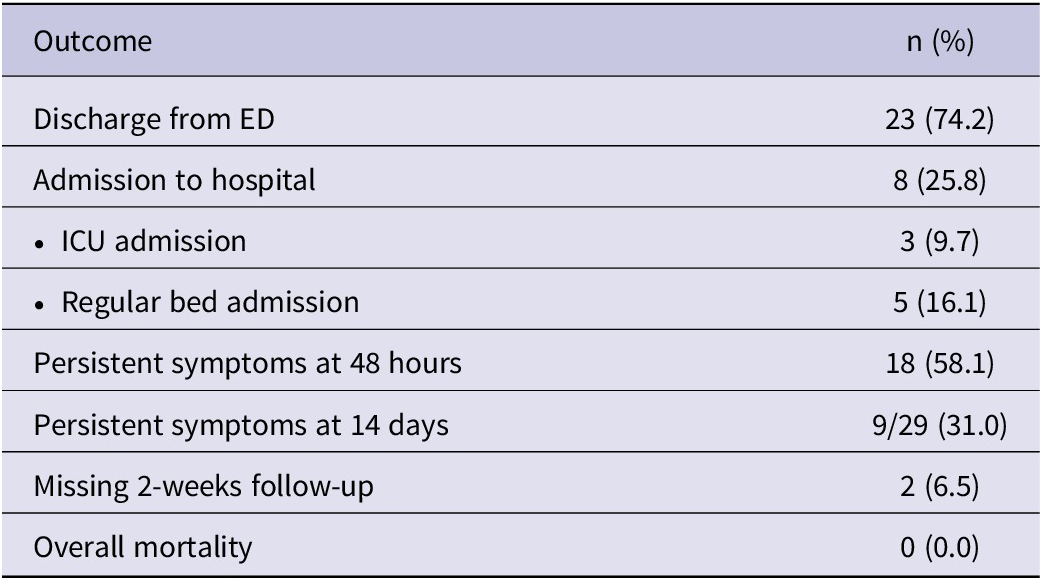
Clinical outcomes of patients following chlorine gas exposure (N = 31).

Table 4. Long description
The table consists of two columns: Outcome and n (percent).
* Discharge from E D: 23 (74.2 percent).
* Admission to hospital: 8 (25.8 percent).
* I C U admission: 3 (9.7 percent).
* Regular bed admission: 5 (16.1 percent).
* Persistent symptoms at 48 hours: 18 (58.1 percent).
* Persistent symptoms at 14 days: 9/29 (31.0 percent).
* Missing 2-weeks follow-up: 2 (6.5 percent).
* Overall mortality: 0 (0.0 percent).
Note. Data are presented as n (%). Percentages for overall outcomes were calculated using the total study population (N = 31). Persistent symptoms at 14 days were assessed among patients available for follow-up (n = 29); 2 patients (6.5%) were lost to follow-up
Most patients (n = 23, 25.8%) were discharged home directly from the ED after 4-6 hours of observation and symptomatic improvement (Table 4). A total of 8 patients (25.8%) required hospital admission: 3 patients (9.7%) were admitted to the ICU for persistent hypoxemia, while 5 patients (12.9%) were admitted to the general medical ward for observation. Six patients, including one ICU patient, were admitted for a total of 24 hours, while the remaining 2 of the 3 ICU patients remained hospitalized for 48 hours.
All 31 patients underwent scheduled reassessment in the ED 48 hours after exposure. At this follow-up, there was a statistically significant increase in the proportion of asymptomatic patients compared with the initial presentation day, with 13 patients (41.9%) being asymptomatic at 48 hours (P = 0.006). Clinical manifestations including wheezing, chest pain, voice changes, vomiting, nausea, ocular itching and redness, blurred vision, impaired concentration, fever, respiratory distress, and diaphoresis showed no statistically significant changes over the 48-hour follow-up period (all P > 0.05). Respiratory symptoms remained the most reported manifestations at the 48-hour evaluation. Notably, the proportion of patients reporting chest pain increased from 2 (6.5%) at presentation to 6 (19.4%) at the 48-hour follow-up, although this increase was not statistically significant. In contrast, there was a statistically significant reduction in several other clinical manifestations assessed during follow-up (Table 2).
Of the 31 patients evaluated on the day of the incident, 29 attended the scheduled 2-week follow-up, while 2 were lost to follow-up. At the 2-week assessment, there was a statistically significant increase in the proportion of asymptomatic patients, with 17 of 29 patients (58.6%) reporting complete resolution of symptoms (P = 0.002). Cough remained the most persistent symptom at the 2-week follow-up, reported by 9 patients (31.0%). Other persistent symptoms included dyspnea, chest tightness, nausea, and blurred vision, each reported by one patient (3.4%). Patients with ongoing symptoms were referred to the medical outpatient clinic for further evaluation and continued management. The temporal evolution of all symptoms from presentation through 2 weeks is comprehensively presented in Table 2.
Limitations
This study has several limitations. First, although all patients exhibited respiratory symptoms, evaluations were performed exclusively in the ED rather than in a dedicated toxicology or pulmonary clinic. Consequently, comprehensive assessments, including pulmonary function testing, were not conducted. Second, due to restricted access to electronic health records from other institutions, 11 cases that were managed at external facilities could not be included in the analysis. Third, although the source of the released gas was known, objective measurements of chlorine gas concentration were not available, limiting our ability to accurately characterize the extent of exposure.
Discussion
The chlorine gas leak incident in Sohar, Oman, serves as a critical example of the public health impact that may be caused by industrial chemical exposures. Chlorine gas, with its high reactivity and toxic effects on mucosal surfaces, presents an immediate and significant health challenge, especially in occupational or industrial areas where large quantities are handled with a risk of a high number of people being affected.Reference Gorguner and Akgun 7 This incident highlights both the acute clinical effects of chlorine inhalation and the systemic challenges encountered in the management of a mass casualty of chemical exposure.
In evaluating the disaster response, our study identified several key areas for improvement to mitigate risks in future incidents. First, none of the victims were wearing PPE, indicating a significant lapse in occupational safety within an industrial setting. Second, the majority of patients were transported by bystanders rather than EMS, revealing gaps in prehospital disaster response and highlighting the need to strengthen EMS preparedness. Third, although the hospital promptly activated its disaster plan and implemented a 2-tiered triage system, only 2 patients underwent formal decontamination, highlighting deficiencies in chemical response procedures.
Most affected individuals in this incident were young, healthy males without pre-existing comorbidities, which may have contributed to the overall favorable clinical outcomes. One patient with pre-existing asthma necessitated intensive care. This isolated finding is consistent with previously reported concerns regarding the potential for underlying respiratory conditions to increase susceptibility to severe respiratory effects following irritant gas exposure.Reference White and Martin 8 , Reference Sever, Mordeniz and Sever 9 However, our study was not designed or powered to establish such an association.
The diagnostic workup in this incident, including chest X-ray and venous blood gas analysis, yielded normal results, aligning with prior data such as a 2009 Turkish study where only one smoker showed abnormal chest X-ray findings likely unrelated to chlorine exposure.Reference Sever, Mordeniz and Sever 9 This suggests limited utility for routine imaging unless prompted by physical exam findings.
Initial treatment involved oxygen therapy, hydrocortisone, and nebulized bronchodilators, consistent with established protocols, though the role of corticosteroids remains uncertain due to lack of isolated use in clinical settings. Experimental evidence from a porcine model has suggested that early administration of inhaled budesonide post-exposure may provide protective effects against chlorine-induced pulmonary injury, highlighting a potential role for corticosteroids in acute chemical inhalation syndromes when administered promptly.Reference Wang, Zhang and Walther 10
No mortality was observed in our cohort, and none of the patients required invasive respiratory support, including endotracheal intubation or noninvasive ventilation. Most patients were discharged directly from the ED, while those requiring hospital admission generally had a short length of stay, with most discharged within 2 days. These favorable clinical outcomes are consistent with findings from a previously reported cohort of 39 patients following accidental chlorine gas exposure, in which no mortality or requirement for mechanical ventilation was reported.Reference Sever, Mordeniz and Sever 9
The follow-up data revealed that a considerable number of patients continued to experience symptoms even 48 hours and 2 weeks after the incident, highlighting the potential for prolonged or delayed health effects even after seemingly mild exposures. Symptoms such as chest pain, shortness of breath, and sore throat were frequently reported, suggesting ongoing airway irritation or inflammation to some extent. Therefore, long-term follow-up and monitoring of patients are essential due to the potential for delayed onset of symptoms such as reactive airways dysfunction syndrome (RADS) or chronic obstructive pulmonary disease (COPD).Reference Hoyle and Svendsen 11 , Reference Rasouli, Hasani Nourian and Ghanei 12
Conclusion
This study highlights key clinical features, management strategies, and systemic gaps in the response to a chlorine gas exposure incident in Oman. Findings underscore the importance of improving occupational safety measures, first responder preparedness, and standardized decontamination and management protocols to enhance outcomes in future chemical exposures.
Author contribution
Hassan Al Balushi: Conceptualization, methodology, data curation, formal analysis, review and editing of the manuscript; Ahmed Al Saidi: Data curation, investigation, writing, review, and editing; Yaqdhan Al Atbi: Formal analysis, validation, visualization, writing—review and editing; Ahmed Al Abri: Data curation, investigation, writing, review, and editing; Suad Al Sulaimani: Data curation, investigation, writing, review, and editing; Fatma Al Balushi: Data curation, investigation, writing, review, and editing; Fatma Al Salhi: Data curation, investigation, writing, review, and editing; Ziad, Kazzi: Data curation, investigation, writing, review, and editing; Mohamed Al Busafi: Supervision, methodology, writing—review and editing; Badria Alhatali: Supervision, methodology, writing—review and editing.
Funding statement
No funding was received for this study.
Competing interests
None.