Implications
Maintaining or improving the health of livestock is of utmost importance as sick animals fail to grow and cost producers in time lost and medication costs. As we continue to select for lean growth and other production traits, producers are faced with reduced immune responsivity to pathogens. Various probiotic products have been demonstrated to alter various aspects of the innate immune response. Data from this study found that pigs supplemented with SynGenX had improved performance, reduced body temperature, stress and pro-inflammatory responses to the lipopolysaccharide (LPS) challenge, suggesting that feeding SynGenX can attenuate the innate immune response to an LPS challenge.
Introduction
In the livestock industry, maintaining or improving the health of animals is of utmost importance as sick animals fail to grow and cost producers in time lost and medication costs. As we continue to select for lean growth and other production traits, particularly in the swine industry, producers are faced with a growing issue of reduced immune responsivity to pathogens (Prunier et al., Reference Prunier, Heinonen and Quesnel2010). This is made clear by the outbreak of Porcine Epidemic Diarrhea Virus in 2013 that quickly spread throughout US swine facilities, resulting in tremendous morbidity and mortality. Compounding this issue is the growing scrutiny of the use of antibiotics in the livestock arena and the impact of such products on animal health and well-being. Consumer pressure regarding animal welfare has led to producers to pursue more natural products to be used to promote health and performance. Various probiotics have been marketed to livestock producers for years, but the potential importance of these products in animal health has only been realized within the past 5 to 10 years. These products in swine and cattle have been demonstrated to reduce body temperature and the stress (e.g. serum cortisol) response, alter circulating immune cell populations, and modulate serum pro-inflammatory cytokine concentrations in response to pathogens (Shen et al., Reference Shen, Piao, Kim, Wang, Liu, Yoon and Zhen2009; Burdick Sanchez et al., Reference Burdick Sanchez, Young, Carroll, Corley, Rathmann and Johnson2013; Finck et al., Reference Finck, Ribeiro, Burdick, Parr, Carroll, Young, Bernhard, Corley, Estefan and Rathmann2014). Thus, probiotic products may be an avenue for producers to maintain and improve animal health and well-being, and thus maintain productivity in the absence of antibiotics and other non-natural additives.
The Lactobacillus acidophilus fermentation product SynGenX (Diamond V, Cedar Rapids, IA, USA) is created from the anaerobic fermentation of L. acidophilus which contains metabolites from the bacteria including organic acids, peptidoglycans, proteins and peptides. SynGenX has been used to improve the performance of nursery pigs. For example, studies have demonstrated that feeding SynGenX improved gain: feed (G:F) and the presence of beneficial gut bacteria (Frank et al., Reference Frank and Scott2013; Fruge et al., Reference Fruge, Hansen, Hansen, Frerichs, Hastad, Scott, Frank and Brainard2013), provided health benefits to pigs when exposed to heat stress (Bass et al., Reference Bass, Bandrick, Frank, Looft, Allen, Casey and Stanton2014), and increased average daily weight gain and average daily feed intake, and reduced the use of injectable antibiotics (Frank and Scott, Reference Frank, Brainard, Wright and Scott2012; Lee et al., Reference Lee, Kim, Koo and Kim2016). While performance data have been published, the ability of this fermentation product to modulate inflammation or immune function is unknown. Studies conducted in humans have found beneficial effects of lactic acid bacteria and their fermentation products on the immune system (Schabussova and Wiedermann, Reference Schabussova and Wiedermann2008; Daniel et al., Reference Daniel, Roussel, Kleerebezem and Pot2011), while a study in pigs found improved immunoglobulin response to vaccination (Lessard and Brisson, Reference Lessard and Brisson1987). Based on this information, it was hypothesized that SynGenX would improve the immune response to an acute immune challenge in young pigs. Therefore, this study was designed to determine if feeding a L. acidophilus fermentation product to weaned pigs would reduce the stress and acute phase responses (APRs) following an acute LPS challenge (Broadway et al., Reference Broadway, Carroll, Burdick Sanchez, Bass and Frank2016).
Material and methods
Experimental design
In total, 30 weaned gilts (PIC 29×380; 19 to 21 days of age; 6.4±0.1 kg BW) were obtained from the University of Arkansas swine farm and transported (approximately 925 km) to the USDA-ARS Livestock Issues Research Unit’s environmentally controlled swine nursery facility in Lubbock, TX, USA. Pigs were housed individually in stainless steel pens equipped with nipple waterers and stainless steel feeders allowing ad libitum feed and water intake. Pigs were weighed upon arrival, assigned to one of three groups (n=10/treatment), and fed for 18 days: (1) Control, fed a non-medicated starter diet; (2) Control diet+L. acidophilus fermentation product at 1 kg/metric ton (SGX1; Diamond V, SynGenX); and (3) Control diet+L. acidophilus fermentation product at 2 kg/metric ton (SGX2). Table 1 contains information on diet formulations. Pigs were allowed to rest from arrival until day 7 before the initiation of any procedures. On day 7, pigs were anesthetized and a small incision (2 to 2.5 cm) was made in the lower abdominal region for the placement of an indwelling temperature recording device (25.4 mm in length, 8.3 mm in diameter, 3.3 g; Star Oddi DST micro-T; MeterMall USA, Marysville, OH, USA) into the peritoneal cavity. Intra-peritoneal (IP) temperature was measured in 5-min intervals from placement of the device until the end of the study. On day 14, pigs were anesthetized and fitted with indwelling jugular vein catheters (Carroll et al., Reference Carroll, Daniel, Keisler and Matteri1999). On day 15, pigs were challenged i.v. with 25 µg/kg BW LPS from Escherichia coli O111:B4 (Sigma Aldrich, St. Louis, MO, USA). A 4.5-ml whole blood sample was collected in Starstedt tubes containing no additive (Sarstedt Inc., Newton, NC, USA) at 0.5-h intervals from −2 to 8 h, and at 24 h relative to the LPS challenge at 0 h. Samples were allowed to clot at room temperature for 30 min before centrifugation at 1500 g for 20 min at 4°C. Isolated serum was stored at −80°C until analyzed for cortisol and cytokine concentrations. A second 4-ml sample was collected in a vacutainer containing ethylenediaminetetraacetic acid at 1-h intervals from −2 to 8 h and again at 24 h for determination of complete blood counts using a ProCyte Dx Hematology Analyzer (IDEXX, Westbrook, ME, USA). Following the collection of each blood sample, 5 ml of sterile saline was administered to each pig to replace fluid loss, followed by administration of 2.5 ml of heparinized saline (10 USP/ml) to maintain catheter patency. Pigs and feeders were weighed upon arrival (day 0; pigs only) and on days 7, 14 and 18. Measurements were used to determine pig weight, pig weight change, average daily gain (ADG), feed disappearance and G:F.
Formulation summary of the basal diet offered to weaned pigs for 18 days

1 453.6 kg of each diet were mixed.
2 The vitamin premix provided the following per kilogram of complete diet: 397.5 mg of Ca, 11 022.9 IU of vitamin A, 1377.9 IU of vitamin D3, 44.09 IU of vitamin E, 0.0386 mg of vitamin B12, 4.41 mg of menadione, 8.27 mg of riboflavin, 27.56 mg of d-pantothenic acid and 49.6 mg of niacin.
3 The mineral premix provided the following per kilogram of complete diet: 84 mg of Ca, 165 mg of Fe, 165 mg of Zn, 39.6 mg of Mn, 16.5 mg of Cu, 0.3 mg of I and 0.3 mg of Se.
4 For the 453.6 kg batches, treatment premixes of 0.91 kg were added to each diet to achieve the following inclusion rates: Control (carrier only) 2 kg/metric ton, and SynGenX providing 1 and 2 kg/metric ton.
Serum analysis
Serum cortisol concentrations were determine in duplicate using a commercially available, porcine-specific enzyme immunoassay kit according to the manufacturer’s directions (Abnova, Taiwan, China) by comparison of unknowns to standard curves generated with known concentrations of cortisol. The intra- and inter-assay coefficients of variation were 15.9% and 15.5%, respectively.
Serum cytokine concentrations (tumor necrosis factor-alpha - TNF-α, interferon-gamma - IFN-γ and interleukin-6 - IL-6) were determined in duplicate by a custom porcine 3-plex sandwich-based chemiluminescence ELISA kit (Searchlight-Aushon BioSystems Inc., Billerica, MA, USA). The intra-assay coefficients of variation were less than 6.1% and inter-assay coefficients of variation were less than 8.3% for all assays.
Statistical analysis
Before analysis, IP temperature data were averaged into 1-h intervals. All data were analyzed using the MIXED procedure of SAS specific for repeated measures (SAS Institute Inc.). Treatment, time and their interaction were included as fixed effects with pig within treatment as the subject, with errors modeled using the Autoregressive(1) covariance structure. Data (with the exception of performance data) were analyzed separately in pre-challenge (−2 to 0 h) and post-challenge periods (0 to 24 h). Average pre-challenge (baseline) values were included as a covariate in the post-challenge analysis. Specific treatment comparisons were made using the PDIFF (piecewise differentiable) option in SAS, with P⩽0.05 considered significant and P=0.05 to 0.10 considered a tendency. During the analysis of IP temperature, a difference in basal body temperature was detected. Therefore, the data were analyzed based on the change in IP temperature, relative to baseline values, with the average baseline values included as a covariate. All data are presented as the least squares mean±standard error mean.
Results
Performance
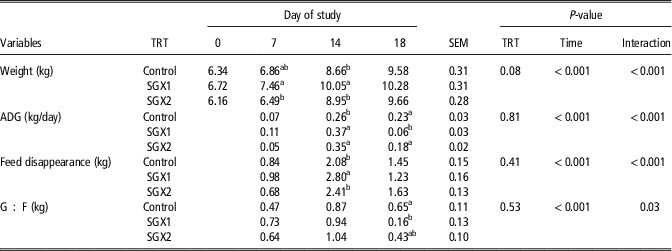
All pig performance data are summarized in Table 2. Pig BW was affected by a treatment×time interaction, where SGX1 pigs had greater BW than SGX2 pigs on day 7 (P=0.02), and SGX1 pigs had greater BW than Control and SGX2 pigs on day 14 (P⩽0.008). There was a treatment × time interaction (P<0.001) for pig ADG such that SGX1 and SGX2-supplemented pigs had greater ADG on day 14 than Control pigs (P⩽0.01), and Control and SGX2 pigs had greater ADG than SGX1 pigs on day 18 (P⩽0.003). There was also a treatment × time interaction (P<0.001) for feed disappearance such that SGX1 pigs had greater feed disappearance than Control and SGX2 pigs on day 14 (P⩽0.001). A treatment × time interaction was also observed for G:F (P=0.03). Specifically, SGX1 pigs had decreased G:F than Control pigs on day 18 (P<0.007).
Performance parameters measured in pigs fed a control (Control) diet or supplemented with Lactobacillus acidophilus fermentation product (SynGenX) at 1 (SGX1) or 2 kg/metric ton (SGX2) for 18 days, with administration of an i.v. lipopolysaccharide challenge (25 µg/kg BW) on day 15

TRT=treatment; Interaction=treatment×time; ADG=average daily gain; G : F=gain to feed.
abTreatments with different superscripts within columns differ (P⩽0.05).
Intraperitoneal temperature
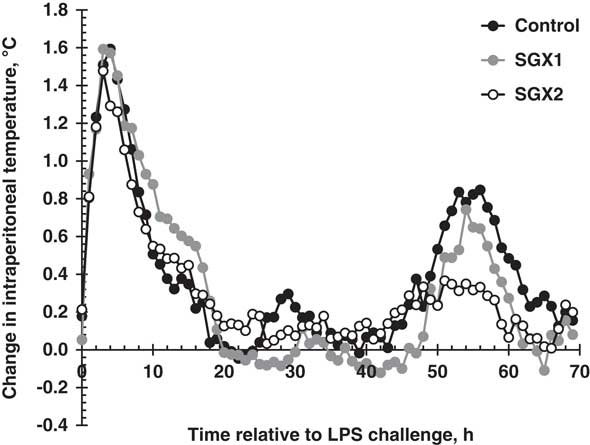
Baseline IP temperature from −186 to 0 h was affected by treatment (P<0.001). Specifically, SGX-supplemented pigs (39.36 and 39.39±0.006°C for SGX1 and SGX2 pigs, respectively) had greater IP temperature than Control pigs (P<0.001; 39.18±0.007°C). In addition, baseline IP temperature was greater in SGX2 pigs than SGX1 pigs (P<0.001). Due to this difference, post-challenge IP temperature values were analyzed based on the change in IP temperature relative to average baseline values, with average baseline values included as a covariate in the analysis. There was a treatment × time interaction for the change in IP temperature following LPS challenge (P=0.009; Figure 1). Specifically, SGX1 pigs had greater IP temperature than Control and SGX2 pigs at 10 h (P⩽0.05), Control pigs had greater IP temperature than SGX1 pigs at 28, 29, 47 and 65 h (P⩽0.05), and SGX2 pigs had reduced IP temperature than Control pigs from 52 to 60 h (P⩽0.01) and SGX1 pigs from 54 to 55 h (P⩽0.05).
Effect of treatment with Lactobacillus acidophilus fermentation product on the change in intra-peritoneal temperature response to an i.v. lipopolysaccharide (LPS; 25 µg/kg BW) challenge in weaned pigs. SynGenX was fed at 1 (SGX1) or 2 (SGX2) kg/metric ton for 18 days. Data presented as least squares mean. The standard error mean is±0.12°C for Control, ±0.13°C for SGX1 and ±0.11°C for SGX2.

Cortisol
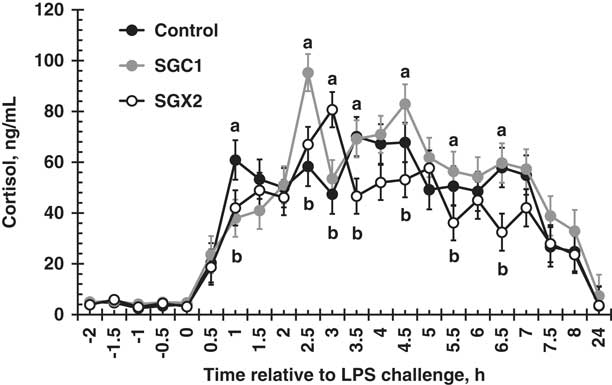
Before administration of LPS, there was no effect of treatment (P=0.18) or a treatment × time interaction (P=0.76). There was an effect of time (P=0.02) for baseline cortisol, but as concentrations were less than 5 ng/ml, the change over time was negligible. Following administration of the LPS challenge, there was a treatment × time interaction (P=0.01; Figure 2). Specifically, cortisol concentrations were greater in Control pigs than SGX1 at 1 h (P=0.03), but less than SGX1 pigs at 2.5 h (P<0.001). Serum cortisol was also reduced in Control pigs than SGX2 at 3 h (P=0.002), but was greater in Control than SGX2 pigs at 3.5 and 6.5 h (P⩽0.02). Finally, cortisol concentrations were greater in SGX1 pigs than SGX2 at 2.5, 3.5, 4.5, 5.5 and 6.5 h (P⩽0.05), but was less in SGX1 compared with SGX2-supplemented pigs at 3 h (P=0.01).
Effect of treatment with Lactobacillus acidophilus fermentation product on the serum cortisol response to an i.v. lipopolysaccharide (LPS; 25 µg/kg BW) challenge in weaned pigs. SynGenX was fed at 1 (SGX1) or 2 (SGX2) kg/metric ton for 18 days. Data presented as least squares mean±standard error mean. a,bTreatments within time point differ P<0.05.

Cytokines
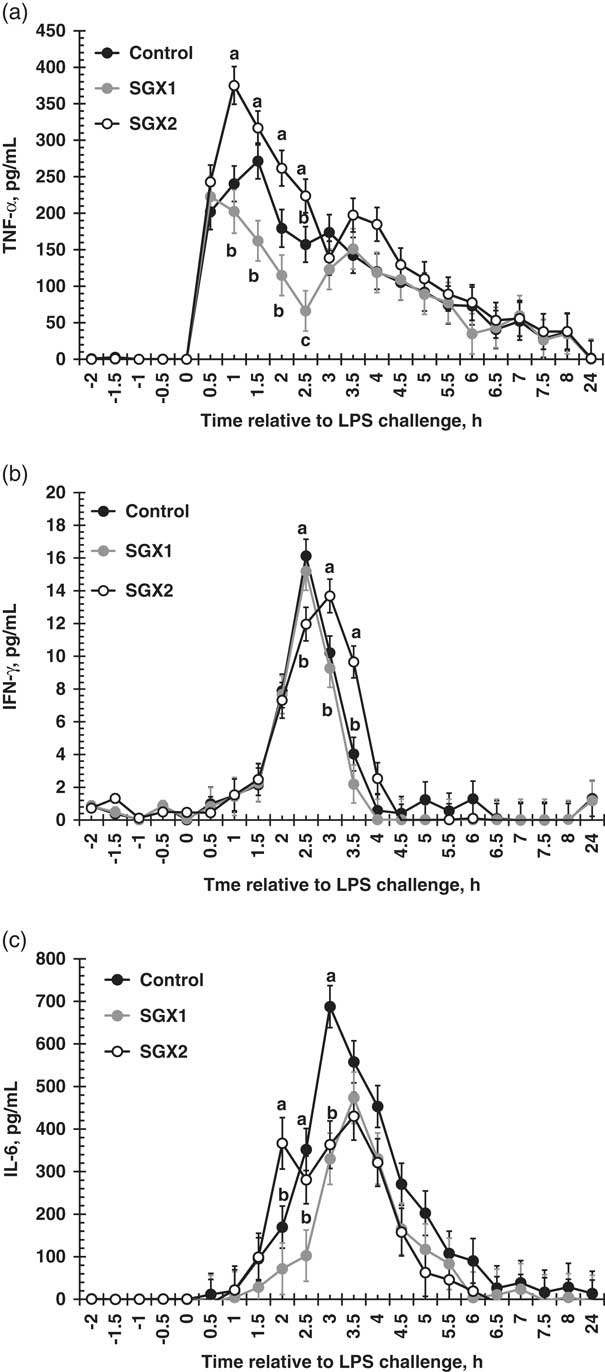
There were no pre-challenge effects of treatment, time or a treatment × time interaction for TNF-α (P⩾0.23). Following administration of LPS, there was a treatment × time interaction (P<0.001) for serum concentrations of TNF-α. Specifically, TNF-α concentrations were greater in Control than SGX1 pigs at 1.5 and 2.5 h (P⩽0.01). In addition, TNF-α was decreased in Control compared with SGX2-supplemented pigs at 1, 2 and 2.5 h (P⩽0.05). Serum TNF-α was also decreased in SGX1 compared with SGX2-supplemented pigs from 1 to 2.5 h (P<0.001; Figure 3a).
Effect of treatment with Lactobacillus acidophilus fermentation product on the serum (a) TNF-α, (b) IL-6 and (c) IFN-γ response to an i.v. lipopolysaccharide (LPS; 25 µg/kg BW) challenge in weaned pigs. SynGenX was fed at 1 (SGX1) or 2 (SGX2) kg/metric ton for 18 days. Data presented as least squares mean±standard error mean. a,b,c Treatments within time point differ P<0.05.

For serum concentrations of IFN-γ, there was no treatment effect or treatment × time interaction (P⩾0.33), but there was an effect of time (P=0.001). However, as baseline concentrations were at or below 1 pg/ml, changes over time were negligible. A treatment×time interaction (P=0.04) was observed for serum concentrations of IFN-γ following administration of LPS. Pigs in the SGX2 treatment group had increased IFN-γ at 2.5 h but decreased IFN-γ from 3 to 3.5 h compared with Control and SGX1 pigs (P⩽0.04; Figure 3b).
Before administration of LPS, there was a treatment × time interaction (P<0.001) for serum IL-6 concentrations. However, as baseline concentrations of IL-6 were 1 pg/ml or less, differences were negligible. There was a tendency (P=0.07) for treatment × time interaction for post-challenge serum IL-6 concentrations. Specifically, IL-6 concentrations were greater in Control than SGX1 pigs from 2.5 to 3 h (P⩽0.001). Serum IL-6 was also decreased in Control than SGX2 pigs at 2 h, but was greater at 3 h (P⩽0.01). Finally, IL-6 was greater in SGX2 compared with SGX1-supplemented pigs at 2 and 2.5 h post-challenge (P⩽0.03), whereas IL-6 was greater in SGX2 than SGX1 pigs from 2 to 2.5 h post-challenge (P⩽0.01; Figure 3c).
Complete blood counts
Before the challenge, there were treatment effects for red blood cell (P=0.006) and eosinophil concentrations (P=0.001; Table 3). Specifically, red blood cell concentrations were greatest in Control and least in SGX2 pigs, whereas eosinophil concentrations were greater in SGX1 compared with Control and SGX2 pigs. There were no treatment effects for hemoglobin, hematocrit, platelets or monocyte concentrations (P⩾0.08), nor were there a time effects or treatment × time interactions for the aforementioned hematological variables (P⩾0.16; Table 3).
Complete blood cell count parameters measured in pigs fed a control (Control) diet or supplemented with Lactobacillus acidophilus fermentation product (SynGenX) at 1 (SGX1) or 2 kg/metric ton (SGX2) for 18 days before an i.v. lipopolysaccharide challenge (25 µg/kg BW) on day 15

TRT=treatment; Interaction=treatment×time.
abTreatments with different superscripts within rows differ (P⩽0.05).
Following administration of LPS at time 0 h, there was a treatment effect for platelet concentrations (P<0.001; Table 4). Specifically, platelet concentrations were greater in SGX1 pigs compared with Control and SGX2-supplemented pigs. In addition, there was a treatment × time interaction (P=0.02) for post-challenge monocyte concentrations, where SGX1-supplemented pigs had greater monocyte concentrations than Control at 24 h, and SGX1-supplemented pigs had greater monocyte concentrations than SGX2 pigs at 8 and 24 h post-challenge. Red blood cell, hemoglobin, hematocrit and eosinophil concentrations were not affected by treatment effects (P⩾0.07) or treatment × time interactions (P⩾0.38), but all variables changed over time (P⩽0.001; Table 4).
Complete blood cell count parameters measured in pigs fed a control (Control) diet or supplemented with Lactobacillus acidophilus fermentation product (SynGenX) at 1 (SGX1) or 2 kg/metric ton (SGX2) for 18 days following administration of an i.v. lipopolysaccharide challenge (LPS; 25 µg/kg BW) on day 15

TRT=treatment; Interaction=treatment×time.
abTreatments with different superscripts within rows differ (P⩽0.05).
1 Cov: covariate, that is, the average baseline values from −2 to 0 h before administration of LPS.
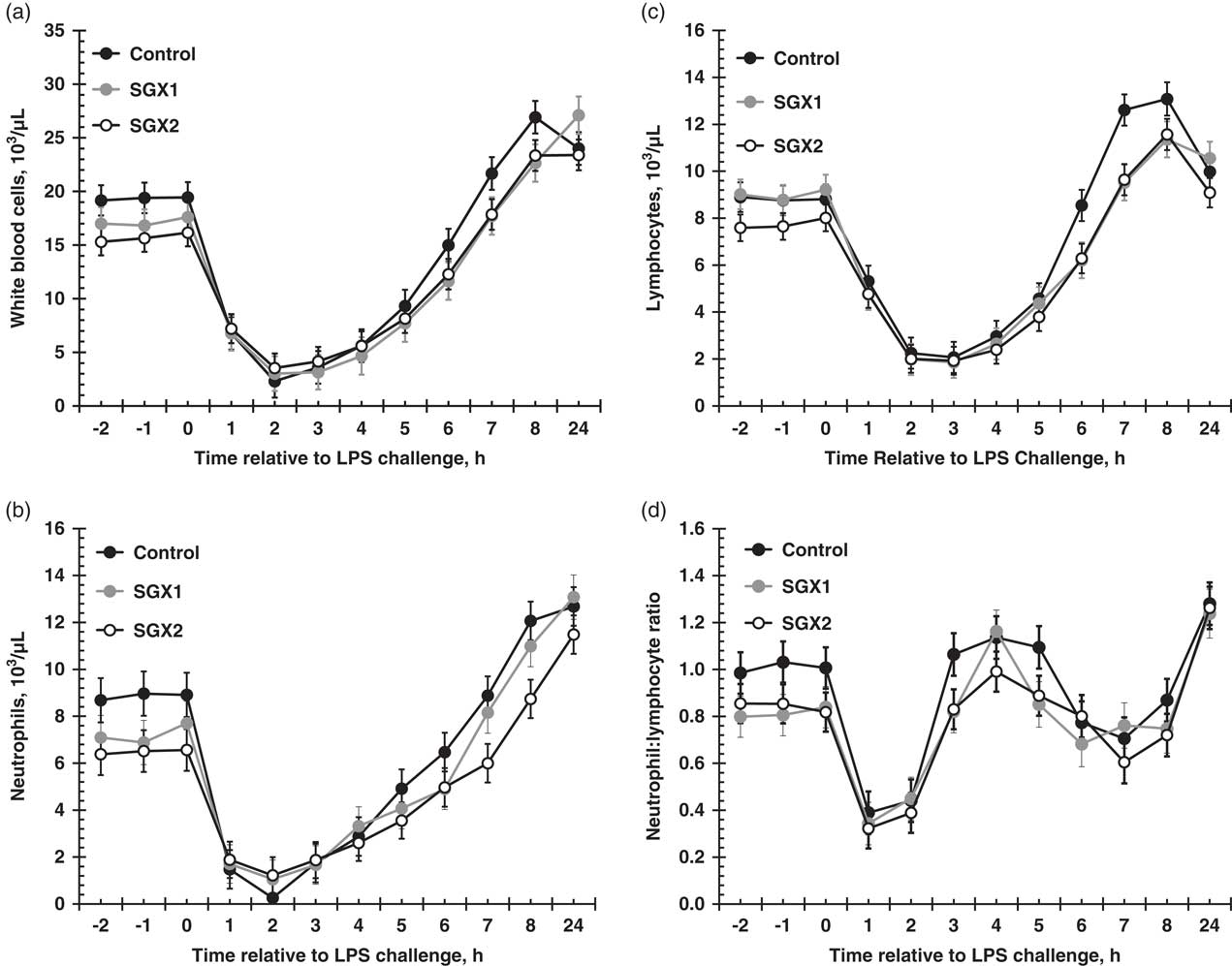
There was a treatment effect (P=0.006) for white blood cell concentrations before the challenge (Figure 4a), but there was no time or treatment × time interaction (P⩾0.87). Specifically, white blood cell counts were greater in Control (19.34±0.82×10³ cells/µl) than SGX2 pigs (15.70±0.73×10³ cells/µl), with SGX1 pigs being intermediate (17.14±0.88×10³ cells/µl). Post-challenge there was an effect of time (P<0.001), but not treatment or treatment × time interaction (P⩾0.23).
Effect of treatment with Lactobacillus acidophilus fermentation product on the (a) total white blood cell, (b) neutrophil, (c) lymphocyte and (d) neutrophil:lymphocyte ratio response to an i.v. lipopolysaccharide (LPS; 25 µg/kg BW) challenge in weaned pigs. SynGenX was fed at 1 (SGX1) or 2 (SGX2) kg/metric ton for 18 days. Data presented as least squares mean±standard error. Time values on x-axis are not to scale (8 to 24 h).

Similarly, there was a treatment effect for neutrophils prior to the challenge (P=0.008) such that Control pigs had greater neutrophil concentrations (8.85±0.54×10³ cells/µl) than SGX1 (7.23±0.54×10³ cells/µl) and SGX2 pigs (6.49± 0.51×10³ cells/µl; Figure 4b). However, there was no time effect or treatment × time interaction pre-challenge (P⩾0.89). Following administration of LPS, there were effects of time and treatment (P⩽0.03), but no treatment × time interaction (P=0.64). Specifically, Control and SGX1 pigs had greater concentration of neutrophils (5.94± 0.27×10³ cells/µl and 5.68±0.27×10³ cells/µl, respectively) than SGX2 pigs (4.97±0.26×10³ cells/µl).
Before administration of LPS, concentrations of lymphocytes were affected by treatment (P=0.02), but not time or treatment × time (P⩾0.85). Pre-LPS lymphocyte concentrations were greater in Control (8.82±0.37×10³ cells/µl) and SGX1 pigs (9.01±0.37×10³ cells/µl) than SGX2 pigs (7.75±0.33×10³ cells/µl; Figure 4c). Following administration of LPS, lymphocyte concentrations were affected by treatment and time (P⩽0.002), but there was no treatment×time interaction (P=0.54). Control pigs had greater lymphocyte counts post-challenge (7.00±0.23×10³ cells/µl) than SGX1 (6.23±0.22×10³ cells/µl) and SGX2 pigs (5.97±0.20×10³ cells/µl), and there was a tendency (P=0.06) for SGX1 pigs to have greater lymphocyte counts than SGX2 pigs.
Similarly, there was a treatment effect (P=0.02) for neutrophillymphocyte (NL) ratio before administration of the LPS challenge. Specifically, the NL ratio was greater in Control (1.01±0.05) compared with SGX1 (0.81±0.05) and SGX2 pigs (0.84±0.05; Figure 4d). There was no pre-challenge time effect or treatment × time interaction (P⩾0.97). There was an effect of treatment and time (P⩽0.03) following the LPS challenge, but there was no treatment × time interaction (P=0.96). Specifically, Control pigs had greater NL ratio (0.87±0.03) compared with SGX2 pigs (0.76±0.03), with SGX1 pigs being intermediate (0.79±0.03).
Discussion
Use of probiotics have been studied for many years, but only recently have studies become more focused on their ability to improve livestock health in light of the increased pressure to reduce antibiotics and include more natural additives in feeds. Many different yeast, live bacteria and bacterial by-products have literature supporting improved performance and immune function in various livestock species. The current study evaluated a product created from the anaerobic fermentation of L. acidophilus which contains metabolites from the bacteria including organic acids, peptidoglycans, proteins and peptides. This research is novel as it is one of the first studies demonstrating a L. acidophilus fermentation product (SGX) can attenuate the APR in weaned pigs to a provocative immune challenge.
Supplementation with the lower dose of SGX (SGX1) in weaned pigs improved pig BW and feed conversion compared with Control pigs in the current study. These data are supported by work in other pig models utilizing the same product where performance parameters were improved compared with non-supplemented pigs (Frank and Scott, Reference Frank, Brainard, Wright and Scott2012; Frank et al., Reference Frank and Scott2013; Fruge et al., Reference Fruge, Hansen, Hansen, Frerichs, Hastad, Scott, Frank and Brainard2013). Studies utilizing a L. acidophilus supplement or a Lactobacillus fermentation product (fermentation product from Lactobacillus bulgaricus, Lactobacillus casei and Streptococcus thermaphilus) also observed enhanced performance in weaned pigs. Specifically, supplemented pigs had improved BW and feed intake compared with control pigs (Lessard and Brisson, Reference Lessard and Brisson1987; Qiao et al., Reference Qiao, Li, Wang and Wang2015; Lan et al., Reference Lan, Koo and Kim2017). Thus, the current study supports previous data reported on the supplementation of SGX and other Lactobacillus products in weaned pigs. Studies utilizing L. acidophilus and Lactobacillus fermentation products suggest one role of the bacteria is stabilization of the gut microbiota or maintenance of gut homeostasis (Lessard and Brisson, Reference Lessard and Brisson1987; Azevedo et al., Reference Azevedo, Zhang, Wen, Gonzalez, Saif, Yousef and Yuan2012). It is possible that this modulation of the gut microbiota influences digestion or digestibility, thus improving overall pig growth and performance. However, more detailed studies using this particular L. acidophilus fermentation product are needed to confirm this hypothesis. In addition, following administration of LPS, decreased ADG and G:F was observed in SGX1-supplemented pigs. It is not clear why there was a decrease in performance in this treatment group following the challenge. However, as data were collected at only one time point following the challenge, it is difficult to determine whether the decreased performance would have been observed past this single time point. More data are needed during the recovery period following an immune challenge to determine whether there is a benefit of supplementing such products on post-challenge performance.
Administration of LPS to pigs produces a controlled and predictable febrile response. The current study is one of the first to demonstrate this response in pigs using an indwelling IP temperature recording device, which allowed for measurement of body temperature at constant, frequent intervals without the need to handle the pigs (Tesch et al., Reference Tesch, Bannert, Kluess, Frahm, Huther, Kersten, Breves, Renner, Kahlert, Rothkotter and Danicke2018). This is a large improvement on current rectal temperature measurements which require handling of pigs, thus inducing a stress response which can alter body temperature. The temporal temperature response in the current study is similar to rectal temperatures reported by others when LPS was administered to pigs (Wright et al., Reference Wright, Balaji, Hill, Dritz, Knoppel and Minton2000; Kim et al., Reference Kim, Lindemann and Cromwell2010). Both treatments in the current study reduced IP temperature change in response to LPS challenge. Interestingly, while most APRs (i.e. cytokines and cortisol) to LPS resolve within 8 h, some of the differences observed in IP temperature were not observed until after 48 h post-challenge. This may be representative of innate immune responses such as production of acute phase proteins which occur 24 to 48 h later (Petersen et al., Reference Petersen, Nielsen and Heegaard2004), or subsequent activation of the adaptive immune response. Although the focus of the current study was the APR, it would be of interest to see if similar treatment responses are observed in other challenge models that focus more on adaptive immunity. Pro-inflammatory cytokines, specifically TNF-α, IL-6 and IL-1β, have been linked to changes in body temperature in response to an immune challenge (Dinarello, Reference Dinarello1996; Steiger et al., Reference Steiger, Senn, Altreuther, Werling, Sutter, Kreuzer and Langhans1999; Black, Reference Black2002). Data from the current study support this link, as decreased IP temperature and decreased TNF-α (SGX1 only) and IL-6 concentrations were observed in SGX-supplemented pigs. However, it is interesting that a differential TNF-α response was observed between the two treatment levels, as discussed more below.
Observing the cortisol data gives insight into the influence of product inclusion rates on the APR due to the dichotomy of the response between treatment doses. Although supplementation with SGX at 1 kg/MT (SGX1) increased the cortisol response compared with Control pigs, supplementing pigs at 2 kg/MT (SGX2) decreased the cortisol response to LPS. Perhaps the greater cortisol observed by SGX1 pigs influenced the reduction observed in TNF-α and IL-6 concentrations post-challenge; however, decreased IL-6 concentrations were also observed in SGX2 pigs. In contrast to the current study, Lee et al. (Reference Lee, Kim, Koo and Kim2016) reported no effect of SGX treatment on cortisol concentrations following IP injection of LPS. The dichotomy of the cortisol response between the two treatment doses may be reflective of the ability of the doses to stimulate the hypothalamic–pituitary–adrenal axis. However, more research is necessary to determine the reason for the dichotomy in cortisol responses between the two treatment groups.
Lee et al. (Reference Lee, Kim, Koo and Kim2016) reported decreased TNF-α and IL-6 concentrations, potentially through mediation of TLR4 and NF-κB, in SGX-supplemented pigs following IP administration of LPS. This supports the decreased TNF-α (SGX1 only) and IL-6 concentrations observed in the current study in SGX-supplemented pigs. A study by Qiao et al. (Reference Qiao, Li, Wang and Wang2015) reported decreased TNF-α and IFN-γ concentrations, but no difference in IL-6 concentrations in L. acidophilus probiotic supplemented pigs. While no treatment differences in IFN-γ was observed among treatments in the current study, it is interesting to note the different pattern of IFN-γ secretion by the SGX2 pigs. Studies in gnobiotic pigs challenged with human rotavirus have suggested a potentiating or pro-inflammatory effect of L. acidophilus on the immune response, resulting in greater pro-inflammatory cytokine production and greater immunoglobulin response to viral challenge (Zhang et al., Reference Zhang, Azevedo, Wen, Gonzalez, Saif, Li, Yousef and Yuan2008; Wen et al., Reference Wen, Li, Bui, Liu, Li, Kocher, Lin, Yang and Yuan2012). Further, Wen et al. (Reference Wen, Li, Bui, Liu, Li, Kocher, Lin, Yang and Yuan2012) reported differential effects on T cells when gnobiotic pigs were supplemented with either a high or a low dose of L. acidophilus probiotic. This is interesting considering the differential cytokine and cortisol responses observed in the current study. Clearly, the gnobiotic pig is a different model, but these aforementioned studies highlight the influence of dose of supplements on the activation of the immune response. The dichotomy in the TNF-α response between the two treatment levels (SGX1 v. SGX2) is also very interesting, as the SGX1 dose appeared to reduce TNF-α concentrations, while the SGX2 dose increased the TNF-α response. As mentioned above, this is opposite from what was observed in cortisol concentrations, suggesting that cortisol may have had a role in the differing TNF-α responses between the two treatment doses. While the ability of cortisol to inhibit production of pro-inflammatory cytokines is supported in the literature (Ashwell et al., Reference Ashwell, Lu and Vacchio2000; Hughes et al., Reference Hughes, Carroll, Burdick Sanchez and Richeson2014; Galbo and Kall, Reference Galbo and Kall2016), there was a positive correlation coefficient (r=0.36; P<0.001) between cortisol and TNF-α in the current study. Thus, further research is necessary to explain the dichotomy between the cortisol and cytokine responses between the two treatment doses.
In response to infection, white blood cells leave the peripheral circulation and enter into tissues where they often differentiate into a more active state. This was observed in the current study, where a significant decrease in white blood cells was observed following administration of LPS. Interestingly, supplementation with SGX influenced both baseline and post-challenge lymphocyte and neutrophil responses. Similar to the current study, decreased lymphocytes were observed in pigs supplemented with SGX 4 h following an IP LPS challenge, and decreased white blood cells were observed at 6 and 12 h post-challenge (Lee et al., Reference Lee, Kim, Koo and Kim2016). In addition, mice fed a heat-killed L. acidophilus had decreased neutrophils and eosinophils in response to bovine β-lactoglobulin sensitization (Li et al., Reference Li, Meng, Duan, Huo, Zheng and Li2013). In contrast, no differences in immune cell populations were found in humans supplemented with L. acidophilus probiotic for 3 weeks (Schiffrin et al., Reference Schiffrin, Rochat, Linkamster, Aeschlimann and Donnethughes1995). Thus, from the available data it appears that supplementation with SGX or other L. acidophilus products may reduce circulating immune cell populations. While the mechanism driving this response is unclear, it is possible that supplementation with SGX was able to prime or prepare the pigs for the challenge, thus requiring a lesser response to the LPS challenge.
In summary, supplementation with the L. acidophilus fermentation product SynGenX increased pig BW and ADG (pre-challenge), reduced the change in IP temperature, and decreased cortisol (SGX2 pigs only), white blood cells (pre-challenge), neutrophils, lymphocytes, NL ratio and serum TNF-α (SGX1 pigs only) and IL-6 concentrations. It is also apparent that different supplementation feed inclusion rates of SynGenX produced differential responses to LPS challenge in cytokine, monocytes and eosinophils concentrations. These data demonstrate that feeding an all-natural L. acidophilus fermentation product to newly weaned pigs can attenuate the APR to an LPS challenge.
Acknowledgments
Mention of trade names or commercial products in this article is solely for the purpose of providing specific information and does not imply recommendation or endorsement by the US Department of Agriculture (USDA). The USDA prohibits discrimination in all its programs and activities on the basis of race, color, national origin, age, disability and where applicable, sex, marital status, familial status, parental status, religion, sexual orientation, genetic information, political beliefs, reprisal, or because all or part of an individual’s income is derived from any public assistance program. (Not all prohibited bases apply to all programs.) Persons with disabilities who require alternative means for communication of program information (Braille, large print, audiotape, etc.) should contact USDA’s TARGET Center at (202) 720–2600 (voice and TDD). To file a complaint of discrimination, write to USDA, Director, Office of Civil Rights, 1400 Independence Avenue, SW, Washington, DC 20250–9410, or call (800) 795–3272 (voice) or (202) 720–6382 (TDD). USDA is an equal opportunity provider and employer. The authors appreciate the excellent technical support provided by J.W. Dailey, J.R. Carroll, and R. E. Buchanan (USDA-ARS). This research was supported in part by Diamond V, Cedar Rapids, IA, USA.
Declaration of interest
The authors declare no conflicts of interest.
Ethics statement
All experimental procedures were in compliance with the Guide for the Care and Use of Agricultural Animals in Research and Teaching and approved by the Institutional Animal Care and Use Committee at the USDA-ARS Livestock Issues Research Unit, Lubbock, TX, USA.
Software and data repository resources
None.