I Introduction
Pandemic and epidemic diseases (PEDs) represent major threats to societies because they are widespread in range and indiscriminate in their effects.Footnote 1 The notion of potentially severe mass injuries or deaths, often coupled with intense pain and suffering, makes the legal and policy response to PEDs a very delicate subject, driven by competing and at times conflicting factors including value-based policy choices, public perception and economic considerations. The inherent complexity of this response is illustrated in general terms by Anniek de Ruijter and Hylke Dijkstra in the Introduction to this special issue. An integrated approach, with elements of both public health and security, is steadily establishing itself as a discrete niche of European policy.Footnote 2
The focus of this article is the EU policy and regulatory framework for the production and distribution of vaccines in the face of PED outbreaks. The essential elements of this framework are the so-called “mock-up” and “emergency” procedures designed, respectively, to rapidly approve and distribute vaccines in advance of a pandemic or once the pandemic has been declared. De Ruijter and Dijkstra identify four major drivers behind the growing health-security nexus in EU policy: the presence of systemic risks; a policy-making style generally reactive to events; expanding EU-level entrepreneurship; and related progressive accumulation of competence. However, the central point of this article is complementary in so far as it identifies as a defining feature of the PED vaccines regulatory framework a tension between public health and a twofold set of competing considerations: on one hand the growing health-security nexus since the A-N1H1 influenza outbreak of 2009–2010, and on the other hand the role of market efficiency considerations and of the private sector, which in a market economy is inevitable when mass production and distribution of sophisticated goods such as vaccines is required. This tension introduces a further layer of intricacy, and the aim of this article is to suggest a research agenda with the goal of clarifying how these different factors interact and contribute to define the space of public health in the complex realm of vaccines for PEDs. To do so, the article is divided into three sections discussing discrete but closely related aspects of the regulatory and policy framework. Within the discussion of each aspect, areas of tension between public health, security and the market will emerge, setting the perimeter of much needed sector-specific in-depth analysis.
The first part outlines the EU policy and regulatory framework governing emergency vaccines. As health emergencies tend to be transnational in nature, the discussion moves from the international scene dominated by the WHO to the transnational networks in which the EU is engaged, and against that backdrop illustrates the technical details of the EU governance model to create a “chart” of the emergency vaccine regulatory framework.
The second part examines the responsiveness and levels of preparedness of the EU vis-à-vis potential outbreaks against the backdrop of international strategies. Currently all existing vaccines approved via mock-up procedure in advance of potential pandemics are exclusively focused on influenza strains. Recent outbreaks of the Ebola and Zika viruses in West Africa and South America question whether the EU approach is sufficient in a world of ever-increasing individual mobility.Footnote 3
The third and final part discusses the accountability of vaccine developers, authorising authorities and rule-makers involved at various levels in PED vaccine mock-up and emergency procedures. The focus is on the extent to which the EU framework balances imperatives of expediency with the need to guarantee sufficient levels of transparency and accountability to avoid generating further threats.
II Contextual analysis of EU PED vaccine governance
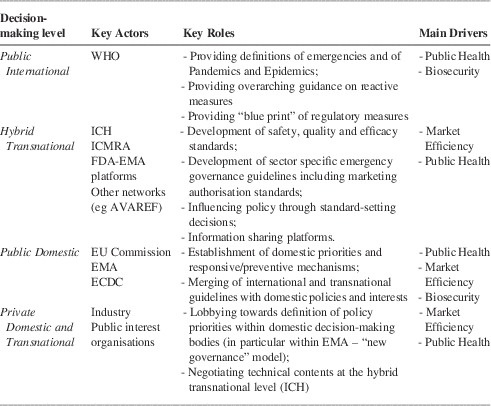
Understanding the multilevel governance framework in place to counter PEDs requires first and foremost a general acknowledgment that public health emergencies are inherently transnational, as diseases do not stop at national borders.Footnote 4 Complex international and transnational bodies and processes are involved in the definition and identification of, and subsequent reaction to, PEDs and ensuing emergencies. There are four different levels at which different stages of decision-making take place, to which correspond four different types of actors involved, with discrete roles and driving motivations – as succinctly depicted in Table 1.
Synopsis of decision-making levels, actors involved, their roles and main drivers

Section 1 considers the international and transnational levels, while the domestic level will be developed in Section 2. The aim is to map interwoven policy and regulatory frameworks in order to enable a subsequent analysis of the substantial and procedural challenges the EU is faced with when it comes to PEDs. As the various levels are analysed, the tension between health, security and market will become progressively clear.
1 The international and transnational framework
a The public international level
In the realm of PEDs, the World Health Organization (WHO)Footnote 5 defines epidemics as follows:
“The occurrence in a community or region of cases of an illness, specific health-related behaviours, or other health-related events clearly in excess of normal expectancy. The community or region and the period in which the cases occur are specified precisely. The number of cases indicating the presence of an epidemic varies according to the agent, size, and type of population exposed, previous experience or lack of exposure to the disease, and time and place of occurrence”Footnote 6
A pandemic on the other hand is “an epidemic occurring worldwide, or over a wide area, crossing international boundaries and usually affecting a large number of people.”Footnote 7 Epidemics and pandemics can trigger the declaration of a “state of emergency” by WHO,Footnote 8 which forms the basis for the adoption of special measures – and in particular, for the purpose of this article, emergency approval of vaccines.Footnote 9 In the face of PEDs, WHO functions as the coordinating entity for the operation of the International Health Regulations 2005 (IHR 2005),Footnote 10 which stipulate a range of reactive measures including (but not limited to) surveillance and reporting duties on states, collaborative risk assessments, and coordination of international responses. The IHR 2005 establish a complex framework, which appears to be increasingly characterised by biosecurity instances (particularly regarding readiness and response to major epidemic-prone diseases such as viral hemorrhagic fevers like Ebola).Footnote 11 Interestingly, while the focus is on rapid exchange of information and assessments, containment strategies and hygienic preventive behaviours, little is said on vaccine development as such. That appears to be still a very much disease-specific feature, largely focused on what has been for decades the focus of vaccine R&D for infectious diseases: influenza.Footnote 12
Since the 2009 A-H1N1 (“Swine Flu”) outbreak, the Global Action Plan for Influenza Vaccines (GAP)Footnote 13 attests that several lessons have been learned in terms of reactivity, clinical trial organisation and preventive measures.Footnote 14 A general plan on influenza pandemic preparedness and responseFootnote 15 has been developed, which should guarantee relatively well-rehearsed regulatory cooperation in the face of pandemic or epidemic influenza through ad hoc fora such as the International Coalition of Medicines Regulatory Authorities (ICMRA).Footnote 16 A-H1N1 was a rather severe test for the IHR 2005, which were supposed to ensure surveillance and early-warning mechanisms.Footnote 17 One of the major criticisms levied against WHO during the “Swine Flu” outbreak was the alleged “overstatement” of the actual severity of health threats posed by the disease, which ended up causing significantly less fatalities than “regular” annual influenza strains.Footnote 18 This raised questions as to the true necessity of emergency vaccine production and distribution, as well as the modes of testing and production of large quantities of such vaccines – distributed in the EU by private companies protected by strong contractual liability shields with Member State governments.Footnote 19 Since the Swine Flu crisis the international response to emerging influenza strains has been maturing. However, quid when the infectious disease threatening regional or global outbreaks is not influenza and therefore falls beyond the scope of the post-2009 GAP? IHR 2005 offers a reactive and containment plan that does not focus principally on vaccination. A WHO-designed R&D blueprint has however been developed and is constantly updated,Footnote 20 together with the adoption of the so-called Emergency Use Assessment and Listing Procedure (EUAL),Footnote 21 initiated as a consequence of the 2014 Ebola outbreak. The effectiveness of these measures will be further discussed in Part III.
b The hybrid transnational level
A significant difficulty when discussing PED vaccine policy and regulatory structures is the clear identification of every level of decision-making. While WHO provides a general “blueprint”, and the related initiatives mentioned above provide overall policy guidance, the “dirty work” of actual standard setting is often carried out at a hybrid transnational level. There are several players at this level. Of particular importance are the numerous cooperation platforms between EMA and FDA,Footnote 22 which are currently in the process of being translated (if not transplanted tout court) into a number of other areas of regional integrationFootnote 23 – this raises the problem of whether eminently “Western” mechanisms are the appropriate recipe for developing countries and regions. An interesting emerging transnational cooperating body is the African Vaccine Regulatory Forum (AVAREF),Footnote 24 which allows African National Regulatory Agencies (NRAs) to collaborate in the design and implementation of clinical trials to expedite marketing approval and accessibility of emerging vaccines. AVAREF was particularly active during the Ebola outbreak, enabling fast-track approval of clinical trials for potential Ebola vaccines – though the results of the trials have been limited, partially due to underfunding of the initiative.Footnote 25
Possibly the most influential body at this level is the recently renamed International Council on Harmonization (ICH),Footnote 26 where regulators from a range of jurisdictions negotiate regulatory and standardisation guidelines with representatives of the industry.Footnote 27 The range of products covered by ICH is wide, and includes vaccines and blood products. Because of its controversial nature ICH will be discussed in greater detail in Part IV.
The supra-national level appears to be “split” between a public international sphere that has the ability and mandate to dictate general policy recommendations, reaction plans with increasing emphasis on biosecurity narratives, and a transnational level of technical decision-making reached through public-private negotiations.Footnote 28
2 The EU Policy and Regulatory Framework for PED Vaccines – or the public domestic level
The EU has developed a detailed legal and policy framework to confront the occurrence of influenza PEDs. The basis of the framework is laid down in Directive 2001/83/EC on the approximation of the laws for pharmaceuticals for human use,Footnote 29 which provides for three different particularly complex approval procedures for pharmaceutical products in general, including vaccines. The possibility of amending (by way of simplification and shortening) the regular marketing authorisation process is provided by Regulation (EC) 1234/2008,Footnote 30 which lays down the “variations of the terms of authorisation” of pharmaceutical products containing several exceptions relating to vaccine approvals. For example, pursuant to Article 12, regular updates of seasonal influenza vaccines benefit from particularly simplified pre-marketing assessments. It is Article 21 that specifically tackles the PED scenario, providing that once an influenza PED is declared by WHO or the EU itself “the Commission may exceptionally and temporarily accept a variation to the terms of a marketing authorisation for a human influenza vaccine, where certain non-clinical or clinical data are missing.” This provision is to be read in conjunction with the essential Commission Decision 1082/2013/EU (Health Threats Decision),Footnote 31 which provides the more general framework for cases of cross-border threats to health, and calls for the application of mock-up or emergency procedures of vaccine approval designed by the European Medicines Agency (EMA). These are special procedures specifically designed for the rapid release of vaccines in the face of influenza PEDs, and they can be outlined as follows:
-
− The mock-up authorisation procedure allows pharmaceutical companies to prepare vaccines based on influenza strains to which very few humans have been exposed: this is to circumvent the obvious problem that when a pandemic breaks, the actual strain is not yet known and therefore not yet worked through. This procedure therefore necessitates strong scientific forecast modelling of potential outbreaks. Once the pandemic breaks out, companies are authorised to replace the “artificial” strain in their vaccines with the actual strain involved in the pandemic.
-
− The emergency authorisation procedure is conceptually different in so far as it does not involve “in lab” created vaccines, but rather the development of an entirely new vaccine based on rolling data supplied by manufacturers as they become available in the course of an outbreak, with stringent review and assessment deadlines for EMA and the EU Commission. The objective is the speedy granting of a “conditional approval” on the premise that the vaccine’s benefits outweigh its risk, with competent authorities maintaining special suspensory powers should the risk/benefit balance change in light of emerging data.Footnote 32
Beyond influenza, the Health Threats Decision creates a comprehensive policy framework, supported by a new body, the Health Security Committee, responsible for EU-wide coordination of reactive measures in the face of merging threats to public health, and reinforces the existing European Center for Disease Control (ECDC)Footnote 33 by widening the scope of its Early Warning and Response System (EWRS).Footnote 34 The Health Threat Decision constitutes a significant step towards bridging security policy and public health, in so far as it makes abundant use of security language, and finds its legal basis on Article 168 TFEU (which constitutes the legal foundation for the health-security nexus in EU law in primary legislation).Footnote 35 This appears to be coherent with the international trend suggested above, where the essential IHR 2005 and WHO emergency framework paint a similar picture. Yet, the EU mechanisms of fast-track approval for vaccines in the face of upcoming PEDs find their legal basis in Art 114 TFEU (Approximation of laws) making the integration of the security element in this piece of the public health puzzle more complex. The impression is that of an unresolved hiatus: on the one hand a growing health-security nexus impacting public health through widening the number and nature of reactive measures at the disposal of public authorities in the face of upcoming widely defined health threats under the Health Threats Decision; on the other hand, a much more narrowly-defined margin of operation in the realm of vaccine approvals.
While the influenza pandemic scenario has been developed to a great level of detail both in policy and regulation, there remains a non-negligible level of uncertainty as regards different new emerging PEDs – situations in which the suggested hiatus might have practical implications. Of course, the development (and a fortiori the urgent development) of vaccines covering new or relatively unknown PEDs is characterised by inherent and unavoidable levels of scientific ignorance that create formidable obstacles to the discovery and approval of safe and effective vaccines. However, the difficulties encountered in recent outbreaks (Ebola and Zika in particular) may also be explained by reference to a concurrent aspect: the structural design of the EU medicines and PED governance framework, where market-driven factors influence medicine and vaccine R&D.
III Contextual analysis of EU levels of responsiveness and preparedness
1 International strategies in the wake of Ebola and Zika
The international framework has been tested in recent years, to the extent that new strategies are in the process of being developed to face future PEDs.Footnote 36 In particular, recent outbreaks of Ebola in West Africa and Zika in South America have revealed a series of structural weaknesses of the international strategies currently in place to prevent and react to emerging health threats falling outside the scope of the (now) well-developed framework for influenza diseases.Footnote 37 As a matter of fact these outbreaks seem to prove a point raised by some commentators criticising the general international attitude towards emerging diseases: eminently post-factum and disease-specific rather than oriented at prevention and general healthcare provision in developing sites.Footnote 38 From this perspective it is important to underline the WHO shift towards biosecurity – ie increasing attention towards preventive rather than reactive measures in high-risk sites – as these recent outbreaks have shown that the old strategies often fail. While it is beyond the scope of this paper to analyse better alternative health policies for locations where emerging health threats are more likely to develop, it is necessary to understand what went wrong in addressing remedial emergency prophylactic measures.
From the perspective of scientific personnel directly involved in the outbreaks’ management, as reported in publications such as the New England Journal of Medicine or The Lancet, five technical issues have emerged when attempting to develop emergency vaccines and treatments. First, (i) there has been an obvious problem of communication between marketing authorisation agencies of “producing countries” and the ones in “affected countries”, specifically with regard to the identification and applicability of testing standards.Footnote 39 Two related capacity problems in affected sites are (ii) the weakness or absence of ethics review committees, making circulation of clinical data from affected countries extremely problematic, and (iii) the total lack of experience in the design and conduct of clinical trials in affected countries.Footnote 40
More to the point, there appears to be a general lack of guidelines on the conduct of trials in emergencies.Footnote 41 While fast-track studies can be conducted and designed in Western countries, the levels of know-how and capacity required to conduct such trials while maintaining minimum standards of quality are exclusively available in highly developed sites, definitely not in the affected areas (raising the general question: is on-site post-factum intervention an appropriate model?).Footnote 42 A fourth (iv) issue regards the limited impact under current circumstances of the WHO EUAL,Footnote 43 as these are meant to work as a sui generis form of WHO prequalification in emergencies, but require pre-existing groundwork (ie trial data) to be effective.
Finally (v) there has been an alarming lack of leadership in coordinating global reactive regulatory efforts (to be addressed by the emerging role of ICMRA).Footnote 44 A study recently conducted by WHO personnel claims that lessons have been learned from the Ebola crisis and that progress is being made across all the five contentious points raised above.Footnote 45 However no concrete evidence is provided and the various areas of improvement are rather developed as normative guidelines for future action. One element of particular interest will be the future use of EUAL procedures, which are “tailored to emergency situations, when communities may be willing to tolerate less certainty about the efficacy and safety of products given the consequences of the disease”Footnote 46 when treatment is not yet available. The WHO study concludes with an observation that the revised international framework is being currently tested by an ongoing outbreak of Lassa Fever in Guinea, with two vaccine candidates in the process of undergoing EUAL procedure.Footnote 47 This was a year ago, and it is not yet clear whether substantial progress has been made as WHO has launched a public consultation process on a “target product profile” for a Lassa Fever vaccine, suggesting that the research is still at a very early stage.Footnote 48
Policies and regulations cannot solve the scientific conundrums that hide behind the development of new vaccines, yet at least three fundamental questions remain in need of further investigation: (i) Are there sufficient regulatory options available for non-influenza PED outbreaks? (ii) Is the specificity of the emergency situation adequately translated into non-influenza PED regulatory frameworks? And (iii) Are there sufficient resources backing up the public health policy agendas and the nominal biosecuritisation of specific health threats?
2 EU’s response/prevention balance
The EU policy and regulatory framework shows weaknesses that are similar to the ones observed in the international community (commentators have gone to the extent of calling the Ebola outbreak a “debacle” for global health).Footnote 49 The dichotomy here is even neater. PED reactive measures are in place at all levels for influenza diseases: there is an overarching legal framework, clear specific regulatory options and fundamental policy choices – all well organised into a coherent prevention/reaction scheme, coupled with explicit legal provisions for the expedited testing and approval of upcoming influenza vaccines (for regular seasonal influenza) as well as a stock of mock-up approved vaccines in advance of potential outbreaks of particularly pernicious strains (eg the Swine Flu or the Avian Flu).Footnote 50 Unfortunately, it is not clear that this is the case for potential outbreaks of other PEDs.
Articles 12 and 13 of Commission Decision 1082/2013 establish that when the Commission recognises the existence of a pandemic, either in relation to human influenza or other serious diseases identified by WHO, that could result in health threats for the EU, Article 21 of Regulation (EC) 1234/2008 can be triggered to allow for special authorisation procedures. Yet the mock-up and emergency procedures are explicitly limited to influenza.Footnote 51 Reactive measures to Ebola and Zika are still entangled in the international difficulties described above. The key question here is whether the codified deference to WHO models of post-factum on site intervention can be accepted as appropriate in a world of: (i) ever-increasing individual mobility;Footnote 52 and (ii) resilient spreads in levels of public health between developed and developing countries;Footnote 53 or whether the increasing EU health-security nexus should prompt proactive action? Focusing specifically on PED vaccines, two observations can be made. First, it appears that although the policy framework is sufficiently developed through the Health Threats Decision, the legal framework to counter emerging health threats is still basic and its level of refinement distant from the predominant influenza model. In particular, the impression here is that while the accent of the growing health-security nexus is generally placed on institutional reaction to health threats,Footnote 54 vaccine development may be tied to a different set of considerations. These involve the practical identification of public health priorities, a theme that leads us back to the initial division in levels and actors.
The private level identified above in Table 1 plays a central role here, as the EU system of PED reaction/prevention is based on incentive mechanisms for vaccine manufacturers to develop and distribute highly risky products. This reliance on market-based incentives poses the obvious problem that highly marketable products take priority within R&D industry strategies. This is not a particularly ground-breaking observation, but it is important to reflect on the fact that legal and regulatory frameworks can only achieve so much when the entire system is based on the premise that it is for the private companies to make the bulk of the investment.Footnote 55 In this sense, a lesson could be learned from the experience of HIV treatments, the success of which rested predominantly on massive public (prominently US)Footnote 56 R&D investment. As the previous section concluded with a series of question marks, the key political question here is whether the health-security nexus that is occupying an increasingly significant space in EU policy language could function as a trigger for the engagement of actors and resources that a scheme based on private initiative alone cannot reach.
IV Reflections on accountability in transnational market-based regulation
Emergency situations tend to exaggerate and amplify difficulties and weaknesses experienced by complex systems under “normal” circumstances.Footnote 57 In the case of PEDs, the key driver in the face of potential outbreaks is the imperative of ensuring the fastest accessibility of counter-measures (with an emphasis on emerging vaccines), as demonstrated for example by the Swine Flu crisis.Footnote 58 Yet the imperative of speediness and prompt market availability must be balanced by adequate accountability mechanisms short of which the paradoxical risk would be that of generating further threats. We have seen how the EU emergency approval framework is currently limited to influenza diseases, so these reflections apply more prominently to influenza vaccines, although they bear general relevance.
While general policy and regulatory frameworks flow from the WHO down to domestic legal systems, the actual process of standardisation where material requirements are developed and subsequently transposed into administrative processes is often outsourced. Again, this is not a particularly revolutionary finding. The EU, internally, is no stranger to this mechanism, which is normally referred to as the New Approach to goods.Footnote 59 A similar principle applies at a transnational level with transnational standard-setting bodies.
Standards and guidelines tend to be the product of negotiations between industry and regulators within hybrid forums. ICH has operated for 27 years as a hybrid public-private platform for regulators and regional representatives of the pharmaceutical industries of the EU, the US and Japan to harmonise regulatory requirements for marketing authorisation in their respective markets. The original functioning of the organisational machinery of ICH has been analysed in detail elsewhere.Footnote 60 For the purpose of the current discussion it is important to underline the (to date) highly confidential and “behind closed doors” nature of the Steering Committee’s (recently renamed “Management Committee”) decision-making. In essence, consultative steps are specifically required at the level of regional administrative agencies (FDA and EMA in particular) at an early stage of the five-step “Formal Procedure” leading to the adoption of harmonised guidelines to ensure local stakeholders’ involvement.Footnote 61 However the decision-making process within the Committee, which leads to the actual adoption or modification of guidelines, is not subject to transparency requirements to the extent that the fate of regional comments cannot be traced. Nor is there any duty to justify the adoption, dismissal or modification of said comments in the final product.Footnote 62
While this article is being drafted, ICH is undergoing a process of restructuring which has led to a series of developments including, inter alia, the introduction of basic transparency requirements such as the publication of minutes of the Management Committee’s meetings and of reports of the newly formed Assembly (this is certainly a welcome improvement; materials are now starting to be made available, which will allow a proper analysis in due course, yet the minimum publicity requirement does not apply retroactively to the vast amount of guidelines currently in use).Footnote 63 However, despite enlarging membership beyond the original founders to a selected number of new countries,Footnote 64 members remain regulators and industry representatives. In other words, while membership is widened in numbers it remains stable in nature, and so does the fundamental market-based driver of the initiative: to reduce R&D costs and promote faster and easier marketing approval in the widest possible number of jurisdictions.
In theory, after ICH approval, guidelines undergo a review process within domestic systems to ensure compliance with fundamental domestic policy choices, in order to bridge the accountability gap – though the tendency is to transpose ICH documents verbatim into domestic regulatory frameworks, which raises questions as to how much the transnational opacity undermines the EU new-governance transparency safeguards.Footnote 65 Emergencies, characterixed by the additional necessity of speediness, exacerbate the “normal” legitimacy and accountability concerns raised by the ICH-EU interplay in the decision-making processes on required standards of safety and efficacy. To give but one example we can refer to the complex ICH Guideline E2E on “Pharmacovigilance Planning”.Footnote 66 The Guideline was approved by ICH in 2004 (with no minutes available as to the content of the negotiations taking place back then) and adopted by the Committee for Medicinal Products for Human Use (CHMP) of the EMA, issued as a CHMP operative guideline CPMP/ICH/5716/03, which came into operation in June 2005.
How exactly is decision-making power allocated in the identification of acceptable levels of societal exposure to emerging health risks? While a fully-fleshed answer to this question requires in-depth analysis that will form the object of future research (particularly necessary in light of the current process of ICH restructuring), substantial research has been recently carried out in the adjacent field of general pharmaceutical products, suggesting that ICH guidelines form de facto policy decisions in the guise of highly technical standardisation documents, which entails the introduction of strong market-based efficiency considerations right at the heart of public health areas.Footnote 67
V Conclusion: towards defining the space of public health
This article had a specific aim: to show the different levels of decision-making involved in vaccine development and approval, and to suggest the drivers that animate the key actors involved. A series of fundamental questions have been raised, which will form the object of future research and hopefully spark some debate in the field.
The preliminary findings of this research can be summarised as follows: increasing governance collaboration is facilitating transnational cooperation in the face of emerging health threats through the adoption of regulatory frameworks (such as IHR 2005) and cooperative networks (such as ICMRA). Yet this collaboration is very much “Western-oriented” both in terms of disease focus and cooperation frameworks. As shown by the Ebola, Zika and more recently Lassa outbreaks, much is still to be achieved on the global stage to bridge the “distance” between developed and developing worlds’ public health priorities when it comes to the development of costly vaccines. A significant gap exists between influenza and other kinds of PEDs as regards policy and regulatory readiness, and that gap is particularly evident looking at the EU framework. On the other hand there remain persistent questions on the ability of current regulatory frameworks to ensure adequate levels of accountability of decision-makers in the wake of PEDs (influenza included).
It seems that two forces are currently influencing the shape of public health policy and regulation of vaccines. On one hand a strong biosecurity narrative is establishing itself in the international sphere, coupled with a growing health-security nexus at the European level, prominently symbolised by the Health Threats Decision. On the other hand the permanence of market-factors is still dominant in industry R&D as well as at a transnational regulatory level (ICH). Defining the space of public health requires confronting these divergent forces.
Two elements emerge clearly from the analysis provided in this article. First, the institutional framework for non-influenza PED vaccines needs further development to account for the specific public needs sparked by outbreaks of highly contagious diseases. On the other hand the resources in place for vaccine R&D are insufficient and reliance on the private sector alone can be problematic. In this sense a final suggestion can be submitted by way of conclusion. The growing health-security nexus could potentially provide the policy platform for significant R&D investment for overlooked potential health threats (eg hemorrhagic fevers).Footnote 68 Yet bringing diseases under the umbrella of security policy comes at a cost, exacerbating problematic accountability mechanismsFootnote 69 if not generating new health threats altogether.Footnote 70 The answer to the conundrum could be the simplest one (if not the easiest politically): that among the competing drivers of public health, security and the market, it should be for public health to dictate the agenda, and for public health authorities to take a leading “entrepreneurial” roleFootnote 71 in vaccine R&D.