Who was David Unaipon?
David Unaipon is commemorated on Australia's 50 dollar note, but who is he and what significant contribution did he make to Australian society? Unfortunately, many Australians will not know the answer to either of these questions (Kidman, Reference Kidman2014). The authors can confirm, that when showing Unaipon's image as it appears on the 50 dollar note in a quiz to name famous Aboriginal and Torres Strait Islander people, many of the participants in a cultural competency workshop, including university staff and teachers, had difficulty in naming him. Furthermore, the participants had no knowledge of his background as a scientist, inventor, author, preacher and strong advocate for his people.
David Unaipon, an Ngarrindjeri Aboriginal man (1872–1967), was born on 28 September 1872 at the Point McLeay Mission, 80 km south east of Adelaide, South Australia (Racismnoway, Reference Racismnoway2015). He has been often referred to as the ‘Australian Leonardo Da Vinci’ for his inventions and scientific ideas (Jones, Reference Jones1990; Kidman, Reference Kidman2014). Unaipon attended the Point McLeay mission school until the age of 13 when he left to become a servant to C. B. Young who encouraged his interest in philosophy, science, music and reading. Upon leaving school, he travelled to Adelaide where he obtained a job as a storeman at a boot making factory before returning to Point McLeay where he worked as a book keeper and later trained to become a preacher (Jones, Reference Jones1990). He later married Katherine Carter (nee Sumner) a Tangani woman from the Coorong in January 1902 and they had one son (Jones, Reference Jones1990).
Despite having no advanced education in mathematics, Unaipon developed a major interest in researching engineering problems and as a result, developed a number of his own inventions and scientific ideas (ABC, 2014; Kidman, Reference Kidman2014). Perhaps the most noted is his first invention, an improved handpiece for sheep shearing (1909), changing the shape from a circular blade to a straight one. This design is still in use today (Berney & Penberthy, Reference Berney and Penberthy2014). Other inventions include: the centrifugal motor, a multiradial wheel and a mechanical propulsion device. He also sought the secret of perpetual motion, pioneered the development of polarized light and predicted helicopter flight by applying the principle of the boomerang in 1914; the first helicopter did not fly until 1930 (Jaunay, n.d.; Berney & Penberthy, Reference Berney and Penberthy2014). It is reported that Unaipon never received financial support to develop any of his 10 inventions and as a result, his provisional patents eventually lapsed and his ideas were stolen or were illegally used by others (ABC, 2014; Berney & Penberthy, Reference Berney and Penberthy2014; Kidman, Reference Kidman2014). Unaipon was also dynamic and creative in other fields as an author, public speaker and an activist for his people. He became the first Aboriginal writer to be published. His works include poetry, a series of articles on Aboriginal culture, myths and legends, books and an autobiography. Like many of his scientific inventions that were stolen, Unaipon suffered a similar fate with one of his authored works. His book on, ‘Aboriginal myths and legends’ was published in the United Kingdom in 1930; however, it was listed under the name of a Scottish author, William Ramsay Smith who had bought the rights to the book from Angus & Robertson (Jaunay, n.d.; Kidman, Reference Kidman2014). Smith made some edits and published it under his name (State Library of NSW, n.d.). In 2001, Unaipon was credited with this work and the book rightfully published under his name. The original manuscript, which also appears on the Australian 50 dollar note, is stored in the Mitchell Library in Sydney, New South Wales (Jones, Reference Jones1990; State Library of NSW, n.d.).
Unaipon was also an activist for his people providing advice on Aboriginal policy to government and participated in Royal Commissions on various Aboriginal issues including the treatment of Aboriginal people (Jones, Reference Jones1990). Among other issues, Unaipon proposed that the Chief Protector of Aborigines, who held authority over Aboriginal people, be replaced by an independent board (Jaunay, n.d.). He also engaged in public speaking to campaign the equal rights for his people to participate in mainstream society according to their terms and not under the policy of Assimilation (Jaunay, n.d.; Jones, Reference Jones1990).
Despite being considered very ‘bright, intelligent, well instructed’ and ‘one of nature's geniuses’ (Berney & Penberthy, Reference Berney and Penberthy2014; Kidman, Reference Kidman2014), he encountered racism in the media and also in his personal life. He was labelled, ‘Australia's cleverest darkie’ and also had to deal with critics who challenged his Aboriginality, as many thought that an Aboriginal person could not achieve what he had done, as such intelligence was linked to ‘white blood’ (Kidman, Reference Kidman2014). His contributions and achievements were recognised in his lifetime through receipt of a Coronation Medal in 1953, an award to commemorate the Coronation of Queen Elizabeth II for community services (Berney & Penberthy, Reference Berney and Penberthy2014). Unaipon died on 7 February 1967, aged 95 and is buried at the Point McLeay Cemetery. His portrait, his manuscript on Aboriginal Legends and his invention of the improved sheep shearing device were immortalised on Australia's $50 bank note in 1995. Sadly, many Australians are not aware of who he is, together with his great inventions, his published works, his advocacy for his people and his work as a preacher (Kidman, Reference Kidman2014). Also of concern, there are not many young people following in his footsteps. This paper looks at targeted initiatives, such as those being conducted by BHP and CSIRO as discussed later in this paper, that may encourage greater Aboriginal and Torres Strait Islander participation in STEM programs and research with the aim of unveiling another Unaipon.
Science in Traditional Aboriginal Culture
The following discussion builds on the seminal work of Michael Christie (Reference Christie1987) with the Yolngu people. Despite traditional Aboriginal culture being considered to be primitive in comparison to Western culture, every day in traditional Aboriginal society strongly reflected scientific and mathematical understandings. For example, traditional Aboriginal people used fire to manage their lands; used the stars to navigate and as a ‘sky calendar’ (ABC science, 2009) to determine seasonal change and availability of food; knew that tides were linked to the phases of the moon; used certain species of plants to cure illnesses, cuts and pain; (ABC science, 2009; Brennan, Reference Brennan2010; Kamenev, Reference Kamenev2011; Norris, Reference Norris2014).
Hunting was a major activity in traditional societies and the development and use of the boomerang, spear and significantly, the spear thrower or woomera, were based on scientific designs. Australian Aboriginal people are credited in designing the wooden boomerang or throwing stick at least 10,000 years ago; however, the first ever boomerang was made of ivory and found in a cave in what is known today as Poland (Culturequest, n.d; Owens boomerangs, 2015). The design of the boomerang is similar to the aerodynamics of an aircrafts’ wing and its principles of flight were incorporated in Unaipon's ideas of anticipating the helicopter (Racismnoway, Reference Racismnoway2015). The invention and first use of the spear thrower or woomera to gain extra distance and accuracy in projecting a spear has been dated back to Mongo Man-from Lake Mungo, at least 40,000 years ago (Austrutime, n.d).
The literature validates that the first Australians were indeed, ‘scientists’ in their own right. Their knowledge of astronomy, biology, chemistry, geography and physics were intertwined within their culture and was integral to everyday life, although variations of these understandings existed from the diversified cultural groupings that were evident throughout Australia (ABC science, 2009; Brennan, Reference Brennan2010; Inspiring Australia, 2013; Kamenev, Reference Kamenev2011; Monroe, n.d.; Steptoe & Passananti, Reference Steptoe and Passsananti2012).
So How Does Aboriginal Science Differ from Western Science?
In discussing Western and Aboriginal science, Christie (Reference Christie1993) believes that both systems are fundamentally alike, however differ in the ways in which conclusions have been reached and agreed upon. He suggests that Aboriginal science incorporates all forms of Aboriginal living: social, spiritual, economic and political are all ‘integrated’ and ‘interpreted within’ the physical universe (p.1). In highlighting the difference between Western and Aboriginal Science, Christie (Reference Christie1993) uses the reproductive cycle of the crocodile as an example. He states that Western science has developed detailed knowledge about the animal; however, this information and associated use of technologies cannot exactly predict when the eggs will be laid on the banks of rivers. Aboriginal science on the other hand may not closely delve into the same degree of information using technology and other measuring devices, but Aboriginal scientists know exactly when the eggs have been laid. How do they know? It is when a certain species of March fly appears. Christie points out that the pure sciences are ‘not open to mitigating influences of negotiation. The negotiation has been done: only empirical data is admissible’ (1993, p.4). In more recent times, however, Western knowledge systems have acknowledged the important contribution that Indigenous knowledge makes to, ‘biodiversity conservation, ecological processes and sustainable resource use and management’ (Inspiring Australia, 2013, p. 3). While this may be the case, research in these fields are conducted within a ‘Western science framework’ and are influenced by Western processes such as government and/or agency policies and by the researchers themselves who may choose to ignore Aboriginal interests (Inspiring Australia, 2013. p. 3).
Programs to Engage Aboriginal Students in Science, Technology, Engineering and Mathematics (STEM) Courses
So where are all the Aboriginal scientists today? What are university enrolment numbers like in Science, Technology, Engineering and Mathematics (STEM) courses? The literature indicates that in 2010, Aboriginal students made up only 1.4% of University enrolments and the low proportion of enrolments is even more prominent in STEM courses (Sansom, Reference Sansom2014). For example, a government report released in 2010 by the Department of Education, Employment and Workplace Relations, revealed that only 11% (1236) of the total enrolment of Indigenous students in higher education (11,236) were enrolled in science related courses, including information technology and agriculture (Inspiring Australia, 2013). While STEM data indicates improved enrolments of all Indigenous students in higher education by 53% (from 8964 to 13,723) between 2003 and 2013 (ATSIHEAC, 2013) with more students choosing to study across a broader field of disciplines (Barhrendt et.al, Reference Berhrendt, Larkin, Griew and Kelly2012) the ACOLA Review (McGagh et al., Reference McGagh, Marsh, Western, Thomas, Hastings, Mihailova and Wenham2016) indicates that overall Indigenous enrolments in STEM courses remain significantly low at 1.4% and account for only 0.55% of completions.
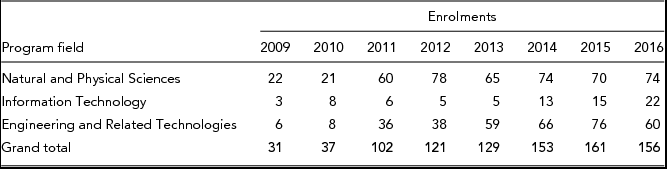
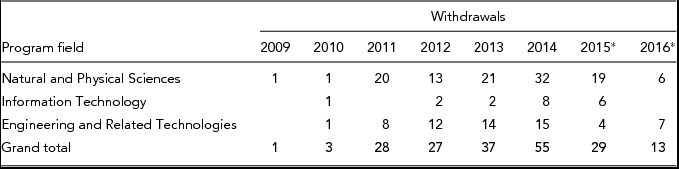
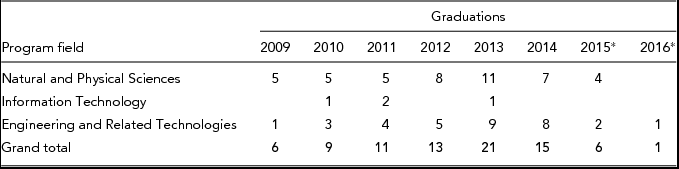
Data collected at three Australian universities across two states, including regional and metropolitan, confirms low enrolments and completions in STEM courses and programs. While the data in Tables 1, 2 and 3 show an improvement over time the numbers remain low and the regional university enrolments account for 50–70% of the total in any given year.
Indigenous Student Enrolments in STEM Programs from 2009 to 2013

Regional university enrolments account for 50–70%.
Indigenous Student Withdrawals from STEM Programs 2009–2013

*Withdrawals numbers were not available for 2015/16 from the regional university.
Number of Indigenous Students Graduated from STEM Programs from 2009–2013

*Graduation numbers were not available for 2015/16 from the regional university.
The data collected across these three universities aligns with the literature and broadly reflects the experience of other Australian universities. This article looks to the literature to inform what is occurring in this sample of universities. The literature comprises information from two broad sources: research into Indigenous and Torres Strait Islander university student experiences; and, government policies and enquiries relating to Aboriginal and Torres Strait Islander access to, and experiences in, Australian universities. Essentially, this literature refers to the broad theme of the university experience, and includes discussion on related issues including access, opportunities, participation and barriers to university entrance; learning outcomes and experiences; learner engagement and satisfaction; and, Indigenous university members of staff. Each of these issues is discussed below.
Access, Opportunities and Participation in Higher Education
In 2010, the Aurora Project findings contributed to the continuous investigation into Indigenous student participation and success in university courses. Essentially, this project identified barriers to success as including lack of communication and collaboration between Indigenous higher education stakeholders; inadequate investments in the student experience; and concentration on support in transition and pathways to university rather than throughout their study period. Research conducted by Lampert and Burnett (Reference Lampert and Burnett2012) adds further inhibitors: recruitment, application and entry process; lack of academic, social, financial and personal support structures; and lack of Aboriginal knowledge systems and Indigenous perspectives in the White academy. In 2015, Asmar, Page and Radloff referred to other barriers cited in a variety of literature: conflict between study and family commitments (Hillman, Reference Hillman2005); institutional ‘climate and discrimination’ (James & Devlin, Reference James and Devlin2006; Sonn, Bishop, & Humphries, Reference Sonn, Bishop and Humphries2000); and, courses not being what students expected (James, Krause, & Jennings, Reference James, Krause and Jennings2010).
Participation rates also receive attention from Pechenkina and Anderson (Reference Pechenkina and Anderson2011) who commented on the parlous state of Indigenous Australian participation rates in higher education. They suggested that there are very low numbers of Indigenous Australians with ‘adequate preparation for tertiary education’ (Pechenkina & Anderson, Reference Pechenkina and Anderson2011, p. 5), and that there were two categories of such students: high enrolment and low completion, and low enrolment and high completion (Pechenkina, Kowal, & Paradies, Reference Pechenkina, Kowal and Paradies2011). To improve participation, Pechenkina and Anderson (Reference Pechenkina and Anderson2011) suggest the development of a new paradigm that develops a university wide strategy which integrates Indigenous strategy within the directions of the Institution. This will require developing Indigenous leadership capability within the university management structure, and an Indigenous strategy into university wide business planning processes.
The most recent example of a report into university access and experiences of Aboriginal and Torres Strait Islander peoples was that conducted by Berhrendt, Larkin, Griew, and Kelly (Reference Berhrendt, Larkin, Griew and Kelly2012). Their report, entitled ‘The Review of Higher Education Access and Outcomes for Aboriginal and Torres Strait Islander People’, identified 35 recommendations across seven areas. Two years after the release of the Berhrendt et al. (Reference Berhrendt, Larkin, Griew and Kelly2012) report, Universities Australia (2014) found that Australia's Indigenous population continued to be underrepresented in the university system, with the causes being those identified in previous research, as discussed below.
Barriers to Participation and Completion
In 2006, the Indigenous Higher Education Advisory Council (IHEAC) identified a number of barriers to Indigenous participation in higher education. Such barriers include ‘. . . financial pressures and living away from home, health-related problems, racism and prejudice towards Indigenous people, and low levels of academic readiness and aspirations of Indigenous students, coupled with the high academic demands of study and insufficient academic support’ (p. 8). In 2011 and 2014, Asmar, Page and Radloff reported that Indigenous students are more likely to seriously consider both leaving their institution and to be less likely to complete than their peers. They identified Indigenous student attributes linked to higher departure intentions as including those: who qualify for financial assistance; are studying externally or at a distance; are from a provincial or remote area; have a disability; are older students; or are male students. They commented further that Indigenous students may not choose to talk about characteristics identified in the literature, which are associated with noncompletion. These characteristics include: poor health; disability; financial stress; caring for dependents; studying off-campus; and, pressures and distress caused by high mortality and incarceration rates in some communities.
Similar issues were identified by Indigenous students in a study of exit factors in a recent study involving 14 preservice teachers at a regional university (Trimmer, Wondunna-Foley, & Ward, Reference Trimmer, Wondunna-Foley and Ward2015). Indigenous students, including exited students, reported that cultural safety, identity and belonging, finances, family and community support, and engagement of Elders were critical factors enabling them to complete their studies. Low levels of Indigenous content and the absence of Indigenous lecturers for most programs undertaken were seen to contribute to lower levels of cultural safety, identity and belonging. Participants provided strong evidence for the need for cultural safety through description of direct experiences where they felt unsafe, uncomfortable, or that they did not belong due to their culture. The results exposed that these feelings were so strong at some points through the educational journey that they were the key consideration for the student considering exiting their program (Trimmer et al. Reference Trimmer, Wondunna-Foley and Ward2015).
More specifically in relation to the nature of the present investigation, in a discussion on Indigenous peoples’ participation in Western science, Rigney (Reference Rigney2001) concludes by emphasising the need for ‘Indigenous intellectual sovereignty . . .’ (p. 10) as an essential element for the future. He also sees a need to develop an intellectual community regarding Indigenous intellectual scholarship.
Strategies for Improved Experience
Overall, the extensive corpus of literature shows that Aboriginal Australians are significantly and chronically underrepresented in both student and staff numbers in Australian universities (e.g., DiGregorio, Farrington, & Page, Reference DiGregorio, Farrington and Page2000; Nakata, Reference Nakata2004; Trudgett, Reference Trudgett2011). Furthermore, there is poor recognition given to Indigenous Studies and a lack of visibility of Indigenous culture and knowledge on university campuses (Herbert, Reference Herbert2010). In 1999, the Department of Education, Training and Youth Affairs commented that ‘. . . Aboriginal and Torres Strait Islander students have lower success rates than non-Indigenous students, . . ., and they are less likely to persist with their university education’ (cited in Boulton-Lewis, Marton, Lewis, & Wills (Reference Boulton-Lewis, Marton, Lewis and Wills2004, p. 92)).
In looking to the then future, Devlin (Reference Devlin2009) argued a need for a research focus on what works in ensuring Indigenous student equity in higher education. Examining existing initiatives and successful Indigenous student experiences would contribute to this discussion. She also suggests the desirability of reviewing the management of systemic problems.
In 2006, IHEAC developed 10 recommendations for policy directions and research issues aimed at improving Indigenous higher education outcomes. In essence, the recommendations related to financial circumstances of Indigenous students, identification of risk factors, stronger institutional leadership, development of a national Indigenous higher education website, incentives for increasing university success rates, train new and retrain existing teachers to improve their understanding of Indigenous education, provide specialised training for the next generation of Indigenous academic leaders, create and introduce new mentoring schemes for Indigenous students and staff, fund a national research agenda and develop and promote exemplars for encouraging and supporting greater community participation in university life and decision-making.
Two years after the release of previously discussed IHEAC (2006) recommendations, a submission to the Department of Higher Education, Employment and Workplace relations was written by the National Union of Students’ Indigenous Student Department (2008). The submission included 27 recommendations, an analysis of which resulted in the identification of nine categories: teaching, funding, outreach and mentoring programs, student services and support, research, participation in higher education, cultural awareness, staff recruitment and retention, and recognition of national Indigenous events.
Preparation for Study and Orientation
In 2010, DiGregorio, Farrington and Page investigated factors influencing the study habits of twelve Indigenous and Torres Strait Islanders enrolled in a Diploma of Health Sciences (Aboriginal Health and Community Development). The participants were both male and female, all aged over 25 years, metropolitan and rural. The study identified a number of factors that influenced their study. First, newness: for example, studying at the tertiary level for the first time, not knowing anybody in a new environment and not knowing where to seek assistance when encountering difficulties.
The researchers concluded that the success of Indigenous students is built on five interlocking factors including; leadership; quality of teachers; adequate support structures in schools, VET and universities; a renewed approach to education promotion within the Indigenous community and links between schools, TAFEs and universities. One example of a specific program aimed at improving Indigenous student learning outcomes is the Scaffolding Academic Literacy program in the Faculty of Health Sciences at the University of Sydney. As discussed by Rose, Rose, Farrington, and Page (Reference Rose, Rose, Farrington and Page2008) the program resulted in a rapid positive impact on student literacy, with its impact in the second year of the course moving the students from an average middle secondary school level, to a literacy level expected at first year undergraduate study.
Teaching and Learning Styles
One strategy for increasing the rate of successful graduations may be related to learning style. In a three year longitudinal study into the conceptions and learning strategies used by 15 Indigenous students in three Australian universities, Boulton-Lewis et al. (Reference Boulton-Lewis, Marton, Lewis and Wills2004) found that ‘The students did not vary their way of learning, reading or writing in the beginning of their studies and less than half of them did so at the end of the three years’. It is argued that encountering variation in ways of learning is a prerequisite for the development of powerful ways of learning and studying’ (p. 91). Most of the students had not developed more powerful strategies: for example,. reflection varying their acts of reading, before they entered university and many of them failed to do so by the time they finished their studies.
In a generic observation about improving Indigenous student learning outcomes in tertiary studies, Nakata, Nakata, and Chin (Reference Nakata, Nakata and Chin2008) suggest a need for a more thorough understanding of how these students engage with course content and demands. Such an understanding should facilitate the development of ‘tools of engagement’ (Nakata et al., Reference Nakata, Nakata and Chin2008, p. 143) with the disciplines. These authors argue that the collection of empirical data is imperative to contribute to knowledge of academic and skill support for Indigenous students. They also emphasise the desirability of developing an understanding of Indigenous students as learners to ensure quality and success in their education.
Shah and Widin (Reference Shah and Widin2010) cited the work of Andersen, Bunda, and Walter (2008), who found that the growth of student population and class size together with the lack of interaction between peers and teachers has a particular impact on Indigenous students and lowers student satisfaction and retention. Additional impacts on Indigenous student satisfaction include the growing use of informational technology and online course offerings. These two trends have a particular impact on Indigenous students who are located in remote areas with limited access to computers and the Internet. In the following year, Asmar, Page, and Radloff (Reference Asmar, Page and Radloff2011) discussed data collected in the 2009 Australasian Survey of Student Engagement (AUSSE) and reported markedly higher levels of engagement in relation to work integrated learning, while in 2014 these authors, in referring to the same survey, commented that ‘. . . Indigenous students are engaged in learning activities at a similar or slightly higher frequency than their non-Indigenous peers’ (p. 19).
Student Services and Support
Using a survey, for which they had a 40% return rate, in a multicampus university in outer Sydney, Shah and Widin (2010) identified services that Indigenous students rated as high on importance and high on performance impact. Items rated as most important, but low on performance were course-related (generic skills) items and learning support. The analysis clearly showed that Indigenous student judgment of quality is based on classroom experience (class size and quality of teachers), relevant support services (library, mentoring, counselling, careers advice, academic writing and accommodation) and progress on the attainment of generic skills. The study reassures that the attributes of high student satisfaction and retention include: course design and assessment methods, range of support services and the attainment of generic skills. Interestingly, Indigenous students rated student accommodation as important while on the campus. Open ended comments in the survey revealed a number of areas students viewed as requiring improvement: timely feedback from teachers on assessments, student support, and services provided by the Indigenous Education Centre. Other challenges identified are related to the curriculum, as exemplified by struggles with ‘timetable issues, such as frequent room changes and having such an intensive schedule of classes’ (DiGregorio et al., Reference DiGregorio, Farrington and Page2000, p. 303) and being unable to access teaching staff members was viewed as a challenge, thereby precluding students being able to continue with their work.
Cumulative effects of individual stressors were identified as a second set of stressors (DiGregorio et al., Reference DiGregorio, Farrington and Page2000). What may otherwise be minor challenges had a cumulative effect, so that ‘not having access to a telephone, having an incompatible roommate, and not having convenient access to transportation from accommodation combined to overwhelm students and to seriously interfere with their study’ (DiGregorio et al., Reference DiGregorio, Farrington and Page2000, p. 303). These were exemplified by unresolved little problems becoming significant challenges to study; the students were studying away from home and having to live in shared accommodation in the city, resulting in reports of disconnection, isolation from families and concern about what was happening at home, while they were away; and, a lack of cooking facilities precluding eating healthy and affordable meals (DiGregorio et al., Reference DiGregorio, Farrington and Page2000, p. 301–302).
DiGregorio et al. (Reference DiGregorio, Farrington and Page2000) identified a number of implications for practice derived from their findings. These included addressing the influence of students’ past educational experience, consideration of the reasons students choose to study, broadening the criteria for selection, enabling students to deal with ‘little problems’ before they become ‘big problems’, carefully managing students’ orientation to the institution, supporting students determined to succeed by maintaining positive learning environments, and remembering that culture matters. In addition, the authors identified ‘vulnerable determination’, that is personal attributes impacting on student success. Cultural matters were also seen as influences in that, for Aboriginal and Torres Strait Islander students, university attendance is a crosscultural experience. In particular, when ‘the program did demonstrate an appreciation of students’ identities as Aboriginal and Torres Strait Islander people, there was a sense that this resonated with the students and positively influenced their study’ (DiGregorio et al., Reference DiGregorio, Farrington and Page2000, p. 304). However, staff members who did not have such an appreciation attracted strong objections as it either ‘affected the community as a whole, or the participants as learners’ (DiGregorio et al., Reference DiGregorio, Farrington and Page2000, p. 305).
Indigenous Academic Staff and Course Content
Kippen, Ward and Warren (Reference Kippen, Ward and Warren2006) identify several other issues impacting on Indigenous higher education students that could be considered to contributing to universities not being as culturally safe as they perhaps should be. Non-Indigenous teaching staff teaching cultural content and assessing work written by Indigenous students has been was identified as an issue, as was a lack of Indigenous staff, or presence of Indigenous staff within the academic population. Day and Nolde (2009) acknowledge that the lack of recognition of the need for cultural inclusion in the content of studies is alienating for Indigenous students by not acknowledging and welcoming their unique cultural perspective. The Trimmer et al. (Reference Trimmer, Wondunna-Foley and Ward2015) study identified a clear need to promote and extend the inclusion of Indigenous content in courses, including culturally appropriate pedagogies and to increase the employment of Aboriginal and Torres Strait Islander people throughout the university in both academic and professional roles.
Current Initiatives
So what initiatives and programs have been implemented to increase Aboriginal and Torres Strait Islander student participation and success in STEM courses? In 2014, the government's, Commonwealth Scientific and Industrial Research Organisation (CSIRO) in partnership with BHP Billiton Foundation earmarked $28.8 million to develop educational programs to increase the number of Aboriginal and Torres Strait Islander students in STEM courses from primary school through to higher education (Sansom, Reference Sansom2014). In 2015, six educational programs were implemented under this partnership that integrates Indigenous culture and identity together with academic rigour. In brief, the programs are as follows:
1. Bachelor of Science (extended) is a supported pathway program that is offered by the University of Melbourne.
2. A Summer School program for Year 10 students to provide information on study and career options in STEM courses.
3. Enquiry for Indigenous science students targets upper primary and lower secondary students using an enquiry-based approach to increase student interest and success in science.
4. The Indigenous mathematics education program provides support for upper primary and lower secondary students to improve outcomes.
5. Science pathways for Indigenous communities provides for ‘on country’ learning involving community Elders and targets primary and lower secondary students living in remote communities.
6. Excellence awards program recognises and rewards Indigenous student achievement is STEM courses (Commonwealth Scientific & Industrial Research Organisation, [CSIRO], n.d.).
As these initiatives have been recently implemented, there is no published data available to identify any early trends that may determine the level of progress made in achieving program outcomes. Therefore, it will be interesting to follow the development of these programs in the near future.
Conclusion
Higher education is widely understood to be important to Indigenous Australians in order to better prepare educated people for leadership roles (Pechenkina et al., Reference Pechenkina, Kowal and Paradies2011) and future workforce needs (Indigenous Higher Education Advisory Council (IHEAC), 2006), to change university culture in general, to build capacity, to become more inclusive and to provide equitable access to opportunity. More recently, the Universities Australia draft Indigenous Strategy 2017–2020 currently under review by Vice Chancellors, recommends development of a range of ways to increase numbers of Indigenous higher degrees by research students (A. Chynoweth, personal communication, 8/11/2016).
The enhancement of Indigenous content in courses, an increase in the number of Indigenous academics and professional staff, the continued support of Indigenous education units, family and community support, including the greater need for higher education institutions to engage Elders in the support and development process for students are other key considerations. The current STEM initiatives that are being offered by the CSIRO and BHP Billiton partnership is a significant momentum for Indigenous students across Australia to develop a major interest in the fields of science and mathematics. The inauguration of the CSIRO STEM awards in 2016 should address one of the concerns regarding Indigenous student retention rates, as identified in the literature. This should occur by both identifying and providing links between Aboriginal and Torres Strait Islander students and scientists. Such links provide a model, which should improve communication between these two groups, thereby overcoming the concern expressed by Aboriginal and Torres Strait Islander students regarding contact with academics from the same cultural background. This CSIRO initiative therefore provides an opportunity to study the impact of this model on Aboriginal and Torres Strait Islander student retention rates, together with identifying how many of these students, as a result of this contact, move into academic careers. In addition, these STEM awards should be seen as a celebration of the ground breaking work of David Unaipon. An increase in the number of scientists from Aboriginal and Torres Strait Islander backgrounds will, undoubtedly, have positive effects for this currently underrepresented group in academic and the country as a whole. It will be interesting in the future to gauge how successful these initiatives have been in increasing the number of Aboriginal and Torres Strait Islander students in STEM courses. Who knows, another David Unaipon may be uncovered in the process.
About the Authors
Karen Trimmer is a Postgraduate Program Coordinator-Education, with the University of Southern Queensland. Her research focus is educational leadership for community capacity building to impact on social justice policy and governance. She has conducted reviews and authored reports evaluating outcomes of government initiatives, with impact on legislation and policy, for the Parliament of Western Australia and the Department of Education and Training. Her most recent and edited publication is Political Pressures on Educational and Social Research: International perspectives.
Graeme Gower is a Senior Research Fellow in the School of Education, Edith Cowan University. Graeme is a descendant of the Yawuru people of Broome and has been involved in Indigenous education for 36 years, eight years as a primary school teacher and 28 years in higher education. He is actively involved in teaching and research, and is particularly interested in developing Indigenous cultural competence among teachers, the health profession and researchers who work with Indigenous Australian people.
Graeme Lock holds the position of Associate Dean Teaching and Learning in the School of Education at Edith Cowan University. He has researched and published, both nationally and internationally, quite extensively in the areas of educational leadership, curriculum, and rural and remote education. The latter led to his interest in Aboriginal and Torres Strait Islander student participation in higher education.