Sending messages via Short Message Service (SMS) has become very popular. Text messages are characterized by the frequent use of abbreviations, such as msg, gr8, or xs4all. Abbreviations are used for speed and convenience, but they can also constitute a stylistic device indicating affiliation with a particular social group. SMS shortcuts have become so common that they have found their way into the educational system. For instance, according to newspaper reports, the UK exam for the General Certificate of Secondary Education in English language in 2010 included a component assessing the knowledge of shortcuts (http://www.telegraph.co.uk/education/secondaryeducation/6574393/GCSE-English-exams-to-include-questions-on-text-messaging.html).
Generally words and texts that are easy to produce are also easy to understand. However, this may not be the case for SMS shortcuts. Shortcuts are by definition short, which should facilitate their processing, given that short words are processed faster than longer words (e.g., Haberlandt & Graesser, Reference Haberlandt and Graesser1985; Rayner, Sereno, & Raney, Reference Rayner, Sereno and Raney1996). However, despite their frequent occurrence in text messages, the overall occurrence of shortcuts in written texts is probably lower than that of the spelled-out equivalents. In addition, the spelling to sound relationship is often highly irregular (e.g., jk for joke), and many shortcuts are ambiguous (e.g., 2 for to, too, or two). All of this might make shortcuts more difficult to process than regular words. This hypothesis is supported by a recent study by Perea, Acha, and Carreiras (Reference Perea, Acha and Carreiras2009), who recorded the eye movements of Spanish participants reading sentences written in SMS style (e.g., irmos l cnciert n m mto) or in traditional orthography (e.g., iremos al concierto en mi moto, “we'll go to the concert on my bike”). Perea et al. (Reference Perea, Acha and Carreiras2009) showed that sentences written in shortcuts were more difficult to read than regular sentences, as indicated by longer reading times and higher numbers of regressions to earlier parts of the sentences.
The present study extends the study by Perea et al. (Reference Perea, Acha and Carreiras2009) in two ways. First, their results suggest that shortcuts are much more difficult to process than regular words. For instance, the average total fixation duration (the sum of all fixations) was more than twice as long for shortcuts than for the spelled-out equivalents. As the authors point out (p. 1566), one factor that may have contributed to this large effect size is that each sentence contained several shortcuts. Because SMS users tend to include only a few shortcuts in their messages (e.g., what r u saying? for what are you saying?; Crystal, Reference Crystal2008), the results obtained by Perea et al. (Reference Perea, Acha and Carreiras2009) might lead one to overestimate the difficulty of processing typical SMS messages. In the present study, we avoided potential spillover effects from one shortcut to the next by using sentences that only included one shortcut each.
Second, we aimed to obtain additional information about the origins of any processing difficulties arising from shortcuts. Reading and understanding a sentence involves, first, recognizing the individual words and, second, combining their syntactic and semantic properties to generate the meaning of the sentence (for recent reviews, see Rastle, Reference Rastle and Gaskell2007; Singer, Reference Singer and Gaskell2007; van Gompel & Pickering, Reference Van Gompel, Pickering and Gaskell2007). It is likely that the first step is more costly for shortcuts than for words. There is evidence that the meaning of a shortcut can be retrieved from its own orthographic form representation without prior access to the corresponding full forms (Ganushchak, Krott, & Meyer, 2011). This is in line with conclusion drawn by Brysbaert, Speybroeck, and Vanderelst (Reference Brysbaert, Speybroeck and Vanderelst2009) with respect to everyday acronyms such as WC or BBC. However, because the lexical representations of shortcuts are likely to be less frequent than the corresponding regular forms, they should be slower to access (e.g., Cleland, Gaskell, Quinlan, & Tamminen, Reference Cleland, Gaskell, Quinlan and Tamminen2006; Rayner, Fischer, & Pollatsek, Reference Rayner, Fischer and Pollatsek1998; Vitu, Reference Vitu1991). The processing of shortcuts might also be hampered by their (usually) low bigram frequency (Lima & Inhoff, Reference Lima and Inhoff1985; White, Reference White2008). In addition, for some of the shortcuts they encounter, readers may not have stored lexical representations. In such cases they must generate the corresponding phonemic representation to access the meaning of the shortcut. This process should take longer than accessing a word meaning on the basis of the regular form (for further discussion, see Perea et al., Reference Perea, Acha and Carreiras2009). Such effects would be similar to the well-attested orthographic regularity effect, which is the observation that words with irregular spelling (e.g., pint) are read more slowly than words with regular spelling (e.g., mint; for a review, see Coltheart, Rastle, Perry, Ziegler, &Landgon, Reference Coltheart, Rastle, Perry, Ziegler and Langdon2001; Plaut, McClelland, Seidenberg, & Patterson, Reference Plaut, McClelland, Seidenberg and Patterson1996). Similarly, including a word with jubmled lettres in a sentence slows down the reading rate by 11% to 36%, depending on where in the word the transposition occurs (Rayner, White, Johnson, & Liversedge, Reference Rayner, White, Johnson and Liversedge2006). Although this evidence suggests longer processing times for shortcuts and lower skipping rates (i.e., lower rates of processing the words without fixating upon them), that shortcuts are shorter than their regular word counterparts might counteract these effects. However, given Perea et al.'s (Reference Perea, Acha and Carreiras2009) results, it would appear that the unusual orthography of shortcuts has a stronger effect on their processing than their short length.
The effects mentioned so far arise during the mapping processes from the visual input onto a lexical representation. It is possible that shortcuts and words differ only in these word recognition processes. Alternatively, difficulties arising during word recognition processes may have knock-on effects on the semantic integration processes. At present, it is not clear how capacity-demanding early word recognition processes are (e.g., Cleland, Gaskell, Quinlan, & Tamminen, Reference Cleland, Gaskell, Quinlan and Tamminen2006; Lien et al., Reference Lien, Allen, Ruthruff, Grabbe, McCann and Remington2006; Reynolds & Besner, Reference Reynolds and Besner2006), but there is strong evidence that sentence-level semantic integration requires central processing capacity (e.g., Just & Carpenter, Reference Just and Carpenter1992; Kintsch, Reference Kintsch, Kintsch and Gernsbacher1994; McDonald, Perlmutter, & Seidenberg, Reference McDonald, Pearlmutter and Seidenberg1994; Miyake, Carpenter, & Just, Reference Miyake, Carpenter and Just1994; Miyake, Just, & Carpenter, Reference Miyake, Just and Carpenter1994; Otten & van Berkum, Reference Otten and van Berkum2009; Tabor & Tanenhaus, Reference Tabor and Tanenhaus1999). If word recognition and semantic integration processes overlap in time, and if they both require central processing capacity, higher processing demands at the word recognition level may disrupt the semantic integration processes.
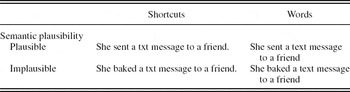
We carried out an eye movement study to explore how the integration of words and shortcuts into a sentence context differed from each other. Participants read four versions of sentences in which target words or their shortcut equivalents appeared in semantically plausible or implausible contexts (see Table 1 for an example). We recorded the readers' eye movements and determined how much time they spent processing the targets and the following word, called the spillover region. The latter region was included in the analyses because earlier studies have shown that plausibility effects can extend beyond the target word (e.g., Rayner, Warren, Juhasz, & Liversedge, Reference Rayner, Warren, Juhasz and Liversedge2004). The following reading measures for the targets and the spillover regions were computed: first fixation duration (the duration of the first fixation on a region), gaze duration (the sum of all first-pass fixations), skipping rate (the probability of not fixating a region during first-pass reading), rate of first-pass regressions (the percentage of regressions crossing the left boundary of a region following a first-pass fixation), second-run duration (the fixation time on a region when it is being reread; fixation time is zero when the region is not fixated again), and total fixation duration (the sum of all fixations on a region). First fixation duration, gaze duration, skipping rate, and first-pass regression are sensitive to the difficulty of early word recognition and at least some comprehension processes (e.g., obvious syntactic anomalies; Frazier & Rayner, Reference Frazier and Rayner1982; Pickering & Traxler, Reference Pickering and Traxler1998; for an overview, see Clifton, Staub, & Rayner, Reference Clifton, Staub, Rayner, van Gompel, Fischer, Murray and Hill2007), whereas second-run and total fixation durations reflect later processing, such as reanalysis and discourse integration (e.g., Frisson & Pickering, Reference Frisson and Pickering1999; Rayner, Reference Rayner1998; Sturt, Reference Sturt2007).
Experimental conditions and examples

Based on the results obtained by Perea et al. (Reference Perea, Acha and Carreiras2009), we expected shortcuts to be more difficult to process than the corresponding words, which should manifest itself in longer first fixation durations, more first-pass regressions, and less skipping for shortcuts than for words. In addition, we expected target words and possibly the following spillover regions to be processed faster in semantically plausible than in implausible sentences (e.g., Pickering & Traxler, Reference Pickering and Traxler1998; Rayner et al., Reference Rayner, Ashby, Pollatsek and Reichle2004; Staub, Rayner, Pollatsek, Hyönä, & Majewski, Reference Staub, Rayner, Pollatsek, Hyönä and Majewski2007; Warren, McConnell, & Rayner, Reference Warren, McConnell and Rayner2008). This should manifest itself in the reading times and regression rates (e.g., Staub et al., Reference Staub, Rayner, Pollatsek, Hyönä and Majewski2007, for first fixation duration; Pickering & Traxler, Reference Pickering and Traxler1998, for regressions) and possibly also in the skipping rates. Although we are unaware of studies examining the effect of plausibility on skipping rates, it is well established that highly predictable words are skipped more often than less predictable words (e.g., Drieghe, Rayner, & Pollatsek, Reference Drieghe, Rayner and Pollatsek2005). Assuming that plausible continuations are also more predictable than implausible ones, we expected higher skipping rates for targets in plausible compared to implausible sentences. If the semantic processing of sentences with shortcuts is the same as that of sentences including only regular words, we should see similar plausibility effects for shortcuts as for words. By contrast, if the semantic processing of the sentences is affected by the presence of shortcuts, plausibility effects might be absent or attenuated for early measures of sentence processing and, perhaps, exaggerated for late measures.
METHOD
Participants
The experiment was conducted with 18 students from the University of Birmingham (13 female; average age = 19.7 years, SD = 3.0 years). They were paid or received course credits for participating in the study. All participants had normal or corrected to normal vision.
Materials and design
The targets were 37 English SMS shortcuts (e.g., gr8) and their spelled-out equivalents (e.g., great). The average length of the shortcuts was 3.2 characters (SD = 1.4, range = 1–6 characters) and the length of the corresponding words was 5.7 characters (SD = 2.2, range = 3–15 characters). Each of these stimuli appeared in two semantically plausible and two matched implausible contexts, yielding a total of 296 sentences. The plausible and implausible version of each sentence differed by one word preceding the target word or shortcut (e.g., “He left you/u a note” vs. “He drank you/u a note; see Appendix A for a list of the materials). The targets appeared in various sentence positions but never as the last word of a sentence. The average length of the sentences was 6.8 words (SD = 1.2 words, range = 5–9 words).
The sentences were tested for predictability and plausibility, using pen and paper questionnaires, which were filled in by 20 participants (15 female; average age = 19.4, SD = 1.2 years). In a cloze task, participants saw the beginnings of the sentences up to the word preceding the target word and were asked to complete the sentences with the first word or words that came to their mind. After finishing this task, the participants saw a list of the complete experimental sentences and were asked to rate how likely they were to encounter them in the real world, using a 7-point scale (7 = very likely; 1 = very unlikely). The results of the cloze task showed that the participants seldom predicted the targets, although the targets were slightly more predictable in plausible sentences (5.1%, SD = 1.5) than in implausible sentences (0.0%, SD = 0). Plausible sentences were rated as very likely to occur in the real world (average rating = 6.5, SD = 0.5) and implausible sentences as unlikely (average response = 1.3, SD = 0.3).
Two stimulus lists were created. Each list included all carrier sentences. Half of the sentences in the first list featured a target shortcut and half a target word. In the second list, the assignment of words and shortcuts to the sentences was reversed. Each participant saw both stimulus lists. The order of the lists was counterbalanced across participants. A different random order of the items within a list was created for each participant.
The sentences were displayed 63 cm from the participants' eyes and appeared in 20-point Times New Roman font; 1 degree of visual angle equaled approximately 3.5 characters.
Procedure
Participants were tested individually. Before the experiment, a calibration procedure using a nine-point grid was carried out. Each experimental trial started with the presentation of a fixation point in the middle of the screen in order to check whether the calibration was still acceptable. The eye tracker was recalibrated whenever the experimenter deemed necessary. The fixation point was followed by the presentation of a fixation cross about two character spaces to the left of the first character of the upcoming sentence. The sentence was automatically displayed 100 ms after the participant had begun to fixate the fixation point. The participant terminated the presentation of a sentence by pressing a button on a hand-held game console. One hundred twenty of the 296 experimental sentences were followed by a yes/no comprehension question (e.g., Did she send a text message?). None of the comprehension questions contained SMS abbreviations. The purpose of presenting the questions was to make sure that the participants read the sentences carefully and understood their meaning. The participants answered by pressing one of two buttons on the console, which terminated the presentation of the question.
Prior to the first experimental sentence, the participant saw five practice sentences. The two lists of experimental sentences followed, separated by a short break. The test session took approximately 35 min.
After the experiment, the participants were given a printed list of all target words and shortcuts used in the study and were asked to indicate how often they read and wrote each of them. Ratings were given on the following 7-point scale: 1 = never, 2 = once a year, 3 = once a month, 4 = once a week, 5 = every 2 days, 6 = once a day, and 7 = several times a day (adapted from Balota, Pilottu, & Cortese, Reference Balota, Pilotti and Cortese2001). Participants first rated the shortcuts and then the words. To determine whether they attributed the intended meanings to the shortcuts, they were also asked to write down the spelled-out equivalents.
Apparatus
We recorded the participants' gaze position during reading using an Eyelink 1000 eye-tracker, which has a spatial resolution of about 0.5 degrees and samples the gaze location every millisecond. A chin rest and a forehead rest were used in order to minimize head movements. Viewing was binocular, but only the movements of the right eye were recorded.
Analyses
An automated procedure combined short contiguous fixations of less than 80 ms and within one character space of each other. Fixations of less than 40 ms and within three character spaces were combined as well. Any remaining fixations shorter than 80 ms and any fixations longer than 1200 ms were excluded from the analyses. In total, 1% of the data were lost due to blinks or technical problems. As explained above, we determined first fixation durations, gaze durations, skipping rates, first-pass regression rates, second-run durations, and total fixation durations for the targets and the spillover regions. In the analyses of total fixation durations, only those trials were included where the region of interest was fixated during first-pass reading. Second-run fixation durations included 0-ms durations (when there were no fixations in second run; this is commonly done to not overestimate the influence of a few long fixations), the other duration measures did not include zero fixations. As described above, each target appeared in two semantically plausible and in two implausible contexts. The statistical analyses were based on the means across the two contexts of the same type. The data were subjected to analyses of variance with semantic plausibility (plausible vs. implausible) and spelling (word vs. shortcut) as fixed effects and either participants (F 1) or items (F 2) as random effects.
RESULTS
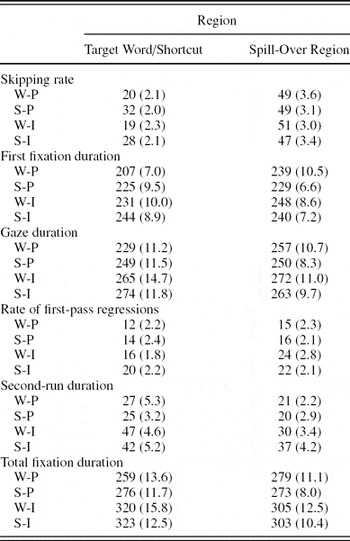
The accuracy for the comprehension questions was 87.3% (SD = 6.0%). The participants' modal responses in the questionnaire showed that on average they read and wrote the shortcuts once a week and used the word equivalents every 2 days. The participants were very familiar with the shortcuts, reporting to be unfamiliar with on average 0.9% (SD = 1.8) of shortcuts. For each participant, trials featuring shortcuts they did not know were eliminated from the analyses. Table 2 presents the results of the eye movement analyses.
Means (standard errors) of skipping rate (%), first fixation duration (ms), gaze duration (ms), first-pass regression rate (%), second-run duration (ms), and total fixation duration (ms) for targets and spill-over regions

Note: W-P, Words in plausible sentences; S-P, shortcuts in plausible sentences; W-I, words in implausible sentences; S-I, shortcuts in implausible sentences.
Skipping rate
On the target region, there were main effects of semantic plausibility, with targets being skipped more often in plausible than in implausible sentences (27% vs. 24%) F 1 (1, 17) = 8.1, p < .05; F 2 (1, 36) = 8.0, p < .01, and of spelling, with shortcuts being skipped more often than words (30% vs. 20% ms); F 1 (1, 17) = 44.4, p < .001; F 2 (1, 36) = 31.0, p < .001. The interaction was not significant (ps ≥ .27). No significant effects were found on the spillover region.
First fixation duration
On the target region, a main effect of semantic plausibility was observed, with fixations being longer on targets in implausible sentences than in plausible sentences (238 vs. 216 ms) F 1 (1, 17) = 52.5, p < .001; F 2 (1, 36) = 23.0, p < .001. The effect of spelling was also significant, F 1 (1, 17) = 19.0, p < .001; F 2 (1, 36) = 13.4, p = .001, with shortcuts being fixated for longer than words (235 vs. 219 ms). The interaction of semantic plausibility and spelling was not significant (Fs < 1). No significant effects were found for the spillover region.
Gaze duration
For the target region, we found a main effect of semantic plausibility, with shorter reading times for targets in plausible sentences compared to implausible sentences (239 vs. 270 ms); F 1 (1, 17) = 71.9, p < .001; F 2 (1, 36) = 32.8, p < .001, and a main effect of spelling, with shorter reading times for words compared to shortcuts (247 vs. 262 ms); F 1 (1, 17) = 11.7, p < .01; F 2 (1, 36) = 5.4, p < .05. The interaction was not significant, F 1 (1, 17) = 2.8, p > .10; F 2 (1, 36) = 1.4, p > .24. The analysis of the spillover region revealed a marginal effect of semantic plausibility with shorter gazes in the plausible than in the implausible condition (254 vs. 268 ms) F 1 (1, 17) = 6.3, p < .05; F 2 (1, 36) = 2.8, p > .10. There was no effect of spelling and no interaction.
Rate of first-pass regressions
Analyses for the target region showed a significant main effect of semantic plausibility, with more regressions for targets in implausible than in plausible sentences (18% vs. 13%) F 1 (1, 17) = 17.8, p = .001; F 2 (1, 36) = 9.2, p < .01. There was also a significant effect of spelling, with more regressions for shortcuts than for words (17% vs. 14%) F 1 (1, 17) = 12.9, p < .01; F 2 (1, 36) = 8.5, p < .01. The interaction was not significant (Fs < 1). On the spillover region, a main effect of semantic plausibility was observed, with more regressions for targets in semantically implausible than in plausible sentences (23% vs. 15%) F 1 (1, 17) = 12.9, p < .01; F 2 (1, 73) = 21.0, p < .001. No other effect approached significance.
Second-run duration
A significant main effect of semantic plausibility was found on the target region, with significantly longer rereading times for implausible than for plausible sentences (26 vs. 44 ms) F 1 (1, 17) = 36.4, p < .001; F 2 (1, 36) = 15.3, p < .001. There was no effect of spelling and no interaction (ps > .15). A comparable effect of semantic plausibility was seen in the spillover region (21 vs. 33 ms) F 1 (1, 17) = 15.2, p = .001; F 2 (1, 36) = 10.3, p < .01, again without an effect of spelling or an interaction (ps ≥ .23).
Total fixation duration
There was a main effect of semantic plausibility for the target region, with targets being read faster in plausible than in implausible sentences (267 vs. 321 ms) F 1 (1, 17) = 112.7, p < .001; F 2 (1, 36) = 41.6, p < .001. The total fixation duration was shorter by 11 ms for words than for shortcuts, but this difference was not significant (289 vs. 300 ms, ps ≥ .13), nor was the interaction of spelling and semantic plausibility (ps ≥ .11). On the spillover region, there was also a main effect of semantic plausibility, with implausible sentences requiring more processing time than plausible sentences (304 vs. 276 ms) F 1 (1, 17) = 22.0, p < .001; F 2 (1, 36) = 9.0, p < .01. No other effects approached significance (all Fs < 1).
Supplementary analyses
As noted in the Methods section, the targets in plausible sentences were slightly more predictable than those in implausible sentences. To address this potential confound, we repeated all analyses reported above excluding all 17 items for which at least one participant had provided the target in the cloze test. Thus, for all of the remaining items, the predictability was 0. The results of these analyses were very similar to those reported above. Specifically, the main effects of spelling and semantic plausibility reported as significant above remained significant and no significant interaction of spelling and plausibility was obtained for any of the dependent variables.
DISCUSSION
Our experiment showed that readers needed more time to recognize shortcuts than words. This was evidenced by significantly longer first fixation and gaze durations and higher rates of regressions for shortcuts than for words. These results replicate findings reported by Perea and colleagues (Reference Perea, Acha and Carreiras2009), albeit with smaller effect sizes. In the present study, the effect of spelling on the average first fixation duration was 16 ms (7% of the duration for words), whereas the corresponding effect in the study by Perea et al. was 52 ms (17%); the effect of spelling on the gaze durations in our study was 15 ms (6%), whereas the corresponding effect observed by Perea et al. (Reference Perea, Acha and Carreiras2009) was 326 ms (105%).Footnote 1 Possible reasons for the difference in the effect sizes will be discussed below; but the main conclusion from both studies is that it takes readers more time to recognize shortcuts than words. There are a number of potential reasons for this. For instance, shortcuts are less frequent in their surface forms than words, they are often orthographically irregular or ambiguous, and readers may sometimes have to generate the corresponding phonological code to derive the meaning.
An observation that appears to argue against this conclusion is that in our study shortcuts were skipped more often than words, which suggests that they were easier to process than words. The opposite pattern of results was observed by Perea et al. (Reference Perea, Acha and Carreiras2009). This difference may be related to the length of the shortcuts used in the two studies. Many of the shortcuts in our study included three or fewer characters, and the average length was 3.2 characters. In the study reported by Perea et al. (Reference Perea, Acha and Carreiras2009), shortcuts were longer (4.4. characters on average). Earlier studies have shown that short words are skipped more often than longer words (e.g., Brysbaert & Vitu, Reference Brysbaert, Vitu and Underwood1998; Rayner & McConkie, Reference Rayner and McConkie1976). Thus, the shortcuts in our study may often have been skipped because they were very short.
To assess this hypothesis, we examined whether the length of the shortcuts influenced the skipping rates.Footnote 2 This was indeed the case: two-character shortcuts (N = 9) were skipped on 45% of the trials, three-character shortcuts (N = 14) on 31% of the trials, and four-character shortcuts (N = 7) on 16% of the trials. The t tests indicated that all comparisons were significant within participants and between items (ps < .01). We then investigated whether the effect of spelling differed for long versus short targets. We split the targets into two groups, with short shortcuts consisting of one to three characters and the corresponding words (length ranging from three to nine letters; average: 4.8; SD = 1.4) forming one group (24 pair) and long shortcuts consisting of four to six characters and the corresponding words (length ranging from 6 to 15; average: 7.4; SD = 2.5) forming another group (13 pair). Analyses of variance showed a significant interaction of length (short vs. long shortcut) and spelling (shortcut vs. word), F 1 (1, 17) = 44.5, p < .001; F 2 (1, 35) = 10.0, p < .01). Short shortcuts were skipped significantly more often than their word counterparts (37% vs. 23%), t (17) = 8.2, p < .001; t (23) = 6.8, p < .001, whereas the skipping rates for long shortcuts and their word counterparts did not differ significantly from each other (14% vs. 18%), t (17) = 1.9, p = .07; t (12) = 1.2, p > .25. Last, we examined whether there was a difference in skipping rates between shortcuts and words of comparable length. four- and five-character shortcuts (N = 12) were compared with four- and five-character words (N = 18). We found that the skipping rate was significantly lower for shortcuts than for words (19% vs. 26%), t (17) = 3.0, p < .01; t (28) = 2.8, p = .01. Taken together, these results demonstrate that the skipping rates for the targets depended both on their spelling (regular spelling vs. shortcut) and on their length. Of interest, there is evidence that the effect of words length on skipping rate is stronger than that of processing difficulty. When the effect of length was controlled for, shortcuts were skipped less often than words. This supports the conclusion drawn on the basis of the analyses of fixation durations, gaze durations, and regression rates that the shortcuts were more difficult to process than the words (for effects of word length and processing difficulty on skipping rates for words, see Brysbaert, Drieghe, & Vitu, Reference Brysbaert, Drieghe, Vitu and Underwood2005; Brysbaert & Vitu, Reference Brysbaert, Vitu and Underwood1998; Drieghe, Brysbaert, Desmet, & De Baecke, Reference Drieghe, Brysbaert, Desmet and De Baecke2004).
In our study, there was no effect of spelling on second-run durations and only a weak tendency toward longer total fixation durations for shortcuts than words. As expected on the basis of earlier studies (e.g., Pickering & Traxler, Reference Pickering and Traxler1998; Staub et al., Reference Staub, Rayner, Pollatsek, Hyönä and Majewski2007), we found strong effects of semantic plausibility for both early and late measures. However, these effects did not interact with effects of spelling. This implies that the shortcuts were more difficult to recognize, but that their semantic processing did not differ much from that of words. This is in line with a recent study showing that shortcuts engage processes of semantic access similar to conventionally spelled words (Ganushchak, Krott, & Meyer, Reference Ganushchak, Krott and Meyer2010a; see also Ganushchak, Krott, & Meyer, Reference Ganushchak, Krott and Meyer2010b).
However, the results reported by Perea and colleagues (Reference Perea, Acha and Carreiras2009) invite a different conclusion. As mentioned earlier, these authors obtained much larger differences between words and shortcuts for measures of early word processing than seen in the present study. In addition, they obtained a substantial effect (223 ms) of spelling for the average total fixation duration. Although Perea et al. (Reference Perea, Acha and Carreiras2009) did not vary the semantic plausibility of the sentences, their results suggest that both the recognition of the shortcuts and the semantic integration were more time consuming than the corresponding processes for words. The reasons for this difference in the results of the two studies need to be determined in further research. As noted, the shortcuts used in the present study were shorter than those used by Perea et al. (Reference Perea, Acha and Carreiras2009). In addition, the participants in the two studies may have differed in their familiarity with the stimuli. Finally, and perhaps most importantly, the sentences used in the present study only included a single shortcut each, whereas each sentence used by Perea et al. (Reference Perea, Acha and Carreiras2009) included several shortcuts. As Perea et al. (Reference Perea, Acha and Carreiras2009) discuss, the use of several shortcuts per sentence may have augmented the processing difficulty for each individual shortcut. This may have a number of reasons. For example, the left context may be used less efficiently to infer or predict the meaning of a target shortcut when it includes other shortcuts that also pose some processing difficulty. In addition, there may be spillover effects such that the fixation and gaze duration for a target shortcut may be increased because the processing of a preceding shortcut has not been completed. Finally, the extrafoveal processing of the shortcuts may be affected. During normal reading, some information can be gleaned about upcoming words prior to fixation. Several studies have shown that this extrafoveal processing of words is more efficient when the fixated word is easy than when it is more difficult to process (e.g., Balota, Pollatsek, & Rayner, Reference Balota, Pollatsek and Rayner1985; Henderson & Ferreira, Reference Henderson and Ferreira1993; Pollatsek, Reichle, & Rayner, Reference Pollatsek, Reichle, Rayner, Hyönä, Radach and Deubel2003; Rayner, Ashby, Pollatsek, & Reichle, Reference Rayner, Warren, Juhasz and Liversedge2004; White, Rayner, & Liversedge, Reference White, Rayner and Liversedge2005). Thus, when a target shortcut follows another shortcut, it is likely to have undergone less extrafoveal processing and will therefore subsequently be looked at for longer than when it follows a word. Whether and how much each of these factors contributes to the difficulty of processing the shortcuts might be assessed in future studies.
In sum, the present study showed that shortcuts were more difficult to process than words. However, the effects of spelling were modest in size and confined to measures of early word processing difficulty. There was no evidence that the semantic processing of the sentences was affected by the presence or absence of shortcuts. In other words, shortcuts appear to be a little harder to recognize than words, but they have been recognized, they are processed in much the same way as regular words. A more general implication of our results is that problems arising during early word recognition processes do not necessarily have implication for semantic integration processes, in contrast to what has been suggested previously (e.g., Sereno, Brewer, & O'Donnell, Reference Sereno, Brewer and O'Donnell2003). A practical implication of the current research is that shortcuts, if used sparingly, put only a small burden on the reader. However, the processing load for the reader might increase substantially when sentences are composed almost exclusively of shortcuts. Users of SMS msgs might want 2 keep this in mind.
APPENDIX A: MATERIALS
Plausible and implausible sentences including target words and shortcuts (italic)

ACKNOWLEDGMENTS
This research was supported by Dutch Organization for Scientific Research (NWO) Grant 446-07-027 (to L.Y.G.). The authors thank Roxana Roumencheva for testing the participants and two anonymous reviewers for their helpful comments on an earlier version of this manuscript.