




No CrossRef data available.
Article contents
A prospective high-risk study of the association among maternal negativity, apparent frontal lobe dysfunction, and the development of bipolar disorder
Published online by Cambridge University Press: 28 March 2006
Abstract
In a previous paper, the authors found that impairment on the Wisconsin Card Sorting Test (WCST) in adolescence was predictive of bipolar disorder in young adulthood among offspring of mothers with bipolar illness. In the present study, the authors explore the contribution of maternal characteristics, beyond maternal mood disorder, to the prediction of offspring dysfunction on the WCST. Results showed that maternal bipolar disorder and maternal negativity were both predictive of impaired performance on the WCST during adolescence. The contribution of maternal negativity to offspring WCST impairment was not better explained by maternal personality disorder, mother's functional impairment, family loading for bipolar disorder, or offspring disruptive behavioral disturbance. Findings did not support a moderator model. However, support was found for a mediation model in which maternal negativity contributed to risk for offspring bipolar disorder through its negative association with apparent frontal lobe functioning, as measured by the WCST. Findings are discussed from the perspective of a vulnerability–stress model. In addition, the authors consider the possibility that maternal negativity and offspring impairment on the WCST may be reflective of a common heritable trait.
The findings presented in this paper come from the doctoral dissertation of the first author, which was funded by an NIMH Intramural Research Training Award. The authors are enormously grateful to Anne Mayfield, without whom this project would not have been possible. We are deeply indebted to Ann S. Masten, W. Andrew Collins, L. Alan Sroufe, Monica Luciana, and Carrie Borchardt, who provided support and guidance throughout all stages of this project. We are also thankful to Robert Asarnow for his advice and encouragement, and to Roger E. Meyer and Daniel N. Klein for their comments on earlier drafts of this paper. In addition, we acknowledge the contributions of Gail Inoff-Germain, who administered diagnostic interviews and neuropsychological measures at adolescent follow-up; Rula B. Garside, who undertook the painstaking job of establishing interrater reliability; Erika Sundstrom, who devoted many hours to data organization and quality assurance; and Sara Avery Torvik and Patricia Kasdan, whose combined gifts of organization and warmth created a comfortable atmosphere for study participants. Finally, we thank the extraordinary research participants of the NIMH Childrearing Study, who have shown enormous bravery and dedication by sharing with us 23 years of their lives.
Information
- Type
- REGULAR ARTICLE
- Information
- Copyright
- 2006 Cambridge University Press
Bipolar I disorder affects approximately 1.2% of the population (Daly, 1997; Weissman & Myers, 1978), and lifetime rates of bipolar spectrum disorders are as high as 6% (Angst, 1998). Traditionally, the peak age of onset for bipolar disorder has been considered to be between 15 and 19 years (McClellan & Werry, 1997). However, more recently, there has been increasing recognition of early onset forms of the disorder (Biederman et al., 1996, 2004; Carlson, 1998; Geller et al., 2002; Leibenluft, Charney, Towbin, Bhangoo, & Pine, 2003; Meyer & Carlson, 2004). According to data from twin, family, and adoption studies, bipolar disorder has among the highest heritability rates of any psychiatric disorder (Daly, 1997; Mendlewicz, 1988), with estimates ranging from .60 to .85 (Smoller & Finn, 2003). As a result, etiological theories of bipolar illness have traditionally focused on genetic and other biological causes (Campbell, 1953; Goodwin & Jamison, 1990; Kraepelin, 1921). However, recognizing the heterogeneity of bipolar illness and the complex mechanisms involved in its transmission and course, investigators are increasingly turning to transactional models (Cicchetti & Toth, 1995) that take into consideration interactions among biological and psychosocial risk factors (Biederman et al., 2001; Chang, Blasey, Ketter, & Steiner, 2001; Delbello & Geller, 2001; Souery, Massat, & Mendlewicz, 2000).
Most of the data regarding environmental vulnerability factors for bipolar disorder come from high-risk studies. These investigations have revealed that parents who suffer from bipolar disorder are more likely to create a caregiving environment characterized by negative affectivity (Inoff-Germain, Nottelmann, & Radke-Yarrow, 1992; Radke-Yarrow, Nottelmann, Belmont, & Welsh, 1993), emotional dysregulation (Coyne, Downey, & Boergers, 1992), and low sensitivity and responsivity (Davenport, Zahn-Waxler, Adland, & Mayfield, 1984). In addition, as a group, parents with bipolar disorder have been found to play less with their children, and are more unhappy, tense, and impaired in their parental role, compared to mothers with no major mood disorder (Davenport et al., 1984). Perhaps most notable in some of these families is the child's experience of inconsistent parental behavior. Anthony (1975) described children of parents with bipolar disorder as being subject to cycles of “omnipotence and impotence, high and low self-esteem, of surplus and depleted energy, of adequate and defective reality testing, and of optimism and pessimism, and, above all, the surprising variations in mood” (p. 288). Due to the episodic nature of their disorder, and the high rate of comorbidity with other disorders and personality pathology, parents with bipolar illness may suddenly shift from exhibiting affectionate and caring behaviors, to acting helpless, unavailable, irritable, and dependent (Davenport et al., 1984; DeMulder, Tarullo, Klimes-Dougan, Free, & Radke-Yarrow, 1995). In reviewing the above literature, it is clear that parental bipolar diagnosis alone does not determine offspring vulnerability (Rutter & Quinton, 1984). On the contrary, many authors have shown that there are a number of risk and protective factors in the caregiving environment that may moderate the effects of parental bipolar illness.
Despite increasing evidence linking early parenting factors to offspring difficulties in families with maternal bipolar illness, the mechanisms underlying this association remain unclear. We know of no published reports in the bipolar literature that address this issue. However, evidence from animal models has shown that stressors in the early caregiving environment may impact offspring brain development, thus increasing risk for mood-disorder-like behavior (Ladd et al., 2000; Liu et al., 1997). In humans, research on the effects of maternal unipolar depression may shed additional light on this issue. Dawson and colleagues (2003) have found support for a model in which impaired parenting and contextual stress in families with maternal depression may increase the risk for offspring emotional and behavioral problems, through their impact on atypical frontal lobe development (Dawson et al., 2003; Morrell & Murray, 2003). Similarly, Morrell and Murray (2003) found that, in a sample of offspring of mothers with unipolar depression, maternal rejection and coercion predicted offspring performance on a measure of frontal lobe integrity at 9 months, which in turn, predicted offspring behavioral symptoms. Both studies support a model in which frontal lobe impairment mediates the association between maternal behaviors and offspring difficulties. However, to date, no study has followed offspring through the period of highest risk for onset of affective illness.
In a previous study, we showed that impairment on the Wisconsin Card Sorting Test (WCST; Grant & Berg, 1948; Heaton, Chelune, Talley, Kay, & Curtiss, 1993), a task that is sensitive to frontal lobe dysfunction, in adolescence was predictive of bipolar disorder in young adulthood among offspring of mothers with affective illness (Meyer et al., 2004). This association was only detected among offspring of mothers with bipolar illness. Specifically, results showed that offspring with familial bipolar disorder made fewer conceptual level responses and completed fewer categories on the WCST than offspring who developed unipolar depression or no major mood disorder. Errors of this nature have consistently been linked, at least in part, to the dorsolateral prefrontal cortex (Berman et al., 1995; Nagahama et al., 1996; Rezai et al., 1993), a brain region that has been implicated in the pathophysiology of bipolar illness (Al-Mousawi et al., 1996; Rajkowska, Halaris, & Selemon, 2001). In the present paper, we continue our investigation of transactional forces in the development of bipolar disorder by exploring the contribution of early caregiving behaviors to the prediction of offspring WCST performance and subsequent bipolar illness in this high-risk sample. With regard to caregiving variables, we focused on maternal negativity, as recent evidence has linked such behaviors to offspring frontal lobe dysfunction and behavioral symptoms among youth at risk for affective illness (Morrell & Murray, 2003). Also relevant are recent findings showing that lack of maternal warmth is highly predictive of relapse among youth with bipolar disorder (Geller et al., 2002; Geller, Tillman, Craney, & Bolhofner, 2004), and elevated levels of negative expressed emotion are associated with relapse among adults with bipolar illness (Yan, Hammen, Cohen, Daley, & Henry, 2004).
We hypothesized that, in this high-risk sample, early exposure to extreme maternal negativity would predict decreased offspring performance on the WCST, over and above mother's bipolar disorder, and that the relation between maternal negativity and offspring WCST performance would not be better accounted for by mother's personality disorder, severity of mother's functional impairment, genetic loading for bipolar disorder, or offspring disruptive behavioral disturbance (i.e., being difficult to control). Moreover, we hypothesized that extreme maternal negativity would moderate the association between maternal bipolar disorder and offspring performance on the WCST, such that the combination of these variables would be a more powerful predictor of offspring WCST performance than maternal bipolar diagnosis alone. Finally, we predicted that exposure to maternal negativity would increase risk for offspring bipolar disorder, but that this association would be largely mediated by the impact of maternal negativity on offspring frontal lobe functioning, as measured by WCST performance.
Methods
Participants
Participants in this study are part of a larger 23-year longitudinal prospective study of offspring of mothers with unipolar depression, bipolar illness, or no history of psychiatric illness (Radke-Yarrow, 1998). The study began in 1979 with the recruitment of families with at least two children, one between the ages of 1.5 and 3.5 years, and another between 5 and 8 years of age. (Exceptions were made in four cases in which the mother suffered from bipolar illness. In these families, there was only one child between the ages of 1.5 and 3.5 years). Families were recruited through newspaper announcements or through parent groups and local clinicians. The initial screening was conducted over the telephone, and potentially eligible families were invited to the laboratory for a structured psychiatric interview. Families were included in the study if the mother met criteria for unipolar depression, bipolar illness, or had no past or present psychiatric diagnosis. If the mother met inclusion criteria, the father was interviewed. None of the fathers in the control sample met criteria for a major psychiatric illness. In families in which the mother suffered from a major affective disorder, fathers were either without psychiatric disorder, or suffered from anxiety and/or mood disorder.
The original sample consisted of 121 families, including 25 families in which the mother met criteria for bipolar disorder, 51 families in which the mother suffered from unipolar depression, and 45 families in which the mother had no history of psychiatric illness. Since the study's inception, there have been six families whose group membership has changed. Specifically, four mothers were switched from the unipolar to the bipolar group, and two well mothers entered the unipolar group. Furthermore, four families have been discontinued from the study due to diagnostic changes. In three control families, the father developed a major affective diagnosis and, thus, the families were no longer eligible for inclusion. In addition, one well mother met criteria for generalized anxiety disorder at Time 3, and therefore, no longer met inclusion standards. The attrition rate from the original sample is 16%. Attrition has been highest among control families, of whom five families have withdrawn and two families could not be located. Three families with bipolar disorder have withdrawn, and one family could not continue due to legal complications. Finally, three families with unipolar depression have withdrawn, four families could not be located, and in one family both parents passed away prior to the Time 2 assessment.
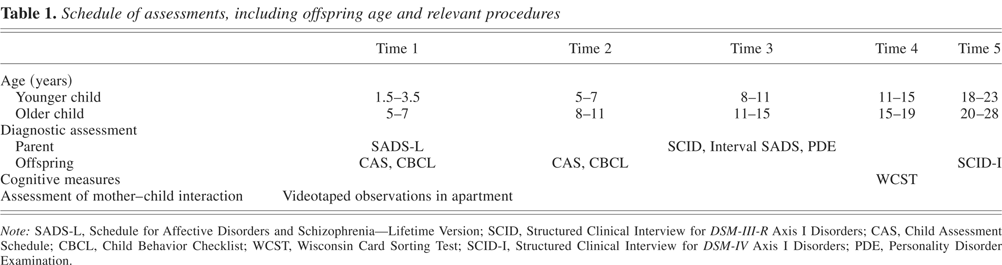
The follow-up sample consists of 98 families, including 48 offspring of mothers with bipolar illness, 84 offspring of mothers with unipolar depression, and 60 offspring of mothers without psychiatric disorders. Families are predominantly middle to upper middle class. Eighty-six percent of families are Caucasian, 11% African American, 1% Latino, and 2% Asian American. As can be seen in Table 1, the same children have been seen four times over the past 20 years at regular intervals, and were recently brought in for a fifth visit. Because of significant procedural changes regarding Time 5 data collection and organization, the present study is limited to those participants who were seen prior to July 2002. Thus, this paper reports on 102 offspring, from 61 families, including 32 young adults from the bipolar risk group, 42 from the unipolar risk group, and 28 from the well group. The younger children range in age from 18 to 23, and the older siblings are between 20 and 28 years old. Approximately equal numbers of younger and older siblings have been seen at follow-up. To increase statistical power, younger and older sibling groups have been combined. Although an effort was made to contact participants in an unbiased manner, the present sample differs from the larger follow-up group in the following ways: A significantly higher percentage of offspring of mothers with bipolar disorder (67%) than offspring of mothers with unipolar depression (50%) and offspring of well mothers (45%) have been seen. Furthermore, a significantly larger percentage of female participants (60%) than males (42%) have been interviewed. Young adult participants are 90% Caucasian, 9% African American, and 1% Latin American. There is no difference in socioeconomic status between individuals seen and those not seen for this study.
Schedule of assessments, including offspring age and relevant procedures

Measures
For diagnostic assessments at each time point, clinicians (psychiatrists or clinical psychologists) or psychometricians with advanced training (i.e., psychiatric nurses or advanced candidacy PhD students) interviewed participants. Cognitive and neuropsychological measures were administered by a clinical psychologist or a trained psychometrician. In cases in which a psychometrician completed the assessments, intensive supervision and consultation with a clinical psychologist or a psychiatrist were provided. All interviewers and evaluators were blind to the diagnostic history of the child and his or her family members.
Parental mood diagnosis
Parents were interviewed at the study's inception using the Schedule for Affective Disorders and Schizophrenia: Lifetime Version (Endicott & Spitzer, 1978). Interviews were conducted by a psychiatric nurse who was trained by a staff member of the New York Psychiatric Institute. Ten interviews were coded independently by nurse and trainer with 100% agreement on diagnosis. Six years into the study (Time 3), parents were again assessed, this time using the Structured Clinical Interview for DSM-III-R Axis I Disorders (Spitzer, Williams, Gibbon, & First, 1992). Interval diagnoses were established using the interval Schedule for Affective Disorders and Schizophrenia. To arrive at parents' lifetime diagnosis, the psychiatric interview assessments at the time of admission to the study and at the Time 3 follow-up were taken into account. In addition to determining maternal diagnosis, interviewers assigned each of the mothers a Global Assessment Schedule score at Time 1 and a Global Assessment of Functioning (GAF) score at Time 3. The lower of the two scores was used to estimate the severity of mothers' functional impairment.
Mother's personality disorder
Mothers completed the Personality Disorder Examination (Loranger, 1988) at the Time 3 assessment. This examination is a semistructured clinical interview designed to identify traits and behaviors that are relevant to the diagnosis of personality disorders in the DSM-III-R classification system. Reliability was based on 20% of cases. Intraclass correlations for individual disorder dimensional scores averaged .90.
Mother's parenting behaviors
The assessment of maternal behavior in interaction with each of her children has been a major focus of this project (Radke-Yarrow, 1998). At Times 1 and 2, families were observed and videotaped in a research apartment that had been designed to simulate home conditions. According to Radke-Yarrow (1998), “The schedule of events in the long periods of time in the apartment was planned to be as natural as possible without sacrificing the control needed for measurement purposes. Time was planned to mimic the range and variety of ordinary, expected, day to day experiences, and to sample situations that tap critical aspects of child rearing at different developmental stages, and aspects most likely to be affected by mother's illness” (pp. 33–35). Ratings of maternal behaviors in the broad domains of affect, communication, and control were scored by observers blind to maternal psychiatric status and behavioral data at other time periods. “The coder rated the mother's actions and words for involvement and interest in the child, demonstration of positive and negative feelings and attitudes toward the child, support and encouragement of the child, efforts to set limits or standards, and expressed affect (enjoyment and pleasure, irritability and anger, warmth and tenderness)” (Radke-Yarrow, 1998, p. 36). Ratings were made approximately every hour, for a total of 6 hr for the younger child and 3 hr for the older child. Scores fell along a Likert-type scale, depending on how much a given behavior was characteristic of the mother (intraclass correlations measuring interrater reliability averaged = .61 based on 24 cases). These ratings were then factor analyzed into three components:
- negative/irritable, with high positive factor loadings on maternal negativity, irritability, and use of strong verbal control;
- considerate control, with high loadings on frequent attempts at control and use of considerate verbal control techniques; and
- positive/facilitating, with high loadings on parental support, involvement, fostering of cognitive competence, proactive behavior, and socialization of the child.
Factor scores were then standardized. Scores at Times 1 and 2 were found to be highly correlated. For purposes of this study, scores were dichotomized such that mothers who scored at or above 1 SD above the mean at Time 1 and/or 2 were categorized as “high” on that parenting factor. The rationale for dichotomizing parenting variables was to isolate dyads that were characterized as extreme on a particular parenting variable. In particular, the authors were interested in focusing on those mothers who displayed extreme levels of negativity toward their child. To ensure that 1 SD above the mean represented a clinically meaningful cutoff point, the first author reviewed qualitative and quantitative data from Time 1 and 2 observational records, and concluded that mothers who scored above this cutoff (n = 16) were, indeed, extreme in the severity and frequency of their use of negative verbal and physical gestures directed toward their children. Examples of behaviors observed among mothers in this group were as follows: threatening to lock their children out of the research apartment, threatening to use physical means to keep a child quiet, and actual displays of physical punishment.
Familial loading for bipolar disorder
At Time 2, both parents were interviewed regarding the occurrence of psychiatric illness among first- and second-degree relatives using the Family History-Research Diagnostic Criteria (Endicott, Andreason, & Spitzer, 1975). For purposes of this study, the authors were interested in family history of bipolar disorder.
Offspring disruptive behavioral problems
Two sources of information were combined using the “or” rule (Bird, Gould, & Staghezza, 1992; Carlson & Youngstrom, 2003) to determine the presence of offspring disruptive behavioral problems at Time 1 and 2: The Child Assessment Schedule (CAS) and the Child Behavior Checklist (CBCL). These measures are described in detail below.
CAS. The CAS (Hodges, McKnew, Cytryn, Stern, & Kline, 1982) is a structured psychiatric interview for children. The CAS was used to interview children ages 5 and older at Times 1 and 2. For those children under the age of 5, an adapted play interview, corresponding with the observational portion of the CAS, was utilized. Interrater reliability was based on ratings of 10 children younger than age 5 (κ = .82) and 25 children aged 5 and older (κ = .83). For this study, the diagnoses of interest were attention-deficit/hyperactivity disorder, conduct disorder, and oppositional defiant disorder.
CBCL. The CBCL (Achenbach & Edelbrock, 1981) has been normed on large national samples, and is widely used to measure childhood difficulties for clinical and research purposes. Mothers filled out the CBCL for each child at Times 1 and 2. For this study, the authors were interested in clinically significant scores (T score at or above the 90th percentile) on the following CBCL scales: attention problems, delinquency problems, and aggression problems.
Measure of apparent frontal lobe dysfunction.
WCST. The WCST (Grant & Berg, 1948; Heaton et al., 1993) is a neuropsychological test designed to measure executive function. It was administered as part of a larger neuropsychological battery at Time 4 when offspring were between the ages of 11 and 19 years (mean age = 14.84 ± 2.59 years). Although there is some controversy surrounding the WCST as a measure of frontal lobe impairment (Anderson, Damasio, Jones, & Tranel, 1991; Mountain & Snow, 1993; Reitan & Wolfson, 1995), evidence from recent brain imaging studies (Berman et al., 1995; Nagahama et al., 1996; Rezai et al., 1993; Weinberger, Berman, & Zec, 1986) and studies of patients with frontal lobe lesions (Stuss et al., 2000) supports the use of the WCST, in the assessment of prefrontal cortical dysfunction. Moreover, impairment on the WCST has been so widely replicated in studies of patients with schizophrenia and other neurobiological disorders, it has been suggested as a possible “endophenotype” for genetic studies (Anokhin, Heath, & Ralano, 2003).
The computer version of the WCST (Loong, 1989) was administered to offspring in this sample by a staff member who provided brief instructions and left the room. The computerized WCST is virtually identical to the original manually administered test in which a participant is presented with 128 cards and is told to place each one beneath one of four stimulus cards. After each try, the participant is told whether he or she is “right” or “wrong” (in the computer version, the computer supplies this feedback), but is given no other clues regarding the card sorting principle. Every time the participant achieves 10 “right” answers in a row, the organizing principle changes without warning. The procedure continues until the subject has successfully completed six sorting categories or until all 128 cards have been used (Spreen & Strauss, 1998).
For purposes of this study, the authors created a composite “executive function” score, based on the factor analytic findings of Greve, Brooks, Crouch, Williams, and Rice (1997). Specifically, Greve et al. (1997) found that parameters of the WCST can be divided into two categories: nonexecutive function abilities and executive function, or frontal lobe, processes. The “executive function” composite score consists of the sum of the standardized scores for number of perseverative errors, number of perseverative responses, and total errors, minus percent conceptual level responses and number of categories completed. To make the data distributions approximately normal, number of perseverative errors, number of perseverative responses, and total errors were transformed logarithmically, and the Percent conceptual level responses was transformed using the square root.
Exclusion criteria
Participants were not included in this study if they had a history of epilepsy (n = 1) or a full-scale IQ score of less than 85 (n = 3). An additional participant was removed from analyses a priori because he suffered from neurological problems secondary to a closed head injury. A final participant was not included in the study because she was taking lithium at the time of the neuropsychological assessment, despite never having met criteria for bipolar disorder.
Statistical methods
Statistical methods were carried out using SPSS Version 10.0 for the Macintosh (Release 10.0.7a2000; SPSS, 2000). Tests of independence were conducted to assess whether siblings from the same family could be considered independent with regard to the outcome variables. An intraclass correlation was conducted comparing sibling scores on the “executive function” composite. Although there were 40 sibling pairs in the present study, only 33 had sufficient data to create the executive function composite score. The result was nonsignificant: intraclass correlation = .033, F (1, 32) = 1.067, p = .427. The kappa statistic was used to compare scores on the categorical outcome variable bipolar disorder Y/N. Again, results were nonsignificant, κ = −.06, χ2 (1) = .17, p = .68, n = 40. Based on these findings, the authors concluded that members of sibling pairs could be treated as independent cases in subsequent analyses. The data were also explored for the presence of extreme outliers. Through this process, one participant was found to have achieved a WCST number of perseverative errors score that was more than 6 SD above the mean, and is suggestive of severe cognitive impairment. In fact, at the time of testing, this participant was a high school honors student with no history of attentional problems, and she achieved a full-scale IQ score well within the expected range. Because of substantial behavioral and objective evidence that this participant's performance on the WCST was invalid, she was excluded from further data analysis.
One-way analysis of variance (ANOVA) was used to investigate group differences in GAF score and age at Time 5. Chi-square tests were used to explore gender differences, by young adult mood diagnosis. A Mann–Whitney test was employed to compare WCST number of categories achieved across offspring diagnostic groups. An ANOVA was used to compare performance on all remaining WCST variables, as well as mother's behavioral variables across offspring diagnostic groups.
A linear regression analysis was employed to determine whether exposure to extreme maternal negativity contributed to the prediction of offspring performance on the WCST over and above maternal bipolar disorder, when adjusting for maternal personality disorder, mother's functional impairment, family loading for bipolar disorder, and offspring disruptive behavioral disturbance. Linear regression was also used to test the prediction that maternal extreme negativity would moderate the impact of maternal bipolar disorder in predicting offspring WCST performance. Finally, logistic regression was used to test the prediction that offspring frontal lobe function, as measured by the WCST, would mediate the association between maternal extreme negativity and offspring bipolar disorder. Age at time of WCST administration (Time 4) was included as an independent variable in all regression analyses, given evidence of significant age effects in performance on the WCST.
Results
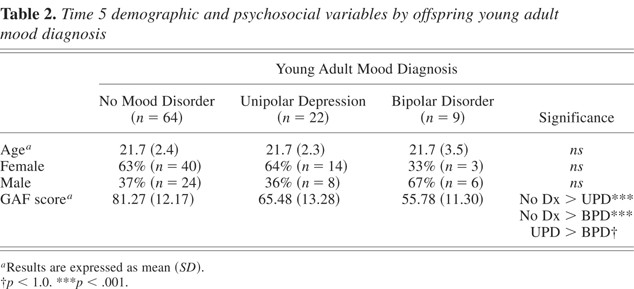
As can be seen in Table 2, at young adult follow-up, 9 offspring in this high-risk sample were diagnosed with bipolar disorder, 22 met criteria for unipolar depression, and 64 had no major mood disorder. There were no differences in age among individuals in our subsample who were diagnosed with bipolar illness, unipolar depression, or did not suffer from a mood disorder at young adult follow-up. Although the gender composition appeared to differ across groups, this was not statistically significant, most likely due to power limitations. ANOVA revealed group differences in social and occupational functioning, as measured by the GAF, F (2, 89) = 25.11, p = .000. Specifically, Tukey honestly significant difference (HSD) post hoc tests showed that participants with no mood disorder received significantly higher GAF scores at the time of assessment than did individuals with unipolar depression (mean difference = 15.80, confidence interval = 8.36–23.23, p = .000) or bipolar disorder (mean difference = 25.50, confidence interval = 14.99–36.00, p = .000).
Time 5 demographic and psychosocial variables by offspring young adult mood diagnosis

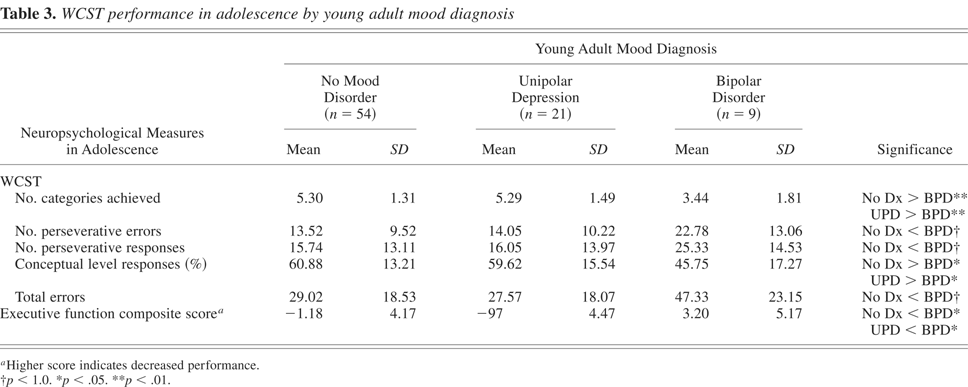
Next, we looked at group differences on the WCST parameters that went into calculating the executive function composite score (Greve et al., 1997). As can be seen in Table 3, the mean WCST number of categories achieved by individuals who developed bipolar disorder was 3.44 (±1.81), which is significantly lower than that of participants with unipolar depression (z = −2.72, p = .007) or no major mood disorder (z = −3.16, p = .002) at young adult follow-up. An ANOVA revealed significant group differences in percent conceptual level responses, F (2, 81) = 4.44, p = .015. Specifically, Tukey HSD post hoc tests indicated that individuals who met criteria for bipolar disorder in young adulthood made significantly fewer conceptual level responses on the WCST at adolescent follow-up than did participants with unipolar depression (mean difference = −.99, confidence interval = −1.97 to −0.02, p = .046) or no major mood disorder (mean difference = −1.09, confidence interval = −1.97 to −0.22, p = .011). Furthermore, there were trend-level group differences with regard to number of perseverative errors, F (2, 81) = 2.46, p = .092, number of perseverative responses, F (2, 81) = 2.638, p = .078, and number of total errors, F (2, 81) = 2.42, p = .095. Tukey HSD post hoc tests showed that individuals who developed bipolar disorder tended to make more perseverative errors and perseverative responses on the WCST in adolescence than individuals with no mood disorder at young adult follow-up (perseverative errors: mean difference = 0.23, confidence interval = −0.02–0.48, p = .075; perseverative responses: mean difference = 0.59, confidence interval = −0.02–1.20, p = .062), and individuals who developed bipolar disorder tended to make more total errors than individuals with no major mood disorder (mean difference = 0.22, confidence interval = −0.03–0.47, p = .091). Finally, an ANOVA showed significant group differences with regard to the executive function composite, F (2, 81) = 3.99, p = .022. Post hoc analyses revealed that participants who developed bipolar disorder scored significantly higher (higher scores indicate poorer performance) than those who developed unipolar depression (mean difference = 4.17, confidence interval = 0.034–8.31, p = .048) and those with no major mood disorder at Time 5 (mean difference = 4.387, confidence interval = 0.65–8.13, p = .017). As previously reported in Meyer et al. (2004), group differences in WCST performance were not accounted for by bipolar diagnosis at the time of WCST administration.
WCST performance in adolescence by young adult mood diagnosis

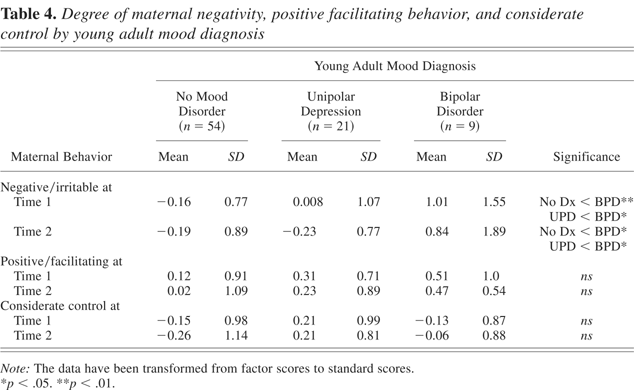
We then investigated group differences in early exposure to maternal behaviors (see Table 4). An ANOVA indicated group differences in levels of maternal negative/irritability at Time 1, F (2, 92) = 6.16, p = .003, and at Time 2, F (2, 92) = 4.51, p = .014. Tukey HSD post hoc analyses revealed that offspring who developed bipolar disorder were exposed to higher levels of maternal negativity at Times 1 and 2 than individuals who developed unipolar depression (Time 1: mean difference = 1.00, confidence interval = 0.12–1.88, p = .022; Time 2: Mean difference = 1.07, confidence interval = 0.11–2.03, p = .023) or no major mood disorder (Time 1: mean difference = 1.17, confidence interval = 0.38–1.96, p = .002; Time 2: mean difference = 1.03, confidence interval = 0.171–1.90, p = .013). There were no significant group differences in levels of maternal positive/facilitating behaviors or considerate control.
Degree of maternal negativity, positive facilitating behavior, and considerate control by young adult mood diagnosis

It is notable that, when the maternal negativity variable was dichotomized, approximately equal percentages of mothers with unipolar depression and bipolar disorder were categorized as extremely negative (23 vs. 21%), whereas, only one mother (4%) in the nonmood disordered group fell above the cutoff for extreme negativity.
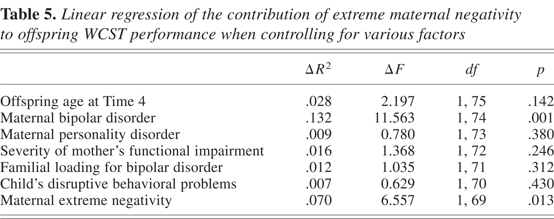
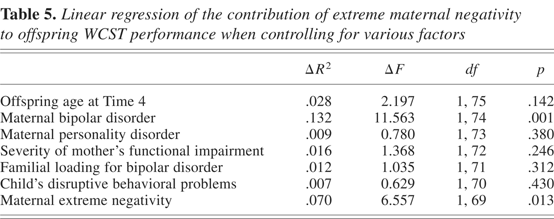
In the next step, we looked at whether exposure to extreme maternal negativity during childhood would predict offspring performance on the WCST in adolescence, over and above maternal bipolar diagnosis. Age at Time 4 was included as an independent variable to control for the effects of age on WCST performance. We also controlled for maternal personality disorder and severity of mother's functional impairment, to ensure that these variables could not better explain the association between maternal negativity and offspring apparent frontal lobe functioning. Finally, family history of bipolar disorder was included as an independent variable, to make sure that findings could not be accounted for by degree of genetic loading for bipolar disorder, and offspring disruptive behavioral disturbance was included to make sure that the mother's negativity could not be explained by the child's being difficult to manage. Table 5 shows that mother's bipolar disorder was the strongest predictor of offspring performance on the WCST, accounting for approximately 13% of the variance. However, mother's negativity toward her child remained a significant predictor, accounting for 7% of the variance, even after controlling for the above variables. None of the other independent variables made a significant contribution to the prediction of offspring WCST performance.
Linear regression of the contribution of extreme maternal negativity to offspring WCST performance when controlling for various factors
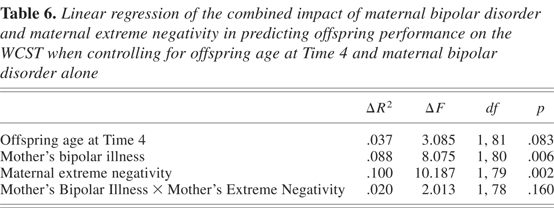
We then tested the hypothesis that maternal extreme negativity would moderate the effects of maternal bipolar disorder in predicting offspring WCST performance, when controlling for age at Time 4. As can be seen in Table 6, results of a linear regression analysis did not support a moderator model. There were main effects of maternal bipolar disorder and maternal extreme negativity, accounting for 9 and 10% of the variance, respectively, whereas the interaction was not significant.
Linear regression of the combined impact of maternal bipolar disorder and maternal extreme negativity in predicting offspring performance on the WCST when controlling for offspring age at Time 4 and maternal bipolar disorder alone

Finally, we tested the hypothesis that maternal extreme negativity would increase risk for offspring bipolar disorder at young adult follow-up, but that its predictive value would be mediated by offspring apparent frontal lobe functioning, as measured by the WCST. A logistical regression analysis revealed that, when controlling for age at Time 4, offspring who were exposed to extreme maternal negativity were at five times greater risk for developing bipolar disorder than offspring who were not exposed this risk variable (odds ratio [OR] = 5.08, p = .03). However, when offspring WCST performance was entered into the equation (OR = 1.17, p = .07), the association between maternal negativity and offspring bipolar disorder was no longer significant (OR = 2.60, p = .271).
Discussion
In the present study, the authors used data from a 23-year longitudinal high-risk study to investigate the contribution of maternal extreme negativity to the prediction of decreased frontal lobe functioning and subsequent bipolar disorder, among offspring of mothers with bipolar disorder, unipolar depression, or no major mood disorder. In a previous report, using data from this same sample, we found that offspring frontal lobe dysfunction, as measured by the WCST, during adolescence was predictive of bipolar disorder in young adulthood. This association was only apparent among offspring of mothers with bipolar disorder. In the current follow-up paper, we were interested in identifying maternal caregiving variables, beyond maternal bipolar diagnosis, that would increase risk for impaired frontal lobe functioning and subsequent bipolar disorder among participants in this high-risk sample.
As predicted, results showed that early exposure to extreme maternal negativity was predictive of offspring performance on the WCST in adolescence, over and above maternal bipolar illness. This association could not be explained by the presence of maternal personality disorder, mother's functional impairment, family loading for bipolar disorder, or offspring disruptive behavioral disturbance. Results did not support a moderator model, indicating that the combined effects of maternal bipolar disorder and maternal extreme negativity are additive, rather than interactive, and the predictive value of maternal negativity on offspring WCST performance did not differ according to whether the mother suffered from bipolar disorder or not.
In contrast, the data did support a mediation model. Specifically, early exposure to maternal extreme negativity was found to significantly increase risk for offspring bipolar disorder in young adulthood. However, when accounting for offspring WCST performance, this association was no longer significant, suggesting that the contribution of maternal extreme negativity to offspring risk for bipolar illness may be largely explained by the impact of maternal negativity on offspring frontal lobe functioning.
We can only speculate as to the mechanisms underlying the association between exposure to maternal extreme negativity and subsequent performance on the WCST. Animal models have provided clues as to possible neurodevelopmental processes through which compromised caregiving may be translated into impaired frontal lobe functioning. In particular, several studies have shown that exposure to suboptimal caregiving may result in long-term alterations in stress system reactivity (Cadji et al., 1998; Francis & Meaney, 1999; Gunnar & Donzella, 2002; Ladd et al., 2000; Liu, Caldji, Sharma, Plotsky, & Meaney, 2000; López, Akil, & Watson, 1999; Meaney et al., 1996; Meyer, Chrousos, & Gold, 2001). Specifically, such early experiences are associated with increased release of norepinephrine, which may modify, or “shut down,” activity of the frontal lobes (Arnsten, 2000). Although this response may be adaptive in the face of extreme danger, chronic elevations in NE may have a detrimental impact on frontal lobe development during periods of increased plasticity. For example, Vawter, Freed, and Kleinman (2000) have posited that elevated levels of NE in the prefrontal cortex may contribute to a loss of glial cells, such as is found among patients with bipolar illness (Rajkowska et al., 2001).
An alternative explanation for our findings is that maternal negativity and offspring impairment on the WCST may be genetically related phenomena. Indeed, a recent twin study revealed heritability estimates for WCST performance ranging from 39 to 46% (Anokhin et al., 2003). According to Rutter (2002), genetic influences may manifest as temperamental dimensions, rather than disorders, per se. Thus, in this case, maternal negativity and offspring impairment on the WCST may both be expressions of the same heritable trait, which in turn, may increase vulnerability for the development of bipolar disorder. Support for this model comes from recent findings showing a strong association between negative affect and performance on a measure of executive function (Luu, Collins, & Tucker, 2000). Unfortunately, we did not conduct neuropsychological assessments of parents in the sample, as it would have been informative to know if mothers with high negativity ratings showed similar deficits to their children on the WCST.
Previous investigations of possible links between disruptions in the caregiving environment and risk for bipolar disorder have produced varying results. On the whole, retrospective studies of adult patients with affective illness have not found support for an association between early parenting history and the development of bipolar disorder (Alnæs & Torgersen, 1993; Cooke, Young, Mohri, Blak, & Joffe, 1999). However, these studies have relied on retrospective, self-report measures of family environment. Similarly, in their study of offspring of parents with bipolar disorder, Chang et al. (2001) failed to find an association between quality of family interaction and offspring risk for bipolar disorder. However, these investigators relied on parental self-report measures, and offspring were between the ages of 6 and 18 years; thus, many had not entered the period of highest risk for onset of bipolar disorder. In general, high-risk studies have been instrumental in shedding light on a variety of vulnerability and protective factors in the caregiving relationship (Coyne et al., 1992; Davenport et al., 1984; DeMulder et al., 1995; Inoff-Germain et al., 1992; Radke-Yarrow et al., 1993; Zahn-Waxler et al., 1988; Zahn-Waxler, McKnew, Cummings, Davenport, & Radke-Yarrow, 1984). However, few of these studies have followed offspring into the period of highest risk for onset of bipolar disorder. Thus, outcome variables generally include broad categories of internalizing and externalizing problems and other presumed precursors to later onset affective illness. The present study is unique in that we not only conducted prospective, observational assessments of caregiver–child interaction, but individuals were followed well into the period of highest risk. This allowed us to begin to explore associations among parenting behaviors, maternal mood diagnosis, and offspring apparent frontal lobe function insofar as they increase risk for the development of bipolar disorder.
Two other studies that we know of have looked at the associations among maternal affective disorder, environmental risk, and offspring frontal lobe dysfunction (Dawson et al., 2003; Morrell & Murray, 2003). Dawson et al. (2003) studied preschool-age children of mothers with unipolar depression and found that both elevated levels of contextual stress and atypical frontal lobe functioning, as measured by EEG, mediated the relation between maternal depression and offspring behavioral difficulties. In addition, Morrell and Murray (2003) followed a group of offspring of mothers with unipolar depression from 2 months to 8 years, and found that, among the males in their sample, maternal rejection and coercion were predictive of impairment on a frontal task (A not B task) at 9 months. In turn, performance on the A not B task was predictive of conduct disorder symptoms at 5 and 8 years. Moreover, maternal hostility was found to mediate the relation between boys' performance on the A not B task and subsequent conduct disorder symptoms. In the present study, we found that maternal extreme negativity was associated with offspring decreased frontal lobe functioning, regardless of whether the mother suffered from unipolar depression or bipolar disorder. However, it was only among offspring of mothers with bipolar disorder that we found a relationship between impaired frontal lobe functioning and increased risk for bipolar disorder. In future investigations, we hope to explore the young adult diagnostic sequelae of frontal lobe dysfunction among offspring of mothers with unipolar depression.
Implications for prevention and intervention efforts
The findings presented in this paper have important implications for the development of early prevention and intervention strategies in working with children at risk for major mood disorders. Our results suggest that early exposure to extreme levels of maternal negativity appears to increase the risk for apparent frontal lobe dysfunction, which in turn, heightens vulnerability for the development of bipolar illness. This suggests that prevention efforts with high-risk families should go beyond children's symptomatology to focus on ways of improving the environments in which they are developing. A precedent for such an approach comes from the work of Cicchetti, Toth, and Rogosch (1999), who showed that toddler–parent psychotherapy was effective in preventing cognitive decline among children of mothers with unipolar depression.
Limitations
Several factors limit the conclusions that may be drawn from the present study. Most importantly, the sample size is small, and only nine participants had developed bipolar disorder at young adult follow-up. Therefore, the results must be interpreted with extreme caution, as it is unclear whether they would generalize to a larger sample. An additional limitation comes from the fact that many participants have not yet passed through the period of highest risk for onset of bipolar disorder. This highlights the need for future follow-up efforts. Moreover, maternal negativity was only measured at Times 1 and 2, whereas it would have been potentially informative to examine its impact during adolescence when considerable development is occurring in the frontal areas of the brain, and when variability would presumably appear on frontal lobe tasks as a function of this development. An additional limitation stems from the fact that evidence of frontal lobe dysfunction was based on a single indirect behavioral measure, the WCST. Ideally, it would have been possible to corroborate findings on the WCST with a broad range of frontal lobe measures, as well as with brain imaging data. An additional issue to consider when interpreting the present findings is that the maternal behavior variables were dichotomized, resulting in reduced variance and potential associations among constructs. However, to test the study hypotheses, the authors felt that it was important to focus on mothers who were extreme in their use of negative verbal and physical gestures. A further limitation to the present study is that participants in this sample are unique, in that all young adults who developed bipolar illness had mothers with a major affective disorder. In the general population, not all individuals who are diagnosed with bipolar disorder have an afflicted first-degree relative (Borchardt, Bernstein, & Crosby, 1995; Mendlewicz, 1988; Mendlewicz & Rainer, 1977). Thus, it is not clear to what extent findings can be generalized. Finally, because the subgroup of individuals who participated in this study differs from the larger follow-up study group, it is unclear whether these findings would have been replicated using data from the entire sample.
References
REFERENCES
Achenbach, T., &
Edelbrock, C. S.
(1981).
Behavioral problems and competencies reported by parents of normal
and disturbed children aged four through sixteen.
Chicago:
University of Chicago Press.
Al-Mousawi, A. H.,
Evans, N.,
Ebmeier, K. P.,
Roeda, D.,
Chaloner, F., &
Ashcroft, G. W.
(1996).
Limbic dysfunction in schizophrenia and mania: A study using
18F-labeled fluorodeoxyglucose and positron emission tomography.
British Journal of Psychiatry,
169,
509–516.CrossRefGoogle Scholar
Alnæs, R., &
Torgersen, S.
(1993).
Mood disorders: Developmental and precipitating events.
Canadian Journal of Psychiatry,
38,
217–224.CrossRefGoogle Scholar
Anderson, S. W.,
Damasio, H.,
Jones, R. D., &
Tranel, D.
(1991).
Wisconsin Card Sorting Test performance as a measure of frontal lobe
damage.
Journal of Clinical and Experimental Neuropsychology,
13,
909–922.CrossRefGoogle Scholar
Angst, J.
(1998).
The emerging epidemiology of hypomania and bipolar II
disorder.
Journal of Affective Disorders,
50,
143–151.CrossRefGoogle Scholar
Anokhin, A. P.,
Heath, A. C., &
Ralano, A.
(2003).
Genetic influences on frontal brain function: WCST performance in
twins.
Cognitive Neuroscience and Neuropsychology,
14,
1975–1978.CrossRefGoogle Scholar
Anthony, E. J.
(1975).
The influence of a manic–depressive environment on the
developing child. In
E. J. Anthony &
T. Benedek (Eds.),
Depression and human existence (pp.
279–315).
Boston:
Little, Brown & Company.
Arnsten, A. F.
(2000).
Stress impairs prefrontal cortical function in rats and monkeys:
Role of dopamine D1 and norepinephrine α-1 receptor mechanisms.
Progress in Brain Research,
126,
183–192.CrossRefGoogle Scholar
Berman, K. F.,
Ostrem, J. L.,
Randolph, C.,
Gold, J.,
Goldberg, T. E.,
Coppola, R.,
et al.
(1995).
Physiological activation of a cortical network during performance of
the Wisconsin Card Sorting Test: A positron emission tomography
study.
Neuropsychologia,
33,
1027–1046.CrossRefGoogle Scholar
Biederman, J.,
Birmaher, B.,
Carlson, G. A.,
Chang, K. D.,
Fenton, W. S.,
Geller, B.,
et al.
(2001).
National Institute of Mental Health research roundtable on
prepubertal bipolar disorder.
Journal of the American Academy of Child and Adolescent
Psychiatry,
40,
871–878.Google Scholar
Biederman, J.,
Faraone, S.,
Mick, E.,
Wozniak, J.,
Chen, L.,
Ouellette, C.,
et al.
(1996).
Attention-deficit hyperactivity disorder and juvenile mania: An
overlooked comorbidity?
Journal of the American Academy of Child and Adolescent
Psychiatry,
35,
997–1008.Google Scholar
Biederman, J.,
Mick, E.,
Faraone, S. V.,
Van Patten, S.,
Burback, M., &
Wozniak, J.
(2004).
A prospective follow-up study of pediatric bipolar disorder in boys
with attention-deficit/hyperactivity disorder.
Journal of Affective Disorders,
82(Suppl. 1),
S17–S23.CrossRefGoogle Scholar
Bird, H. R.,
Gould, M. S., &
Staghezza, B.
(1992).
Aggregating data from multiple informants in child psychiatry
epidemiological research.
Journal of the American Academy of Child and Adolescent
Psychiatry,
31,
78–85.CrossRefGoogle Scholar
Borchardt, C. M.,
Bernstein, G. A., &
Crosby, R. D.
(1995).
Psychopathology in the families of inpatient affective disordered
adolescents.
Child Psychiatry and Human Development,
26,
71–84.CrossRefGoogle Scholar
Cadji, C.,
Tannenbaum, B.,
Sharma, S.,
Francis, D.,
Plotsky, P. M., &
Meaney, M. J.
(1998).
Maternal care during infancy regulates the development of neural
systems mediating the expression of fearfulness in the rat.
Proceedings of the National Academy of Science USA,
95,
5335–5340.CrossRefGoogle Scholar
Campbell, J. D.
(1953).
Manic–depressive disease.
Philadelphia, PA:
J.B. Lippincott.
Carlson, G. A.
(1998).
Mania and ADHD: Comorbidity or confusion.
Journal of Affective Disorders,
51,
177–187.CrossRefGoogle Scholar
Carlson, G. A., &
Youngstrom, E. A.
(2003).
Clinical implications of pervasive manic symptoms in
children.
Biological Psychiatry,
53,
1050–1058.CrossRefGoogle Scholar
Chang, K. D.,
Blasey, C.,
Ketter, T. A., &
Steiner, H.
(2001).
Family environment of children and adolescents with bipolar
parents.
Bipolar Disorders,
3,
73–78.CrossRefGoogle Scholar
Cicchetti, D., &
Toth, S. L.
(1995).
Developmental psychopathology and disorders of affect. In
D. Cicchetti &
D. J. Cohen (Eds.),
Developmental psychopathology
(Vol. 2, pp.
369–420).
New York:
Wiley.
Cicchetti, D.,
Toth, S. L., &
Rogosch, F. A.
(1999).
The efficacy of toddler–parent psychotherapy to increase
attachment security in offspring of depressed mothers.
Attachment and Human Development,
1,
34–66.CrossRefGoogle Scholar
Cooke, R. G.,
Young, L. T.,
Mohri, L.,
Blak, P., &
Joffe, R. T.
(1999).
Family of origin characteristics in bipolar disorder: A controlled
study.
Canadian Journal of Psychiatry,
44,
379–381.CrossRefGoogle Scholar
Coyne, J. C.,
Downey, G., &
Boergers, J.
(1992).
Depression in families: A systems perspective. In
D. Cicchetti &
S. L. Toth (Eds.),
Rochester Symposium on Developmental Psychopathology: Developmental
perspectives on depression
(Vol. 4, pp.
211–249).
Rochester, NY:
University of Rochester Press.
Davenport, Y. B.,
Zahn-Waxler, C.,
Adland, M. L., &
Mayfield, A.
(1984).
Early child-rearing practices in families with a
manic–depressive parent.
American Journal of Psychiatry,
141,
230–235.Google Scholar
Dawson, G.,
Ashman, S. B.,
Panagiotides, H.,
Hessl, D.,
Self, J.,
Yamada, E.,
et al.
(2003).
Preschool outcomes of children of depressed mothers: Role of
maternal behavior, contextual risk, and children's brain
activity.
Child Development,
74,
1158–1175.CrossRefGoogle Scholar
Delbello, M. P., &
Geller, B.
(2001).
Review of studies of child and adolescent offspring of bipolar
parents.
Bipolar Disorders,
3,
325–334.CrossRefGoogle Scholar
DeMulder, E. K.,
Tarullo, L. B.,
Klimes-Dougan, B.,
Free, K., &
Radke-Yarrow, M.
(1995).
Personality-disorders of affectively ill mothers: Links to maternal
behavior.
Journal of Personality Disorders,
9,
199–212.CrossRefGoogle Scholar
Endicott, J.,
Andreason, N., &
Spitzer, R. L.
(1975).
Family history research diagnostic criteria.
New York:
New York State Psychiatric Institute, Biometrics Research.
Endicott, J., &
Spitzer, R. L.
(1978).
A diagnostic interview: The Schedule for Affective Disorders and
Schizophrenia.
Archives of General Psychiatry,
35,
837–844.CrossRefGoogle Scholar
Francis, D. D., &
Meaney, M. J.
(1999).
Maternal care and the development of stress responses.
Current Opinion in Neurobiology,
9,
128–134.CrossRefGoogle Scholar
Geller, B.,
Craney, J. L.,
Bolhofner, K.,
Nickelsburg, M. J.,
Williams, M., &
Zimerman, B.
(2002).
Two-year prospective follow-up of children with a prepubertal and
early adolescent bipolar disorder phenotype.
American Journal of Psychiatry,
159,
927–933.CrossRefGoogle Scholar
Geller, B.,
Tillman, R.,
Craney, J. L., &
Bolhofner, K.
(2004).
Four-year prospective outcome and natural history of mania in
children with a prepubertal and early adolescent bipolar disorder
phenotype.
Archives of General Psychiatry,
61,
459–467.CrossRefGoogle Scholar
Goodwin, F. K., &
Jamison, K. R.
(1990).
Manic–depressive illness.
New York:
Oxford University Press.
Grant, D. A., &
Berg, E. A.
(1948).
A behavioral analysis of degree of reinforcement and ease of
shifting to new responses in a Weigl-type card sorting problem.
Journal of General Psychology,
38,
404–411.CrossRefGoogle Scholar
Greve, K. W.,
Brooks, J.,
Crouch, J. A.,
Williams, M. C., &
Rice, W. J.
(1997).
Factorial structure of the Wisconsin Card Sorting Test.
British Journal of Clinical Psychology,
36,
283–285.CrossRefGoogle Scholar
Gunnar, M. R., &
Donzella, B.
(2002).
Social regulation of the cortisol levels in early human
development.
Psychoneuroendocrinology,
27,
199–220.CrossRefGoogle Scholar
Heaton, R. K.,
Chelune, G. J.,
Talley, J. L.,
Kay, G. G., &
Curtiss, G.
(1993).
Wisconsin Card Sorting Test Manual—Revised and
expanded.
Odessa, FL:
Psychological Assessment Resources.
Hodges, K.,
McKnew, D.,
Cytryn, L.,
Stern, L., &
Kline, J.
(1982).
The Child Assessment Schedule (CAS) diagnostic interview: A report
on reliability and validity.
Journal of the American Academy of Child Psychiatry,
21,
468–473.CrossRefGoogle Scholar
Inoff-Germain, G.,
Nottelmann, E. D., &
Radke-Yarrow, M.
(1992).
Evaluative communications between affectively ill and well mothers
and their children.
Journal of Abnormal Child Psychology,
20,
189–212.CrossRefGoogle Scholar
Kraepelin, E.
(1921).
Manic–depressive insanity and paranoia
(R. M. Barclay, Trans.).
Edinburgh:
E & S Livingstone.
Ladd, C. O.,
Huot, R. L.,
Thrivikraman, K. V.,
Nemeroff, C. B.,
Meaney, M. J., &
Plotsky, P. M.
(2000).
Long-term behavioral and neuroendocrine adaptations to adverse early
experience.
Progress in Brain Research,
122,
81–103.CrossRefGoogle Scholar
Leibenluft, E.,
Charney, D. S.,
Towbin, K. E.,
Bhangoo, R. K., &
Pine, D. S.
(2003).
Defining clinical phenotypes of juvenile mania.
American Journal of Psychiatry,
160,
430–437.CrossRefGoogle Scholar
Liu, D.,
Caldji, C.,
Sharma, S.,
Plotsky, P. M., &
Meaney, M. J.
(2000).
Influence of neonatal rearing conditions on stress-induced
adrenocorticotropin responses and norepinephrine release in the
hypothalamic paraventricular nucleus.
Journal of Neuroendocrinology,
12,
5–12.Google Scholar
Liu, D.,
Diorio, J.,
Tannenbaum, B.,
Caldji, C.,
Francis, D.,
Freedman, A.,
et al.
(1997).
Maternal care, hippocampal glucocorticoid receptors, and
hypothalamic–pituitary–adrenal responses to stress.
Science,
277,
1659–1662.CrossRefGoogle Scholar
Loong, J.
(1989).
The Wisconsin Card Sorting Task (Version 1.0).
San Luis Obisbo, CA:
Wang Neuropsychological Laboratory.
López, J. F.,
Akil, H., &
Watson, S. J.
(1999).
Neural circuits mediating stress.
Biological Psychiatry,
46,
1461–1471.CrossRefGoogle Scholar
Loranger, A. W.
(1988).
Personality Disorder Examination (PDE) manual.
Yonkers, NY:
DV Communications.
Luu, P.,
Collins, P., &
Tucker, D. M.
(2000).
Mood, personality, and self-monitoring: Negative affect and
emotionality in relation to frontal lobe mechanisms of error
monitoring.
Journal of Experimental Psychology: General,
129,
43–60.CrossRefGoogle Scholar
McClellan, J., &
Werry, J.
(1997).
Practice parameters for the assessment and treatment of children and
adolescents with bipolar disorder.
Journal of the American Academy of Child and Adolescent Psychiatry,
36(Suppl. 10),
157S–176S.CrossRefGoogle Scholar
Meaney, M. J.,
Diorio, J.,
Francis, D.,
Widdowson, J.,
LaPlante, P.,
Caldji, C.,
et al.
(1996).
Early environmental regulation of forebrain glucocorticoid receptor
gene expression: Implications for adrenocortical responses to
stress.
Developmental Neuroscience,
18,
49–72.CrossRefGoogle Scholar
Mendlewicz, J.
(1988).
Population and family studies in depression and mania.
British Journal of Psychiatry,
153(Suppl. 3),
16–25.Google Scholar
Mendlewicz, J., &
Rainer, J. D.
(1977).
Adoption study supporting genetic transmission in
manic–depressive illness.
Nature,
268,
327–329.CrossRefGoogle Scholar
Meyer, S. E., &
Carlson, G. A.
(2004).
bipolar disorder in youth: An update.
Current Psychosis and Therapeutics Reports,
1,
79–84.Google Scholar
Meyer, S. E.,
Carlson, G. A.,
Wiggs, E. A.,
Martinez, P. E.,
Ronsaville, D. S.,
Klimes-Dougan, B.,
et al.
(2004).
A prospective study of the association among impaired executive
functioning, childhood attentional problems, and the development of
bipolar disorder.
Development and Psychopathology,
16,
461–476.Google Scholar
Meyer, S. E.,
Chrousos, G. P., &
Gold, P. W.
(2001).
Major depression and the stress system: A life span
perspective.
Development and Psychopathology,
13,
565–580.CrossRefGoogle Scholar
Morrell, J., &
Murray, L.
(2003).
Parenting and the development of conduct disorder and hyperactive
symptoms in childhood: A prospective longitudinal study from 2 months to 8
years.
Journal of Child Psychology and Psychiatry,
44,
489–508.CrossRefGoogle Scholar
Mountain, M. A., &
Snow, W. G.
(1993).
Wisconsin Card Sorting Test as a measure of frontal pathology: A
review.
Clinical Neuropsychologist,
7,
108–118.CrossRefGoogle Scholar
Nagahama, Y.,
Fukuyama, H.,
Yamauchi, H.,
Matsuzaki, S.,
Konishi, J.,
Shibasaki, H.,
et al.
(1996).
Cerebral activation during performance of a card sorting
task.
Brain,
119,
1667–1675.CrossRefGoogle Scholar
Radke-Yarrow, M.
(1998).
Children of depressed mothers: From early childhood to
maturity.
New York:
Cambridge University Press.
Radke-Yarrow, M.,
Nottelmann, E.,
Belmont, B., &
Welsh, J. D.
(1993).
Affective interactions of depressed and nondepressed mothers and
their children.
Journal of Abnormal Child Psychology,
21,
683–695.CrossRefGoogle Scholar
Rajkowska, G.,
Halaris, A., &
Selemon, L. D.
(2001).
Reductions in neuronal and glial density characterize the
dorsolateral prefrontal cortex in bipolar disorder.
Biological Psychiatry,
49,
741–752.CrossRefGoogle Scholar
Reitan, R. M., &
Wolfson, D.
(1995).
Category Test and Trail Making Test as measures of frontal-lobe
functions.
Clinical Neuropsychologist,
9,
50–56.CrossRefGoogle Scholar
Rezai, K.,
Andreasen, N. C.,
Alliger, R.,
Cohen, G.,
Swayze, V., &
O'Leary, D. S.
(1993).
The neuropsychology of the prefrontal cortex.
Archives of Neurology,
50,
636–642.CrossRefGoogle Scholar
Rutter, M.
(2002).
The interplay of nature, nurture, and developmental
influences.
Archives of General Psychiatry,
59,
996–1000.CrossRefGoogle Scholar
Rutter, M., &
Quinton, D.
(1984).
Parental psychiatric disorder: Effects on children.
Psychological Medicine,
14,
853–880.CrossRefGoogle Scholar
Smoller, J. W., &
Finn, C. T.
(2003).
Family, twin, and adoption studies of bipolar disorder.
American Journal of Medical Genetics,
123C,
48–58.CrossRefGoogle Scholar
Souery, D.,
Massat, I., &
Mendlewicz, J.
(2000).
Genetics of bipolar disorders.
Acta Neuropsychiatrica,
12,
65–68.CrossRefGoogle Scholar
Spitzer, R. L.,
Williams, J. B. W.,
Gibbon, M., &
First, M. B.
(1992).
The Structured Clinical Interview for DSM-III-R (SCID). 1.
History, rationale, and description.
Archives of General Psychiatry,
49,
624–629.CrossRefGoogle Scholar
Spreen, O., &
Strauss, E.
(1998).
A compendium of neuropsychological tests: Administration, norms, and
commentary.
New York:
Oxford University Press.
SPSS.
(2000).
SPSS 10.0 for Macintosh. Release 10.0.7a.2000.
Chicago:
Author.
Stuss, D. T.,
Levine, B.,
Alexander, M. P.,
Hong, J.,
Palumbo, C.,
Hamer, L.,
et al.
(2000).
Wisconsin Card Sorting Test performance in patients with focal
frontal and posterior brain damage: Effects of lesion location and test
structure on separable cognitive processes.
Neuropsychologia,
38,
388–402.CrossRefGoogle Scholar
Vawter, M. P.,
Freed, W. J., &
Kleinman, J. E.
(2000).
Neuropathology of bipolar disorder.
Biological Psychiatry,
48,
486–504.CrossRefGoogle Scholar
Weinberger, D. R.,
Berman, K. F., &
Zec, R. F.
(1986).
Physiologic dysfunction of dorsolateral prefrontal cortex in
schizophrenia. 1. Regional cerebral blood-flow evidence.
Archives of General Psychiatry,
43,
114–124.Google Scholar
Weissman, M. M., &
Myers, J. K.
(1978).
Affective disorders in a US urban community: The use of research
diagnostic criteria in an epidemiological survey.
Archives of General Psychiatry,
35,
1304–1311.CrossRefGoogle Scholar
Yan, L. J.,
Hammen, C.,
Cohen, A. N.,
Daley, S. E., &
Henry, R. M.
(2004).
Expressed emotion versus relationship quality variables in the
prediction of recurrence in bipolar patients.
Journal of Affective Disorders,
83,
199–206.CrossRefGoogle Scholar
Zahn-Waxler, C.,
Mayfield, A.,
Radke-Yarrow, M.,
McKnew, D. H.,
Cytryn, L., &
Davenport, Y. B.
(1988).
A follow-up investigation of offspring of parents with bipolar
disorder.
American Journal of Psychiatry,
145,
506–509.Google Scholar
Zahn-Waxler, C.,
McKnew, D. H.,
Cummings, E. M.,
Davenport, Y. B., &
Radke-Yarrow, M.
(1984).
Problem behaviors and peer interactions of young children with a
manic–depressive parent.
American Journal of Psychiatry,
141,
236–240.Google Scholar
Schedule of assessments, including offspring age and relevant procedures
Time 5 demographic and psychosocial variables by offspring young adult mood diagnosis
WCST performance in adolescence by young adult mood diagnosis
Degree of maternal negativity, positive facilitating behavior, and considerate control by young adult mood diagnosis
Linear regression of the contribution of extreme maternal negativity to offspring WCST performance when controlling for various factors
Linear regression of the combined impact of maternal bipolar disorder and maternal extreme negativity in predicting offspring performance on the WCST when controlling for offspring age at Time 4 and maternal bipolar disorder alone
 You have
Access
- 29
- Cited by