Recently there has been growing public and academic interest in the effects of bilingualism on cognitive function, with studies suggesting a bilingual advantage relative to monolinguals in executive processing tasks assessing the control over attention to competing cues (e.g., Bialystok, Craik, Klein & Viswanathan, Reference Bialystok, Craik, Klein and Viswanathan2004; Bialystok, Craik & Ryan, Reference Bialystok, Craik and Ryan2006; Costa, Hernández & Sebastián-Gallés, Reference Costa, Hernández and Sebastián-Gallés2008). Also experience with two or more languages facilitates novel-word learning (e.g., Kaushanskaya & Marian, Reference Kaushanskaya and Marian2009a, Reference Kaushanskaya and Marian2009b; Poepsel & Weiss, Reference Poepsel and Weiss2016; Singh, Fu, Tay & Golinkoff, Reference Singh, Fu, Tay and Golinkoff2017) and other aspects of linguistic processing (e.g., metalinguistic awareness; cf. Reder, Marec-Breton, Gombert & Demont, Reference Reder, Marec-Breton, Gombert and Demont2013). However, despite this, there still remains little consensus regarding the impact of bilingualism on cognition (see Gathercole, Thomas, Kennedy, Prys, Young, Viñas Guasch, Roberts, Hughes & Jones, Reference Gathercole, Thomas, Kennedy, Prys, Young, Viñas Guasch, Roberts, Hughes and Jones2014; Duñabeitia, Hernández, Antón, Macizo, Estévez, Fuentes & Carreiras, Reference Duñabeitia, Hernández, Antón, Macizo, Estévez, Fuentes and Carreiras2014; Hilchey & Klein, Reference Hilchey and Klein2011). One factor that leads to problems of replication is wide variation in the criteria used to define bilingualism and frequent heterogeneity of language combinations within bilingual samples (cf. Hua & David, Reference Hua and David2008; Miękisz, Haman, Łuniewska, Kuś, O'Toole & Katsos, Reference Miękisz, Haman, Łuniewska, Kuś, O'Toole and Katsos2017). The current study seeks to reduce problems of replicability by using a well-defined group of Hindi–English bilinguals to examine how novel-word learning differs between bilinguals and monolinguals and to examine the extent to which differences in executive processes and other aspects of working memory can account for performance.
Executive control and novel-word learning in bilinguals
Executive control refers to a set of top-down attentional processes that are fundamental to task maintenance and execution (see Miyake & Friedman, Reference Miyake and Friedman2012). Bilingual adults are reportedly more efficient than their monolingual peers in the deployment of attentional resources and are significantly less affected by irrelevant information (e.g., Hernández, Costa & Humphreys, Reference Hernández, Costa and Humphreys2012). To account for this advantage it has been suggested that the need for bilinguals to focus processing on one language and avoid interference from the other language leads them to develop more efficient processes of executive control (see Green & Abutalebi, Reference Green and Abulatebi2013). Similarly, recent evidence suggests that the bilingual advantage in novel-word learning may be facilitated by enhanced executive control (see Bartolotti & Marian Reference Bartolotti and Marian2012; Bartolotti, Marian, Schroeder & Shook, Reference Bartolotti, Marian, Schroeder and Shook2011; Kaushanskaya & Marian, Reference Kaushanskaya and Marian2009a, Reference Kaushanskaya and Marian2009b), possibly reflecting the need to suppress erroneous responses (cf. Hammer, Mohammadi, Schmicker, Saliger & Münte, Reference Hammer, Mohammadi, Schmicker, Saliger and Münte2011; Warmington & Hitch, Reference Warmington and Hitch2014; Warmington, Hitch & Gathercole, Reference Warmington, Hitch and Gathercole2013). More generally, executive control abilities have been shown to be a concurrent and longitudinal predictor of vocabulary development in monolinguals, and children and adolescents with specific language impairment show significant deficits in performing executive tasks (see Gathercole, Reference Gathercole2006; Rose, Feldman & Jankowski, Reference Rose, Feldman and Jankowski2009).
However, research on cognition in bilinguals has raised a number of concerns. One is the possibility of a publication bias in favour of positive results (see De Bruin, Treccani & Della Sala, Reference De Bruin, Treccani and Della Sala2014; but, see Bialystok, Kroll, Green, MacWhinney & Craik, Reference Bialystok, Kroll, Green, MacWhinney and Craik2015). Another issue is undue reliance on a limited set of measures of executive abilities focused on response conflict (i.e., Simon and Flanker tasks; see Paap & Greenberg, Reference Paap and Greenberg2013; Paap, Johnson & Sawi, Reference Paap, Johnson and Sawi2015). The Simon (Lu & Proctor, Reference Lu and Proctor1995) and Flanker tasks (Eriksen & Eriksen, Reference Eriksen and Eriksen1974) require the resolution of conflict in identifying a target stimulus. In the Simon task the location of the response key is randomly either congruent or incongruent with the location of the target. In the Flaker task the target stimulus is surrounded by non-target stimuli that are either congruent or incongruent to the directional response of the target. Reaction times are faster on congruent trials than on incongruent trials and the size of this congruency effect is taken to reflect the efficiency with which an individual is able to resolve conflict by inhibiting irrelevant information (i.e., Flanker) or a motor reaction (i.e., Simon). Bilingual children and adults have been shown to produce faster reaction times and smaller congruency effects than their monolingual counterparts on both tasks (Flanker: Costa et al., Reference Costa, Hernández and Sebastián-Gallés2008; Luk, De Sa & Bialystok, Reference Luk, de Sa and Bialystok2011; Simon: Bialystok, Reference Bialystok2006; Bialystok et al., Reference Bialystok, Craik, Klein and Viswanathan2004; Martin-Rhee & Bialystok, Reference Martin-Rhee and Bialystok2008; see Bialystok, Reference Bialystok2017 for a review). Crucially, bilinguals demonstrate no time/accuracy trade-off (i.e., their accuracy is comparable to monolinguals) in their faster reaction times highlighting that they are more efficient than monolinguals in performing these tasks (cf. Kapa & Colombo, Reference Kapa and Colombo2013). However, not all studies have yielded consistent findings. For example, although Bialystok, Martin, and Viswanathan (Reference Bialystok, Martin and Viswanathan2005) found a bilingual advantage on the Simon task in children, middle aged (30-59 years) and older adults (60-80 years), this effect was absent in young adults (20-30 years). Furthermore, Gathercole et al. (Reference Gathercole, Thomas, Kennedy, Prys, Young, Viñas Guasch, Roberts, Hughes and Jones2014) found no evidence of a bilingual advantage in children, adolescents (13-16 years) and adults (18-90 years) (see also Paap & Greenberg, Reference Paap and Greenberg2013 for the Flanker task). In a recent review Hilchey and Klein (Reference Hilchey and Klein2011) found that although bilinguals tended to perform faster than monolinguals, the congruency effect was of similar magnitude. This led them to conclude that bilinguals “enjoy a general processing advantage that can be detected early developmentally and that persists throughout life. . . [but] places the locus of control not on inhibitory processes per se, but on a central executive system that has some capacity to regulate processing across a wide variety of task demands” (p., 654). The central executive system is a broad construct, comprising a set of correlated but broadly separable processes involving attention, cognitive flexibility and memory updating (see Friedman, Miyake, Young, DeFries, Corley & Hewitt, Reference Friedman, Miyake, Young, DeFries, Corley and Hewitt2008; Friedman & Miyake, Reference Friedman and Miyake2004; Miyake & Friedman, Reference Miyake and Friedman2012). Given that the Simon and Flanker tasks measure only limited aspects of executive control (selective attention and conflict monitoring), use of a broader range of tasks to assess the potential cognitive advantages associated with bilingualism may be prudent.
Role of working memory in executive control and novel-word learning
At this point it is useful to consider executive control and novel-word learning in the context of working memory, the limited capacity system responsible for retaining and manipulating information in cognitive tasks. According to the influential model of Baddeley and Hitch (Reference Baddeley, Hitch and Bower1974), the working memory system consists of a central executive attentional controller interacting with short-term buffer stores for verbal and for visuo-spatial information. Of particular relevance in the present context, the verbal short-term store has been associated with the ability to acquire new (novel) word forms. Thus, neuropsychological patients with a selective impairment in verbal short-term memory show deficits in novel-word learning (e.g., Bormann, Seyboth, Umarova & Weiller, Reference Bormann, Seyboth, Umarova and Weiller2015). Furthermore, verbal short-term memory is a significant predictor of children's vocabulary (e.g., Gathercole, Willis, Emslie & Baddeley, Reference Gathercole, Willis, Emslie and Baddeley1992), as well as their ability to learn novel-words (e.g., Gathercole, Hitch, Service & Martin, Reference Gathercole, Hitch, Service and Martin1997). The verbal short-term store has been conceptualised as a system whose function is to hold new phonological sequences while more stable lexical representations are created in long-term memory (cf. Baddeley, Gathercole & Pagagno, Reference Baddeley, Gathercole and Papagno1998).
In contrast, much less is known about working memory in relation to bilingualism. In a seminal study Papagno and Vallar (Reference Papagno and Vallar1995) compared adult Italian polyglots and controls on verbal paired associate learning (PAL). The polyglots learned word-nonword (Italian–Russian) pairs more efficiently, but performed comparably in learning word-word (Italian–Italian) pairs. They also performed significantly better on measures of verbal short-term memory while performing comparably on tests of visuo-spatial short-term memory (see also Van Hell & Mahn, Reference Van Hell and Mahn1997 for similar results in the case of Dutch multilinguals). This evidence suggests that the novel-word learning advantage in bilinguals arises as a consequence of enhanced verbal short-term storage capacity. However, in a recent study Kaushanskaya (Reference Kaushanskaya2012) found that bilinguals outperformed monolinguals in novel-word learning even when their verbal short-term memory ability was matched, challenging the view that the novel-word learning advantage should be attributed to enhanced verbal short-term memory. Instead, Kaushanskaya argued that the advantage was due to the impact of the bilingual experience on learning (see also Bartolotti et al., Reference Bartolotti, Marian, Schroeder and Shook2011; Kaushanskaya & Marian, Reference Kaushanskaya and Marian2009a, Reference Kaushanskaya and Marian2009b).
Other findings have been contradictory too. In a group of bilingual children aged between 5 and 7 years Morales, Calvo, and Bialystok (Reference Morales, Calvo and Bialystok2013) found a bilingual advantage in a task involving visuo-spatial working memory. Similarly, Blom, Küntay, Messer, Verhagen, and Leseman (Reference Blom, Küntay, Messer, Verhagen and Leseman2014) found that Turkish–Dutch children aged 5–6 years outperformed monolingual children on tests involving verbal and visuospatial working memory. In contrast, Engel de Abreu (Reference Engel de Abreu2011) reported that 6-year-old bilingual children performed comparably to monolinguals on standardised tasks taken from the Luxembourgish adapted versions of the Automated Working Memory Assessment (AWMA: Alloway, Reference Alloway2007) assessing various aspects of verbal working memory (see also Engel de Abreu, Cruz-Santos, Tourinho, Martin & Bialystok, Reference Engel de Abreu, Cruz-Santos, Tourinho, Martin and Bialystok2012; Namazi & Thordardottir, Reference Namazi and Thordardottir2010). In one of the few studies conducted with adults Ratiu and Azuma (Reference Ratiu and Azuma2015) examined verbal and visuo-spatial working memory in Spanish–English bilinguals who had reported speaking both languages before the age of 4. Ratiu and Azuma found that lifelong bilingualism did not facilitate working memory capacity.
In light of this evidence, it remains unclear as to the cognitive mechanisms underpinning the bilingual advantage in novel-word learning. Another limitation of the current evidence is that previous studies have considered the role of attention and working memory in bilingual novel-word learning separately (e.g., Bartolotti et al., Reference Bartolotti, Marian, Schroeder and Shook2011; Papagno & Vallar, Reference Papagno and Vallar1995). We are not aware of studies that have examined the roles of attentional control and working memory mechanisms simultaneously in learning novel-words in bilinguals. In the present study, we compared monolinguals and bilinguals on novel-word learning, executive control and short-term storage and assessed the extent to which these aspects of cognition contribute to the bilingual advantage in novel-word learning.
Overview of present study
Cummins (Reference Cummins1976) proposed that a certain level of competence in both languages was required for bilingualism to yield cognitive benefits. Consistent with this, Bialystok and colleagues (e.g., Barac & Bialystok, Reference Barac and Bialystok2012; Luk et al., Reference Luk, de Sa and Bialystok2011) have demonstrated that the cognitive benefits of bilingualism are associated with early onset and significant bilingual experience. Thus, counter to most previous studies we recruited a single population of bilinguals (i.e., Hindi–English) who acquired both languages early on in life. They had started to speak two languages before the age of 7, having achieved fairly equal proficiency in both (often referred to as early sequential bilinguals) with lifelong experience of using both languages. The bilinguals were predominantly international university students who lived in India for most of their lives and only recently moved from India to study in the United Kingdom (UK). A group of monolingual English-speaking university students served as controls. Hindi and English do not share scripts, have no commonality in phonology and do not contain cognates (cf. Mishra & Singh, Reference Mishra and Singh2014).
Departing from previous studies that have utilised a single task to assess executive processes (cf. Antón, Duñabeitia, Estévez, Hernández, Castillo, Fuentes, Davidson & Carreiras, Reference Antón, Duñabeitia, Estévez, Hernández, Castillo, Fuentes, Davidson and Carreiras2014; Bialystok, Craik, Grady, Chau, Ishii, Gunji & Pantev, Reference Bialystok, Craik, Grady, Chau, Ishii, Gunji and Pantev2005; Bialystok & Viswanathan, Reference Bialystok and Viswanathan2009; Duñabeitia et al., Reference Duñabeitia, Hernández, Antón, Macizo, Estévez, Fuentes and Carreiras2014; Kirk, Fiala, Scott-Brown & Kempe, Reference Kirk, Fiala, Scott-Brown and Kempe2014; Prior & Gollan, Reference Prior and Gollan2011) we were keen to employ multiple tasks measuring various aspects of attention and working memory to help identify more precisely which aspects of cognition are privileged in bilingualism. Previous studies have differentiated two processes related to attention – one that facilitates suppression of irrelevant information and the other that aids inhibiting prepotent response tendencies (e.g., Bunge, Dudukovic, Thomason, Vaidya & Gabrieli, Reference Bunge, Dudukovic, Thomason, Vaidya and Gabrieli2002). We use the terms selective attention (i.e., the ability to respond to the appropriate stimulus, while successfully ignoring distracters) and response inhibition (i.e., the ability to stop an ongoing response) to denote these two attentional control processes (e.g., Booth, Burman, Meyer, Lei, Trommer, Davenport, Li, Parrish, Gitelman & Mesulam, Reference Booth, Burman, Meyer, Lei, Trommer, Davenport, Li, Parrish, Gitelman and Mesulam2003) using the Flanker task (Eriksen & Eriksen, Reference Eriksen and Eriksen1974) to assess selective attention and the Stop Signal Reaction Time (SSRT) task (Logan, Reference Logan, Dagenbach and Carr1994) to assess response inhibition. The Flanker task requires participants to selectively attend to a target (usually by responding to a relevant feature) while ignoring distracters that are either congruent or incongruent to the target. The SSRT task is one in which an infrequently presented stop signal indicates that an ongoing action should be aborted. By varying the delay before presentation of the stop signal the paradigm can be used to measure the time taken to inhibit a simple reaction time response (see Band, van der Molen & Logan, Reference Band, van der Molen and Logan2003; Logan & Cowan, Reference Logan and Cowan1984). Thus, if the stop process finishes before the go process the response is inhibited, but if the go process finishes first the response escapes inhibition and is executed. By applying a horse-race model the SSRT can be calculated as the time required for inhibiting the go response.
To assess the various components of working memory we administered subtests from the AWMA (Alloway, Reference Alloway2007), a standardised measure that taps central executive function in the verbal and visuo-spatial domains, as well as verbal and visuo-spatial short-term memory. There were eight subtests in all, two of each of the four types. They have been standardised with children aged 4–18 years and adults aged 19–23 years, with the adult norms based on students with English as their first language attending UK universities, representing top, average, and low ranking higher education institutions (see Alloway, Reference Alloway2007).
To assess novel-word learning we adopted a modified version of Papagno and Vallar's (Reference Papagno and Vallar1995) word-nonword PAL task. Participants were administered a visual-verbal PAL task which involves learning arbitrary cross-modal associations between a stimulus and response (cf. Warmington & Hulme, Reference Warmington and Hulme2012), a process that has been aligned with attentional control (cf. Abrahamse, Braem, Notebaert & Verguts, Reference Abrahamse, Braem, Notebaert and Verguts2016; Blaisdell, Sawa, Leising & Waldmann, Reference Blaisdell, Sawa, Leising and Waldmann2006). “Whereas learning is concerned with acquiring new (or updating old) knowledge and skills, cognitive control enables us to counter negative effects of such learning (i.e., when it opposes current goals)” (Abrahamse et al., Reference Abrahamse, Braem, Notebaert and Verguts2016, p. 693). The design we adopted was in principle very simple: specifically, participants learned Spanish words for a set of novel objects. The Spanish words were selected so that they were dissimilar to words in either Hindi or English in order to focus on learning unfamiliar phonological word forms, as when learning an unusual name for someone you just met (cf. Papagno & Vallar, Reference Papagno and Vallar1995). We selected 8 pairs, which is typical of visual-verbal PAL studies (see Mayringer & Wimmer, Reference Mayringer and Wimmer2000; Messbauer & De Jong, Reference Messbauer and de Jong2003; Papagno & Vallar, Reference Papagno and Vallar1995; Warmington & Hitch, Reference Warmington and Hitch2014). Unlike previous studies that focused on immediate learning (e.g., Kaushanskaya & Marian, Reference Kaushanskaya and Marian2009a; Papagno & Vallar, Reference Papagno and Vallar1995) we were additionally interested in assessing language group differences regarding the integrity of the newly learned items over the long-term. Thus, participants’ learning was assessed both immediately and one day later.
Finally, participants were administered a set of measures to assess their general cognitive ability. Fluid intelligence and verbal ability were assessed using the Matrix Reasoning and Vocabulary subtests taken from the Wechsler Abbreviated Scale of Intelligence (WASI: Wechsler, Reference Wechsler1999) and a tapping task was used to assess motor processing speed.
In summary, we investigated whether bilingual adults show an advantage relative to monolingual peers on a constellation of tasks involving (1) attention and working memory (Experiment 1) and (2) novel-word learning (Experiment 2).
Consistent with research that bilingualism modulates attentional control (see Adesope, Lavin, Thompson & Ungerleider, Reference Adesope, Lavin, Thompson and Ungerleider2010) we predicted a bilingual advantage in selective attention (i.e., Flanker task) and response inhibition (i.e., SSRT task). We expected bilingual advantages to emerge on (1) the time required for inhibiting a response (i.e., SSRT task), and (2) congruency effects (i.e., time taken to resolve conflict by inhibiting irrelevant information) and overall response time on the Flanker task; however, we did not expect group differences to emerge on Flanker task accuracy (cf. Kapa & Colombo, Reference Kapa and Colombo2013).
Given that working memory is implicated in both language processing (cf. Gathercole et al., Reference Gathercole, Hitch, Service and Martin1997) and executive control (Engle, Reference Engle2002), there are good grounds to speculate that working memory would be enhanced in bilinguals. Bilinguals’ ability to focus processing on one language while avoiding interference from the other language is heavily dependent on working memory (see Thorn & Gathercole, Reference Thorn and Gathercole1999), and lifelong use of working memory resources may lead to enhanced working memory capacity. Thus, we predicted a working memory advantage in bilinguals.
As bilingualism is associated with better attentional control (see Bialystok, Reference Bialystok2017) and metalinguistic awareness (Bialystok, Majumder & Martin, Reference Bialystok, Majumder and Martin2003) it has been postulated that these cognitive-linguistic advantages may have additive effects on novel-word learning in bilinguals (see Cenoz, Reference Cenoz2003). In light of this, as well as the growing body of evidence (cf. Kaushanskaya & Marian, Reference Kaushanskaya and Marian2009a, Reference Kaushanskaya and Marian2009b; Poepsel & Weiss, Reference Poepsel and Weiss2016; Singh et al., Reference Singh, Fu, Tay and Golinkoff2017), we predicted a bilingual advantage in novel-word learning. Moreover, given the (1) documented relationship between executive control and working memory (cf. Engle, Reference Engle2002); (2) that working memory is implicated in vocabulary development and novel-word learning (e.g., Gathercole et al., Reference Gathercole, Hitch, Service and Martin1997); (3) that optimal learning is contingent on a set of sophisticated systems that implicitly facilitates the simultaneous monitoring of feedback from the environment, updating a task-appropriate representation and behavioural control – skills that correspond to working memory and attention (cf. Van Duijvenvoorde, Jansen, Griffioen, Van der Molen & Huizenga, 2013); and (4) that learning and attentional control are considered as complementary functions (cf. Abrahamse et al., Reference Abrahamse, Braem, Notebaert and Verguts2016), we anticipated that verbal working memory and attention would be concurrent predictors of novel-word learning. Further, we predicted that these relationships would differ between language groups (i.e., attention would be a unique significant predictor in bilinguals, but not monolinguals, due to their enhanced attentional control).
Experiment 1
This experiment examined the bilingual advantage in executive control – working memory, selective attention, response inhibition. Given recent failures to replicate the bilingual advantage in cognition (e.g., Paap et al., Reference Paap, Johnson and Sawi2015), we sought to first establish whether a bilingual advantage exists in a well-defined group of Hindi–English bilinguals. We predicted medium to large magnitude effect sizes (i.e., bilingual advantage) across all measures. We conducted a priori power analyses using the software package, G*Power 3 (Faul & Erdfelder Reference Faul and Erdfelder1992), to determine the appropriate sample size for detecting language group differences in working memory and attention. Given a minimum statistical power (i.e., 1 – β probability) of .80 with α .05 (Fritz & MacKinnon, Reference Fritz and MacKinnon2007), to detect medium to large effects in working memory (Cohen's d = .45; Morales et al., Reference Morales, Calvo and Bialystok2013) and attention (Cohen's d = .76; Engel de Abreu et al., Reference Engel de Abreu, Cruz-Santos, Tourinho, Martin and Bialystok2012) a total sample size of 42 and 44 participants, respectively, is required. Experiment 1 has a total of 46 participants and as such there was adequate power to detect the predicted effects.
Method
Participants
Twenty three monolingual adult speakers of English (mean age 23 years, 4 months; 15 females and 8 males) and 23 bilingual adult speakers of Hindi and English (mean age 23 years, 7 months; 14 females and 9 males) with no known hearing problems participated. Both groups did not differ significantly in age, t(44) = .55, p = .87. All were university students studying in the UK and reported having no knowledge of Spanish. All participants recruited were included in all analyses reported.
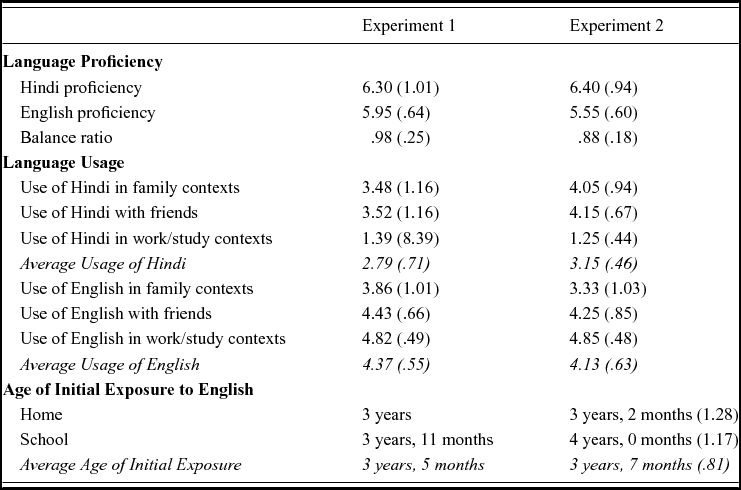
Bilinguals completed a language background questionnaire adapted from Bialystok et al. (Reference Bialystok, Craik, Klein and Viswanathan2004) in which they rated their proficiency in both languages as well as their usage of each language at home, work (or school), and with friends (see Table 1). They reported using English significantly more than Hindi on average, t(22) = 7.21, p < .001, d = 2.51; but rated their proficiency in Hindi and English as comparable, t(22) = 1.32, p = .20, d = .42. In addition, following Flege, MacKay, and Piske (Reference Flege, MacKay and Piske2002) we estimated the degree of bilingualism by dividing reported English proficiency by reported Hindi proficiency (i.e., L2/L1 ratio). The mean ratio was .98 (see Table 1). This did not differ significantly from a value that might be taken to indicate perfect bilingual balance (i.e., a ratio of 1.0), t(22) = .41, p = .69, d = .03. Reported age of initial exposure to English was 3 years, 5 months; with first exposure to English occurring in the home, approximately 11 months earlier than their exposure to English in school, t(19) = 3.76, p = .001, d = 1.02 (see Table 1). All bilinguals reported that they learned English through formal education and by speaking English with others.
Mean (and standard deviation) language proficiency and language usage self-reports of bilinguals for Experiment 1 (N = 23) and Experiment 2 (N = 20).

Note. Language proficiency was rated on a 7 point scale, with 1 = very poor and 7 = native like. Use of language was rated on a 5 point scale, with 1 = never and 5 = all the time.
Design and materials
Fluid intelligence and verbal ability
In WASI Matrix Reasoning participants viewed a series of incomplete matrixes and completed each one by selecting the correct response option. In WASI Vocabulary participants provided spoken English definitions for English words presented visually and orally.
Motor processing speed
A motor tapping task that required participants to tap a key as many times as possible in 5000ms was administered. The start of a trial was signalled by a tone followed immediately by a picture displayed for approximately 5000ms and the end of the trial was signalled by a tone and a different visual stimulus. There were three conditions: (1) using the index finger of the preferred hand, participants tapped a key on the keyboard as many times as possible (2) using the index finger of the preferred hand, participants alternately tapped two keys on the keyboard as many times as possible and (3) using the middle and index fingers of the preferred hand, participants alternately tapped two keys on the keyboard as many times as possible. Each condition consisted of 6 trials. The principal measure was ms/tap. The motor tapping task was run using the DMDX software (Forster & Forster, Reference Forster and Forster2003).
Working memory measures
Subtests from the AWMA were administered. Each began with practice trials followed by test trials presented in blocks of increasing difficulty, with each block containing 6 trials. If the participant responded correctly on 4 out of 5 trials in a block the test continued to the next block. Otherwise the test was discontinued.
Verbal short-term memory was assessed using Digit Recall and Nonword Recall in which sequences of spoken digits and nonwords respectively have to be immediately repeated in the order that they were presented.
Visuo-spatial short term memory was assessed using Dot Matrix and Block Recall. Dot Matrix requires the individual to remember the location and order of dots displayed sequentially in a grid. In Block Recall, the individual views a series of blocks being tapped and reproduces the sequence in the correct order by tapping on the blocks.
Verbal executive was assessed using Listening Recall and Backward Digit Recall. In the Listening Recall task, the individual is presented with a series of spoken sentences, has to determine the veracity of the sentence and recalls the final word for each sentence in sequence. In Backward Digit Recall, the individual is required to recall a sequence of spoken digits in reverse order.
Visuo-spatial executive was assessed using Odd One Out and Spatial Recall. In the Odd One Out task the individual views three shapes, each in a box presented in a row, and identifies the odd-one-out shape. At the end of each trial, the individual recalls the location of each odd-one-out shape, in the correct order, by tapping the correct box on the screen. In Spatial Recall the individual views a picture of two arbitrary shapes, where the shape on the right has a red dot on it. The individual identifies whether the shape on the right is the same as or opposite to the shape on the left. The shape with the red dot may also be rotated. At the end of each trial the individual has to recall the location of the red dot on each shape in sequence by pointing to a picture with three compass points that represent the possible location of the red dot.
Attention measures
Selective attention was assessed using the Flanker task where participants were required to identify the direction of a central target while disregarding a number of adjacent distracters that may be congruent or incongruent to the direction of the target. The task consisted of 40 congruent and 40 incongruent trials. The congruent trials consisted of a central target (i.e., either an arrow pointing to the left or the right) and four distracters (i.e., two arrows on either side of the target) pointing in the same direction as the target. The incongruent trials consisted of a central target (i.e., either an arrow pointing to the left or the right) and four distracters (i.e., two arrows on either side of the target) pointing in the opposite direction as the target. Participants were required to identify the direction of the target (i.e., left or right) as quickly as possible by pressing the right and left shift keys respectively while ignoring the orientation of the distracters. The stimulus for each trial was displayed on the computer screen for approximately 1000ms. Participants were instructed to respond as quickly as possible to the direction of the target. The principal measures taken were mean reaction time and accuracy for congruent and incongruent trials.
Response inhibition was assessed using a Stop Signal Reaction Time task. This task had a frequent visual ‘go’ signal set up to a prepotent response tendency and a less frequent visual ‘stop’ signal for participants to withhold their response. Go signals occurred on 75% of trials and stop signals on 25% of trials. The go signal followed a fixation point and participants were required to respond with a single button press when it appeared. On stop trials, the stop signal followed the onset of the go signal at different delays as outlined in Jennings, Van der Molen, Pelham, Debski, and Hoza (Reference Jennings, van der Molen, Pelham, Debski and Hoza1997) and Overtoom, Kenemans, Verbaten, Kemner, van der Molen, Van Engeland, Buitelaar, and Koelega (Reference Overtoom, Kenemans, Verbaten, Kemner, van der Molen, Van Engeland, Buitelaar and Koelega2002). Participants were instructed to respond as quickly as possible without making mistakes, trying not to respond on stop trials. They were instructed not to wait for the stop signal, because it occurred randomly and infrequently. The purpose of this instruction was to avoid monitoring for the stop signal. SSRT (i.e., mean time required for inhibiting responses) served as an index of response inhibition. Variability of response latencies for go-trials (i.e., SDRT) served as an index of response variability, and the proportion of trials that were successfully inhibited on stop-trials (i.e., P(i)) served as an index of probability of inhibition. Additionally, accuracy and response latencies on go-trials were measured.
The order of trial presentation in the selective attention and response inhibition tasks was randomised for each participant and was run using DMDX.
Testing schedule
All tasks were administered in one session that lasted for approximately one hour, with a 5 minute break. All participants were tested in the UK.
Results
Preliminary analyses
Overall, monolinguals and bilinguals were matched on general cognitive ability and motor processing speed: groups did not differ significantly on verbal ability as measured by WASI Vocabulary (monolinguals = 63, bilinguals = 63; F(1, 44) = .06, p = .81, ŋp2 = .001), fluid intelligence (monolinguals = 60, bilinguals = 62; F(1, 44) = 2.87, p = .09, ŋp2 = .06) and motor processing speed (monolinguals = 212ms/tap, bilinguals = 227ms/tap; F(1, 44) = 3.84, p = .06, ŋp2 = .08).
Before examining group differences on the core tasks, reliability was computed for the attention tasks (Cronbach's α). The reliability of these tasks was excellent: Flanker .95 and SSRT .96. We also adopted the following criteria to reduce the effects of outliers in the Flanker task: prior to analysis, erroneous responses were excluded and an inverse transformation was used to reduce the effect of remaining outliers (see Ratcliff, Reference Ratcliff1993; Ulrich & Miller, Reference Ulrich and Miller1994). For the Stop Signal Reaction Time task, SSRTs were estimated using the mean method (mean of inhibition function subtracted from the mean of RT distribution) as outlined by Band et al. (Reference Band, van der Molen and Logan2003) and Verbruggen and Logan (Reference Verbruggen and Logan2009).
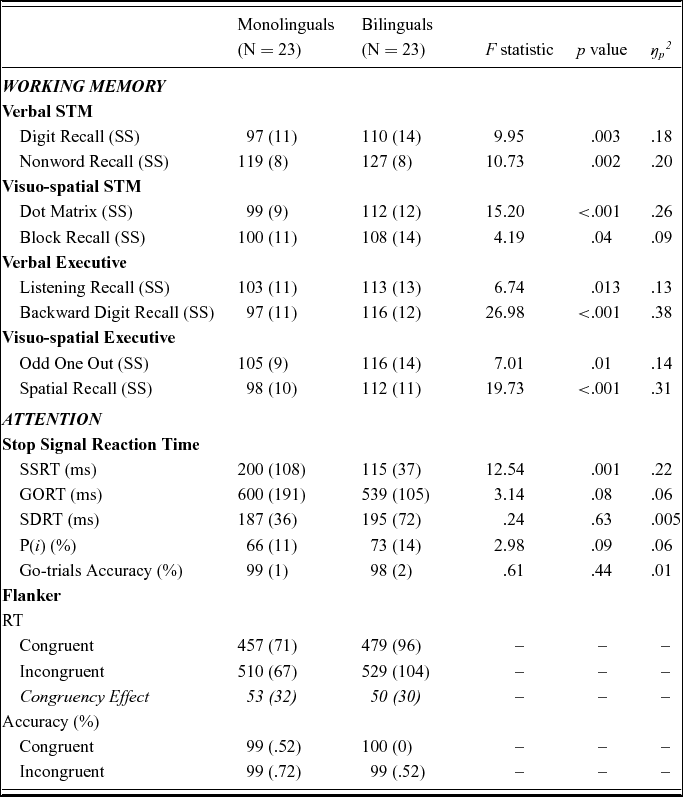
Table 2 summarises the performance of the monolinguals and bilinguals on the eight working memory tasks and the two attention tasks.
Mean (and standard deviation) for working memory and attention measures for both groups with group differences (N = 46) for Experiment 1.

Note. df = (1,44); STM = short-term memory; SS = Standard Score; GORT = reaction time for go-trials; SDRT = standard deviation (variability) of RTs for go-trials; P(i) = probability of inhibition (i.e., the proportion of trials that were inhibited on stop-trials); Congruency Effect = calculated by subtracting RT on incongruent trials from RT on congruent trials; ŋp2 = partial eta squared (small effect = .01, medium effect = .09, large effect = .25).
Working memory
Data were entered in to a multivariate analysis of variance (MANOVA), with language group as the fixed factor. Using Pillai's Trace, there was a statistically significant effect of language group on working memory, V = .54, F (8, 37) = 5.43, p < .001, ŋp2 =.54. Furthermore, separate univariate analyses of variance (ANOVA) showed that bilinguals performed significantly better than monolinguals on all 8 working memory measures (see Table 2).
Attention
Response inhibition
Data were entered in to a MANOVA, with language group as the fixed factor. Using Pillai's Trace, there was a statistically significant effect of language group, V = .36, F (5, 40) = 4.42, p = .003, ŋp2 = .36. Separate univariate ANOVA on the outcome variables showed a bilingual advantage in mean time required for inhibiting responses (i.e., SSRT). However, there were no language group differences on response latencies for go-trials, SDRT, P(i) and accuracy on go-trials (see Table 2).
Selective attention
RT data were entered into a 2 (language group: bilinguals, monolinguals) × 2 (congruency: congruent, incongruent) repeated measures ANOVA. As expected, in the Flanker task there was a statistically significant congruency effect (i.e., response latencies on congruent trials were significantly shorter than response latencies on incongruent trials), F(1, 44) = 119.02, p < .001, ηp2 = .73 (see Table 2). Importantly, monolinguals and bilinguals did not differ in overall response latencies, F(1, 44) = .90, p = .35, ηp2 = .02, and there was no statistically significant interaction between language group and congruency effect, F(1, 44) = .56, p = .46, ηp2 = .01 (see Table 2).
Accuracy on the Flanker task was excellent (99.89%), and a 2 (language group: bilinguals, monolinguals) × 2 (congruency: congruent, incongruent) repeated measures ANOVA revealed that there was no statistically significant main effect of congruency (i.e., no difference between congruent and incongruent trials) and language group, F(1, 44) = .98, p = .33, ηp2 = .02 and F(1, 44) = 1.07, p = .31, ηp2 = .02, respectively (see Table 2). Similarly, the language group × congruency interaction was not statistically significant, F(1, 44) = .00, p = 1.00, ηp2 = .00 (see Table 2), illustrating that there was no time/accuracy trade-off in task performance.
Discussion
Bilinguals showed an advantage in working memory, supporting the view that lifelong use of more than one language enhances working memory. Regarding executive control, a bilingual advantage was found in response inhibition, but not in selective attention, highlighting the notion that bilingualism modulates different aspects of executive mechanisms: bilingualism enhances the ability to inhibit ongoing responses, but has no impact on the ability to supress irrelevant perceptual information.
Experiment 2
Experiment 2 sought to replicate and extend Experiment 1 by additionally examining novel-word learning advantage in bilinguals, and the underlying skills that may contribute to this advantage. Based on the effects reported in Experiment 1 and by Papagno and Vallar (Reference Papagno and Vallar1995) we predicted medium to large magnitude effect sizes for language group differences in working memory (Cohen's d = 1.17), response inhibition (Cohen's d = .56) and novel-word learning (Cohen's d = 1.04; Papagno & Vallar, Reference Papagno and Vallar1995); but a small effect in selective attention (Cohen's d = .10). Thus, given a minimum statistical power of .80 with α .05 a total sample size of 22, 30, 26 and 28 participants are required for the working memory, response inhibition, novel-word learning and selective attention tasks, respectively. Experiment 2 has a total of 40 participants; thus, there was adequate power to detect the predicted effects.
Method
Participants
Twenty monolingual adult speakers of English (mean age 21 years, 7 months; 10 males and 10 females) and 20 bilingual adult speakers of Hindi and English (mean age 23 years, 5 months; 14 males and 6 females) with no known hearing problems participated. The bilinguals were significantly older than the monolinguals by approximately 21 months, t(38) = .2.93, p = .006. As in Experiment 1 participants were university students studying in the UK and reported having no knowledge of Spanish. Similar to the bilinguals in Experiment 1, the bilinguals reported using English significantly more than Hindi on average, t(19) = 5.23, p < .001, d = 2.40. In contrast to Experiment 1, bilinguals rated their proficiency in Hindi significantly higher than their proficiency in English, t(19) = 3.85, p < .001, d = 1.76. Additionally, the mean ratio for the degree of bilingualism was .88 (see Table 1), and this differed significantly from a value that might be taken to indicate perfect bilingual balance, t(19) = 2.76, p = .013, d = .62. Reported age of initial exposure to English was 3 years, 7 months; with first exposure to English occurring in the home, approximately 10 months earlier than their exposure to English in school, t(16) = 2.86, p = .01, d = 1.43 (see Table 1). Bilinguals reported that they learned English through formal education and by speaking English with others. All participants recruited for this experiment were included in all analyses reported.
Design and materials
The design and materials are the same as in Experiment 1, except where differences are noted below.
Visual-verbal PAL
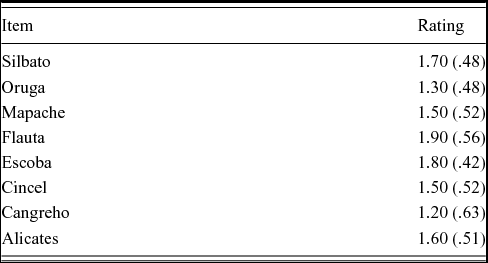
In this task participants learned novel names for novel objects. Forty spoken English words with low frequency ratings (see Morrison, Chappell & Ellis, Reference Morrison, Chappell and Ellis1997; Morrison, Ellis & Quinlan, Reference Morrison, Ellis and Quinlan1992) were translated and recorded in Spanish by a native Spanish speaker. Ten adults (mix of bilinguals and monolinguals) with no knowledge of Spanish rated the familiarity of the Spanish words on a 5 point scale (1= not familiar, 5 = very familiar) in order to ensure that the words were not familiar. Based on these ratings, 8 spoken Spanish words were selected and were paired with 8 unfamiliar pictured objects taken from Warmington and Hitch (Reference Warmington and Hitch2014). Appendix A provides the mean familiarity ratings for the Spanish words and novel objects. The novel-word learning task consisted of three phases: familiarization, training and test.
During the familiarization phase participants were presented with each word-object pair one at a time. Each pictured object appeared one at a time on the computer screen for 5000ms while its name was simultaneously presented over headphones. Participants were instructed to repeat each name aloud during presentation. Each pair was presented across three blocks and item presentation was randomized within blocks and across participants.
Following familiarization, participants were administered the training phase in which each pictured object appeared one at a time on the computer screen. Participants were required to provide the name of the object. If their response was incorrect or they failed to provide a response corrective feedback was provided. This procedure was repeated until participants learned the name of the objects to criterion: that is, named 6 out of 8 objects (75%) correctly in a given trial. Participants had a maximum of 10 trials to reach criterion. Item presentation was randomized within trials and across participants. Once participants reached criterion they completed the test phase (i.e., object naming and object-name recognition) with no corrective feedback.
Object naming
Learning was assessed via an object naming task presented immediately after training (immediate test). In each case the 8 pictures were shown in a random order and the number named correctly and errors were recorded. The object naming task was administered again in second session a day later (delayed test), in a fresh, randomized order.
Object-name recognition
This task was presented in the delayed test only. Participants heard the novel names one at a time over headphones and had to match each name with the corresponding pictured object. Each name was presented simultaneously with a number on the computer screen. Participants had before them a sheet of paper showing the 8 learned objects and 2 novel distracter objects and had to match the object with its name by writing the number under the correct pictured object. Participants were not allowed to change their response once they moved on to the next item.
The experiment was run using DMDX software that recorded participants' responses for scoring. Item presentation across all phases was randomized for each participant. The principal measures taken were number of trials taken to reach criterion, object naming accuracy at immediate and delayed test, and object-name recognition accuracy.
Testing schedule
There were two sessions. In session 1 participants were administered the novel-word learning task, object naming (immediate test), working memory measures and language background questionnaire. In session 2 (a day later) participants completed the object naming (delayed test), object-name recognition, attention, processing speed and general cognitive ability tasks. Sessions lasted for approximately one hour, each with a 5 minute break. All participants were tested in the UK.
Results
Preliminary analyses
Overall, monolinguals and bilinguals were matched on general cognitive ability and motor processing speed: groups did not differ significantly on verbal ability as measured by WASI Vocabulary (monolinguals = 65, bilinguals = 64; F(1, 38) = .28, p = .59, ŋp2 = .007) and motor processing speed (monolinguals = 219ms/tap, bilinguals = 233ms/tap; F(1, 38) = 1.52, p = .23, ŋp2 = .04); bilinguals tended to perform slightly better than monolinguals on WASI Matrix Reasoning (monolinguals = 59, bilinguals = 62), but this difference did not reach statistical significance, F(1, 38) = 3.89, p = .06, ŋp2 = .09.
As in Experiment 1, reliability (Cronbach's α) for our bespoke measures was good: Flanker .98, SSRT .94, novel-word learning .78. We adopted the same criteria as in Experiment 1 to reduce the effects of outliers in the Flanker task.
As the bilinguals and monolinguals differed significantly in age, when analysing language group differences on the core task (i.e., working memory, attention and novel-word learning) we entered age as a covariate.
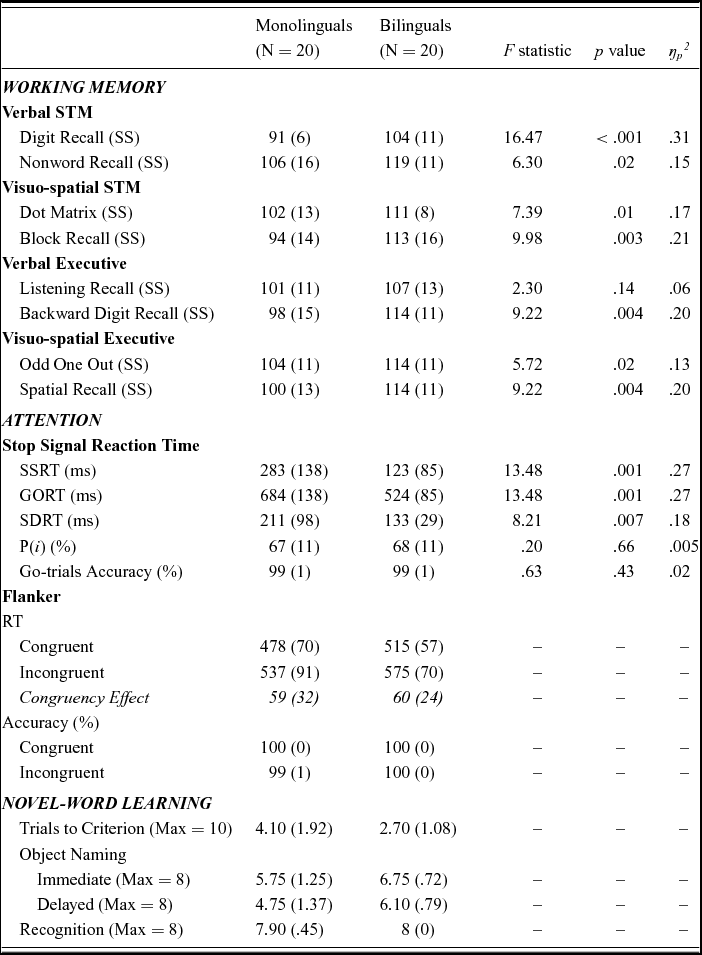
Table 3 summarises the performance of the monolinguals and bilinguals on the eight working memory, the two attention and novel-word learning tasks.
Mean (and standard deviation) for working memory, attention and novel-word learning measures for both groups with group differences (N = 40) in Experiment 2.

Note. df = (1,37); STM = short-term memory; SS = Standard Score; GORT = reaction time for go-trials; SDRT = standard deviation (variability) of RTs for go-trials; P(i) = probability of inhibition (i.e., the proportion of trials that were inhibited on stop-trials); Congruency Effect = calculated by subtracting RT on incongruent trials from RT on congruent trials; ŋp2 = partial eta squared (small effect = .01, medium effect = .09, large effect = .25)
Working memory
Data were entered in to a multivariate analysis of covariance (MANCOVA), with language group as the fixed factor and age as a covariate. Using Pillai's Trace, there was a statistically significant effect of language group on working memory, V = .45, F (8, 30) = 3.02, p = .013, ŋp2 = .45. Furthermore, separate univariate ANOVA showed that bilinguals performed significantly better than monolinguals on 7 of the 8 working memory measures, the single exception being Listening Recall (see Table 3). There was no statistically significant effect of age on working memory, V = .19, F (8, 30) = .86, p = .56, ŋp2 =.19.
Attention
Response inhibition
Data were entered in to a MANCOVA, with language group as the fixed factor and age as a covariate. Using Pillai's Trace, age was not statistically significant, V = .10, F (4, 34) = .96, p = .44, ŋp2 = .10.
The effect of language group on response inhibition was statistically significant, V = .34, F (4, 34) = 4.48, p = .005, ŋp2 = .35. Furthermore, separate univariate ANOVA on the outcome variables confirmed a bilingual advantage in SSRT (see Table 3). Additionally, response latencies on go-trials were significantly shorter and less variable in the bilinguals than in the monolinguals (see Table 3). In contrast, language groups did not differ significantly in the proportion of stop-trials that were successfully inhibited (i.e., P(i)) and accuracy on go-trials (see Table 3).
Selective attention
RT data were entered into a 2 (language group: bilinguals, monolinguals) × 2 (congruency: congruent, incongruent) repeated measures ANCOVA with age as a covariate. As in Experiment 1 monolinguals and bilinguals did not differ in overall response latencies, F(1, 37) = 2.67, p = .11, ηp2 = .07, and the language group × congruency interaction was not statistically significant, F(1, 37) = .00, p = .99, ηp2 = .00 (see Table 3). In contrast to Experiment 1, response latencies on congruent trials did not differ significantly from response latencies on incongruent trials, F(1, 37) = 1.69, p = .20, ηp2 = .04 (see Table 3). The covariate, age, was not statistically significant, F(1, 37) = .56, p = .46, ηp2 = .01.
Accuracy on the Flanker task was excellent (99.87%), and a 2 (language group: bilinguals, monolinguals) × 2 (congruency: congruent, incongruent) repeated measures ANCOVA with age as a covariate revealed that there was no statistically significant main effect of congruency (i.e., no differences between congruent and incongruent trials), age and language group, F(1, 37) = .02, p = .87, ηp2 = .001, F(1, 37) = .09, p = .77, ηp2 = .002 and F(1, 37) = 2.73, p = .11, ηp2 = .07, respectively (see Table 3). Similarly, the language group × congruency interaction was not statistically significant, F(1, 37) = 2.73, p = .11, ηp2 = .07, illustrating that there was no time/accuracy trade-off (see Table 3).
Novel-word learning
Trials to criterion
A univariate ANCOVA, with language group as the fixed factor and age as the covariate showed a bilingual advantage in the number of trials taken to reach criterion, F(1, 37) = 7.71, p = .009, ηp2 = .17 (see Table 3). However, age was not significantly related to the number of trials taken to reach criterion, F(1, 37) = .29, p = .59, ηp2 = .008.
Object naming
A 2 (language group: bilinguals, monolinguals) × 2 (test session: immediate, delayed) repeated measures ANCOVA with age as a covariate, showed a bilingual advantage in object naming, F(1, 37) = 12.39, p = .001, ηp2 = .25 (see Table 3). Performance did not decrease significantly between test sessions, F(1, 37) = 1.03, p = .32, ηp2 = .03, and the language group × test session interaction was not statistically significant, F(1, 37) = .39, p = .54, ηp2 = .01. The covariate, age, was not statistically significant, F(1, 37) = .05, p = .82, ηp2 = .001.
Object-name recognition
Object-name recognition performance was at ceiling (99.37%). Data were entered into a univariate ANCOVA, with language group as the fixed factor and age as the covariate. Results showed no statistically significant effect of language group, F(1, 37) = .12, p = .73, ηp2 = .003, and age, F(1, 37) = 1.72, p = .19, ηp2 = .04 (see Table 3).
Correlation analyses
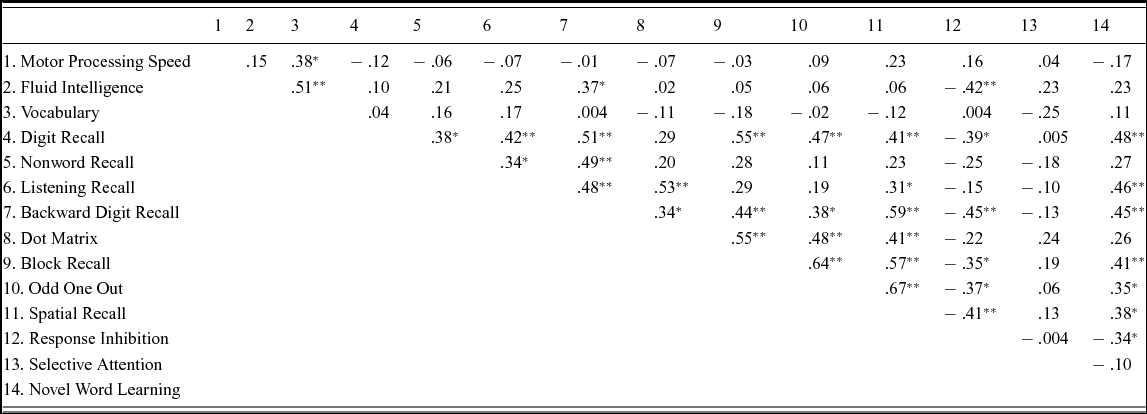
Table 4 shows the Pearson product-moment correlations between measures. Correlations were collapsed across groups in order to ascertain the general pattern of relationships between working memory, attention and novel-word learning (cf. Gathercole et al., Reference Gathercole, Hitch, Service and Martin1997). A novel-word learning score was derived by averaging the number of correct responses collapsed across test delay in the object naming task (performance at immediate and delayed test correlated highly and significantly, r = .59, p < .01).
Correlations between working memory, attention and novel-word learning collapsed across language groups (N = 40).

Note. *p < .05 **p < .01. Motor Processing Speed = Simple Reaction Time; Fluid Intelligence as measured by WASI Matrix Reasoning; Vocabulary as measured by the WASI; Response Inhibition = SSRT; Selective Attention was calculated by subtracting RT on incongruent trials from RT on congruent trials.
Six of the 8 working memory measures correlated moderately and significantly with novel-word learning (rs ranging from .34–.48, p < .05), the exceptions being Nonword Recall and Dot Matrix, which correlated weakly and non-significantly with novel-word learning (rs ranging from .26–.27, p > .05). Novel-word learning correlated moderately with response inhibition (r = –.34, p < .01), but weakly and non-significantly with Vocabulary (r = .11, p > .05), selective attention (r = –.10, p > .05), fluid intelligence (r = .23, p > .05) and motor processing speed (r = –.17, p > .05).
Response inhibition correlated moderately and significantly with fluid intelligence, verbal and visuospatial short term memory (Digit Recall and Block Recall) and verbal and visuospatial executive (Backward Digit Recall, Odd One Out and Spatial Recall) (rs ranging from –.42–.45, p < .05). Selective attention correlated weakly and non-significantly with verbal and visuospatial short term memory and verbal and visuospatial executive (rs ranging from .005–.25, p > .05). Furthermore, selective attention correlated weakly and non-significantly with response inhibition (r = –.004, p > .05).
A separate set of analyses showed that, for the bilinguals, the balance ratio correlated strongly and significantly with response inhibition (i.e., SSRT) (r = .70, p = .001), but weakly and non-significantly with selective attention (i.e., Flanker task) (r = .16, p = .51). These patterns of correlations augment the group differences by illustrating that bilingualism enhances the ability to stop ongoing responses, but has no additional facilitative impact on the ability to suppress irrelevant perceptual information.
Regression analyses: Predicting novel-word learning from verbal working memory and attention
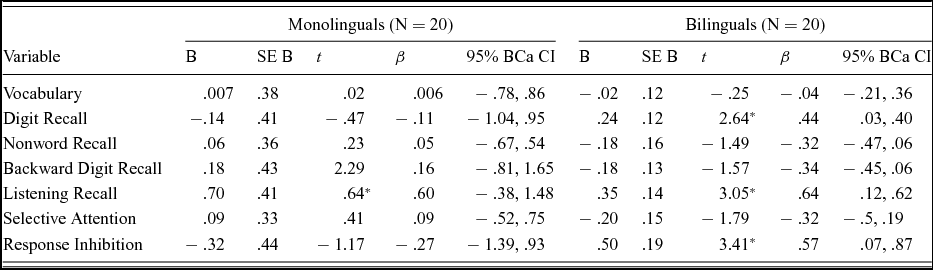
We conducted regression analyses in order to determine the role of verbal working memory and attention in predicting unique variance in novel-word learning in monolinguals and bilinguals separately. The predictor variables were Vocabulary, Digit Recall, Nonword Recall, Backward Digit Recall, Listening Recall, selective attention (Flanker task) and response inhibition (SSRT), and were entered into the model in this order. The regression analysis consisted of a single step with all 7 variables entered together. Vocabulary and the verbal working memory measures were entered as predictors given their established relationship with novel-word learning (see Gathercole & Baddeley, Reference Gathercole and Baddeley1990; Gathercole et al., Reference Gathercole, Hitch, Service and Martin1997; Papagno & Vallar, Reference Papagno and Vallar1995).
Additionally, to address the issue of multicollinearity (i.e., two or more variables are very closely linearly related) between predictors entered in the regression analyses (cf. Kreft,& de Leeuw, Reference Kreft and de Leeuw1998) all relevant variables were standardised (i.e., converted into z scores) prior to analyses. Multicollinearity among the predictor variables was assessed using the variance inflation factor (VIF) and tolerance statistics. VIF scores of less than 4 indicate that the result will not significantly influence the stability of the parameter estimates (Myers, Reference Myers1990). VIF scores for the predictor variables ranged between 1.14–1.55 for monolinguals and between 1.09–2.00 for bilinguals. Similarly, tolerance statistics were well above .20 (monolinguals = .64–.88; bilinguals = .49–.92) also indicating that there was no collinearity in the data (Menard, Reference Menard1993). Further, given the small sample size in each group an additional bootstrapping procedure (Efron & Tibshirani, Reference Efron and Tibshirani1994; Shrout & Bolger, Reference Shrout and Bolger2002) was applied to increase confidence in the reliability of findings. We achieved this by re-sampling with replacement 1000 samples derived from the original sample. Thus, 95% confidence intervals of unstandardized coefficients derived from bootstrap analysis are included in the regression results.
Table 5 shows the hierarchical regression analysis for novel-word learning in monolinguals and bilinguals.
Hierarchical regression with vocabulary, verbal working memory and attention as predictors of novel-word learning in monolinguals and bilinguals (N = 40).

Note. *p < .05. Vocabulary as measured by the WASI; Selective Attention was calculated by subtracting RT on incongruent trials from RT on congruent trials; Response Inhibition = SSRT; B = bootstrap unstandardised coefficients; SE B = bootstrap standard error for unstandardised coefficients; β = standardised beta values; BCa CI = bias-corrected bootstrap confidence intervals.
For monolinguals, the model accounted for 47.20% of the variance in novel-word learning, F(7, 12) = 1.53, p = .24, and only Listening Recall explained statistically significant unique variance.
In contrast, for bilinguals the model accounted for 72.70% of the variance in novel-word learning, F(7, 12) = 4.57, p = .01. Interestingly, not only did verbal working memory (i.e., Digit Recall and Listening Recall) explain statistically significant unique variance in novel-word learning in bilinguals, but response inhibition also accounted for unique significant variance. This pattern is consistent with the idea that enhanced executive skills underpin the novel-word learning advantage in bilinguals.
Vocabulary did not contribute statistically significant unique variance to novel-word learning in both groups. This suggests that, regardless of language status, lexical knowledge did not support novel-word learning in the present sample of young adults, perhaps reflecting our use of Spanish words that had no phonological or lexical resemblance to either English or Hindi.
Mediation analysis: Does verbal working memory mediate the relationship between bilingualism and novel-word learning?
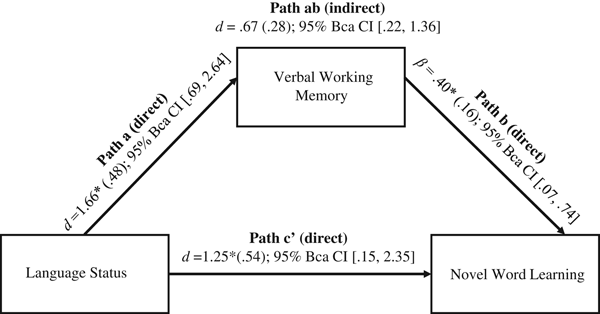
A simple mediation model was tested to examine the extent to which verbal working memory (i.e., Digit Recall and Listening Recall), as a statistically significant unique predictor in the regression, mediated the relationship between language status (monolingual vs. bilingual) and novel-word learning. All continuous variables were converted into standardised z scores on the full sample to facilitate between and within-model comparisons and allow unstandardised regression coefficients to be interpreted as Cohen's d effect sizes when predicting from a categorical variable, in this case language status/group (Hayes, Reference Hayes2009). Additionally, we derived a verbal working memory composite by summing the z scores for Digit Recall and Listening Recall.
Mediation analysis was carried out using bias-corrected bootstrapping to minimise Type II error (Shrout & Bolger, Reference Shrout and Bolger2002) and to establish the statistical significance of all total, direct, and indirect effects. The bootstrapping method is advantageous primarily because it increases power and was carried out using the PROCESS macro for SPSS developed by Preacher and Hayes (Hayes, Reference Hayes2013; Preacher & Hayes, Reference Preacher and Hayes2008). The Preacher and Hayes bootstrapping method is a non-parametric test and as such does not violate assumptions of normality, making it ideal for small sample sizes. In the analysis reported 1000 samples were derived from the original sample (N = 40) by a process of resampling with replacement. PROCESS allowed us to detect the difference between the direct effect of language status on novel-word learning, and the indirect effect after accounting for verbal working memory. Cohen's d effect sizes, standard errors, 95% bias-corrected confidence intervals, are shown in Figures 1 and 2.
Schematic model depicting total effects of language status on novel-word learning. Cohen's d for the c pathway reflects the impact of language status on novel-word learning before taking into account the mediating variable. Effect sizes (or β weights) are significant based on 95% BCa CI. Note: *p < .05. Language Status = dummy coded variable: 0 - monolinguals; 1 - bilinguals; d = Cohen's d effect size; BCa CI = bias-corrected bootstrap confidence intervals.

Schematic model depicting direct, indirect and mediating effects of verbal working memory (i.e., composite of Digit Recall and Listening Recall) on novel-word learning. Cohen's d for the c’ pathways reflects the impact of language status on novel-word learning after taking into account the mediating variable. Effect sizes (or β weights) are significant based on 95% BCa CI. Values for path b reflect β weights due to the use two continuous variables to calculate the direct effect. Solid lines represent significant pathways. Note: *p < .05. Language Status = dummy coded variable: 0 - monolinguals; 1 - bilinguals; d = Cohen's d effect size; BCa CI = bias-corrected bootstrap confidence intervals.

Examination of the total effect (see Figure 1) showed that language status was related significantly to novel-word learning, such that bilingualism was associated with better novel-word learning prior to accounting for verbal working memory. Importantly, verbal working memory was a statistically significant, partial mediator of language status differences in novel-word learning, and accounted for 35% of the variance in the relation (see Figure 2).
Discussion
The results of Experiment 2 are consistent with Experiment 1: bilingual advantage in working memory (excluding Listening Recall) and response inhibition, but not in selective attention. Bilinguals outperformed monolinguals in novel-word learning, and this advantage was partially mediated by bilingual's enhanced verbal working memory capacity. Additionally, individual differences in response inhibition explained unique variance in bilingual novel-word learning.
General discussion
Our results confirm a bilingual advantage in virtually all measures of working memory (excluding Listening Recall: Experiment 2) and response inhibition (depicting medium to large effects), but not in selective attention. This is consistent with the view that the bilingual advantage in cognition is attributable to a particular pattern of strengths in executive control and working memory.
Selective attention and response inhibition correlated weakly. Response inhibition correlated moderately with working memory, while selective attention correlated weakly with working memory. These patterns are consistent with the suggestion of some commonality and diversity across executive mechanisms (Miyake & Friedman, Reference Miyake and Friedman2012).
We found a bilingual advantage in novel-word learning, and this was true for the number of trials taken to reach criterion and their ability to recall the names both at immediate and delayed test. Instead, individual differences in response inhibition and verbal working memory explained unique significant variance in bilingual novel-word learning, but not in monolinguals. Additionally, verbal working memory was a partial mediator of differences in novel-word learning between language groups. On the basis of this preliminary evidence, we propose that the underlying cognitive characteristics of being bilingual contributed to this advantage in novel-word learning. Whilst monolinguals only activated verbal (executive) working memory, bilinguals simultaneously activated verbal short-term memory, verbal (executive) working memory and response inhibition when retrieving new words.
At first glance the present findings appear to be at odds with studies that reported no differences in attention between monolinguals and bilinguals who were university students (i.e., young adults: Bialystok et al., Reference Bialystok, Craik, Grady, Chau, Ishii, Gunji and Pantev2005; Gathercole et al., Reference Gathercole, Thomas, Kennedy, Prys, Young, Viñas Guasch, Roberts, Hughes and Jones2014; Paap & Greenberg, Reference Paap and Greenberg2013). We employed two attention tasks – Stop Signal Reaction Time and Flanker tasks. Previous studies typically utilised the Simon task, which taps selective attention or interference control. The Simon and Flanker tasks are logically equivalent: both assess the participant's ability to respond to a task-relevant perceptual attribute while suppressing or ignoring a task-irrelevant attribute. However, the Stop Signal Reaction Time task is distinct from both of these in the sense that it taps the inhibition of an ongoing response (cf. Khng & Lee, Reference Khng and Lee2014). Performance on the Flanker and Stop Signal Reaction Time tasks are influenced by different cognitive processes (cf. Khng & Lee, Reference Khng and Lee2009; Livesey, Keen, Rouse & White, Reference Livesey, Keen, Rouse and White2006), consistent with the fact that both tasks were uncorrelated in the present study. Furthermore, we found that SSRT was highly correlated with balance ratio whereas selective attention was weakly and non-significantly correlated. Thus, our results are consistent with the argument that selective attention offers no additional processing advantage in bilinguals (see Bialystok et al., Reference Bialystok, Craik, Grady, Chau, Ishii, Gunji and Pantev2005; Gathercole et al., Reference Gathercole, Thomas, Kennedy, Prys, Young, Viñas Guasch, Roberts, Hughes and Jones2014; Paap & Greenberg, Reference Paap and Greenberg2013). Moreover, our results highlight the importance of adopting multiple tasks to identify the aspects of executive processes that are enhanced in bilinguals (Paap et al., Reference Paap, Johnson and Sawi2015).
We report a bilingual advantage in verbal and visuo-spatial working memory, extending the findings of Papagno and Vallar (Reference Papagno and Vallar1995) by illustrating that the bilingual advantage in working memory is also evident in visuo-spatial working memory. Our findings are consistent with those reported by Morales et al. (Reference Morales, Calvo and Bialystok2013) and Blom et al. (Reference Blom, Küntay, Messer, Verhagen and Leseman2014), but differ from those reported by Engel de Abreu and colleagues (Engel de Abreu, Reference Engel de Abreu2011; Engel de Abreu et al., Reference Engel de Abreu, Cruz-Santos, Tourinho, Martin and Bialystok2012). We are confident that the differences between our findings and those reported by Engel de Abreu are not down to task differences, as we used the same tasks from the AWMA as Engel de Abreu. Additionally, our results are inconsistent with those reported by Ratiu and Azuma (Reference Ratiu and Azuma2015). Alternatively, we suggest that these differences may be related to sampling factors such as the heterogeneity of the bilinguals (cf. Gasquoine, Weimer & Amador, Reference Gasquoine, Weimer and Amador2017), and as such it is vital that subsequent research considers accounting for sample heterogeneity when comparing monolinguals and bilinguals.
Additionally, working memory was significantly related to response inhibition (cf. Namazi & Thordardottir, Reference Namazi and Thordardottir2010; Unsworth & Spillers, Reference Unsworth and Spillers2010). This pattern of results is unsurprising, adding to a long-standing body of evidence that working memory is not only used for maintaining online information, but also for using that information along with contextual cues to generate imminent action (cf. Roberts, Hager & Heron, Reference Roberts, Hager and Heron1994).
We acknowledge that a closed system of learning 8 novel words is not entirely typical of word learning outside the laboratory. Nevertheless, the current findings provide insight regarding how bilinguals and monolinguals differ in terms of the underlying mechanisms they recruit to establish and retrieve novel associations from memory. Unlike previous bilingual word learning studies that teach participants the associations between a novel and a familiar word (e.g., Papagno & Vallar, Reference Papagno and Vallar1995), our participants learned the associations between novel words and novel objects. Despite lacking ecological validity, this approach provides a useful demonstration that bilinguals acquire novel verbal information more efficiently even when there are very few contextual/situational cues to facilitate learning.
Although our findings must be interpreted cautiously due to the small sample, they nevertheless highlight that bilingualism is not a unitary construct. Furthermore, our findings shed light on the notion that associative learning mechanisms are implicated in executive control processes (Abrahamse et al., Reference Abrahamse, Braem, Notebaert and Verguts2016), and that future research should consider testing paradigms related to the application of implicit learning in executive control.
Mean (SD) familiarity ratings for Spanish words

Mean familiarity ratings for novel objects taken from Warmington and Hitch (Reference Warmington and Hitch2014)