1. Introduction
At the start of the twentieth century, the question of what held constituents together in ordinary chemicals was a live scientific issue, but by the middle of the century the main problems connected with chemical bonding had been solved. But, as van Brackel (Reference van Brakel2005) and Simonian (Reference Simonian2005) have shown, there is still considerable philosophical uncertainty about fundamental aspects of chemistry. Some of this may be connected with the fact that chemists customarily use one and the same word to apply to a unit as an independent entity and also to designate a related center that is a component in a more inclusive whole, even though, strictly speaking, those are two distinct types of referents. This customary polysemy (use of a single word with multiple meanings) was recognized in 1931 for the word “element” by the eminent chemist Fritz Paneth (Reference Paneth2003). For example, the word “hydrogen” is used to refer to a flammable gas and also to a component of organic materials, although these are two distinct meanings. Similarly, the meaning of the word “substance” in chemistry differs in important ways from meanings of “substance” often used in philosophy. This paper proposes that some sorts of chemical coherences should be regarded as “substances” (as that term is often used in philosophy) even though they do not qualify as “chemical substances.”
2. Water and H2O
Most philosophers of science would probably agree with Armstrong's (Reference Armstrong2004, 32) statement: “It is known that water is composed of water molecules, and these molecules are made up of two atoms of hydrogen and one of oxygen.” Perhaps regrettably, the words “molecule” and “atom” that are used in Armstrong's statement have double meanings, similar to those of “element.” The word “atom” is primarily used in physics and chemistry to refer to an unattached and electrically neutral unit containing a nucleus and extranuclear electron density just sufficient to balance the positive charge of that nucleus. Free uncombined atoms surely exist in samples of the noble gases, but in other gases (e.g., dinitrogen, ammonia, water vapor) molecules (and larger aggregates) are present rather than single atoms. The parts of chemical molecules are not, strictly speaking, “atoms.” The more massive components of molecules would better be designated as “elemental centers.” Each such center consists of a nucleus characteristic of some element and (except for hydrogen) inner electron shells closely bound to that nucleus. Each such center is associated with (more or less delocalized) bonding-electron density that keeps the entire molecular aggregate together. In common practice chemists and others do use the word “atom” to refer to an elemental center that is a part of a molecule—but they do not thereby imply that the item designated has independent existence in that aggregate. Philosophers should recognize that to say that atoms are constituents of chemical molecules is to use the word “atom” in an extended, metaphorical, sense.
Similarly, the primary referent of the term “water molecule” is an independent unit represented by the formula H2O. Single H2O molecules may exist in water vapor at low pressure, but H2O molecules are rare (or nonexistent) in liquid water. Contemporary models of liquid water (Smith et al. Reference Smith, Cappa, Wilson, Messer, Cohen and Saykally2004) do not involve H2O molecules but, rather, concern a variety of dynamic aggregates of the general formula H2nOn—in which n is larger, often much larger, than unity. In each of those entities each oxygen center is (on average) strongly bound to two hydrogen centers and weakly attached to two additional hydrogen centers. Nevertheless, in discussing “the total electron yield near-edge x-ray absorption fine structure (TEY-NEXAFS) spectrum” of liquid water as a function of temperature, Smith et al. (Reference Smith, Cappa, Wilson, Messer, Cohen and Saykally2004) uses the word “molecule” to designate an oxygen center with its attendant electron density, even though what is referred to is clearly not an independent H2O unit but rather a component (only partially analogous to an H2O unit) that was a part of a larger aggregate. Ignoring the difference between these two distinct usages of the word “molecule” causes no problems in the ordinary technical discourse of science, such as Smith et al. (Reference Smith, Cappa, Wilson, Messer, Cohen and Saykally2004), but it might well lead to misunderstandings in philosophical discussions, such as those that the next section discusses.
3. Eliminativism
Standard mereology—the branch of logic that deals with parts and wholes—is not directly applicable to topics of chemical interest. As part of a project devoted to developing a macroscopic ontology, Paul Needham (Reference Needham2003) extended standard mereology to include entities—such as chemical concentrations—that are spatially extended but do not fill space. In a more radical departure from standard mereology, Peter van Inwagen (Reference van Inwagen1990, Reference van Inwagen2002) rejected the notion that any collection of entities whatsoever can constitute an existent—a “mereological sum.” He eventually concluded that only “simples” and “lives” exist—but was silent on how lives might be related to simples. Trenton Merricks (Reference Merricks2001, Reference Merricks2003) defends a metaphysics that is similar to van Inwagen's. He favors “eliminativism”—a system that holds that statues, baseballs, windows, and most other macroscopic items “do not exist.” Merricks denies that any baseball has ever shattered a window, because neither windows nor baseballs exist. This conclusion is based on the “Overdetermination Argument.”
(1) The baseball—if it exists—is causally irrelevant to whether its constituent atoms, acting in concert, cause the shattering of the window.
(2) The shattering of the window is caused by those atoms, acting in concert.
(3) The shattering of the window is not overdetermined. Therefore, if the baseball exists, it does not cause the shattering of the window. (Merricks Reference Merricks2001, 56)
An effect is overdetermined if the following are true: that the effect is caused by an object; that object is causally irrelevant to whether some other—i.e., numerically distinct—object or objects cause that effect; and the other object or objects do indeed cause that effect (Merricks Reference Merricks2001, 58). … For material objects to be is to have non-redundant causal powers. … Every material object not only has causal powers, but has non-redundant causal powers. … Material objects must be causally nonredundant. (Merricks Reference Merricks2001, 115)
This conclusion seems related to the “Eleatic Principle” (also known as “Alexander's Dictum”; Hudson Reference Hudson2003)—“everything that we postulate to exist should make some sort of contribution to the causal/nomic order of the world” (Armstrong Reference Armstrong2004, 37).
The Official Rules of Major League Baseball (MLB) state: “1.09 The ball shall be a sphere formed by yarn wound around a small core of cork, rubber or similar material, covered with two stripes of white horsehide or cowhide, tightly stitched together. It shall weigh not less than five or more than 5 1/4 ounces avoirdupois and measure not less than nine or more than 9 1/4 inches in circumference.”Footnote 1 Contemporary chemistry reports that the resilient core, yarn winding, hide cover, and stitching of the official baseball all consist of large (polymeric) molecular and supermolecular aggregates, not free individual atoms. Strictly speaking, there are no “atoms” in a regulation baseball. Each of the many macromolecular components of the baseball contains many elemental centers—including nuclei of carbon, oxygen, and nitrogen (each with a closely associated inner electron shell), protons (hydrogen nuclei), and more or less delocalized bonding-electron density—of the sort discussed in detail by quantum chemists. The bonding of each elemental center to its neighbors accounts for the (otherwise inexplicable) circumstance that, when a baseball moves, many (∼1025) elemental centers “act in concert.”
Current scientific understanding is that window glass consists of negatively charged SiO4 and AlO4 tetrahedral units, each such unit connected to each of about three neighboring units by the sharing of corner oxygen centers—with various positive ions (Na+, Ca2+ …) sufficient in number to yield overall neutrality of charge located nearby. Connections among silicon and aluminum centers through oxygen centers lead to a highly irregular macromolecular structure that may adjust to imposed strain (by rupture and reformation of chemical bonds) if allowed enough time but would disintegrate otherwise, with resultant shattering of the glass. Each sheet of glass may properly be said to be composed of “atoms” only if it is recognized that each and every such unit is highly constrained by the network of chemical bonds that hold that glass sheet together. Free atoms, such as might exist in argon gas, are poor models for the elemental centers in window glass. The attachment of oxygen centers into tetrahedral units and the complex bonding network that links tetrahedral units to each other are both necessary to understand how it is that, in a window, myriad elemental centers “act in concert” to keep rain out of a room while allowing sunlight to enter—but yet fail to exclude rapidly moving baseballs.
One may agree with Merricks that certain “atoms, acting in concert” can cause shattering of a window but not agree that: “The baseball—if it exists—is causally irrelevant to whether its constituent atoms, acting in concert, cause the shattering of the window.” The interatomic binding (into yarn, core, hide, and lacing) and mode of assembly mandated by MLB's rule 1.09 account for the otherwise inexplicable fact that myriads of atoms “act in concert.” The chemical bonds that hold elementary centers in their relative locations in macromolecules and also the physical wrapping and stitching that secure the integrity of the aggregate are causally relevant to any fenestral damage that may occur. To this extent, eliminativism fails. This failure may derive from lack of appreciation of the difference in meaning between “atom” as an independent unit and “atom” as a bound constituent of more inclusive coherence—an elementary center. The eliminativist project depends on the assumption that “atoms” are fully independent agents so that larger objects are only aggregates of those units.
William Wimsatt (Reference Wimsatt2000) considered four conditions necessary for the properties of a composite to be a “mere aggregate” of the properties of its parts. He concluded: “It is rare indeed that all of these conditions are met” (emphasis is in the original). Contemporary science operates with a concept of multilevel hierarchic structuring that is well summarized by Herbert Simon (Reference Simon1996). That outlook seems quite remote from the radical reductionism of the eliminativists. In his final work, Ludwig Wittgenstein (Reference Wittgenstein, Anscombe and von Wright1969, 62e) observed: “[It] is not a kind of seeing on our part; it is our acting, which lies at the bottom of the language game. … Children do not learn that books exist, that armchairs exist, etc., etc.,—they learn to fetch books, sit in armchairs, etc., etc.” This view is quite consistent with the pragmatic ontology that is used in science (Da Costa and French Reference Da Costa and French2003). To the extent that such considerations are applicable, every ontology must depend on the aims of the discourse of which it is a part—as well as on states of affairs that exist in the world. Merricks's outlook seems quite different:
In much of what follows, I'll make claims about atoms arranged statuewise. I have in mind here the atoms of physics, not Democritus. For there is no need to build in a commitment to (or, for that matter, against) simples into eliminativism. … Then again, there is no need to build in a commitment to the atoms of physics either. So consider my claims about the atoms of physics to be useful but expendable. Such claims are really place holders for claims about whatever microscopic entities are actually down there. (Merricks Reference Merricks2001, 3)
I assume there is an objective fact of the matter about what exists. And I think we use the apparatus of existential quantification—expressions like ‘there is’, ‘there are’, and ‘exists’—to say what (we believe) objectively exists. But there is nothing magical about ‘there is’, ‘there are’, or ‘exists’. We control them; they do not control us. So we can use those bits of language any way we choose. We could use them ‘deviantly’ to do something other than to describe what (we believe) exists. … ‘there is’ is used deviantly in ordinary occurrences of ‘there is a statue’. Eliminativism has nothing to say about such deviancy. Eliminativism claims only that ‘there is a statue’ is false when ‘there is’ is being used as a legitimate and straightforward existential quantifier. (Merricks Reference Merricks2001, 18–19)
In addition to imagined microscopic entities “down there,” eliminativists have a second basic ontological category—“lives” for van Inwagen, “human persons” (and perhaps some others) for Merricks. Merricks's discussion of nonredundant causality as referred to this second category seems relevant to clarifying the differing uses of the word “substance” in chemistry and in philosophy. Differing usage of the word “substance” in chemical and philosophical contexts may cause difficulty in interpreting “substance properties” (Needham Reference Needham2005).
4. Substances and Chemistry
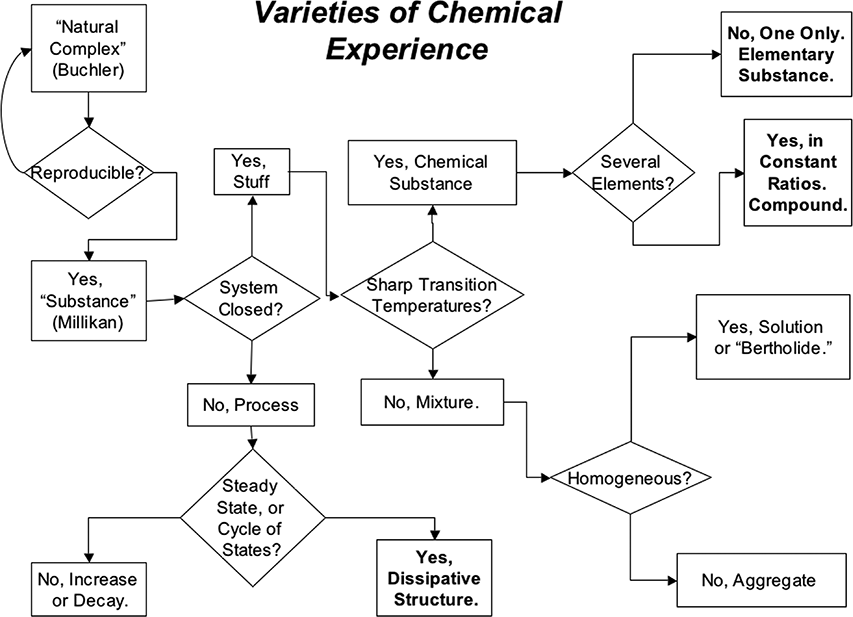
Ruth Garrett Millikan (Reference Millikan2000, 33) discussed the concept of substance, as that term is frequently used in philosophy: “Substances … are whatever one can learn from given only one or a few encounters, various skills or information that will apply to other encounters. … Further, this possibility must be grounded in some kind of natural necessity. … The function of a substance concept is to make possible this sort of learning and use of knowledge for a specific substance.” Although not all philosophers who use substance notions may fully agree with Millikan's characterization, it seems adequate for present purposes. The substance concept, as understood by Millikan, is somewhat more restrictive than is Justus Buchler's (Reference Buchler1990, 31) notion of “natural complex”: “Whatever is discriminated in any way (whether it is ‘encountered' or produced or otherwise related to) is a natural complex, and no complex is more ‘real' or more ‘genuine' or more ultimate than any other.” Figure 1 outlines some aspects of the categorical scheme that chemists routinely use (Earley Reference Earley2005). In virtue of the constancy of their properties over time, elementary substances and chemical compounds clearly are “substances” in Millikan's sense. The constancy of the properties of samples of chemical substances can be understood in terms of relations among microscopic components.
Basic categorial scheme used in chemistry. (An earlier version is discussed in Earley Reference Earley2005.) Boldface entries correspond to “substances” as defined in Millikan (Reference Millikan2000).

The internal potential energy of any molecular species varies with the distance between the elementary centers that account for the bulk of the mass of that unit. At low values of elemental center to elemental center distance, internal energy is positive (repulsive) because, at short distances, strong forces oppose interpenetration of elemental centers. But for stable species, as the centers separate (for whatever reason) potential energy becomes negative (attractive) due to interactions between elemental centers and bonding-electron density. That attraction decreases (potential energy, though negative, becomes small in magnitude) if distance between centers increases. At intermediate center-to-center distances, components of molecules are strongly bound together. Successive advances in theory have made accurate computations of energy-distance relationships possible for some molecular systems.
At all temperatures for which a molecule is stable, vibration occurs about the center-to-center distance that corresponds to the potential energy minimum. The elemental centers in the molecule repeatedly cycle between stretched arrangements and compressed configurations. As temperature increases, vibration becomes faster and has greater amplitude, until the substance decomposes. Complex vibratory motion—reiteration, recursion, and repetition of a set of molecular configurations—allows a molecular system to act as one unit in collisions with other similarly constituted assemblages (Earley Reference Earley, Sobczynska, Zeidler and Zielonaka-Lis2003b). The stability of this motion arises from closure of networks of constraints that arise from interactions between the constituents of the molecule. The chemical interactions (including bonds) that define the molecule cause the constituents to “act in concert”—hence those interactions are relevant to causal powers of the aggregate. Thus each such chemical entity (Earley Reference Earley, Bogaard and Treash1993) may fulfill both the Eleatic Principle and Merricks's nonredundancy condition.
Chemists encounter kinds of coherences—flames in Bunsen burners, for instance—that may function as substances in Milliken's sense although they are not “chemical substances” in the usual meaning of that term. Such systems are called “dissipative structures” (Kondepudi and Prigogine Reference Kondepudi and Prigogine1998). These coherences may be considered as self-organizing collections of processes—as ordinary chemical substances can be regarded as self-assembling collections of things (ions, molecules, atoms …). Each (e.g., flame-like) example of this type of network of chemical and physical processes is capable of making significant alterations in that with which it interacts. On this basis, each such coherence (as a unit) is a center of agency—a substance in Milliken's sense.
When chemical systems (a) are far from equilibrium, (b) involve a process that gets faster as it proceeds (autocatalysis), and (c) include interactions that reduce the effective rate of the autocatalytic process, then a persistent nonequilibrium steady state or continuous oscillations in chemical concentration may occur (Earley Reference Earley, Eastman and Keeton2003a). In the case of a flame in a dihydrogen-fed burner, the combustion of dihydrogen to yield water also produces heat. The heat functions as an autocatalyst by increasing the speed of combustion—but the hotter the system becomes, the more rapidly heat diffuses away, thus limiting the autocatalytic effect. A stable flame (a nonequilibrium steady state) may result from the balance of these two processes. Every persistent oscillation of chemical concentrations depends on an appropriate balance of an autocatalytic change and one or more processes that inhibit autocatalysis—just as each molecule arises from a dynamic balance of attractive and repulsive interactions. Nelson et al. (Reference Nelson, Ihekwaba, Elliott, Johnson, Gibney, Foreman, Nelson, See, Horton, Spiller, Edwards, McDowell, Unitt, Sullivan, Grimley, Benson, Broomhead, Kell and White2004) give a striking illustration of how the achievement of such a balance on one hierarchic level may have important effects on many levels.
Chemical reactions that generate nonequilibrium steady states or continuous oscillations of concentrations can be set up in closed (batch) reactors that do not exchange chemicals or energy with their surroundings, but then steady states become unstable and oscillations gradually decline. In contrast, in pumped (flow) reactors—open systems that involve continual addition and removal of material—nonequilibrium steady states and oscillations can persist indefinitely. Pumped systems often have two nonequilibrium steady states. One of these steady states—let's call it “blue”—has a high autocatalyst concentration: that state occurs if pumping is slow. At higher pump rates, a different steady state (call it “red”) with a low autocatalyst concentration exists. At intermediate pump rates, both of these nonequilibrium steady states may become unstable and thus produce continuous oscillations. Each cycle of oscillation involves a shift from something close to the red state to a condition similar to the blue state, and then the reverse transition. As long as conditions remain favorable, concentrations of all the chemical components of chemical dissipative structure continually rise and fall—tracing out the same sequence of states in each oscillation. In chemical chaos, oscillations do not follow a single closed set of states (a “limit cycle”) but rather trace out a sequence of states that repeats approximately rather than exactly (a “strange attractor”). Each of the changes between quasi-steady states (red/blue) involves many millions of billions of tightly synchronized molecular-level events. In the functioning of each dissipative structure, immense numbers of molecules and molecular ions “act in concert”—as do the myriad of elemental centers in a baseball striking a window. There is a major difference, however, in that reactive centers in dissipative structures are not bound together in the direct way that elemental centers are interconnected in window glass or in baseballs. The many centers in the dissipative structure undergo nearly simultaneous change due to the details of the closed network of nonlinear chemical and physical processes in which they are involved.
Dissipative structure may be short-lived, but some such structures may be remarkably resilient—oscillations or steady states may continue for days or weeks with only minor change, even under considerable variation of conditions. Such inherent flexibility allows the reaction systems to maintain their integrity while interacting with, and influencing, the rest of the world. In this respect, the oscillation of a pumped system is similar to vibration of a dihydrogen molecule, the basis for that molecule's maintenance of integrity through collisions. Interactions of a system with its surroundings are quite different in the presence of a dissipative structure than they would be in the absence of that coherence. So long as the defining constraints are met, the dissipative structure continues to exist, and that structure, as an integral unit, may serve as a center of agency—it is a persistent “substance” in Milliken's sense of the word.
The effects of the structure as a whole are the resultant of the effects of the components, but the concentrations of the components that exist in the system at any instant are the effects of the closure of the limit cycle (an attractor). In this sense, the closure of the network of relationships among chemical concentrations that gives rise to a particular dissipative structure (Earley Reference Earley2000, Reference Earley, Baird and Scerri2006) is a “unit-determining” feature, one required to secure “unithood,” in D. M. Armstrong's (Reference Armstrong1997) terminology. Once such closure is attained, a system may maintain its coherence indefinitely and may function as a unit in yet higher-level coherences. Networks of interaction abound in biochemistry, molecular biology, organismic biology, and ecology—as well as in economics and the areas studied by the social sciences. In favorable cases, systems in all these areas display “unit-making” closure of relationships quite similar to those displayed by dissipative structures.
From one point of view, living organisms—“lives” in van Inwagen's (Reference van Inwagen1990) sense—may be regarded as especially elaborate dissipative structures. Consistent with this view, in considering whether viruses are “living,” microbiologist L. P. Villarreal (Reference Villarreal2004, 103) states: “Another way to think about life is as an emergent property of a collection of certain nonliving things. Both life and consciousness are examples of emergent complex systems. They each require a critical level of complexity or interaction to achieve their respective states.” The persistent oscillations in constituent compositions that are characteristic of dissipative structures in pumped flow reactors are partial models for the multiple integrations that are typical of living biological organisms and share some characteristics with functioning human brains (O'Connor Reference O’Connor2003; Kim Reference Kim2005)—structures of processes even more complex than those found in microorganisms.
Whenever a number of agents, such as concentrations of chemical species—entities distributed in space (Needham Reference Needham2003)—interact in such a way that sustained oscillation (or an approximation thereto) develops, the net effect of that aggregate of agents on some interacting (test) entities may be changed so that the activity of those test entities is modified by the existence of the oscillation. On this basis, identification of the collection of agents as a new entity may be warranted (Earley Reference Earley2003c). Every dissipative structure is a self-organizing coherence of reactions that maintains its integrity while taking in and giving off chemical species. Dissipative structures are “substances” of a chemical sort, even though they are not “chemical substances.”