
I. INTRODUCTION
As an alternative power source, direct alcohol fuel cells (DAFCs) is popular due to its high electromotive force, low toxicity, limited fuel crossover as well as high practical power densities. Reference Zhou, Lewera, Larsen, Masel, Bagus and Wieckowski1,Reference Yang, Chen, Zhou, Tang and Lu2 Among various types of alcohols, ethylene glycol (EG) is one of the most promising candidates as it can be produced directly from biomass. Reference Pang, Zheng, Wang and Zhang3,Reference Yuan, Li, Wang, Wang, Cheng and Cui4 Moreover, EG has superior energy density (7.56 kW h/L) and higher boiling point (198 °C) than other typical alcohol fuels such as methanol and ethanol. Reference Yue, Zhao, Ma and Gong5 So it is very significant to study the application for EG as alcohol fuel cells. Additionally, Pd has certain catalytic effects on alcohol electrooxidation in alkaline medium. Reference Shen and Xu6,Reference Liu, Ye, Xu, Jiang and Tong7 Furthermore, Pd is much more abundant compared to Pt on the earth Reference Shao, Huang, Liu, Zhang, Sasaki, Vukmirovic and Adzic8 and thus the Pd-based catalysts facilitate their commercialization application. The combination of nanostructured Pd with transition metal oxides has originated a distinctive class of Pd-based electrocatalysts for DAFCs applications. Reference Bianchini and Shen9 It was reported that the addition of transition metal oxides (CeO2, Co3O4, Mn3O4, NiO, MnO2) could obviously improve the activity and the stability of Pd catalyst for alcohol oxidation. Reference Shen and Xu6,Reference Zhang, Liu, Zhao, Tu, Ou, Cui, Wei, Chen and Cheng10 For example, Shen et al. Reference Hu, Ding, Song and Shen11 found that carbonized TiO2 nanotube supported Pd was not only superior in electrocatalytic activity for ethanol oxidation reaction (EOR) but also more stable during the constant current density polarization in alkaline media than Pd/C. Moreover, some studies have been reported that C-doped TiO2 has better catalytic activity. Reference Dong, Liu, Wang and Pei12–Reference Chen, Qiu, Zhang, Liang, Zhu and Cao14
However, the activity of Pd-based catalysts should be further enhanced to fulfill commercialization as they are used in practical fuel cells. For this purpose, uniform nanocatalysts with large surface area and high activity per unit area are needed to design; and various approaches are proposed to achieve these conditions, such as size control, Reference Chen, Wang, Wang, Jiang, Zhu and Wang15 surface modification, Reference Simões, Baranton and Coutanceau16,Reference Wen, Li, Liu, Fang, Xie and Xu17 mesoporous materials Reference Liu, Yan, Chen, Tian, Xia and Chen18 and fabrication of hollow materials. Reference Lu, Ye, Guo, Wang, Lu and Zhao19 So far, most of previous research focused on the single factor, while the joint action of two or more factors above can greatly improve catalytic activity, for example, modification with other active metals on hollow material surfaces is a feasible approach to obtain highly active catalysts.
TiO2 is recognized as one of the most promising materials in energy-, environment- and health-oriented applications due to its high catalytic activity, non-toxicity, chemical stability, and low cost. So, micro and nanometer-sized TiO2 hollow spheres with interpenetrated and regular mesopore systems have recently triggered enormous research activities due to their fascinating features such as low cost, environmental benignity, good chemical stability, excellent electronic and optical properties, Reference Li, Yu and Jaroniec20,Reference Chen, Liu and Huang21 and high specific surface areas. Reference Si, Huang, Lv, Ye, Deng and Wu22 It is reported that Bi has some promoting effects on the catalyst for electrooxidation of small organic molecules alcohol, Reference Cai, Huang and Guo23 for example in Pt or Pd catalysts. Reference Tusi, Polanco, Silva, Spinacé and Neto24,Reference Neto, Tusi, Polanco, Silva, Santos and Spinacé25 The improved activity can be explained through surface modification mechanism such as diminishing the adsorption of poisoning species on the active sites of catalyst surface and modifying the electric properties of the catalyst. Reference Casella and Contursi26 Therefore, in our research, carbon-doped TiO2 hollow spheres (TiO2HS-C) will be designed, prepared and used as the support to anchor Pd catalyst for EG electrooxidation in alkaline medium. Then, by introducing Bi to Pd catalysts, the electrocatalytic properties for EG oxidation and the poison-tolerance ability is discussed in detail.
In the paper, the TiO2 hollow spheres (TiO2HS) were firstly synthesized by a simple hydrothermal process method, and the PdBi/TiO2HS-C catalysts with different molar ratios of Pd to Bi were also prepared by NaBH4 reduction. Some characterization techniques such as XRD, ICP, SEM, TEM, EDX, BET and XPS were used to measure the structure, composition, morphology and element electronic state of the as-synthesized Pd-based catalysts. The electrochemical properties of PdBi/TiO2HS-C for EG electrooxidation in alkaline medium were systemically investigated by comparing with Pd/TiO2HS-C, Pd/RTiO2NP-C and PdBi/RTiO2NP-C (1:0.1), in which Bi-modified Pd/TiO2HS-C (Pd:Bi = 1:0.1) exhibited the best electrocatalytic activity and stability, and the possible reasons were also discussed on the excellent catalytic activity and stability toward the oxidation of EG.
II. EXPERIMENTAL
A. Materials
Vulcan XC-72R was obtained from Cabot Corp. (Boston, Massachusetts). Nitric acid (HNO3), potassium titanium oxide oxalate [K2TiO(C2O4)2·2H2O], hydrogen peroxide (H2O2, 30%), hydrochloric acid (HCl), ethanol (C2H6O), ethylene glycol (C2H6O2), palladium chloride (PdCl2), bismuth nitrate pentahydrate [Bi(NO3)3·5H2O], potassium hydroxide (KOH), sodium borohydride (NaBH4), and isopropyl alcohol (C3H8O) were purchased from Sinopharm Chemical Reagent Co., Ltd. (Shanghai, China). Nafion solution (5 wt%) was from DuPont Corp. (Wilmington, Delaware). All chemicals and reagents used were of analytical grade without further purification. Additionally, we used de-ionized water as the reaction solvent.
B. Synthesis of catalysts
The active carbon black (Vulcan XC-72R, Cabot Corp.) was first pretreated with concentrated HNO3 in a flask with a reflux set placed in an oil bath at 180 °C for 1 h. Then, the mixture was neutralized, filtered, washed and dried at 80 °C overnight in a vacuum oven. The TiO2 hollow sphere (TiO2HS) was synthesized by hydrothermal process at high pressure. K2TiO(C2O4)2·2H2O (0.9 g), H2O2 (18.75 mL, 30%), aqueous HCl (2.5 mL, 37 wt%) and deionized water (18.75 mL) were placed in a 40 mL Teflon-liner autoclave and heated at 160 °C for 12 h. After cooling down naturally, the white precipitate was collected and filtered and washed thoroughly with ethanol and deionized water. So, the TiO2HS was obtained after dried at 80 °C overnight in a vacuum oven. Subsequently, 100 mg of Vulcan XC-72 carbon was dispersed in 50 mL of deionized water with the aid of ultrasonication for 30 min to obtain a well-dispersed suspension. Then, 100 mg of the TiO2HS was added the suspension above under vigorous stirring for 1 h. Finally, the resultant solution was filtered, washed with deionized water and ethanol and then dried at 80 °C overnight in a vacuum oven. The obtained material with a mass ratio of TiO2HS to Vulcan XC-72 carbon being 1:1 was denoted as TiO2HS-C. For comparison, carbon-doped raw TiO2 nanoparticles (RTiO2NP-C) were also prepared under the same condition.
The PdBi/TiO2HS-C catalyst was synthesized as follows: 47.5 mg of TiO2HS-C was dispersed in 50 mL of EG in a flask and ultrasonicated for 30 min. Subsequently, this suspension was added a aqueous solution of metal salts 6.24 mL of 18.9 mM PdCl2 and 5.7 mg of Bi(NO3)3·5H2O under vigorous stirring. The mixture was adjusted to pH 10.8 with KOH. After a homogeneous suspension was formed, 70 mg of NaBH4 was dissolved in 50 mL of water and this solution was added dropwise into the suspension above to reduce Pd2+ and Bi3+ ions. This redox reaction was conducted for 3 h. Finally, the resulting black precipitates were collected through filtration and dried in the vacuum oven at 80 °C for 10 h for further use. The product is denoted as PdBi/TiO2HS-C (1:0.1), where the theoretical molar ratio of Pd to Bi is kept at 1:0.1. For comparison, PdBi/TiO2HS-C with different Pd/Bi molar ratios, Pd/RTiO2NP-C and PdBi/RTiO2NP-C (1:0.1) catalysts were also synthesized by the same method. The total Pd loading of all these catalysts was maintained at 20 wt%.
C. Characterization
Powder x-ray diffractions (XRD) of products were examined in the range 5–80° using a Rigaku D/max-3C x-ray diffractometer (Rigaku Corporation, Tokyo, Japan) with Cu Kα (40 kV, 40 mA) radiation (λ = 0.15406 nm) at the scan rate of 5° min−1 with a step of 0.02° to identify the phase purity and crystallinity. The metal loadings of catalysts were determined by an IRIS Intrepid IIXSP inductively coupling plasma-atomic emission spectrometer (ICP-AES). Before the tests, the samples were dissolved in a mixed solution containing 5 mL HF, 4 mL HNO3 and a few drops of HClO4. This process was repeated twice after acid evaporation. Finally, the residue was dissolved in chloroazotic acid and the mixture was heated until dryness. An aqueous HNO3 solution was then added and the solution was transferred to a volumetric flask for analysis. The morphology and composition of the samples were observed by a JSM7100F field emission scanning electron microscope (SEM, scanning voltages 15 kV; JEOL Ltd., Beijing, China) equipped with an energy dispersive x-ray detector (EDX). The dispersion of the catalyst was characterized using a Tecnai G20 U-Twin transmission electron microscope (TEM; FEI Company, Hillsboro, Oregon) at 200 kV. The TEM samples were prepared by dropping a suspension of samples on a polymer-film coated copper grid. The surface area and the pore size of the samples were determined by N2 adsorption at Micromeritics ASAP 2020 at 77 K and analyzed by using Brunauer–Emmett–Teller (BET) and Barrett–Joyner–Halenda (BJH) method. The electronic states of the as-synthesized samples were investigated by x-ray photoelectron spectroscopy (XPS; Thermo ESCALAB 250Xi, Thermo Fisher Scientific, Shanghai, China) with an Al Kα x-ray source of 1487 eV. The chamber pressure was kept below 3 × 10⁻¹⁰ mbar during test and specific correction was conducted by using a C 1s binding energy of 285 eV.
D. Electrochemical measurement
The electrochemical measurements of the catalysts were performed using a CHI660C electrochemical working station (CH Instrument Inc., Bee Cave, Texas). A Pt foil and the mercuric oxide electrode (Hg/HgO/1 M KOH, 0.098 V versus SHE) Reference Singh, Singh and Anindita27 were used as the counter and reference electrodes, respectively. A piece of glassy carbon (0.1256 cm2) covered by the catalyst was used as the working electrode. For the catalytic electrode preparation, a specific amount of the catalyst was dispersed in a suspension of 910 μL isopropyl alcohol and 90 μL of 5 wt% Nafion solution (DuPont Corp.) under ultrasonic stirring. A 4 μL aliquot of the slurry was spread on the polished working electrode surface and dried at 80 °C for 30 min. Before measurements, the electrolyte (1 M KOH or 1 M KOH + 0.5 M EG solution) was first deaerated with high purity N2.
The cyclic voltammograms (CVs) were recorded in a potential range of −0.9–0.4 V versus Hg/HgO at a sweep rate of 50 mV/s (1 M KOH, 1 M KOH + 0.5 M EG, respectively). The chronoamperometry was carried out at a potential of −0.1 V (1 M KOH + 0.5 M EG). The CV and chronoamperometry of each catalyst were recorded after 10 cycles in 1 M KOH. All electrochemical measurements were performed at 25 ± 1 °C.
III. RESULTS AND DISCUSSION
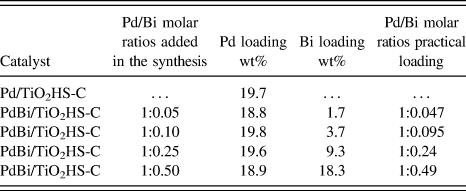
The loading effect and ratio of the metals Pd and Bi in the as-prepared catalysts were successfully measured by ICP-AES, as shown in Table I. It can be seen that the practical loading of Pd and Bi is in good agreement with the initial added amount in the PdBi/TiO2HS-C catalysts with different Pd/Bi molar ratios, confirming that the metals Pd and Bi were almost reduced by NaBH4 and fully deposited on the surface of TiO2HS-C, in which the practical loading ratio of Pd to Bi were 1:0.047, 1:0.095, 1:0.24 and 1:0.49 compared with theoretical added amount 1:0.05, 1:0.10, 1:0.25 and 1:0.50, respectively. This good loading ability between Pd-Bi and TiO2HS-C is attributed to the strong reducibility of NaBH4, the high specific surface area of TiO2HS-C and the formation of Pd–Bi ultrafine particles.
Elemental analysis of PdBi/TiO2HS-C with different Pd/Bi molar ratios determined by ICP-AES.

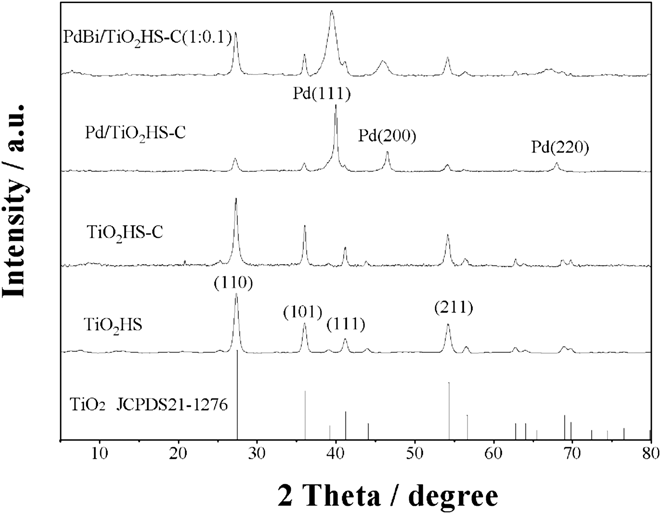
The XRD patterns of TiO2, TiO2HS, TiO2HS-C, Pd/TiO2HS-C and PdBi/TiO2HS-C (1:0.1) are shown in Fig. 1. It can be seen clearly that the diffraction peaks of TiO2HS are ascribed to the rutile phase TiO2 (JCPDS 21-1276), which is formed in the hydrothermal process. Hydrothermal process is a kind of thermal treatment different from high temperature solid state reaction. In the hydrothermal process of inorganic materials, high-pressure heat treatment of the solution has a distinct effect on the grain morphology and crystalline phase. Under the condition, the dissolution of smaller particles occurs in favor of the growth of larger grains and improves the crystallinity of the particles. Reference Bavykin, Parmon, Lapkin and Walsh28,Reference Wilson, Matijasevich, Mitchell, Schulz and Will29 From Fig. 1, it is found that the strong diffraction peaks of the TiO2HS at the 2θ of about 27.4°, 36.1°, 41.2° and 54.3° are corresponding to the (110), (101), (111) and (211) planes of the rutile phase TiO2, respectively. Moreover, the XRD pattern of as-prepared TiO2HS-C is also in good agreement with rutile phase TiO2, confirming that TiO2 hollow spheres were successfully synthesized and the addition of Vulcan XC-72R did not affect the typical crystalline structure of TiO2. From the XRD patterns of Pd/TiO2HS-C, the three peaks at 40.1°, 46.7° and 68.1° are assigned to Pd (111), (200) and (220) planes of the Pd face center cubic crystal (JCPDS 65-2867), respectively. From the XRD patterns of PdBi/TiO2HS-C (1:0.1), the half peak width at 40.1° is obviously broader than that of Pd/TiO2HS-C. This phenomenon is probably caused by the reduced particle size of Pd due to Bi codoping in the catalyst, which is favorable for catalytic reactions based on metal nanoparticles uniform distribution, bimetallic Pd–Bi electronic effects and abundant active sites. Reference Huang, Dong, Wang, Xu and Guan30 In addition, there is no obvious diffraction peaks of element Bi, it may relate with Bi low loading and/or amorphous phase, Reference Huang, Zheng, Lin, Su and Guo31 as suggested by ICP results shown in Table I.
XRD patterns of different samples.

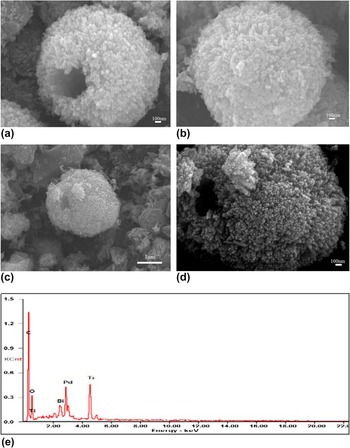
The SEM and EDX measurements were used to observe the morphology, microstructure and loading effect of the as-prepared TiO2HS and PdBi/TiO2HS-C (1:0.1) catalyst. Figure 2(a) shows a high magnification SEM image of a single TiO2 hollow sphere, which clearly demonstrates its hollow nature from the hole on its shell. Figure 2(b) also illustrates the feature from the other side of the hollow sphere. As can be seen that the diameter of TiO2HS is about 2.2 μm with regular spherical shapes, and its surface is pretty rough. The as-prepared PdBi/TiO2HS-C (1:0.1) catalyst was chosen as the representative for the investigation of the morphology and microstructure details and shown in Figs. 2(c) and 2(d). Figure 2(c) shows a low magnification SEM image of the sample PdBi/TiO2HS-C (1:0.1). Obviously, it still displays a hollow feature in the interiors of the sphere, the diameter of sphere is increased to about 2.8 μm after the carbon and metal coating. Figure 2(d) shows a high magnification SEM image of the sample PdBi/TiO2HS-C (1:0.1). It is found that the Pd–Bi nanoparticles are uniformly dispersed on the surface of carbonized TiO2 hollow spheres, indicating that the loading of Pd–Bi nanoparticles does not affect TiO2HS-C specific hollow sphere structure, which plays a very important role to improve the electrocatalytic activity toward the oxidation of EG. To further confirm the presence of Pd–Bi nanoparticles in the surface of TiO2HS-C, the EDX spectrum was measured, see Fig. 2(e). Moreover, the actual Pd–Bi loadings in all samples had been determined based on ICP-AES, as showed in Table I.
SEM images of (a and b) TiO2HS, (c and d) PdBi/TiO2HS-C and (e) EDX spectra of PdBi/TiO2HS-C catalysts.

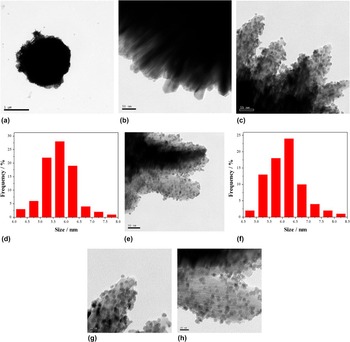
Figure 3 shows the TEM images of the samples and the particle size distribution histograms of Pd/TiO2HS-C and PdBi/TiO2HS-C (1:0.1) catalysts. Figures 3(a) and 3(b) present the low and high magnification TEM images of TiO2HS. From Fig. 3(a), it is clear that the diameter of TiO2HS is about 2.1 μm with regular spherical shapes, in good agreement with the SEM results shown in Fig. 2. From Fig. 3(b), we can see that the TiO2 hollow sphere is composed of many TiO2 nanorods. Figures 3(c) and 3(e) show the high magnification TEM images of Pd/TiO2HS-C and PdBi/TiO2HS-C (1:0.1) catalysts. It can be seen that the metal nanoparticles are highly dispersed on the TiO2HS-C support only with a little agglomeration. Figures 3(d) and 3(f) show the particle size distribution histograms of Pd/TiO2HS-C and PdBi/TiO2HS-C catalysts. The diameter of the metal particles ranges from 4.4 to 7.9 nm for Pd/TiO2HS-C catalyst, and from 4.6 to 8.2 nm for PdBi/TiO2HS-C catalyst, respectively. The average particle size of PdBi/TiO2HS-C is similar to that of Pd/TiO2HS-C. It is found that the morphology and particle size are not significantly changed by the addition of Bi. Reference Cai, Huang and Guo23 The high-resolution TEM (HRTEM) images of Pd/TiO2HS-C [Fig. 3(g)] and PdBi/TiO2HS-C (1:0.1) [Fig. 3(h)] catalysts can further reveal that metal nanoparticles are highly and fully dispersed on the surface of TiO2HS-C support, which helps to improve the electrocatalytic activity.
TEM images of (a and b) TiO2HS, (c) Pd/TiO2HS-C and (e) PdBi/TiO2HS-C, the particle size distribution histograms of (d) Pd/TiO2HS-C and (f) PdBi/TiO2HS-C catalysts, and the HRTEM images of (g) Pd/TiO2HS-C and (h) PdBi/TiO2HS-C.

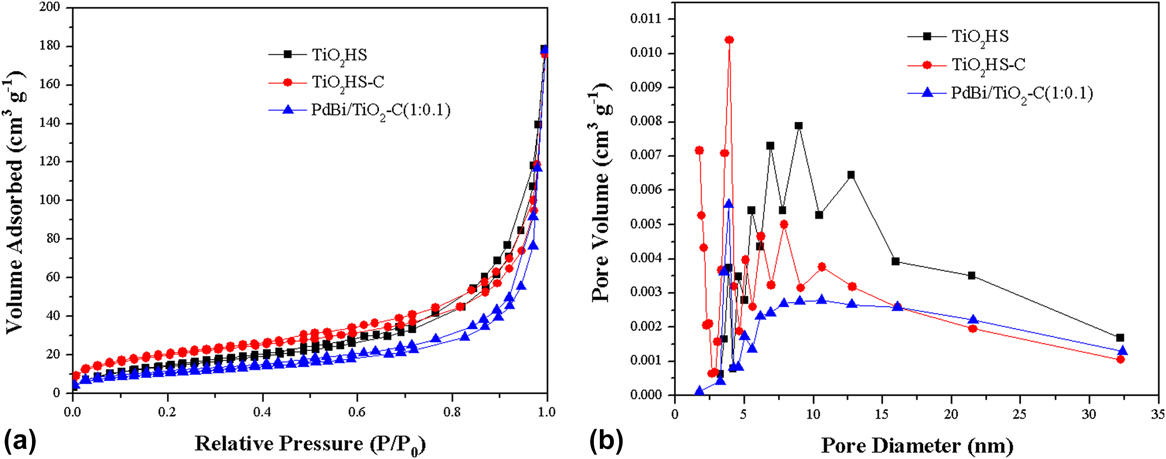
The N2 adsorption–desorption isotherms and pore size distribution curves of the TiO2HS, TiO2HS-C and PdBi/TiO2HS-C (1:0.1) are presented in Fig. 4. From Fig. 4(a), the surface areas of the TiO2HS, TiO2HS-C and PdBi/TiO2HS-C are measured to 55.2, 73.7 and 39.4 m2/g, respectively. Resulted from the hollow structure, the surface area of TiO2HS is much higher than that of the raw TiO2 nanoparticles (RTiO2NP), that of RTiO2NP is only 34.7 m2/g. Reference Yin, Wang, Wang, Yuan and Zhao32 By comparison with the TiO2HS-C, the significant decrease in the surface area of PdBi/TiO2HS-C indicates that the cavities of TiO2HS-C are either occupied or blocked by the dispersed metal nanoparticles. Figure 4(b) shows the pore size analysis of the TiO2HS, TiO2HS-C and PdBi/TiO2HS-C from desorption branch data based on Barrett–Joyner–Halenda (BJH) method. The average pore sizes of the TiO2HS, TiO2HS-C and PdBi/TiO2HS-C are 13.4, 9.4 and 14.0 nm, respectively, which are also assigned to mesoporous materials. Large surface area and porous structure of TiO2HS-C were preferable to the dispersion of nanosized PdBi on the surface of the TiO2HS-C support, leading to the low electrical resistance to facilitate electron transport during the electrochemical reactions, maximum contact with fuel or oxidant and by-product release, and strong interaction between the metal PdBi nanoparticles and the support, increasing the catalytic activity of PdBi/TiO2HS-C for EG electrooxidation. Reference Ju, Shi and Wu33
(a) N2 adsorption–desorption isotherms of TiO2HS, TiO2HS-C and PdBi/TiO2HS-C (1:0.1). (b) Pore size distribution curves of TiO2HS, TiO2HS-C and PdBi/TiO2HS-C (1:0.1).

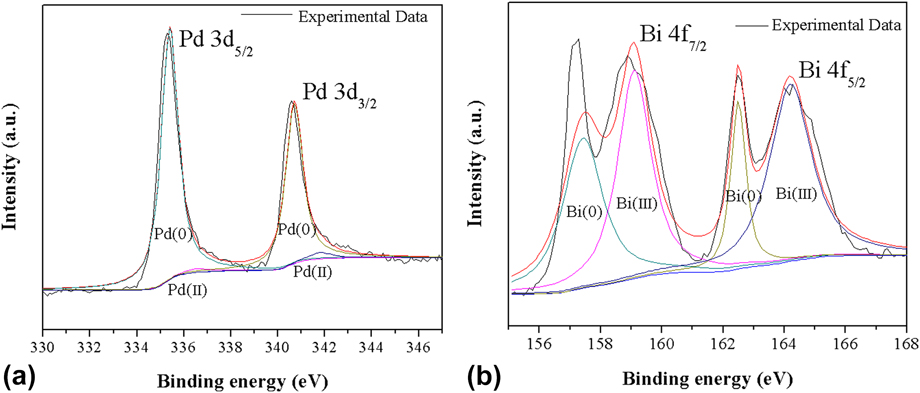
The XPS measurement was used to demonstrate metallic electronic states in the PdBi/TiO2HS-C (1:0.1) catalyst. Figures 5(a) and 5(b) show the typical XPS spectra of the catalyst in Pd 3d and Bi 4f regions, respectively. As can be seen in Fig. 5(a), Pd 3d signal region shows that the binding energies (BEs) of Pd 3d 5/2 (335.4 and 336.5 eV) are 5.3 eV lower than those of Pd 3d 3/2 (340.7 and 341.8 eV) for each doublet. Reference Xu, Zhao, Shen and Li34,Reference Casella and Contursi35 Moreover, the two asymmetrical peaks with low energy band at 335.4 and 340.7 eV and high energy band at 336.5 and 341.8 eV belong to Pd (0) and Pd (II) species, such as PdO and Pd(OH)2, respectively. Figure 5(b) shows the absorptions located at 159.1 and 164.2 eV for Bi 4f 7/2 and Bi 4f 5/2, respectively, are readily corresponding to the Bi (III), such as Bi2O3. Besides, Bi (0) is found at 157.7 and 162.8 eV for Bi 4f 7/2 and Bi 4f 5/2, respectively. The binding energy of high energy brand (Bi 4f 5/2) is 5.1 eV higher than that of the low energy band (Bi 4f 7/2). The results are agreeing with that published XPS spectra. Reference Huang, Cai, Liu and Guo36
XPS spectra of PdBi/TiO2HS-C: (a) Pd 3d; (b) Bi 4f regions.

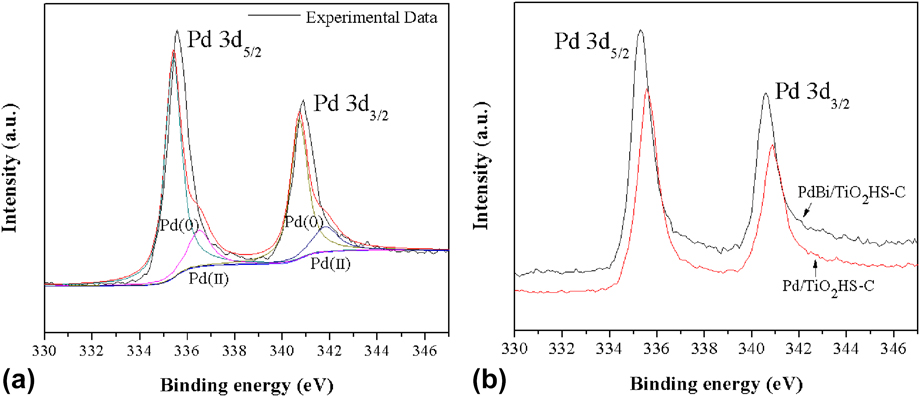
The Pd in the Pd/TiO2HS-C catalyst is also consisted of metal Pd (0) and Pd (II) as shown in Fig. 6(a), which exhibits the same features with Fig. 5(a). To study interaction between Pd and Bi, comparison of Pd 3d between PdBi/TiO2HS-C and Pd/TiO2HS-C is shown in Fig. 6(b). We can find that the Pd 3d 5/2 and Pd 3d 3/2 peaks of PdBi/TiO2HS-C shift negatively than that of Pd/TiO2HS-C, revealing there exists an electronic interaction between Pd and Bi, Reference Simões, Baranton and Coutanceau16,Reference Zhou and Lee37,Reference Holme, Zhou, Pasquarelli and O'Hayre38 this interaction can modify the electronic and catalytic properties of metal nanoparticles and lead to the activation of both dispersed metal and the matrix toward electrode processes. The electronic effect is considered to be able to change the electronic structure and density of state of metal catalysts and weaken the bond energy between metal and the strongly adsorbed poisons. Reference Huang, Cai, Liu and Guo36,Reference Liu, Wang, Wang, Deng, Wu and Gao39 Therefore, to the PdBi/TiO2HS-C catalyst, due to the presence of Bi and TiO2HS-C, the negative shift of Pd 3d peaks will weaken bond energy between metal and the strongly adsorbed poisons, which promoted the EG electrooxidation.
XPS spectra of (a) Pd 3d region in Pd/TiO2HS-C; (b) comparison of Pd 3d regions between Pd/TiO2HS-C and PdBi/TiO2HS-C.

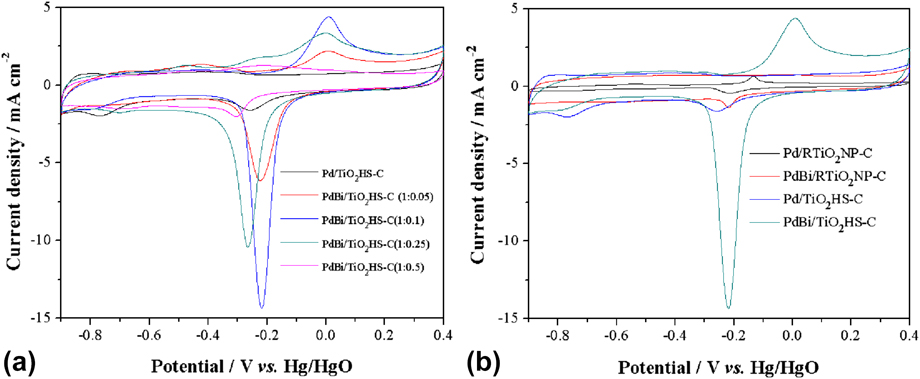
The cyclic voltammograms (CVs) of the catalysts were recorded when a stable response was obtained, as shown in Fig. 7. Figure 7(a) shows the CVs of Pd/TiO2HS-C and PdBi/TiO2HS-C catalysts with different Pd/Bi molar ratios in 1 M KOH solution. Broad peaks from −0.9 to −0.6 V can be ascribed to the hydrogen desorption/adsorption regions of the catalysts. It can be found that these regions were suppressed in diverse degrees with incorporation of Bi in the catalysts, suggesting part coating of Pd active sites by Bi atoms, and the corresponding reduction peak located at about −0.25 V can be attributed to the reduction of Pd(II) and reformation of Pd(0) layer in the negative-going scan. Reference Liang, Zhao, Xu and Zhu40 Moreover, the reduction peak becomes higher in diverse degrees with the addition of Bi, which is ascribed to the simultaneous reduction of Pd(II) and Bi(III). This result demonstrates the electronic interaction between Pd and Bi, as suggested by XPS measurement. Reference Simões, Baranton and Coutanceau16 In addition, there are some new features on PdBi/TiO2HS-C compared with Pd/TiO2HS-C catalyst. An intense peak appears at about 0 V on PdBi/TiO2HS-C catalyst and can be assigned to surface oxidation of adsorbed Bi in the positive-going scan, Reference Neto, Tusi, Polanco, Silva, Santos and Spinacé25,Reference Casella and Contursi26,Reference Kang, Lee, Lee, Chung and Tak41 while the intense peak is unconspicuous on the Pd/TiO2HS-C. It can also be seen in Fig. 7(a) that the current density of the oxidation peak on these catalysts is obtained in the following order: PdBi/TiO2HS-C (1:0.1) > PdBi/TiO2HS-C (1:0.25) > PdBi/TiO2HS-C (1:0.05) > PdBi/TiO2HS-C (1:0.5) > Pd/TiO2HS-C. Obviously, the intensities of oxidation peaks present a tendency of first increase and then decrease with increasing of the Pd/Bi molar ratio, and the maximum value appears at the Pd/Bi molar ratio of 1:0.1. Therefore, the appropriate amount of Bi into Pd nanoparticles can change the electronic interaction and enhance remarkably its electrocatalyst activity for ethanol oxidation.
Cyclic voltammograms of (a) Pd/TiO2HS-C and PdBi/TiO2HS-C catalysts with different Pd/Bi molar ratios; (b) Pd/RTiO2NP-C, PdBi/RTiO2NP-C (1:0.1), Pd/TiO2HS-C and PdBi/TiO2HS-C (1:0.1) in 1 M KOH solution. Scan rate: 50 mV/s.

To study the effects of different supports and Bi modification on electrocatalytic properties, comparison of the cyclic voltammograms among Pd/RTiO2NP-C, PdBi/RTiO2NP-C (1:0.1), Pd/TiO2HS-C and PdBi/TiO2HS-C (1:0.1) in 1 M KOH solution is shown in Fig. 7(b). From Fig. 7(b), the redox peaks are unconspicuous in the support RTiO2NP-C, while these peaks in the support TiO2HS-C and Bi modification can be clearly observed at 0 V and −0.25 V. Moreover, the double-layer capacitance is higher compared to the former, implying PdBi/TiO2HS-C better proton conductivity. This result is attributed to Pd–Bi depositing on the unique hollow structure and large surface area of TiO2HS that a greater number of active sites is available for oxidation of EG. It is crucial to electrocatalytic oxidation of small organic molecules because it facilitates removal of strongly adsorbed intermediates via a bifunctional effect between Pd-Bi nanoparticles and TiO2HS-C. Reference Futamata and Luo42 Additionally, as can be seen that the redox peaks of Pd/RTiO2NP-C and Pd/TiO2HS-C are increased in diverse degrees with the addition of Bi due to Pd–Bi nanoparticles uniform distribution on the surface of supports and the electronic interaction between Pd and Bi. Reference Simões, Baranton and Coutanceau16
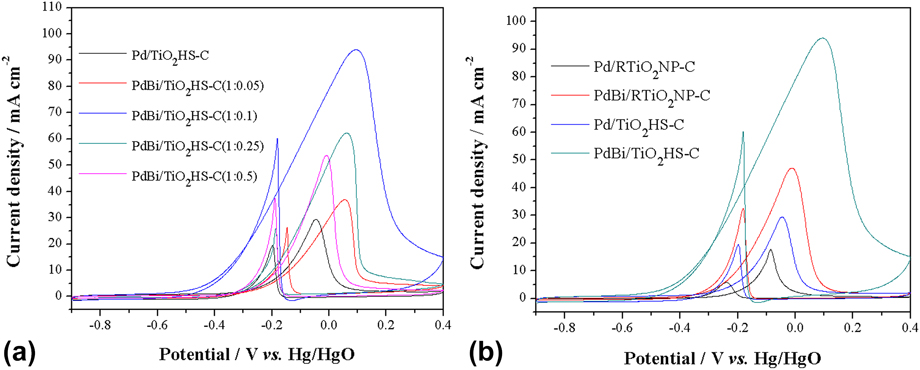
The cyclic voltammograms of Pd/TiO2HS-C and PdBi/TiO2HS-C catalysts were obtained in 1 M KOH + 0.5 M EG solution in the range of −0.9 to 0.4 V and shown in Fig. 8(a). The curves were recorded after a stable response was obtained. To study the effect of the Pd/Bi molar compositions in the catalysts toward the oxidation of EG, the PdBi/TiO2HS-C catalysts with different Pd/Bi molar ratios were tested. From Fig. 8(a), it is found that there are two anodic peaks observed in the forward and reverse scans, which correspond to EG electrooxidation and the removal of the residual carbonaceous species, respectively. Reference Ye, Zhou, Zhu, Xu and Shen43,Reference Zheng, He, Chen, Wang, Xue and Feng44 Obviously, the PdBi/TiO2HS-C (1:0.1) exhibits the highest current density than other Pd/Bi molar ratio and not Bi-doping, the following peak current density order is obtained: PdBi/TiO2HS-C (1:0.1) > PdBi/TiO2HS-C (1:0.25) > PdBi/TiO2HS-C (1:0.05) > PdBi/TiO2HS-C (1:0.5) > Pd/TiO2HS-C. The order is in good agreement with that in the 1 M KOH solution. The peak current density on PdBi/TiO2HS-C (1:0.1) catalyst (94.06 mA/cm2) is 3.2 times higher than on Pd/TiO2HS-C catalyst (29.45 mA/cm2). Besides, the onset potential and peak potential of EG electrooxidation on these catalysts also exhibit the same trend as their peak current densities. These results are consistent with the reports in Refs. Reference Tusi, Polanco, Silva, Spinacé and Neto24, Reference Neto, Tusi, Polanco, Silva, Santos and Spinacé25, Reference Demarconnay, Brimaud, Coutanceau and Léger45, and Reference Huang, Cai and Guo46. The reason may be that the appropriate amount of Bi into Pd nanoparticles changes the electronic interaction between the reactant and the active sites of the catalyst and enhances adsorption of hydroxyl species on Pd surface. Reference Simões, Baranton and Coutanceau16,Reference Tusi, Polanco, Silva, Spinacé and Neto24,Reference Neto, Tusi, Polanco, Silva, Santos and Spinacé25 However, more Bi loading would result in the excess coverage of Pd active sites for ethanol oxidation. Reference Huang, Cai and Guo46 Therefore, the PdBi/TiO2HS-C (1:0.1) catalyst exhibits the best electrocatalytic activity for EG oxidation.
Cyclic voltammograms of (a) Pd/TiO2HS-C and PdBi/TiO2HS-C catalysts with different Pd/Bi molar ratios and (b) Pd/RTiO2NP-C, PdBi/RTiO2NP-C (1:0.1), Pd/TiO2HS-C and PdBi/TiO2HS-C (1:0.1) in 1 M KOH + 0.5 M EG solution. Scan rate: 50 mV/s.

The electrocatalytic activities of the as-prepared catalysts with different support materials and in the presence/absence of Bi-doping were systematically evaluated for the EG oxidation. Figure 8(b) shows the cyclic voltammograms under the follow catalysts Pd/RTiO2NP-C, PdBi/RTiO2NP-C (1:0.1), Pd/TiO2HS-C and PdBi/TiO2HS-C (1:0.1) in 1 M KOH + 0.5 M EG solution. It can be seen that the same metal loading in the catalysts, TiO2HS-C is obviously a better support compared to RTiO2NP-C because Pd/TiO2HS-C and PdBi/TiO2HS-C show the higher EG oxidation peak current at 29.45 and 94.06 mA/cm2, relative to the Pd/RTiO2NP-C 17.63 mA/cm2 and PdBi/RTiO2NP-C (1:0.1) 47.12 mA/cm2, respectively. This result indicates that the carbonized TiO2 hollow spheres can induce more uniform dispersion of metal nanoparticles, give a detectable electronic effect which facilitates removal of poisoning species and promote dehydrogenation ability. In addition, it can be seen that, in the case of same support, Bi incorporation into the catalyst could promote the catalytic activity probably via a electronic effect of Pd-Bi and bifunctional effect between Pd–Bi and TiO2HS-C. Based on the affects of the carbonized TiO2 hollow spheres and Bi addition, the PdBi/TiO2HS-C (1:0.1) catalyst exhibits the highest peak current of 94.06 mA/cm2 for the EG electrooxidation.
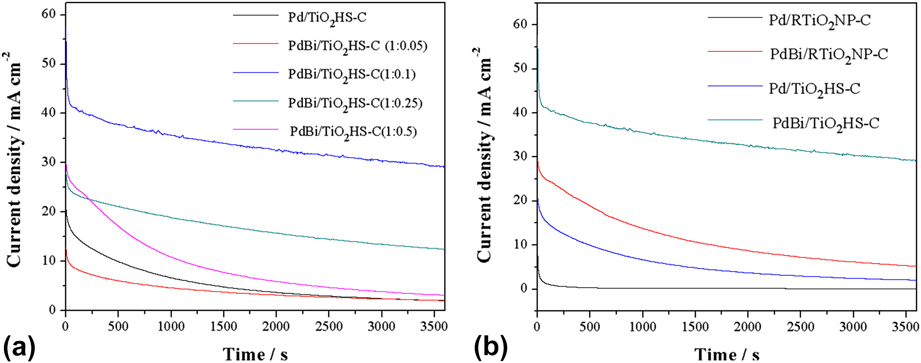
The chronoamperometry was used to investigate the effect of Bi and TiO2HS on relative catalytic durability and stability in the long-term EG oxidation. The current–time curves on Pd/TiO2HS-C and PdBi/TiO2HS-C catalysts with different Pd/Bi molar ratios in 1 M KOH + 0.5 M EG solution are shown in Fig. 9(a). It is found that the initial current densities of on all catalysts fall quickly at the stage of 0–250 s, which is attributed to the accumulations of poisonous intermediates on the catalyst surface. After that, the currents decrease slowly and tend to reach relative stable state, in which the adsorption of oxygenated species and poisonous species keeps a relative balance. Reference Thotiyl, Kumar and Sampath47,Reference Hoster, Iwasita, Baumgārtner and Vielstich48 The current density of PdBi/TiO2HS-C (1:0.1) keep highest in the whole stage among all catalysts, indicating the better tolerance toward poisonous species and catalytic durability of the catalyst. Therefore, the catalytic durability of Pd catalyst is enhanced by adding a certain amount of Bi, and the order is as follows: PdBi/TiO2HS-C (1:0.1) > PdBi/TiO2HS-C (1:0.25) > PdBi/TiO2HS-C (1:0.5) > PdBi/TiO2HS-C (1:0.05) > Pd/TiO2HS-C. It can be seen that the steady current density for PdBi/TiO2HS-C (1:0.1) keeps 29.25 mA/cm2 at 3600 s, which is 14 times higher than the value obtained on Pd/TiO2HS-C (2.04 mA/cm2), owing to the appropriate amount of Bi resulting in the increase of the hydroxyl concentration on catalyst surface and no excessive Bi covering at active site. Reference Tusi, Polanco, Silva, Spinacé and Neto24,Reference Holme, Zhou, Pasquarelli and O'Hayre38,Reference Huang, Cai and Guo46
Current-time curves of (a) Pd/TiO2HS-C and PdBi/TiO2HS-C catalysts with different Pd/Bi molar ratios and (b) Pd/RTiO2NP-C, PdBi/RTiO2NP-C (1:0.1), Pd/TiO2HS-C and PdBi/TiO2HS-C (1:0.1) in 1 M KOH + 0.5 M EG solution at the potential of −0.1 V.

To further explore the effect of different supports on the durability and stability, comparison of the current–time curves among Pd/RTiO2NP-C, PdBi/RTiO2NP-C (1:0.1), Pd/TiO2HS-C and PdBi/TiO2HS-C (1:0.1) in 1 M KOH + 0.5 M EG solution is shown in Fig. 9(b). From Fig. 9(b), the current densities using TiO2HS as supports maintain the higher in the whole stage, the final current values on these catalysts show in the following order: PdBi/TiO2HS-C (1:0.1) > Pd/TiO2HS-C > PdBi/RTiO2NP-C (1:0.1) > Pd/RTiO2NP-C, which reveals the catalysts in TiO2HS-C support have the better electrocatalytic stability and durability than that of RTiO2NP-C.
IV. CONCLUSION
In summary, for the first time, carbon-doped TiO2 hollow spheres (TiO2HS-C) and PdBi/TiO2HS-C catalysts with different Pd/Bi molar ratios have been designed and successfully prepared and applied to the electrocatalytic oxidation of EG in alkaline medium at room temperature. This unique PdBi/TiO2HS-C catalyst exhibits excellent electrocatalytic activity and stability toward the oxidation of EG, owing to the TiO2 hollow structure, large surface area of the hollow spheres, metal nanoparticles uniform distribution, the electronic effect between Pd and Bi as well as the bifunctional effect between Pd–Bi nanoparticles and TiO2HS-C. In the catalysts with different supports and Bi-doping, the PdBi/TiO2HS-C (1:0.1) shows the highest forward peak current density (94.06 mA/cm2), which is about 3.2 times higher than the corresponding value on Pd/TiO2HS-C catalyst (29.45 mA/cm2), and its durability and anti-poisoning ability are also significantly enhanced. The outstanding performance makes the PdBi/TiO2HS-C (1:0.1) catalyst as a feasible candidate for the application in alkaline fuel cells for EG electrooxidation.
ACKNOWLEDGMENTS
This project was supported by the Natural Science Fund for Creative Research Groups of Hubei Province (2014CFA015) of China. This work was also supported by the Hubei College Students' Innovation Training Program of China (201410512024, 201510512030).