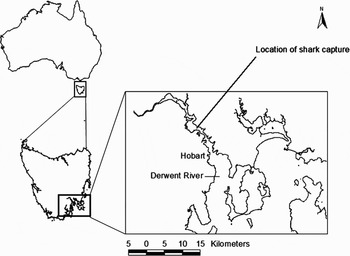
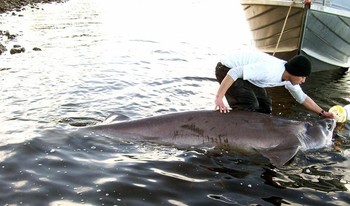
During a study examining the coastal habitat use by the broadnose sevengill shark Notorynchus cepedianus (Péron), a 3.4 m female bluntnose sixgill shark Hexanchus griseus (Bonnaterre) was captured in 10 m of water, approximately 30 km up the Derwent River in Hobart, Tasmania (Australia) (Figure 1). The animal was caught on an overnight bottom-set longline on 24 July 2007. It was measured, photographed (Figure 2), tagged and released. Unlike N. cepedianus, H. griseus does not typically occur in shallow coastal ecosystems (Compagno et al., Reference Compagno, Dando and Fowler2005; Last & Stevens, Reference Last and Stevens2009) and this is the first confirmed report of an adult sixgill shark in a river. However, there was an unsubstantiated report of a 3.5 m specimen captured in the Derwent River in the 1800s (Last et al., Reference Last, Scott and Talbot1983).
Location of sixgill shark capture in south-east Tasmania.

Photograph of the sixgill shark.

The Derwent River runs through the City of Hobart. It is a highly stratified, salt wedge/partially mixed estuarine system with one major freshwater input at the estuarine head (Davies & Kalish, Reference Davies and Kalish1994). The river consistently reaches depths of 20 to 30 m, with a maximum depth of 44 m. In some sections, the depth drops off steeply from the shoreline, reaching in excess of 20 m. The deepest area within 2 km of the capture location was 12 m. The shark was captured in winter, when water temperatures range from 8°C at the surface to 13°C at 10 m depth.
Six and sevengill sharks belong to the family Hexanchidae, which comprises four species. Hexanchus griseus is the largest species in this group, reaching a maximum length of 5.5 m (Compagno et al., Reference Compagno, Dando and Fowler2005). It is a deep-water demersal species with a global distribution, and has been recorded down to depths of 1875 to 2500 m (Ebert, Reference Ebert2003; Compagno et al., Reference Compagno, Dando and Fowler2005; Last & Stevens, Reference Last and Stevens2009). Its preferred habitat is believed to be continental slopes and shelves of islands, seamounts and mid-ocean ridges of temperate and tropical oceans at 500–1100 m depth (Compagno et al., Reference Compagno, Dando and Fowler2005; Last & Stevens, Reference Last and Stevens2009). However, H. griseus has been reported to enter relatively shallower (20–40 m) waters in some regions, normally adjacent to deep-water trenches or shelves, as in the shallow waters off British Columbia, USA (Dunbrack & Zielinski, Reference Dunbrack and Zielinski2003). Here, Dunbrack & Zielinski (Reference Dunbrack and Zielinski2003) suggest that the seasonal occurrence of sixgills may be related to seasonal changes in water temperature. This species also occurs occasionally in San Francisco Bay, which has been attributed to its comparatively deep (120 m) entrance (Ebert, Reference Ebert1986). Sixgill sharks in Puget Sound (Washington State, USA) showed clear diel vertical migration patterns where they move from deeper water during the day into shallower waters (as shallow as 3 m) at night (Andrews et al., Reference Andrews, Williams, Farrer, Tolimieri, Harvey, Bargmann and Levin2009).
It is interesting that both sightings of this species in Tasmanian waters have come from shallow habitats (Derwent River) that are >100 km from the deeper waters off the continental shelf, and that there are no reports from deep-water around Tasmania or in southern Australian waters in general, even though there has been a considerable amount of deep-water fishing in these areas over the past 40 years. Trawl, dropline and bottom-set longline fisheries target species such as blue grenadier (Macruronus novaezealandiae), blue eye trevalla (Hyperoglyple antarctica) and pink ling (Genypterus blacodes) to depths of 600 m, and orange roughy (Hoplostethus atlanticus) as deep as 1400 m (Kailola et al., Reference Kailola, Williams, Stewart, Reichelt, McNee and Grieve1993; Larcombe et al., Reference Larcombe, McLoughlin and Tilzey2001) in Tasmanian waters. Despite this considerable fishing effort in known bluntnose sixgill shark depth-ranges, this species has not been reported in the by-catch. Additionally, reports of this species in the Southern & Eastern Scalefish and Shark Fishery (SESSF) are extremely uncommon, even though this fishery operates to depths of greater than 600 m over a large area of New South Wales, Victoria, Tasmania and South Australia. From 2000 to 2006, the estimated catch of bluntnose sixgill sharks was only 254 kg (Walker & Gason, Reference Walker and Gason2007), which would be the equivalent of one or two sharks. The lack of catch records is hard to explain given this species' occurrence in commercial catches elsewhere (Ebert, Reference Ebert1986; Andrews et al., Reference Andrews, Levin, Katz, Farrer, Gallucci and Bargmann2007), but may be due to their low catchability or poor reporting.
The Derwent River, along with other coastal estuaries and embayments in Tasmania, is protected as a shark refuge area. However, very little is known about when and how the different shark species actually utilize these habitats. Records such as this emphasize the importance of understanding the significance of these refuge areas; this is especially so for species that are only rarely observed and whose habitat use is poorly understood.
ACKNOWLEDGEMENTS
The authors thank The Derwent Estuary Program and Zinefex for temperature data. Funding was generously provided by the Save Our Seas Foundation, the Winifred Violet Scott Trust Fund and the Holsworth Wildlife Endowment. The project is conducted under Ethics no. A0009120 and Permit no. 8028.