INTRODUCTION
Cognitive dysfunction is increasingly recognized as a key feature of bipolar disorder (BD). Neurocognitive deficits persist across illness stages including euthymia, with patients scoring an average of 2/3 to 1 SD below the mean (Robinson et al., Reference Robinson, Thompson, Gallagher, Goswami, Young, Ferrier and Moore2006), and may be more severe in patients with BD with a history of psychosis (BDP) (Lewandowski, Cohen, Keshavan, & Ongür, Reference Lewandowski, Cohen, Keshavan and Ongür2011). Cognitive dysfunction in BDP appears to fall between the level of healthy controls and patients with schizophrenia (SZ) (Hill et al., Reference Hill, Reilly, Keefe, Gold, Bishop, Gershon and Sweeney2013), although not all studies report differences between patient groups (Lewandowski et al., Reference Lewandowski, Cohen, Keshavan and Ongür2011). Cognitive deficits are associated with functional outcomes in both SZ and BD (Green, Reference Green2006) and are among the strongest predictors of future functioning (Lewandowski, Cohen, Keshavan, Sperry, & Ongür, Reference Lewandowski, Cohen, Keshavan, Sperry and Ongür2013).
Patients with BD appear to exhibit deficits in social cognition, although findings in this domain are mixed. Social cognition is a multidimensional construct that is comprised of many aspects of social processing, and patients with BD may exhibit selective deficits in certain domains but not others. For instance, while patients with BD show deficits in emotion processing and Theory of Mind, they may not show broad deficits across all dimensions of social cognition (Samamé, Martino, & Strejilevich, Reference Samamé, Martino and Strejilevich2012). Deficits in social cognition may be especially predictive of community outcomes in patients with SZ (Couture, Penn, & Roberts, Reference Couture, Penn and Roberts2006); the association between social cognition and community outcomes in BD is less clear (Van Rheenen & Rossell, Reference Van Rheenen and Rossell2014).
Given that cognitive deficits are numerous, severe and functionally impairing across the psychoses, development of assessments to measure key cognitive domains in patients with BD is essential for proper characterization of the nature and course of cognitive dysfunction and the development of targeted treatments and monitoring of therapeutic success. The Measurement and Treatment Research to Improve Cognition in Schizophrenia (MATRICS) Initiative set forth to do just this through the development of a consensus cognitive battery (MATRICS Consensus Cognitive Battery; MCCB) assembled to assess key cognitive domains in SZ (Marder & Fenton, Reference Marder and Fenton2004). Despite growing evidence of significant and functionally relevant neurocognitive impairment in patients with BD, no such battery has been created for use with this population and there is a lack of consensus regarding appropriate neurocognitive assessment in terms of both domains to be assessed and measures to be used. Given evidence of substantial overlap in cognitive dysfunction between SZ and BD, particularly BDP, the MCCB may be appropriate for the assessment of cognition in this population.
The International Society for Bipolar Disorders (ISBD) conducted a meta-analysis of individual measures included in the MCCB and endorsed its use in patients with BD for assessment of most cognitive domains excluding reasoning/problem solving and social cognition (Yatham et al., Reference Yatham, Torres, Malhi, Frangou, Glahn, Bearden and Chengappa2010). Indeed, Burdick et al. (Reference Burdick, Goldberg, Cornblatt, Keefe, Gopin, Derosse and Malhotra2011) found that both euthymic and symptomatic outpatients with BD performed worse than healthy controls on all MCCB domains except reasoning/problem solving and social cognition. Van Rheenen and Rossell (Reference Van Rheenen and Rossell2013a) reported that patients only performed worse than controls on processing speed, visual learning, and working memory; however, their sample was heterogeneous, including both patients with BDI and BDII, and they did not report potentially relevant factors such as history of psychosis. To our knowledge, no studies to date have examined the relationship of MCCB with community functioning in patients with BD.
We aimed to investigate the sensitivity of the MATRICS Consensus Cognitive Battery in detecting cognitive deficits in patients with BDP. Here we present the first study to directly compare MCCB scores in BDP to both healthy participants and participants with SZ. We aimed to increase the homogeneity of our BD sample by including only those subjects with a history of psychosis, a feature that has been associated with greater illness burden and poorer cognitive functioning in previous studies. We hypothesized that (1) patients would perform worse than controls on the MCCB but better than patients with SZ, and (2) MCCB scores would be associated with community functioning in both patient groups.
METHOD
Participants
Participants were recruited through the Schizophrenia and Bipolar Disorder Program (SBDP) at McLean Hospital and via fliers posted around the hospital. Participants were recruited in the context of several separate but related studies: patients with BDP were recruited for a study of cognitive remediation, patients with SZ were recruited for a study of genotype and phenotype in psychosis or for a study of cognitive remediation, and HC were recruited through Craigslist or a study investigating brain metabolism. All procedures were approved by the McLean Hospital IRB. Participants were outpatients at the time of testing. Exclusion criteria for all participants included history of head trauma with loss of consciousness, history of seizure, and current substance abuse or dependence. Participants with BDP were excluded for Clozaril use in the cognitive remediation study due to its sedating side effects. HC participants had no history of a psychiatric diagnosis, no first-degree relatives diagnosed with a psychiatric illness, and no history of substance abuse or dependence.
Inclusion criteria included a DSM-IV (SCID-IV-TR) diagnosis of SZ, schizoaffective disorder depressed type, or BDP. BDP was defined as having at least one psychotic symptom (3 on at least one criteria A SCID-IV item) during a manic or depressed episode during the lifetime. Three participants with schizoaffective disorder depressed type were included in the SZ sample as Kern et al. (Reference Kern, Gold, Dickinson, Green, Nuechterlein, Baade and Marder2011) combined these groups in the initial standardization studies of the MCCB. The final study sample included patients with BDP (n=56), patients with SZ (n=37), and HC (n=57). All participants were between the ages of 18 and 55.
Materials
Diagnosis was confirmed by Structured Clinical Interview for DSM-IV (SCID-IV-TR) through patient interview, medical record review, and consultation with the participants’ treatment provider(s). Clinical assessment included the Young Mania Rating Scale (YMRS; Young, Biggs, Ziegler, & Meyer, Reference Young, Biggs, Ziegler and Meyer1978), the Montgomery-Asberg Depression Rating Scale (MADRS; Montgomery & Asberg, Reference Montgomery and Asberg1979), and the Positive and Negative Syndrome Scale (PANSS; Kay, Fiszbein, & Opler, Reference Kay, Fiszbein and Opler1987). Community functioning was measured using an abbreviated version of the Multnomah Community Ability Scale (MCAS) as described in Lewandowski et al. (Reference Lewandowski, Cohen, Keshavan, Sperry and Ongür2013). The MCCB was used to measure neurocognitive and social cognitive functioning. The MCCB produces six domain scores and a composite. Domains include: Speed of Processing (Trail Making Test A; Brief Assessment of Cognition in Schizophrenia: Symbol Coding; Category Fluency); Attention/Vigilance (Continuous Performance Test: Identical Pairs); Working Memory (Wechsler Memory Scale Spatial Span; Letter Number Span); Visual Learning (Brief Visuospatial Memory Test); Verbal Learning (Hopkins Verbal Learning Test); Reasoning/Problem Solving (Neuropsychological Assessment Battery: Mazes); Social Cognition (Mayer-Salovey-Caruso Emotional Intelligence Test: Managing Emotions). Domain scores and the composite were converted to standard (T) scores based on MCCB age and gender adjusted norms.
Design and Procedure
Neuropsychological and clinical assessments were conducted in a single session lasting approximately 2 hrs. Procedures across all studies were standardized and the same study staff completed these assessments. The cognitive and clinical symptom assessments were always completed within the same visit. The diagnostic interview was administered before neurocognitive testing. Chlorpromazine equivalents (CPZ) were calculated (Baldessarini, Reference Baldessarini2012).
Statistical Analysis
Subjects were compared on demographic and clinical variables using analysis of variance (ANOVA) or Chi-Square. Cognitive domain and composite scores were compared by group using a One-Way ANOVA followed by pairwise comparisons. A subsequent analysis of covariance (ANCOVA) was used for pairwise comparisons between SZ and BDP on cognitive domains, covarying for PANSS score. Effect sizes were calculated using Cohen’s D. To examine the association of cognition and community functioning, a series of linear regressions was performed predicting MCAS scores using neurocognitive scores as predictors after accounting for the effects of education, PANSS, MADRS total, and diagnosis. All analyses were performed using SPSS v.19.
RESULTS
Groups differed on age, sex, education, MCAS, MADRS, PANSS, and CPZ (Table 1). Correlations were conducted to examine the relationship between clinical and cognitive measures. PANSS was significantly correlated with Processing Speed, r=−.38, p<.01, Working Memory, r=−.29, p<.01, Verbal Memory, r=−.24, p<.05, and the Composite, r=−.28, p<.01; YMRS and MADRS were not correlated with any cognitive measures (p>.05).
Demographic and clinical variables by group

a Education is coded based on the SCID: 1=grade 6 or less; 2=grade 7–12 (without graduating); 3=high school grad or equivalent; 4=part college; 5=graduated 2-year college; 6=graduated 4-year college; 7=part graduate/professional school; 8=completed graduate/professional school.
*p<.05.
***p<.001.
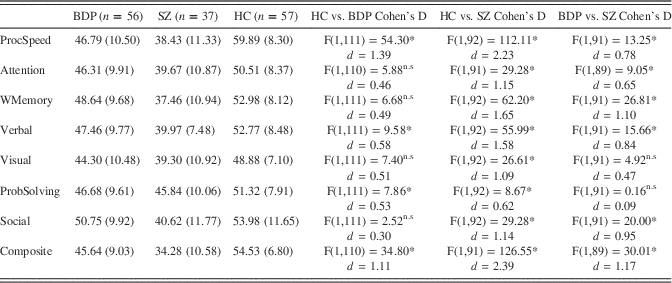
A One-Way ANOVA examining cognitive performance by diagnosis indicated that groups differed on all domains and the Composite (p<.001 for all tests). To correct for multiple comparisons, all pairwise analyses were Bonferroni-corrected (a=.006) (see Table 2). Patients with BDP performed worse than HC on Processing Speed, Verbal Memory, Problem Solving, and the Composite; patients with BDP performed better than patients with SZ on all domains except Visual Memory and Problem Solving. Patients with SZ performed worse than healthy controls on all MCCB domains. All pairwise comparisons yielded moderate to large effect sizes. To account for differences in PANSS scores between patient groups, ANCOVAs comparing BDP and SZ groups on all MCCB variables covarying PANSS total score were conducted. After accounting for PANSS score, BDP and SZ no longer differed on Processing Speed [F(1,91)=6.25; p>.05; d=0.78] or Attention [F(1,89)=6.98; p>.05; d=0.65], although effect sizes were still in the moderate range.
MCCB domain and composite T scores by group

Note. Bonferroni corrected p-values.
*p<.006.
A series of linear regressions was conducted examining the association between MCCB domains and community function after accounting for the effects of education, PANSS, MADRS, CPZ, and diagnosis. PANSS and MADRS were included as confounders as they were correlated with MCAS scores. We included patients only in this analysis, as there was very little variance in the HC group on MCAS scores (as would be expected based on the nature of the instrument). We found no associations between any MCCB domain and the MCAS (p>.05).
DISCUSSION
The present study examined the utility of the MCCB in the measurement of neuro- and social cognitive deficits in BDP and associations between MCCB score and community functioning. As expected, patients with BDP performed better than patients with SZ on most domains, although some domains were no longer significant after controlling for PANSS score.
This is the first study to investigate the cognitive profile of patients with BDP using the MCCB compared to two control groups: healthy participants and patients with SZ. Restricting our sample along a symptom dimension that has been associated with cognition may improve the interpretability of findings of MCCB performance in BDP compared to SZ and healthy controls.
Previous reports suggest that patients with BD perform approximately 0.4 to 1.2 SDs below the mean on most measures, and patients with SZ perform approximately 1 to 1.7 SDs below the mean (Burdick et al., Reference Burdick, Goldberg, Cornblatt, Keefe, Gopin, Derosse and Malhotra2011; Kern et al., Reference Kern, Gold, Dickinson, Green, Nuechterlein, Baade and Marder2011); however, we found that on average, all three groups performed approximately 0.5 SD better than would be expected compared to MCCB norms and previous findings in BD, SZ, and HC studies using the MCCB (Burdick et al., Reference Burdick, Goldberg, Cornblatt, Keefe, Gopin, Derosse and Malhotra2011). Our samples may have been slightly higher functioning than is typical due to access to higher education in our recruitment area.
Consistent with the other two reports of MCCB in BD, we did not find social cognitive deficits in our BDP sample using the MSCEIT, although we did find significant deficits in social cognition in our SZ patients. While substantial evidence exists of deficits in some aspects of social cognition in patients with BD including deficits in facial emotion perception (Van Rheenen & Rossell, Reference Van Rheenen and Rossell2013b) and Theory of Mind (Samamé et al., Reference Samamé, Martino and Strejilevich2012), social cognition is a multifaceted construct and not all domains appear to be equally affected in BD. Indeed, the specific nature of social cognitive deficits between SZ and BD may differ; thus, while the MSCEIT: Managing Emotions appears to detect significant deficits in patients with SZ, this measure may not adequately capture the social cognitive deficits commonly experienced by patients with BDP. Emotion perception and ToM appear to be among the most commonly reported areas of social cognitive dysfunction in BD. Since social cognitive deficits specific to BDP are not adequately captured by the MCCB, we recommend inclusion of one or more diagnosis-appropriate measures to assess specific aspects of social cognition when using the MCCB in this population.
Cognitive deficits are among the strongest predictors of community functioning in patients with SZ and BD. Unexpectedly, we did not find any associations between MCCB domains and community functioning in our sample. This may be due to our measure of community functioning, which assesses broad domain of functioning using patient report and may not be sensitive in evaluating current instrumental functional deficits associated with cognitive processing. Based upon recommendations by the FDA, the MATRICS Initiative suggests including an ecologically valid measure of psychosocial functioning, particularly performance-based measures that may have greater sensitivity in detecting functional deficits related to cognition (Green et al., Reference Green, Nuechterlein, Kern, Baade, Fenton, Gold and Marder2008).
Several limitations of the present study should be noted. Data were collected from multiple separate but related studies, and several inclusion and exclusion criteria differed by diagnostic group including clinical symptomatology at baseline and use of clozapine. While we controlled for CPZ in some of our analyses, no subjects in the BDP group were prescribed clozapine, whereas clozapine use was not an exclusion for participants with SZ. We did not examine the effects of Lithium or mood stabilizers on cognition. Future studies would benefit from examining these differences. In addition, groups were not well matched on age and gender; however, MCCB scores are normed based on age and gender so these differences are not expected to affect the results. Lastly, analyses did not examine the effects of premorbid IQ on cognitive functioning, as these data were not available for the full sample.
The MCCB appears to be a valid measure of neurocognitive deficits in patients with BDP across a range of relevant domains at the group level; however, there is considerable cognitive heterogeneity in patients with BD (and other psychotic disorders). Several studies report that approximately 30 to 40% of patients with BD perform in the normal range on measures of neurocognition (Burdick et al., Reference Burdick, Russo, Frangou, Mahon, Braga, Shanahan and Malhotra2014; Lewandowski, Sperry, Cohen, & Ongür, Reference Lewandowski, Sperry, Cohen and Ongür2014). Consistent with these reports, 37.5% of our BDP sample fell in the “normal” range, ≥−0.5 SDs on the MCCB Composite. Group-level analyses may obscure a more precise examination of the cognitive heterogeneity common across the psychoses.
The present findings suggest that the MCCB is an appropriate measure of neurocognitive functioning but not social cognition in BD, and highlights the lack of diagnostic specificity of most domains of the MCCB in the bipolar-schizophrenia spectrum. However, given that social cognition is a multidimensional construct, consideration should be given to the appropriateness of the MCCB social cognition measure for particular study populations. For instance, measures of emotion processing and ToM should be added to the MCCB when studying social cognitive dysfunction in BD. Many measures used to examine these constructs in BD are also well validated in SZ and can be used cross-diagnostically. In addition, these findings highlight the importance of using well-validated performance based measures of functional outcomes to elucidate whether cognitive improvements result in better community functioning.
Acknowledgments
We thank the participants for their time and effort and Samira Pingali for her assistance with data collection. This work was supported by the National Institutes of Health (KEL, Grant #K23MH91210 and DO, Grant #R01MH094594, #R21MH096107); The Shervert Frazier Research Institute at McLean Hospital (KEL); NARSAD/BBRF Independent Investigator Award (DO). Dost Öngur served on the scientific advisory board for Eli Lilly. Kathryn Lewandowski served as a consultant for Clintara. Matcheri Keshavan has a grant with Sunovion. Sarah Sperry, Bruce Cohen, and Lauren O’Connor report no disclosures.