Implications
The findings of this study expand the existing knowledge on the hormonal mechanisms mediating the effect of nutrition on liver lipid synthesis in vivo. It clearly shows the involvement of corticoids, insulin and glucagon in the control of triglyceride synthesis in pig hepatocytes. Decreased hepatic glucose production elicited by conjugated linoleic acid (CLA) in vitro warrants further research on the insulin-sensitizing properties of CLA in vivo.
Introduction
Conjugated linoleic acids (CLAs), naturally occurring isomers of linoleic acid (LA), have been reported to impact glucose metabolism, improving glucose tolerance in diabetic models (Houseknecht et al., Reference Houseknecht, Vanden Heuvel, Moya-Camarena, Portocarrero, Peck, Nickel and Belury1998) but inducing hyperinsulinemia in wild-type mice (Tsuboyama-Kasaoka et al., Reference Tsuboyama-Kasaoka, Takahashi, Tanemura, Kim, Tange, Okuyama, Kasai, Ikemoto and Ezaki2000). In animal nutrition, the interest in feeding CLA to pigs has increased as a result of its potential to improve growth (Thiel-Cooper et al., Reference Thiel-Cooper, Parrish, Sparks, Wiegand and Ewan2001) and reduce body fat (Dugan et al., Reference Dugan, Aalhus, Schaefer and Kramer1997; Thiel-Cooper et al., Reference Thiel-Cooper, Parrish, Sparks, Wiegand and Ewan2001). Body fat reduction elicited by CLA was accompanied by liver enlargement and steatosis in mice (Tsuboyama-Kasaoka et al., Reference Tsuboyama-Kasaoka, Takahashi, Tanemura, Kim, Tange, Okuyama, Kasai, Ikemoto and Ezaki2000; Clement et al., Reference Clement, Poirier, Niot, Bocher, Guerre-Millo, Krief, Staels and Besnard2002). Some of the effects of CLA appear to be associated with lipid and carbohydrate metabolism.
Many of the effects of fatty acids or hormones on hepatic metabolism may not be noticed when using short-term (3 h) cultures. Monolayer cultures of porcine hepatocytes provide a viable model for testing the long-term (⩾24 h) effects on hepatocyte function (Fernández-Fígares et al., Reference Fernández-Fígares, Shannon, Wray-Cahen and Caperna2004). Although a great deal is known about xenobiotic metabolism and albumin synthesis in primary monolayer cultures of pig hepatocytes (Koebe and Schildberg, Reference Koebe and Schildberg1996; Behnia et al., Reference Behnia, Bhatia, Jastromb, Balis, Sullivan, Yarmush and Toner2000; Gregory et al., Reference Gregory, Connolly, Toner and Sullivan2000), few studies have been conducted to elucidate how hormones control hepatic functions and energy metabolism in these cultures. Moreover, possible interrelationships between CLA and metabolic hormones on hepatic metabolism have not been studied in detail. In pig hepatocytes, insulin and glucagon have been shown to regulate glycogen deposition and ketogenesis (Fernández-Fígares et al., Reference Fernández-Fígares, Shannon, Wray-Cahen and Caperna2004). However, their effect on triglyceride (TG) synthesis or content has not been investigated. Furthermore, to our knowledge, there is no available information on how CLA affects porcine liver lipid content in vivo or in vitro. The addition of dexamethasone has long been known to be important for the maintenance of differentiated hepatocyte function in vitro (Guillouzo, Reference Guillouzo1986). Nevertheless, there are no available data on the role of dexamethasone in TG synthesis or content of pig hepatocytes.
Therefore, the aims of the present work were to study the effects of CLA on hepatic lipid and glucose metabolism and IGF-1 production, to determine TG synthesis capacity of monolayer cultures of pig hepatocytes, their regulation by hormones that are integrally involved in the utilization and partitioning of dietary nutrients and the possible interaction with fatty acids.
Material and methods
Isolation of liver cells
Care and treatment of all pigs were approved in advance by the Institutional Bioethical Committee of CSIC. Except where noted, reagents were purchased from Sigma-Aldrich, Spain. Hepatocytes were isolated from five pure-bred Iberian barrows (11 to 21 kg live weight, 50 to 80 days old) provided from Sánchez Romero Carvajal Jabugo S.A. (Seville, Spain). At arrival, piglets were restrictively fed (85% ad libitum) a standard commercial diet. The day before slaughter, they had free access to food. After stunning by electric shock, they were exsanguinated and livers were immediately excised and the left lateral lobe removed. Hepatocytes were isolated as described previously by Fernández-Fígares et al. (Reference Fernández-Fígares, Shannon, Wray-Cahen and Caperna2004), except that collagenase-digestion buffer was modified to contain 92 mM NaCl, 3.1 mM CaCl2 and 6.0 mM KCl. Collagenase class II used was from Worthington Biochemical Corp. (Lakewood, NJ, USA).
Viability of isolated hepatocytes from animals in this study was 80.7 ± 1.2% (trypan blue dye exclusion) and cell yield from each liver preparation was 5.4 ± 0.8 × 10⁸ viable hepatocytes.
Cell culture
Hepatocytes (4.5 × 10⁶) were seeded into vented T-25 flasks essentially as described by Fernández-Fígares et al. (Reference Fernández-Fígares, Shannon, Wray-Cahen and Caperna2004), except that basal medium was William's E amended with β-mercaptoethanol (0.1 mM), glutamine (2 mM), antibiotics (gentamicin, penicillin, streptomycin and amphotericin B; GIBCO-BRL, Rockville, MD, USA) containing insulin : transferrin : selenium (2.5 μg/ml : 2.75 ng/ml : 2.5 ng/ml) and 10% fetal bovine serum (Hyclone, Logan, UT, USA). Following a 3-h attachment period, flasks were washed twice with 4-(2-hydroxyethyl)-1-piperazineethanesulfonic acid (HEPES)-buffered saline, and subsequently basal medium containing 5% fetal bovine serum was added to each flask. On the following day, flasks were washed twice with HEPES-buffered saline and medium was replaced with serum-free basal medium containing dimethyl sulfoxide (1 mg/l), l-carnitine (1 mM), Na2SeO3 (100 nM) dexamethasone (10 and 100 nM), insulin (10 and 500 ng/ml), glucagon (0 and 100 ng/ml) and CLA or LA (0.05 and 0.10 mM) as detailed for each assay. Triplicate flasks were used for each experimental condition.
Analytical
Preparation of albumin-bound fatty acids
According to Svedberg et al. (Reference Svedberg, Björntorp, Smith and Lönnroth1990), LA and CLA (mixture of cis-9, trans-11 and trans-10, cis-12-CLA) were bound to albumin with slight modifications. Fatty acids were provided by Sigma-Aldrich, Spain. The fatty acid–albumin molar ratio was kept at less than three to ensure that the fatty acids were bound to fatty acid–free albumin. Final concentrations of fatty acids were 0.05 and 0.10 mM.
IGF-1 synthesis
Cells were amended on the first day of serum-free culture with a high concentration of insulin (high insulin, 500 ng/ml), dexamethasone (10 and 100 nM) and fatty acids (LA or CLA; 0.05 and 0.10 mM), and cultivated for 24 h to study how dexamethasone, concentration and the type of fatty acid affect IGF-1 secretion. Media and cells were harvested and frozen at −80°C. Before the analysis of IGF-1, media was concentrated 12X by means of a rotary evaporator (SpeedVac, SPD131DDA-230, Thermo, Milford, MA, USA). A two-site immunoradiometric assay (Diagnostic Systems Laboratories, Inc., Webster, TX, USA) was used to analyze IGF-1. The analytical procedure included an extraction step in which IGF-1 was separated from its binding proteins, for detection of total IGF-1 in culture media. The intra- and inter-assay CV were 4.8% and 6.9%, respectively.
Glycogen synthesis
Cells were preincubated on day 1 for 3 h in a culture medium with a low concentration of insulin (10 ng/ml) and high concentration of glucagon (100 ng/ml) to deplete glycogen stores (Fernández-Fígares et al., Reference Fernández-Fígares, Shannon, Wray-Cahen and Caperna2004), and cells from three flasks were harvested to set the initial point for glycogen synthesis determination. The rest of the flasks were switched to a culture medium with LA or CLA (0.05 and 0.10 mM) and high insulin (Fernández-Fígares et al., Reference Fernández-Fígares, Shannon, Wray-Cahen and Caperna2004) for 21 h. The effect of concentration and kind of fatty acid on glycogen synthesis was evaluated. Cells were harvested and frozen at −80°C. Glycogen synthesis was quantified as the difference in glycogen content of cells cultured in the presence of high insulin and cells with basal glycogen content. Glycogen in cell homogenates was determined as described by Fernández-Fígares et al. (Reference Fernández-Fígares, Shannon, Wray-Cahen and Caperna2004) except that the enzymatic method used was Glucose Trinder (Labkit, Chemelex, S.A., Barcelona, Spain).
Glycogen degradation
Cells were cultured on day 1 for 24 h in a culture medium with high insulin to achieve maximal glycogen content, and three flasks were harvested to set the starting point for glycogen degradation. The rest of the flasks were cultivated in glucose-free Dulbecco's modified Eagle's medium with low insulin and high glucagon, to ease glycogen degradation, and LA or CLA (0.05 and 0.10 mM), for 3 h to study how the concentration and type of fatty acid affect glycogen content. Cells were harvested and frozen at −80°C. Glycogen degradation was quantified as the difference in glycogen content of cells with full glycogen load and cells where degradation was facilitated.
Gluconeogenesis
Cells were cultured on day 1 for 24 h in a basal medium with high glucagon and low insulin to deplete glycogen stores, and subsequently cultured for 40 min in glucose-free Dulbecco's modified Eagle's medium, 5 mM lactate, 0.5 mM pyruvate, 5 mM alanine and LA or CLA (0.05 and 0.10 mM), low insulin and high glucagon. Gluconeogenesis was estimated as glucose released to the media assuming negligible glycogenolysis. Free glucose in the media was measured using an enzymatic method Glucose Trinder GOD-POD (Labkit, Chemelex, S.A., Barcelona, Spain).
TG synthesis
Cells were cultured for 3 h in a culture medium with low insulin and high glucagon to deplete lipid stores, and cells from three flasks were harvested to estimate the basal TG content for the determination of TG synthesis.
To study the effect of dexamethasone on TG synthesis, as well as the possible interactions with the type and concentration of fatty acid, cells were switched to a culture medium with high insulin to mimic postprandial conditions, fatty acid (LA or CLA; 0.05 and 0.10 mM) and dexamethasone (10 and 100 nM) for 21 h.
Similarly, to evaluate the effect of insulin/glucagon ratio, as well as the possible interactions with the type and concentration of fatty acid, cells were switched to a culture medium amended with dexamethasone (100 nM), fatty acid (LA or CLA; 0.05 and 0.10 mM) and high or low insulin/glucagon ratios (500 ng/ml insulin : 0 ng/ml glucagon; and 10 ng/ml insulin : 100 ng/ml glucagon, respectively). Cells were harvested and frozen at −80°C until analysis.
Lipids were extracted according to Ametaj et al. (Reference Ametaj, Bobe, Lu, Young and Beitz2003) and dissolved in isopropanol. Intracellular TG content was determined using the glycerol determination procedure (Labkit, Chemelex, S.A., Barcelona, Spain). TG synthesis was estimated as the difference in TG content of cells cultured in the presence of high insulin and cells with basal TG content.
Protein determination
Protein in cell homogenates was determined using a modified Lowry procedure following NaOH solubilization of trichloroacetic acid precipitated material (Nerurkar et al., Reference Nerurkar, Marino and Adams1981). As the protein standard bovine serum albumin was used, all data were normalized to protein content.
Statistical analysis
As the metabolic activity may vary among pigs, data were analyzed using the PROC MIXED procedure of SAS (SAS Institute 2004, version 9.1.3, Cary, NC, USA) with pigs fitted as random, so that possible differences in the size of the treatment effect across pigs could be assessed. Five separate cell preparations, each from a different pig, constituted an experiment, and treatments within each preparation were replicated in three flasks. All data from individual flasks were used in the analysis of variance. A completely randomized block design was used where pigs served as blocks. The model for IGF-1 synthesis and TG content and synthesis was μijklm = Pi + Fj + Lk + Nl + (FL)jk + (FN)jl + (LN)kl + (FLN)jkl + (CFLN)ijkl + eijklm, where i = 1, 2, 3, 4, 5 represents pig; j = 1, 2 represents type of fatty acid, CLA or LA; k = 1, 2 represents fatty acid level, 0.05 or 0.1 mM; l = 1, 2 represents dexamethasone level, 10 or 100 nM; and m = 1, 2, 3 represents flask. The error term used for testing treatment effects was defined by the interaction pig × fatty acid × level × dexamethasone ((CFLN)ijkl). When the effect of insulin/glucagon ratio (high and low) on TG synthesis and content was included, it substituted the effect of dexamethasone level in the equation model. The model used for glycogen synthesis and degradation, gluconeogenesis, TG synthesis and degradation was μijklm = Pi + Fj + Lk + (FL)jk + eijkm, where i = 1, 2, 3, 4, 5 represents pig; j = 1, 2 represents type of fatty acid, CLA or LA; k = 1, 2 represents fatty acid level, 0.05 or 0.1 mM; and m = 1, 2, 3 represents flask. The error term used to test treatment effects was defined by the interaction pig × fatty acid × level ((CFL)ijk). Interactions were not significant, and thus they were removed from the model.
Results are expressed as least square means ± s.e. Statistical significance was assessed using Fisher's least significant difference test to determine differences between treatment groups. The level of significance was set to 5%.
Results
CLA
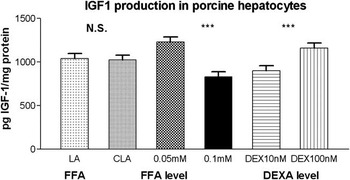
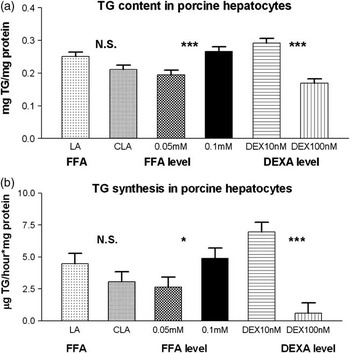
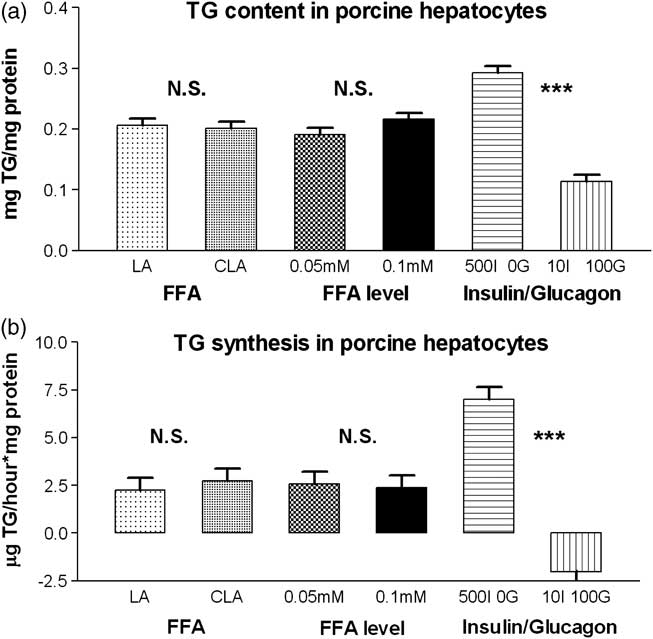
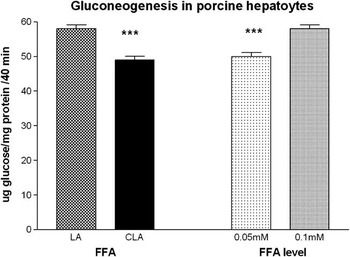
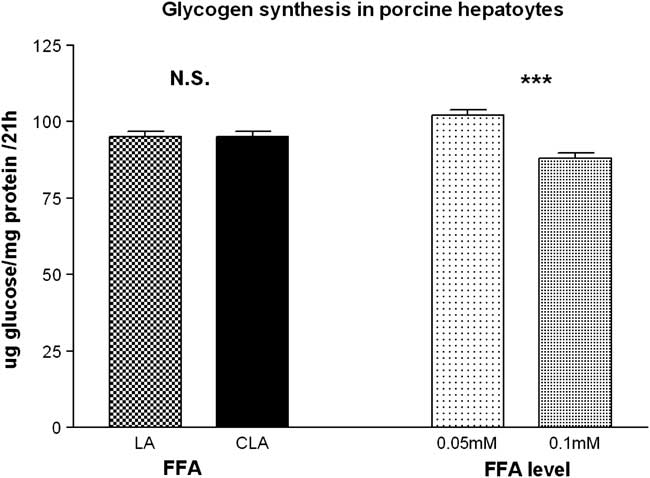
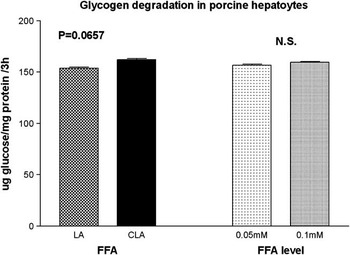
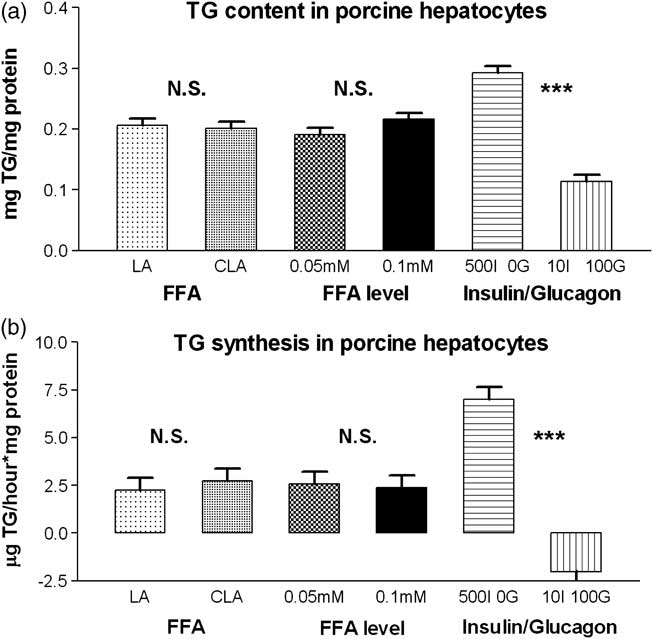
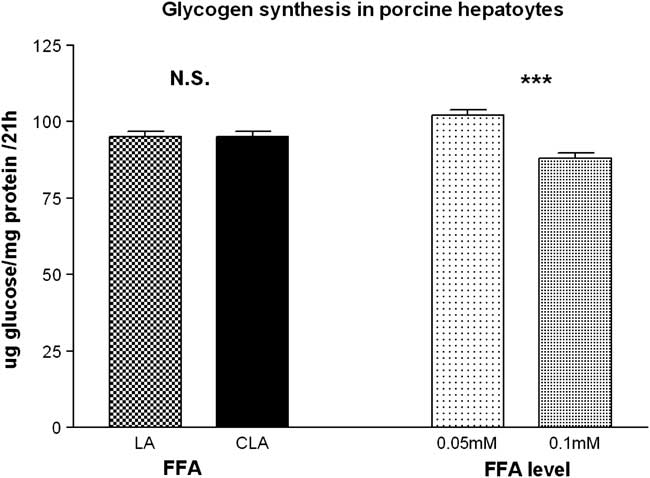
In the present conditions, CLA amended to the media did not alter IGF-1 production compared with LA, although increased concentration of fatty acids decreased IGF-1 in the media (32%; P < 0.001; Figure 1). No differences were found (P > 0.10) in TG content or synthesis when CLA- or LA-supplemented porcine hepatocytes were compared at different dexamethasone levels (Figure 2) and insulin/glucagon ratios (Figure 3). Nevertheless, hepatic TG content and synthesis of hepatocytes cultured without glucagon were increased (37%; P < 0.001 and 85%; P < 0.05, respectively) as the amount of fatty acids in the media increased (Figure 2). When glucagon was present in the media, TG synthesis did not increase on increasing fatty acid concentration (Figure 3). Glucose production was decreased (16%; P < 0.05) when hepatocytes were cultured with CLA compared with LA (Figure 4). Increasing the concentration of fatty acid increased (16%; P < 0.05) gluconeogenesis (Figure 4). Basal glycogen content of hepatocytes cultured for 3 h with high glucagon was 6.0 ± 1.1 μg glycogen/mg of protein. CLA had no effect (P > 0.10) on glycogen synthesis (Figure 5). Glycogen synthesis significantly decreased (14%, P < 0.001) when the concentration of fatty acid in the media increased (Figure 5). As for glycogen degradation, basal glycogen content of hepatocytes cultured for 24 h with high insulin was 208 ± 24 μg glycogen/mg of protein. A trend (P = 0.066) for a slight increase (5%) in glycogen degradation was found in hepatocytes cultivated in the presence of CLA compared with LA (Figure 6). Nevertheless, no effect of the concentration of fatty acids on glycogen degradation was found (P > 0.10).
Effects of fatty acid types (conjugated linoleic acid or linoleic acid), fatty acid levels and dexamethasone (DEXA) concentration on IGF-1 production in porcine hepatocytes. Hepatocytes were cultivated in the presence of insulin (500 ng/ml) for 24 h. No significant interactions were found between factors. Data are expressed as mean ± s.e., n = 5. ***Groups differ at P < 0.001; N.S., not significant, P > 0.10.

Effects of fatty acid types (conjugated linoleic acid or linoleic acid), fatty acid levels and dexamethasone (DEXA) concentration on triglyceride content (a) and synthesis (b) in porcine hepatocytes. Hepatocytes were cultivated in the presence of insulin (500 ng/ml) and absence of glucagon for 21 h. No significant interactions were found between factors. Data are expressed as mean ± s.e., n = 5. *Groups differ at P < 0.05; ***groups differ at P < 0.001; N.S., not significant, P > 0.10.

Effects of fatty acid types (conjugated linoleic acid or linoleic acid), fatty acid levels and insulin/glucagon ratio on triglyceride content (a) and synthesis (b) in porcine hepatocytes. Hepatocytes were cultivated with high (500 ng/ml insulin and no glucagon) or low (10 ng/ml insulin and 100 ng/ml glucagon) insulin/glucagon ratio for 24 h. Dexamethasone concentration was set at 10 nM. No significant interactions were found between factors. Data are expressed as mean ± s.e., n = 5. ***Groups differ at P < 0.001; N.S., not significant, P > 0.10.
Effects of fatty acid types (conjugated linoleic acid or linoleic acid) and fatty acid levels on gluconeogenesis in porcine hepatocytes. Hepatocytes were cultivated in the presence of insulin (10 ng/ml), glucagon (100 ng/ml) and dexamethasone (10 nM). No significant interactions were found between factors. Data are expressed as mean ± s.e., n = 5. ***Groups differ at P < 0.001.

Effects of fatty acid types (conjugated linoleic acid or linoleic acid) and fatty acid levels on synthesis of glycogen in porcine hepatocytes. Hepatocytes were cultivated in the presence of insulin (500 ng/ml) and dexamethasone (10 nM) for 21 h. No significant interactions were found between factors. Data are expressed as mean ± s.e., n = 5. ***Groups differ at P < 0.001; N.S., not significant, P > 0.10.
Effects of fatty acid types (conjugated linoleic acid or linoleic acid) and fatty acid levels on glycogen degradation in porcine hepatocytes. Hepatocytes were cultivated in the presence of insulin (10 ng/ml), glucagon (100 ng/ml) and dexamethasone (10 nM). No significant interactions were found between factors. Data are expressed as means ± s.e., n = 5. N.S., not significant, P > 0.10.

Dexamethasone
In our study, porcine hepatocytes cultivated in the presence of high insulin and fatty acids had increased (29%; P < 0.001) IGF-1 production when dexamethasone concentration in the media rose from 10 to 100 nM (Figure 1). In the present experiment, the addition of 100 nM dexamethasone to porcine hepatocytes in the presence of insulin and fatty acids sharply decreased (91%; P < 0.001) TG synthesis as compared with 10 nM dexamethasone (Figure 2), and as a consequence hepatocyte TG content diminished (42%; P < 0.001) accordingly.
Insulin/glucagon ratio
Porcine hepatocytes cultivated in the presence of dexamethasone (10 nM), fatty acids and a high insulin/glucagon ratio for 24 h increased (450%) hepatic TG synthesis and cellular TG content (61%; both P < 0.001) compared with hepatocytes cultivated with low insulin/glucagon ratio (Figure 3). No significant interactions were found between factors in any case.
Discussion
To our knowledge, the results represent the first direct demonstration of the control of TG synthesis by insulin, glucagon and dexamethasone in pig hepatocytes. In addition, the influences of CLA and concentration of fatty acids on pig hepatocyte metabolism have not been previously investigated. In this study, l-carnitine was added to all culture media to ensure that fatty acid entry into mitochondria was not limited by carnitine availability (Agius et al., Reference Agius, Chowdhury and Alberti1986), and that all fatty acids were complexed to albumin (Calder et al., Reference Calder, Bond, Harvey, Gordon and Newsholme1990) at concentrations that simulated physiological conditions (Stangl et al., Reference Stangl, Müller and Kirchgessner1999).
CLA
The liver is an organ that plays a crucial role in metabolism and has been reported to be a key target for CLA (Pariza and Park, Reference Pariza and Park2001). Although Li et al. (Reference Li, Seifert, Ney, Grahn, Grant, Allen and Watkins1999) suggested that CLA modulates body mass through mechanisms involving the IGF system in rats, we have not found any effect of CLA on IGF-1 synthesis in porcine hepatocytes, in line with in vivo evidence in young pigs (Fernández-Fígares et al., Reference Fernández-Fígares, Lachica, Nieto and Aguilera2007). Although some workers have reported modest improvement of growth parameters in pigs fed CLA (Thiel-Cooper et al., Reference Thiel-Cooper, Parrish, Sparks, Wiegand and Ewan2001), circulating IGF-1 was not determined.
No information has been found on how the concentration of fatty acids in the media affects IGF-1 synthesis in hepatocytes. Increasing fatty acid level decreased hepatocyte IGF-1 production in our conditions, which may be interpreted as a derangement on insulin sensitivity (Dunger et al., Reference Dunger, Yuen and Ong2004).
Pig hepatocytes were refractive to an effect of CLA on TG synthesis in our experimental conditions. Furthermore, fatty acid oxidation in livers of neonatal pigs fed CLA was not affected (Corl et al., Reference Corl, Oliver, Lin, Oliver, Ma, Harrell and Odle2008). Nevertheless, CLA treatment decreased fatty acid synthase activity and transcripts when compared with LA in adipose tissue explant cultures from 78 kg pigs (José et al., Reference José, Gama and Lanna2008), although esterification was not determined. In rats, CLA decreased hepatic steatosis in vivo (Purushotham et al., Reference Purushotham, Shrode, Wendel, Liu and Belury2007) and hepatic TG level, and increased fatty acid oxidation in cultured hepatocytes (Priore et al., Reference Priore, Giudetti, Natali, Gnoni and Geelen2007). Although pig liver is a minor site of lipogenesis in mature pigs (Lee et al., Reference Lee, Azain, Hausman and Ramsay2000; Gondret et al., Reference Gondret, Ferré and Dugail2001), the importance of liver adipogenesis may be considerable in the young piglets used in this study (Fenton et al., Reference Fenton, Roehrig, Mahan and Corley1985).
It is interesting to note that fatty acid stimulation of hepatic TG synthesis elicited in porcine hepatocytes was blunted in the presence of glucagon probably because of increased ketogenesis. In accordance with this hypothesis, low insulin/glucagon ratio markedly increased ketogenesis in porcine hepatocytes (Fernández-Fígares et al., Reference Fernández-Fígares, Shannon, Wray-Cahen and Caperna2004), and pharmacological levels of glucagon abolished lipogenesis while stimulating fatty acid oxidation in rat hepatocytes (McGarry and Foster, Reference McGarry and Foster1980). Furthermore, inhibition of fatty acid oxidation increased TG secretion in perfused rat livers (Yamamoto et al., Reference Yamamoto, Fukuda, Fukui, Kai, Ikeda and Sakai1996), and increasing fatty acid concentration raised fatty acid uptake, TG synthesis (Hansson et al., Reference Hansson, Asztély, Clapham and Schreyer2004) and lipid accumulation (Granlund et al., Reference Granlund, Larsen, Nebb and Pedersen2005) in primary rat hepatocytes.
As for gluconeogenesis, hepatocytes were preincubated with high glucagon for 24 h, which virtually depleted glycogen stores (data not shown). Media glucose was therefore a consequence essentially from gluconeogenesis and not from glycogen degradation. The effects of CLA on gluconeogenesis have not been extensively studied. In this study, CLA had an insulin-sensitizing effect depressing glucose production compared with LA in porcine hepatocytes, similarly to rat hepatocyte cultures (Cantwell et al., Reference Cantwell, Devery, Oshea and Stanton1999).
Increasing fatty acids in the media increased gluconeogenesis in pig hepatocytes in line with similar findings in perfused livers of rats (Williamson et al., Reference Williamson, Browning and Scholz1969). Stimulation of gluconeogenesis by the level of fatty acids in the media could act to increase glycogenesis by expanding the pool of glycogen precursors and pushing substrate toward glucose storage (Nordlie et al., Reference Nordlie, Sukalski and Alvares1980; Youn et al., Reference Youn, Youn and Bergman1986). In spite of decreased glycogen synthesis by fatty acids with high insulin/glucagon ratio, we cannot rule out the possibility that fatty acids elicit a relative increase in glycogenesis under low insulin/glucagon ratio. In contrast to rats (Pégorier et al., Reference Pégorier, Ferré and Girard1977; Ferré et al., Reference Ferré, Satabin, El Manoubi, Callikan and Girard1981), the link between adequate rates of fatty acid oxidation and gluconeogenesis is not clearly established in pigs (Pégorier et al., Reference Pégorier, Duée, Girard and Peret1983; Boyd et al., Reference Boyd, Whitehead and Butler1985; Duée et al., Reference Duée, Pégorier, Peret and Girard1985; Lepine et al., Reference Lepine, Boyd and Whitehead1991). In fact, fatty acid oxidative capacity is not the first limiting factor to full expression of gluconeogenesis in hepatocytes isolated from fasted newborn pigs (Lepine et al., Reference Lepine, Watford, Boyd, Ross and Whitehead1993).
There is a scarcity of information regarding the effect of CLA on hepatic glycogen in any species. We have shown that porcine hepatocytes are refractive to CLA regarding glycogen synthesis. Furthermore, whereas glycogen synthesis was diminished, glycogen degradation was not affected on increasing fatty acids in the culture media of pig hepatocytes. Although it has been suggested that a regulation of hepatic glucose production by decreasing glycogenolysis when gluconeogenesis is elevated and vice versa (Clore et al., Reference Clore, Glickman, Helm, Nestler and Blackard1991), this mechanism does not seem to apply in porcine hepatocytes. The trend toward increased degradation of glycogen in the presence of CLA encountered in porcine hepatocytes was marginal. The CLA-induced changes in glucose tolerance and liver metabolism observed in various animal and human studies are conflicting. In our hands, a mixture with a similar amount of cis-9, trans-11 and trans-10, cis-12-CLA isomers decreased gluconeogenesis, marginally affecting glycogen turnover in pig hepatocytes. Nevertheless, increased fatty acid concentration induced hepatic insulin resistance, increasing endogenous glucose output by decreasing glycogen synthesis and increasing gluconeogenesis without affecting glycogen breakdown. Furthermore, as already mentioned, fatty acid-induced diminished hepatic IGF-1 synthesis could also facilitate peripheral insulin resistance.
Dexamethasone
Dexamethasone stimulation of IGF-1 production found in our experiments is in accordance with increased expression and production of IGF-1 in pig (Brameld et al., Reference Brameld, Weller, Saunders, Buttery and Gilmour1995; Ajuwon et al., Reference Ajuwon, Kuske, Ragland, Adeola, Hancock, Anderson and Spurlock2003) and rat (Arany et al., Reference Arany, Strain, Hube, Phillips and Hill1993; Beauloye et al., Reference Beauloye, Ketelslegers, Moreau and Thissen1999) hepatocytes.
Although fatty acid synthesis has been studied in great detail, rather less is known about the mechanisms regulating esterification, which mediates TG synthesis. Reduction of TG content elicited by dexamethasone in our experiments is in accordance with a lower rate of TG synthesis. Fernández-Fígares et al. (Reference Fernández-Fígares, Shannon, Wray-Cahen and Caperna2004) suggested that glucagon had a similar effect to dexamethasone and opposite to insulin, enhancing cyclic adenosine monophosphate production. In agreement with this hypothesis, low insulin/glucagon ratio had a similar effect to dexamethasone on TG synthesis and content in our experiments. In rats, however, glucocorticoids directly stimulated hepatic fatty acid and TG synthesis in vitro (Diamant and Shafrir, Reference Diamant and Shafrir1975) and in vivo (Mantha et al., Reference Mantha, Palacios and Deshaies1999), although an interaction between insulin and glucocorticoids was noted (Amatruda et al., Reference Amatruda, Danahy and Chang1983). The lower hepatocyte TG content when dexamethasone level was increased could be due to increased fatty acid oxidation (Yamamoto et al., Reference Yamamoto, Fukuda, Fukui, Kai, Ikeda and Sakai1996) or increased very low-density lipoprotein secretion. Increased ketogenesis would be expected with higher dexamethasone concentration in the media (Fernández-Fígares et al., Reference Fernández-Fígares, Shannon, Wray-Cahen and Caperna2004). According to our results, dexamethasone may modulate IGF-1 and TG synthesis and storage, that is, the long-term endogenous TG production in porcine hepatocytes.
Insulin/glucagon ratio
No data on the control of TG synthesis by insulin and glucagon in pig hepatocytes have been found in the literature. Our results indicate that TG synthesis is regulated by glucagon and insulin, and thus increasing insulin/glucagon augmented TG content and synthesis in porcine hepatocytes. Fernández-Fígares et al. (Reference Fernández-Fígares, Shannon, Wray-Cahen and Caperna2004) showed that high levels of insulin increased NADH/NAD+. A relative increase in NADH would result in an inhibition of enzymes that promote the tricarborxylic acid cycle activity (Nelson and Cox, Reference Nelson and Cox2000). Consequently, a shift toward TG and glycogen deposition, with a concomitant reduction in ketogenesis, would be expected in porcine hepatocytes cultivated with high insulin/glucagon. In rats, insulin increased hepatic TG synthesis and reduced the rate of secretion of very low-density lipoprotein, increasing TG content of the hepatocyte (Duerden and Gibbons, Reference Duerden and Gibbons1990). Indeed, insulin inhibits the secretion of apolipoprotein B by enhancing the susceptibility of apolipoprotein B to degradation (Sparks and Sparks, Reference Sparks and Sparks1994). On the other hand, glucagon inhibited TG synthesis in perfused isolated rat liver (Soler-Argilaga et al., Reference Soler-Argilaga, Russell and Heimberg1977) and hepatocytes (Christiansen, Reference Christiansen1977) and stimulated fatty acid oxidation in rat hepatocytes (McGarry and Foster, Reference McGarry and Foster1980). Glucagon enhancement of ketogenesis has been reported consistently in rats (Witters and Trasko, Reference Witters and Trasko1979) and pigs (Fernández-Fígares et al., Reference Fernández-Fígares, Shannon, Wray-Cahen and Caperna2004). Decreased ketogenesis with high insulin/glucagon ratio, as found previously in pig hepatocytes (Fernández-Fígares et al., Reference Fernández-Fígares, Shannon, Wray-Cahen and Caperna2004), would partially explain the increased esterification of fatty acids into cellular TG in our experiment.
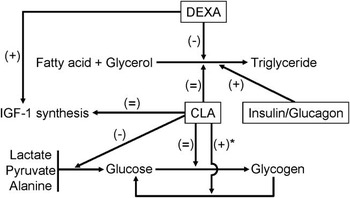
A schematic description of the observed effects of CLA, dexamethasone and insulin/glucagon on glucose metabolism, IGF-1 synthesis and TG synthesis in porcine hepatocytes is depicted in Figure 7.
Regulation of glucose metabolism, IGF-1 synthesis and triglyceride synthesis by conjugated linoleic acid, dexamethasone and insulin/glucagon in porcine hepatocytes. (+) stands for stimulation; (−) stands for inhibition; (=) stands for no effect; (*) slight stimulation.

In conclusion, esterification of fatty acids into TG is regulated in primary culture of porcine hepatocytes so that it is decreased by dexamethasone and increased by insulin/glucagon ratio. Furthermore, dexamethasone increased liver IGF-1 production. In addition, CLA did not induce insulin resistance in terms of glucose production.
Acknowledgments
The authors wish to thank Dr A. Haro for TG analysis, Dr L. Lara for statistical advice and Prof. Dr J. F. Aguilera for critically reading the manuscript. This work was supported by the Ministry of Science and Education of Spain, Grant AGL2002-01562.