Introduction
Subjective memory complaints (SMCs) are experienced by a large proportion of middle-aged and older adults, with some estimates being as high as 50% (Ponds et al., Reference Ponds, Commissaris and Jolles1997; Jonker et al., Reference Jonker, Geerlings and Schmand2000). SMCs can cause significant distress and worry (Commissaris et al., Reference Commissaris, Ponds and Jolles1998) and are known to be associated with depression, anxiety and poor quality of life (Mol et al., Reference Mol, Carpay, Ramakers, Rozendaal, Verhey and Jolles2007). However, only a small proportion of those with concerns about their memory seek help (Commissaris et al., Reference Commissaris, Ponds and Jolles1998).
Although they have limited association with current cognitive performance, SMCs have shown relationships with future cognitive decline (Reid and MacLullich, Reference Reid and MacLullich2006). Indeed, SMCs form part of the criteria for mild cognitive impairment (MCI), believed to be a transitional stage between normal aging and dementia in some cases, affecting 17–34% of older adults (Burns and Zaudig, Reference Burns and Zaudig2002). Patients with MCI are at an increased risk of developing dementia compared with similar aged adults in the general population (Petersen et al., Reference Petersen, Stevens, Ganguli, Tangalos, Cummings and DeKosky2001b). The conversion rate to Alzheimer's disease (AD) is cited as being between 10–15% per year in MCI compared to 1–2% per year in a normal adult population (Petersen et al., Reference Petersen2001a). The potential importance of SMCs is reflected in new diagnostic criteria proposed for early (and prodromal) AD (Dubois et al., Reference Dubois, Picard and Sarazin2009).
Early identification and monitoring of people with SMCs would allow diagnosis of dementia at the earliest stage providing opportunities for adequate future planning (Winblad et al., Reference Winblad2004). Monitoring will become increasingly important if preventative or disease modifying treatments become available for dementia (Petersen et al., Reference Petersen2001a). Furthermore, psychosocial interventions such as memory retraining may be beneficial for people with SMCs, helping to reduce distress through improvements in memory ability (Mol et al., Reference Mol, Ruiter, Verhey, Dijkstra and Jolles2008). However, such advances depend on early identification, which, in the absence of large-scale routine screening, relies upon individuals both perceiving the problem and seeking help.
Despite the prevalence and potential significance of SMCs, little is known about the beliefs held by individuals about their memory problems and the impact of these beliefs upon decisions such as help-seeking behavior. Understanding more about older adults’ perceptions of their subjective memory problems may help us to understand why some people seek help for memory problems while others do not and also why some individuals experience more psychological distress than others.
Declines in memory experienced by older adults can be interpreted as a threat to the health of an individual. Leventhal et al. (Reference Leventhal, Nerenz, Steele, Baum and Singer1984) proposed a theoretical model to explain how people respond when they experience a threat to their health known as the Common Sense Model (CSM). Leventhal and colleagues argued that when an individual experiences a threat to their health, such as a physical symptom, they formulate a common sense representation or model of the problem. This model consists of beliefs or perceptions about the health threat based on information from several sources including past experience, lay knowledge, information from friends and family, the media and the medical profession. Beliefs run along five major themes: the cause of the symptom, the consequences of the symptom, how long the symptom is likely to last, controllability of the symptom and finally the label applied to the symptom. These beliefs are thought to determine the coping strategies an individual employs to deal with the health threat which in turn determine mental and physical health outcomes and inform health-related decisions such as the decision to seek help. Illness perceptions and health outcomes have been associated across several health conditions (Hagger and Orbell, Reference Hagger and Orbell2003; Petrie et al., Reference Petrie, Jago and Devcich2007).
Before any investigation of the relationship between perceptions of SMCs, well-being and help-seeking behavior can take place, the content of perceptions held by people with SMCs must be examined and compared to the themes of illness perception proposed by Leventhal et al. (Reference Leventhal, Nerenz, Steele, Baum and Singer1984). Secondly a quantitative measure of perceptions of SMCs is needed.
The aims of the present study were (i) to investigate the perceptions of memory problems held by individuals with SMCs using qualitative interviews, and (ii) to use this information to adapt the Illness Perception Questionnaire Revised (IPQ-R) (Moss-Morris et al., Reference Moss-Morris, Weinman and Petrie2002) for use with people with SMCs. The IPQ-R is a generic measure of illness perceptions which is regularly modified to suit specific health conditions (Fortune et al., Reference Fortune, Barrowclough and Lobban2004; Lobban et al., Reference Lobban, Barrowclough and Jones2005; Figueiras and Alves, Reference Figueiras and Alves2007). It was hypothesized that the domains of illness perception measured by the IPQ-R would be present in participants’ accounts of SMCs and that the adapted measure would show good validity and reliability.
Methods
Phase 1: Investigating dimensions of illness perception in SMCs
Participants
Thirty-two people with SMCs participated in the first phase of the study (13 males and 19 females), with a mean age of 74.3 years (range 52–91, SD 8.7) and a mean of 11.0 years of education (range 7–20, SD 3.2). All participants were aged 50 years or above, had subjective memory complaints, did not have serious or unstable medical conditions and scored 24 or above on the Mini-mental State Examination (MMSE; Folstein et al., Reference Folstein, Folstein and McHugh1975). Participants had a mean score of 26.6 (SD 1.9) on the MMSE, a brief measure of global cognitive functioning. All participants reported memory problems with onset in middle/old age.
Procedure
In order to encompass the widest range of perceptions held by people with SMCs, both help-seekers and non-help-seekers were included. A consecutive series of individuals with SMCs attending the Manchester Memory Clinic were invited to take part in the study. All those approached about the study agreed to participate. Additionally, participants with SMCs were recruited from community groups and sheltered housing projects. A short presentation about the research project was given at group meetings. Individuals interested in participating in the project approached the researcher after the meeting. Five individuals were excluded from the study; two had learning difficulties, one met criteria for dementia and two were receiving treatment for a psychiatric disorder. After obtaining informed consent, all assessments were performed at a single visit to the participant's home by the researcher.
Eliciting illness perceptions
A brief structured interview was performed to elicit perceptions of memory problems to allow assessment of the applicability of the dimensions of illness perception measured in the IPQ-R. The IPQ-R measures nine dimensions of illness belief based on the five original dimensions established by Leventhal et al. (Reference Leventhal, Nerenz, Steele, Baum and Singer1984): Identity, Cause, Consequences, Timeline Cyclical, Timeline Acute/Chronic, Personal Control, Treatment Control, Illness Coherence and Emotional Representation. Following a method used by Lau et al. (Reference Lau, Bernard and Hartman1989), Fortune et al. (Reference Fortune, Barrowclough and Lobban2004) and Lobban et al. (Reference Lobban, Barrowclough and Jones2005), participants were asked to describe their experience using the standard question: “Tell me about your experience of memory problems”. Participants could be prompted on up to two occasions using the phrase “Can you tell me anymore about that?” The interviewer had minimal input to prevent bias in the information produced by the participants. Participants were given a maximum of two minutes to respond to the question. After the free response task participants were questioned regarding each of the dimensions of belief measured in the IPQ-R (for example, “What do you think the consequences of having memory problems are?”). Interviews were recorded and later transcribed. After transcribing, the free response interviews were broken down into distinct “thoughts” or “cognitions” by an independent researcher and verified by a second researcher with high consistency (86%). Repeated cognitions were removed and each of the remaining 85 cognitions was placed on a separate card. Two researchers familiar with the CSM attempted to sort the cognitions into the dimensions of the IPQ-R.
Phase 2: Adaptation of the IPQ-R and investigation of psychometric properties
The information gathered from the interviews was used to adapt the IPQ-R for use in SMCs. The psychometric properties of the adapted measure, named the Illness Perception Questionnaire for Memory Disorders (IPQ-M), were then assessed.
Participants
Ninety-eight participants with SMCs (including 18 from phase 1), 34 males, 64 females (mean age 73.4 years, range 53–91, SD 8.8; mean MMSE score 27.4, range 24–30, SD 2.6; mean years of education 10.8, range 0–20, SD 2.9), were recruited from the Manchester Memory Clinic and community groups as described previously. Five participants refused to take part in the study: two due to family problems, one due to ill health, one did not want any visitors and one gave no reason. Three participants were excluded: one due to severe physical health problems and two due to learning difficulties.
IPQ-R adaptation
Item wording
Items from the original measure which were retained in the adapted measure were re-worded where necessary: for example, “My illness strongly affects the way others see me” became “My memory problems strongly affect the way others see me”. The term “illness” was removed both to focus on the target problem and due to the fact that SMCs do not in themselves define a disorder. In addition, individuals with SMCs rarely consider themselves ill, even if they are formally diagnosed with dementia (Clare et al., Reference Clare, Goater and Woods2006).
Identity subscale
The Identity scale of the IPQ-R was not deemed appropriate as it consists solely of physical symptoms. Symptoms mentioned by participants in the interview stage of the study were used in the Identity scale. This list was cross-referenced with existing measures of SMCs to ensure the items were representative of common memory complaints (Crook et al., Reference Crook, Feher and Larrabee1992; Gilewski and Zelinski, Reference Gilewski and Zelinski1988).
Cause subscale
Items from the IPQ-R Cause subscale were retained in the adapted measure. Additional causal items mentioned in the interview study were added.
New subscales
Two new dimensions were added: Timeline Stability/Decline and Social Comparison. Items for these subscales were derived from information gathered in the interviews. Previous research has suggested that the Personal Control dimension could be subdivided into blame and helplessness (Lobban, Reference Lobban2003). Personal Control (blame) assesses the extent to which a person blames themselves for not trying to control their illness. Personal Control (helplessness) assesses whether a person believes there is anything they can do to control their illness. Timeline Cyclical was removed from the measure as it was not mentioned in the free response task in phase 1 and appears redundant due to the nature of memory problems. All questionnaire items are shown in the Appendix.
Scoring
All subscales, with the exception of Identity, are scored on a 1–5 (strongly disagree–strongly agree) Likert scale with a score of 3 representing neither agree nor disagree.
Additional measures
The Geriatric Depression Scale (GDS; Yesavage et al., Reference Yesavage1983) is a self-report “yes/no” depression scale. Scores range from 0 to 15, with scores above 5 indicating mild depression, and scores above 10 indicating severe depression. Some 27.6% of the sample were mildly depressed and 6.1% were severely depressed.
The Memory Functioning Questionnaire (MFQ; Gilewski and Zelinski, 1992) assesses memory complaints using four subscales: General Forgetting, Seriousness of Forgetting, Retrospective Functioning and Mnemonics Usage. Lower scores indicate greater complaints of memory loss, greater seriousness of memory problems, poorer current memory functioning compared to past functioning and greater use of mnemonics.
Procedure
Two clinical psychologists and one old age psychiatrist examined the draft questionnaire to ensure that any additional beliefs commonly held by people with SMCs were not omitted. The questionnaire was piloted with five people aged 50 years and above. The measure was reported to be acceptable among the pilot group and no further changes were made. After obtaining informed consent all assessments were performed during one visit to the participant's home by the researcher. The IPQ-M was repeated during a second visit to the participant's home after six months.
Results
Phase 1: Investigating dimensions of illness perception in SMCs
Classification of cognitions
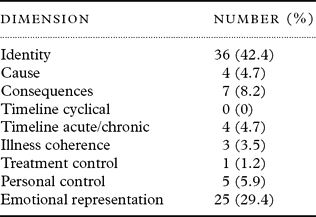
The cognitions from the free response task were sorted into the dimensions of the IPQ-R. Each cognition could only be placed into one dimension. This allowed the frequency of the use of each dimension to be examined. The number of cognitions placed in each dimension and the percentage of the total number of cognitions produced are shown in Table 1.
Number of cognitions produced in each illness perception dimension
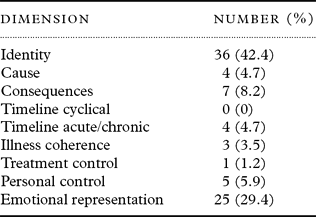
Identity cognitions were most common (42%). All dimensions of the IPQ-R were used to describe memory problems except Timeline Cyclical. Treatment Control was only mentioned by one participant, suggesting that it was not a common cognition in this population. In addition to these dimensions, it was noted that participants frequently made reference to worry about the possibility of future degeneration, constituting 26% of the Emotional Representation cognitions produced. Another dominant theme noted was comparisons of memory function, both to the former self and peers, 25.7% of Identity Cognitions involved comparisons.
Phase 2: Adaptation of the IPQ-R and investigation of psychometric properties
Psychometric properties
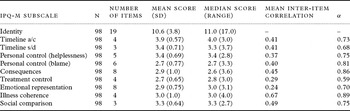
A series of analyses were performed in order to determine the validity and reliability of the adapted measure. All subscales of the measure were normally distributed and so parametric statistical tests were used. The reliability statistics for each subscale are summarized in Table 2 with the mean and median subscale scores.
Mean scores, median scores, inter-item correlations and Cronbach's α for each subscale of the IPQ-M

a/c = acute chronic; s/d = stability/decline.
Overall the sample viewed their memory problems as chronic with a deteriorating timeline. Participants felt they had some personal control over their memory problems and did not blame themselves for their difficulties. Treatment was felt to provide little control over memory problems. Memory problems were perceived to cause some negative consequences and produced some negative emotions. Finally, participants perceived their memory to be much worse than their peers.
Age was the most frequently rated causal attribution item with 79.6% of the sample believing age to be a cause of their memory problems. Lack of concentration/not listening (51.5%), stress or worry (42%), lack of blood to the brain (35.1%) and chance or bad luck (34%) were also frequently endorsed as potential causes of memory problems.
Internal reliability
Cronbach's α was calculated for each subscale in order to assess internal reliability (Table 2). Cronbach's α was not calculated for the identity subscale as it comprises a symptom list rather than a coherent construct. All the scales demonstrated good internal reliability with α between 0.68 and 0.89 (Kline, Reference Kline1999) with the exception of treatment control (0.59) suggesting the subscale may be unreliable. As only one participant mentioned treatment control in the free response task and the subscale showed poor internal reliability the treatment control dimension was removed from further analysis.
Inter-item correlations
Average inter-item correlations were calculated for each item within each subscale. Ideally, items within a subscale should correlate between 0.2 and 0.4 (Briggs and Cheek, Reference Briggs and Cheek1986); high correlations suggest that some items in the scale may be redundant, low correlations suggest the item is measuring a different construct. Correlations for all subscales fell within this range with the exception of illness coherence (0.67).
Inter-subscale correlations
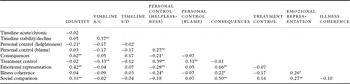
In order to demonstrate that the IPQ-R has discriminant validity and is able to measure distinct illness perceptions, inter-subscale correlations were performed as shown in Table 3. While we would expect all subscales to be related as they are all measuring perceptions of SMCs, we would not expect high correlations between subscales. The presence of very high correlations would suggest that the subscales are measuring the same construct. A wide range of correlations was shown between the subscales, indicating that the IPQ-M is at least partly effective in discriminating between the theoretically and empirically distinctive perceptions. Consistent with the findings of Hagger and Orbell (Reference Hagger and Orbell2003), positive associations were found between Consequences, Timeline, and Identity dimensions. Negative beliefs were found to correlate together. The Consequences subscale reasonably correlated with both Identity (0.60) and Emotional Representation (0.66). Although the level of correlation suggests some overlap between the constructs the differential nature of the subscales, a list of consequences versus a list of symptoms and emotional reaction statements suggests that the subscales are tapping different constructs.
IPQ-M inter-subscale Pearson's correlations

a/c = acute chronic; s/d = stability/decline.
*p = <0.05, **p = <0.01.
Test-retest reliability
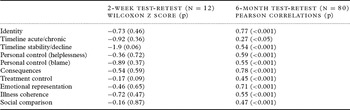
Twelve participants were asked to complete the IPQ-M again after two weeks. Due to the small number of participants, Wilcoxon Signed Ranks Test was performed, rather than correlations, to compare baseline and two-week scores (Table 4). No significant differences were found on any subscales suggesting the measure has good short-term test-retest reliability. The measure was completed again at six months by 80 participants, and Pearson's correlations were performed between baseline and six-month IPQ-M scores. All subscales were moderately to highly correlated (r = 0.45–0.78) indicating good long-term test-retest reliability (Table 4) with the exception of Timeline Acute/Chronic (r = 0.27).
IPQ-M test-retest reliability statistics at 2 weeks and 6 months

Concurrent validity
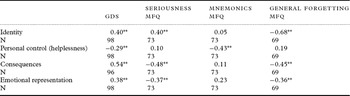
In order to assess the concurrent validity of the IPQ-M, Pearson's correlations were performed between IPQ-M subscales and measures thought to assess related constructs (Table 5). The general forgetting subscale of the Memory Functioning Questionnaire provides a measure of subjective memory complaints. The identity dimension correlated negatively with general forgetting providing concurrent validity for the identity subscale. Participants scoring highly on identity were also more depressed.
IPQ-M concurrent validity: correlations between IPQ-M dimensions and GDS and MFQ subscales

*p = <0.05, **p = <0.01.
IPQ-M = Illness Perception Questionnaire – Memory; GDS = Geriatric Depression Scale; MFQ = Memory Functioning Questionnaire.
The mnemonics subscale of the MFQ measures use of mnemonics to control memory with a lower score indicating more mnemonics usage. Negative associations were observed between personal control (helplessness) and mnemonics score. Greater personal control was associated with higher reported use of mnemonics. Furthermore, perceptions of low control over memory were correlated with GDS scores providing further concurrent validity for the personal control subscale as the CSM predicts that low personal control will be associated with poor mental health outcomes.
The consequences subscale is designed to measure the impact the patient feels their memory problems have on their life, including judgments of seriousness. A negative correlation was found between consequences and seriousness of forgetting subscale of the MFQ. Higher perceived consequences were correlated with greater perceived seriousness. Positive correlations were found between consequences and depression scores, beliefs in negative consequences have been associated with emotional distress (Beck et al., Reference Beck1987).
Positive associations were observed between emotional representation and depression scores providing evidence of concurrent validity for the emotional representation dimension. Although the emotional representation subscale is designed to measure emotional responses specifically generated by SMCs we would expect to find some shared variance between measures of emotional representation and participants’ current emotional state. Negative emotional representations were associated with higher depression scores.
Discriminant validity
In order to assess whether the IPQ-M is able to discriminate between the perceptions of help-seekers and non-help-seekers and be useful for examining help-seeking behavior, IPQ-M scores were examined between both groups within the sample. No significant differences were found between the MMSE score of help-seekers and non-help-seekers (t(96) = 0.922, p = 0.359) suggesting that differences in help-seeking were not simply a reflection of severity of cognitive impairment.
Help-seekers and non-help-seekers were found to differ on three IPQ-M subscales. Help-seekers reported more symptoms on the Identity subscale (t(96) = 4.177, p<0.001), perceived their memory problems to have more serious consequences (t(91.084) = 3.048, p = 0.003) and to be worse than their peers (t(96) = 7.983, p < 0.001).
Discussion
The present study is the first to systematically explore beliefs held by individuals about SMCs using the Common Sense Method of illness perception. As evidence from other sources suggests that health beliefs are an important determinant of help-seeking behavior, we chose to include individuals who were seeking help via National Health Service Memory Clinics as well as individuals who had not sought such help. Such sampling was aimed at improving the chance that the main findings and the IPQ-M could be broadly applied to individuals with SMCs at the level of both primary and secondary care.
Perceptions of SMCs
Participants with SMCs used all of the dimensions of illness perception measured by the IPQ-R when talking about memory problems, with the exception of Timeline Cyclical, suggesting that the IPQ-R provides a valid model of illness cognitions in people with SMCs. It may have been expected that Timeline Cyclical would not be a dimension used by people describing SMCs since memory problems are characterized by a stable or declining course rather than recurring problems with periods of remission. Cognitions were easily grouped into the dimensions of the IPQ-R. Consistent with findings in early Alzheimer's disease, perceptions of social comparison and future degeneration were common (Clare et al., Reference Clare, Goater and Woods2006; Harman and Clare, Reference Harman and Clare2006).
Psychometric properties of the IPQ-M
Overall, internal reliabilities for each of the subscales were good and mean inter-item correlations fell within the desired range. Inter-subscale correlations demonstrated that while the subscales are related, as noted in previous literature (Moss-Morris et al., Reference Moss-Morris, Weinman and Petrie2002; Hagger and Orbell, Reference Hagger and Orbell2003), the correlations remained low enough (for the majority of subscales) to suggest that each subscale was measuring a distinct underlying concept. The correlations present between subscales of the MFQ, GDS and IPQ-M dimensions provided evidence for the concurrent validity of the measure. Differences in IPQ-M subscale scores found between help-seekers and non-help-seekers suggest that the measure was able to discriminate between perceptions held by the two groups.
The new dimensions added to the IPQ-R in the present study fit well within the five broad themes of the CSM. Rather than being new dimensions, Social Comparison and Timeline Stability/Decline represent a further break down of the original dimensions to reflect their relative importance for particular conditions. Social Comparison was treated as a distinct construct in the present study; although some may argue that it represents part of the Identity construct as it provides a judgment of seriousness and whether the person considers him/herself to be “ill”. In the present study Social Comparison was felt to be an important construct in its own right, and to show some subtle differences from Identity. Those who do not consider their memory to be any worse than their peers may still consider themselves, and indeed their peers, to have a memory problem. Within the context of the Identity dimension, not considering your health to be worse than your peers suggests a perception that you are not “ill”. Evidence for this assertion was provided by the moderate correlation found between the Identity and Social Comparison subscales (r = 0.31); whilst they are clearly related, they are not measuring entirely the same construct. Research into subjective well-being has demonstrated important effects of comparison. If a comparison is made with a past state which is seen as positive it can result in lower reports of present well-being (Tversky and Griffin, Reference Tversky, Griffin, Strack, Argyle and Schwartz1991). Comparing oneself with others in a similar situation allows individuals to evaluate their own experience and to gain comfort from a perceived “shared fate” (Taylor et al., Reference Taylor, Wayment, Carrillo, Sorrentino and Higgins1996), leading to increased subjective well-being. Comparison may be of central importance in models of memory problems and impact on the well-being of people with SMCs.
Implications
Consistent with the distress and worry reportedly associated with SMCs (Commissaris et al., Reference Commissaris, Ponds and Jolles1998), participants were found to have a negative emotional reaction towards SMCs. As may be expected, owing to the nature of memory problems and consistent with previous findings (Clare et al. Reference Clare, Goater and Woods2006), SMCs were perceived as chronic with a deteriorating timeline. Aging was the most frequently endorsed causal item. The attribution of memory problems to aging suggests some level of belief in the inevitability of memory problems which could potentially lead to feelings of lack of control and consequently poor well-being as predicted in the CSM (Hagger and Orbell, Reference Hagger and Orbell2003). Further investigation of causal attributions and their relationship to well-being in SMCs is warranted.
Quantitative measurement of perceptions of SMCs will allow relationships between perceptions and help-seeking to be investigated. A post hoc comparison of help-seekers and non-help seekers supports the ability of the IPQ-M to reveal potentially useful differences between the two subgroups. Exploring factors which prevent and motivate help-seeking could inform interventions aimed at promoting help-seeking. As previously stated, help-seeking allows individuals at higher risk of developing dementia to be monitored for cognitive decline; additionally, psychosocial interventions such as memory retraining and cognitive restructuring offered by many memory clinics may help to reduce the distress and worry experienced by people with SMCs (Rapp et al., Reference Rapp, Brenes and Marsh2002; Mol et al., Reference Mol, Ruiter, Verhey, Dijkstra and Jolles2008). Furthermore, psychosocial interventions which aim to improve psychological well-being may be enhanced if perceptions of SMCs are found to be related to mental health outcomes. By attempting to alter unhelpful perceptions, well-being may improve – as has been shown in other health conditions (Petrie et al., Reference Petrie, Cameron, Ellis, Buick and Weinman2002).
It is likely that a proportion of participants in the present study met criteria for mild cognitive impairment (MCI), although they were not assessed and so no diagnosis could be made. Future research could profitably examine any difference in health beliefs between those with MCI (and therefore possibly prodromal dementia) and those who could be best considered to be the “worried well”. Patients with MCI are at greater risk of developing dementia than the general population (Petersen et al., Reference Petersen, Stevens, Ganguli, Tangalos, Cummings and DeKosky2001b) and have high rates of concurrent depression (Kumar et al., Reference Kumar, Jorm, Parslow and Sachdev2006), highlighting the importance of encouraging help-seeking behavior among this group. Investigation of perceptions of memory complaints within MCI is potentially beneficial through promoting help-seeking and informing interventions designed to improve psychological well-being.
Limitations of the study
The present study attempted to test the validity and reliability of an adapted version of the IPQ-R in SMCs. While we acknowledge that Confirmatory Factor Analysis (CFA) would be the method of choice when examining validity, constraints on the sample size prevented CFA being conducted.
The impact of cognitive impairment on the elicitation of illness cognitions in the qualitative study must be considered. However, the mean number of cognitions produced by each participant (5.02) was slightly higher than the 3.75 found for schizophrenia (Lobban et al., Reference Lobban, Barrowclough and Jones2005), the 4.5 found for physical illness (Lau et al., Reference Lau, Bernard and Hartman1989) and the 4.38 found for depression (Fortune et al., Reference Fortune, Barrowclough and Lobban2004) in previous research, suggesting that SMCs did not affect the production of cognitions.
Conclusions
The present study demonstrated use of the dimensions of illness perceptions measured by the IPQ-R in SMCs and highlighted additional dimensions of belief which appear central to representations of SMCs. Based on these observations, the IPQ-R was adapted to include items measuring concepts found to be important to people with SMCs not present in the IPQ-R. Redundant items which may make the questionnaire difficult to answer were removed.
The IPQ-M represents the first quantitative assessment of health beliefs in people with SMCs. The development of such a measure will enable the investigation of relationships between illness perceptions, coping, adjustment and help-seeking behavior in SMCs. The identification of perceptions associated with negative outcomes will provide a framework within which to design interventions aimed at improving the well-being of people with SMCs.
Conflict of interest
None.
Description of authors’ roles
C. Hurt assisted with design of the study, collected and analyzed the data and wrote the paper. A. Burns assisted with design of the study, supervised the data collection and analysis and assisted with writing. R. Brown assisted with writing the paper. C. Barrowclough assisted with design of the study, supervised the data collection and analysis and assisted with writing the paper.
Appendix: IPQ-M Items